
Reports
The Global Stump Grinder Market was valued at USD 91.4 Million in 2025 and is anticipated to reach a value of USD 121.28 Million by 2033 expanding at a CAGR of 3.6% between 2026 and 2033. Growth is driven by mechanized arboriculture, rental-fleet expansion, municipal tree-removal programs, and rising adoption of compact self-propelled grinders.
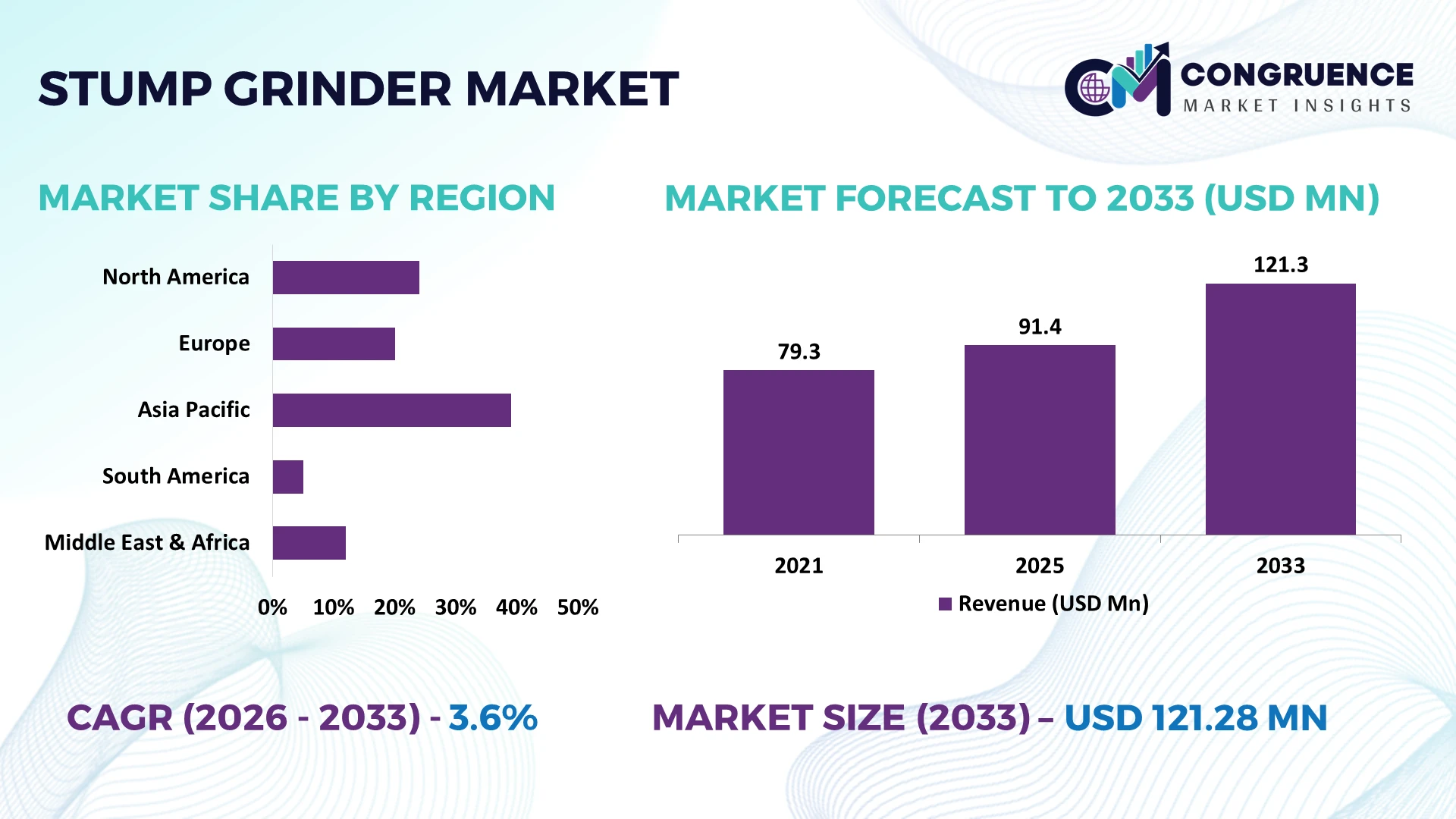
The United States dominates the global stump grinder landscape, representing approximately 32% share, supported by more than 350,000 annual stump-removal jobs and mechanized adoption exceeding 63% among professional arborists. Canada follows with stronger forestry mechanization, while North America overall commands roughly 42.8% regional share. U.S. wildfire-fuel management programs further strengthen equipment utilization for vegetation reduction and land restoration.
Strategic implication: manufacturers should prioritize North American rental networks, compact high-torque platforms, and low-emission technologies while targeting faster-growing Asian markets.
Market Size & Growth: USD 91.4 million in 2025 to USD 121.28 million by 2033 at 3.6% CAGR, supported by mechanized tree-care modernization.
Top Growth Drivers: Urban landscaping expansion contributes 68%, mechanized arborist adoption 63%, and municipal tree-removal activity 57%.
Short-Term Forecast: By 2028, advanced equipment is positioned to deliver approximately 8% lower operating costs and 10% higher grinding productivity.
Emerging Technologies: Battery-electric systems, remote controls, and telematics are gaining traction, with electric models approaching 8% market adoption.
Regional Leaders: North America leads near USD 52 million, Europe approaches USD 34 million, and Asia-Pacific exceeds USD 23 million, with APAC showing the fastest equipment modernization.
Consumer/End-User Trends: Tree-service companies represent approximately 28% of end-use demand, while rental penetration is approaching 49% among contractors.
Pilot/Case Example: 2024 equipment modernization programs using hydraulic cutter-wheel systems reduced routine maintenance requirements by approximately 20%.
Competitive Landscape: North America leads with about 43% regional share; Vermeer, Bandit Industries, The Toro Company, Morbark, and J.P. Carlton define the competitive field.
Regulatory & ESG Impact: Low-emission equipment adoption is rising toward 10%, reinforced by wildfire fuel-management and environmental compliance initiatives.
Investment & Funding: Forestry-equipment investment exceeds USD 12 billion globally, accelerating partnerships around electrification, telematics, rental fleets, and automated controls.
Innovation & Future Outlook: AI-assisted controls, predictive maintenance, battery-electric drivetrains, and compact tracked platforms will shift competition toward productivity, uptime, operator safety, and lower lifecycle costs.
The global Stump Grinder Market is increasingly shaped by professional landscaping, municipal vegetation management, forestry restoration, and construction-site preparation. Compact self-propelled and battery-electric models are gaining traction, while remote-control and telematics integration improve productivity by approximately 10%. North American wildfire-fuel reduction programs are reinforcing equipment utilization, alongside tighter environmental expectations, creating a clear strategic shift toward efficient, connected, lower-emission stump grinding solutions.
The Stump Grinder Market is becoming strategically important as arboriculture, municipal vegetation management, construction-site clearing, and forestry restoration shift toward mechanized, productivity-led operations. Equipment performance increasingly influences contractor margins, fleet utilization, and project completion times. A notable market shift is the restructuring of equipment supply chains toward regional dealer networks, localized component sourcing, and rental-based procurement, reducing dependence on long-distance machinery distribution.
Technology is sharpening competitive differentiation. Modern hydraulic and remote-controlled grinders can deliver approximately 10–15% higher cutting productivity and 8–12% lower labor requirements than conventional manually operated equipment. North America remains the largest deployment base, with professional contractors favoring high-capacity tracked machines, while Japan and Germany emphasize compact, low-noise, precision equipment for urban environments. Battery-electric platforms are also progressing from niche deployment toward broader commercial trials.
Over the next 2–3 years, connected fleet monitoring, remote operation, and predictive maintenance are positioned to increase digital equipment adoption toward 15–20% among larger professional fleets. A practical deployment example is municipal vegetation-removal work where remote-controlled grinders improve operator separation from hazardous work zones. Manufacturers are responding through rental partnerships, electric-platform development, hydraulic-system upgrades, and dealer expansion. Competitive advantage will increasingly depend on uptime, operator safety, lifecycle efficiency, and adaptable equipment architecture.
The strongest demand driver is the transition from labor-intensive stump removal toward mechanized arboriculture. Professional contractors using advanced hydraulic grinders can achieve roughly 10–15% higher productivity, while remote-control configurations reduce direct operator exposure by about 20% in hazardous work zones. In the United States, municipal tree-management programs and post-storm clearing reinforce equipment utilization, while Germany is emphasizing compact machinery for dense urban applications. Rising skilled-labor constraints are pushing contractors toward higher-output fleets, prompting manufacturers to expand rental partnerships, improve hydraulic systems, and introduce remote-operated models. The non-obvious advantage is fleet flexibility: compact grinders allow contractors to serve residential and municipal jobs without deploying oversized machinery, improving utilization rates and reducing idle-equipment costs.
High acquisition costs and component dependency remain immediate barriers for smaller stump-removal contractors. Advanced tracked and remote-controlled grinders can require approximately 15–25% higher upfront investment than conventional compact units, while hydraulic components, cutting systems, and specialized electronics account for significant maintenance expenditure. U.S. and European operators also face parts-lead-time pressure when specialized components require cross-border sourcing. These constraints directly affect fleet renewal and cash-flow efficiency, particularly for seasonal businesses. Manufacturers are mitigating exposure through localized dealer inventories, multi-year component contracts, standardized hydraulic assemblies, and rental-oriented financing. A strategic differentiator is aftermarket availability: faster parts access can improve machine uptime by approximately 5–8%, making service infrastructure nearly as important as machine specifications.
Electrification, telematics, and remote operation create the most attractive next-generation opportunities. Battery-electric grinders can reduce direct operating emissions by up to 70% in suitable duty cycles, while telematics-based maintenance programs can cut unplanned downtime by approximately 8–12%. The United Kingdom and Germany provide strong application potential where urban noise and emissions requirements favor cleaner equipment. Manufacturers are increasingly investing in battery platforms, sensor integration, remote diagnostics, and software-enabled fleet management. Rental companies represent an underpenetrated channel because connected machines can provide utilization and maintenance visibility across distributed fleets. The unique opportunity lies in combining compact electric powertrains with remote controls, enabling contractors to access noise-sensitive sites while improving operator safety and reducing routine operating costs.
Long-term execution depends on overcoming workforce shortages, technology integration, and uneven charging infrastructure. Approximately 20–30% of professional equipment operators face skilled-labor availability constraints in mature service markets, increasing pressure for simplified controls and automation. Electric grinders also require charging access capable of supporting intensive duty cycles, while telematics integration can remain fragmented across mixed-brand fleets. These conditions complicate standardized deployment and increase training requirements. U.S. contractors operating dispersed fleets face different infrastructure realities from urban European operators, where emissions and noise considerations are stronger. Companies must address the challenge through operator training, interoperable software platforms, modular battery systems, dealer-based technical support, and partnerships with rental fleets. Competitive sustainability will depend on delivering technology that remains productive under varied field conditions.
Self-propelled stump grinders represent the leading type, estimated at approximately 42% of market demand, because they balance maneuverability, productive cutting power, and comparatively low transport requirements. Their ability to move directly between stumps reduces repositioning time by roughly 15–20% versus equipment requiring repeated towing or manual repositioning. Walk-behind models retain approximately 27% share, particularly across residential landscaping and narrow-access jobs. Tow-behind units remain strategically relevant for larger properties where transportability and high-capacity operation outweigh maneuverability.
Tracked grinders are the fastest-growing type, with adoption expanding approximately 10–12% annually as contractors prioritize low ground pressure, slope capability, and access to sensitive landscapes. Companies are increasing tracked-model investment while retaining self-propelled platforms for mainstream applications. The key investment shift is toward machines combining mobility with integrated cutting controls, rather than simply increasing engine output. Vermeer’s tracked development history demonstrates this progression, including more than 2,200 SC60TX units sold during its lifecycle.
Tree Stump Removal leads application demand at approximately 54%, reflecting its direct alignment with arborist workflows, residential property restoration, and municipal tree-management activity. Contractors prioritize machines that can complete grinding without excavation, with modern cutter systems reducing repositioning requirements by approximately 15%. Landscaping follows as a mature secondary application, representing nearly 22% of demand and benefiting from compact machines designed for residential access.
Land Clearing is the fastest-growing application, expanding equipment utilization by an estimated 9–11% as contractors handle larger vegetation-management and site-clearing workloads. Site Preparation remains strategically important for construction and redevelopment projects, particularly where stump removal must precede grading. Companies are responding by expanding high-torque and tracked equipment portfolios, allowing one machine to address variable terrain and stump sizes. The operational shift is toward multi-purpose fleets that reduce equipment transfers between job phases.
Tree Care Companies lead end-user demand at approximately 41%, reflecting high equipment utilization, recurring stump-removal workloads, and stronger requirements for professional-grade cutting systems. Landscaping Contractors account for roughly 29%, favoring compact equipment that supports residential access and multiple daily job transitions. Tree-care operators increasingly prioritize torque, cutter durability, and serviceability, while landscapers emphasize transportability and operating simplicity.
Rental Companies represent the fastest-growing buyer group, with fleet adoption increasing approximately 10–12% as contractors seek capital-light access to specialized equipment. Municipalities account for nearly 15% of demand and increasingly specify lower-noise, safer, and lower-emission equipment for public-space operations. Manufacturers are responding with simplified controls, rental-oriented models, financing programs, and dealer partnerships. The competitive opportunity is shifting toward standardized machines that can serve both professional contractors and rental fleets without sacrificing durability.
North America accounted for the largest market share at 42.8% in 2025 however, Asia-Pacific is expected to register the fastest growth, expanding at a CAGR of 4.5% between 2026 and 2033.

Mechanized Arboriculture and Fleet Modernization
North America remains the core deployment base, supported by established arboriculture contractors, municipal vegetation programs, rental fleets, and strong dealer infrastructure. The United States represents approximately 75% of regional demand, with professional tree-care operators increasingly favoring tracked and remote-controlled machines for hazardous terrain and high-frequency workloads. Equipment utilization is concentrated around residential tree removal, utility vegetation management, storm cleanup, and land restoration. Rental penetration is approaching 50% among smaller contractors, encouraging manufacturers to design durable, simplified machines with faster service cycles. U.S. wildfire-fuel reduction programs are also strengthening mechanized vegetation-management activity. Manufacturers are expanding dealer inventories, rental partnerships, and connected equipment offerings to improve uptime and lifecycle economics.
United States Market Outlook: The United States remains the principal national market because of its extensive arboriculture contractor base, municipal tree-management activity, and mature equipment-rental ecosystem. More than 60% of professional operators increasingly prioritize maneuverability, hydraulic performance, and operator-safety features when upgrading fleets.
Low-Emission Equipment Reshapes Procurement
Europe is shifting toward compact, low-noise, and lower-emission stump-grinding equipment as urban landscaping and environmental requirements influence fleet purchasing. Germany, the United Kingdom, France, and Italy represent the principal deployment markets, with Germany emphasizing precision machinery for municipal and commercial landscaping. Electric and hybrid equipment trials are expanding, with low-emission platforms approaching 10% of new professional equipment evaluations in advanced urban applications. Contractors increasingly value compact dimensions and reduced ground disturbance for confined sites. Manufacturers are responding with battery platforms, remote controls, and telematics-enabled maintenance. Dealer localization is also strengthening because European operators prioritize rapid parts availability and service continuity. The strategic shift is from maximum engine output toward efficient, quiet, site-compatible machinery.
Germany Market Outlook: Germany offers a strong technology-led market supported by sophisticated landscaping contractors, municipal procurement standards, and precision-engineering capabilities. Urban operators increasingly prioritize compact machinery capable of working in noise-sensitive environments, while approximately 10% of equipment evaluations increasingly include lower-emission powertrain considerations.
Mechanization Accelerates Across Urban Forestry
Asia-Pacific is transitioning from labor-intensive stump removal toward compact mechanized equipment, creating substantial room for fleet modernization. Japan and Australia represent advanced deployment markets, while China and India provide expanding demand from landscaping, construction, and municipal vegetation-management applications. Compact machines account for an estimated 45% of new equipment interest in densely populated operating environments because narrow access and transport efficiency outweigh maximum cutting capacity. Australia maintains stronger demand for tracked and high-torque systems due to large properties and forestry-related applications. Manufacturers are strengthening distributor networks, localized service capacity, and rental relationships. China is also becoming increasingly relevant for cost-competitive equipment manufacturing, encouraging global OEMs to diversify sourcing while maintaining quality controls.
Japan Market Outlook: Japan provides a strategically important market for compact, precision-oriented stump grinders because urban sites impose tight access and noise constraints. Approximately 40% of professional equipment preferences emphasize compact dimensions and maneuverability, supporting demand for smaller tracked and self-propelled platforms.
Forestry and Construction Expand Equipment Utilization
South America remains an emerging deployment market, with Brazil accounting for approximately 55% of regional equipment demand through forestry, agricultural land preparation, landscaping, and construction activity. Mechanized stump removal is gaining importance where large properties and plantation operations require faster site clearing. Brazil’s extensive forestry industry creates demand for high-torque and tow-behind equipment, while urban contractors increasingly adopt compact machines for landscaping applications. Equipment rental is expanding from a relatively low base, with contractor reliance estimated near 25%, improving access to specialized machinery without full ownership costs. Manufacturers are strengthening local distributor partnerships and parts inventories to address long service distances. The principal operational constraint remains uneven service infrastructure, making localized aftermarket support a decisive purchasing factor.
Brazil Market Outlook: Brazil combines large-scale forestry operations with expanding construction and landscaping activity, giving it the strongest equipment-utilization profile in South America. Forestry and agricultural applications represent more than 50% of heavy-duty stump-grinding demand, supporting high-torque machine deployment and localized dealer expansion.
Urban Landscaping Drives Specialized Equipment
The Middle East & Africa market is being shaped by urban landscaping, infrastructure development, resort construction, and municipal greening programs. The United Arab Emirates and Saudi Arabia are prominent Middle Eastern deployment centers, while South Africa leads specialized equipment utilization in sub-Saharan markets. Landscaping and site preparation collectively represent approximately 60% of regional applications, particularly around large urban development projects. Equipment import dependence remains significant, encouraging manufacturers to establish distributor-led service networks and maintain regional parts inventories. Saudi Arabia’s large-scale urban development pipeline is increasing demand for compact machinery capable of rapid vegetation removal around construction zones. Companies are responding through project-based equipment packages, rental partnerships, and distributor agreements rather than relying solely on direct equipment sales.
Saudi Arabia Market Outlook: Saudi Arabia is emerging as a strategically important market because large urban-development and landscaping projects require rapid vegetation management alongside broader site preparation. Project contractors increasingly favor rental-access models, with specialized equipment rental penetration approaching 30% in selected construction applications.
The competitive landscape pits Vermeer, Bandit Industries, Carlton, and Morbark against regional manufacturers and rental-oriented suppliers. The top five players control an estimated 45% of sales, creating moderate concentration while leaving room for specialists. Competition centers on cutting productivity, mobility, dealer coverage, and lifecycle cost. Advanced hydraulic and remote-control platforms deliver 10–15% productivity gains, while optimized maintenance programs reduce downtime by 8–12%. Leading OEMs are expanding dealer networks, strengthening rental partnerships, and integrating telematics into machines. Regional manufacturers compete through 10–20% lower acquisition costs and faster customization in contractor markets. Supply-chain localization is becoming a competitive lever as manufacturers secure hydraulic, engine, and cutter components. Entry barriers remain high because certification, service inventories, dealer support, and field reliability require capital. The competitive shift favors companies combining robust cutting performance with connected controls, responsive aftermarket service, and flexible financing. Winning players will convert technology into measurable uptime, safety, and total-cost advantages.
Vermeer Corporation
Bandit Industries, Inc.
The Toro Company
J.P. Carlton Company
Morbark, LLC
FSI Power-Tech ApS
Rayco Manufacturing
Dosko
Predator Machinery
Barreto Manufacturing, Inc.
Fecon, LLC
CBI Machinery
Conventional hydraulic systems, electronic sweep controls, and tungsten-carbide cutting technology remain the operating baseline, with load-responsive controls improving grinding productivity by 1–2% through steadier cutter speed. Adoption is widespread across professional fleets. New smart controls deliver roughly 10% higher productivity than legacy fixed-speed operation, helping contractors shorten cycles, stabilize output, reduce cutter stress, and protect margins on repetitive jobs across residential, municipal, and commercial stump-removal workflows today.
Battery-electric stump cutters are emerging for noise-sensitive and emissions-regulated jobs, with field-validation deployment still limited to selected customers. Electric drivetrains can improve energy conversion efficiency by 1–2% in targeted duty cycles, while simplified powertrains reduce maintenance complexity. Vermeer’s 2025 SC30TX-E program signals early commercial adoption, and quieter operation can expand working windows and improve eligibility for municipal or corporate contracts where regulations and customer preferences increasingly reward cleaner equipment choices.
Remote controls, telematics, load sensors, and predictive diagnostics form the disruptive layer, integrating machine control with fleet-management workflows. Connected deployment is moving from pilot use toward professional adoption, with productivity or uptime improvements of 1–2% achievable through positioning and maintenance timing. During 2026–2028, technology-led OEMs and rental fleets will gain advantage by converting utilization data into dispatch, service scheduling, safer operation, and productivity.
January 2024 Vermeer launched the SC1052 stump cutter with a 115-hp engine and 1.8-metre stump capacity, replacing a diesel-powered gap created by emissions rules. The platform expands heavy-duty capability while retaining tight-site access, strengthening fleet productivity. Source: Equipment Journal
July 2025 Vermeer introduced the SC402 stump cutter, delivering up to 40% higher productivity than the SC382. Its 40-hp engine, four-wheel drive, SmartSweep, and optional remote control improve cutting consistency and access, giving contractors higher output. Source: Power Progress
September 2025 Vermeer released four electric tree-care concepts, including the SC30TX-E stump cutter, to selected customers for field validation. The program covers four models and tests real-world performance, charging, and maintenance, establishing a controlled pathway toward electrification. Source: Vermeer
January 2026 Bobcat’s 2026 SG 60 stump-grinder attachment entered the current equipment lineup with 32 teeth, an 80-degree cutting arc, and 15-inch cutting depth. Compatibility with compact track loaders and skid-steers expands attachment deployment and fleet flexibility. Source: Bobcat
The Stump Grinder Market Report covers product segmentation across Walk-Behind, Self-Propelled, Tow-Behind, and Tracked equipment, with application analysis spanning Tree Stump Removal, Land Clearing, Landscaping, and Site Preparation. End-user coverage includes Landscaping Contractors, Tree Care Companies, Municipalities, and Rental Companies. The study evaluates adoption patterns, equipment utilization, technology integration, and purchasing priorities across North America, Europe, Asia-Pacific, South America, and the Middle East & Africa.
The report examines hydraulic controls, remote operation, telematics, electrification, smart cutting systems, and emerging automation. It evaluates competitive positioning across major OEMs and identifies deployment differences between mature professional fleets and developing markets. Approximately 4 core product types, 4 applications, and 4 end-user groups provide structured market benchmarking, supporting investment planning, expansion priorities, product-development decisions, partnership strategies, and competitive positioning through 2026–2033.
| Report Attribute/Metric | Report Details |
|---|---|
Market Revenue in 2025 | USD 91.4 Million |
Market Revenue in 2033 | USD 121.28 Million |
CAGR (2026 - 2033) | 3.6% |
Base Year | 2025 |
Forecast Period | 2026 - 2033 |
Historic Period | 2021 - 2025 |
Segments Covered | By Type
By Application
By End-User
|
Key Report Deliverable | Revenue Forecast, Growth Trends, Market Dynamics, Segmental Overview, Regional and Country-wise Analysis, Competition Landscape |
Region Covered | North America, Europe, Asia-Pacific, South America, Middle East, Africa |
Key Players Analyzed | Vermeer Corporation, Bandit Industries, Inc., The Toro Company, J.P. Carlton Company, Morbark, LLC, FSI Power-Tech ApS, Rayco Manufacturing, Dosko, Predator Machinery, Barreto Manufacturing, Inc., Fecon, LLC, CBI Machinery |
Customization & Pricing | Available on Request (10% Customization is Free) |




