
Reports
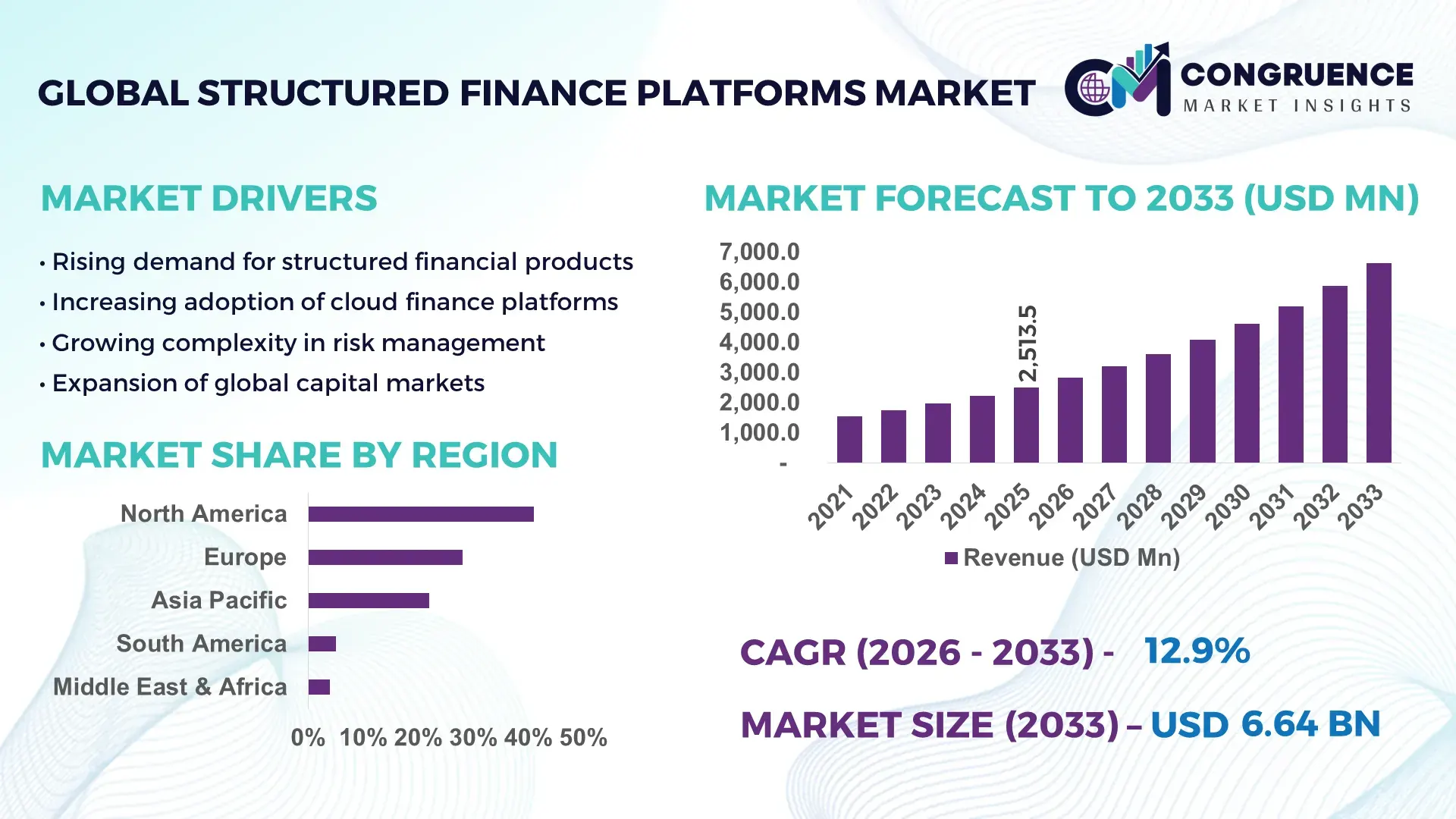
The Global Structured Finance Platforms Market was valued at USD 2,513.5 Million in 2025 and is anticipated to reach a value of USD 6,639.5 Million by 2033 expanding at a CAGR of 12.91% between 2026 and 2033, according to an analysis by Congruence Market Insights. The growth is primarily driven by increasing digitization of securitization processes and rising demand for automated risk assessment systems.
The United States leads the Structured Finance Platforms Market with over 48% enterprise-level adoption of digital securitization platforms across banking and capital markets institutions. More than 65% of large financial institutions in the country have integrated structured finance software for asset-backed securities (ABS) and mortgage-backed securities (MBS) processing. Investment in fintech infrastructure exceeded USD 80 billion in 2024, with structured finance platforms forming a significant share of capital markets digitization. Additionally, over 70% of structured credit transactions in the U.S. are now supported by cloud-based platforms, enhancing transparency, compliance tracking, and real-time analytics capabilities across institutional investors and issuers.
Market Size & Growth: Valued at USD 2,513.5 Million in 2025, projected to reach USD 6,639.5 Million by 2033, growing at a CAGR of 12.91% driven by automation in securitization workflows.
Top Growth Drivers: Digital platform adoption (62%), regulatory compliance automation (48%), demand for real-time analytics (55%).
Short-Term Forecast: By 2028, processing efficiency is expected to improve by 35% through AI-driven underwriting tools.
Emerging Technologies: AI-based risk modeling, blockchain-enabled asset tracking, and cloud-native structured finance platforms.
Regional Leaders: North America (~USD 2,800 Million by 2033) with high fintech penetration; Europe (~USD 1,950 Million) driven by regulatory frameworks; Asia-Pacific (~USD 1,450 Million) fueled by digital banking expansion.
Consumer/End-User Trends: Banks and asset managers account for over 68% usage, with increasing adoption among fintech startups.
Pilot or Case Example: In 2024, a major U.S. bank improved deal processing speed by 40% using AI-powered structured finance software.
Competitive Landscape: Leading player holds ~18% share, followed by key players including Bloomberg, Finastra, FIS, and SS&C Technologies.
Regulatory & ESG Impact: Over 52% of firms adopted ESG-linked securitization compliance frameworks in 2025.
Investment & Funding Patterns: More than USD 12 billion invested globally in structured finance fintech platforms between 2023–2025.
Innovation & Future Outlook: Increasing integration of predictive analytics and decentralized finance (DeFi) models shaping next-generation platforms.
Structured Finance Platforms Market demonstrates strong alignment with capital markets, banking, and insurance sectors, contributing approximately 45%, 30%, and 15% respectively to overall adoption. Innovations such as AI-powered credit scoring and blockchain-based securitization are enhancing operational transparency by over 40%. Regulatory frameworks promoting digital compliance and ESG-linked instruments are accelerating adoption across Europe and North America, while Asia-Pacific shows rising demand due to digital banking expansion and cross-border investment growth.
The Structured Finance Platforms Market is becoming strategically vital as financial institutions increasingly prioritize digital transformation, operational efficiency, and regulatory compliance. Platforms integrating artificial intelligence, blockchain, and advanced analytics are enabling faster structuring, pricing, and risk assessment of complex financial instruments. AI-powered credit risk engines deliver nearly 45% improvement compared to traditional manual underwriting processes, significantly reducing transaction turnaround time while enhancing accuracy.
Regionally, North America dominates in transaction volume, while Asia-Pacific leads in adoption with over 58% of financial institutions implementing digital structured finance tools to support rapid growth in securitization markets. European markets are advancing through regulatory-driven adoption, particularly under frameworks focusing on transparency and standardized reporting practices.
In the short term, by 2028, AI-driven automation is expected to reduce operational costs by up to 30% while improving deal execution timelines by 25%. Blockchain-enabled asset tracking is also projected to improve transparency metrics by over 40%, especially in cross-border securitization transactions.
From an ESG perspective, firms are committing to sustainability-linked finance structures, targeting 35% improvement in ESG compliance metrics by 2030. These platforms are increasingly integrating carbon tracking and green asset tagging features to align with global sustainability goals.
A notable micro-scenario occurred in 2024, where a leading U.S. financial institution achieved a 38% reduction in processing errors by implementing AI-driven structured finance platforms for mortgage-backed securities.
Overall, the Structured Finance Platforms Market is evolving into a critical pillar supporting financial resilience, regulatory adherence, and sustainable capital market growth, positioning it as a foundational element in the future of digital finance ecosystems.
The Structured Finance Platforms Market is experiencing dynamic transformation driven by rapid digitalization across capital markets and increasing complexity in structured financial products. Financial institutions are shifting toward automated platforms to manage large volumes of asset-backed securities, collateralized loan obligations, and mortgage-backed securities. Over 60% of global banks have adopted at least one structured finance technology solution to enhance deal structuring, compliance tracking, and investor reporting. The integration of AI and machine learning is improving predictive analytics accuracy by nearly 35%, enabling better credit risk evaluation. Additionally, cloud-based deployment models now account for approximately 55% of platform usage due to scalability and real-time processing benefits. Regulatory pressures across developed markets are pushing organizations to adopt standardized digital solutions, while emerging markets are witnessing rising adoption due to expanding securitization activities and increasing institutional investments.
The rising demand for automation in complex financial structuring processes is significantly driving the adoption of structured finance platforms. Financial institutions are increasingly handling high volumes of structured products such as ABS and CLOs, where manual processing can lead to inefficiencies and errors. Automation technologies are enabling up to 40% faster deal execution and reducing operational errors by nearly 30%. Over 65% of global banks have prioritized workflow automation to improve scalability and reduce reliance on manual underwriting. Additionally, real-time analytics capabilities are allowing institutions to monitor portfolio performance continuously, improving decision-making accuracy by over 25%. The shift toward digital-first strategies is also encouraging the deployment of integrated platforms that combine risk management, compliance, and reporting functionalities into a single ecosystem, enhancing overall operational efficiency.
Despite strong growth, data security concerns and system integration challenges remain significant restraints in the Structured Finance Platforms Market. Approximately 48% of financial institutions cite cybersecurity risks as a major barrier to adopting cloud-based structured finance solutions. Sensitive financial data, including borrower information and asset details, requires robust encryption and compliance frameworks, increasing implementation complexity. Additionally, integrating structured finance platforms with legacy banking systems poses technical challenges, with over 42% of institutions reporting delays due to incompatible IT infrastructure. Regulatory compliance requirements further add to operational burdens, as organizations must ensure adherence to multiple jurisdictional standards. These challenges lead to increased deployment timelines and higher initial costs, limiting adoption among smaller financial institutions and slowing overall market penetration.
The accelerating digital transformation across global capital markets presents significant opportunities for the Structured Finance Platforms Market. Over 58% of financial institutions are actively investing in digital infrastructure to modernize securitization workflows and improve transparency. The expansion of structured credit products in emerging markets, particularly in Asia-Pacific and Latin America, is creating new demand for scalable and cloud-based platforms. Additionally, the rise of ESG-linked financial instruments is opening avenues for platforms capable of integrating sustainability metrics, with nearly 47% of new securitization deals incorporating ESG parameters in 2025. The increasing use of APIs and open banking frameworks is enabling seamless integration between financial systems, improving interoperability by over 30%. Furthermore, the growing demand for real-time analytics and predictive modeling is driving innovation in AI-powered platforms, offering enhanced decision-making capabilities and risk forecasting. These developments are creating a strong foundation for long-term market expansion.
Regulatory complexity and high implementation costs continue to pose critical challenges to the Structured Finance Platforms Market. Financial institutions must comply with multiple regulatory frameworks across jurisdictions, with over 50% of firms reporting increased compliance costs due to evolving transparency and reporting requirements. The need for continuous system updates to align with regulatory changes adds operational strain and increases total cost of ownership. Additionally, deploying advanced structured finance platforms requires significant upfront investment in IT infrastructure, training, and cybersecurity, which can exceed 25% of annual technology budgets for mid-sized institutions. Data standardization issues further complicate cross-border transactions, as inconsistent reporting formats reduce operational efficiency by nearly 20%. Moreover, limited availability of skilled professionals capable of managing advanced analytics and AI-driven platforms creates a talent gap, restricting optimal utilization of these technologies and slowing adoption rates across smaller organizations.
Rising Adoption of AI-Driven Risk Analytics: Over 62% of financial institutions have integrated AI-based analytics into structured finance platforms, improving credit risk prediction accuracy by nearly 38%. Automated underwriting tools are reducing deal processing times by approximately 35%, enabling faster securitization cycles and enhanced investor confidence in complex financial instruments.
Expansion of Blockchain in Asset Securitization: Blockchain technology is being adopted by nearly 41% of large financial firms for asset tracking and transaction validation. Distributed ledger systems have reduced reconciliation errors by 28% and improved transparency in cross-border transactions by over 45%, making them critical for structured finance ecosystems.
Shift Toward Cloud-Native Platform Deployment: Cloud-based structured finance platforms account for over 55% of new deployments, offering scalability and cost efficiency. Organizations adopting cloud solutions have reported up to 32% reduction in infrastructure costs and 27% improvement in system performance, particularly in high-volume transaction environments.
Integration of ESG and Sustainable Finance Metrics: Approximately 49% of structured finance transactions now incorporate ESG-linked parameters, with platforms enabling automated tracking of sustainability metrics. This integration has improved compliance reporting efficiency by 33% and enhanced investor participation in green securitization products by over 25%.
The Structured Finance Platforms Market is segmented based on type, application, and end-user, each playing a critical role in shaping adoption patterns. Platform types vary from cloud-based to on-premise and hybrid solutions, with cloud deployment gaining traction due to scalability and real-time processing capabilities. Applications span across asset-backed securities, mortgage-backed securities, and collateralized loan obligations, reflecting diverse financial structuring needs. End-users include banks, asset managers, insurance firms, and fintech companies, with banks leading due to high transaction volumes. Approximately 60% of adoption is concentrated among large financial institutions, while mid-sized firms are gradually increasing participation. The segmentation highlights strong demand for integrated solutions that combine analytics, compliance, and reporting functionalities, enabling efficient management of complex financial instruments across global markets.
The Structured Finance Platforms Market includes cloud-based platforms, on-premise platforms, and hybrid deployment models. Cloud-based platforms currently dominate, accounting for approximately 52% of adoption due to their scalability, cost efficiency, and ability to support real-time analytics. On-premise solutions hold around 28% share, primarily used by institutions requiring high data control and security. However, hybrid platforms are emerging as the fastest-growing segment, expected to expand at a CAGR of 14.8%, driven by the need for flexible deployment and seamless integration with legacy systems. Cloud-based solutions are widely adopted due to their ability to reduce infrastructure costs by nearly 30% and improve operational efficiency by over 25%. On-premise platforms remain relevant in highly regulated environments, while hybrid solutions offer a balanced approach, combining security with scalability. The remaining 20% share is distributed among niche deployment models tailored for specific financial use cases.
• In 2025, a major financial institution implemented hybrid structured finance platforms to manage cross-border securitization transactions, reducing processing time by 33% and improving compliance tracking accuracy significantly.
Applications in the Structured Finance Platforms Market include asset-backed securities (ABS), mortgage-backed securities (MBS), collateralized loan obligations (CLOs), and other structured credit instruments. ABS leads with approximately 38% share due to its widespread use in consumer finance and auto loans. MBS follows with around 27%, supported by strong housing finance markets. CLOs represent the fastest-growing segment, projected to expand at a CAGR of 15.6%, driven by increasing corporate lending activities. Other applications contribute nearly 35% combined share, including structured notes and credit derivatives. In 2025, more than 42% of financial institutions globally reported adopting structured finance platforms specifically for ABS processing. Additionally, over 58% of institutional investors prefer platforms offering integrated analytics for structured credit portfolios.
• In 2025, over 120 financial institutions implemented advanced platforms for MBS analytics, improving loan performance tracking accuracy by more than 30% across large-scale portfolios.
End-users in the Structured Finance Platforms Market include banks, asset management firms, insurance companies, and fintech organizations. Banks dominate with approximately 46% share due to their extensive involvement in securitization and structured credit transactions. Asset managers account for around 24%, leveraging platforms for portfolio optimization and risk assessment. Fintech companies represent the fastest-growing segment, expanding at a CAGR of 16.2% due to innovation in digital finance solutions. Insurance companies and other financial entities contribute nearly 30% combined share, utilizing structured finance platforms for risk diversification and investment management. In 2025, over 60% of global banks reported active deployment of structured finance platforms for transaction processing. Additionally, nearly 45% of fintech firms are integrating AI-driven analytics to enhance platform capabilities.
• In 2025, a leading fintech firm deployed AI-powered structured finance solutions, improving transaction efficiency by 37% and reducing operational costs significantly across its client base.
North America accounted for the largest market share at 41% in 2025 however, Asia-Pacific is expected to register the fastest growth, expanding at a CAGR of 14.2% between 2026 and 2033.
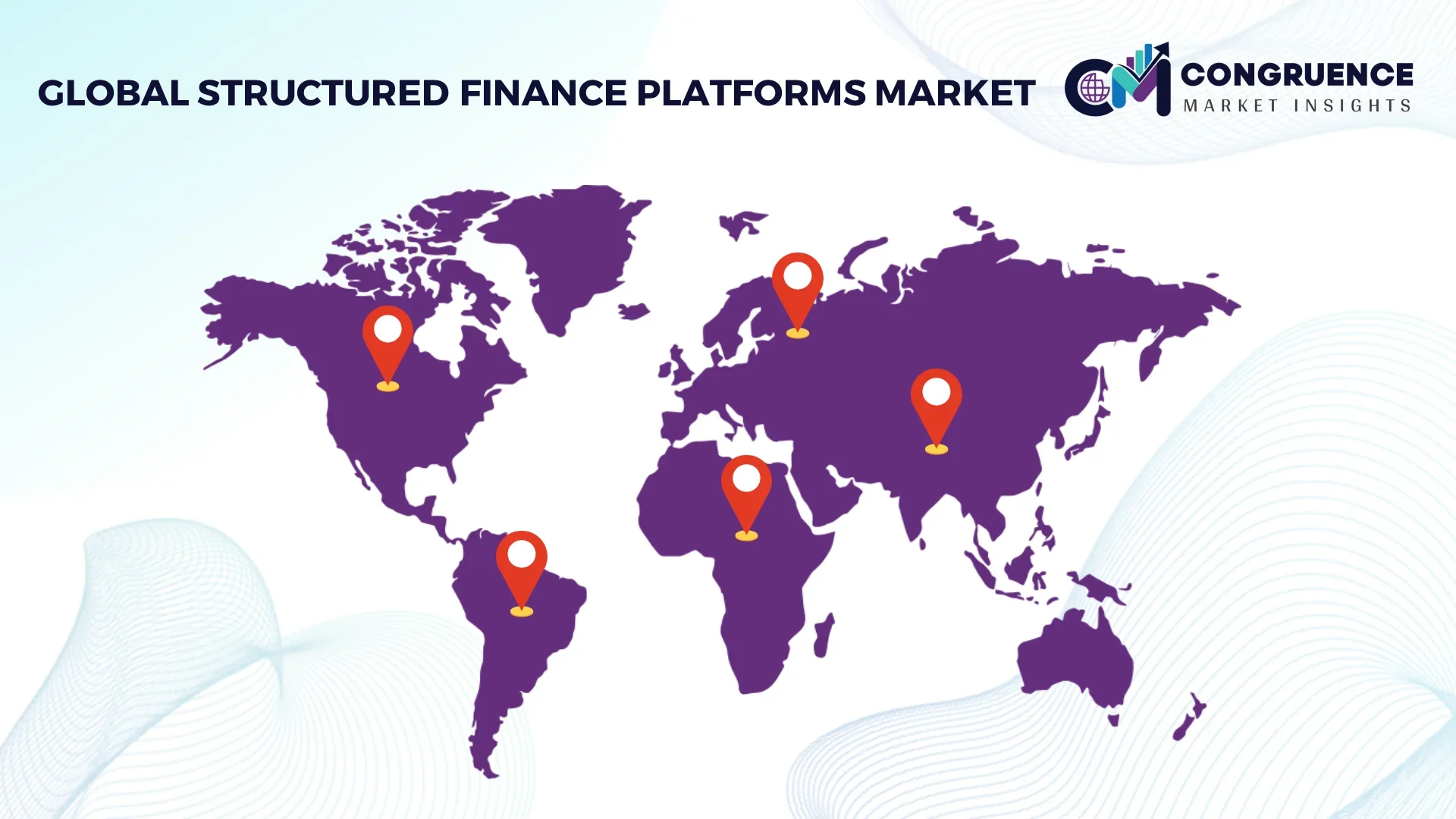
North America leads with over 70% adoption among tier-1 financial institutions and more than 65% usage of cloud-based structured finance platforms. Europe follows with approximately 28% share, driven by regulatory compliance requirements and ESG-linked financing adoption. Asia-Pacific holds around 22% share, with rapid growth supported by digital banking expansion in China, India, and Southeast Asia. Latin America and the Middle East & Africa together account for nearly 9% of the market, with increasing adoption in infrastructure financing and energy sectors.
North America holds approximately 41% share of the Structured Finance Platforms Market, driven by strong demand from banking, asset management, and capital markets sectors. Over 72% of large financial institutions in the region have implemented structured finance platforms to enhance securitization processes. Regulatory frameworks focusing on transparency and reporting have accelerated adoption, while technological advancements such as AI and blockchain are improving efficiency by over 35%. A leading U.S.-based financial technology firm has introduced AI-powered deal structuring tools, reducing transaction timelines by 40%. Consumer behavior reflects high enterprise adoption, particularly in finance and healthcare sectors, where automation and analytics are prioritized.
Europe accounts for around 28% of the Structured Finance Platforms Market, with key markets including Germany, the UK, and France. Regulatory initiatives focused on transparency and ESG compliance are driving demand, with over 55% of financial institutions adopting structured finance platforms. Emerging technologies such as blockchain and AI are being integrated into financial workflows, improving reporting accuracy by 30%. A European fintech company has developed ESG-focused securitization tools, enabling automated compliance tracking. Consumer behavior shows strong preference for explainable and regulation-compliant platforms across financial institutions.
Asia-Pacific ranks among the fastest-growing regions, with increasing adoption across China, India, and Japan. The region contributes approximately 22% of market activity, supported by expanding digital banking infrastructure. Over 60% of financial institutions in major economies are investing in structured finance technologies. Innovation hubs are focusing on AI and cloud-based solutions, improving transaction efficiency by 28%. A regional fintech firm has launched cloud-native platforms targeting SME securitization. Consumer behavior is driven by mobile-first financial services and growing investment in digital finance ecosystems.
South America holds nearly 5% share of the Structured Finance Platforms Market, with Brazil and Argentina leading adoption. Infrastructure and energy financing projects are driving demand for structured finance solutions. Government policies promoting financial inclusion have increased platform usage by over 20%. A regional financial institution has implemented structured finance platforms to support renewable energy projects. Consumer behavior reflects growing reliance on digital financial tools for investment and risk management.
The Middle East & Africa region accounts for approximately 4% of the market, driven by demand in oil & gas, construction, and infrastructure sectors. Countries such as the UAE and South Africa are leading adoption, with over 35% of financial institutions investing in digital platforms. Technological modernization initiatives are improving operational efficiency by 25%. A regional bank has introduced structured finance platforms to support large-scale infrastructure projects. Consumer behavior indicates increasing adoption of digital finance solutions aligned with economic diversification strategies.
United States – 38% Market share: Driven by high fintech investment and advanced capital markets infrastructure
China – 16% Market share: Supported by rapid digital banking expansion and increasing securitization activities
The Structured Finance Platforms Market is moderately consolidated, with the top five companies accounting for approximately 52% of the total market share. The market consists of over 120 active competitors, ranging from global financial technology providers to niche platform developers. Leading players are focusing on strategic partnerships, mergers, and acquisitions to strengthen their technological capabilities and expand their global footprint. Approximately 45% of companies have invested in AI and machine learning integration to enhance platform functionality. Product innovation remains a key competitive factor, with over 30% of firms launching new solutions focused on automation and real-time analytics between 2023 and 2025.
Additionally, collaboration between fintech startups and established financial institutions is increasing, enabling faster deployment of advanced solutions. The market is characterized by continuous technological advancements, with companies prioritizing scalability, security, and compliance to maintain competitive advantage.
Finastra
Fidelity National Information Services (FIS)
SS&C Technologies
Moody’s Analytics
S&P Global
Oracle Financial Services
SAP SE
Clearwater Analytics
Numerix
Intex Solutions
RiskSpan
FactSet Research Systems
Refinitiv
The Structured Finance Platforms Market is being significantly transformed by advancements in artificial intelligence, blockchain, and cloud computing technologies. AI-driven analytics are improving credit risk assessment accuracy by nearly 40%, enabling financial institutions to make faster and more informed decisions. Machine learning models are increasingly used for predictive analysis, helping organizations identify potential defaults and optimize portfolio performance.
Blockchain technology is enhancing transparency and security in structured finance transactions, with over 42% of large institutions adopting distributed ledger systems for asset tracking. These systems reduce reconciliation errors by approximately 28% and improve transaction validation efficiency. Cloud computing is another critical technology, with more than 55% of platforms deployed on cloud infrastructure, offering scalability and cost savings of up to 30%.
Automation technologies are streamlining workflows, reducing manual intervention by over 35%, and improving operational efficiency. Integration of APIs is enabling seamless data exchange between financial systems, enhancing interoperability by nearly 25%. Additionally, advanced visualization tools and dashboards are improving data interpretation, allowing stakeholders to monitor performance metrics in real time. Emerging technologies such as quantum computing and decentralized finance (DeFi) are also expected to influence the market, providing new opportunities for innovation and efficiency in structured finance processes.
• In February 2026, Bloomberg Index Services Limited partnered with the Structured Finance Association to launch a securitized credit index designed to improve benchmarking, price discovery, and risk evaluation across asset-backed securities markets, directly integrating into Bloomberg Terminal workflows for institutional investors. Source: www.structuredfinance.org
• In March 2025, 9fin acquired Bond Radar, adding over 20 years of global bond issuance data to its platform and enhancing real-time tracking of structured credit and securitized debt markets, strengthening analytics capabilities for institutional investors and advisors.
• In December 2024, AlpInvest Partners, in collaboration with Mubadala Investment Company, launched a portfolio financing platform delivering structured credit solutions to private equity funds, supporting liquidity and fund-level financing transactions globally.
• In October 2024, AlpInvest Partners successfully closed a $1 billion collateralized fund obligation (CFO), representing one of the largest publicly rated transactions of its kind, demonstrating growing institutional adoption of structured finance platforms for alternative credit structuring and fund financing solutions.
The Structured Finance Platforms Market Report provides a comprehensive analysis of the global market landscape, covering key segments such as platform types, applications, end-users, and regional markets. The report evaluates cloud-based, on-premise, and hybrid deployment models, highlighting their adoption patterns and technological advancements. It also examines applications including asset-backed securities, mortgage-backed securities, and collateralized loan obligations, offering insights into their usage across financial institutions.
Geographically, the report covers major regions including North America, Europe, Asia-Pacific, South America, and the Middle East & Africa, providing detailed insights into regional trends, adoption levels, and technological developments. The study includes analysis of over 20 countries, focusing on key financial markets and emerging economies.
The report also explores industry-specific adoption across banking, asset management, insurance, and fintech sectors, emphasizing the role of structured finance platforms in improving operational efficiency and compliance. It highlights technological innovations such as AI, blockchain, and cloud computing, which are reshaping the market. Additionally, the report provides insights into competitive dynamics, investment trends, and emerging opportunities, offering valuable information for decision-makers, investors, and industry professionals seeking to understand the evolving structured finance ecosystem.
| Report Attribute / Metric | Details |
|---|---|
| Market Revenue (2025) | USD 2,513.5 Million |
| Market Revenue (2033) | USD 6,639.5 Million |
| CAGR (2026–2033) | 12.91% |
| Base Year | 2025 |
| Forecast Period | 2026–2033 |
| Historic Period | 2021–2025 |
| Segments Covered |
By Type
By Application
By End-User Insights
|
| Key Report Deliverables | Revenue Forecast; Market Trends; Growth Drivers & Restraints; Technology Insights; Segmentation Analysis; Regional Insights; Competitive Landscape; Regulatory & ESG Overview; Recent Developments |
| Regions Covered | North America; Europe; Asia-Pacific; South America; Middle East & Africa |
| Key Players Analyzed | Bloomberg LP; Finastra; Fidelity National Information Services (FIS); SS&C Technologies; Moody’s Analytics; S&P Global; Oracle Financial Services; SAP SE; Clearwater Analytics; Numerix; Intex Solutions; RiskSpan; FactSet Research Systems; Refinitiv |
| Customization & Pricing | Available on Request (10% Customization Free) |




