
Reports
The Global Structural Adhesives Market was valued at USD 13240 Million in 2025 and is anticipated to reach a value of USD 18119.8 Million by 2033 expanding at a CAGR of 4% between 2026 and 2033. Growth is supported by lightweight vehicle manufacturing, higher composite material usage, and automated assembly processes across aerospace, construction, electronics, and industrial equipment production.
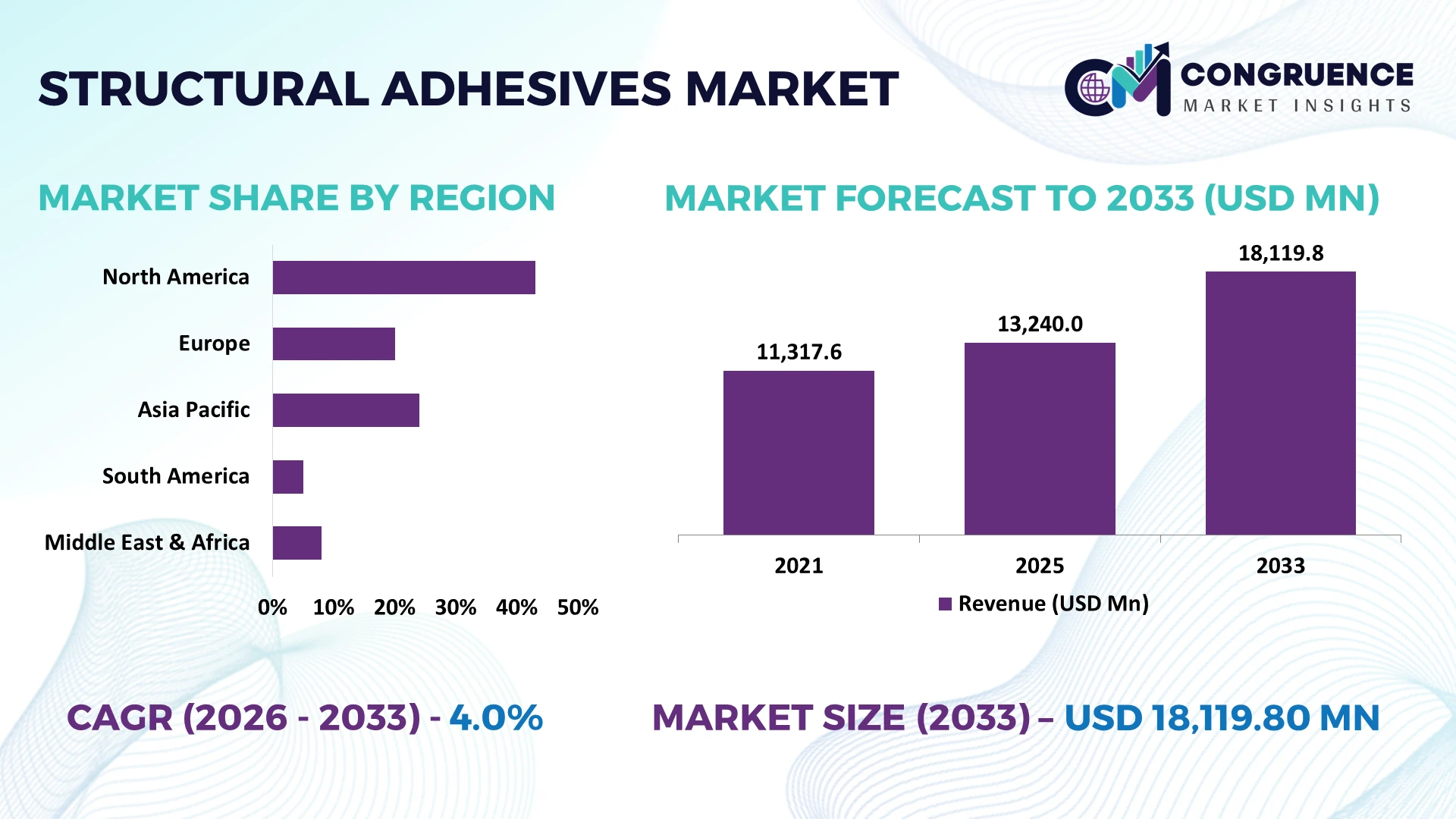
China remains the dominant country, accounting for approximately 36% of global structural adhesives consumption, supported by large-scale automotive, wind energy, and electronics manufacturing investments. Over 65% of advanced EV battery pack assembly facilities utilize high-performance structural adhesives, while Germany maintains stronger aerospace-grade adhesive penetration with nearly 25% higher premium application intensity. Ongoing supply-chain diversification following Red Sea shipping disruptions has accelerated regional manufacturing localization and procurement resilience.
Manufacturers expanding advanced adhesive production close to high-growth industrial clusters are positioned to strengthen supply security, improve operating margins, and capture long-term contracts across strategic manufacturing sectors.
Market Size & Growth: USD 13240 Million in 2025, reaching USD 18119.8 Million by 2033 at 4% CAGR, driven by lightweight manufacturing and advanced material integration.
Top Growth Drivers: EV production contributes 28% demand growth, composite material adoption expands 24%, and industrial automation improves adhesive utilization by 18%.
Short-Term Forecast: By 2028, automated dispensing systems reduce material waste by 15% while production efficiency increases by 20%.
Emerging Technologies: AI-enabled quality inspection, robotic adhesive dispensing, and high-performance epoxy formulations improve bonding precision by over 22%.
Regional Leaders: Asia-Pacific exceeds USD 8.4 Billion with EV expansion, Europe approaches USD 4.6 Billion through aerospace adoption, while North America surpasses USD 3.9 Billion with advanced manufacturing investments.
Consumer/End-User Trends: More than 62% of automotive OEMs prioritize structural adhesives to replace mechanical fasteners for lightweight vehicle platforms.
Pilot/Case Example: In 2026, automated composite assembly programs improved bond consistency by 19% and reduced assembly time by 14%.
Competitive Landscape: Leading manufacturers collectively control approximately 47% market share, with Henkel, 3M, Sika, H.B. Fuller, and Arkema maintaining broad industrial portfolios.
Regulatory & ESG Impact: Low-VOC adhesive adoption exceeds 35%, supporting manufacturing compliance and reducing solvent-related emissions across global production facilities.
Investment & Funding: More than USD 2.8 Billion supports capacity expansion, regional manufacturing partnerships, and supply-chain localization initiatives.
Innovation & Future Outlook: Next-generation hybrid structural adhesives and smart manufacturing platforms accelerate production flexibility and strengthen competitive differentiation.
Structural adhesives are experiencing stronger demand across electric vehicles, aerospace structures, renewable energy equipment, and modular construction, where durable lightweight bonding improves manufacturing performance. Advanced hybrid epoxy and polyurethane formulations increase bond reliability by approximately 20%, while automated dispensing technologies enhance production consistency. Ongoing regional supply-chain localization and stricter sustainability requirements continue reshaping procurement strategies, setting the foundation for broader strategic market developments.
Structural adhesives have become strategically important as manufacturers replace mechanical fastening with lightweight bonding technologies to improve production efficiency, product durability, and design flexibility. Supply-chain restructuring after recent global logistics disruptions has accelerated regional manufacturing localization, while stricter vehicle emission standards and infrastructure modernization programs are increasing adoption across automotive, aerospace, wind energy, and industrial equipment. This transition is strengthening competition around advanced formulations, production capacity, and long-term customer partnerships.
Advanced automated adhesive dispensing systems deliver approximately 18% higher material utilization and reduce assembly time by nearly 15% compared with conventional manual application, improving production consistency and lowering rework costs. China continues to scale deployment through high-volume EV manufacturing, while Germany emphasizes aerospace-grade innovation and high-performance composite applications with greater investment intensity. Over the next two to three years, automated dispensing adoption is expected to exceed 55% across newly commissioned advanced manufacturing facilities, supported by factory digitalization initiatives.
A leading automotive battery assembly program integrating structural adhesives and robotic dispensing achieved around 20% faster production throughput while reducing component weight. Manufacturers are expanding regional production sites, strengthening raw material partnerships, and investing in sustainable adhesive technologies with lower VOC content. Companies building integrated manufacturing ecosystems and application engineering capabilities will secure stronger competitive positioning, greater operational resilience, and higher long-term customer retention.
Automotive electrification and composite-intensive manufacturing remain the strongest structural drivers for structural adhesives. More than 60% of new electric vehicle platforms incorporate structural bonding to reduce component weight, while advanced composites improve overall structural efficiency by nearly 25%. China's expanding EV manufacturing ecosystem and India's growing industrial production investments are accelerating adhesive consumption across transportation and electronics. Higher automation levels have improved adhesive application precision by approximately 18%, increasing production consistency. In response, manufacturers are expanding localized production facilities, developing hybrid epoxy and polyurethane formulations, and forming strategic partnerships with OEMs to secure long-term supply agreements. Companies integrating application engineering with product innovation are achieving stronger customer retention and greater operational differentiation.
Structural adhesive manufacturers continue to face pressure from fluctuating petrochemical feedstock costs and dependence on specialty resin suppliers. Prices of selected epoxy-based raw materials have experienced fluctuations exceeding 15% during recent procurement cycles, while import dependence remains above 40% for several specialty chemical inputs in multiple manufacturing markets. Red Sea shipping disruptions increased transportation complexity and inventory planning requirements for industrial producers. These conditions compress operating margins and complicate long-term production scheduling. Companies are responding by localizing procurement, expanding regional supplier networks, negotiating multi-year sourcing contracts, and increasing investment in alternative resin technologies. Strong procurement diversification has become a decisive operational advantage for maintaining stable production and customer delivery performance.
The convergence of digital manufacturing and environmentally responsible material science is creating new value opportunities across structural adhesives. AI-enabled dispensing and inline quality inspection improve bonding consistency by approximately 22%, while low-VOC formulations reduce process emissions by nearly 30% in selected industrial applications. Japan continues investing in precision manufacturing technologies, and South Korea is expanding advanced electronics production requiring high-performance structural bonding solutions. Companies are increasing R&D spending on bio-based chemistries, hybrid adhesive systems, and automated application platforms while strengthening technology partnerships with robotics providers. The combination of sustainable formulations and intelligent manufacturing systems enables productivity improvements beyond traditional material innovation, creating differentiation in premium industrial applications.
Expanding advanced structural adhesive deployment across diverse manufacturing environments requires consistent process control, skilled workforce availability, and standardized validation procedures. More than 35% of manufacturers report integration complexity when transitioning from mechanical fastening to structural bonding, while qualification timelines for aerospace-grade applications often extend beyond 12 months. Germany's highly regulated industrial standards require extensive performance verification before commercial deployment, increasing implementation costs and engineering requirements. Companies must strengthen technical training, digital process monitoring, collaborative product testing, and automated inspection capabilities to ensure consistent bonding quality across global production networks. Organizations that successfully standardize manufacturing processes and certification workflows will achieve stronger operational resilience and sustain long-term competitive advantage.
Advanced Automation Expands Production Automated adhesive dispensing and AI-assisted quality inspection are becoming standard across high-volume manufacturing. More than 58% of newly commissioned automotive assembly lines now integrate robotic bonding systems, reducing adhesive waste by nearly 16% and improving process consistency by 20%. Rising labor shortages in Germany and Japan are accelerating factory automation, prompting manufacturers to scale smart production cells, expand robotics partnerships, and standardize digital process monitoring for faster throughput.
Regional Supply Chain Localization Manufacturers are restructuring procurement and production networks to reduce dependence on long-distance sourcing. Around 42% of leading producers have expanded regional raw material sourcing, while localized manufacturing shortens delivery lead times by approximately 18%. Continued logistics disruptions around major maritime routes have reinforced this transition. Companies are investing in regional production hubs, dual-supplier strategies, and inventory optimization to strengthen operational resilience and improve contract fulfillment.
Low-Emission Adhesive Development Demand for environmentally compliant structural adhesives continues to reshape product portfolios. Low-VOC formulations now represent nearly 35% of new industrial product launches, while curing energy requirements have declined by approximately 14% through formulation improvements. Tightening industrial environmental standards are encouraging manufacturers to redesign chemistries, increase bio-based material research, and expand sustainable product certification across automotive and construction applications.
Hybrid Material Compatibility Structural adhesives are increasingly engineered for multi-material assemblies combining aluminum, composites, and advanced polymers. Nearly 48% of new electric vehicle platforms incorporate hybrid bonding technologies, improving structural integrity by about 18% compared with conventional joining approaches. Manufacturers are strengthening collaboration with OEM engineering teams, expanding application testing facilities, and developing customized adhesive systems that simplify production while supporting lightweight design objectives.
Epoxy remains the leading structural adhesive type, accounting for approximately 41% of global demand due to superior mechanical strength, chemical resistance, and compatibility with automotive, aerospace, and industrial manufacturing applications. Its proven durability and suitability for composite bonding continue supporting large-scale production. Polyurethane is the fastest-growing segment as manufacturers increasingly require flexible bonding solutions capable of absorbing vibration and thermal expansion, particularly in electric vehicles and modular construction. Adoption of polyurethane formulations has increased by nearly 19% across lightweight transportation applications during recent production cycles.
Acrylic adhesives continue expanding in high-speed assembly environments because of rapid curing characteristics, while cyanoacrylate maintains strategic importance for precision electronics and small-component manufacturing. Silicone adhesives remain essential where thermal stability and environmental resistance are operational priorities. Companies are expanding specialty product portfolios, investing in hybrid chemistries, and strengthening application engineering services to capture higher-value industrial programs. Product development is increasingly focused on balancing structural strength, processing speed, and sustainability requirements across diversified manufacturing sectors.
Automotive Assembly represents the largest application, contributing approximately 38% of structural adhesive consumption as vehicle manufacturers increase lightweight construction, battery integration, and multi-material assembly. Advanced bonding technologies improve crash performance while reducing vehicle weight, supporting broad deployment across passenger and commercial vehicles. Aerospace is the fastest-growing application, with advanced composite airframe manufacturing increasing adhesive utilization by nearly 21% as producers seek stronger and lighter structural assemblies for next-generation aircraft.
Building & Construction continues benefiting from modular construction techniques and infrastructure modernization, while Electronics records steady expansion through miniaturized device manufacturing requiring precision bonding. Industrial Manufacturing maintains broad demand across machinery, heavy equipment, and automated production systems. Companies are expanding automated dispensing capabilities, strengthening OEM partnerships, and developing application-specific formulations to improve production efficiency and long-term structural reliability across multiple manufacturing environments.
Automotive remains the dominant end-user, representing approximately 40% of structural adhesive purchases due to continuous investment in lightweight vehicle platforms, battery systems, and automated manufacturing. Large production volumes and increasing multi-material assembly requirements sustain demand for advanced bonding technologies. Electronics is emerging as the fastest-growing end-user segment, with adhesive utilization expanding by nearly 20% as manufacturers produce smaller, more complex devices requiring precision structural bonding and thermal management capabilities.
Construction continues generating consistent purchasing activity through commercial infrastructure and prefabricated building systems, while Aerospace & Defense emphasizes certified high-performance adhesives for safety-critical applications. Industrial Manufacturing maintains diversified demand across machinery, automation equipment, and heavy engineering sectors. Suppliers are responding through customized product development, technical support programs, long-term supply agreements, and localized manufacturing strategies that improve customer responsiveness while strengthening competitive positioning across high-value industrial segments.
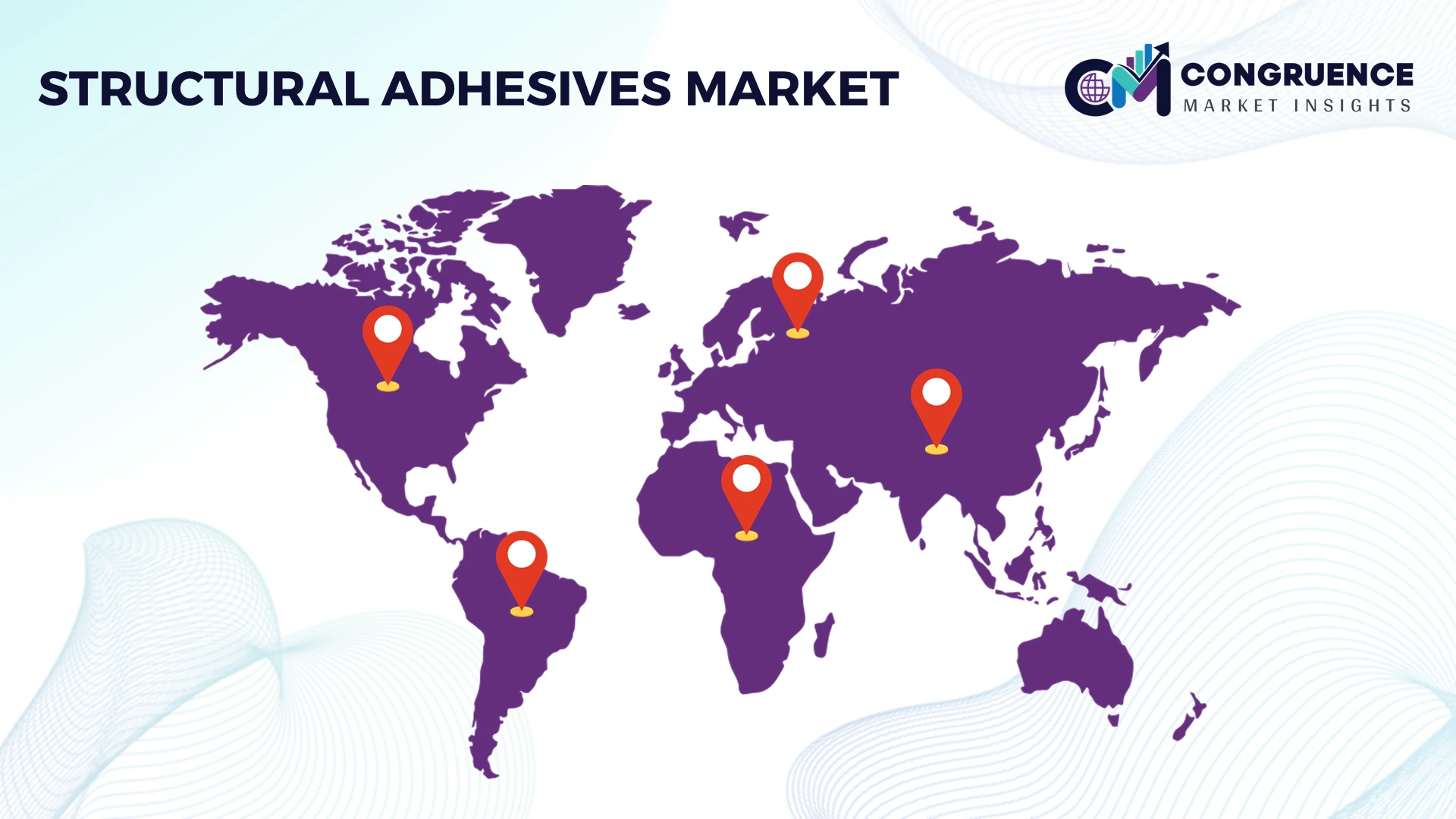
Asia-Pacific accounted for the largest market share at 46% in 2025 however, Middle East & Africa is expected to register the fastest growth, expanding at a 5.8% between 2026 and 2033.
Advanced Manufacturing and Aerospace Integration
North America represents approximately 24% of the global Structural Adhesives market, supported by advanced automotive production, aerospace manufacturing, and industrial automation. High adoption of lightweight materials and composite structures continues increasing structural adhesive deployment across vehicle assembly and aircraft manufacturing. More than 68% of newly commissioned automated assembly lines incorporate robotic adhesive dispensing to improve bonding consistency and production throughput. Growing battery manufacturing investments across the United States and Mexico are strengthening demand for high-performance epoxy and polyurethane formulations. Companies are expanding regional production facilities, securing specialty resin supply agreements, and integrating digital quality monitoring to improve operational efficiency while reducing manufacturing variability.
United States Market Outlook: The United States leads regional demand through large-scale automotive, aerospace, and defense manufacturing capabilities. More than 70% of domestic electric vehicle battery assembly facilities utilize structural bonding technologies for lightweight construction and enhanced structural integrity. Manufacturers continue investing in localized adhesive production, application engineering centers, and collaborative development programs with OEMs to strengthen supply resilience and accelerate commercialization of advanced bonding solutions.
Sustainability Standards Accelerate Material Innovation
Europe accounts for nearly 22% of global demand, driven by advanced automotive engineering, aerospace manufacturing, and strict environmental compliance standards. Low-emission adhesive formulations continue replacing solvent-intensive alternatives, while automated production technologies improve application precision across industrial manufacturing. Approximately 40% of newly introduced industrial adhesive products emphasize lower VOC performance and improved sustainability profiles. Infrastructure modernization and composite-intensive transportation projects continue expanding demand for premium structural bonding technologies. Manufacturers are increasing investment in bio-based formulations, regional production capacity, and strategic technology collaborations to strengthen long-term competitiveness.
Germany Market Outlook: Germany remains Europe's strategic manufacturing hub for structural adhesives through its leadership in automotive engineering, industrial automation, and aerospace production. More than 35% of European automotive adhesive development projects originate from German manufacturing networks. Companies continue expanding research partnerships, pilot production facilities, and advanced testing laboratories to accelerate qualification of next-generation structural bonding technologies for premium industrial applications.
Manufacturing Scale Drives Global Leadership
Asia-Pacific contributes approximately 46% of global market demand through its unmatched manufacturing scale across automotive, electronics, renewable energy, and construction industries. Rapid expansion of electric vehicle production and consumer electronics manufacturing continues strengthening structural adhesive consumption. Nearly 65% of global battery manufacturing capacity is concentrated within the region, supporting sustained deployment of advanced bonding technologies. Industrial automation investments and localized raw material production further improve manufacturing competitiveness. Leading suppliers are expanding production capacity, establishing regional innovation centers, and strengthening OEM partnerships to secure long-term industrial supply agreements.
China Market Outlook: China remains the largest national market through integrated automotive, electronics, renewable energy, and industrial manufacturing ecosystems. Approximately 36% of global structural adhesive consumption is concentrated in Chinese manufacturing operations. Continued expansion of electric vehicle production, high-speed rail infrastructure, and advanced industrial automation encourages manufacturers to increase specialty adhesive capacity, strengthen domestic supply chains, and accelerate development of high-performance sustainable formulations.
Industrial Modernization Supports Demand Expansion
South America accounts for approximately 5% of global structural adhesive consumption, supported by automotive assembly, construction activities, and industrial manufacturing modernization. Brazil and Argentina continue expanding localized vehicle production, increasing demand for lightweight bonding technologies across commercial and passenger vehicles. Industrial automation projects have improved manufacturing efficiency by approximately 12% in selected production facilities. Infrastructure investment and renewable energy developments are supporting wider deployment of structural adhesives despite logistics and specialty chemical supply limitations. Companies are responding through regional distribution expansion, localized inventory strategies, and partnerships with industrial manufacturers to improve product availability and technical support.
Brazil Market Outlook: Brazil represents the largest regional opportunity due to its diversified manufacturing base and established automotive production infrastructure. More than half of South America's vehicle assembly output is concentrated in Brazil, supporting growing adoption of structural adhesives for lightweight assembly. Manufacturers continue strengthening regional warehousing, technical service capabilities, and domestic distribution partnerships to improve customer responsiveness and reduce delivery lead times.
Infrastructure Investment Reshapes Industrial Demand
The Middle East & Africa market is gaining momentum through infrastructure modernization, industrial diversification, renewable energy investments, and expanding manufacturing capacity. Large-scale construction developments and industrial projects are increasing structural adhesive deployment across commercial buildings, transportation infrastructure, and energy facilities. More than 30% of new industrial developments in Gulf economies incorporate advanced construction materials supporting structural bonding applications. Manufacturers are expanding regional distribution networks, strengthening technical partnerships, and establishing localized service capabilities to improve supply responsiveness while supporting large infrastructure programs.
Saudi Arabia Market Outlook: Saudi Arabia leads regional market expansion through industrial diversification, mega infrastructure developments, and advanced manufacturing initiatives. Industrial localization programs continue increasing demand for structural bonding solutions across construction, transportation, and renewable energy sectors. Investments in manufacturing clusters and logistics infrastructure are improving supply-chain efficiency, while producers expand regional technical support and application engineering capabilities to serve large-scale industrial projects.
The Structural Adhesives market is led by Henkel, 3M, Sika, H.B. Fuller, Arkema, and Huntsman, with global technology leaders competing against regional formulation specialists and cost-focused manufacturers. The top five companies collectively control approximately 47% of global market share through diversified product portfolios and established OEM relationships. Competition centers on formulation performance, application engineering, supply-chain reliability, and production responsiveness rather than price alone. Advanced dispensing technologies improve manufacturing efficiency by nearly 18%, while customized adhesive systems enhance production productivity by approximately 15%, creating measurable differentiation. Leading suppliers continue expanding manufacturing capacity, securing long-term raw material partnerships, investing in low-emission formulations, and strengthening vertical integration to improve delivery reliability. Regional manufacturers compete through localized production, faster technical support, and customized solutions for domestic industries. High qualification requirements, application testing, and customer certification remain significant entry barriers. Sustainable success depends on combining material innovation, resilient supply networks, technical collaboration, and rapid commercialization capabilities.
Henkel AG & Co. KGaA
3M Company
Sika AG
H.B. Fuller Company
Arkema S.A.
Huntsman Corporation
Avery Dennison Corporation
Illinois Tool Works Inc.
DELO Industrie Klebstoffe GmbH & Co. KGaA
Permabond LLC
LORD Corporation
Parson Adhesives Inc.
Master Bond Inc.
Jowat SE
Structural adhesive technology is rapidly shifting toward high-performance epoxy, polyurethane, and hybrid acrylic formulations designed for lightweight, multi-material assemblies. Automated dispensing systems now operate in approximately 58% of new automotive production lines, improving adhesive utilization by nearly 16% while reducing application variability. Digital process monitoring further enhances bond consistency by around 12%, enabling manufacturers to lower rework rates and strengthen quality assurance across high-volume industrial production.
Emerging technologies include AI-assisted dispensing optimization, inline ultrasonic bond inspection, and low-temperature curing chemistries integrated with Industry 4.0 manufacturing platforms. AI-enabled process control improves production efficiency by approximately 14%, while advanced hybrid formulations increase fatigue resistance by nearly 18% in demanding structural applications. Compared with conventional manual bonding processes, automated smart adhesive systems deliver about 20% faster assembly and 15% lower material waste. Electronics and electric vehicle manufacturers are leading adoption because production scalability and precision directly improve competitive performance.
Disruptive innovation between 2026 and 2028 will focus on recyclable structural adhesives, debond-on-demand technologies, digital material traceability, and bio-based polymer chemistry. More than 40% of leading manufacturers are expanding investment in sustainable adhesive platforms integrated with automated manufacturing ecosystems. Companies deploying intelligent bonding technologies earlier will secure shorter production cycles, stronger OEM relationships, improved supply-chain resilience, and differentiated positions in high-value industrial markets.
April 2025 Henkel introduced AI-generated virtual adhesives, structural adhesive debonding technology, and digital battery traceability solutions for EV manufacturing, supporting structural bonds up to 12 MPa while improving repairability and circularity across battery systems. Business impact: faster product development and recycling efficiency. Source: henkel.com
February 2026 Henkel expanded its Adhesive Technologies sustainability platform by enhancing the HEART environmental assessment tool with use-phase emissions analysis and stricter audited product classification, improving sustainability transparency across 100% of assessed portfolio categories. Business impact: stronger customer decision support and compliance.
May 2026 Henkel launched the TEROSON EP 52 Series structural adhesive, combining vibration damping with structural bonding in one formulation and eliminating the need for conventional bitumen sheets. Business impact: lower vehicle weight and seamless integration into automated Body-in-White production lines.
June 2026 Henkel announced that 24 tons of LOCTITE EA 9497 structural adhesive supported completion of the Sagrada Familia's central towers through modular construction techniques. Business impact: validated long-term structural durability and strengthened confidence in advanced structural adhesive deployment for complex infrastructure projects. Source: henkel.com
The report provides comprehensive coverage of the Structural Adhesives market across epoxy, polyurethane, acrylic, cyanoacrylate, and silicone technologies, evaluating performance characteristics, deployment patterns, and competitive positioning. It analyzes demand across automotive assembly, building & construction, aerospace, electronics, and industrial manufacturing while assessing purchasing behavior among major end-user industries. Regional assessments cover North America, Europe, Asia-Pacific, South America, and the Middle East & Africa, with country-level operational insights for leading manufacturing economies.
The study evaluates technology adoption, manufacturing automation, sustainability initiatives, and supply-chain localization trends influencing industry development between 2026 and 2033. More than 40% of the analysis focuses on high-growth industrial applications and emerging material innovations, while benchmarking major manufacturers, competitive strategies, investment priorities, and deployment trends. Strategic insights support expansion planning, product portfolio optimization, partnership evaluation, competitive positioning, and long-term operational decision-making across established and emerging structural adhesive markets.
| Report Attribute/Metric | Report Details |
|---|---|
Market Revenue in 2025 | USD 13240 Million |
Market Revenue in 2033 | USD 18119.8 Million |
CAGR (2026 - 2033) | 4% |
Base Year | 2025 |
Forecast Period | 2026 - 2033 |
Historic Period | 2021 - 2025 |
Segments Covered | By Type
By Application
By End-User
|
Key Report Deliverable | Revenue Forecast, Growth Trends, Market Dynamics, Segmental Overview, Regional and Country-wise Analysis, Competition Landscape |
Region Covered | North America, Europe, Asia-Pacific, South America, Middle East, Africa |
Key Players Analyzed | Henkel AG & Co. KGaA, 3M Company, Sika AG, H.B. Fuller Company, Arkema S.A., Huntsman Corporation, Avery Dennison Corporation, Illinois Tool Works Inc., DELO Industrie Klebstoffe GmbH & Co. KGaA, Permabond LLC, LORD Corporation, Parson Adhesives Inc., Master Bond Inc., Jowat SE |
Customization & Pricing | Available on Request (10% Customization is Free) |




