
Reports
The Global Stroboscope Tachometer Market was valued at USD 170.6 Million in 2025 and is anticipated to reach a value of USD 265.8 Million by 2033 expanding at a CAGR of 5.7% between 2026 and 2033. Growth is primarily driven by expanding predictive maintenance programs, Industry 4.0 adoption, and increasing deployment of non-contact rotational speed measurement across industrial manufacturing and process automation.
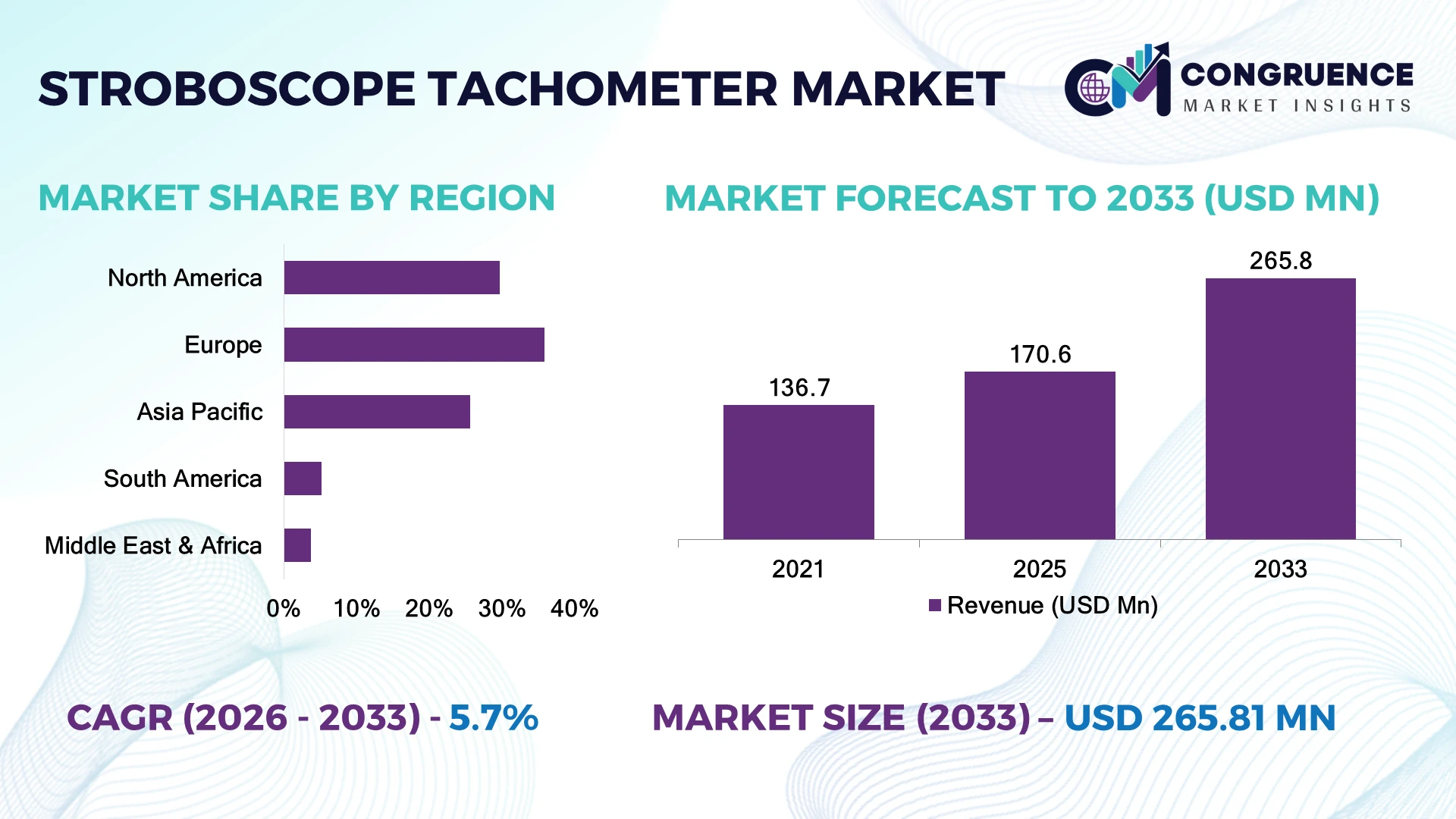
Germany leads the global stroboscope tachometer market with approximately 24% of high-precision industrial measurement equipment production, supported by strong machinery manufacturing, automotive engineering, and industrial automation investments. More than 61% of advanced maintenance facilities in Germany utilize non-contact diagnostic instruments, compared with nearly 47% in Japan, reflecting broader predictive maintenance adoption. Ongoing supply-chain diversification across Europe following geopolitical manufacturing realignments has further strengthened regional instrumentation production and technology deployment.
Strategic investment in smart diagnostic instruments, digital maintenance ecosystems, and localized manufacturing partnerships is becoming essential for long-term competitive differentiation.
Market Size & Growth: Valued at USD 170.6 million in 2025 and projected to reach USD 265.8 million by 2033 at a CAGR of 5.7%, driven by predictive maintenance and industrial automation.
Top Growth Drivers: Predictive maintenance adoption (41%), Industry 4.0 integration (36%), and automated manufacturing expansion (29%) accelerate demand.
Short-Term Forecast: By 2028, inspection efficiency is expected to improve by 22% while maintenance downtime decreases by approximately 18%.
Emerging Technologies: AI-assisted diagnostics, wireless connectivity, digital LED stroboscopes, and IoT-enabled monitoring enhance equipment inspection accuracy.
Regional Leaders: Europe exceeds USD 82 million, Asia-Pacific approaches USD 75 million, and North America surpasses USD 69 million through smart factory deployment.
Consumer/End-User Trends: Nearly 58% of large manufacturing facilities now prefer portable non-contact rotational measurement systems.
Pilot/Case Example: During 2025, digital maintenance implementation reduced rotating equipment inspection time by approximately 24% in advanced manufacturing facilities.
Competitive Landscape: The top five manufacturers hold approximately 54% market share, led by Fluke, SKF, PCE Instruments, Monarch Instrument, and Testo.
Regulatory & ESG Impact: Energy-efficiency initiatives improved predictive maintenance adoption by nearly 19% across industrial operations.
Investment & Funding: More than USD 620 million has been invested globally in industrial monitoring technologies through strategic expansion and automation partnerships.
Innovation & Future Outlook: Smart sensors, cloud-connected diagnostics, and integrated condition monitoring are redefining industrial equipment maintenance strategies.
Stroboscope tachometers are becoming essential across automotive manufacturing, industrial machinery, power generation, and process industries where non-contact rotational analysis improves maintenance accuracy and operational safety. Nearly 52% of newly deployed inspection systems now incorporate digital LED technology with wireless connectivity. Continued industrial modernization and resilient manufacturing supply chains are accelerating adoption, setting the foundation for broader strategic transformation across the global market.
The stroboscope tachometer market has become strategically significant as manufacturers transition from reactive equipment servicing to predictive maintenance supported by digital diagnostics. Industrial automation, smart factory modernization, and condition-based maintenance programs are increasing demand for high-precision non-contact measurement systems. Companies are simultaneously restructuring supply chains by regionalizing production of electronic components to reduce procurement risks and improve delivery reliability following recent global manufacturing disruptions.
Modern LED-based digital stroboscope tachometers deliver approximately 27% greater measurement accuracy and reduce power consumption by nearly 32% compared with legacy xenon flash systems while providing improved operational flexibility through wireless connectivity and digital data integration. Germany continues leading precision industrial instrumentation deployment through advanced manufacturing ecosystems, whereas China is expanding production capacity to serve high-volume industrial automation projects. More than 46% of newly commissioned manufacturing facilities now integrate predictive maintenance technologies into equipment lifecycle management.
Industrial equipment manufacturers are expanding partnerships with automation providers and maintenance software developers to deliver integrated asset monitoring solutions. Increasing deployment across wind energy facilities, automotive production plants, and precision engineering workshops demonstrates how businesses are prioritizing operational uptime and maintenance optimization. Between 2026 and 2028, organizations investing in connected diagnostics, intelligent maintenance platforms, and precision measurement technologies will strengthen operational resilience, reduce lifecycle costs, and secure long-term competitive advantage in industrial equipment management.
Predictive maintenance is becoming the primary catalyst for stroboscope tachometer adoption as manufacturers prioritize non-contact rotational analysis to reduce unexpected equipment failures. Approximately 43% of large industrial facilities now incorporate predictive maintenance into asset management strategies, while digital inspection tools improve maintenance scheduling efficiency by nearly 26%. Germany continues expanding smart manufacturing initiatives that integrate precision diagnostic instruments into automated production environments. This operational shift enables earlier fault detection, reduces maintenance interruptions, and extends equipment life across rotating machinery. Instrument manufacturers are responding by expanding wireless product portfolios, integrating Bluetooth-enabled diagnostics, and forming partnerships with industrial automation providers. A notable strategic trend is the transition from standalone measurement devices to connected condition-monitoring ecosystems supporting continuous operational intelligence.
Dependence on precision electronic components and high-performance LEDs continues creating supply constraints for stroboscope tachometer manufacturers. Approximately 37% of production costs are associated with electronic assemblies, while component lead times remain nearly 18% above pre-disruption levels in several industrial supply chains. Japan's optical component manufacturers continue facing procurement variability caused by specialized semiconductor availability and logistics adjustments. These structural constraints increase production costs, delay product deliveries, and compress manufacturer margins within highly competitive industrial instrumentation markets. Companies are reducing exposure by diversifying supplier networks, localizing electronic assembly operations, and securing long-term procurement agreements with component manufacturers. Strategic inventory management has become an essential competitive differentiator for maintaining reliable delivery performance.
The rapid integration of industrial IoT and connected maintenance platforms is creating new opportunities for advanced stroboscope tachometers. Nearly 48% of newly commissioned smart factories now deploy connected inspection equipment capable of digital data transfer and remote diagnostics, while cloud-enabled maintenance workflows improve asset utilization by approximately 23%. China continues expanding intelligent manufacturing initiatives that encourage adoption of digitally integrated measurement technologies across automotive and electronics production facilities. Manufacturers are investing in AI-assisted diagnostics, mobile applications, and predictive analytics platforms while strengthening partnerships with industrial software providers. A significant strategic opportunity lies in combining rotational measurement with enterprise asset management systems, enabling recurring service revenues beyond conventional hardware sales.
The transition toward intelligent diagnostic systems requires specialized technical expertise that many industrial facilities currently lack. Approximately 35% of maintenance teams require additional digital competency training to effectively utilize connected diagnostic instruments, while implementation timelines increase by nearly 19% when software integration expertise is unavailable. The United States continues experiencing shortages of experienced predictive maintenance specialists across advanced manufacturing sectors. These execution challenges reduce deployment consistency, delay operational optimization, and limit returns from digital maintenance investments. Companies must strengthen technical training programs, expand certified service partnerships, and simplify user interfaces through automation and intuitive analytics. Long-term competitiveness will depend on building integrated service ecosystems alongside precision hardware innovation.
Wireless Diagnostics Become Standard Portable wireless stroboscope tachometers now account for approximately 46% of newly installed industrial inspection equipment, reducing technician inspection time by nearly 22%. Manufacturing companies are integrating Bluetooth communication and mobile reporting platforms into maintenance workflows, responding to labor shortages and increasing demand for faster field diagnostics.
LED Technology Replaces Xenon High-intensity LED flash technology has reached nearly 63% adoption across newly launched products, delivering approximately 35% lower energy consumption and extending operational life by nearly 40%. Instrument manufacturers are restructuring product portfolios toward digital LED systems as industrial users prioritize reliability, lower maintenance, and longer service intervals.
Integrated Asset Monitoring Expands Around 38% of advanced manufacturing facilities now connect stroboscope tachometers with computerized maintenance management systems, improving inspection traceability and reducing reporting errors by approximately 20%. Companies are partnering with industrial software developers to deliver integrated maintenance platforms rather than standalone measurement instruments, creating stronger long-term customer retention.
Localized Manufacturing Gains Momentum Electronic component sourcing strategies are shifting toward regional manufacturing hubs, with nearly 29% of instrumentation suppliers increasing localized procurement to strengthen supply resilience. Industrial automation investments in China and Germany are accelerating product customization, shorter delivery cycles, and flexible production planning, enabling manufacturers to respond more efficiently to evolving industrial maintenance requirements.
Digital stroboscope tachometers accounted for approximately 67% of the global stroboscope tachometer market in 2025, making them the dominant product category due to superior measurement accuracy, programmable flash frequency, wireless connectivity, and seamless integration with predictive maintenance platforms. Their ability to store inspection data and interface with industrial asset management software has accelerated adoption across automotive, manufacturing, and energy facilities. Analog stroboscope tachometers continue serving cost-sensitive applications where basic rotational speed verification is sufficient, while LED stroboscope tachometers have become the preferred illumination technology because of longer operational life and lower power consumption.
LED-based stroboscope tachometers represent the fastest-growing segment as industries replace xenon-based systems with energy-efficient digital alternatives. Nearly 61% of newly introduced portable inspection instruments now utilize LED flash technology, while wireless-enabled digital models account for approximately 44% of new industrial equipment purchases. Manufacturers are expanding Bluetooth-enabled product portfolios, investing in rugged handheld devices, and integrating cloud-compatible diagnostics to strengthen aftermarket service offerings. Investment priorities increasingly favor intelligent measurement platforms that improve maintenance efficiency while reducing equipment downtime.
According to the VDMA Machinery and Equipment Association's 2026 industrial maintenance assessment, more than half of newly commissioned precision manufacturing facilities in Germany deployed digital condition-monitoring instruments, reinforcing the transition toward connected inspection technologies.
Industrial machinery inspection held approximately 46% of the global stroboscope tachometer market in 2025, reflecting widespread deployment across production plants, process industries, and rotating equipment maintenance. Manufacturers increasingly rely on non-contact speed measurement to verify machine performance, identify vibration-related issues, and minimize unplanned downtime without interrupting production. Automotive maintenance remains a significant application supported by precision engine diagnostics, while power generation and HVAC system inspection continue generating stable demand through scheduled maintenance programs.
Production line monitoring is emerging as the fastest-growing application as smart factories integrate real-time equipment diagnostics into automated manufacturing workflows. Approximately 39% of newly automated production facilities now incorporate digital rotational inspection technologies, while predictive maintenance deployment has improved inspection productivity by nearly 24%. Equipment suppliers are integrating tachometers with maintenance software platforms, expanding industrial automation partnerships, and developing portable wireless inspection solutions to support continuous operational monitoring across increasingly digitized production environments.
A 2025 Manufacturing Leadership Council enterprise survey reported that approximately 58% of advanced manufacturers expanded predictive maintenance deployment, increasing demand for non-contact rotational inspection technologies across automated production environments.
Manufacturing industries accounted for approximately 52% of the global stroboscope tachometer market in 2025, driven by continuous equipment monitoring requirements across automotive, metal processing, food processing, and industrial machinery production. High deployment intensity, complex rotating equipment, and preventive maintenance programs continue supporting sustained procurement. Power generation companies represent another mature customer group requiring accurate rotational diagnostics for turbines, generators, and auxiliary equipment, while aerospace maintenance organizations maintain demand for high-precision inspection instruments supporting critical component verification.
Industrial maintenance service providers represent the fastest-growing end-user segment as outsourcing of predictive maintenance expands across asset-intensive industries. Nearly 34% of large industrial operators now utilize specialized maintenance contractors, while integrated diagnostic service contracts have increased by approximately 21% over the past two years. Instrument manufacturers are responding through customized maintenance packages, software-enabled service ecosystems, flexible pricing models, and strategic partnerships with industrial automation providers to strengthen recurring revenue and long-term customer retention.
According to the 2026 SMRP (Society for Maintenance & Reliability Professionals) industry benchmarking study, facilities implementing structured predictive maintenance programs achieved significantly higher utilization of digital diagnostic instruments, reinforcing manufacturing and maintenance service providers as the primary purchasers of advanced stroboscope tachometers.
Europe accounted for the largest market share at 35.8% in 2025 however, Asia-Pacific is expected to register the fastest growth, expanding at a CAGR of 6.5% between 2026 and 2033.

Precision Maintenance Platforms Drive Industrial Instrument Adoption
North America accounted for approximately 29.7% of the global stroboscope tachometer market, supported by advanced manufacturing, predictive maintenance adoption, and widespread deployment of industrial automation systems. Automotive, aerospace, food processing, and power generation industries continue investing in non-contact rotational measurement technologies to improve equipment reliability and minimize downtime. Nearly 49% of large manufacturing facilities across the region have integrated digital maintenance platforms that utilize precision inspection instruments. Industrial automation vendors are strengthening partnerships with measurement equipment manufacturers to deliver connected diagnostic ecosystems, while investments in smart manufacturing infrastructure continue accelerating deployment of wireless and cloud-enabled tachometers across enterprise maintenance operations.
United States Market Outlook: The United States dominates the regional market through its extensive industrial manufacturing base, advanced maintenance practices, and strong automation ecosystem. Approximately 71% of North America's predictive maintenance software deployments originate from U.S. industrial enterprises. Manufacturers continue integrating stroboscope tachometers with digital asset management platforms while expanding investment in intelligent maintenance programs to improve equipment availability and operational efficiency across critical industrial sectors.
Industrial Modernization Reinforces Precision Measurement Leadership
Europe represents approximately 35.8% of the global stroboscope tachometer market, benefiting from advanced machinery manufacturing, stringent equipment reliability standards, and widespread Industry 4.0 implementation. Precision engineering companies continue upgrading maintenance processes through connected diagnostic technologies and digital inspection workflows. Nearly 57% of industrial automation projects commissioned within major manufacturing economies now include predictive maintenance capabilities supporting non-contact measurement equipment. Instrument manufacturers are expanding high-performance digital product lines while strengthening collaborations with industrial automation providers to improve equipment monitoring and lifecycle management.
Germany Market Outlook: Germany remains the region's largest market due to its globally competitive machinery, automotive, and industrial automation sectors. Approximately 42% of Europe's industrial machinery exports originate from Germany, creating sustained demand for precision maintenance equipment. Domestic manufacturers continue integrating smart diagnostics into production facilities while investing in intelligent factory infrastructure that supports widespread deployment of advanced stroboscope tachometers.
Manufacturing Scale Accelerates Smart Inspection Deployment
Asia-Pacific accounts for approximately 25.6% of the global stroboscope tachometer market and continues strengthening its position through expanding manufacturing capacity, factory automation, and industrial digitalization. Electronics, automotive, heavy machinery, and semiconductor production facilities increasingly deploy portable and connected diagnostic instruments to improve production efficiency. Nearly 45% of newly automated manufacturing lines across key industrial economies incorporate predictive maintenance solutions requiring precision rotational measurement. Equipment manufacturers are expanding regional production facilities and developing cost-efficient digital instruments tailored for high-volume industrial applications.
China Market Outlook: China leads the regional market through its extensive manufacturing ecosystem, industrial automation investment, and growing domestic instrumentation industry. More than 31% of global manufacturing output is concentrated in China, supporting continuous demand for maintenance and inspection technologies. Domestic manufacturers continue expanding smart factory deployments while increasing production of digital industrial measurement instruments for both domestic use and international exports.
Industrial Asset Management Expands Equipment Monitoring
South America represents approximately 5.2% of the global stroboscope tachometer market, supported by modernization across mining, food processing, oil and gas, and industrial manufacturing sectors. Companies increasingly prioritize preventive maintenance to improve equipment reliability while reducing operational interruptions in asset-intensive industries. Approximately 24% of recent industrial maintenance upgrades within major economies have included digital inspection equipment and predictive diagnostic technologies. Despite infrastructure limitations and uneven technology adoption, manufacturers continue strengthening distributor partnerships and localized service capabilities to improve industrial equipment support.
Brazil Market Outlook: Brazil is the region's leading market due to its diversified industrial base, mining operations, and expanding manufacturing sector. Approximately 56% of South America's industrial production is concentrated in Brazil, supporting sustained demand for equipment maintenance technologies. Industrial enterprises continue investing in predictive maintenance solutions and workforce modernization to improve machinery availability while reducing maintenance-related production losses.
Infrastructure Investment Supports Industrial Diagnostics
The Middle East & Africa accounts for approximately 3.7% of the global stroboscope tachometer market, driven by industrial diversification, energy infrastructure expansion, and modernization of manufacturing facilities. Oil and gas operators, utilities, and heavy industrial plants continue strengthening predictive maintenance programs to improve rotating equipment performance. Nearly 21% of recently commissioned industrial infrastructure projects within leading regional economies incorporate digital maintenance and equipment monitoring technologies. Measurement equipment suppliers are expanding regional distribution partnerships while improving technical service capabilities to support growing industrial automation requirements.
Saudi Arabia Market Outlook: Saudi Arabia has emerged as the region's most significant market through continued investment in industrial diversification, energy infrastructure, and advanced manufacturing initiatives. Approximately 28% of newly commissioned heavy industrial projects within the Gulf region are located in Saudi Arabia, increasing demand for precision maintenance instruments. Industrial operators continue deploying connected inspection technologies to improve operational reliability, extend equipment life, and support digitally enabled maintenance strategies across strategic industrial facilities.
Global instrumentation leaders including Monarch Instrument, SKF, Fluke, Testo, and PCE Instruments compete through high-precision digital platforms, while regional manufacturers challenge them with lower-cost handheld solutions and faster local delivery. The top five companies collectively control approximately 54% of the global market. Competition centers on measurement accuracy, wireless connectivity, ruggedness, calibration services, and predictive maintenance integration rather than price alone. Premium digital models improve inspection productivity by nearly 24%, while LED technology reduces maintenance requirements by approximately 35% compared with xenon systems. Leading manufacturers are expanding through distributor partnerships, localized assembly, software integration, and vertically integrated calibration services to strengthen customer retention. The competitive landscape is shifting toward connected diagnostic ecosystems as smart factories demand interoperable inspection equipment. Strict calibration requirements, specialized optical engineering expertise, and established industrial distribution networks remain major entry barriers. Winning requires precision hardware, digital connectivity, reliable after-sales calibration, and seamless integration with enterprise maintenance platforms.
Monarch Instrument
SKF
Fluke Corporation
Testo SE & Co. KGaA
PCE Instruments
Checkline
Extech Instruments
OMEGA Engineering
B&B Electronics Manufacturing Company
Shimpo Instruments
Hans Schmidt & Co. GmbH
Lutron Electronic Enterprise Co., Ltd.
Ono Sokki Co., Ltd.
Unilux Inc.
LED-based digital stroboscope tachometers have become the industry standard by combining high-intensity illumination, programmable flash control, and integrated optical speed measurement within compact handheld devices. Approximately 64% of newly deployed industrial units now feature digital LED architecture, improving measurement repeatability by nearly 23% while reducing power consumption by approximately 34%. Bluetooth connectivity, onboard memory, and cloud-compatible reporting are increasingly integrated into predictive maintenance workflows, enabling maintenance teams to capture inspection data without interrupting production. Companies deploying connected diagnostic platforms gain faster maintenance planning and improved equipment utilization.
Emerging technologies include AI-assisted vibration diagnostics, wireless sensor synchronization, and industrial IoT integration that transform stroboscope tachometers from standalone inspection devices into connected maintenance tools. Compared with legacy xenon systems, modern LED platforms extend operational life by approximately 40% while reducing routine maintenance requirements by nearly 35%. Premium manufacturers benefit through differentiation based on software integration and digital service offerings, whereas cost-focused suppliers continue competing primarily through portable hardware.
Between 2026 and 2028, digital twins, edge analytics, and enterprise asset management integration will reshape industrial inspection practices. Nearly 46% of advanced manufacturing facilities are expected to prioritize connected diagnostic instruments over conventional standalone equipment. Organizations investing early in intelligent inspection ecosystems, remote diagnostics, and predictive maintenance software will strengthen operational efficiency, improve customer retention, and establish durable competitive advantages as industrial maintenance becomes increasingly data-driven.
March 2024 Monarch Instrument expanded its Nova-Pro LED Stroboscope/Tachometer portfolio with enhanced predictive maintenance capabilities, including integrated laser tachometer functionality and up to 9 hours of continuous battery operation, improving field inspection efficiency. Source: monarchinstrument.com
September 2025 Monarch Instrument introduced the PLS Pocket LED Stroboscope featuring a 30–300,000 FPM operating range and tachometer mode supporting measurements up to 250,000 RPM, strengthening portable industrial diagnostics. Source: monarchinstrument.com
January 2026 Monarch Instrument expanded availability of its Nova-Pro LED stroboscope portfolio through its worldwide distribution network, supporting ISO 9001:2015 manufacturing and broader industrial maintenance deployment across international markets. Source: monarchinstrument.com
April 2026 SKF continued expanding predictive maintenance solutions integrating portable condition-monitoring instruments with digital asset reliability programs, enabling more efficient rotating equipment inspection workflows across industrial facilities. Source: skf.com
The report provides comprehensive coverage of the global stroboscope tachometer market across product types, including digital, analog, LED, and xenon-based systems, while evaluating applications in industrial machinery inspection, production line monitoring, automotive maintenance, power generation, HVAC systems, and other rotating equipment environments. End-user analysis covers manufacturing industries, maintenance service providers, power utilities, aerospace, and additional industrial sectors across North America, Europe, Asia-Pacific, South America, and the Middle East & Africa. More than 60% of the assessment emphasizes digital inspection technologies and predictive maintenance deployment.
The study further evaluates wireless diagnostics, industrial IoT integration, LED illumination technology, AI-assisted maintenance, and enterprise asset management connectivity shaping future competitive positioning. It benchmarks leading manufacturers, deployment patterns, technology adoption, distribution strategies, and product innovation priorities, delivering actionable intelligence for investment planning, portfolio expansion, competitive differentiation, operational modernization, and strategic decision-making across the global stroboscope tachometer market between 2026 and 2033.
| Report Attribute/Metric | Report Details |
|---|---|
|
Market Revenue in 2025 |
USD 170.6 Million |
|
Market Revenue in 2033 |
USD 265.8 Million |
|
CAGR (2026 - 2033) |
5.7% |
|
Base Year |
2025 |
|
Forecast Period |
2026 - 2033 |
|
Historic Period |
2021 - 2025 |
|
Segments Covered |
By Type
By Application
By End-User
|
|
Key Report Deliverable |
Revenue Forecast, Growth Trends, Market Dynamics, Segmental Overview, Regional and Country-wise Analysis, Competition Landscape |
|
Region Covered |
North America, Europe, Asia-Pacific, South America, Middle East, Africa |
|
Key Players Analyzed |
Monarch Instrument, SKF, Fluke Corporation, Testo SE & Co. KGaA, PCE Instruments, Checkline, Extech Instruments, OMEGA Engineering, B&B Electronics Manufacturing Company, Shimpo Instruments, Hans Schmidt & Co. GmbH, Lutron Electronic Enterprise Co., Ltd., Ono Sokki Co., Ltd., Unilux Inc. |
|
Customization & Pricing |
Available on Request (10% Customization is Free) |




