
Reports
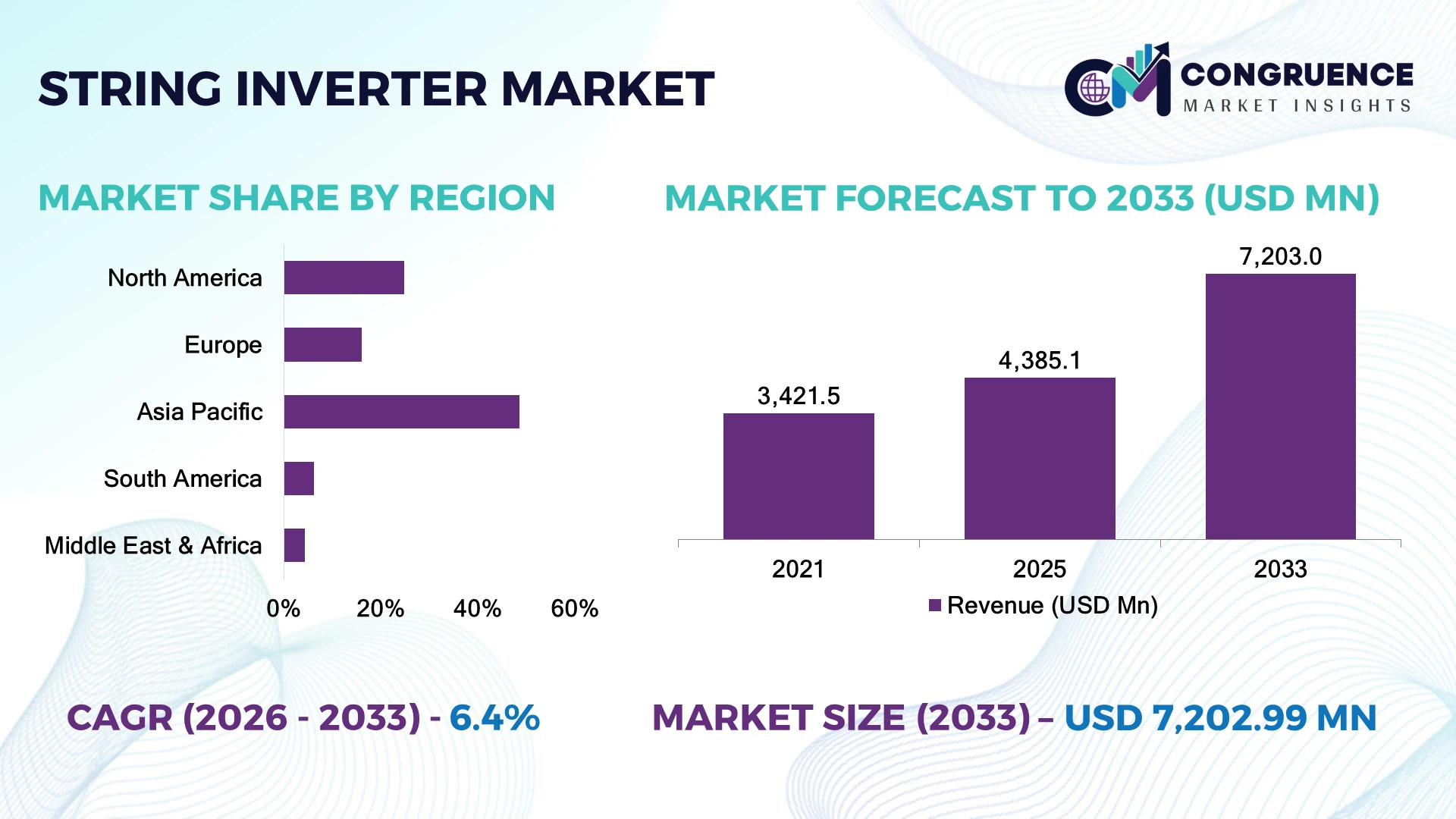
The Global String Inverter Market was valued at USD 4,385.1 Million in 2025 and is anticipated to reach a value of USD 7,203.0 Million by 2033 expanding at a CAGR of 6.4% between 2026 and 2033. Growth is being reinforced by utility-scale solar expansion, higher module power ratings, distributed-generation deployment, and inverter architectures increasingly supporting grid-forming, rapid shutdown, and advanced monitoring functions.
China remains the dominant manufacturing and deployment base, supported by a solar PV manufacturing ecosystem representing more than 80% of global module production capacity. India is expanding utility and commercial solar deployment rapidly, while Europe emphasizes grid compliance and system-level reliability. String inverter efficiencies increasingly exceed 98%, strengthening their position where modular servicing and partial-load performance matter.
Strategically, suppliers with localized manufacturing, grid-code expertise, and high-efficiency platforms are best positioned to capture incremental solar capacity.
Market Size & Growth: USD 4,385.1 million in 2025 to USD 7,203.0 million by 2033 at 6.4% CAGR, driven by expanding solar PV capacity and higher inverter replacement demand.
Top Growth Drivers: Utility-scale solar deployment contributes approximately 32%, distributed generation 27%, and commercial rooftop installations 19% to major demand expansion.
Short-Term Forecast: By 2028, advanced string inverter adoption is positioned to improve system monitoring efficiency by approximately 12% and reduce servicing requirements by 8%.
Emerging Technologies: AI-based diagnostics, 1,500V architectures, and module-level power optimization are gaining traction, with advanced monitoring adoption approaching 25% in newer installations.
Regional Leaders: Asia-Pacific leads deployment, followed by Europe and North America, while advanced grid-support functionality is increasingly specified in more than 20% of new large solar projects.
Consumer/End-User Trends: Commercial and industrial users increasingly prioritize monitoring, remote diagnostics, and rapid shutdown, with digitalized inverter platforms representing roughly 30% of new C&I installations.
Pilot/Case Example: 2025 solar deployments using advanced string architectures recorded operational improvements of approximately 5–8% through better MPPT performance, monitoring, and fault isolation.
Competitive Landscape: Huawei, Sungrow, SMA, Sineng Electric, and FIMER remain influential, with leading suppliers collectively accounting for roughly 45–50% of global string-inverter demand.
Regulatory & ESG Impact: Grid-code modernization and stricter safety requirements are increasing demand for reactive-power control, anti-islanding, and rapid-shutdown functions across more than 20% of regulated installations.
Investment & Funding: Solar manufacturing and inverter ecosystem investments exceeded USD 10 billion globally across major capacity expansions, localization programs, and supply-chain partnerships.
Innovation & Future Outlook: 2026–2028 priorities center on AI-enabled predictive maintenance, higher-voltage platforms, grid-forming capability, silicon-carbide components, and integrated energy-storage controls.
The global String Inverter Market is increasingly defined by modular architecture, high conversion efficiency, digital asset management, and grid-interactive functionality. Commercial rooftops, utility-scale solar farms, and hybrid solar-plus-storage projects are strengthening demand for platforms capable of handling higher DC input levels and more complex operating profiles. Efficiency above 98% is becoming increasingly important as developers seek greater energy yield without proportional increases in equipment footprint. In 2026, supply-chain localization and tighter grid-interconnection requirements are also influencing procurement decisions, particularly in India, the United States, and European markets. The shift toward intelligent inverter platforms is creating a clear transition from equipment procurement toward lifecycle-oriented energy management.
String inverters are becoming strategically important because inverter selection increasingly determines not only conversion efficiency but also plant availability, grid compliance, diagnostics, and maintenance economics. Higher-power PV modules and increasingly distributed solar assets are pushing developers toward architectures that combine granular MPPT control with centralized digital supervision. In the United States, India, and Europe, evolving interconnection requirements are accelerating specifications for reactive-power management, remote control, and fault-response capabilities.
New-generation string platforms can deliver conversion efficiencies above 98%, compared with roughly 96–97% for older commercial architectures, translating into approximately 1–2% additional energy conversion under comparable operating conditions. Digital diagnostics can also reduce troubleshooting time by around 15–20% by identifying underperforming strings before physical inspection.
The next two to three years will emphasize 1,500V systems, AI-assisted fault detection, silicon-carbide switching components, and tighter integration with battery storage. China retains scale advantages in manufacturing, while the United States prioritizes grid-interactive functionality and domestic supply chains. Companies deploying these technologies are increasing R&D, forming software partnerships, and localizing service networks. Competitive advantage will increasingly depend on combining efficiency, grid intelligence, cybersecurity, and dependable field support rather than inverter hardware alone.
Rising deployment of high-wattage PV modules is strengthening demand for string inverters capable of higher DC input, multiple MPPT channels, and 1,500V system architectures. Modules above 600W now represent a growing share of new utility and commercial installations, while advanced string platforms routinely achieve conversion efficiencies above 98%. In India, large solar parks increasingly favor modular architectures because distributed MPPT improves energy harvesting across variable irradiance conditions. Grid-support requirements are also expanding, with reactive-power and voltage-control functions becoming standard specifications in more projects. Manufacturers are responding by expanding high-power product families, integrating advanced monitoring, and partnering with EPC firms. The strategic advantage is shifting toward suppliers that combine higher power density with granular fault isolation and grid-code compliance.
String inverter economics remain exposed to semiconductor, capacitor, magnetics, and power-electronics component volatility. Silicon and electronic component costs can influence equipment pricing by approximately 5–8%, while currency fluctuations add another 3–5% pressure for import-dependent markets such as India and Brazil. Grid-interconnection requirements also increase engineering complexity, particularly where utilities demand reactive-power control, anti-islanding, and remote dispatch functions. In the United States, localized-content requirements are reshaping procurement and encouraging domestic sourcing strategies. These constraints can compress EPC margins and extend qualification cycles. Manufacturers are reducing exposure through multi-supplier contracts, regional assembly, standardized component platforms, and localized service inventories. A non-obvious pressure point is that aggressive component standardization can reduce procurement costs but limit customization for country-specific grid requirements.
The strongest emerging opportunity lies in integrating string inverters with battery storage, advanced energy-management software, and predictive diagnostics. Hybrid solar-plus-storage deployments are expanding, while digital monitoring penetration in newly commissioned commercial systems is moving toward 30–40%. AI-assisted fault detection can reduce troubleshooting workloads by roughly 15–20%, creating measurable value where service teams manage geographically dispersed assets. In Australia and India, distributed solar operators are increasingly prioritizing platforms capable of coordinated PV, storage, and grid-support functions. Manufacturers are investing in hybrid inverter architectures, software partnerships, and open communication interfaces. The less obvious opportunity is lifecycle monetization: suppliers can convert inverter installations into recurring service relationships through remote diagnostics, firmware management, performance analytics, and fleet-level optimization rather than relying solely on hardware sales.
As string inverters evolve into grid-interactive assets, software integration and cybersecurity become long-term execution challenges. Advanced installations increasingly combine inverter controls, SCADA, energy-management platforms, and storage interfaces, creating interoperability requirements across multiple protocols. Cybersecurity controls can add approximately 3–5% to system engineering and commissioning workloads, while software-related commissioning issues can extend deployment schedules by 5–10% in complex projects. In Germany and the United States, increasingly sophisticated grid requirements also demand faster firmware validation and dependable remote-control functionality. Manufacturers must invest in secure-by-design architectures, automated testing, standardized APIs, and specialist engineering teams. The strategic challenge is no longer conversion efficiency alone; suppliers that cannot maintain reliable software updates across long asset lifecycles risk losing competitiveness even when their hardware performance remains strong.
Higher Power Density Platforms String inverter ratings are moving toward 250–350 kW for large commercial and utility applications, while efficiencies above 98% are increasingly standard. Adoption of higher-wattage modules is reducing inverter count and balance-of-system complexity by approximately 8–12%. Manufacturers are redesigning thermal systems and MPPT architectures to support higher DC loading without sacrificing reliability.
AI-Based Fault Diagnostics AI-assisted monitoring is moving from pilot deployments into commercial solar operations, with digital diagnostics adoption approaching 25–30% among newer C&I projects. Predictive alerts can shorten fault-identification time by 15–20%, reducing technician travel and improving plant availability. Suppliers are embedding analytics directly into inverter platforms as operators face tighter maintenance staffing and larger distributed fleets.
Grid Support Becomes Standard Utilities are increasingly specifying reactive-power control, voltage regulation, and remote-dispatch capabilities, particularly in the United States and Germany. Grid-interactive functions now appear in roughly 20–25% of newly specified large projects. Manufacturers are responding with firmware upgrades, advanced control algorithms, and utility partnerships, turning inverter software capability into a procurement differentiator.
Localized Supply Chains Expand India, the United States, and Europe are increasing emphasis on regional manufacturing and component sourcing amid supply-chain restructuring. Localized assembly can reduce equipment logistics exposure by approximately 5–10% and shorten service-response cycles. Manufacturers are establishing regional inventories, qualifying alternate component suppliers, and adapting product configurations to local grid and procurement requirements.
Three-Phase Architecture Leads Commercial and Utility Deployment
Three-phase string inverters represent the leading type, accounting for approximately 59% of global string inverter demand, supported by higher power handling, balanced load distribution, and compatibility with commercial, industrial, and utility-connected PV systems. Their ability to integrate multiple MPPT channels and advanced grid-support functions gives them a clear advantage over single-phase units in higher-capacity installations. Single-phase inverters retain strong relevance in residential rooftops, where simpler electrical architecture and lower upfront costs remain decisive. Approximately 60–65% of new commercial-oriented string inverter deployments increasingly favor three-phase configurations as project sizes and grid-interconnection requirements rise.
The fastest-growing shift is toward high-power three-phase platforms supporting 1,500V DC architectures and higher-current bifacial modules. Manufacturers are expanding 250–350 kW product families, increasing MPPT density and thermal performance. In contrast, single-phase systems remain strategically important for distributed generation, particularly where residential electrification and battery integration are accelerating. Investment is therefore shifting toward high-power, grid-interactive platforms without abandoning modular residential portfolios.
The IEA PVPS reported in 2026 that global PV installations reached approximately 698 GW in 2025, with China accounting for around 60% of new capacity, reinforcing demand for higher-capacity inverter architectures across large-scale deployments.
Utility-Scale Systems Drive Volume While Rooftops Reshape Growth
Utility applications represent the leading application for string inverters, accounting for approximately 45% of demand where modular inverter blocks increasingly compete with centralized architectures on redundancy, MPPT granularity, and maintenance flexibility. Commercial and industrial installations follow at roughly 32%, supported by rooftop expansion and electricity-cost optimization. Residential systems account for about 23%, but their demand profile is changing faster as battery-ready and digitally monitored systems gain adoption. Companies are increasingly standardizing inverter platforms across project sizes, with monitoring and remote diagnostics incorporated into approximately 30% of newer commercial deployments.
Residential applications represent the fastest-growing use case as rooftop solar programs, self-consumption, and battery integration accelerate deployment. Commercial operators prioritize higher-power three-phase units, while utility developers increasingly specify high-current platforms compatible with bifacial modules. Manufacturers are responding through scalable product families, integrated storage interfaces, and software-enabled fleet management. The business implication is a widening technology gap: mature utility deployments prioritize power density and reliability, whereas emerging residential demand increasingly rewards interoperability, simplified commissioning, and intelligent energy management.
IEA PVPS reported in 2025 that utility-scale PV represented approximately 62% of new global installations in 2024, while distributed and prosumer markets continued expanding through self-consumption and new business models.
Utilities Anchor Volume as Commercial Buyers Accelerate
Utilities represent the dominant end-user group, accounting for approximately 44% of string inverter demand because of large project pipelines, standardized procurement, and intensive grid-integration requirements. Commercial and industrial users contribute about 34%, with factories, logistics facilities, data-intensive operations, and large rooftops increasingly adopting three-phase string architectures. Residential users account for approximately 22% but represent the fastest-growing buyer group as rooftop programs and battery integration broaden access. Suppliers are responding with differentiated pricing, modular capacities, longer warranties, and service agreements tailored to each procurement profile.
Commercial and industrial buyers are shifting toward lifecycle economics rather than equipment price alone, placing greater weight on remote monitoring, predictive maintenance, and rapid fault isolation. Residential buyers remain more price-sensitive, while utilities prioritize availability, grid compliance, and bankability. Approximately 15–20% of newer commercial procurement specifications increasingly emphasize advanced monitoring or storage compatibility. Manufacturers are strengthening EPC partnerships and installer networks while expanding localized technical support. Future competitive positioning will increasingly depend on serving fragmented C&I demand without sacrificing the scale economics required by utility procurement.
JMK Research reported in 2026 that India recorded more than 14.2 GW of inverter shipments in Q4 2025, while the country is projected to add approximately 42.5 GW of new solar capacity during 2026, strengthening both utility and distributed-generation procurement requirements.
Asia-Pacific accounted for the largest market share at 48.6% in 2025 moreover, Asia-Pacific is also expected to register the fastest growth, expanding at a CAGR of 8.9% between 2026 and 2033.

Grid-Interactive Solar Deployment Reshapes Inverter Procurement
North America represented approximately 24.8% of the global String Inverter Market in 2025, supported by large commercial rooftops, utility-scale solar additions, and increasing battery-coupled installations. The United States remains the primary demand center, with utility-scale solar accounting for a substantial share of new generation capacity and increasingly stringent requirements for reactive-power control, remote dispatch, and grid support. Developers are also prioritizing higher-power three-phase platforms to reduce balance-of-system complexity. Domestic supply-chain localization is strengthening procurement preference for regionally assembled equipment, while software-enabled monitoring is becoming a differentiator in large distributed portfolios. Manufacturers are responding through localized production, EPC partnerships, expanded service networks, and 1,500V product portfolios. The strategic shift favors suppliers combining bankable hardware with grid-compliant controls and dependable lifecycle support.
United States Market Outlook: The United States holds the region's strongest strategic position because of its large utility-scale pipeline, sophisticated grid-interconnection requirements, and expanding battery-storage integration. The U.S. Energy Information Administration expects 86 GW of new utility-scale generation capacity in 2026, with solar representing 51% of planned additions. This deployment profile reinforces demand for high-power string architectures, advanced controls, and domestic service capabilities. Manufacturers are increasingly aligning product roadmaps with U.S. grid requirements and localized supply-chain priorities, creating an advantage for suppliers capable of combining manufacturing resilience with rapid technical support.
Grid Compliance and Distributed Solar Modernization
Europe accounted for approximately 16.1% of the global String Inverter Market in 2025, supported by mature rooftop solar markets, commercial installations, and increasingly sophisticated grid-management requirements. Germany, Spain, Italy, and France remain important deployment centers, with inverter procurement increasingly influenced by grid stability, energy-storage compatibility, and digital monitoring. Germany added approximately 16.4 GW of solar capacity in 2025, reinforcing demand for modular architectures across both building-mounted and ground-mounted projects. Manufacturers are responding with higher-efficiency three-phase platforms, integrated battery interfaces, and software-based diagnostics. The market is shifting from basic conversion equipment toward grid-interactive energy-management infrastructure, making interoperability and compliance increasingly important purchasing criteria.
Germany Market Outlook: Germany is the region's most strategically significant country because of its mature distributed-solar ecosystem, strong inverter manufacturing base, and extensive grid-integration experience. Installed solar capacity reached approximately 117 GW at the end of 2025, while around 430,000 plug-in balcony systems were registered during the year. This combination of utility, commercial, and residential deployment creates demand across multiple inverter power classes. Manufacturers benefit from a technically sophisticated installer network and established after-sales infrastructure, while local buyers increasingly prioritize efficiency, storage compatibility, cybersecurity, and compliance with evolving distribution-grid requirements.
Manufacturing Scale Meets High-Volume Solar Deployment
Asia-Pacific dominated the String Inverter Market with an estimated 48.6% share in 2025, supported by China's manufacturing scale, India's rapid solar additions, and expanding commercial and utility projects across Southeast Asia. China alone accounted for roughly 60% of new global PV capacity in 2025, creating substantial demand for high-power inverter platforms and localized component ecosystems. India added approximately 45.7 GW of solar capacity during 2025, strengthening demand for three-phase string architectures across utility and commercial projects. Manufacturers are expanding automated production, increasing 1,500V platform availability, and developing higher-current products for large-format modules. The region's strategic advantage lies in vertically integrated supply chains, enabling faster product iteration and competitive equipment pricing while supporting large-volume deployment.
China Market Outlook: China remains the most strategically significant country because of its unmatched PV manufacturing ecosystem, project scale, and domestic inverter demand. The country commissioned nearly 370 GW of solar PV capacity in 2025, creating exceptional requirements for power-conversion equipment, grid controls, and replacement systems. Its dense concentration of module, inverter, semiconductor, and power-electronics suppliers supports rapid product localization and cost optimization. Manufacturers are increasingly developing higher-power string platforms, advanced MPPT configurations, and intelligent monitoring systems to address large-scale solar bases and increasingly complex grid operating conditions.
Distributed Solar Scale-Up Drives Modular Adoption
South America accounted for approximately 6.2% of global String Inverter demand in 2025, with Brazil serving as the principal deployment and manufacturing hub. The region's demand is concentrated in distributed generation, commercial rooftops, and utility-scale solar, where modular inverter designs provide operational flexibility across geographically dispersed projects. Brazil's solar PV capacity reached approximately 64.8 GW in 2025, increasing 33.7% year over year and reinforcing demand for three-phase string platforms. Financing conditions, transmission constraints, and currency exposure remain important procurement considerations in other South American markets. Suppliers are strengthening local distribution partnerships, service inventories, and installer networks. The market increasingly rewards manufacturers that can combine competitive pricing with dependable field support and equipment suited to distributed project configurations.
Brazil Market Outlook: Brazil represents the region's strongest opportunity because of its large distributed-generation base, expanding utility-scale portfolio, and established solar installation ecosystem. Solar generation reached approximately 88.1 TWh in 2025, while distributed micro- and minigeneration accounted for a substantial installed base. This diversified deployment structure creates demand for residential, commercial, and utility-grade string inverter platforms rather than a single standardized architecture. Manufacturers are strengthening Brazilian distributor relationships, local technical support, and product portfolios compatible with high-temperature operating conditions. Competitive positioning increasingly depends on warranty support, installer familiarity, financing compatibility, and efficient replacement logistics.
Utility Solar Expansion Accelerates High-Power Deployment
Middle East & Africa represented approximately 4.3% of the global String Inverter Market in 2025, with demand concentrated in large solar developments in Saudi Arabia, the United Arab Emirates, Egypt, and South Africa. Utility-scale projects dominate procurement, creating strong requirements for high-power conversion, thermal management, remote monitoring, and grid-support functionality. The region added approximately 23.7 GW of solar capacity in 2025, highlighting accelerating deployment activity. Harsh temperatures, dust exposure, and long-distance service requirements are influencing equipment specifications and lifecycle planning. Manufacturers are responding with enhanced cooling architectures, high-temperature-rated platforms, regional service partnerships, and integrated monitoring. The competitive opportunity is increasingly tied to field reliability and maintenance capability rather than equipment price alone.
Saudi Arabia Market Outlook: Saudi Arabia is the region's most strategically significant country because of its large utility-scale solar pipeline, national energy diversification agenda, and expanding renewable infrastructure. The country added approximately 6.8 GW of solar capacity in 2025, placing it among the world's leading new solar markets. Large projects require inverter platforms capable of operating reliably under high ambient temperatures, dust exposure, and demanding grid conditions. Manufacturers are positioning through local partnerships, regional service capabilities, and high-power architectures designed for utility-scale deployment. The country's project concentration also creates opportunities for long-term maintenance contracts, centralized monitoring, and standardized inverter fleets.
Huawei and Sungrow compete directly as scale-driven global leaders, while SMA, Fronius, SolarEdge, and GoodWe challenge them through European engineering, smart optimization, localization, and C&I specialization. The top five players collectively represent approximately 52% of global inverter shipments, indicating concentrated purchasing power. Competition centers on technology, price, reliability, and supply-chain execution: advanced platforms improve conversion efficiency by 1–2%, while localized manufacturing can reduce delivery times by 15–25%. Chinese manufacturers leverage manufacturing scale and cost leadership; European and U.S. suppliers emphasize grid compliance, software, and domestic production. Players are expanding localized factories, forming manufacturing partnerships, integrating storage, and embedding AI diagnostics and advanced MPPT architectures. The competitive shift is moving from hardware pricing toward integrated solar-plus-storage platforms and grid-support functionality. High certification requirements, bankability, service networks, and semiconductor supply access constrain new entrants. Winning requires scalable manufacturing, proven reliability, localized supply, intelligent controls, and strong EPC relationships.
Huawei Technologies Co., Ltd.
Sungrow Power Supply Co., Ltd.
SMA Solar Technology AG
Fronius International GmbH
SolarEdge Technologies, Inc.
Ginlong Technologies Co., Ltd. (Solis)
GoodWe Technologies Co., Ltd.
Growatt New Energy Technology Co., Ltd.
Enphase Energy, Inc.
TMEIC Corporation
Power Electronics S.L.
FIMER S.p.A.
Sineng Electric Co., Ltd.
Advanced string inverters are shifting toward higher-current architectures, multi-MPPT designs, silicon-carbide switching, AI-assisted fault detection, and integrated storage controls. Newer platforms typically deliver 1–2% higher conversion efficiency than legacy architectures while reducing thermal losses and improving power density. Adoption is strongest in C&I and utility projects using high-power modules, where 20–21A string inputs and 1500V architectures are becoming increasingly common. Companies integrating inverter, monitoring, storage, and grid-management functions gain stronger O&M visibility and system-level differentiation.
Digital commissioning and remote diagnostics are also reshaping installation economics. Modern string inverter platforms can reduce installation time by up to 60% versus conventional commercial configurations, while automated string detection and firmware management reduce troubleshooting workload. AI-powered AFCI and predictive diagnostics improve fault response by approximately 1–2% through earlier anomaly identification. Huawei, Sungrow, SolarEdge, GoodWe, and SMA benefit most where software, power electronics, and service ecosystems reinforce hardware performance.
During 2026–2028, grid-forming controls, bidirectional storage integration, higher DC oversizing, and edge-based analytics will become stronger differentiators. Suppliers combining 99%+ efficiency with modular serviceability and interoperable energy-management platforms will capture premium C&I and utility deployments, while cost-focused manufacturers compete through scale and localized production.
June 2024 Huawei launched its Cell-to-Grid Smart String and Grid-Forming ESS platform, integrating string power conversion, storage controls, and grid-forming functions. The platform targets lower lifetime energy costs and stronger renewable-grid stability, accelerating intelligent inverter adoption for projects. Source: solar.huawei.com
September 2025 SMA Solar Technology and Create Energy agreed to manufacture string inverters and PowerSkids in Tennessee, targeting production from Q1 2026. PowerSkid exceeds 2 MW per block, strengthening U.S. localization, shortening lead times, and improving service resilience for developers. Source: sma.de
October 2025 GoodWe launched its 50 kW C&I string inverter, supporting 180% PV oversizing and operation below 50 dB at full load. More than 100,000 units of the series had shipped in China, demonstrating scalable demand for quieter commercial systems. Source: goodwe.com
January 2025 Fronius introduced the Argeno 125 kW commercial inverter, reaching 99.1% peak efficiency through silicon-carbide technology and ten MPP trackers. The design targets complex commercial roofs, improving energy yield and strengthening European manufacturers’ differentiation in high-performance C&I applications worldwide. Source: fronius.com
The String Inverter Market Report covers the industry across power ratings, installation types, applications, end-use industries, and major geographic markets. Analysis spans residential, commercial, industrial, utility, agriculture, and infrastructure deployments, alongside rooftop, ground-mounted, and emerging floating-solar configurations. The study evaluates single-phase and three-phase architectures, high-current MPPT systems, 1500V platforms, hybrid configurations, and smart monitoring capabilities.
Regional assessment covers North America, Europe, Asia-Pacific, South America, and the Middle East & Africa, with country-level analysis of deployment intensity, manufacturing activity, grid modernization, and policy-driven investment. Competitive coverage profiles 13 major participants and evaluates technology positioning, localization, partnerships, product innovation, and supply-chain strategies. The report supports 2026–2033 investment planning, market-entry decisions, portfolio expansion, procurement strategy, competitive positioning, and identification of high-priority C&I, utility-scale, storage-integrated, and digitally managed inverter opportunities.
| Report Attribute/Metric | Report Details |
|---|---|
|
Market Revenue in 2025 |
USD 4,385.1 Million |
|
Market Revenue in 2033 |
USD 7,203.0 Million |
|
CAGR (2026 - 2033) |
6.4% |
|
Base Year |
2025 |
|
Forecast Period |
2026 - 2033 |
|
Historic Period |
2021 - 2025 |
|
Segments Covered |
By Type
By Application
By End-User
|
|
Key Report Deliverable |
Revenue Forecast, Growth Trends, Market Dynamics, Segmental Overview, Regional and Country-wise Analysis, Competition Landscape |
|
Region Covered |
North America, Europe, Asia-Pacific, South America, Middle East, Africa |
|
Key Players Analyzed |
Huawei Technologies Co., Ltd., Sungrow Power Supply Co., Ltd., SMA Solar Technology AG, Fronius International GmbH, SolarEdge Technologies, Inc., Ginlong Technologies Co., Ltd. (Solis), GoodWe Technologies Co., Ltd., Growatt New Energy Technology Co., Ltd., Enphase Energy, Inc., TMEIC Corporation, Power Electronics S.L., FIMER S.p.A., Sineng Electric Co., Ltd. |
|
Customization & Pricing |
Available on Request (10% Customization is Free) |




