
Reports
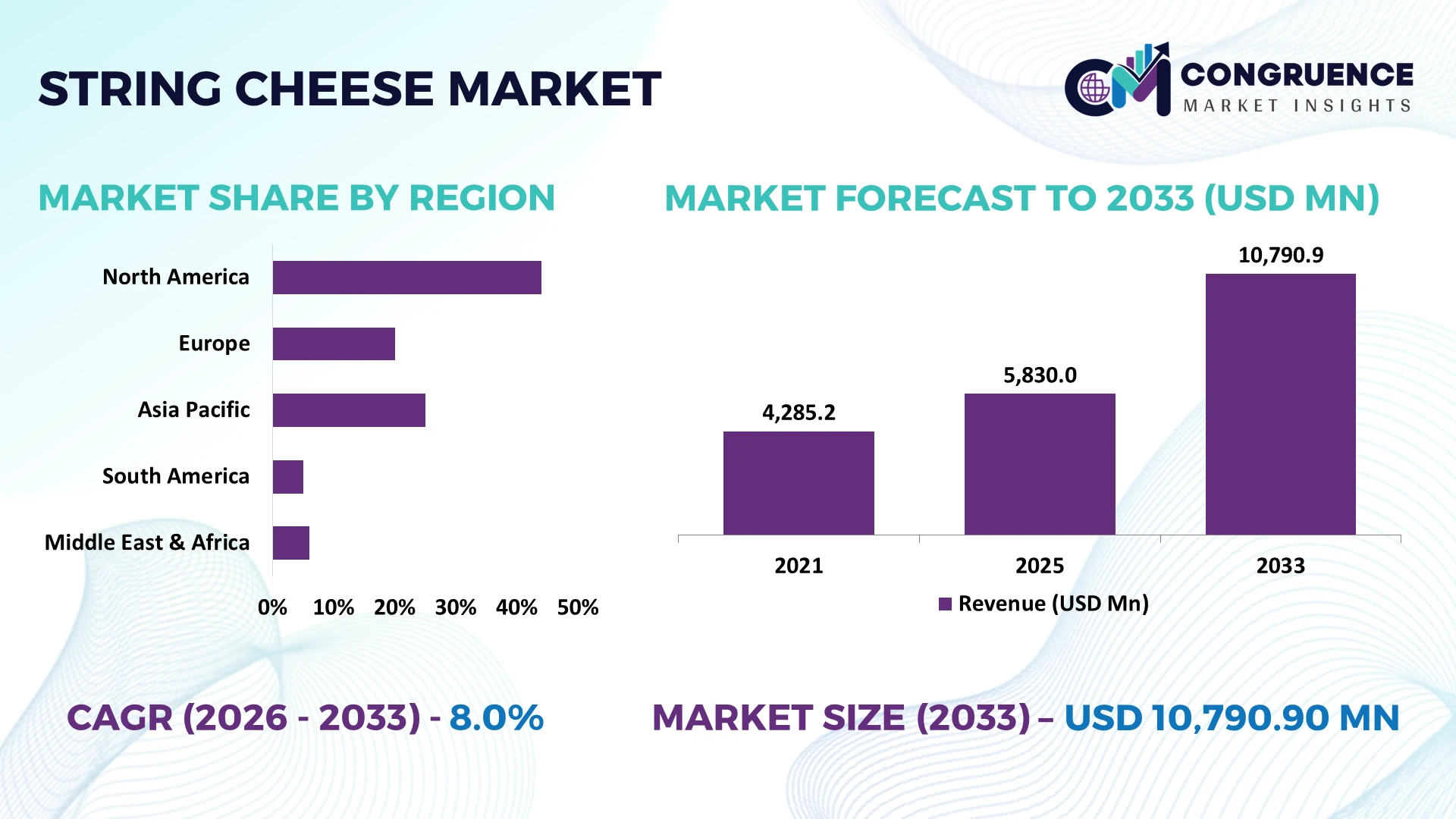
The Global String Cheese Market was valued at USD 5830 Million in 2025 and is anticipated to reach a value of USD 10790.9 Million by 2033 expanding at a CAGR of 8% between 2026 and 2033. Growth is driven by individually wrapped mozzarella snacks, automated cheese stretching and portioning, expanding refrigerated convenience food distribution, and protein focused product innovation.
The United States leads industrial string cheese manufacturing, supported by approximately 102.6 billion pounds of annual milk production in Wisconsin and California combined during 2024, representing nearly 46% of national output. Wisconsin produced approximately 3.5 billion pounds of cheese, strengthening mozzarella processing infrastructure. Leprino Foods, Saputo, and Lactalis operate established dairy manufacturing networks, while automated extrusion and packaging support individually portioned products. Compared with Italy's traditional mozzarella industry, American manufacturers emphasize standardized snack formats and large scale refrigerated retail distribution.
Strategically, manufacturers should prioritize automated mozzarella processing, reliable milk procurement, and refrigerated snack distribution to strengthen competitiveness across established and emerging dairy markets.
Market Size & Growth: USD 5,830 million in 2025, reaching USD 10,790.9 million by 2033 at 8% CAGR, supported by portioned mozzarella snack production.
Top Growth Drivers: Three estimated demand influences include protein snacking at 35%, convenient packaging at 30%, and refrigerated retail expansion at 25%.
Short-Term Forecast: By 2027, projected market expansion reaches approximately 16.6% against 2025, strengthening processing capacity requirements.
Emerging Technologies: Three innovations include automated cheese stretching, AI quality inspection, and precision portioning for consistent snack dimensions.
Regional Leaders: Illustrative 2033 allocations place North America at USD 4,532.18 million, Europe at USD 2,805.63 million, and Asia Pacific at USD 2,589.82 million.
Consumer/End-User Trends: A typical 28 gram mozzarella string cheese serving provides approximately 6–8 grams of protein, supporting portion controlled snacking.
Pilot/Case Example: In 2024, automated cheese portioning targeting 2% lower product giveaway demonstrated the potential value of precision weight control.
Competitive Landscape: Lactalis, Saputo, Leprino Foods, Bel Brands, and Sargento compete through branded distribution; verified global leader share remains unavailable.
Regulatory & ESG Impact: United States mozzarella standards require minimum 45% milkfat in dry matter for whole milk mozzarella, influencing formulation compliance.
Investment & Funding: A verified global investment total is unavailable; capital allocation prioritizes 3 areas: processing automation, packaging equipment, and refrigerated distribution.
Innovation & Future Outlook: Three priorities shape advanced string cheese production: high protein positioning, recyclable packaging, and automated quality monitoring.
The Global String Cheese Market encompasses individually portioned mozzarella snacks distributed through supermarkets, convenience stores, educational foodservice, and refrigerated online grocery channels. Manufacturers increasingly emphasize consistent texture, convenient packaging, and protein content to differentiate products. A standard 28 gram serving commonly supplies approximately 6–8 grams of protein, reinforcing its position within portable dairy snacks. Automated stretching, cooling, and packaging systems improve production consistency, while reduced plastic packaging formats attract development investment. United States dairy processors benefit from established milk supply networks, although refrigeration requirements influence distribution economics. These developments strengthen the strategic importance of processing efficiency and differentiated product positioning.
The String Cheese Market is becoming strategically important as dairy manufacturers compete for refrigerated snack distribution, institutional foodservice contracts, and protein focused consumer purchases. Wisconsin produced approximately 3.5 billion pounds of cheese in 2024, demonstrating the manufacturing scale supporting American mozzarella processing. Retailers increasingly prioritize individually wrapped portions, standardized nutrition, and dependable refrigerated delivery. This shift is encouraging processors to integrate milk procurement, cheese manufacturing, and automated packaging rather than relying on conventional bulk cheese distribution.
Automated extrusion and precision cutting offer operational advantages over manual portioning. A targeted 2% reduction in product giveaway preserves approximately 20 kilograms of cheese per metric ton packaged. American processors emphasize high volume snack production, while Italian manufacturers retain stronger specialization in traditional mozzarella formats. Between 2026 and 2028, investment priorities will increasingly include machine vision inspection, automated packaging, and digital temperature monitoring to improve production consistency and distribution reliability.
Saputo, Lactalis, and Sargento operate established cheese manufacturing and branded distribution networks. Practical deployment involves integrating continuous mozzarella stretching, controlled cooling, and individual wrapping into coordinated production lines. Manufacturers achieving consistent texture, accurate portion weights, and dependable refrigerated fulfillment will strengthen retailer relationships and defend competitive positioning.
Protein focused snacking is strengthening demand for individually portioned mozzarella string cheese across supermarkets, convenience stores, and institutional foodservice channels. A typical 28 gram serving provides approximately 6–8 grams of protein, equivalent to roughly 12%–16% of a 50 gram daily reference intake. Standard whole milk mozzarella contains at least 45% milkfat in dry matter under United States identity requirements, supporting consistent formulation standards. Retailers increasingly favor convenient dairy snacks with predictable portion sizes and nutritional labeling. Lactalis, Saputo, and Sargento are strengthening branded cheese assortments, packaging capabilities, and refrigerated distribution partnerships. Manufacturers that combine standardized protein content with dependable product availability gain stronger access to recurring retail and school foodservice procurement.
String cheese manufacturers face structural exposure to milk procurement conditions, processing energy requirements, and refrigerated distribution expenses. California and Wisconsin together contribute approximately 46% of United States milk production, concentrating significant dairy manufacturing capacity within established production regions. Whole milk mozzarella standards require at least 45% milkfat in dry matter, limiting formulation flexibility when milk component prices fluctuate. Refrigerated cheese distribution generally requires temperatures at or below 4°C, increasing dependence on continuous cooling infrastructure. Weather disruptions, dairy herd health conditions, and transportation interruptions affect raw material availability and delivery schedules. Saputo, Lactalis, and regional processors manage these constraints through diversified milk procurement, longer term supplier agreements, and geographically distributed processing operations. Supply security remains essential for maintaining consistent production economics.
Precision processing and differentiated dairy formulations create opportunities for string cheese manufacturers to improve material utilization and expand specialized snack offerings. Automated cutting systems targeting a 2% reduction in product giveaway preserve approximately 20 kilograms per metric ton packaged. Machine vision inspection targeting 99% dimensional conformity can strengthen retailer specification compliance, although actual performance depends on equipment validation. Reduced fat mozzarella formulations must meet applicable compositional and labeling requirements, creating opportunities for differentiated nutrition positioning. India's expanding organized refrigerated retail infrastructure supports potential distribution of individually wrapped cheese snacks. Manufacturers including Lactalis and Saputo are positioned to develop specialized formulations, compact packaging, and automated production capabilities. The strongest opportunity lies in combining nutritional differentiation with precise manufacturing control and efficient cold chain deployment.
Scaling string cheese manufacturing requires precise coordination of mozzarella stretching, moisture control, cooling, cutting, and individual wrapping. Conventional mozzarella standards specify maximum moisture content of 52% for whole milk mozzarella, making formulation and processing control essential for consistent product performance. A production line targeting 99% package integrity still permits up to 1% defective packages, demonstrating the importance of inspection accuracy at industrial scale. Automated systems must accommodate variation in milk composition, cheese elasticity, and cooling behavior without compromising peelable texture. American processors also face evolving packaging requirements and increasing expectations for recyclable materials. Lactalis, Saputo, and specialized manufacturers must strengthen process monitoring, equipment integration, and packaging validation. Sustainable competitiveness depends on maintaining consistent sensory quality while increasing automated production throughput.
Retailers Expand Multipack Cheese Formats: American supermarkets increasingly merchandise individually wrapped string cheese in 12 and 24 count multipacks, supporting household replenishment and predictable inventory turnover. Manufacturers are coordinating packaging configurations with retailer shelf capacity and promotional calendars. Lactalis and Sargento maintain diversified pack sizes, improving distribution flexibility while reducing the frequency of individual purchasing decisions.
Refrigerated Distribution Gains Digital Visibility: Dairy processors are integrating temperature sensors and electronic shipment records into refrigerated transportation. Cheese distribution commonly targets temperatures between 0°C and 4°C, while continuous monitoring identifies excursions before product delivery. Saputo and other integrated manufacturers prioritize temperature controlled logistics, improving shipment accountability and reducing exposure to quality deterioration during extended distribution routes.
School Nutrition Standards Influence Product Specifications: Updated United States school meal standards establish sodium reduction targets of 10% for breakfast and 15% for lunch by July 2027. Cheese suppliers serving institutional procurement are reviewing sodium content, nutrition labeling, and portion specifications. Manufacturers are adjusting product formulations and packaging documentation to maintain eligibility for regulated school meal programs.
Milk Component Management Shapes Production Planning: Wisconsin produced approximately 3.5 billion pounds of cheese in 2024, demonstrating substantial manufacturing concentration. String cheese processors increasingly coordinate mozzarella production with milk protein and fat availability. Standard whole milk mozzarella requires at least 45% milkfat in dry matter. Dairy manufacturers are strengthening component testing and production scheduling to improve batch consistency and manage ingredient variability.
Mozzarella String Cheese represents the leading segment, with an indicative market share of approximately 65% in 2025. Its dominance reflects established manufacturing infrastructure, recognizable peelable texture, and extensive refrigerated supermarket distribution. Conventional mozzarella processing supports continuous stretching, cooling, and portioning, enabling standardized snack production. Cheddar String Cheese holds an estimated 17%, supported by consumers seeking stronger cheese flavors and differentiated snack assortments. Colby-Jack String Cheese contributes approximately 10%, offering blended flavor profiles and product variety. Lactalis, Saputo, and Sargento maintain competitive positions through branded mozzarella products, packaging differentiation, and established retail relationships.
Low-Fat String Cheese represents the fastest growing type, with an indicative 8% market contribution. Its expansion reflects demand for portion controlled dairy snacks with modified nutritional profiles. A standard 28 gram mozzarella string cheese serving commonly provides 6–8 grams of protein, supporting nutritional positioning across conventional and reduced fat variants. Manufacturers are refining milk composition, moisture control, and stretching parameters to preserve texture. Investment increasingly targets formulation development, specialized packaging, and consistent refrigerated product quality.
Snacking represents the leading application, accounting for an indicative 68% of the global String Cheese Market in 2025. Its dominance reflects widespread utilization of individually wrapped cheese portions in household snacks, lunchboxes, and refrigerated convenience food assortments. Foodservice accounts for approximately 14%, supported by commercial kitchens and organized catering operations requiring standardized cheese portions. Manufacturers benefit from predictable packaging specifications and consistent product dimensions, enabling efficient retail distribution. Lactalis and Sargento are strengthening branded snack assortments, while Saputo supports diversified cheese manufacturing and commercial distribution. Snacking retains the strongest product identity because peelable cheese formats are specifically designed for convenient individual consumption.
Ready-to-Eat Meals represents the fastest growing application, supported by expanding refrigerated meal kits and protein focused prepared food formats. Bakery and Pizza applications account for a smaller specialized segment, where string cheese is used in stuffed crust products and portion controlled fillings. Industrial buyers prioritize consistent melting characteristics, moisture control, and predictable ingredient performance. Manufacturers are developing customized cheese dimensions and packaging formats to support commercial food production and specialized meal assembly.
Households represent the leading end user segment, accounting for an indicative 64% of global String Cheese Market demand in 2025. Their dominance reflects established supermarket purchasing, individually wrapped product convenience, and recurring refrigerated snack consumption. Schools and Institutions contribute an estimated 18%, supported by organized meal programs and standardized portion requirements. Household buyers prioritize familiar flavors, nutritional content, and packaging convenience, while institutional purchasers emphasize food safety documentation and consistent product specifications. Lactalis, Sargento, and Saputo maintain diversified cheese portfolios serving retail and commercial distribution. Multipack offerings strengthen household purchasing frequency, while individually portioned formats simplify institutional meal planning.
Schools and Institutions represent the fastest growing end user category, supported by evolving school nutrition requirements and increasing emphasis on standardized dairy portions. Restaurants and QSRs utilize string cheese in selected menu preparations, while Food Manufacturers incorporate it into prepared snacks and specialty food products. United States school meal regulations introduce sodium reduction requirements of 10% for breakfast and 15% for lunch by July 2027. Manufacturers are reviewing formulation specifications and strengthening institutional distribution partnerships to maintain procurement eligibility.
North America accounted for the largest market share at an estimated 42% in 2025 however, Asia-Pacific is expected to register the fastest growth, expanding at an estimated CAGR of 10.2% between 2026 and 2033.

Established Dairy Infrastructure Supports Packaged Snack Leadership
North America represents an estimated 42% of the global String Cheese Market, supported by extensive mozzarella manufacturing capacity, established refrigerated distribution, and strong supermarket penetration. The United States dominates regional production through Wisconsin and California, which maintain substantial milk processing and cheese manufacturing infrastructure. Lactalis, Saputo, Sargento, and Leprino Foods participate in industrial cheese production and distribution, supporting differentiated dairy product portfolios. Individually wrapped mozzarella sticks commonly contain approximately 28 grams per serving, enabling standardized packaging and nutritional labeling. Canadian processors contribute through established dairy manufacturing facilities and regulated milk procurement systems. Manufacturers increasingly emphasize automated stretching, continuous cooling, and packaging consistency to maintain high volume retail supply. Regional investment priorities include production efficiency, refrigerated logistics optimization, and differentiated snack formats targeting household and institutional purchasing.
United States Market Outlook: The United States maintains a competitive advantage through extensive dairy manufacturing infrastructure and established branded cheese distribution. Wisconsin produced approximately 3.5 billion pounds of cheese during 2024, reinforcing its importance in domestic processing. Sargento and other cheese manufacturers benefit from proximity to milk suppliers and refrigerated transportation networks. Automated mozzarella extrusion, portioning, and packaging support consistent snack production, while school foodservice procurement provides an additional distribution channel.
Dairy Product Diversification Strengthens Snack Manufacturing
Europe represents an estimated 26% of the global String Cheese Market, supported by established dairy processing infrastructure, organized refrigerated retail distribution, and product diversification across cheese manufacturing. Germany, France, Italy, and the United Kingdom maintain significant dairy production and packaging capabilities. European Union milk production exceeds 150 million metric tons annually, providing substantial raw material availability for industrial cheese manufacturing. Lactalis, Arla Foods, and Bel Group operate extensive dairy processing and distribution networks, supporting branded cheese snacks and convenient dairy formats. European manufacturers increasingly emphasize portion controlled products, packaging efficiency, and nutritional transparency. Regulation governing dairy composition, food labeling, and packaging materials influences product development and manufacturing specifications. Investment priorities include automated packaging, differentiated cheese formulations, and refrigerated distribution systems capable of supporting convenient dairy snacks across multiple national retail markets.
Germany Market Outlook: Germany benefits from extensive milk production, industrial cheese processing infrastructure, and established supermarket distribution networks. The country produces more than 30 million metric tons of milk annually, supporting substantial dairy manufacturing capacity. German processors maintain advanced quality control and packaging systems, enabling standardized refrigerated products. Manufacturers increasingly target convenient cheese snacks through specialized product formats, controlled portion sizes, and retailer partnerships, while European Union food safety requirements support consistent manufacturing practices.
Refrigerated Retail Expansion Enables Dairy Snack Adoption
Asia-Pacific represents an estimated 24% of the global String Cheese Market, supported by expanding dairy processing infrastructure, modern grocery distribution, and increasing availability of packaged cheese products. Japan, China, Australia, and India maintain distinct dairy manufacturing and consumption patterns. Japan has an established market for individually portioned cheese snacks, while China is expanding refrigerated dairy distribution through supermarkets and convenience stores. Australia's annual milk production exceeds 8 billion liters, supporting domestic cheese manufacturing and export capabilities. Companies including Fonterra, Bega Group, and regional dairy processors participate in cheese production and specialized dairy distribution. Manufacturers are adapting portion sizes, flavor profiles, and packaging formats to local purchasing preferences. Regional investment increasingly targets cold storage infrastructure, automated packaging, and partnerships with organized retail operators to improve product accessibility and distribution efficiency.
Japan Market Outlook: Japan maintains a developed refrigerated convenience retail infrastructure supporting individually packaged cheese snacks. Major convenience store chains operate tens of thousands of outlets nationwide, providing established distribution access for portion controlled dairy products. Domestic manufacturers including Megmilk Snow Brand and Morinaga Milk Industry operate extensive dairy processing networks. Product development emphasizes compact packaging, consistent texture, and convenient consumption formats suited to urban retail purchasing patterns.
Regional Dairy Processing Supports Product Diversification
South America represents an estimated 5% of the global String Cheese Market, supported by established dairy production in Brazil, Argentina, and Uruguay. Brazil maintains extensive milk production infrastructure, with annual output exceeding 30 billion liters, providing substantial raw material availability for cheese manufacturing. Traditional mozzarella products dominate many domestic cheese applications, while individually portioned string cheese remains a specialized retail category. Dairy processors are evaluating convenient cheese snack formats through existing manufacturing and refrigerated distribution networks. Argentina contributes through established mozzarella processing capabilities and organized dairy manufacturing operations. Refrigerated transportation costs, uneven cold storage availability, and consumer familiarity with conventional cheese formats influence expansion decisions. Manufacturers prioritize localized packaging, retailer partnerships, and product differentiation to strengthen adoption without requiring extensive new processing infrastructure.
Brazil Market Outlook: Brazil maintains a substantial dairy manufacturing industry supported by milk production clusters in Minas Gerais, Paraná, and Rio Grande do Sul. Established processors manufacture mozzarella and other cheese varieties for retail and foodservice distribution. Individually wrapped cheese snacks represent an opportunity for product diversification within organized supermarket channels. Manufacturers benefit from existing pasteurization, cheese processing, and refrigerated transportation infrastructure, although packaging costs and consumer price sensitivity influence commercial positioning.
Dairy Processing Localization Strengthens Snack Distribution
The Middle East and Africa represent an estimated 3% of the global String Cheese Market, supported by expanding dairy manufacturing infrastructure, organized supermarket networks, and refrigerated food distribution. Saudi Arabia, the United Arab Emirates, and South Africa maintain established dairy processing and packaged food industries. Saudi Arabia's domestic dairy sector benefits from integrated production operations and substantial investment in refrigerated logistics. Almarai operates extensive dairy manufacturing and distribution infrastructure, supporting opportunities for convenient cheese snack diversification. South African processors maintain established cheese manufacturing capabilities serving supermarkets and institutional foodservice channels. Regional adoption remains influenced by refrigeration availability, product pricing, and consumer familiarity with individually portioned cheese formats. Manufacturers increasingly prioritize localized processing, reliable cold storage, and partnerships with modern retail operators to strengthen product accessibility.
Saudi Arabia Market Outlook: Saudi Arabia maintains advanced integrated dairy manufacturing infrastructure supported by companies including Almarai and SADAFCO. Domestic dairy processors benefit from established refrigerated distribution networks serving supermarkets and convenience retailers. Food safety oversight by the Saudi Food and Drug Authority supports standardized processing and labeling requirements. Individually portioned cheese products offer manufacturers an opportunity to diversify convenient dairy assortments through existing production, packaging, and distribution capabilities.
The global String Cheese Market features competition between multinational dairy processors, branded snack specialists, and regional cheese manufacturers. Lactalis, Saputo, Sargento, Bel Group, and Leprino Foods compete through manufacturing scale, product differentiation, refrigerated distribution, and retailer relationships. Their combined global string cheese share remains unverified; an estimated concentration percentage cannot be established reliably without comparable product specific disclosures. North America accounts for an estimated 42% of demand, while Europe represents approximately 26%, concentrating competition within established dairy processing markets. Mozzarella String Cheese holds an indicative 65% segment share, reinforcing the importance of specialized stretching and portioning capabilities. Lactalis and Saputo leverage integrated processing networks, while Sargento emphasizes branded differentiation and retail merchandising. Manufacturers are strengthening automated packaging, nutrition focused formulations, and distribution partnerships. Milk procurement concentration, refrigeration requirements, and retailer shelf access create significant entry barriers. Competitive success requires consistent texture, efficient manufacturing, differentiated packaging, and dependable refrigerated fulfillment.
Lactalis Group
Saputo Inc.
Sargento Foods Inc.
Leprino Foods Company
Bel Group
Arla Foods amba
Fonterra Co-operative Group Limited
Bega Group Limited
Schreiber Foods Inc.
Dairy Farmers of America, Inc.
Megmilk Snow Brand Co., Ltd.
Morinaga Milk Industry Co., Ltd.
Almarai Company
Savencia Fromage & Dairy
Current string cheese manufacturing relies on continuous mozzarella stretching, controlled cooling, automated cutting, and individual wrapping. Integrated processing lines maintain consistent moisture, elasticity, and portion dimensions across industrial production. Precision weighing systems targeting 2% lower product giveaway preserve approximately 20 kilograms per metric ton packaged. Compared with conventional manual portioning, automated cutting can target 15% higher throughput, subject to equipment configuration and production validation.
Emerging technologies include machine vision inspection, digital moisture monitoring, and intelligent refrigeration controls. Optical inspection systems targeting 99% dimensional conformity help manufacturers identify irregular portions before packaging. Automated temperature monitoring supports refrigerated distribution between 0°C and 4°C, reducing quality deterioration risks. Lactalis, Saputo, and Sargento benefit from integrating these technologies with established dairy processing and distribution infrastructure. Deployment priorities increasingly emphasize continuous production monitoring rather than isolated equipment upgrades.
Disruptive technologies include artificial intelligence guided process optimization, predictive maintenance, and advanced recyclable packaging materials. Between 2026 and 2028, manufacturers will prioritize connected production systems that coordinate stretching conditions, cooling performance, and packaging integrity. A targeted 5% reduction in refrigeration energy consumption would strengthen operating efficiency. Companies achieving validated quality improvements, dependable equipment utilization, and consistent product texture will gain advantages in competitive retail procurement.
March 2024: Sargento introduced 2 string cheese flavors, Fiesta Pepper and Smokehouse, combining mozzarella with spicy and smoky profiles. The launch expanded its refrigerated snack assortment nationwide, strengthening flavor differentiation and consumer choice within established retail dairy distribution channels. Source: sargentofoods.com.
May 2024: Saputo USA introduced whole milk Frigo Cheese Heads string cheese in 12 count packages, delivering 5 grams of protein per serving. Redesigned character packaging accompanied the launch, strengthening product recognition and differentiation across refrigerated retail snack assortments. Source: dairyprocessing.com.
October 2025: Saputo USA expanded Frigo Cheese Heads Snack Sticks with Sharp Cheddar and Pepper Jack varieties in 12 count packs. The portfolio expansion increased flavor selection and package availability, supporting household sharing occasions and broader refrigerated retail merchandising opportunities. Source: prnewswire.com.
June 2026: BelGioioso Cheese announced Polly-O Oaxaca String Cheese in a 10 ounce package alongside its specialty cheese innovations. The introduction extends traditional Oaxaca cheese into portable snack formats, supporting product diversification and additional merchandising opportunities within refrigerated retail dairy assortments. Source: specialtyfood.com.
The String Cheese Market Report examines production infrastructure, consumer purchasing patterns, product innovation, and competitive positioning between 2026 and 2033. Type segmentation covers Mozzarella String Cheese, Cheddar String Cheese, Colby-Jack String Cheese, and Low-Fat String Cheese. Application analysis includes Snacking, Foodservice, Bakery and Pizza, and Ready-to-Eat Meals. End user assessment evaluates Households, Restaurants and QSRs, Schools and Institutions, and Food Manufacturers, highlighting procurement requirements and product differentiation opportunities.
Regional coverage spans North America, Europe, Asia Pacific, South America, and the Middle East and Africa. North America's indicative 42% market share establishes a benchmark for manufacturing concentration. Technology assessment covers automated stretching, precision cutting, machine vision inspection, and intelligent refrigeration. The report supports processing investment, geographic expansion, product portfolio planning, and competitive strategy across established and emerging dairy snack markets.
| Report Attribute/Metric | Report Details |
|---|---|
Market Revenue in 2025 | USD 5830 Million |
Market Revenue in 2033 | USD 10790.9 Million |
CAGR (2026 - 2033) | 8% |
Base Year | 2025 |
Forecast Period | 2026 - 2033 |
Historic Period | 2021 - 2025 |
Segments Covered | By Type
By Application
By End-User
|
Key Report Deliverable | Revenue Forecast, Growth Trends, Market Dynamics, Segmental Overview, Regional and Country-wise Analysis, Competition Landscape |
Region Covered | North America, Europe, Asia-Pacific, South America, Middle East, Africa |
Key Players Analyzed | Lactalis Group, Saputo Inc., Sargento Foods Inc., Leprino Foods Company, Bel Group, Arla Foods amba, Fonterra Co-operative Group Limited, Bega Group Limited, Schreiber Foods Inc., Dairy Farmers of America, Inc., Megmilk Snow Brand Co., Ltd., Morinaga Milk Industry Co., Ltd., Almarai Company, Savencia Fromage & Dairy |
Customization & Pricing | Available on Request (10% Customization is Free) |




