
Reports
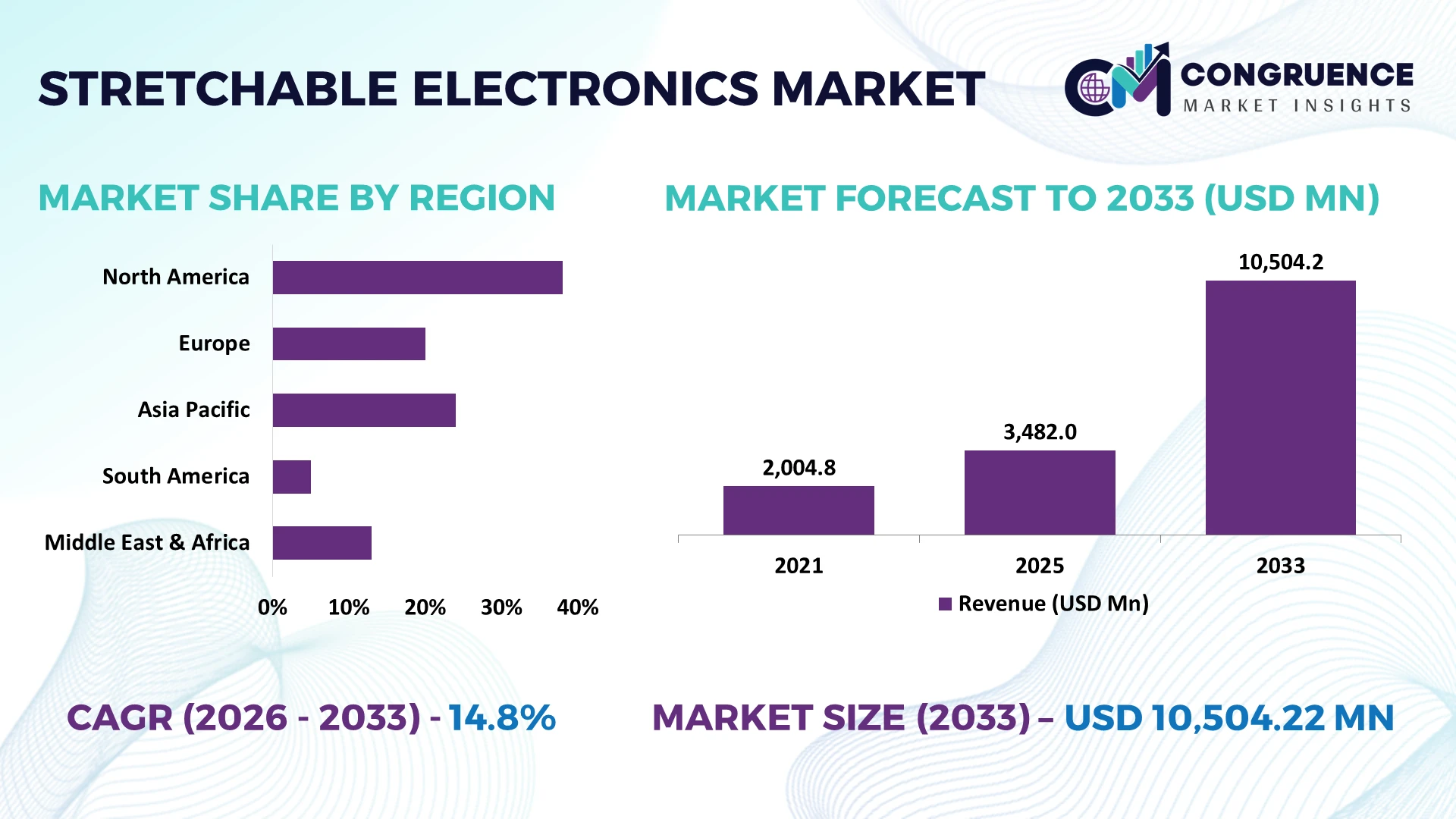
The Global Stretchable Electronics Market was valued at USD 3482 Million in 2025 and is anticipated to reach a value of USD 10504.22 Million by 2033 expanding at a CAGR of 14.8% between 2026 and 2033. Growth is being accelerated by skin conformable medical sensors, flexible bioelectronic patches, wearable health monitoring, soft robotics, and conductive elastomers that maintain electrical performance during repeated deformation.
The United States represents a dominant innovation and commercialization base, supported by semiconductor research, digital health adoption, defense electronics, and advanced wearable development. North America accounts for more than 35% of global semiconductor research and development spending, strengthening access to materials, fabrication expertise, and intellectual property. US health systems are also integrating continuous wearable sensing into remote monitoring programs, while South Korea and Japan retain stronger positions in advanced display manufacturing. US CHIPS Act investments exceeding USD 50 billion reinforce domestic semiconductor infrastructure and reduce exposure to Asian electronics supply concentration.
For manufacturers and investors, competitive advantage increasingly depends on integrating stretchable materials, scalable fabrication, medical validation, and semiconductor supply partnerships before high volume wearable and healthcare applications mature.
Market Size & Growth: USD 3.482 billion in 2025 advances to USD 10.504 billion by 2033 at 14.8% CAGR, supported by wearable biosensors and conformable medical electronics.
Top Growth Drivers: Wearable healthcare contributes an estimated 35% of demand momentum, advanced sensors 28%, and flexible displays and interfaces 22%.
Short Term Forecast: By 2028, printed conductive architectures are positioned to reduce material utilization by 15% while improving manufacturing throughput by 20%.
Emerging Technologies: Liquid metal conductors, conductive elastomers, and self healing electronic materials are targeting stretchability above 100% without sacrificing continuous electrical pathways.
Regional Leaders: North America, Asia Pacific, and Europe remain commercialization centers, with projected 2033 values near USD 3.6 billion, USD 4.0 billion, and USD 2.1 billion respectively.
Consumer and End User Trends: Healthcare and wearable applications represent more than 40% of commercial opportunities as continuous physiological monitoring shifts electronics toward skin compatible formats.
Pilot and Case Example: In 2024, researchers demonstrated stretchable electronic platforms capable of maintaining functionality beyond 100% strain, supporting movement intensive wearable and robotic applications.
Competitive Landscape: Samsung Electronics holds a significant intellectual property and commercialization position, alongside Panasonic, DuPont, Henkel, and 3M across materials, displays, adhesives, and electronic integration.
Regulatory & ESG Impact: European electronics policy targets 65% collection of electrical and electronic equipment placed on the market, increasing design pressure around material recovery and product lifecycle management.
Investment & Funding: More than USD 50 billion in US CHIPS Act semiconductor incentives strengthens domestic fabrication infrastructure relevant to advanced sensors, packaging, and next generation electronic systems.
Innovation & Future Outlook: Stretchability exceeding 100%, integrated biosensing, and scalable printed fabrication are shifting the global market from laboratory prototypes toward manufacturable healthcare, robotics, and human machine interfaces.
The Stretchable Electronics Market is increasingly shaped by continuous health monitoring, electronic skin, soft robotics, smart textiles, and conformable human machine interfaces. Conductive elastomers, liquid metals, printable circuits, and self healing materials are improving mechanical durability while enabling electronics to operate under more than 100% strain in advanced designs. Healthcare remains a central demand area as manufacturers integrate sensing directly into skin compatible patches and wearable platforms. Semiconductor localization initiatives are simultaneously strengthening regional fabrication resilience, making scalable manufacturing, material compatibility, and validated device performance central to the next strategic phase.
Stretchable electronics is becoming strategically important because medical wearables, electronic skin, soft robotics, and human machine interfaces increasingly require circuits that tolerate deformation without losing sensing performance. The shift from rigid assemblies toward conformable architectures is redirecting investment into liquid metal conductors, conductive elastomers, stretchable semiconductors, and printed fabrication. US semiconductor localization, reinforced by more than USD 50 billion in CHIPS Act incentives, is also encouraging developers to shorten electronics supply chains and establish closer material, fabrication, and packaging partnerships.
Technologically, additive printed circuitry can reduce material waste by 20% to 30% compared with subtractive fabrication while enabling thinner, application specific geometries. The United States leads biomedical and defense commercialization, while South Korea and Japan provide deeper display and high volume electronics manufacturing capabilities. China combines extensive electronics production infrastructure with expanding flexible device research. Through 2028, commercial development will increasingly target devices sustaining 50% to 100% strain while maintaining repeatable electrical performance.
A practical pathway is the integration of stretchable electrode arrays into skin mounted patches for continuous electrophysiological monitoring, reducing dependence on bulky wired interfaces. Materials suppliers, semiconductor companies, medical device developers, and research institutions are consequently forming joint development programs around scalable printing, encapsulation, and biocompatibility. Competitive positioning will depend on converting mechanical flexibility into validated manufacturing yield, reliable sensing, and repeatable high volume production.
Healthcare digitization is the strongest structural driver as continuous monitoring shifts sensing from episodic equipment toward skin conformable electronics. Wearable devices can capture physiological information across more than 90% of a patient's daily routine outside clinical settings, while advanced stretchable architectures can tolerate strains exceeding 50% in movement intensive applications. Printed fabrication can reduce functional material consumption by 20% to 30% compared with conventional subtractive processing. In the United States, remote patient monitoring reimbursement and expanding digital care infrastructure are strengthening the commercial pathway for biosensor patches. Device developers are responding through partnerships with materials specialists, semiconductor suppliers, and healthcare organizations to improve biocompatibility, signal stability, and manufacturability. The strategic advantage lies in owning validated sensor platforms that combine continuous data capture with comfortable long duration wear.
Commercial scaling remains constrained by specialized conductive materials, multilayer encapsulation requirements, and manufacturing yields that remain less predictable than established rigid electronics processes. Stretchable conductors can require 20% to 40% higher processing complexity when additional patterning, encapsulation, and mechanical reliability steps are incorporated, while prototype to production yield losses can exceed 15% for immature architectures. Dependence on silver based inks and specialized polymers also exposes producers to input price fluctuations and geographically concentrated chemical supply chains. Japan and South Korea possess sophisticated electronics manufacturing ecosystems, but transferring laboratory processes into continuous production remains capital intensive. Manufacturers are reducing exposure by qualifying multiple conductive materials, adopting roll compatible printing, simplifying layer structures, and securing longer supplier agreements. Controlling yield variation matters more strategically than minimizing individual material prices because rejected multilayer devices compound total manufacturing losses.
Electronic skin creates an attractive expansion pathway beyond conventional wearables by combining pressure, temperature, strain, and biochemical sensing within deformable surfaces. Advanced laboratory systems already demonstrate stretchability above 100%, while printed manufacturing techniques can reduce material waste by more than 20% compared with subtractive circuit formation. Soft robotic platforms can require dozens of distributed sensing points, creating demand for integrated sensor arrays rather than isolated components. Japan's robotics ecosystem provides a particularly relevant commercialization environment as manufacturers pursue safer human robot interaction and dexterous automation. Developers are increasing research investment in self healing polymers, liquid metal interconnects, multimodal sensors, and wireless power integration. A less obvious opportunity lies in supplying standardized stretchable sensor modules to robotics manufacturers, allowing component specialists to capture recurring platform demand without developing complete robotic systems themselves.
Long term reliability is the critical execution challenge because laboratory stretchability does not automatically translate into millions of mechanically stable operating cycles. Devices experiencing 50% or greater strain must preserve conductivity, adhesion, encapsulation integrity, and sensor calibration simultaneously, while even 5% signal drift can undermine precision healthcare applications. Multimaterial interfaces create additional failure points because conductive inks, elastomers, adhesives, and semiconductor islands respond differently to repeated bending and stretching. Germany's medical technology manufacturers also face stringent validation requirements when flexible sensors enter regulated diagnostic workflows. Companies must invest in accelerated fatigue testing, digital simulation, standardized interconnect architectures, and partnerships between materials engineers and device manufacturers. Competitive differentiation will increasingly depend on cycle life and calibration stability rather than maximum laboratory stretchability, making reliability engineering central to sustainable commercial deployment.
Hybrid Architectures Replace Maximum Stretchability: Device engineering is shifting from extreme elongation toward application specific strain tolerance and electrical stability. Academic prototypes often exceed 100% elongation, although practical healthcare and industrial use typically requires substantially lower deformation. Developers are combining rigid semiconductor islands with elastic interconnects, concentrating investment on repeatable conductivity, thinner encapsulation, and manufacturable geometries rather than record strain performance.
Transparent Electrodes Gain Functional Density: Inkjet printed metal grid hybrids are improving the performance balance between transparency, conductivity, and deformation. A 2025 electrode architecture achieved 84.8% optical transmittance and sheet resistance of 29.9 ohms per square while supporting wireless multimodal sensing. Electronics developers are integrating these structures into touch interfaces and skin sensors, reducing the need for separate sensing and display layers.
Clinical Data Integration Becomes Priority: US wearable usage increased from 30.2% in 2020 to 41.1% in 2024, yet clinician data sharing remained only 14.2% to 19.2%. This integration gap is redirecting product development toward interoperable sensor platforms, standardized data pipelines, and clinically actionable outputs. Medical electronics companies are consequently partnering with digital health platforms rather than optimizing hardware performance independently.
Self Repairing Materials Enter Development: Stretchable systems are moving toward recyclable and self healing substrates as device longevity becomes commercially important. Liquid metal and reversible polymer architectures introduced during 2025 target repairable strain sensing instead of disposable assemblies. Developers are redesigning conductive pathways and polymer interfaces to recover functionality after mechanical damage, potentially lowering replacement frequency while strengthening lifecycle performance in smart textiles and soft machines.
Stretchable Conductors represent the leading type, accounting for an estimated 30% of market activity because every deformable electronic architecture requires mechanically compliant electrical pathways. Their position reflects broad integration across sensors, circuits, displays, and power components rather than dependence on one application. Metal nanowires, conductive polymers, liquid metals, and engineered metal grids increasingly provide conductivity under repeated deformation. Stretchable Sensors follow with an estimated 25% share and are becoming the fastest expanding type as physiological monitoring, electronic skin, and robotic tactile sensing require distributed measurement across curved surfaces.
Stretchable Displays remain strategically important for conformable visual interfaces, while Stretchable Circuits connect sensing, processing, and communication components within integrated systems. Stretchable Batteries represent a smaller but increasingly critical segment because conventional rigid power sources restrict fully deformable device architectures. Current research priorities therefore extend beyond isolated component performance toward system compatibility. Materials companies are developing conductive inks and elastomers, while electronics manufacturers are strengthening partnerships around printing, encapsulation, interconnect reliability, and integrated sensor fabrication. Investment is consequently shifting toward platforms that combine conductivity, strain tolerance, and scalable processing.
Wearable Electronics constitutes the leading application, representing an estimated 35% of Stretchable Electronics Market demand as manufacturers move sensing functions closer to skin, clothing, and continuously moving body surfaces. Healthcare Monitoring follows closely because conformable electrodes can capture electrophysiological and biomechanical signals without the mechanical mismatch associated with rigid devices. Flexible Displays retain established consumer interface relevance, whereas Human Machine Interfaces increasingly combine multimodal sensing with gesture and touch recognition. In the United States, wearable device use reached 41.1% of adults in 2024, establishing a substantial installed base for advanced conformable technologies.
Soft Robotics is emerging as the fastest developing application because compliant machines require distributed strain, pressure, temperature, and tactile feedback without restricting actuator movement. Smart Textiles provide another integration pathway by embedding sensing and communication functions directly into garments. Companies are therefore moving from individual components toward interconnected sensing surfaces, wireless communication, and edge processing. The operational shift favors suppliers capable of integrating Stretchable Sensors, circuits, power management, and encapsulation into application ready modules rather than selling isolated functional materials.
Consumer Electronics is the largest end user, accounting for an estimated 32% of demand through wearables, advanced interfaces, flexible displays, and emerging body conformable devices. Its advantage comes from established semiconductor procurement, high production volumes, and mature electronics distribution. Healthcare is the fastest expanding buyer group as monitoring shifts toward continuous, unobtrusive sensing. A 2025 US digital health survey found that 46% of respondents owned a wearable, while 57% owned at least one wearable or connected health device, reinforcing the addressable ecosystem for conformable sensing technologies.
Sports and Fitness buyers increasingly require lightweight motion and biometric sensors capable of maintaining contact during intensive movement. Automotive adoption centers on adaptive interiors and Human Machine Interfaces, while Aerospace and Defense prioritizes lightweight sensing, structural conformity, and equipment integrated monitoring. Industrial Automation is developing demand through soft robotics, machine interfaces, and worker monitoring. Suppliers are responding with application specific materials, customized sensor geometries, and joint development partnerships. Competitive investment is shifting toward Healthcare because qualification barriers are higher but validated platforms can support deeper integration into recurring monitoring workflows.
North America accounted for the largest market share at 35.9% in 2025 however, Asia Pacific is expected to register the fastest growth, expanding at a CAGR of 15.35% between 2026 and 2033.
Biomedical Commercialization Drives Deployment
North America maintains the strongest commercialization position through biomedical electronics, wearable sensing, aerospace systems, advanced materials, and soft robotics. The region represents about 35% of global industry activity, with the United States providing the principal concentration of research institutions, medical device developers, semiconductor engineering, and venture backed bioelectronics. Direct business sales account for 64.9% of the North American stretchable electronics for wearables segment, reflecting the technical customization required for conductive materials, sensor architectures, and device integration. US semiconductor localization is also strengthening domestic access to advanced packaging and fabrication infrastructure. Companies are prioritizing biocompatible substrates, mechanically stable interconnects, and integrated sensing platforms rather than standalone materials. This structure favors suppliers capable of moving prototypes through reliability validation and into regulated or industrial production environments.
United States Market Outlook: The United States anchors North American deployment through digital health, defense electronics, medical technology, and university led materials engineering. The country accounted for more than 80% of the North American stretchable electronics for wearables market in 2025. Developers increasingly combine sensor design, advanced packaging, software analytics, and clinical validation, creating a commercialization advantage for vertically coordinated technology partnerships.
Manufacturing Reliability Shapes Commercialization
Europe represents about 25.6% of global stretchable and conformal electronics activity, supported by automotive engineering, medical technology, printed electronics, industrial sensing, and smart textiles. Germany provides an important manufacturing bridge between materials research and industrial implementation through expertise in thermoplastic substrates, printed conductors, electronic textiles, and stretchable circuit boards. Current engineering priorities emphasize production compatible architectures rather than maximum laboratory deformation. Fraunhofer IZM has demonstrated stretchable electronic systems capable of elongation up to 60% while retaining electronic functionality, creating practical pathways for automotive interiors, medical phototherapy, implants, and textile sensors. European developers are also emphasizing lower temperature bonding and biocompatible substrates as sustainability and medical qualification requirements become more important. Suppliers able to combine established electronics processes with stretchable materials gain an advantage by reducing industrial transfer complexity.
Germany Market Outlook: Germany combines automotive manufacturing, medical engineering, printed electronics, and applied materials research. Fraunhofer IZM can fabricate flexible substrates up to 60 by 40 centimeters with conductive structures reaching 10 micrometers line spacing. This capability supports prototype transition into manufacturable sensor patches, electronic textiles, and conformable automotive electronics without requiring entirely separate fabrication ecosystems.
Electronics Scale Accelerates Industrialization
Asia Pacific accounts for about 23% of global stretchable and conformal electronics activity and possesses the strongest manufacturing foundation for scaling displays, sensors, semiconductor components, and wearable devices. China, South Korea, Japan, and Taiwan combine high volume electronics production with advanced materials, display fabrication, robotics, and semiconductor supply chains. Recent technology development includes 200 PPI stretchable automotive displays and integrated sensor displays reaching 500 PPI, demonstrating movement from basic flexible prototypes toward higher density functional surfaces. China provides production scale, South Korea contributes advanced display integration, while Japan maintains substantial materials and precision manufacturing capabilities. Manufacturers are increasingly coordinating substrate development, printing, display engineering, and semiconductor integration within domestic supply ecosystems. This manufacturing depth reduces the distance between laboratory development and volume qualification, giving the region a strong operational advantage as stretchable architectures become more complex.
China Market Outlook: China combines extensive consumer electronics manufacturing with expanding wearable, automotive, display, and sensor production capacity. Within Asia Pacific stretchable electronics for wearables, China represented about 32.1% of activity in 2024. Its strategic advantage lies in connecting component sourcing, electronics assembly, display fabrication, and domestic device demand within a highly concentrated production ecosystem.
Healthcare Demand Meets Import Dependency
South America represents a smaller commercialization base, with Latin America accounting for roughly 5.7% of global stretchable and conformal electronics activity in 2026. Demand is concentrated around wearable health monitoring, sports technology, consumer devices, and emerging industrial sensing rather than domestic production of advanced stretchable components. Brazil provides the principal addressable ecosystem because of its medical device industry, electronics assembly base, healthcare scale, and growing digital health adoption. Regional suppliers remain dependent on imported conductive materials, specialized substrates, sensors, and semiconductor components, increasing exposure to currency movements and international logistics. Companies are therefore emphasizing application integration, distribution partnerships, and localized final assembly instead of capital intensive materials fabrication. The non obvious opportunity is customization: local integrators can create defensible positions by adapting imported sensing platforms to healthcare, sports, and industrial workflows without replicating upstream semiconductor infrastructure.
Brazil Market Outlook: Brazil offers the strongest South American pathway through its healthcare system, medical device manufacturing, sports technology demand, and established electronics assembly sector. Commercial positioning centers on importing advanced functional materials while localizing device integration and software. This structure lowers fabrication requirements but makes supplier diversification strategically important for protecting production schedules against external component disruptions.
Digital Health Investment Broadens Adoption
Middle East and Africa represents about 10.7% of global stretchable and conformal electronics activity, with adoption concentrated in digital health, smart infrastructure, defense applications, wellness technology, and university research. Saudi Arabia and the United Arab Emirates provide the strongest investment environments because national transformation programs are directing capital toward healthcare digitization, advanced manufacturing, robotics, and connected infrastructure. Unlike established electronics manufacturing hubs, regional deployment relies more heavily on imported materials and components combined with local systems integration. This creates opportunities for international developers to enter through research partnerships, healthcare pilots, and specialized technology programs rather than large component factories. Universities are also building relevant capabilities through research into stretchable electronics, wearable sensing, additive manufacturing, and human machine interfaces. Suppliers aligned with institutional research and government backed technology programs can establish early deployment relationships before local supply chains mature.
Saudi Arabia Market Outlook: Saudi Arabia is strengthening its position through healthcare modernization, university research, robotics, and advanced technology investment. KAUST maintains dedicated research covering flexible and stretchable electronics, sensors, actuators, wearables, and human machine interfaces. This research infrastructure gives technology suppliers a practical entry point for collaborative prototyping and application development before broader domestic manufacturing capabilities emerge.
Samsung Electronics, LG Display, DuPont, 3M, Panasonic, and specialist materials developers compete across different layers of the stretchable electronics value chain. Samsung and LG Display leverage display engineering and manufacturing scale, while DuPont and 3M compete through conductive materials, substrates, adhesives, and integration chemistry. The five largest suppliers collectively represent about 52% of industry activity. Samsung holds roughly 16%, giving it scale advantages in device integration, while materials specialists compete by improving stretchability above 50% and reducing qualification time by 10% to 20%. Competition is shifting from standalone components toward vertically coordinated sensor, interconnect, encapsulation, and substrate platforms. Panasonic and Rogers strengthen application specific engineering, while StretchSense and Dycotec target specialized sensing and printable materials. The principal entry barrier is achieving repeatable conductivity under cyclic strain while maintaining scalable yields. Winning therefore requires proprietary materials, validated reliability, manufacturing partnerships, and rapid conversion of prototypes into application ready production platforms globally.
Samsung Electronics
LG Display
DuPont
3M
Panasonic
Rogers Corporation
StretchSense
Heraeus
Dycotec Materials
Toyobo
Sekisui Polymatech
FlexEnable
Current stretchable electronics rely on conductive elastomers, silver inks, serpentine interconnects, and Micro LED architectures that preserve electrical continuity during deformation. Printed fabrication can reduce material waste by 20% to 30% versus subtractive processing, while development increasingly targets devices tolerating 30% to 50% strain. Manufacturers can integrate sensors, displays, and circuits onto skin, textiles, curved automotive surfaces, and robotic structures without rigid packaging.
Emerging systems combine liquid metal conductors, carbon nanotube transistors, multimodal biosensors, and edge computing. High density stretchable circuits demonstrated 2,500 sensors per square centimeter, while newer integrated circuits operate 1,000 times faster than earlier stretchable designs. Compared with legacy rigid silicon sensing, conformable architectures improve mechanical contact and can strengthen physiological signal acquisition by more than 100%. Healthcare developers, robotics companies, and wearable manufacturers benefit because improved conformity reduces motion interference and enables continuous data capture.
Through 2026 to 2028, disruptive development will center on self healing polymers, stretchable batteries, wireless power, and AI enabled sensing. Integration will shift from individual components toward deformable systems supporting displays, sensing, processing, and communications. Companies securing scalable printing, encapsulation, and material partnerships gain manufacturing advantages as deployment moves toward higher density medical patches, electronic skin, smart textiles, and adaptive interfaces.
November 2024 LG Display unveiled a 12 inch stretchable Micro LED prototype expanding to 18 inches, delivering 50% elongation, 100 PPI resolution, and durability beyond 10,000 stretches. The advance doubled previous stretchability and strengthened commercialization prospects for automotive wearable displays.
May 2025 Samsung Display presented its multi axis stretchable Micro LED display at Display Week 2025, enabling two screen areas to protrude simultaneously. The demonstrated architecture extended deformable display functionality beyond conventional flexible panels, supporting automotive, wearable and spatial interfaces.
June 2025 StretchSense expanded its Edinburgh operation for XR training, planning to more than double local headcount to over 10 employees. The strategic expansion substantially strengthened EMEA coverage for stretch sensor gloves across healthcare, engineering, automotive, energy and emergency training.
June 2026 Heraeus Electronics showcased its PriElex portfolio for stretchable electronics at TechBlick California, emphasizing silver inks engineered for mechanical deformation. Material optimization addressed stretch requirements spanning 10% to 500% elongation, supporting more reliable conductive films for scalable device manufacturing.
The report evaluates the Stretchable Electronics Market across Stretchable Conductors, Stretchable Sensors, Stretchable Displays, Stretchable Batteries, and Stretchable Circuits, linking component performance with commercialization readiness. Application coverage includes Wearable Electronics, Healthcare Monitoring, Human Machine Interfaces, Soft Robotics, Smart Textiles, and Flexible Displays, while end user analysis spans Consumer Electronics, Healthcare, Automotive, Aerospace and Defense, Sports and Fitness, and Industrial Automation. Quantitative assessment tracks segment concentration, strain tolerance above 50%, deployment maturity, and manufacturing scalability.
Regional analysis covers North America, Europe, Asia Pacific, South America, and Middle East and Africa, with country level evaluation of innovation, production ecosystems, infrastructure, and adoption. Technology coverage examines conductive elastomers, liquid metals, printed circuitry, Micro LED architectures, electronic skin, wireless integration, and self healing materials. The 2026 to 2033 framework supports investment prioritization, partnership selection, capacity planning, competitive positioning, and identification of emerging commercialization pathways.
| Report Attribute/Metric | Report Details |
|---|---|
Market Revenue in 2025 | USD 3482 Million |
Market Revenue in 2033 | USD 10504.22 Million |
CAGR (2026 - 2033) | 14.8% |
Base Year | 2025 |
Forecast Period | 2026 - 2033 |
Historic Period | 2021 - 2025 |
Segments Covered | By Type
By Application
By End-User
|
Key Report Deliverable | Revenue Forecast, Growth Trends, Market Dynamics, Segmental Overview, Regional and Country-wise Analysis, Competition Landscape |
Region Covered | North America, Europe, Asia-Pacific, South America, Middle East, Africa |
Key Players Analyzed | Samsung Electronics, LG Display, DuPont, 3M, Panasonic, Rogers Corporation, StretchSense, Heraeus, Dycotec Materials, Toyobo, Sekisui Polymatech, FlexEnable |
Customization & Pricing | Available on Request (10% Customization is Free) |




