
Reports
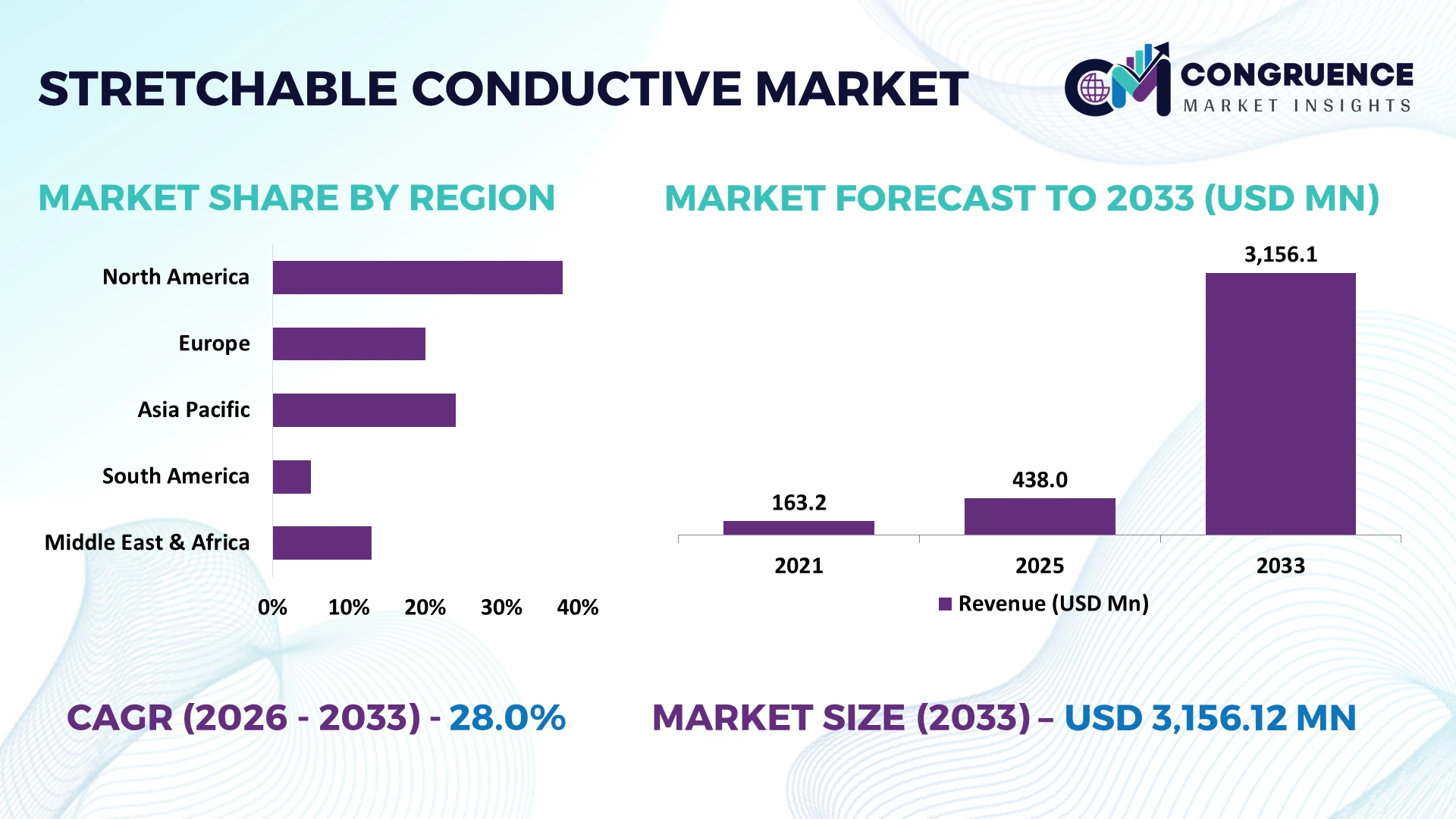
The Global Stretchable Conductive Market was valued at USD 438 Million in 2025 and is anticipated to reach a value of USD 3156.12 Million by 2033 expanding at a CAGR of 28% between 2026 and 2033. Growth is driven by skin-mounted biosensors, electronic textiles, soft robotics, flexible medical electrodes, deformable interconnects, and printable silver, liquid-metal, carbon, and conductive-polymer formulations.
The United States represents an estimated 31% of global Stretchable Conductive demand, supported by semiconductor R&D, wearable healthcare, defense electronics, and university commercialization. Federal CHIPS programs authorized USD 52.7 billion for domestic semiconductor capabilities, strengthening adjacent advanced-material ecosystems. South Korea offers greater electronics-manufacturing density, while the U.S. leads biomedical and defense-oriented commercialization. Laboratory stretchable conductors increasingly retain conductivity beyond 100% strain. U.S.-China technology restrictions are simultaneously accelerating domestic sourcing of strategically important electronic materials and fabrication capabilities.
Strategically, suppliers should prioritize scalable printable formulations and medical-grade integration partnerships that convert laboratory elasticity into repeatable high-volume manufacturing.
Market Size & Growth: USD 438 million in 2025 reaches USD 3,156.12 million by 2033 at 28%, propelled by wearable biosensing and deformable electronics.
Top Growth Drivers: Wearable electronics 38%, medical sensing 34%, and soft robotics 28% lead commercialization demand.
Short-Term Forecast: By 2028, roll-to-roll process optimization can reduce conductive-pattern fabrication costs by approximately 25%.
Emerging Technologies: Liquid metals, nanowire networks, and conductive polymers increasingly sustain electrical functionality beyond 100% mechanical strain.
Regional Leaders: North America approaches USD 980 million, Asia-Pacific USD 1.35 billion, and Europe USD 620 million as printed-electronics capacity expands.
Consumer/End-User Trends: Wearable medical applications account for approximately 35% of advanced stretchable-conductor adoption, emphasizing skin compatibility and signal stability.
Pilot/Case Example: 2025 research platforms demonstrated conductors maintaining electrical performance through more than 1,000 repeated stretching cycles, advancing durability validation.
Competitive Landscape: DuPont holds an estimated 16% position, competing with Henkel, Celanese, DIC Corporation, and Toyobo across conductive-material platforms.
Regulatory & ESG Impact: EU electronics policy targets 55% collection of applicable electronic waste categories, increasing pressure for material-efficient printed architectures.
Investment & Funding: USD 52.7 billion in U.S. CHIPS authorization strengthens domestic semiconductor and advanced-electronics ecosystems supporting material commercialization.
Innovation & Future Outlook: Conductors tolerating above 100% strain are shifting development toward conformable circuits, robotic skins, and continuously worn diagnostic interfaces.
The Stretchable Conductive Market is advancing from experimental materials toward manufacturable electronic interfaces for healthcare patches, smart textiles, robotic sensing, automotive surfaces, and human-machine systems. Silver composites, liquid-metal channels, conductive polymers, and nanomaterial networks increasingly combine electrical continuity with deformation exceeding 100% strain. Product development now emphasizes screen printing, low-temperature curing, encapsulation, and substrate compatibility rather than conductivity alone. Semiconductor localization programs and tighter technology supply chains are strengthening interest in regional advanced-material capacity, creating a strategic transition toward scalable formulations, qualification partnerships, and application-specific conductor architectures.
Stretchable conductors are becoming strategically important because electronics are moving from rigid housings onto skin, textiles, soft machines, and curved structural surfaces. This changes material competition from maximum conductivity toward conductivity retained under deformation, adhesion, biocompatibility, and scalable deposition. Semiconductor localization in the United States, Japan, and South Korea is also redirecting investment toward domestic electronic-material ecosystems, reducing exposure to concentrated Asian component supply chains.
Printed stretchable traces can eliminate connectors and rigid interconnect assemblies in conformable devices, reducing component count by approximately 20%–30% versus conventional wired architectures. Liquid-metal and nanowire conductors can remain functional beyond 100% strain, compared with copper traces that tolerate only limited elastic deformation. Japan brings precision materials and electronics manufacturing, while the United States has stronger biomedical commercialization. A skin-mounted cardiac patch illustrates the advantage: deformable electrodes maintain continuous contact during body movement, improving signal stability without rigid sensor fixtures.
Through 2028, investment will concentrate on printable inks, low-temperature curing, encapsulation, and automated patterning. Material suppliers are partnering with wearable, medical-device, and robotics developers to qualify formulations earlier in product design. Competitive leadership will depend on proving mechanical reliability at manufacturing scale, not achieving laboratory conductivity records alone.
Continuous physiological monitoring is accelerating demand for conductors that follow skin movement without signal interruption. Human skin routinely experiences local strains above 20%, while advanced stretchable electrodes can maintain conductivity beyond 50%–100% deformation. Wearable healthcare represents roughly 35% of current high-value stretchable-conductor applications, supported by cardiac monitoring, electrophysiology, rehabilitation, and motion sensing. U.S. medical-device developers are shifting from rigid electrode assemblies toward thin conformal patches that improve contact across moving surfaces. Material companies are responding with silver-elastomer inks, conductive polymers, skin-compatible encapsulants, and medical-device partnerships. The strategic advantage is not simply flexibility: stable electrode contact can reduce motion-induced signal artifacts by 20%–30%, improving usable sensor data and strengthening the economics of longer-duration remote monitoring.
Silver remains central to highly conductive stretchable inks, exposing producers to commodity volatility and material-cost pressure. Conventional silver formulations can contain more than 50% metallic solids by weight, while conductive filler can represent 30%–60% of formulation cost in performance-oriented inks. Silver prices have experienced annual swings exceeding 20%, complicating long-term pricing for printed-electronics manufacturers. China’s dominant role in electronics processing further concentrates upstream procurement exposure for globally sourced formulations. Producers are lowering silver loading through hybrid carbon-silver networks, copper alternatives, optimized particle geometries, and longer-term supplier contracts. The non-obvious constraint is curing economics: replacing silver is commercially useful only when alternative materials preserve low-temperature processing, because higher curing temperatures can damage elastomeric substrates and eliminate raw-material savings through additional manufacturing complexity.
Electronic textiles provide a pathway from specialized medical patches toward larger-area conductive applications in sportswear, occupational safety, rehabilitation, and human-machine interfaces. Textile substrates routinely experience 20%–50% localized deformation, requiring conductive patterns that survive bending, washing, and repeated extension. Roll-to-roll printing can increase coated-area throughput by more than 30% compared with batch patterning while reducing material waste approximately 20% through selective deposition. South Korea’s integrated textile and electronics manufacturing base provides a strong environment for combining conductive inks with automated garment production. Suppliers are developing washable encapsulation, screen-printable formulations, conductive yarn interfaces, and textile-industry partnerships. The strategic opportunity lies in surface area: smart garments consume substantially more conductive material per unit than compact biosensors, creating volume potential once wash-cycle durability becomes commercially repeatable.
Commercial scaling depends on maintaining electrical performance through repeated deformation, environmental exposure, and manufacturing variation rather than achieving exceptional initial stretchability. Consumer and medical products can experience thousands of bending or extension cycles, while resistance changes above 10%–20% can destabilize sensitive measurements. Laboratory conductors increasingly survive more than 1,000 cycles, but industrial qualification can demand substantially longer endurance alongside humidity, sweat, washing, and temperature testing. Japanese electronics manufacturers impose particularly rigorous reliability standards before integrating new functional materials into high-volume products. Suppliers must improve interface adhesion, crack-resistant encapsulation, automated resistance inspection, and accelerated-life testing while working with OEM qualification teams. The long-term competitive barrier is reproducibility: formulations that perform at 100% strain in prototypes still lose commercial relevance if batch-to-batch rheology or printed thickness varies enough to alter resistance materially.
Low Temperature Processing Gains Priority Electronics manufacturers are reducing thermal budgets as stretchable circuits move onto TPU, silicone, and other heat-sensitive substrates. New conductive formulations cure below 120°C versus conventional metallic systems often requiring above 150°C, cutting process temperatures by roughly 20%–30%. Suppliers are reformulating binders and particle systems while equipment companies refine photonic and rapid curing. The shift lowers substrate deformation risk and enables faster integration with established flexible-electronics production lines.
Liquid Metal Patterning Becomes Automated Gallium-based conductors are progressing from manually formed laboratory channels toward printing, microfluidic deposition, and automated patterning. Eutectic gallium-indium remains liquid near room temperature and can sustain deformation exceeding 100% without conventional fracture. Equipment developers are improving dispensing accuracy below 100 micrometers, while materials companies optimize oxide management and encapsulation. Automation reduces operator dependence and strengthens repeatability, moving liquid metals closer to scalable robotic sensing and highly deformable interconnect manufacturing.
Recyclable Electronics Influence Material Selection Circular-design requirements are increasing attention on separable substrates, recoverable metals, and lower-material architectures. EU policy targets collection rates reaching 85% for certain electronic-waste streams, while selective printing can reduce conductor consumption by approximately 20%–40% versus blanket coating. Developers are adopting patterned deposition, recoverable substrates, and thinner conductive layers. The non-obvious commercial effect is design simplification: easier material separation can reduce downstream recycling complexity while improving compliance positioning for wearable and disposable electronics.
Hybrid Conductors Balance Performance Tradeoffs Material developers increasingly combine silver, carbon nanotubes, graphene, and polymers rather than relying on single conductive phases. Hybrid networks can maintain electrical pathways at strains above 50% while reducing precious-metal loading by 15%–30%. Companies are optimizing filler geometry, dispersion, and elastomer interfaces through formulation partnerships. This approach balances conductivity, elasticity, and material economics, enabling application-specific products without requiring manufacturers to accept the cost profile of heavily silver-loaded formulations.
Conductive Inks lead with an estimated 32% market share because screen, inkjet, aerosol, and dispensing processes enable patterned conductors across flexible substrates without conventional subtractive fabrication. Their compatibility with established printing equipment supports scalable production and material-efficient deposition. Silver-Based Materials remain important where low resistance is essential, while Conductive Polymers offer lightweight processing and mechanical compliance. Conductive Textiles serve garment-integrated electronics, and Carbon-Based Materials provide attractive flexibility where conductivity requirements permit alternatives to metals.
Liquid Metals are the fastest-growing type as electronic skin, soft machines, and deformable interconnects require extreme mechanical compliance. Gallium-based systems can tolerate strains exceeding 100%, materially outperforming conventional metallic traces under repeated deformation. Manufacturers are developing printable liquid-metal formulations, encapsulation systems, and automated microchannel processes. Investment priorities are therefore shifting from conductivity alone toward conductivity retained under strain. Suppliers capable of combining printable processing, adhesion, low resistance, and mechanical endurance can address higher-value applications while reducing OEM qualification complexity.
Wearable Electronics represent the leading application with an estimated 34% share because body-mounted devices require conductive pathways that conform to movement while maintaining electrical continuity. Flexible Sensors benefit from similar mechanics across pressure, strain, and physiological measurement, while Healthcare Devices prioritize skin contact and signal integrity. Smart Textiles extend circuitry across larger surfaces, whereas Flexible Displays require transparent or highly deformable electrode structures. Commercial development increasingly favors conductors retaining stable performance through thousands of bending and stretching events.
Electronic Skin is the fastest-growing application as robotics, prosthetics, and human-machine interfaces require distributed tactile sensing across deformable surfaces. Research systems increasingly integrate arrays containing hundreds of sensing points while supporting strains above 50%. Soft Robotics provides another emerging outlet because conventional wiring restricts actuator deformation. Material suppliers and device developers are therefore expanding co-development programs around patterned electrodes, sensor arrays, encapsulation, and connector-free architectures. Business value is moving toward application-qualified material systems that simplify integration rather than standalone conductor formulations sold primarily by electrical specification.
Consumer Electronics lead with an estimated 30% share, supported by wearable devices, body-mounted sensors, flexible interfaces, and emerging conformable electronics manufactured at comparatively high volumes. Healthcare follows with stronger qualification requirements but higher value per application. Sports & Fitness increasingly integrates sensing into garments and accessories, while the Textile Industry requires washable conductive structures compatible with conventional fabrication. Automotive and Aerospace & Defense emphasize reliability across vibration, temperature variation, and curved surfaces, creating longer qualification cycles than consumer applications.
Robotics is the fastest-growing end-user as soft grippers, humanoid platforms, prosthetics, and tactile systems require conductors that move with actuators and artificial skin. Industrial robot installations exceed 4 million units globally, while emerging collaborative and humanoid designs increase demand for compliant sensing surfaces. Suppliers are targeting robotics companies through customized liquid-metal channels, stretchable sensor matrices, and development partnerships. Competitive positioning is consequently shifting toward sector-specific formulations: consumer buyers prioritize manufacturability, healthcare demands biocompatibility, and robotics developers value extreme deformation tolerance and repeated-cycle reliability.
North America accounted for the largest market share at 36.8% in 2025 however, Asia-Pacific is expected to register the fastest growth, expanding at a CAGR of 31.2% between 2026 and 2033.
Biomedical Commercialization Drives Material Qualification
North America represents approximately 36.8% of global Stretchable Conductive demand, supported by biomedical electronics, aerospace systems, advanced wearables, flexible sensors, and university-to-enterprise technology transfer. The region’s advantage centers on translating conductive materials into regulated, high-value devices rather than commodity-scale production. U.S. semiconductor policy has authorized USD 52.7 billion for manufacturing, research, and workforce initiatives, strengthening domestic ecosystems for advanced electronic materials and packaging. Medical-device developers increasingly evaluate stretchable electrodes capable of maintaining electrical continuity above 50% strain, while aerospace programs prioritize lightweight sensing structures. Materials companies are establishing joint development programs with device OEMs, research laboratories, and contract manufacturers to accelerate qualification. This commercialization model favors suppliers offering formulation engineering, application testing, and scalable deposition processes alongside conductive performance.
United States Market Outlook: The United States combines biomedical engineering depth with semiconductor research, defense procurement, and advanced manufacturing infrastructure. More than 6,000 hospitals create substantial downstream potential for conformable monitoring technologies, while federally supported semiconductor capacity strengthens domestic electronics development. Suppliers positioned near medical-device and microelectronics clusters gain faster access to prototype qualification, specialized engineering talent, and high-value application partners.
Circular Electronics Reshape Material Engineering
Europe accounts for approximately 22.6% of global demand, with Germany, France, the United Kingdom, Netherlands, and Italy supporting printed electronics, automotive sensing, medical devices, and smart-textile development. Material selection increasingly incorporates recyclability, chemical compliance, energy-efficient curing, and end-of-life separation alongside conductivity. EU electronic-waste rules establish an 85% recovery target for generated WEEE, encouraging thinner conductive layers and material-efficient additive processing. Germany’s automotive engineering base provides an important pathway for conformable sensors integrated into interiors, seating, controls, and human-machine interfaces. European companies are strengthening collaborations among chemical suppliers, printing specialists, textile producers, and electronics OEMs. This cross-industry structure supports faster qualification of conductive polymers and hybrid formulations where lifecycle performance and manufacturing compatibility outweigh laboratory conductivity alone.
Germany Market Outlook: Germany combines automotive engineering, specialty chemicals, industrial automation, and applied materials research, creating a strong qualification environment for stretchable electronics. The country manufactures more than 4 million passenger cars annually, providing scale for future conductive surfaces, pressure-sensitive interiors, and embedded sensing. Its industrial advantage lies in linking materials development directly with high-volume component validation and automated production engineering.
Electronics Scale Accelerates Industrialization
Asia-Pacific holds approximately 32.4% of global demand and provides the strongest manufacturing ecosystem for displays, semiconductors, electronic components, textiles, batteries, and advanced materials. South Korea and Japan contribute precision materials and display expertise, while China combines large-scale electronics assembly with extensive chemical and conductive-material supply chains. Taiwan’s semiconductor infrastructure strengthens opportunities for heterogeneous flexible systems incorporating sensing and processing. Manufacturing density allows stretchable-electronics developers to shorten prototype-to-production cycles and access established printing, coating, encapsulation, and component-assembly capabilities. Governments are simultaneously expanding semiconductor localization programs, encouraging suppliers to build application laboratories near electronics clusters. Companies are responding through local R&D centers, OEM partnerships, pilot coating lines, and vertically coordinated supply chains, making production engineering a decisive regional advantage.
South Korea Market Outlook: South Korea offers strategic strength through advanced displays, semiconductors, batteries, and high-density electronics manufacturing. The country accounts for roughly 20% of global semiconductor production capacity, creating extensive technical infrastructure for emerging flexible systems. Samsung- and LG-centered supply networks also provide material developers with sophisticated pathways for qualifying stretchable electrodes, conductive films, sensors, and next-generation display interfaces.
Medical Wearables Anchor Early Adoption
South America represents approximately 3.4% of global demand, with Brazil providing the principal commercial and research base for printed electronics, healthcare devices, smart textiles, and flexible sensing. Market development remains application-led because regional production of specialized conductive nanomaterials and inks is limited, increasing reliance on imported formulations and equipment. Brazil’s healthcare system serves more than 200 million people, creating a substantial potential deployment environment for low-profile physiological monitoring and disposable sensing platforms. Universities and technology institutes are developing printed sensors and functional textiles, while manufacturers increasingly collaborate with foreign material suppliers rather than internalizing formulation production. Currency movements and imported-material lead times constrain rapid scaling, making localized printing, converting, and device assembly more commercially practical than complete upstream material localization.
Brazil Market Outlook: Brazil combines Latin America’s largest healthcare infrastructure with established textile, automotive, and electronics manufacturing. Its textile sector employs more than 1 million workers, providing industrial capabilities relevant to future conductive-fabric integration. Local companies can create defensible positions by importing specialized conductive materials while performing printing, lamination, encapsulation, and garment integration domestically, reducing finished-device import dependence.
Technology Investment Builds Application Capacity
Middle East & Africa represents approximately 4.8% of global demand, with the UAE, Saudi Arabia, Israel, and South Africa providing the strongest innovation and deployment environments. Israel contributes advanced medical-device and sensor engineering, while Gulf investment programs increasingly fund semiconductor capabilities, digital healthcare, robotics, and localized technology manufacturing. Saudi Arabia targets substantial expansion of domestic industrial content under Vision 2030, creating pathways for advanced-material integration within electronics and healthcare ecosystems. The UAE’s research institutions are expanding work in robotics, flexible devices, and advanced manufacturing. Suppliers are initially targeting high-value applications requiring limited material volumes rather than commodity production. Partnerships with universities, technology parks, healthcare groups, and sovereign-backed industrial programs provide the most efficient route for entering these developing application ecosystems.
Israel Market Outlook: Israel provides the region’s strongest combination of medical-device engineering, semiconductor design, defense electronics, and startup commercialization. R&D expenditure exceeds 6% of GDP, among the world’s highest levels, supporting intensive development of sensors, digital healthcare systems, and advanced materials. Stretchable-conductor suppliers benefit from partnership opportunities where rapid prototyping and intellectual-property development carry greater strategic value than manufacturing scale.
DuPont and Henkel compete through established conductive-ink portfolios and OEM relationships, while Toyobo and DIC Corporation leverage polymer chemistry against specialist advanced-material developers such as CHASM. The top five suppliers hold an estimated 42% combined share, reflecting fragmented application requirements across printed electronics, textiles, healthcare, and robotics. Silver-based formulations retain conductivity advantages, but hybrid systems can reduce precious-metal loading by 15%–30%, intensifying competition around material economics. Low-temperature inks cutting processing temperatures by roughly 20% challenge legacy formulations on heat-sensitive substrates. Suppliers are expanding application laboratories, co-development partnerships, pilot coating capacity, and customized formulations rather than competing solely on catalog products. The competitive shift favors integrated material systems combining conductor, substrate, encapsulation, and process compatibility. Qualification cycles, formulation intellectual property, dispersion consistency, and OEM validation remain formidable entry barriers. Winning requires reproducible electrical performance under deformation, scalable processing, application-specific engineering, and early integration into customer design cycles.
DuPont
Henkel
Toyobo
DIC Corporation
Celanese Corporation
CHASM Advanced Materials
Heraeus
Nagase & Co.
Nano Dimension
Canatu
Brewer Science
Vorbeck Materials
Creative Materials
Applied Nanotech
Current stretchable-conductor platforms combine serpentine interconnect geometry, anisotropic conductive networks, and photonic curing to preserve electrical continuity while accelerating fabrication. Photonic processing can shorten thermal treatment from minutes to seconds, improving line throughput by roughly 20% while protecting temperature-sensitive elastomers. Laser-patterned architectures reduce conductor consumption approximately 15% through selective material removal. Adoption is moving into pilot-scale printed electronics, benefiting manufacturers requiring repeatable circuitry without conventional subtractive processing.
Emerging technology centers on self-healing conductive composites, conductive hydrogels, and microcracked metal films engineered to reconnect after deformation. Self-repairing networks can recover more than 90% of initial electrical performance after localized damage, outperforming conventional traces that permanently fracture. Integration with stretchable transistors and sensor arrays is creating deformable circuits rather than isolated electrodes. Medical-device and robotics developers benefit because fewer rigid interfaces simplify mechanical design and reduce failure points.
Between 2026 and 2028, digital manufacturing will combine machine-vision inspection, automated rheology control, and additive patterning for closed-loop quality management. Inline resistance mapping can reduce defective printed circuits by approximately 15% compared with batch inspection. Suppliers integrating material formulation with process analytics will gain qualification advantages. Acting now secures OEM design-in positions before conductor specifications become embedded within wearable, robotic, and conformable electronic architectures.
November 2024 Henkel partnered with Covestro and Quad Industries to accelerate printed medical wearables, combining three companies’ conductive inks, TPU films, and manufacturing expertise. The collaboration shortened development pathways for stretchable healthcare electronics and expanded production-ready material integration. Source: henkel.com
December 2024 Interlink Electronics acquired Conductive Transfers and Global Print Solutions for approximately $314,000, adding patented stretchable printed-electronics processes. The transaction expanded Interlink into functional e-textiles, wearable heating, rehabilitation electrodes, and automotive applications while strengthening European manufacturing capabilities. Source: sec.gov
January 2025 CHASM licensed its AgeNT Express silver-nanowire and carbon-nanotube hybrid film exclusively to Mativ for transparent heating. The agreement targeted three application sectors—architectural, military, and transportation—accelerating commercialization of conductive films through Mativ’s glazing-material manufacturing platform. Source: prnewswire.com
January 2026 Canatu and DENSO signed a 17-month joint development agreement to build larger-area CNT manufacturing equipment beyond Canatu’s existing 600-millimeter production line. The program targets full-windshield heaters, advancing scalable transparent conductive films for automotive thermal-management applications globally. Source: canatu.com
The report evaluates Conductive Textiles, Conductive Inks, Conductive Polymers, Liquid Metals, Carbon-Based Materials, and Silver-Based Materials across Wearable Electronics, Flexible Sensors, Smart Textiles, Flexible Displays, Electronic Skin, Soft Robotics, and Healthcare Devices. Conductive Inks represent approximately 32% of type demand, while Wearable Electronics account for about 34% of application activity, providing benchmarks for portfolio prioritization and production planning.
End-user coverage spans Consumer Electronics, Healthcare, Automotive, Aerospace & Defense, Sports & Fitness, Textile Industry, and Robotics across North America, Europe, Asia-Pacific, South America, and Middle East & Africa. Technology assessment includes photonic curing, self-healing composites, additive patterning, conductive hydrogels, deformable circuitry, and automated quality inspection. The 2026–2033 scope supports capacity investment, material qualification, geographic expansion, OEM partnerships, competitive positioning, and identification of emerging electronic-skin, robotic-sensing, and conformable-device opportunities.
| Report Attribute/Metric | Report Details |
|---|---|
Market Revenue in 2025 | USD 438 Million |
Market Revenue in 2033 | USD 3156.12 Million |
CAGR (2026 - 2033) | 28% |
Base Year | 2025 |
Forecast Period | 2026 - 2033 |
Historic Period | 2021 - 2025 |
Segments Covered | By Type
By Application
By End-User
|
Key Report Deliverable | Revenue Forecast, Growth Trends, Market Dynamics, Segmental Overview, Regional and Country-wise Analysis, Competition Landscape |
Region Covered | North America, Europe, Asia-Pacific, South America, Middle East, Africa |
Key Players Analyzed | DuPont, Henkel, Toyobo, DIC Corporation, Celanese Corporation, CHASM Advanced Materials, Heraeus, Nagase & Co., Nano Dimension, Canatu, Brewer Science, Vorbeck Materials, Creative Materials, Applied Nanotech |
Customization & Pricing | Available on Request (10% Customization is Free) |




