
Reports
The Global Strapping Materials Market was valued at USD 4207 Million in 2025 and is anticipated to reach a value of USD 5497.14 Million by 2033 expanding at a CAGR of 3.4% between 2026 and 2033. Growth is primarily supported by rising automation in packaging lines, increasing recycled polymer utilization, and expanding logistics networks requiring durable, lightweight, and high-performance strapping solutions.
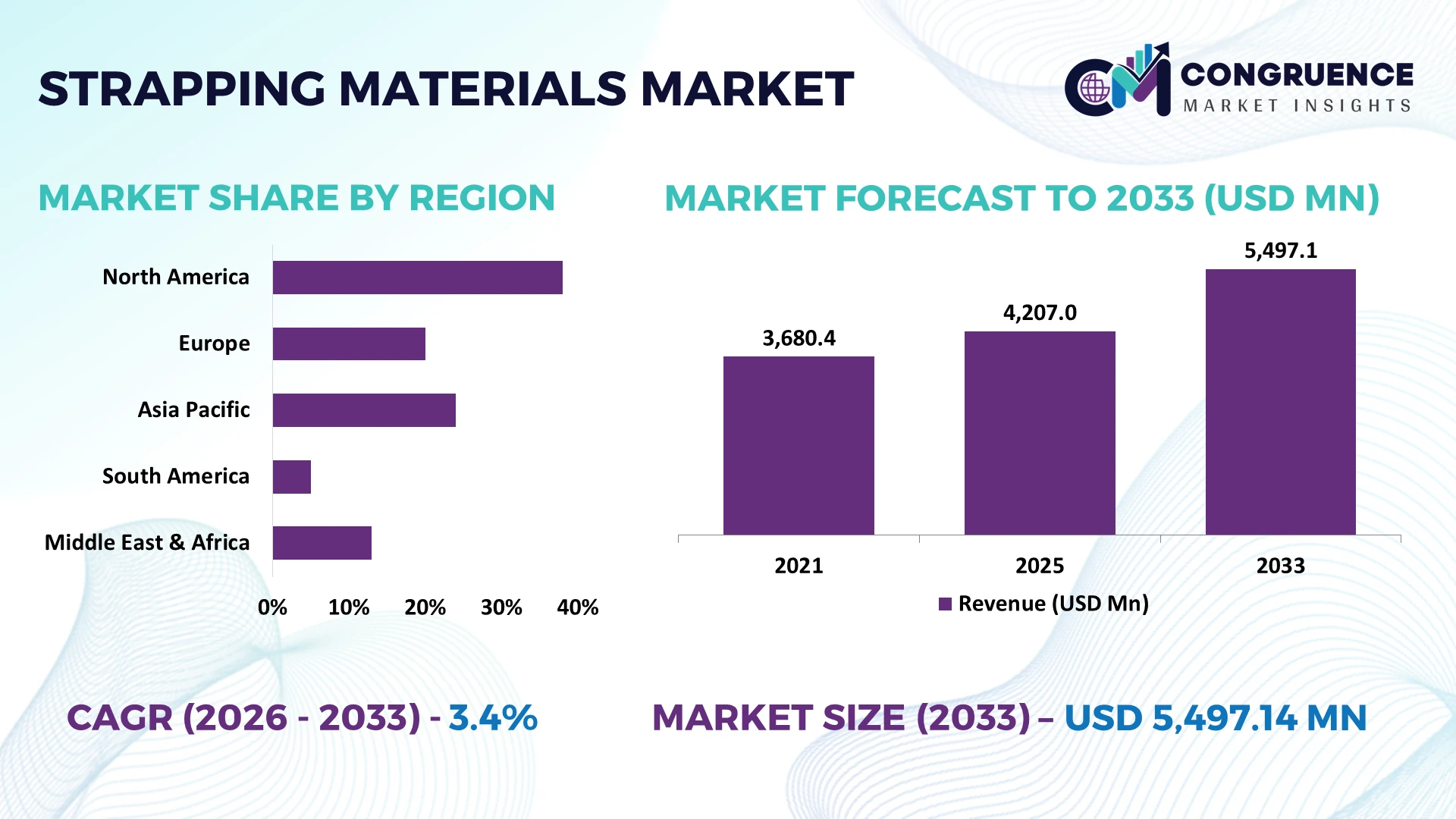
China accounts for approximately 34% of global strapping material production capacity, supported by large-scale manufacturing, export-oriented packaging, and sustained industrial investments, while the United States contributes nearly 18% through advanced automated packaging adoption across food, e-commerce, and industrial sectors. Ongoing supply-chain diversification following Red Sea shipping disruptions has accelerated regional sourcing strategies and capacity optimization. Businesses should prioritize resilient supplier networks and recyclable material portfolios to strengthen long-term competitiveness.
Market Size & Growth: USD 4207 Million (2025) to USD 5497.14 Million (2033) at 3.4% CAGR, driven by expanding automated packaging and warehouse modernization.
Top Growth Drivers: Automation adoption (+22%), recycled polymer usage (+18%), and e-commerce logistics expansion (+15%) continue strengthening global demand.
Short-Term Forecast: By 2028, automated strapping lines improve packaging efficiency by 20% while reducing material waste by nearly 12%.
Emerging Technologies: AI-enabled quality inspection, robotic packaging systems, and advanced recycled PET materials improve consistency and operational productivity.
Regional Leaders: Asia Pacific approaches USD 2.6 Billion, North America exceeds USD 1.3 Billion, and Europe reaches about USD 1.1 Billion through sustainable packaging adoption and regional manufacturing expansion.
Consumer/End-User Trends: More than 58% of industrial packaging operations increasingly prefer recyclable plastic strapping over conventional alternatives.
Pilot/Case Example: In 2026, an automated logistics packaging upgrade reduced strapping consumption by 14% while increasing line throughput by 17%.
Competitive Landscape: The leading supplier holds approximately 14% market share alongside Signode, Mosca, Samuel Strapping Systems, Polychem, and FROMM.
Regulatory & ESG Impact: Recycled-content initiatives increase sustainable material adoption by over 25%, supporting circular packaging strategies across global supply chains.
Investment & Funding: More than USD 650 Million supports manufacturing expansion, recycling capacity, and strategic partnerships amid regional supply-chain diversification.
Innovation & Future Outlook: High-strength bio-based polymers, digital production monitoring, and lightweight advanced materials accelerate next-generation industrial packaging solutions.
The Strapping Materials Market continues to advance through demand from logistics, food and beverage, construction, and manufacturing sectors where durable, recyclable packaging solutions remain essential. Advanced recycled PET formulations and automated tension-control technologies have improved packaging consistency by approximately 18%, while evolving sustainability requirements and regional supply-chain optimization continue reshaping procurement priorities, setting the stage for broader strategic market evaluation.
The Strapping Materials Market has become strategically important as manufacturers, logistics operators, and exporters prioritize packaging reliability, automation, and material efficiency to strengthen supply-chain resilience. Ongoing supply-chain restructuring following disruptions in major shipping corridors has accelerated investment in localized packaging operations and high-performance strapping solutions. Companies increasingly view strapping materials as a productivity asset that reduces product damage, supports warehouse automation, and improves transport consistency across industrial supply networks.
Modern PET and high-tensile polyester strapping deliver nearly 25% lower weight and up to 18% lower lifecycle handling costs than conventional steel strapping while maintaining comparable load stability in many industrial applications. China continues to scale production capacity through integrated manufacturing clusters, whereas Germany emphasizes advanced automated packaging systems with higher digital integration across industrial facilities. Over the next two to three years, automated strapping installations are expected to increase by approximately 20%, driven by warehouse modernization and smart manufacturing initiatives.
A leading logistics operator deploying automated strapping equipment across distribution centers reduced packaging downtime by around 15% while improving shipment consistency. Manufacturers are expanding recycling capabilities, strengthening converter partnerships, and investing in intelligent packaging technologies to improve operational flexibility. Organizations that combine sustainable materials with automation-ready product portfolios will secure stronger competitive positioning and long-term operational resilience.
Rapid adoption of automated packaging lines is reshaping demand for advanced strapping materials across manufacturing, logistics, and distribution sectors. More than 60% of newly commissioned warehouse packaging systems now integrate automated strapping equipment, while recycled PET utilization has increased by approximately 22% in industrial packaging applications. India's expanding manufacturing initiatives and China's continued investment in export-oriented production have accelerated demand for lightweight, high-strength strapping solutions. This operational shift reduces packaging downtime, improves load stability, and lowers material consumption. Companies are responding through capacity expansion, strategic recycling investments, and partnerships with automation equipment suppliers to deliver integrated packaging solutions that improve productivity while supporting sustainable industrial operations.
Volatility in polypropylene and polyester resin prices continues to pressure production planning and procurement strategies. Feedstock cost fluctuations exceeding 15% in certain procurement cycles have narrowed manufacturer margins, while imported resin dependence remains above 40% for several packaging producers in developing economies. Periodic shipping disruptions and container imbalances further complicate inventory management and delivery schedules. These structural constraints reduce pricing stability and limit long-term contract flexibility for converters and distributors. Companies are mitigating exposure through localized sourcing, multi-supplier procurement agreements, recycled polymer integration, and longer-term supply contracts that improve procurement predictability while reducing operational risk across packaging value chains.
Growing adoption of circular economy practices creates new opportunities for recyclable and high-performance strapping materials. Recycled-content packaging usage has expanded by approximately 24%, while automated packaging investments have improved line productivity by nearly 18% in large industrial facilities. Japan and South Korea are accelerating smart factory deployments that integrate digital monitoring with automated packaging equipment for greater operational visibility. Manufacturers are investing in bio-based polymers, intelligent quality inspection, and closed-loop recycling partnerships to differentiate product portfolios. An emerging strategic opportunity lies in supplying customized strapping systems that combine sustainable materials with automation compatibility, enabling customers to reduce waste while improving logistics efficiency.
Achieving consistent deployment of advanced strapping systems across diverse industrial environments remains a significant execution challenge. Nearly 35% of small and mid-sized manufacturers still operate semi-automated packaging lines, creating integration complexity with modern digital equipment. Skilled maintenance shortages and legacy machinery compatibility issues extend commissioning timelines by approximately 12% in several industrial facilities. Germany and the United States continue investing in workforce training and equipment standardization to improve implementation consistency. Companies must strengthen technical partnerships, digital service capabilities, and infrastructure modernization programs to ensure scalable deployment, maintain operational reliability, and sustain competitive performance as intelligent packaging ecosystems become increasingly interconnected.
Advanced Recycled Material Integration Recycled PET content in industrial strapping has increased by approximately 24%, while converter adoption of closed-loop polymer recovery has expanded by nearly 18%. Extended producer responsibility regulations and customer sustainability targets are accelerating material substitution. Manufacturers are expanding recycling partnerships and redesigning production workflows to reduce virgin resin dependence while improving procurement stability and operational efficiency.
Warehouse Automation Accelerates Deployment Automated strapping equipment installations have increased by nearly 20%, reducing packaging cycle times by around 16% and lowering manual handling requirements by 22%. Labor shortages across Germany and the United States continue driving packaging automation investments. Equipment suppliers are strengthening OEM partnerships and integrating digital monitoring platforms to improve throughput, maintenance scheduling, and packaging consistency across distribution facilities.
Localized Manufacturing Network Expansion Companies have increased regional production localization by approximately 15% to reduce transportation risks and improve delivery responsiveness. Supply-chain restructuring following Red Sea shipping disruptions has encouraged manufacturers to diversify sourcing and establish multi-country production networks. This strategy shortens lead times, improves inventory resilience, and enables faster customer fulfillment through decentralized manufacturing and strategic converter partnerships.
High-Performance Product Customization Demand for application-specific strapping solutions has risen by roughly 19%, particularly for heavy industrial loads and automated packaging systems. Smart quality-control technologies have improved production consistency by nearly 14%, reducing rejection rates. Producers are expanding specialized product portfolios, adopting digital inspection systems, and collaborating with equipment manufacturers to deliver customized solutions that improve operational reliability and packaging performance.
Polyester (PET) remains the leading segment with an estimated 42% market share, supported by its high tensile strength, corrosion resistance, lightweight profile, and compatibility with automated packaging systems. Its ability to replace steel strapping across numerous industrial applications has strengthened demand among logistics, manufacturing, and export-oriented industries. Polypropylene (PP) continues to serve cost-sensitive packaging operations due to its flexibility and affordability, while Steel maintains relevance for extremely heavy-duty industrial loads where maximum load retention remains essential.
Corded strapping is emerging as the fastest-growing type, supported by increasing adoption in construction materials, timber, and irregular cargo handling. Demand for corded solutions has increased by approximately 17%, while recycled PET usage across industrial packaging has expanded by nearly 22%. Manufacturers are investing in recyclable PET grades, expanding regional production, and developing customized product portfolios for automated packaging environments. Investment priorities increasingly favor lightweight, sustainable materials that balance operational performance with lower lifecycle costs.
Industrial Packaging represents the largest application segment with approximately 36% market share, driven by high-volume manufacturing, export shipments, and automated production environments requiring secure load stabilization. Growing investment in warehouse automation and integrated packaging lines continues reinforcing demand across heavy industrial operations. Logistics has emerged as the fastest-growing application as distribution centers increasingly automate fulfillment operations to improve throughput and shipment consistency.
Palletizing remains a mature and essential application for large-scale warehouse operations, while Carton Packaging continues expanding alongside consumer goods manufacturing. Bundling maintains strategic importance across steel products, construction materials, and paper products requiring compact load management. Automated packaging deployment has increased by nearly 20%, reducing packaging cycle times by approximately 16%. Companies are expanding equipment integration, strengthening packaging automation partnerships, and optimizing application-specific strapping solutions to improve operational efficiency and reduce handling costs.
Manufacturing remains the dominant end-user with an estimated 39% market share due to continuous packaging requirements across automotive, machinery, chemicals, consumer goods, and industrial equipment production. Large production volumes and automated packaging operations create sustained demand for durable strapping materials capable of maintaining shipment integrity. Logistics represents the fastest-growing end-user as fulfillment centers continue expanding automated packaging infrastructure to support increasing shipment volumes and shorter delivery cycles.
Food & Beverage continues strengthening demand through hygiene-focused packaging and high-volume pallet shipments, while Construction maintains stable consumption for heavy building materials requiring secure transport. Paper & Pulp remains an important niche segment supporting bundled paper products and export shipments. Automated packaging adoption among logistics operators has increased by nearly 21%, while customized strapping solutions have improved operational productivity by approximately 15%. Companies are responding through tailored product offerings, long-term customer partnerships, and integrated packaging service models that strengthen customer retention and operational value.
Asia-Pacific accounted for the largest market share at 46% in 2025 however, South America is expected to register the fastest growth, expanding at a 4.6% CAGR between 2026 and 2033.
Advanced Packaging Automation Strengthens Industrial Competitiveness
North America represents approximately 24% of the global market, supported by highly automated manufacturing, sophisticated warehouse infrastructure, and strong adoption across food processing, logistics, consumer goods, and industrial production. Companies continue replacing conventional packaging lines with integrated strapping systems to improve throughput, reduce labor dependency, and minimize product damage during transportation. Automated packaging installations have increased by nearly 19% across major distribution facilities, while recycled PET integration continues expanding within industrial packaging operations. Strategic investments in smart warehousing, fulfillment centers, and regional manufacturing are reinforcing demand for high-performance strapping materials. Enterprise partnerships between packaging equipment suppliers and material manufacturers continue improving operational compatibility and production efficiency across large-scale industrial facilities.
United States Market Outlook: The United States remains the regional leader due to its extensive manufacturing base, advanced logistics infrastructure, and widespread warehouse automation. More than 65% of large distribution centers utilize automated end-of-line packaging systems, creating sustained demand for premium strapping solutions. Companies continue investing in recyclable materials, digital production monitoring, and localized packaging operations to improve supply-chain resilience while supporting growing e-commerce and industrial shipment volumes.
Sustainability Regulations Reshape Material Innovation
Europe accounts for approximately 21% of global demand, driven by advanced industrial manufacturing, stringent sustainability standards, and widespread adoption of recyclable packaging materials. Packaging producers continue replacing conventional materials with recycled-content solutions while expanding automated production capabilities to meet environmental objectives. Industrial facilities have increased recycled polymer utilization by approximately 23%, supported by modernization of packaging operations and investment in efficient production technologies. Strong collaboration between converters, polymer suppliers, and equipment manufacturers continues accelerating deployment of environmentally responsible strapping products. Industrial automation and circular material initiatives remain central to operational competitiveness across the region.
Germany Market Outlook: Germany leads the European market through its advanced manufacturing ecosystem, engineering expertise, and high concentration of automated production facilities. Nearly 70% of large industrial packaging operations incorporate automated strapping equipment, supporting productivity improvements and consistent packaging quality. Domestic manufacturers continue expanding recycling infrastructure and digital quality-control technologies to strengthen competitiveness while aligning with evolving industrial sustainability requirements.
Manufacturing Scale Drives Global Leadership
Asia-Pacific contributes approximately 46% of global market demand through its dominant manufacturing capacity, export-oriented production, and rapidly expanding logistics infrastructure. China, India, Japan, and Southeast Asian manufacturing hubs continue strengthening packaging automation and industrial output, supporting sustained consumption of PET and polypropylene strapping materials. Regional production capacity has expanded by approximately 18% over recent years, while automated packaging deployments continue increasing across electronics, consumer goods, and industrial manufacturing facilities. Ongoing investment in export infrastructure and regional supply-chain diversification further reinforces the region's leadership in production and consumption.
China Market Outlook: China remains the largest national market, accounting for roughly one-third of global production capacity through integrated manufacturing clusters and export-focused industrial operations. Automated packaging adoption continues accelerating across consumer goods, electronics, and machinery manufacturing, with industrial facilities increasing production efficiency by approximately 20% through digital packaging technologies. Companies continue expanding recyclable material production and localized supply networks to strengthen global competitiveness.
Industrial Modernization Expands Packaging Demand
South America is strengthening its market position through expanding manufacturing activities, agricultural exports, mining operations, and improving logistics infrastructure. Industrial packaging demand continues increasing as exporters modernize packaging processes to improve shipment reliability and reduce transit damage. Warehouse modernization projects have increased by approximately 14%, while industrial packaging automation continues expanding across large manufacturing facilities. Infrastructure development remains uneven across several countries, creating execution challenges despite improving industrial investment. Companies are responding by establishing regional distribution partnerships, localized inventory networks, and application-specific packaging solutions to improve operational responsiveness.
Brazil Market Outlook: Brazil represents the largest market within South America due to its diversified industrial economy, large food processing sector, and growing logistics network. Industrial packaging investments continue supporting automated production upgrades, while expanding export activity increases demand for durable strapping materials. Manufacturers are strengthening domestic converter partnerships and expanding regional production capabilities to improve delivery reliability and reduce dependence on imported packaging materials.
Infrastructure Investment Supports Industrial Expansion
The Middle East & Africa market continues evolving through industrial diversification, logistics corridor development, and investment in manufacturing infrastructure. Growth is supported by expanding construction projects, food processing capacity, and regional distribution networks requiring reliable industrial packaging solutions. Industrial packaging deployment has increased by approximately 16% across key logistics hubs, while manufacturing modernization initiatives continue improving packaging efficiency. Companies are strengthening regional partnerships and expanding localized distribution operations to improve supply reliability while supporting infrastructure-led industrial development across multiple sectors.
Saudi Arabia Market Outlook: Saudi Arabia leads the regional market through large-scale industrial diversification programs, expanding manufacturing investments, and strategic logistics infrastructure. Industrial zones continue integrating automated packaging operations to support chemicals, construction materials, and food processing industries. Packaging technology deployment has increased by approximately 18% across major industrial facilities, encouraging manufacturers to establish regional partnerships and strengthen local production capabilities for long-term operational resilience.
The competitive landscape is shaped by Signode, FROMM Group, Mosca GmbH, Polychem Corporation, and Samuel Strapping Systems, competing directly with regional converters and low-cost Asian manufacturers. Global leaders emphasize integrated packaging systems and premium performance, while regional suppliers compete aggressively on pricing and delivery flexibility. The top five companies collectively control approximately 44% of the market, creating moderate concentration with room for specialized participants. Competition increasingly depends on automation compatibility, recycled-material innovation, customized product design, and supply-chain responsiveness rather than price alone. Automated strapping solutions improve packaging productivity by nearly 20%, while recycled PET integration reduces material costs by approximately 15%, strengthening competitive differentiation. Leading companies continue expanding production capacity, forming equipment partnerships, investing in recycling infrastructure, and vertically integrating material sourcing to improve supply security. Industry competition is shifting toward sustainable packaging portfolios and intelligent automation, increasing pressure on manufacturers relying solely on conventional products. High capital investment, established distribution networks, and technical certification requirements remain key entry barriers. Sustainable innovation, operational reliability, and automation-ready solutions define long-term competitive success.
Signode
FROMM Group
Mosca GmbH
Polychem Corporation
Samuel Strapping Systems
Teufelberger
PAC Strapping Products, Inc.
Dynaric, Inc.
TITAN Umreifungstechnik GmbH & Co. KG
Messersì Packaging S.r.l.
Cyklop International
Cordstrap B.V.
Advanced automation, digital inspection, and sustainable material engineering are redefining strapping material production and deployment. AI-enabled quality inspection reduces production defects by approximately 18%, while automated tension-control systems improve packaging consistency by nearly 20%. Around 58% of newly installed industrial packaging lines now integrate intelligent monitoring capabilities, enabling predictive maintenance and real-time process optimization. These technologies strengthen operational efficiency while reducing packaging failures across manufacturing and logistics environments.
Recycled PET formulations, bio-based polymers, and high-strength composite strapping are replacing conventional steel solutions in multiple industrial applications. Modern PET strapping delivers nearly 25% lower weight and reduces handling costs by approximately 18% compared with legacy steel strapping while maintaining comparable load stability for most applications. Global manufacturers, logistics operators, and automated warehouse operators gain the greatest advantage through lower transportation costs, improved automation compatibility, and enhanced sustainability performance.
Between 2026 and 2028, digital production analytics, machine-vision inspection, and smart manufacturing integration will become standard competitive differentiators. Deployment of connected packaging equipment is expected to exceed 65% among large industrial facilities, enabling continuous process optimization and improved traceability. Companies investing early in intelligent automation, recyclable material innovation, and integrated packaging ecosystems will achieve stronger operational resilience, faster customer response, and durable competitive positioning as industrial packaging requirements continue becoming more technology-driven.
May 2026 Signode launched the BXT Go™ battery-powered plastic strapping tool at Interpack 2026, delivering improved mobility and faster field operation through a lightweight cordless platform weighing approximately 3.8 kg. The launch strengthens automated end-of-line packaging productivity across industrial applications. Source: Signode
May 2026 EAM-Mosca inaugurated its first strap manufacturing facility in Mexico with an USD 8 million investment, establishing localized production to strengthen regional supply chains and reduce delivery lead times across Latin America. The expansion improves manufacturing resilience and customer responsiveness. Source: EAM-Mosca
May 2026 GroupMosca and SIAT signed a strategic partnership to deliver integrated end-of-line packaging solutions worldwide, combining expertise across 2 complementary packaging technology portfolios. The collaboration expands solution integration while improving automation capability for industrial customers. Source: Mosca
January 2026 Mosca confirmed expansion of its Malaysia production site and preparations for new tape manufacturing operations in Mexico while accelerating AI integration into internal processes. The Malaysia facility increases regional manufacturing capacity, supporting international supply flexibility and operational efficiency. Source: Packaging Europe
This report provides comprehensive analysis of the global Strapping Materials Market across Polypropylene (PP), Polyester (PET), Steel, and Corded products, together with detailed assessment of Palletizing, Carton Packaging, Bundling, Logistics, and Industrial Packaging applications. The study evaluates Manufacturing, Logistics, Food & Beverage, Construction, and Paper & Pulp end-users across North America, Europe, Asia-Pacific, South America, and the Middle East & Africa. More than 40% of the assessment focuses on operational deployment trends, automation adoption, sustainable material innovation, and competitive positioning.
The report examines production strategies, supply-chain optimization, recycling integration, packaging automation, and emerging intelligent packaging technologies expected to influence industry development between 2026 and 2033. It assesses competitive benchmarking, regional investment priorities, enterprise expansion strategies, and technology adoption patterns while highlighting evolving customer requirements, deployment intensity, and niche opportunities. The analysis supports strategic planning, product portfolio optimization, geographic expansion, partnership evaluation, procurement decisions, and long-term competitive positioning across the industrial packaging ecosystem.
| Report Attribute/Metric | Report Details |
|---|---|
Market Revenue in 2025 | USD 4207 Million |
Market Revenue in 2033 | USD 5497.14 Million |
CAGR (2026 - 2033) | 3.4% |
Base Year | 2025 |
Forecast Period | 2026 - 2033 |
Historic Period | 2021 - 2025 |
Segments Covered | By Type
By Application
By End-User
|
Key Report Deliverable | Revenue Forecast, Growth Trends, Market Dynamics, Segmental Overview, Regional and Country-wise Analysis, Competition Landscape |
Region Covered | North America, Europe, Asia-Pacific, South America, Middle East, Africa |
Key Players Analyzed | Signode, FROMM Group, Mosca GmbH, Polychem Corporation, Samuel Strapping Systems, Teufelberger, PAC Strapping Products, Inc., Dynaric, Inc., TITAN Umreifungstechnik GmbH & Co. KG, Messersì Packaging S.r.l., Cyklop International, Cordstrap B.V. |
Customization & Pricing | Available on Request (10% Customization is Free) |




