Global Straight Condensing Steam Turbine Market Report Overview
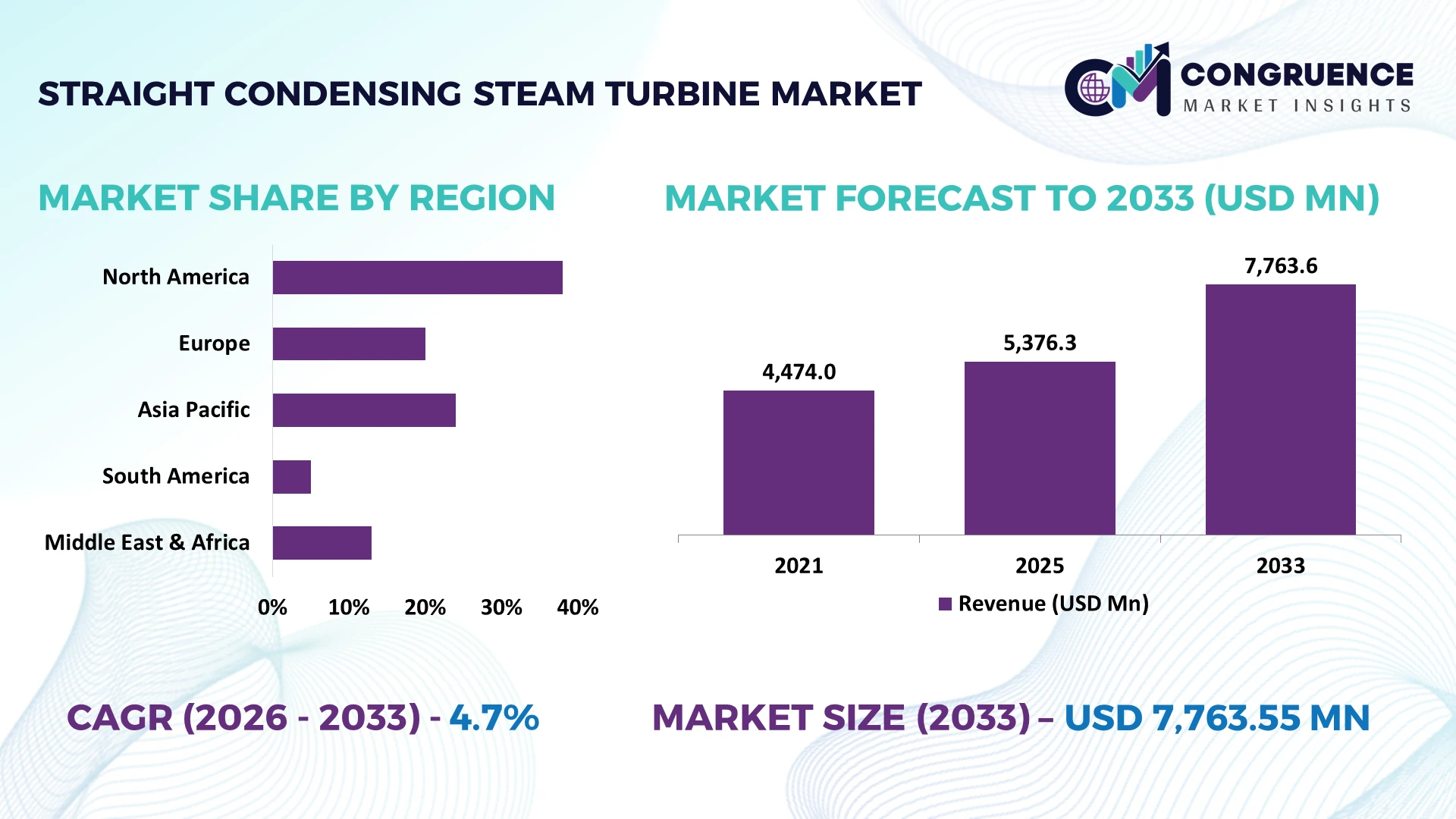
The Global Straight Condensing Steam Turbine Market was valued at USD 5376.34 Million in 2025 and is anticipated to reach a value of USD 7763.55 Million by 2033 expanding at a CAGR of 4.7% between 2026 and 2033. Growth is driven by new thermal power installations, nuclear turbine island procurement, industrial waste-heat recovery, and efficiency-focused turbine retrofits.
China dominates the global thermal power infrastructure landscape, supporting substantial demand for straight condensing steam turbine equipment. The country commissioned approximately 78.1 GW of coal-fired generating capacity in 2025, compared with India's 10 GW. China's coal fleet expanded by approximately 6%, while electricity generation from coal declined 1.2%, reflecting changing utilization patterns. Harbin Electric, Dongfang Electric, and Shanghai Electric support domestic turbine manufacturing, including advanced steam-path components. China's 2026–2030 power system modernization priorities increasingly emphasize operational flexibility, thermal efficiency, and equipment reliability.
Manufacturers combining high-efficiency turbine engineering with modernization services and localized production are positioned to capture significant opportunities across new installations and existing power infrastructure.
Key Highlights of the Global Straight Condensing Steam Turbine Market
-
Market Size & Growth: Valued at USD 5376.34 Million in 2025 and projected to reach USD 7763.55 Million by 2033, expanding at 4.7% CAGR, driven by baseload thermal capacity additions in emerging economies and nuclear plant refurbishment cycles.
-
Top Growth Drivers: (1) Global electricity demand escalation contributing 45% of incremental capacity needs; (2) Nuclear power renaissance accounting for 22% of new turbine orders; (3) Efficiency mandates for coal plant retrofits representing 18% of demand.
-
Short-Term Forecast: By 2027, optimized flow passage designs reduce total enthalpy loss by approximately 20% and increase isentropic efficiency by over 3%, lowering lifecycle costs for utility operators.
-
Emerging Technologies: AI-driven predictive maintenance, IoT-enabled performance monitoring, and computational fluid dynamics optimization for wet-steam stages are reshaping turbine design and operational paradigms.
-
Regional Leaders: Asia-Pacific leads with China at USD 4.54 billion and Japan at USD 1.61 billion in 2025; North America's market is concentrated in U.S. retrofit activity; Europe's demand centers on biomass and waste-to-energy applications.
-
Consumer/End-User Trends: Utility-scale power generation captures 64.8% of steam turbine applications, with industrial cogeneration expanding at a faster rate as manufacturers seek combined heat and power solutions.
-
Pilot/Case Example: A 2026 Chinese thermal plant optimization project improved overall thermal efficiency by 9.3% and saved CNY 700,000 annually through low-pressure exhaust heat cascade utilization.
-
Competitive Landscape: GE leads with approximately 18-20% global share, followed by Siemens, Mitsubishi Power, Dongfang Turbine, and Shanghai Electric as principal competitors.
-
Regulatory & ESG Impact: Stricter emission standards under U.S. EPA and EU frameworks are accelerating retirement of subcritical units, with 15% of aging coal capacity facing compliance-driven replacement by 2030.
-
Investment & Funding: Capital flows prioritize Asia-Pacific capacity expansion and Western retrofit projects, with utility capital expenditure on turbine modernization rising 12% year-over-year.
-
Innovation & Future Outlook: Supercritical and ultra-supercritical designs, nanodroplet injection for condensation loss mitigation, and modular turbine architectures for distributed generation represent the next innovation frontier.
The Straight Condensing Steam Turbine Market is increasingly influenced by utility-scale electricity generation, nuclear power infrastructure, and industrial steam-cycle optimization. Equipment manufacturers are introducing advanced rotor designs, improved last-stage blades, and digitally monitored condenser systems to enhance turbine reliability and energy conversion. Siemens Energy's industrial turbine technology demonstrates efficiency improvements of up to 2% through upgraded blading compared with previous designs. Meanwhile, concentrated thermal power construction in China and India is reshaping equipment sourcing and manufacturing priorities. These developments are strengthening the strategic importance of operational efficiency, service capabilities, and technology differentiation across the global turbine industry.
What Is the Strategic Relevance and Future Pathways of the Straight Condensing Steam Turbine Market?
Straight condensing steam turbines are becoming strategically important as electricity producers balance thermal generation reliability, nuclear power expansion, and equipment modernization requirements. Global coal-fired power capacity increased 3.5% in 2025, while electricity generation declined 0.6%, signaling a structural shift toward flexible operation rather than continuous baseload generation. This transition strengthens investment in turbine efficiency upgrades, digital condition monitoring, and improved condenser performance. Equipment manufacturers are prioritizing lifecycle services and modular component replacement to extend operational asset value.
Advanced steam-path technologies demonstrate measurable advantages over conventional turbine configurations. GE Vernova's upgraded designs deliver up to 2.2% additional steam turbine output and 0.7% improved combined-cycle heat rate in specified applications. China concentrates new thermal installations, while European utilities emphasize refurbishment and nuclear infrastructure development. Between 2026 and 2028, investment priorities increasingly favor automated performance monitoring, advanced blade materials, and optimized part-load operation.
India's NTPC Ramagundam modernization demonstrates practical deployment benefits, achieving a 9.9% turbine heat-rate improvement across two refurbished units. Siemens Energy, GE Vernova, and Mitsubishi Power are strengthening engineering capabilities, service partnerships, and modernization offerings. Competitive leadership increasingly depends on delivering measurable efficiency improvements while minimizing turbine downtime and extending equipment operating life.
Straight Condensing Steam Turbine Market Dynamics
DRIVER:
Thermal Capacity Expansion and Grid Reliability Requirements
Expanding dispatchable power infrastructure is strengthening demand for utility-scale straight condensing steam turbines, particularly in countries managing rapid electricity consumption growth. Global coal-fired generating capacity increased 3.5% during 2025, while China's operational coal fleet expanded 6% and India's capacity increased 3.8%. These developments support procurement of turbine-generator equipment, condensers, and associated steam-cycle components. India's Central Electricity Authority has identified requirements for substantial additional thermal capacity to maintain grid reliability during peak demand periods. Manufacturers including BHEL, Dongfang Electric, and Harbin Electric are responding through production planning, equipment localization, and turbine engineering upgrades. The strategic advantage lies in supplying high-capacity units designed for flexible dispatch rather than continuous baseload operation.
RESTRAINT:
Uneven Thermal Investment and Equipment Procurement Concentration
Geographical concentration of power plant construction restricts supplier diversification and increases dependence on a limited number of utility procurement markets. China and India accounted for approximately 95% of global coal power construction during 2025, leaving only 5% distributed across other countries. Meanwhile, global coal-fired electricity generation declined 0.6%, weakening the commercial case for new equipment in regions prioritizing renewable power. European coal retirement policies further limit conventional turbine replacement opportunities. Manufacturers face pricing pressure when production capacity depends heavily on fewer national procurement programs. Siemens Energy and other international suppliers are addressing exposure through aftermarket services, nuclear turbine applications, and geographically diversified maintenance contracts, protecting utilization of specialized manufacturing facilities.
OPPORTUNITY:
Nuclear Turbine Islands and Advanced Steam-Path Refurbishment
Nuclear power development presents an expanding opportunity for condensing steam turbine manufacturers seeking alternatives to conventional fossil-fuel applications. Global nuclear construction capacity reached approximately 78 GW in 2025, with China representing nearly 50% of the construction pipeline. China's installed nuclear generating capacity also increased 76% between 2016 and 2024, demonstrating sustained infrastructure expansion. Large nuclear facilities require specialized turbine islands, advanced moisture separation, and reliable low-pressure turbine sections. Meanwhile, modern steam-path upgrades offer up to 2% efficiency improvement compared with earlier turbine designs under specified operating conditions. Arabelle Solutions, Mitsubishi Power, and Siemens Energy are positioning through technology development, equipment modernization, and nuclear project partnerships. Specialized turbine engineering creates stronger competitive differentiation than standardized thermal equipment manufacturing.
CHALLENGE:
Flexible Operation and Long-Term Equipment Reliability
Increasing renewable electricity penetration creates substantial engineering challenges for steam turbines originally optimized for continuous, stable operating conditions. China's coal-fired generation declined 1.2% during 2025 despite expanding installed capacity, while India's generation contracted 2.9%, reflecting changing dispatch requirements. Globally, coal power capacity under development increased 12%, creating a potential mismatch between installed equipment and actual utilization. Frequent startup cycles, thermal expansion, and fluctuating condenser loading accelerate component fatigue and complicate maintenance scheduling. Manufacturers must develop improved rotor materials, adaptive turbine controls, and predictive maintenance systems to preserve operating performance. The critical operational challenge is maintaining efficient steam conversion during variable loading without increasing outage frequency, component replacement costs, or equipment reliability risks.
Straight Condensing Steam Turbine Market Latest Trends
• Performance Upgrades Replace Routine Overhauls: Power operators are shifting planned maintenance toward steam-path optimization rather than replacing worn components with identical designs. GE Vernova's advanced steam-path technology delivers up to 2.2% additional turbine output and 0.7% combined-cycle heat-rate improvement. Manufacturers are expanding retrofit portfolios incorporating redesigned diaphragms, improved seals, and optimized flow passages, enabling higher generation from existing turbine infrastructure.
• Automated Startup Controls Improve Flexibility: Electricity producers are introducing rotor-stress monitoring, automatic temperature ramping, and adaptive startup sequences to improve operational responsiveness. GE Vernova's steam turbine control upgrades offer up to 57% shorter startup times and fuel savings reaching $9,000 per start. Equipment providers are integrating advanced control algorithms with condition monitoring, improving dispatch flexibility and reducing operator intervention during changing electricity demand.
• Condenser Optimization Gains Operational Importance: Turbine operators are tightening vacuum performance monitoring and cooling-water management to protect steam-cycle output. A 1 kPa increase in condenser backpressure can materially reduce turbine performance, depending on exhaust conditions. Manufacturers are introducing digital vacuum monitoring, automated cleaning, and improved heat-transfer surfaces, helping utilities detect cooling-related losses before they trigger substantial generation penalties or maintenance interruptions.
• Modular Manufacturing Reshapes Installation Economics: Equipment suppliers are expanding factory-assembled turbine-generator packages to reduce construction complexity and commissioning requirements. Siemens Energy offers integrated single-lift packages exceeding 500 tonnes, combining five principal equipment elements. Standardized modules reduce site assembly interfaces and improve quality control. Manufacturers are strengthening prefabrication capabilities and project engineering partnerships, particularly where skilled installation labor and construction schedules constrain project execution.
Segmentation Analysis
By Type
Multi-Stage Turbines Lead Utility-Scale Steam Conversion
Multi-Stage Turbines represent the leading configuration in the Straight Condensing Steam Turbine Market because sequential steam expansion supports higher power output, improved energy extraction, and efficient operation across utility-scale installations. Siemens Energy's SST-6000 platform accommodates 300–1,200 MW applications and achieves power plant efficiencies of approximately 46.5%, reaching 48% with double-reheat configurations. Reaction Turbines maintain strong relevance through pressure-driven energy conversion and advanced aerodynamic blade designs. Impulse Turbines remain important for high-pressure stages requiring controlled steam expansion and robust rotor configurations. Manufacturers combine impulse and reaction principles within optimized turbine architectures to improve performance.
Back-Pressure-Free Condensing Turbines are gaining attention where operators prioritize maximum electrical generation through low exhaust pressure and dedicated condenser integration. Single-Stage Turbines retain application relevance in smaller installations where equipment simplicity, compact construction, and lower maintenance complexity outweigh maximum conversion efficiency. GE Vernova and Siemens Energy are improving multistage steam-path geometries, sealing arrangements, and low-pressure blade designs. Investment increasingly favors configurations delivering measurable performance gains while limiting installation complexity and lifecycle servicing requirements.
- GE Vernova's 2026 advanced steam-path technology assessment identifies up to 2.2% additional turbine output and 0.7% combined-cycle heat-rate improvement, demonstrating the commercial value of modernizing multistage turbine sections without replacing complete generating units.
By Application
Utility Power Generation Anchors Turbine Procurement
Utility Power Generation represents the dominant application for straight condensing steam turbines, supported by high-capacity generating installations, centralized steam cycles, and established electricity transmission infrastructure. China's commissioning of nearly 80 GW of coal-fired generating capacity during 2025 illustrates the scale of utility equipment requirements. Combined-Cycle Power Plants constitute another important application, using recovered exhaust heat to generate steam for additional electricity production. Industrial Power Generation emphasizes operational reliability and integration with on-site energy infrastructure. Biomass Power Plants increasingly employ condensing configurations to maximize electricity output where process-steam requirements are limited. Manufacturers prioritize scalable turbine modules, efficient exhaust systems, and plant-specific performance engineering.
Waste-to-Energy Plants present an emerging application opportunity as municipal waste management and electricity generation become increasingly integrated. Geothermal Power Generation also supports specialized condensing turbine demand, although steam conditions and resource characteristics determine equipment suitability. GE Vernova and Mitsubishi Power are adapting turbine technology for different operating temperatures, steam qualities, and installation capacities. Competitive positioning increasingly depends on application-specific engineering, compact equipment configurations, and lower maintenance expenditure across varied operating environments.
- The International Energy Agency reported in 2026 that global renewable electricity generation increased approximately 8.5% during 2025. Expanding renewable generation reinforces requirements for efficient steam-cycle integration and dependable dispatchable power infrastructure.
By End-User
Electric Utilities Dominate Large-Scale Equipment Demand
Electric Utilities represent the leading end-user category in the Straight Condensing Steam Turbine Market because centralized generating stations require high-capacity turbine-generator systems, specialized maintenance, and extensive operational support. Siemens Energy's installed SST-6000 fleet exceeds 100,000 MW worldwide, demonstrating substantial utility-scale equipment deployment. Independent Power Producers represent another important customer group, emphasizing plant availability, competitive electricity generation costs, and performance-based maintenance agreements. Chemical and Petrochemical Plants prioritize dependable internal electricity supply and integration with industrial steam infrastructure. Pulp and Paper Mills use on-site power generation to support energy-intensive manufacturing operations. Suppliers tailor equipment specifications according to load profiles, steam conditions, and operational reliability requirements.
Cement Plants and Steel Manufacturers require robust electricity generation solutions supporting continuous industrial processes, while Food Processing Facilities prioritize compact installations and predictable energy expenditure. Independent Power Producers represent a dynamic procurement opportunity where existing generating assets undergo performance modernization. GE Vernova, Siemens Energy, and BHEL are strengthening service agreements, customized turbine engineering, and operational support capabilities. Competitive differentiation increasingly centers on guaranteed availability, refurbishment economics, and measurable reductions in equipment downtime.
- The International Energy Agency's 2025 coal assessment projected approximately 14 GW of new coal-fired capacity in India, highlighting continued procurement requirements among electric utilities and independent producers operating dispatchable generating infrastructure.
Region-Wise Market Insights
Asia-Pacific leads the global Straight Condensing Steam Turbine Market in 2025, supported by concentrated thermal generating capacity, extensive turbine manufacturing infrastructure, and utility-scale equipment procurement. North America and Europe remain important markets for steam-cycle modernization, nuclear turbine installations, and advanced equipment servicing.
North America Straight Condensing Steam Turbine Market
Thermal Fleet Optimization and Advanced Nuclear Turbine Integration
North America's Straight Condensing Steam Turbine Market is characterized by extensive installed generating infrastructure, advanced turbine engineering, and growing emphasis on equipment modernization. The United States maintains substantial demand for steam-path refurbishment, condenser optimization, and performance monitoring across existing utility installations. GE Vernova's steam turbine technology equips approximately 40% of worldwide combined-cycle steam turbine capacity, reflecting the region's significant equipment engineering and servicing capabilities. Aging generating assets are encouraging utilities to extend operational lifespans through upgraded rotor components, improved sealing arrangements, and digital maintenance systems. Canada contributes through nuclear infrastructure development and specialized turbine island engineering partnerships. Regulatory requirements and increasing electricity consumption are reshaping equipment procurement toward flexible operation and dependable generation. Manufacturers are strengthening aftermarket services, modular turbine engineering, and lifecycle support contracts to improve asset utilization and operational reliability.
United States Market Outlook: The United States benefits from established turbine manufacturing capabilities, specialized engineering personnel, and extensive utility maintenance infrastructure. GE Vernova operates a global combined-cycle steam turbine fleet exceeding 1,200 units across more than 80 countries. Domestic electricity producers increasingly emphasize reliability-centered maintenance, advanced vibration monitoring, and optimized turbine startup procedures. These capabilities support demand for replacement blades, digital control upgrades, and specialized refurbishment services.
Europe Straight Condensing Steam Turbine Market
Nuclear Infrastructure Expansion and High-Efficiency Turbine Modernization
Europe's Straight Condensing Steam Turbine Market is increasingly influenced by nuclear power investments, industrial efficiency requirements, and refurbishment of established generating infrastructure. France, Germany, and the United Kingdom maintain significant capabilities in turbine manufacturing, steam-cycle engineering, and specialized component production. In October 2025, Arabelle Solutions secured a contract to supply two complete turbine islands for the United Kingdom's Sizewell C nuclear power project. Each turbine incorporates 75-inch last-stage blades, demonstrating the technological complexity of high-capacity steam expansion equipment. Germany emphasizes replacement components, industrial turbine servicing, and efficient electricity generation technologies, while France supports advanced nuclear turbine engineering through its established manufacturing ecosystem. European suppliers increasingly prioritize standardized turbine modules, advanced materials, and long-term maintenance agreements. These strategies strengthen equipment reliability while reducing engineering duplication and installation complexity across major power infrastructure projects.
United Kingdom Market Outlook: The United Kingdom is advancing large-scale nuclear generating infrastructure through Hinkley Point C and Sizewell C, supporting specialized steam turbine procurement. Sizewell C incorporates two EPR reactors and turbine-generator shaft lines measuring approximately 70 metres each. The project strengthens opportunities for equipment manufacturing, precision machining, engineering services, and long-duration maintenance contracts, with domestic suppliers participating in component fabrication and installation activities.
Asia-Pacific Straight Condensing Steam Turbine Market
Large-Scale Thermal Installations and Domestic Turbine Manufacturing
Asia-Pacific maintains the strongest position in the Straight Condensing Steam Turbine Market through extensive electricity generation infrastructure, high-capacity turbine manufacturing, and concentrated thermal power investment. China commissioned approximately 78.1 GW of coal-fired capacity during 2025, compared with India's 10 GW, demonstrating the scale of regional equipment deployment. Dongfang Electric, Harbin Electric, and Shanghai Electric maintain established manufacturing capabilities supporting large turbine-generator installations. India contributes through BHEL's engineering and production facilities, supplying equipment for domestic utility modernization and generating capacity expansion. Japan and South Korea emphasize precision turbine manufacturing, advanced metallurgy, and high-efficiency steam-cycle engineering. Regional manufacturers increasingly integrate automated machining, digitally monitored production processes, and advanced rotor designs. These capabilities strengthen supply-chain control, shorten component delivery schedules, and support international equipment competitiveness across utility and industrial installations.
China Market Outlook: China dominates high-capacity steam turbine manufacturing through established production centers in Harbin, Shanghai, and Deyang. The country had approximately 291 GW of permitted or under-construction coal generating capacity at the end of 2025, sustaining a substantial equipment pipeline. Domestic manufacturers support advanced supercritical turbine configurations, high-temperature materials, and integrated generator systems. Increasing emphasis on flexible plant operation is directing engineering resources toward improved part-load efficiency and rapid load adjustment.
South America Straight Condensing Steam Turbine Market
Biomass Electricity Expansion and Industrial Steam-Cycle Optimization
South America's Straight Condensing Steam Turbine Market is increasingly associated with biomass electricity generation, industrial power infrastructure, and modernization of established thermal assets. Brazil maintains the strongest regional industrial position through its sugarcane processing, pulp manufacturing, and biomass-based electricity generation sectors. Brazilian biomass thermal generation reached 66.1 TWh in 2025, increasing 7.6% from the previous year and accounting for approximately 8.5% of national electricity generation. These developments support demand for efficient steam turbines, condenser systems, and automated plant controls. Argentina and Chile maintain more selective equipment requirements associated with industrial energy infrastructure and power plant maintenance. Brazil's WEG and other engineering suppliers support domestic equipment integration and turbine servicing. Financing constraints and variable fuel availability influence procurement decisions, encouraging operators to prioritize efficient retrofits, predictable maintenance expenditure, and reliable electricity export capabilities.
Brazil Market Outlook: Brazil benefits from an established biomass processing industry and domestic power equipment manufacturing capabilities concentrated in São Paulo and other industrial centers. Sugarcane residues accounted for 75% of bioelectricity supplied to the national grid during 2024. WEG and specialized turbine manufacturers support industrial energy conversion through high-pressure steam equipment, generators, and automation technologies. These capabilities strengthen opportunities for condensing turbine installations at facilities prioritizing electricity export rather than process-steam extraction.
Middle East & Africa Straight Condensing Steam Turbine Market
Thermal Infrastructure Modernization and Generation Reliability Investments
The Middle East & Africa Straight Condensing Steam Turbine Market is shaped by utility infrastructure development, electricity reliability requirements, and upgrades to established thermal generation facilities. South Africa represents a significant equipment servicing market through its extensive coal-fired power station fleet and continuing operational recovery initiatives. In September 2025, Eskom's Kusile Unit 6 achieved commercial operation, adding approximately 800 MW of generating capacity and completing the plant's six-unit configuration. Saudi Arabia and the United Arab Emirates maintain requirements for steam turbine equipment within combined-cycle electricity generation facilities. Egypt contributes through conventional power infrastructure and nuclear generating capacity development. Manufacturers and service contractors are prioritizing turbine availability, condenser maintenance, and digital performance monitoring. Equipment localization, technical workforce development, and reliable replacement-component supply remain important competitive factors across geographically dispersed generating installations.
South Africa Market Outlook: South Africa maintains one of Africa's largest established steam turbine operating fleets, supported by Eskom's substantial thermal generation infrastructure. Kusile and Medupi power stations provide a combined installed capacity of approximately 9,600 MW. The country increasingly prioritizes turbine refurbishment, generator reliability, and improved equipment maintenance practices. Established industrial engineering capabilities in Gauteng and Mpumalanga support specialized component servicing, outage management, and thermal plant performance optimization.
Market Competition Landscape
Siemens Energy, GE Vernova, Mitsubishi Heavy Industries, Toshiba Energy Systems, and Doosan Škoda Power anchor the global steam turbine market, collectively commanding approximately 48% of market share in 2025. Siemens Energy alone holds over 11.5% share, positioning it as the single largest supplier. Competition bifurcates between global OEMs offering full-scope turbine design, manufacturing, installation, and lifecycle services for utility-scale projects, and regional manufacturers including Dongfang Turbine, Harbin Electric, and Shanghai Electric competing on cost efficiency and localized industrial applications. The basis of competition is shifting toward flexible baseload capability and hydrogen co-firing tolerance: turbines with rapid start and low turndown features command 8–12% equipment price premiums as grids with high renewable penetration require synchronous inertia support. Players compete through repowering contracts for aging F-class plants—valued at 40–50% of greenfield capex with sub-seven-year paybacks—and strategic portfolio restructuring, exemplified by Siemens Energy’s pending €10 billion majority stake sale of its steam turbine unit to private equity.
Companies Profiled in the Straight Condensing Steam Turbine Market Report
-
Siemens Energy
-
GE Vernova
-
Mitsubishi Heavy Industries
-
Toshiba Energy Systems & Solutions
-
Doosan Škoda Power
-
Dongfang Turbine
-
Shanghai Electric
-
Harbin Electric Corporation
-
Hangzhou Steam Turbine
-
Ansaldo Energia
-
Bharat Heavy Electricals Limited
-
Triveni Turbine
-
Kawasaki Heavy Industries
-
MAN Energy Solutions
Technology Insights for the Straight Condensing Steam Turbine Market
Straight condensing steam turbines increasingly incorporate advanced multistage blading, upgraded seals, and digitally controlled steam admission. Modern steam-path improvements deliver up to 2.2% additional turbine output, while selected combined-cycle applications achieve 0.7% heat-rate improvement. Compared with conventional fixed-geometry components, aerodynamic blade upgrades reduce internal losses without replacing complete turbine-generator assemblies. Digital vibration monitoring and automated condenser diagnostics strengthen maintenance planning across utility installations. Operators benefit through improved generation efficiency and extended component service intervals.
Emerging technologies include additive-manufactured turbine components, thermal-stress analytics, and automated startup optimization. Advanced control platforms have demonstrated startup-time reductions reaching 57% under specified conditions, improving operational flexibility compared with traditional sequences. Siemens Energy's SST-6000 technology covers 300–1,200 MW applications, demonstrating established deployment of high-capacity turbine architecture. Manufacturers are integrating predictive diagnostics with rotor-temperature monitoring to reduce unnecessary inspections and improve maintenance scheduling across operating fleets.
Disruptive developments center on digital twins, adaptive steam-path control, and advanced high-temperature materials. Between 2026 and 2028, integrated monitoring systems will increasingly support condition-based refurbishment and automated performance optimization. Manufacturers combining turbine engineering, proprietary diagnostics, and aftermarket services gain competitive advantages through measurable lifecycle improvements. Utilities should prioritize upgrade compatibility, availability guarantees, and reduced maintenance exposure when selecting suppliers for major modernization programs.
Recent Developments in the Global Straight Condensing Steam Turbine Market
• August 2024, Mitsubishi Power received orders for a steam turbine and gas turbine serving a 500 MW combined-cycle plant in Sarawak, Malaysia. The contract includes long-term maintenance support, expanding equipment deployment and sustained servicing opportunities in Southeast Asia's power sector. Source: power.mhi.com.
• July 2024, GE Power India secured modernization work covering three 210 MW steam turbines at NTPC Vindhyachal. The contract targets heat-rate improvement and operational life extension, strengthening refurbishment demand within India's established generating fleet and enhancing service opportunities. Source: gevernova.com.
• February 2025, BHEL secured the Koradi supercritical power project comprising two 660 MW units in Maharashtra. Its turbine-generator supply and commissioning responsibilities reinforce domestic equipment manufacturing, strengthen local engineering capabilities, and expand the company's large-unit thermal equipment order pipeline. Source: bhel.com.
• October 2025, Arabelle Solutions won Sizewell C's contract for two complete turbine islands featuring 75-inch last-stage blades. Replicating Hinkley Point C engineering reduces design duplication and supports earlier equipment manufacturing and installation planning for the British nuclear project. Source: sizewellc.com.
Scope of the Straight Condensing Steam Turbine Market Report
The Straight Condensing Steam Turbine Market Report examines five equipment types, including Impulse Turbines, Reaction Turbines, Single-Stage Turbines, Multi-Stage Turbines, and Back-Pressure-Free Condensing Turbines. Application analysis covers six categories spanning utility generation, industrial power, combined-cycle facilities, biomass, waste-to-energy, and geothermal installations. Seven end-user groups are assessed, including electric utilities, independent power producers, and energy-intensive industrial manufacturers. Technology evaluation addresses steam-path aerodynamics, condenser optimization, rotor engineering, and automated turbine controls.
Geographical analysis encompasses five major regions, with country-level assessment of manufacturing capabilities, installed infrastructure, and procurement activity. The report evaluates modernization opportunities, supplier positioning, service partnerships, and emerging high-efficiency turbine applications. Strategic coverage supports investment planning, geographic expansion, competitive benchmarking, and equipment portfolio development between 2026 and 2033, emphasizing operational reliability, manufacturing localization, and lifecycle performance.
Straight Condensing Steam Turbine Market Report Summary
| Report Attribute/Metric | Report Details |
|---|
Market Revenue in 2025 | USD 5376.34 Million |
Market Revenue in 2033 | USD 7763.55 Million |
CAGR (2026 - 2033) | 4.7% |
Base Year | 2025 |
Forecast Period | 2026 - 2033 |
Historic Period | 2021 - 2025 |
Segments Covered | By TypeBack-Pressure-Free Condensing Turbines
By ApplicationIndustrial Power Generation Combined-Cycle Power Plants Geothermal Power Generation
By End-UserIndependent Power Producers Chemical and Petrochemical Plants Food Processing Facilities
|
Key Report Deliverable | Revenue Forecast, Growth Trends, Market Dynamics, Segmental Overview, Regional and Country-wise Analysis, Competition Landscape |
Region Covered | North America, Europe, Asia-Pacific, South America, Middle East, Africa |
Key Players Analyzed | Siemens Energy, GE Vernova, Mitsubishi Heavy Industries, Toshiba Energy Systems & Solutions, Doosan Škoda Power, Dongfang Turbine, Shanghai Electric, Harbin Electric Corporation, Hangzhou Steam Turbine, Ansaldo Energia, Bharat Heavy Electricals Limited, Triveni Turbine, Kawasaki Heavy Industries, MAN Energy Solutions |
Customization & Pricing | Available on Request (10% Customization is Free) |





