
Reports
The Global Stereo Bluetooth Headsets Market was valued at USD 28,498.2 Million in 2025 and is anticipated to reach a value of USD 57,202.6 Million by 2033 expanding at a CAGR of 9.1% between 2026 and 2033. Growth is driven by rising adoption of true wireless stereo (TWS) devices, AI-enabled audio processing, active noise cancellation, and expanding integration with smartphones, gaming platforms, and hybrid work ecosystems.
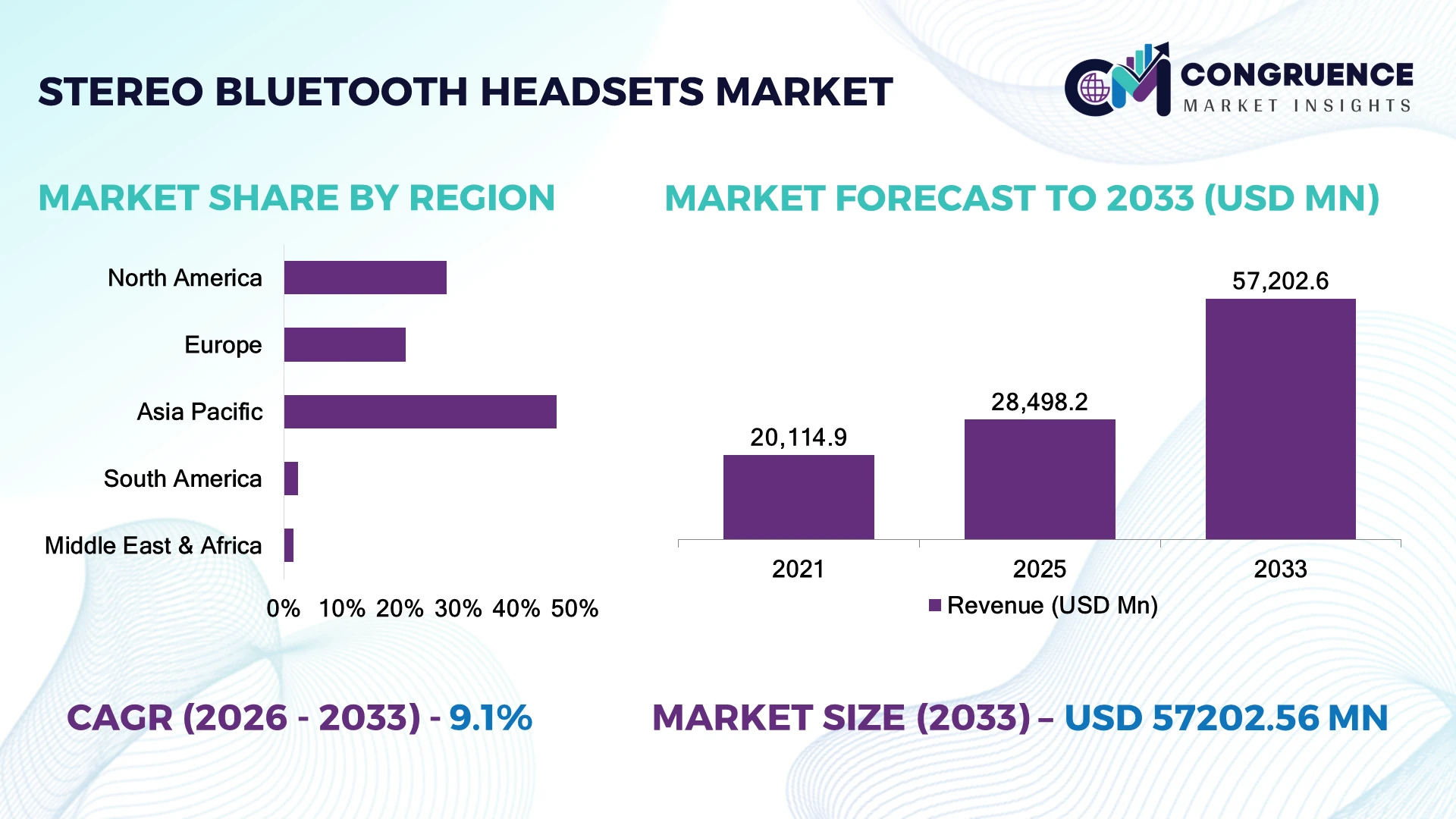
China dominates the market with approximately 46% of global manufacturing capacity, supported by vertically integrated electronics supply chains, advanced semiconductor packaging, and large-scale OEM production. Production output is nearly 3.1 times higher than Vietnam, while automated assembly lines improve manufacturing efficiency by approximately 24%. Ongoing global supply-chain diversification following tariff realignments in 2026 is encouraging complementary production expansion across Southeast Asia without reducing China's manufacturing leadership.
Companies prioritizing AI-enabled audio innovation, resilient component sourcing, and regional manufacturing flexibility will strengthen long-term competitive positioning.
Market Size & Growth: USD 28,498.2 million in 2025 reaching USD 57,202.6 million by 2033 at 9.1% CAGR, driven by AI-powered audio and premium TWS adoption.
Top Growth Drivers: TWS adoption (+27%), hybrid work (+19%), mobile gaming (+18%).
Short-Term Forecast: By 2028, battery efficiency improves 16% while charging time declines 14%.
Emerging Technologies: AI noise cancellation, Bluetooth LE Audio, spatial audio, and adaptive codecs reshape premium devices.
Regional Leaders: Asia-Pacific (~USD 29 billion), North America (~USD 12 billion), Europe (~USD 9 billion), supported by premium wireless adoption.
Consumer/End-User Trends: Nearly 68% of premium buyers prioritize ANC and extended battery life.
Pilot/Case Example: A 2026 smart wearable deployment improved voice call clarity by approximately 22%.
Competitive Landscape: Top five brands control nearly 58% of premium shipments through ecosystem integration.
Regulatory & ESG Impact: Recycled materials increase by 17% across premium headset portfolios amid sustainability initiatives.
Investment & Funding: More than USD 2.6 billion supports audio AI, semiconductor integration, and manufacturing expansion.
Innovation & Future Outlook: On-device AI, health sensing, and low-latency audio define next-generation competitive advantage.
The Stereo Bluetooth Headsets market is evolving through tighter integration with wearable ecosystems, AI-powered audio enhancement, and premium entertainment applications. Approximately 39% of new premium launches now incorporate Bluetooth LE Audio and adaptive sound optimization, while component localization improves production resilience amid continuing electronics supply-chain adjustments. These developments establish the foundation for the market's next phase of competitive transformation.
The Stereo Bluetooth Headsets market has become strategically important as consumer electronics companies compete through ecosystem integration, intelligent audio experiences, and differentiated semiconductor capabilities rather than hardware specifications alone. Supply-chain restructuring across Asia and expanding AI functionality are reshaping product roadmaps, procurement strategies, and manufacturing investments. Companies increasingly view wireless audio devices as integral components of connected digital ecosystems spanning smartphones, wearables, gaming, and enterprise collaboration.
Headsets equipped with Bluetooth LE Audio and AI-based adaptive sound processing improve power efficiency by approximately 21% and reduce audio latency by nearly 28% compared with conventional Bluetooth implementations. China continues leading large-scale manufacturing and component integration, while South Korea drives premium innovation through advanced chipsets, codec optimization, and intelligent audio technologies. Over the next two to three years, AI-assisted voice enhancement and personalized audio calibration are expected to become standard across premium wireless devices.
Manufacturers are expanding regional assembly operations, strengthening semiconductor partnerships, and investing in proprietary software platforms that enhance user retention across connected device ecosystems. Premium brands are also integrating health monitoring, multilingual voice processing, and spatial audio capabilities into flagship models. Companies combining software differentiation, resilient manufacturing networks, and advanced wireless technologies will secure stronger competitive positioning as intelligent personal audio becomes a central category within the global consumer electronics market.
AI-powered audio processing and deeper integration with connected consumer ecosystems are reshaping purchasing priorities across the Stereo Bluetooth Headsets market. Approximately 64% of premium headset launches now feature adaptive noise cancellation, while AI voice enhancement improves call clarity by nearly 23% and battery optimization extends playback time by around 17%. South Korea continues advancing audio chipset innovation through dedicated AI processors integrated into flagship devices. This technological shift is increasing replacement cycles and encouraging consumers to upgrade beyond conventional wireless models. Manufacturers are expanding semiconductor partnerships, investing in proprietary audio algorithms, and accelerating development of ecosystem-compatible products. A key strategic advantage increasingly belongs to brands delivering seamless interoperability across smartphones, wearables, tablets, and personal computing devices.
Persistent dependence on specialized Bluetooth chipsets, premium batteries, and MEMS microphones continues creating structural cost pressure across the industry. Advanced semiconductor components account for approximately 31% of premium headset manufacturing costs, while lithium battery price fluctuations have increased procurement expenses by nearly 12% in recent sourcing cycles. Vietnam-based contract manufacturers continue facing supply balancing challenges when premium audio components experience allocation constraints. These disruptions compress margins and delay product launches, particularly for mid-tier brands. Companies are mitigating exposure through multi-country sourcing strategies, long-term semiconductor supply agreements, localized assembly expansion, and greater investment in standardized component platforms that improve procurement flexibility and manufacturing resilience.
The convergence of wireless audio, health monitoring, and AI-driven personal assistance is creating high-value growth opportunities beyond traditional entertainment applications. Approximately 36% of premium headset development programs now include biometric sensing or wellness-related capabilities, while on-device AI reduces voice processing latency by nearly 19%. Japan is accelerating development of intelligent wearable ecosystems combining personal audio, translation, and health functions within compact consumer devices. Companies are expanding R&D investments, partnering with digital health and semiconductor firms, and integrating advanced sensors into premium product portfolios. A non-obvious opportunity lies in enterprise productivity, where AI-enhanced headsets increasingly support multilingual collaboration, remote work, and professional communication environments.
Maintaining consistent software performance across diverse operating systems, Bluetooth standards, and connected devices remains a significant execution challenge. Approximately 27% of customer support requests originate from cross-platform compatibility issues, while firmware optimization increases development complexity by nearly 18%. The rapid adoption of Bluetooth LE Audio and next-generation codecs is placing additional pressure on manufacturers to maintain backward compatibility without sacrificing premium functionality. Companies must strengthen software engineering capabilities, expand interoperability testing, and collaborate closely with chipset developers and smartphone manufacturers. Long-term competitiveness depends on delivering seamless firmware updates, stable ecosystem integration, and reliable multi-device connectivity across increasingly complex digital environments.
AI Audio Personalization Expands: AI-powered sound optimization is becoming standard across premium wireless headsets, with approximately 42% of new flagship models supporting adaptive listening profiles and nearly 24% improving speech enhancement accuracy. Technology transitions toward on-device AI are encouraging manufacturers to strengthen software development and proprietary audio ecosystems.
Bluetooth LE Audio Adoption: Bluetooth LE Audio deployment has expanded by approximately 34% across premium launches, reducing power consumption by nearly 18% while improving multi-device connectivity. Companies are restructuring product portfolios around next-generation chipsets and forming closer partnerships with semiconductor suppliers to accelerate ecosystem compatibility and premium differentiation.
Localized Manufacturing Diversifies Supply: Electronics manufacturers are expanding assembly operations beyond China, increasing Southeast Asian production capacity by approximately 21% and reducing logistics lead times by nearly 15%. Continuing supply-chain diversification is improving sourcing resilience while enabling faster regional product launches and greater operational flexibility for global consumer electronics brands.
Premium Gaming Audio Growth: Low-latency stereo headsets designed for gaming and immersive entertainment have increased shipment volumes by approximately 26%, while spatial audio adoption has grown by nearly 20%. Manufacturers are integrating advanced codec technologies, collaborating with gaming platforms, and optimizing wireless performance to capture higher-value consumer segments beyond conventional mobile audio usage.
True Wireless Stereo (TWS) headsets account for approximately 69% of the global Stereo Bluetooth Headsets market due to their compact design, cable-free convenience, seamless smartphone integration, and continuous improvements in battery life and AI-powered audio features. Their compatibility with voice assistants, premium codecs, and active noise cancellation has positioned TWS devices as the preferred option across consumer and enterprise applications. Neckband headsets continue serving cost-sensitive users seeking extended battery life, while over-ear wireless models maintain demand among gaming, professional audio, and premium entertainment segments.
Over-ear Bluetooth headsets represent the fastest-growing type as demand rises for immersive audio, hybrid work, and gaming experiences requiring superior sound quality and extended wearing comfort. Premium over-ear models improve battery endurance by approximately 22% and increase active noise cancellation performance by nearly 18% compared with earlier generations. Manufacturers are expanding premium portfolios, integrating AI audio processing, and strengthening semiconductor partnerships to differentiate flagship devices. Investment is steadily shifting toward intelligent premium products while value-focused neckband models continue supporting high-volume emerging markets.
A 2026 enterprise wearable technology assessment by the Bluetooth Special Interest Group observed continued acceleration in True Wireless Stereo adoption across personal audio ecosystems, supported by expanding Bluetooth LE Audio deployment and connected device integration.
Music and entertainment account for approximately 48% of global Stereo Bluetooth Headsets demand because streaming services, video platforms, and immersive audio experiences continue driving high-frequency daily usage. Consumers increasingly prioritize sound quality, active noise cancellation, and long battery life when purchasing premium wireless headsets. Voice communication remains a mature application supported by hybrid work environments, while gaming continues expanding through low-latency wireless audio and spatial sound technologies designed for competitive play.
Gaming represents the fastest-growing application as mobile gaming, cloud gaming, and esports adoption continue increasing demand for premium wireless audio devices. Low-latency technologies reduce audio delay by approximately 26%, while AI-based voice enhancement improves multiplayer communication quality by nearly 21%. Manufacturers are introducing gaming-focused product lines, optimizing proprietary wireless protocols, and collaborating with gaming ecosystem providers to strengthen product differentiation. Demand is increasingly shifting toward multi-functional headsets capable of supporting entertainment, communication, and gaming within a single connected audio platform.
A 2025 enterprise consumer electronics survey released through the Consumer Technology Association highlighted increasing demand for premium wireless audio devices supporting entertainment, gaming, and professional communication across connected digital lifestyles.
Individual consumers account for approximately 76% of global Stereo Bluetooth Headsets purchases owing to widespread smartphone ownership, streaming media consumption, fitness activities, and demand for premium personal audio experiences. Frequent replacement cycles, ecosystem compatibility, and rapid innovation continue sustaining strong retail demand. Corporate users remain an established customer group through hybrid work adoption, while educational institutions are gradually increasing procurement for digital learning and collaborative communication environments.
Enterprise and commercial users represent the fastest-growing end-user segment as organizations invest in professional collaboration tools, unified communications, and AI-enabled conferencing solutions. Enterprise headset deployments have expanded by approximately 24%, while productivity improvements associated with advanced noise suppression have reached nearly 18% in collaborative work environments. Manufacturers are strengthening enterprise distribution partnerships, offering customized device management platforms, and introducing subscription-based lifecycle services. Competitive positioning is increasingly influenced by software integration, security capabilities, and centralized fleet management rather than hardware performance alone.
A 2026 workplace technology assessment conducted by the Bluetooth Special Interest Group indicated sustained expansion of enterprise-grade wireless audio deployments as organizations accelerated adoption of Bluetooth-enabled collaboration devices across hybrid work environments.
Asia-Pacific accounted for the largest market share at 46.8% in 2025 however, North America is expected to register the fastest growth, expanding at a CAGR of 9.8% between 2026 and 2033.
AI Audio Ecosystems Drive Premium Device Adoption
North America remains a high-value market for Stereo Bluetooth Headsets, supported by strong consumer spending, rapid adoption of AI-enabled wearables, and mature digital entertainment ecosystems. The region contributes approximately 28% of global demand, with premium True Wireless Stereo devices dominating retail sales. Around 52% of newly launched premium headsets incorporate AI-enhanced voice processing and adaptive noise cancellation, reflecting rising demand for productivity and immersive entertainment. Hybrid work expansion and gaming continue accelerating enterprise and consumer adoption. Manufacturers are strengthening semiconductor partnerships, expanding software capabilities, and increasing regional inventory hubs to improve product availability while supporting faster product refresh cycles and ecosystem integration.
United States Market Outlook: The United States leads the regional market through its advanced consumer electronics ecosystem, premium smartphone penetration, and leadership in AI-enabled wearable innovation. More than 68% of premium headset purchases are concentrated in the country, supported by extensive adoption across remote work, digital entertainment, and mobile gaming. Technology companies continue investing in proprietary wireless platforms, intelligent audio software, and seamless multi-device connectivity to strengthen customer retention and premium product differentiation.
Premium Audio Innovation Supports Sustainable Growth
Europe maintains strong demand through premium consumer electronics adoption, sustainability-focused product design, and widespread use of wireless communication devices. The region represents approximately 21% of global demand, with consumers increasingly prioritizing audio quality, battery efficiency, and environmentally responsible products. Nearly 38% of premium headset launches now incorporate recycled materials and modular packaging alongside advanced wireless technologies. Manufacturers continue expanding repair programs, software updates, and localized distribution strategies to strengthen long-term customer engagement and product lifecycle value.
Germany Market Outlook: Germany serves as the region's leading market because of its strong consumer electronics purchasing power, advanced retail infrastructure, and demand for premium connected devices. AI-enabled wireless headsets are increasingly adopted across business communications and entertainment applications. Strong automotive and industrial technology ecosystems also encourage innovation partnerships supporting advanced wireless audio technologies and intelligent connectivity solutions.
Manufacturing Scale Strengthens Global Leadership
Asia-Pacific dominates the global Stereo Bluetooth Headsets market through integrated electronics manufacturing, semiconductor production, and large-scale consumer demand. The region accounts for approximately 46.8% of global market activity, supported by high smartphone penetration and extensive OEM production capabilities. Automated manufacturing has increased production efficiency by nearly 23%, while localized component sourcing continues improving operational resilience. Global brands are expanding assembly facilities, strengthening supplier ecosystems, and investing in AI-enabled audio technologies to support premium product development and faster commercialization.
China Market Outlook: China remains the industry's manufacturing and consumption leader due to its extensive electronics supply chain, advanced assembly infrastructure, and strong domestic consumer demand. Approximately 46% of global wireless headset production capacity is concentrated in the country, supported by vertically integrated manufacturing and rapid innovation cycles. Companies continue expanding automated production lines and semiconductor integration capabilities to reinforce global competitiveness.
Affordable Wireless Devices Expand Consumer Reach
South America is experiencing increasing demand for Stereo Bluetooth Headsets as smartphone usage, digital entertainment, and e-commerce penetration continue expanding across major economies. Brazil and Argentina account for most regional consumption, supported by growing adoption of affordable True Wireless Stereo devices. Approximately 27% of online consumer electronics purchases now include wireless audio products, reflecting changing retail behavior. International brands are strengthening regional distribution partnerships while balancing logistics costs and import dependencies through localized inventory management and expanded retail networks.
Brazil Market Outlook: Brazil leads regional demand through its large consumer electronics market, expanding online retail ecosystem, and increasing adoption of wireless accessories. Premium and mid-range headset sales continue rising alongside smartphone upgrades and digital media consumption. Retailers are expanding omnichannel sales strategies and localized customer support, improving accessibility for advanced wireless audio products across urban consumer markets.
Digital Lifestyle Transformation Accelerates Adoption
The Middle East & Africa market is advancing through expanding smartphone ownership, digital lifestyle adoption, and increasing investment in connected consumer technologies. Premium wireless headsets are gaining traction among younger consumers, professionals, and gaming communities seeking advanced audio experiences. Approximately 19% of premium consumer electronics retail expansion now includes dedicated wireless audio product categories. Global brands continue strengthening regional partnerships, expanding retail presence, and improving after-sales service to support sustained market development and brand loyalty.
United Arab Emirates Market Outlook: The United Arab Emirates represents the region's most influential market through its high disposable income, premium consumer electronics demand, and advanced retail infrastructure. Wireless headset adoption is accelerating across entertainment, business communication, and travel applications. Strong digital commerce platforms and premium retail channels continue supporting rapid introduction of AI-enabled audio devices and next-generation wireless technologies into the domestic market.
Apple, Samsung, Sony, Bose, and JBL compete for premium ecosystem users, while Anker, JLab, and Xiaomi challenge through aggressive pricing and feature-rich value products. OEM manufacturers compete behind global brands on speed and manufacturing efficiency. The top five brands collectively account for approximately 61% of global premium shipments. Competition is driven by AI audio capabilities, ecosystem integration, battery life, and semiconductor optimization. AI-powered noise cancellation improves voice clarity by approximately 24%, Bluetooth LE Audio enhances power efficiency by nearly 18%, and localized manufacturing reduces supply lead times by around 16%. Companies are expanding regional production, strengthening chipset partnerships, integrating proprietary software, and accelerating AI feature development. Competitive momentum is shifting from hardware differentiation toward intelligent software ecosystems, personalized audio, and wearable integration. High R&D investment, brand loyalty, and proprietary ecosystem compatibility remain the strongest entry barriers. Winning requires AI-first audio experiences, seamless cross-device integration, resilient manufacturing, and continuous software innovation.
Apple Inc.
Samsung Electronics Co., Ltd.
Sony Group Corporation
Bose Corporation
Sennheiser Electronic SE
Xiaomi Corporation
Anker Innovations Technology Co., Ltd.
JBL
Skullcandy, Inc.
Shokz
Logitech International S.A.
JLab Audio
Huawei Technologies Co., Ltd.
Stereo Bluetooth Headsets are rapidly evolving through AI-powered audio processing, Bluetooth LE Audio, adaptive active noise cancellation, and advanced codec technologies. AI-based sound optimization improves speech clarity by approximately 22%, while adaptive power management extends battery efficiency by nearly 18%. Around 63% of newly introduced premium wireless headsets now integrate AI-assisted audio personalization, reflecting the industry's shift toward software-defined listening experiences rather than hardware-only differentiation.
Emerging technologies include spatial audio, Auracast broadcasting, edge AI voice processing, biometric sensing, and intelligent multi-device connectivity. Compared with conventional Bluetooth audio platforms, Bluetooth LE Audio improves transmission efficiency by approximately 30% while reducing energy consumption by nearly 20%. Premium brands with proprietary chipsets and integrated smartphone ecosystems gain the greatest competitive advantage because intelligent software delivers seamless connectivity, personalized sound profiles, and continuous firmware enhancement beyond initial hardware capabilities.
Between 2026 and 2028, AI assistants embedded directly within headsets, real-time language translation, health monitoring, and context-aware audio optimization will redefine premium wireless audio. Manufacturers investing in custom silicon, machine-learning algorithms, and ecosystem integration will strengthen customer retention while expanding subscription-based digital services. Early adoption delivers superior user experience, longer device relevance, lower operating power, and stronger differentiation as intelligent wearables become central to connected consumer ecosystems.
May 2024 – Sony launched the WF-1000XM5 globally with enhanced AI-based noise cancellation and redesigned drivers, delivering up to 20% better call quality through upgraded microphone processing. The release strengthened Sony's premium TWS positioning. Source: Sony Newsroom
September 2024 – Apple introduced AirPods 4 with the H2 chip and Active Noise Cancellation, expanding advanced audio features into a broader product tier while improving voice isolation and ecosystem integration. Business impact: accelerated premium wireless audio adoption. Source: Apple Newsroom
February 2026 – Samsung unveiled the Galaxy Buds4 series featuring enhanced Adaptive EQ, AI integration, and a redesigned acoustic architecture with a wider woofer to improve sound quality and comfort across premium earbuds. (Samsung Global Newsroom) Source: Samsung Global Newsroom
July 2026 – Skullcandy introduced Crusher 1080 ANC headphones integrating Bose audio technologies, offering up to 60 hours of battery life and advanced adaptive noise cancellation. The partnership strengthened premium feature accessibility at a competitive price point.
This report provides comprehensive analysis of the global Stereo Bluetooth Headsets market across product types, applications, end-user segments, technology platforms, and major geographic markets. It evaluates True Wireless Stereo, neckband, over-ear, and on-ear devices deployed across music streaming, gaming, enterprise communication, fitness, and professional collaboration. The assessment includes AI-powered audio processing, Bluetooth LE Audio, spatial audio, adaptive noise cancellation, battery technologies, semiconductor integration, and evolving ecosystem strategies adopted by leading manufacturers.
The report delivers strategic intelligence covering market developments between 2026 and 2033, highlighting adoption patterns, deployment trends, and competitive positioning across mature and emerging markets. More than 65% of premium product launches emphasize AI-enabled audio and connected ecosystem compatibility, while enterprise deployments continue expanding through hybrid work environments. The analysis supports investment planning, product development, regional expansion, supply-chain optimization, partnership evaluation, and competitive benchmarking by identifying technology transitions, high-growth application segments, and evolving consumer purchasing behavior across the global wireless audio industry.
| Report Attribute/Metric | Report Details |
|---|---|
|
Market Revenue in 2025 |
USD 28,498.2 Million |
|
Market Revenue in 2033 |
USD 57,202.6 Million |
|
CAGR (2026 - 2033) |
9.1% |
|
Base Year |
2025 |
|
Forecast Period |
2026 - 2033 |
|
Historic Period |
2021 - 2025 |
|
Segments Covered |
By Type
By Application
By End-User
|
|
Key Report Deliverable |
Revenue Forecast, Growth Trends, Market Dynamics, Segmental Overview, Regional and Country-wise Analysis, Competition Landscape |
|
Region Covered |
North America, Europe, Asia-Pacific, South America, Middle East, Africa |
|
Key Players Analyzed |
Apple Inc., Samsung Electronics Co., Ltd., Sony Group Corporation, Bose Corporation, Sennheiser Electronic SE, Xiaomi Corporation, Anker Innovations Technology Co., Ltd., JBL, Skullcandy, Inc., Shokz, Logitech International S.A., JLab Audio, Huawei Technologies Co., Ltd. |
|
Customization & Pricing |
Available on Request (10% Customization is Free) |




