
Reports
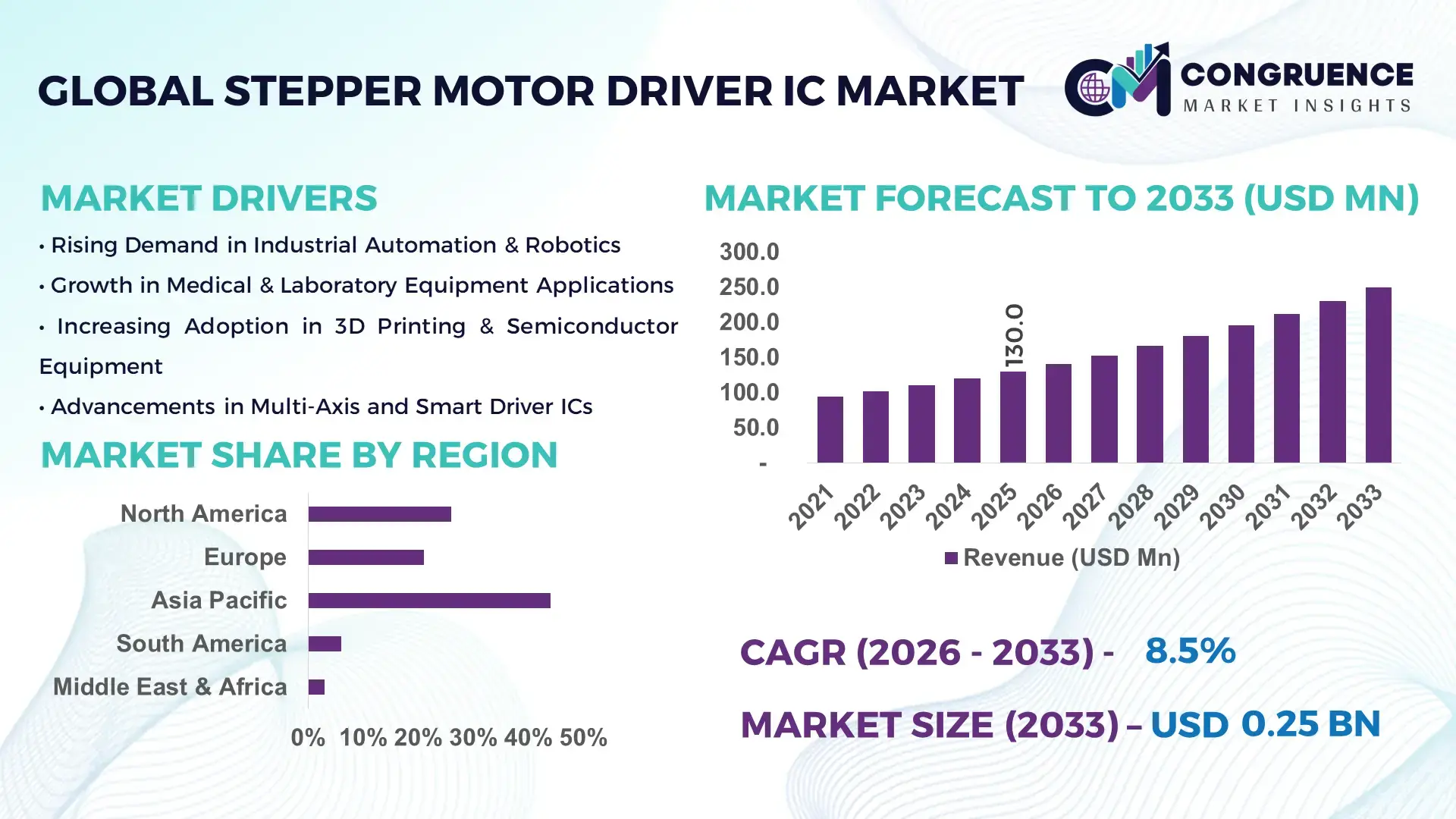
The Global Stepper Motor Driver IC Market was valued at USD 130.0 Million in 2025 and is anticipated to reach a value of USD 249.7 Million by 2033 expanding at a CAGR of 8.5% between 2026 and 2033, according to an analysis by Congruence Market Insights. This growth is primarily driven by the rising integration of precision motion control solutions across industrial automation, medical devices, and advanced manufacturing systems.
China currently dominates the Stepper Motor Driver IC Market through its large-scale semiconductor fabrication base and vertically integrated electronics supply chain. The country operates more than 30 dedicated mixed-signal and power IC fabrication facilities supporting motor control production, with annual output exceeding 4.5 billion motor control IC units across consumer and industrial categories. In 2024, China invested over USD 45 billion in domestic semiconductor manufacturing expansion, including multiple 12-inch wafer fabs dedicated to automotive and industrial-grade ICs. Stepper motor driver ICs are widely deployed in CNC machinery, textile automation, 3D printing systems, and battery manufacturing equipment, with industrial automation accounting for nearly 38% of domestic unit consumption. Technological progress includes sub-40 nm mixed-signal nodes for low-noise drivers and integrated diagnostics modules improving fault detection accuracy by more than 25%.
Market Size & Growth: USD 130.0 Million in 2025, projected to reach USD 249.7 Million by 2033, growing at 8.5% CAGR, supported by rising automation intensity across manufacturing.
Top Growth Drivers: Industrial automation adoption +42%, robotics deployment +36%, energy-efficient motor control penetration +29%.
Short-Term Forecast: By 2028, driver IC power efficiency is expected to improve by 18%, reducing system-level thermal losses.
Emerging Technologies: Integrated current-sensing drivers, AI-enabled fault diagnostics, multi-axis driver SoC platforms.
Regional Leaders: Asia Pacific USD 102.5 Million by 2033 with electronics manufacturing growth; North America USD 74.2 Million driven by robotics; Europe USD 58.9 Million supported by factory automation upgrades.
Consumer/End-User Trends: Industrial machinery represents 41% of deployments, followed by medical equipment at 17% and office automation at 14%.
Pilot or Case Example: In 2024, a German robotics plant reduced positioning error by 22% using advanced microstepping driver ICs.
Competitive Landscape: Market leader holds ~18% share, followed by 5 major competitors each holding 6–10%.
Regulatory & ESG Impact: Energy efficiency directives are driving 25% lower standby power consumption in new driver designs.
Investment & Funding Patterns: Over USD 3.8 Billion invested in motor control IC fabs and R&D during 2023–2025.
Innovation & Future Outlook: Integration of multi-protocol interfaces and predictive maintenance features is shaping next-generation platforms.
The Stepper Motor Driver IC Market serves industrial automation (41%), robotics (22%), medical devices (17%), and office automation (11%). Recent innovations include integrated thermal protection reducing failure rates by 19% and microstepping resolution improvements of 32%. Regulatory focus on energy efficiency and regional reshoring policies are influencing production localization. Asia Pacific remains the largest consumption base, while smart factories and autonomous systems are shaping future demand patterns.
The Stepper Motor Driver IC Market holds strategic importance as a core enabler of precision motion control across advanced manufacturing, robotics, medical instrumentation, and semiconductor equipment. Modern driver IC platforms integrate current regulation, microstepping control, diagnostics, and communication interfaces, reducing system complexity by up to 28% compared to discrete driver architectures. Digital microstepping technology delivers 35% improvement in positional accuracy compared to legacy full-step drivers, directly supporting high-precision production requirements.
Asia Pacific dominates in volume due to large-scale electronics manufacturing, while Europe leads in adoption with nearly 46% of advanced factories deploying digitally controlled motor driver platforms. By 2028, AI-assisted motor control algorithms are expected to cut unplanned equipment downtime by 24% through predictive fault detection and adaptive current tuning. Firms are committing to ESG improvements such as 30% reduction in driver IC standby power consumption by 2030 to comply with industrial energy efficiency regulations.
In 2024, a Japanese robotics manufacturer achieved a 21% improvement in assembly line throughput by deploying multi-axis driver ICs with integrated diagnostics and closed-loop feedback control. Short-term projections indicate that by 2029, smart driver IC platforms will improve system-level energy efficiency by 19% and reduce maintenance cycles by 26%. The Stepper Motor Driver IC Market is positioned as a pillar of resilience, compliance, and sustainable growth across digitally enabled industrial ecosystems.
The Stepper Motor Driver IC Market dynamics are shaped by the convergence of industrial automation, robotics adoption, and precision manufacturing requirements. Demand is closely linked to factory digitization, where more than 62% of new production lines integrate electronically controlled motion systems. Technological evolution toward integrated driver ICs combining control logic, protection circuits, and communication interfaces is reducing board area by 35% and improving system reliability. At the same time, supply chain localization, automotive electrification, and medical device expansion are creating new application segments. However, design complexity, semiconductor capacity constraints, and qualification cycles influence deployment timelines and cost structures.
Industrial automation is a primary growth driver, with over 68% of new factories incorporating automated motion control systems. Stepper motor driver ICs enable precise positioning in CNC machines, packaging lines, and semiconductor tools, where positioning accuracy below 0.01 mm is required. Global robot installations surpassed 590,000 units annually, with each system integrating 6–20 driver IC channels. Automation intensity has improved manufacturing throughput by 27% and reduced defect rates by 19%, directly increasing demand for high-performance driver IC platforms.
Semiconductor capacity constraints remain a restraint, with analog and mixed-signal fabs operating above 85% utilization rates. Qualification cycles for industrial-grade ICs extend beyond 12–18 months, delaying new product introductions. Rising wafer costs, which increased by 22% between 2022 and 2024, are impacting pricing flexibility. Additionally, long certification cycles in medical and automotive applications slow market penetration despite strong demand fundamentals.
Robotics and medical automation offer strong opportunities, with surgical robot installations growing by 31% annually and diagnostic automation expanding across 44% of new hospital labs. Advanced driver ICs enable sub-micron positioning accuracy and low-noise operation critical for imaging and surgical systems. Battery-powered medical devices are increasing demand for low-power drivers achieving 28% longer operating life. Multi-axis integration further opens opportunities in compact robotic platforms.
Increasing integration complexity presents a challenge as modern driver ICs combine sensing, protection, and communication in single packages. Verification cycles now exceed 14 weeks per design, increasing development cost by 26%. EMC compliance requirements are tightening, forcing redesigns in 18% of industrial platforms. Thermal management is another challenge, as power density has increased by 33% over five years, raising reliability risks in compact enclosures.
Integration of Smart Diagnostics and Predictive Control: Over 52% of newly launched driver ICs now integrate fault detection and temperature monitoring, reducing unplanned downtime by 24%. Predictive control algorithms have improved maintenance planning accuracy by 31% across smart factories.
Expansion of Multi-Axis Driver Platforms: Multi-axis driver IC adoption has increased by 38%, enabling compact robotic arms and reducing PCB area by 42%. These platforms support synchronized motion with positioning error reduced by 29%.
Shift Toward Energy-Efficient Motor Control: Low-power driver designs have reduced standby power consumption by 27%, supporting compliance with industrial energy efficiency standards and cutting operating energy use by 18%.
Rise in Modular and Prefabricated Construction: The adoption of modular construction is reshaping demand dynamics in the Stepper Motor Driver IC Market. Research suggests that 55% of new projects achieved cost benefits through modular practices. Automated prefabrication increased precision equipment deployment by 34%, driving higher consumption of high-accuracy driver ICs in Europe and North America.
The Stepper Motor Driver IC Market is segmented by type, application, and end-user, reflecting the diverse precision control requirements across industrial and commercial systems. By type, the market ranges from basic full-step drivers to advanced microstepping and digitally controlled driver ICs that integrate diagnostics and communication interfaces. Adoption patterns show a clear shift toward highly integrated, low-noise, and energy-efficient platforms as factories digitize and equipment miniaturizes. By application, industrial automation remains the anchor segment, supported by robotics, medical devices, and office automation systems where positioning accuracy below 0.01 mm is required. End-user segmentation highlights manufacturing enterprises as the primary adopters, followed by healthcare and electronics OEMs. Across segments, higher integration density, multi-axis control, and embedded protection features are increasingly determining procurement decisions, while reliability standards and lifecycle cost considerations influence long-term deployment strategies.
The Stepper Motor Driver IC Market by type is led by microstepping driver ICs, which currently account for approximately 46% of total adoption, driven by their ability to deliver smoother motion, lower vibration, and up to 35% improvement in positioning accuracy compared to full-step drivers. Traditional full-step and half-step driver ICs together represent nearly 24% of deployments, primarily in cost-sensitive office automation and entry-level industrial equipment. However, digitally controlled smart driver ICs are the fastest-growing type, expanding at an estimated 11.2% CAGR, supported by the integration of diagnostics, SPI/I²C interfaces, and adaptive current control in next-generation automation systems. Integrated multi-axis driver SoCs are gaining traction in robotics, reducing component count by 38% and lowering PCB area by 42%. The remaining niche segments, including legacy discrete driver modules and custom ASIC-based drivers, together contribute around 30% of total installations, serving specialized equipment and long-life industrial platforms.
In 2025, a national robotics program deployed digitally controlled microstepping drivers across over 12,000 industrial robots, reducing positioning error by 28% and cutting maintenance interventions by 21%.
By application, industrial automation dominates with nearly 41% of total deployments, supported by CNC machines, packaging lines, and semiconductor equipment where high repeatability and torque stability are critical. Robotics systems account for approximately 23% of adoption, while medical devices represent 17%, driven by imaging, diagnostics, and surgical platforms requiring ultra-low noise control. Office automation, 3D printing, and consumer electronics together contribute a combined 19%. The fastest-growing application is collaborative robotics and autonomous manufacturing, expanding at an estimated 12.6% CAGR, supported by rising installation of smart factories and flexible production cells.
In 2025, more than 44% of global manufacturers reported deploying precision motion control upgrades in at least one production line. Over 39% of hospitals in developed markets are testing automated diagnostic platforms using precision motor control for sample handling and imaging alignment.
In 2024, a public healthcare modernization program equipped over 180 hospitals with automated diagnostic analyzers using precision stepper drivers, improving sample throughput by 32% and reducing processing errors by 18%.
By end-user, manufacturing enterprises lead with nearly 48% of total usage, reflecting widespread adoption across automotive, electronics, and machinery production. Healthcare institutions and medical device OEMs account for around 21%, followed by electronics and consumer device manufacturers at 17%. Research institutions and logistics automation together represent the remaining 14%. The fastest-growing end-user group is medical and life sciences automation, expanding at an estimated 13.1% CAGR, driven by laboratory automation, imaging platforms, and robotic-assisted procedures.
In 2025, more than 46% of global factories reported increasing investment in digitally controlled motion systems for quality improvement. In the US, 42% of hospitals are testing automated sample preparation and imaging alignment systems using precision stepper drivers.
In 2025, a national laboratory automation initiative enabled over 600 diagnostic centers to deploy robotic analyzers using smart driver ICs, improving daily test throughput by 29% and reducing manual handling errors by 24%.
Asia-Pacific accounted for the largest market share at 44% in 2025 however, North America is expected to register the fastest growth, expanding at a CAGR of 9.6% between 2026 and 2033.

Asia-Pacific led global unit consumption with more than 2.1 billion stepper motor driver IC units deployed across electronics manufacturing, industrial automation, and battery equipment. North America represented nearly 26% of total installations, driven by robotics density exceeding 185 robots per 10,000 workers and factory automation penetration above 58%. Europe followed with 21% share, supported by over 42,000 CNC and automated production lines upgraded annually. South America and the Middle East & Africa together contributed 9%, but recorded double-digit increases in industrial automation projects, exceeding 14,000 new motion-controlled systems installed in 2025. Regional demand is increasingly shaped by reshoring policies, energy efficiency mandates, and smart factory investments exceeding USD 120 billion globally.
North America holds approximately 26% of the global Stepper Motor Driver IC Market, supported by strong demand from industrial automation, robotics, aerospace, and medical equipment manufacturing. More than 61% of new factories in the US and Canada integrate digitally controlled motion platforms. Government support includes federal incentives for advanced manufacturing and semiconductor localization, with over 120 automation-focused industrial projects approved in 2024. Technological trends emphasize closed-loop stepper systems, predictive maintenance integration, and low-noise drivers for medical imaging. A leading US-based motion control company expanded its multi-axis driver production capacity by 35% to meet robotics demand. Regional consumer behavior shows higher enterprise adoption in healthcare and advanced manufacturing, with over 48% of hospitals deploying automated diagnostic and imaging alignment systems.
Europe accounts for nearly 21% of global installations, led by Germany, France, and the UK, which together contribute over 62% of regional demand. Germany alone operates more than 190,000 CNC and robotic workstations using precision drivers. Sustainability initiatives under industrial energy directives require 20–30% lower motor system losses, accelerating adoption of high-efficiency driver ICs. Digital transformation in factories has reached 54% penetration across Western Europe. A German automation firm recently introduced smart driver modules enabling 27% lower power consumption per axis. Regional behavior shows regulatory pressure leading to higher demand for explainable and traceable control systems, particularly in automotive and pharmaceutical manufacturing.
Asia-Pacific is the largest region with 44% market share and the highest deployment volume globally. China, Japan, and South Korea together account for more than 68% of regional consumption, while India records the fastest increase in new factory installations. The region operates over 3.8 million industrial robots and more than 420,000 automated production lines. Manufacturing clusters in Shenzhen, Osaka, and Seoul serve as innovation hubs for smart driver ICs and multi-axis platforms. A leading Japanese electronics firm expanded its motor control IC output by 40% to supply robotics OEMs. Regional consumer behavior shows growth driven by e-commerce logistics automation and mobile device manufacturing, with over 57% of new warehouses deploying automated motion systems.
South America contributes around 6% of global demand, led by Brazil and Argentina, which together represent over 72% of regional installations. Infrastructure modernization and renewable energy projects are driving adoption in conveyor systems, packaging lines, and grid automation. Government incentives in Brazil support automation upgrades across over 9,000 small and mid-sized factories. A regional automation integrator recently deployed precision motion systems across 140 food processing plants, improving throughput by 23%. Regional consumer behavior shows demand tied to localized manufacturing and export-oriented production, especially in agribusiness and packaging sectors.
Middle East & Africa represents about 3% of global installations, with growth concentrated in the UAE, Saudi Arabia, and South Africa. Oil & gas automation, construction equipment, and logistics hubs are primary demand drivers. Over 1,200 smart factory and infrastructure projects were initiated across the region in 2025. Trade partnerships and industrial free zones support electronics assembly and automation imports. A UAE-based industrial group deployed automated material handling systems across 18 logistics parks, reducing manual handling by 31%. Regional behavior reflects higher adoption in logistics, construction, and energy-sector automation.
China – 32% Market Share: High production capacity supported by large-scale electronics manufacturing and extensive industrial automation deployment.
United States – 18% Market Share: Strong end-user demand from robotics, aerospace, and medical automation supported by advanced manufacturing investments.
The Stepper Motor Driver IC Market is competitive with 30+ active global competitors vying for share in industrial automation, robotics, automotive, and consumer electronics segments. The market exhibits a semi-consolidated nature, where several large semiconductor firms lead through diversified portfolios while numerous specialized mid-tier players focus on niche applications such as medical automation and 3D printing. The top 5 companies collectively control an estimated 40–48% combined share of the overall market, reflecting a mix of broad market influence and fragmentary mid-tier participation. Major players continually strengthen positioning through strategic collaborations, product innovations, and regional expansions. For example, NXP Semiconductors formed a co-development partnership with Allegro MicroSystems in 2025 to accelerate high-precision digital motion solutions for industrial automation, reflecting a trend toward collaborative innovation and product diversification. Infineon, STMicroelectronics, and Texas Instruments have each launched advanced driver families with integrated protection, encoder interfaces, and higher current capabilities, directly addressing performance demands in sophisticated systems. Product launches increasingly emphasize energy efficiency improvements, integrated diagnostics, digital communication interfaces, and compact package designs that reduce board space and simplify system integration. Amid this competitive environment, innovation in multi-axis drivers, AI-enabled control algorithms, and microstepping enhancements continues to shape differentiation and long-term competitive advantage across market segments.
ON Semiconductor (onsemi)
Infineon Technologies AG
Allegro MicroSystems, Inc.
ROHM Semiconductor
Toshiba Electronic Devices & Storage Corporation
Microchip Technology Inc.
Renesas Electronics Corporation
Analog Devices, Inc.
Sanken Electric Co., Ltd.
Monolithic Power Systems (MPS)
Panasonic Corporation
Melexis NV
Diodes Incorporated
Current and emerging technologies are significantly shaping the Stepper Motor Driver IC Market by enhancing performance, integration, and system intelligence. Microstepping technologies are advancing resolution capabilities, enabling smoother motion with finer step increments that reduce vibration and torque ripple, crucial for precision applications in robotics, CNC systems, and medical devices. Integrated diagnostic features—such as built-in thermal protection, overcurrent/undervoltage lockout, and stall detection—are becoming standard, improving reliability and reducing maintenance costs. Digital communication interfaces like SPI, CAN, and EtherCAT are increasingly embedded in driver ICs, facilitating real-time configuration and monitoring between controllers and host systems. Emerging AI-enabled control algorithms optimize drive current and motion profiles, improving energy efficiency and dynamically adjusting performance based on load conditions. System-in-package (SiP) and multi-axis driver solutions dramatically reduce board area, power losses, and integration complexity, enabling compact designs ideal for space-constrained equipment such as handheld devices and collaborative robots.
Thermal performance innovations—such as enhanced heat-dissipation materials and package designs—allow driver ICs to handle higher current densities and extend operational life in industrial environments. Hardware support for closed-loop control and encoder feedback improves positioning precision while enabling adaptive response to mechanical wear and environmental disturbances. On the materials front, advances in substrate technologies and lower resistance MOSFET integration are reducing conduction losses and improving overall system efficiency. Collectively, these technologies are enabling systems with higher throughput, better energy utilization, and enhanced diagnostics without significantly increasing design complexity—critical for decision-makers looking to future-proof automation platforms and smart motion control solutions.
• In January 2026, Toshiba Electronics Europe GmbH launched a next-generation stepper motor driver IC (TB67S579FTG) featuring Advanced Microstep Technology with AGC2 and AWGS functions, delivering high efficiency, reduced vibration, and comprehensive protection functions for consumer and industrial equipment. Source: www.toshiba.semicon-storage.com
• In April 2025, STMicroelectronics showcased its industrial and enabling technologies, including advanced motion-control components, at electronica China 2025, highlighting expanded industrial solutions and future direction for stepper and motion control IC ecosystems in industrial and automotive sectors. Source: www.st.com
• In November 2024, Infineon Technologies launched a new generation of EiceDRIVER digital motor control ICs with integrated encoder interfaces, targeting higher performance and simplified integration for digital stepper and servo drives in automation systems.
• In June 2025, Analog Devices announced a collaboration with STMicroelectronics to deliver integrated motor-control solutions that combine ADI precision sensing with ST’s microcontrollers, improving sensorless and encoder-based stepper motor performance for advanced automation applications.
The Stepper Motor Driver IC Market Report provides a comprehensive and structured overview of the global motion control IC landscape, covering core segments such as product types, applications, end-user industries, and geographic regions. The report’s scope includes detailed analysis of bipolar, unipolar, integrated, and multi-axis driver ICs, capturing their technical differentiation and relative deployment across machinery, robotics, medical, automotive, and consumer electronics applications. End-user coverage spans industrial automation, healthcare equipment, automotive systems, robotics platforms, and office automation environments, illustrating how precision motion control requirements vary by system performance and reliability needs.
Geographically, the report examines major regional markets including Asia-Pacific, North America, Europe, South America, and the Middle East & Africa, with insights on consumption volumes, regional deployment patterns, infrastructure influences such as manufacturing density and automation investment, and local regulatory landscapes impacting energy efficiency and digital integration. The technology landscape section focuses on innovations in microstepping, digital interfacing, real-time diagnostics, and multi-axis integration, as well as supporting ecosystem developments like encoder interfaces and adaptive current control, which are critical for advanced applications requiring low noise and high torque stability.
Additionally, the report explores industry-specific trends such as robotics accuracy thresholds, CNC machine repeatability requirements, and diagnostic automation expectations in medical labs. Detailed competitive profiling, strategic initiative mapping (partnerships, product launches, capacity expansions), and regional adoption variations provide decision-makers with actionable insights on where opportunities lie, how technologies are evolving, and how market participants are positioning themselves across segments and regions, enabling informed strategic planning and investment decisions.
| Report Attribute / Metric | Details |
|---|---|
| Market Revenue (2025) | USD 130.0 Million |
| Market Revenue (2033) | USD 249.7 Million |
| CAGR (2026–2033) | 8.5% |
| Base Year | 2025 |
| Forecast Period | 2026–2033 |
| Historic Period | 2021–2025 |
| Segments Covered |
By Type
By Application
By End-User Insights
|
| Key Report Deliverables | Revenue Forecast, Market Trends, Growth Drivers & Restraints, Technology Insights, Segmentation Analysis, Regional Insights, Competitive Landscape, Regulatory & ESG Overview, Recent Developments |
| Regions Covered | North America, Europe, Asia-Pacific, South America, Middle East & Africa |
| Key Players Analyzed | Texas Instruments Inc., STMicroelectronics NV, NXP Semiconductors, ON Semiconductor (onsemi), Infineon Technologies AG, Allegro MicroSystems, Inc., ROHM Semiconductor, Toshiba Electronic Devices & Storage Corporation, Microchip Technology Inc., Renesas Electronics Corporation, Analog Devices, Inc., Sanken Electric Co., Ltd., Monolithic Power Systems (MPS), Panasonic Corporation, Melexis NV, Diodes Incorporated |
| Customization & Pricing | Available on Request (10% Customization Free) |




