
Reports
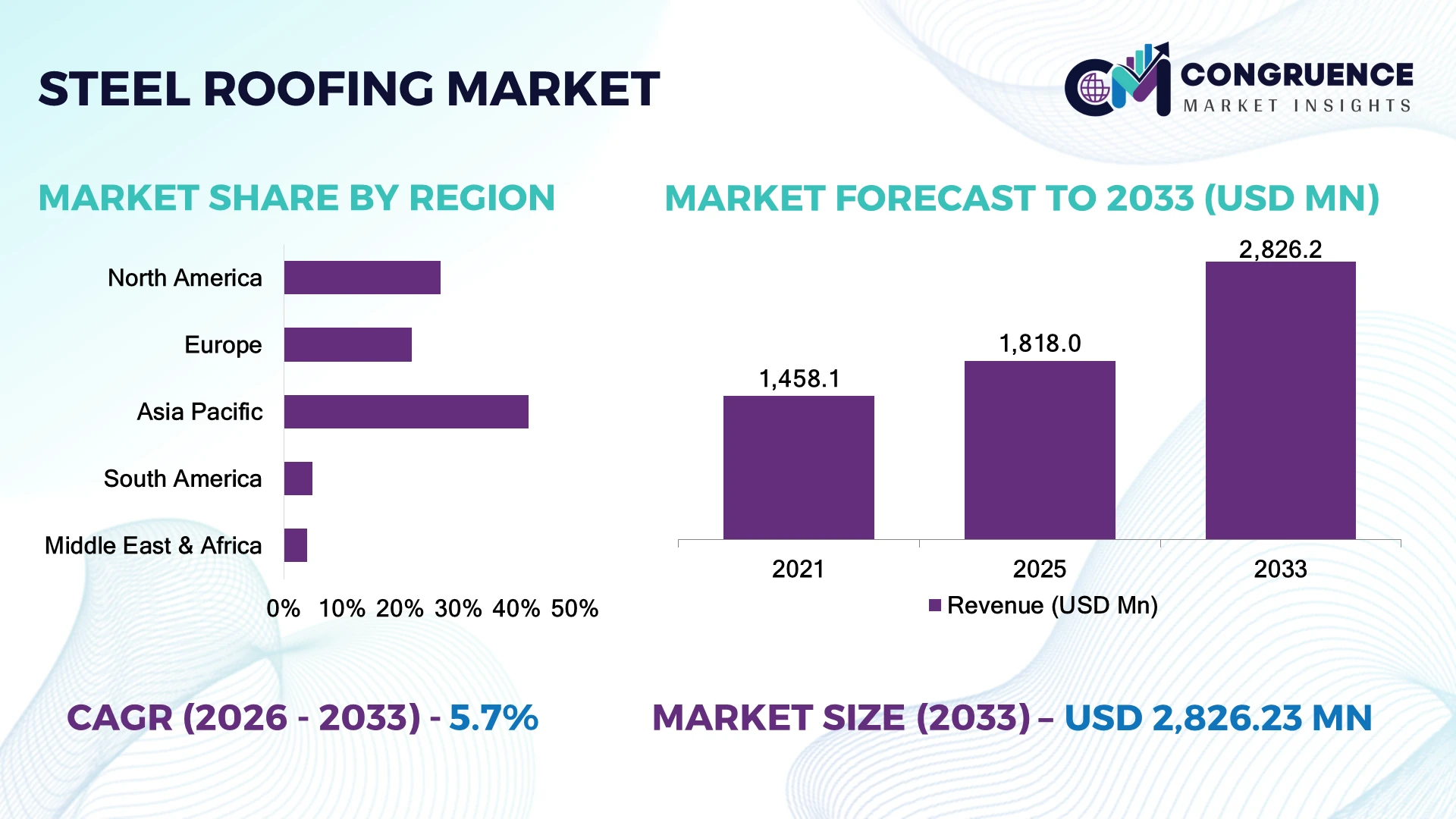
The Global Steel Roofing Market was valued at USD 1,818.0 Million in 2025 and is anticipated to reach a value of USD 2,826.2 Million by 2033 expanding at a CAGR of 5.67% between 2026 and 2033. Growth is being driven by accelerated replacement of aging roofing systems, rising adoption of corrosion-resistant coated steel panels, and large-scale infrastructure modernization programs across industrial and commercial sectors.
China remains the dominant country in the steel roofing market, accounting for approximately 32% of global steel roofing consumption, supported by annual crude steel production exceeding 1 billion tons and continued investment in logistics, manufacturing, and urban infrastructure projects. In comparison, the United States contributes nearly 14% of global demand, driven by reroofing activity and energy-efficient building upgrades. Advanced galvanized and Galvalume roofing penetration exceeds 55% in newly developed industrial facilities in China, highlighting strong technology adoption and scale advantages. The ongoing diversification of supply chains beyond traditional manufacturing hubs further strengthens China's leadership position.
Strategic implication manufacturers that align capacity expansion with coated steel innovation and infrastructure-led demand centers are best positioned to capture long-term value.
Market Size & Growth: The market is projected to expand from USD 1,818.0 Million in 2025 to USD 2,826.2 Million by 2033 at 5.67%, supported by coated steel adoption and building modernization initiatives.
Top Growth Drivers: Industrial reroofing (+28%), energy-efficient building retrofits (+24%), and infrastructure construction activity (+21%) remain the strongest demand catalysts.
Short-Term Forecast: By 2028, installation efficiency is expected to improve by nearly 18% through prefabricated roofing systems and digital project planning tools.
Emerging Technologies: AI-assisted roof inspection, advanced Galvalume coatings, and automated roll-forming systems are reducing maintenance cycles by over 20%.
Regional Leaders: Asia-Pacific exceeds USD 1,000 Million supported by industrial expansion; North America surpasses USD 700 Million through reroofing demand; Europe approaches USD 500 Million with sustainable building upgrades.
Consumer/End-User Trends: More than 48% of commercial building owners prioritize reflective steel roofing to reduce cooling loads and lifecycle operating costs.
Pilot/Case Example: In 2024, a large logistics park deployment in Southeast Asia reduced roofing installation time by 22% through modular steel roofing systems.
Competitive Landscape: The leading supplier group controls approximately 34% market share, with Tata BlueScope Steel, Nucor, Kingspan, BlueScope Steel, and Cornerstone Building Brands among major competitors.
Regulatory & ESG Impact: Cool-roof standards and energy codes have increased adoption of reflective steel roofing by nearly 19% in regulated construction projects.
Investment & Funding: More than USD 900 Million has been directed toward coating-line upgrades, manufacturing expansion, and strategic partnerships across major producing countries.
Innovation & Future Outlook: High-performance coatings, recyclable roofing materials, and digitally integrated fabrication systems are reshaping competitive positioning and operational efficiency.
Steel roofing continues gaining traction across warehouses, logistics facilities, manufacturing plants, and residential retrofit projects due to its durability, lightweight design, and lifecycle cost advantages. Recent innovations include self-cleaning coatings, enhanced corrosion protection technologies, and solar-ready roofing systems. Reflective roofing adoption has increased by nearly 20% in energy-conscious developments, while ongoing supply-chain regionalization is encouraging localized production and faster project delivery, setting the stage for deeper strategic market evolution.
Steel roofing is becoming strategically important as governments, contractors, and asset owners prioritize durable building materials capable of supporting long-term infrastructure resilience. The market is increasingly linked to industrial modernization, logistics expansion, and energy-efficiency objectives. Supply-chain restructuring following geopolitical trade disruptions has encouraged greater localization of steel processing and roofing panel manufacturing, strengthening procurement stability and project execution.
Technology improvements are enhancing the value proposition of steel roofing compared with legacy asphalt systems. Modern coated steel roofs typically deliver service lives exceeding 40 years while reducing maintenance requirements by nearly 30% versus conventional alternatives. In China and India, deployment is driven by industrial construction and warehouse expansion, whereas the United States and Germany emphasize retrofit projects, sustainability targets, and premium roofing solutions.
Over the next two to three years, adoption of automated fabrication, digital roof assessment platforms, and solar-compatible roofing systems is expected to accelerate. Several manufacturers are expanding coating capacity, forming distribution partnerships, and investing in localized production networks. A notable example is the deployment of pre-engineered roofing packages for logistics facilities, enabling faster installation and reduced material waste. Companies that combine advanced coatings, supply-chain resilience, and project execution capabilities will secure stronger competitive positioning and long-term market relevance.
Infrastructure renewal and industrial facility expansion are reshaping steel roofing demand patterns globally. More than 60% of newly developed logistics and warehousing projects increasingly specify metal roofing systems because of durability and lower maintenance requirements. Reflective coated steel roofs can reduce rooftop heat absorption by up to 25%, while advanced corrosion-resistant coatings extend operational life by over 30% compared with traditional systems. China's continued investment in industrial parks and India's expanding manufacturing hubs are accelerating deployment. The cause-and-effect relationship is clear: larger infrastructure pipelines increase demand for long-life roofing solutions, prompting manufacturers to expand coating capacity and introduce premium product lines. Leading companies are investing in advanced Galvalume technologies, automated production facilities, and strategic contractor partnerships. A key strategic insight is that coating technology now influences purchasing decisions as strongly as material cost.
Steel roofing manufacturers continue to face significant exposure to steel coil pricing fluctuations and supply-chain disruptions. Hot-rolled coil prices in major producing countries have experienced swings exceeding 20% during recent procurement cycles, creating uncertainty for contractors and distributors. Transportation costs remain 10–15% above pre-disruption benchmarks in several trade corridors, while imported coating materials add further cost pressure. These constraints directly affect project profitability, bid accuracy, and inventory planning. Companies operating in export-dependent markets face additional exposure to trade policy shifts and tariff adjustments. To mitigate risks, manufacturers are localizing sourcing networks, securing long-term supply agreements, and expanding domestic coating operations. A critical operational insight is that supply-chain resilience has become a competitive differentiator, often determining contract success more than production capacity alone.
The convergence of roofing systems with renewable energy infrastructure creates a high-value opportunity for industry participants. Solar-compatible steel roofing installations are increasing by more than 18% annually in several developed construction markets, while building automation integration has expanded by approximately 15% across new industrial developments. Advanced roofing systems equipped with reflective coatings, embedded monitoring sensors, and solar mounting compatibility deliver measurable operational efficiencies. Countries such as Australia and the United States are encouraging energy-efficient building upgrades through performance-based standards and incentive programs. Manufacturers are responding through product innovation, R&D investments, and ecosystem partnerships involving solar providers and smart-building technology firms. A distinctive strategic opportunity lies in positioning steel roofing as an integrated energy-management platform rather than solely a structural building component.
Long-term market expansion depends on overcoming installation and project execution constraints. In several major construction markets, skilled roofing labor shortages exceed 12%, while complex industrial projects can experience installation delays of 15% or more when specialized expertise is unavailable. Advanced roofing systems increasingly require precise fabrication, digital measurement tools, and specialized coating handling procedures. These requirements create scalability challenges, particularly in rapidly urbanizing countries where workforce development has not kept pace with project pipelines. Poor installation quality can reduce expected roof performance and compromise lifecycle benefits. Companies are addressing this challenge through contractor certification programs, digital installation platforms, and partnerships with vocational training institutions. A key strategic insight is that workforce capability is becoming as important as product innovation in maintaining deployment consistency and long-term competitiveness.
Advanced Coating Systems Accelerate Premium Galvalume and specialty-coated roofing products are gaining momentum, with reflective coating adoption rising by nearly 22% and corrosion-resistant specifications increasing by 18% across industrial projects. Stricter energy-performance requirements in the United States and Australia are pushing developers toward longer-life roofing systems. Manufacturers are expanding coating-line capacity and introducing multilayer protective technologies that reduce maintenance frequency and improve lifecycle performance, creating stronger differentiation beyond basic steel panel pricing.
Modular Installation Gains Traction Prefabricated roofing assemblies are reducing installation timelines by approximately 20% while lowering on-site labor requirements by 15%. Persistent skilled labor shortages in construction markets such as Germany and Canada are accelerating adoption of factory-engineered roofing components. Contractors are increasingly integrating digital measurement workflows and pre-configured fastening systems, improving project predictability. Companies are responding through automation investments, contractor training programs, and closer coordination with fabrication partners to improve delivery speed and execution consistency.
Solar-Compatible Roof Integration Expands Solar-ready steel roofing specifications have increased by 19%, while rooftop photovoltaic attachment rates on standing seam systems have grown by nearly 16%. Building owners are prioritizing roofing platforms that simplify renewable energy deployment without structural modifications. The shift is particularly visible in logistics facilities and manufacturing campuses. Roofing suppliers are forming partnerships with solar integrators and developing attachment solutions that reduce installation complexity, creating additional value streams beyond traditional roofing materials.
Supply Chain Localization Intensifies Regional sourcing initiatives have expanded by roughly 17%, while domestic procurement of coated steel products has increased by 12% among large commercial projects. Geopolitical trade uncertainty and transportation bottlenecks are encouraging manufacturers to shorten supply chains and diversify sourcing networks. A less obvious outcome is faster project approval cycles due to improved material availability. Leading companies are restructuring distribution footprints, increasing local inventory buffers, and strengthening supplier partnerships to improve responsiveness and operational resilience.
Standing seam roofing remains the leading type segment, accounting for approximately 38% of global demand due to superior weather resistance, concealed fastening systems, and compatibility with large-span commercial and industrial structures. Its ability to minimize leakage risks and support rooftop solar installations has strengthened adoption across logistics centers and manufacturing facilities. Corrugated steel panels continue to represent a significant portion of volume demand, particularly in cost-sensitive industrial and agricultural projects where installation speed and material efficiency remain critical advantages. Standing seam roofing systems held the largest product share in recent industry assessments.
Stone-coated steel tiles are emerging as the fastest-growing type, supported by rising residential renovation activity and demand for premium aesthetics combined with steel durability. Adoption of stone-coated products has increased by nearly 14% in weather-prone housing markets, while steel shingles continue expanding in upscale residential applications. Manufacturers are broadening product portfolios, introducing advanced coatings, and increasing customization capabilities. Investment priorities are gradually shifting toward premium roofing architectures that deliver higher margins, energy performance benefits, and enhanced lifecycle value, reinforcing product innovation as a competitive differentiator.
Commercial applications represent the leading steel roofing market segment with an estimated share of approximately 38–40%, supported by sustained investment in warehouses, retail facilities, institutional buildings, and logistics infrastructure. Large-scale facilities increasingly favor steel roofing because of durability, low maintenance requirements, and compatibility with insulation and energy-management systems. Demand concentration remains particularly strong in China, India, and the United States, where industrial real estate development continues to expand. Commercial buildings held the largest application share in recent market evaluations.
Residential applications are emerging as the fastest-growing segment as homeowners increasingly replace aging roofing materials with impact-resistant and energy-efficient steel systems. Residential adoption has risen by approximately 12%, while reflective roofing installations have increased by nearly 18% in climate-sensitive housing developments. Industrial facilities remain strategically important due to operational durability requirements, while agricultural structures continue relying on corrugated steel formats for cost efficiency. Companies are scaling distribution networks, enhancing contractor engagement, and expanding product offerings tailored to residential aesthetics. Demand is becoming increasingly diversified, reducing reliance on a single construction category.
New construction remains the dominant end-user segment, representing approximately 65% of steel roofing installations. Demand is concentrated in industrial parks, logistics facilities, manufacturing complexes, and large commercial developments where roofing specifications are integrated during project design stages. Developers increasingly prioritize steel roofing because of long service life, structural reliability, and reduced maintenance obligations. The segment benefits from ongoing urban infrastructure development and factory construction initiatives across China, India, and Southeast Asia. New construction accounted for the largest end-use share in recent industry assessments.
Retrofit and replacement projects represent the fastest-growing end-user category as aging building stock drives roof modernization programs. Re-roofing activity has increased by nearly 16% in mature construction markets, while energy-focused retrofit programs have contributed to a 13% rise in reflective roofing upgrades. Commercial property owners are increasingly seeking solutions that improve operational efficiency without major structural modifications. Manufacturers are responding through retrofit-focused product packages, installer partnerships, and simplified mounting technologies. Competitive positioning is increasingly tied to lifecycle performance, creating stronger demand for advanced roofing systems capable of extending asset longevity.
Asia-Pacific accounted for the largest market share at 42% in 2025 however, North America is expected to register the fastest growth, expanding at a CAGR of 6.2% between 2026 and 2033.
North America represents approximately 27% of global steel roofing demand, supported by extensive reroofing activity, commercial property modernization, and increasing adoption of reflective roofing systems. The region benefits from a mature contractor ecosystem, advanced manufacturing capacity, and widespread use of premium roofing products in industrial and logistics facilities. Steel roofing deployment is increasingly linked to energy-performance upgrades and insurance-driven resilience requirements in weather-exposed states. More than 45% of large commercial reroofing projects now incorporate high-reflectivity coated steel systems. Manufacturers are expanding distribution networks and investing in automated fabrication technologies to improve delivery speed and customization. Strategic partnerships between roofing suppliers and solar integrators are further strengthening adoption across warehouses, distribution centers, and institutional facilities.
United States Market Outlook: The United States remains the largest steel roofing market in North America due to its extensive commercial building stock, strong industrial construction pipeline, and large-scale reroofing sector. More than 60% of regional steel roofing demand originates from the U.S., supported by warehouse expansion, manufacturing investments, and climate-resilient building initiatives. Advanced standing seam roofing systems continue gaining traction across logistics and industrial projects because of their durability and solar compatibility. Strong domestic steel production and established distribution networks provide additional operational advantages for market participants.
Europe accounts for approximately 22% of global steel roofing demand and is increasingly influenced by sustainability-focused construction standards and building renovation programs. The market is characterized by strong adoption of coated steel roofing systems in industrial facilities, commercial buildings, and infrastructure modernization projects. Energy-efficiency requirements are encouraging the use of reflective roofing technologies and recyclable construction materials. Nearly 35% of newly specified commercial roofing projects incorporate advanced coated steel solutions designed to improve thermal performance. Manufacturers are investing in lower-emission production methods and expanding premium product portfolios to align with evolving regulatory expectations. Industrial refurbishment activity across manufacturing and logistics sectors continues to support stable demand.
Germany Market Outlook: Germany serves as the strategic center of the European steel roofing market due to its industrial manufacturing base, advanced engineering capabilities, and extensive building renovation activity. Industrial facilities and logistics centers remain major end users of high-performance steel roofing systems. More than 40% of large commercial refurbishment projects incorporate upgraded roofing assemblies designed to improve operational efficiency and building longevity. Strong technical standards and widespread adoption of sustainable construction practices reinforce Germany's leadership position within the regional market.
Asia-Pacific leads the global steel roofing market with approximately 42% share, supported by large-scale construction activity, extensive steel production capacity, and rapid industrial expansion. China, India, Vietnam, and Indonesia continue investing heavily in manufacturing facilities, logistics infrastructure, and urban development projects that require durable roofing solutions. The region accounts for over half of global steel production, creating significant supply advantages and pricing competitiveness. Industrial parks and warehouse developments have increased steel roofing deployment by nearly 20% in several high-growth manufacturing hubs. Producers are expanding coating facilities, modernizing production lines, and strengthening regional distribution networks to meet growing demand. The combination of infrastructure investment and manufacturing concentration remains a key competitive advantage.
China Market Outlook: China dominates regional steel roofing consumption through its unmatched steel manufacturing ecosystem and large-scale infrastructure pipeline. The country contributes roughly one-third of global steel roofing demand and supports extensive deployment across factories, logistics centers, industrial parks, and transportation infrastructure. Annual steel output exceeding one billion tons provides substantial raw-material availability and production efficiency. Continued investment in advanced coated steel technologies and automated manufacturing facilities strengthens China's position as both a major consumer and supplier within the global market.
South America represents approximately 5% of global steel roofing demand, with growth supported by industrial construction, agricultural infrastructure, and warehouse development projects. Steel roofing is increasingly preferred in commercial and agricultural facilities due to durability advantages and reduced maintenance requirements under challenging environmental conditions. Brazil, Chile, and Colombia remain important deployment centers, while modernization of logistics and manufacturing infrastructure is creating new opportunities. Industrial roofing specifications have increased by nearly 12% across selected manufacturing projects during recent development cycles. However, infrastructure bottlenecks and economic volatility continue to affect project timelines and procurement planning. Companies are strengthening local distribution capabilities and pursuing regional partnerships to improve market access and operational flexibility.
Brazil Market Outlook: Brazil is the largest steel roofing market in South America, benefiting from its extensive agricultural economy, industrial base, and growing logistics sector. Warehouses, processing facilities, and commercial buildings represent key demand centers. The country accounts for more than 45% of regional steel roofing consumption and continues investing in transportation and industrial infrastructure. Local steel production capacity supports supply availability, while expanding agribusiness operations create sustained demand for cost-efficient and weather-resistant roofing systems.
The Middle East & Africa region accounts for approximately 4% of global steel roofing demand and is increasingly shaped by large-scale infrastructure investments, industrial diversification programs, and urban development initiatives. Steel roofing adoption is expanding across logistics hubs, industrial zones, transportation facilities, and commercial developments due to durability and lifecycle performance advantages. Gulf countries continue investing in major construction projects that require advanced roofing systems capable of withstanding demanding environmental conditions. Industrial and logistics-related roofing deployments have increased by nearly 15% across several strategic development corridors. Manufacturers are establishing regional partnerships and expanding supply capabilities to support long-term project pipelines. Infrastructure modernization remains the primary market catalyst across the region.
Saudi Arabia Market Outlook: Saudi Arabia is the most strategically significant steel roofing market within the Middle East & Africa region due to its extensive infrastructure agenda, industrial diversification initiatives, and large-scale construction pipeline. Industrial cities, logistics centers, and transportation projects continue driving roofing demand. More than 30% of major construction developments within the Gulf region are concentrated in Saudi Arabia, creating substantial opportunities for premium steel roofing systems. Continued investment in manufacturing capacity and industrial infrastructure strengthens the country's role as a key regional demand center.
The competitive landscape is led by BlueScope Steel, Cornerstone Building Brands, Kingspan Group, Nucor, and Tata BlueScope Steel, which collectively control approximately 42% of global market activity. Global integrated manufacturers compete directly with regional fabricators on coating technology, supply reliability, and project execution, while specialized roofing brands challenge volume-focused producers through customization and premium product performance. Competition is increasingly defined by operational efficiency rather than material supply alone. Advanced coated roofing systems deliver up to 25% longer service life, while automated fabrication reduces production lead times by nearly 15% and project waste by 10%. Companies are strengthening positions through acquisitions, manufacturing expansion, distribution network growth, and vertically integrated steel processing capabilities. The current competitive shift centers on solar-compatible roofing systems, localized supply chains, and premium corrosion-resistant products. Capital-intensive coating facilities, contractor relationships, and certification requirements remain significant entry barriers. Winning requires superior coating innovation, localized fulfillment, contractor engagement, and scalable manufacturing agility.
Cornerstone Building Brands
Kingspan Group plc
Nucor Corporation
Tata BlueScope Steel
Carlisle Companies Incorporated
ATAS International, Inc.
McElroy Metal, Inc.
Metal Sales Manufacturing Corporation
Ideal Roofing Company Limited
Reed's Metals
Safal Group
Bilka Steel
Isopan S.p.A.
Steel roofing technology is rapidly shifting from conventional galvanized panels toward advanced coated, digitally engineered, and energy-integrated systems. High-performance Galvalume and zinc-aluminum-magnesium coatings now improve corrosion resistance by 20–30% compared with traditional galvanized roofing, extending operational life in industrial and coastal environments. Adoption of premium coated roofing exceeds 55% in newly developed logistics and manufacturing facilities, reflecting growing emphasis on lifecycle performance. Companies with proprietary coating technologies benefit from stronger pricing power and lower replacement rates.
Emerging technologies are focused on automation and building integration. AI-assisted roof measurement platforms reduce estimation errors by approximately 15%, while automated roll-forming systems improve manufacturing throughput by nearly 18%. Solar-ready standing seam roofing is becoming a preferred specification for commercial facilities, with adoption increasing across warehouses and industrial campuses. Compared with conventional exposed-fastener systems, integrated standing seam designs can reduce maintenance interventions by more than 25%, improving long-term operational efficiency and asset reliability.
Between 2026 and 2028, competitive advantage will increasingly depend on smart roofing ecosystems incorporating energy generation, reflective coatings, and digital asset monitoring. Deployment of solar-compatible roofing systems is expected to exceed 20% of new commercial specifications in several developed markets. Manufacturers investing now in coating innovation, factory automation, and integrated roofing platforms will secure stronger contractor relationships, faster project delivery, and greater differentiation in premium construction segments.
July 2024 – Cornerstone Building Brands announced the acquisition of Mueller Supply Company, adding approximately 38 retail branches and five manufacturing facilities to strengthen its residential metal roofing presence across Texas and the U.S. Southwest. The move significantly expands distribution reach and production capacity. Source: domain: Cornerstone Building Brands
September 2025 – Cornerstone Building Brands completed the acquisition of Metal Sales Manufacturing Corporation, integrating a business with roughly 900 employees and a combined network exceeding 100 manufacturing and distribution locations. The transaction enhances market coverage and supply-chain efficiency across North America. Source: domain: MBCI Blog
January 2026 – Cornerstone Building Brands partnered with AUO Energy Business to launch factory-integrated SunSteel™ solar panels delivering up to 1.17 kW per integrated assembly with Double-Lok™ standing seam roofing. The innovation simplifies rooftop solar deployment and reduces installation complexity for commercial projects. Source: domain: Cornerstone Building Brands Investor Relations
June 2026 – Cornerstone Building Brands expanded MBCI® capabilities through Metal Sales integration, providing customer access to more than 100 manufacturing and distribution locations and broader architectural metal roofing offerings. The initiative improves project coordination, procurement efficiency, and large-scale roofing execution. Source: domain: Cornerstone Building Brands
The report provides a comprehensive assessment of the global steel roofing industry across major product categories, application segments, and end-user groups. Coverage includes standing seam roofing, corrugated panels, steel shingles, and stone-coated steel systems, alongside analysis of commercial, residential, industrial, and agricultural applications. The study evaluates deployment trends, product adoption patterns, coating technology penetration, and evolving procurement strategies across key construction ecosystems. More than 40% of market activity remains concentrated within industrial and commercial infrastructure projects, highlighting the importance of large-scale deployment dynamics.
The report further examines competitive positioning across North America, Europe, Asia-Pacific, South America, and the Middle East & Africa, with dedicated country-level insights for leading demand centers. Technology coverage includes advanced coatings, automated fabrication, solar-compatible roofing systems, and digital project workflows. Strategic analysis supports investment prioritization, manufacturing expansion planning, supply-chain optimization, partnership development, and long-term market positioning through 2033 while identifying emerging opportunities in premium roofing, retrofit modernization, and integrated energy-efficient building solutions.
| Report Attribute / Metric | Details |
|---|---|
| Market Revenue (2025) | USD 1,818.0 Million |
| Market Revenue (2033) | USD 2,826.2 Million |
| CAGR (2026–2033) | 5.67% |
| Base Year | 2025 |
| Forecast Period | 2026–2033 |
| Historic Period | 2021–2025 |
| Segments Covered |
By Type
By Application
By End-User
|
| Key Deliverables | Revenue Forecast; Market Trends; Growth Drivers & Restraints; Technology Insights; Segmentation Analysis; Regional Insights; Competitive Landscape; Regulatory & ESG Overview; Recent Developments |
| Regions Covered | North America; Europe; Asia-Pacific; South America; Middle East & Africa |
| Companies Profiled | BlueScope Steel Limited; Cornerstone Building Brands; Kingspan Group plc; Nucor Corporation; Tata BlueScope Steel; Carlisle Companies Incorporated; ATAS International, Inc.; McElroy Metal, Inc.; Metal Sales Manufacturing Corporation; Ideal Roofing Company Limited; Reed's Metals; Safal Group; Bilka Steel; Isopan S.p.A. |
| Customization & Pricing | Available on Request (10% Customization Free) |




