
Reports
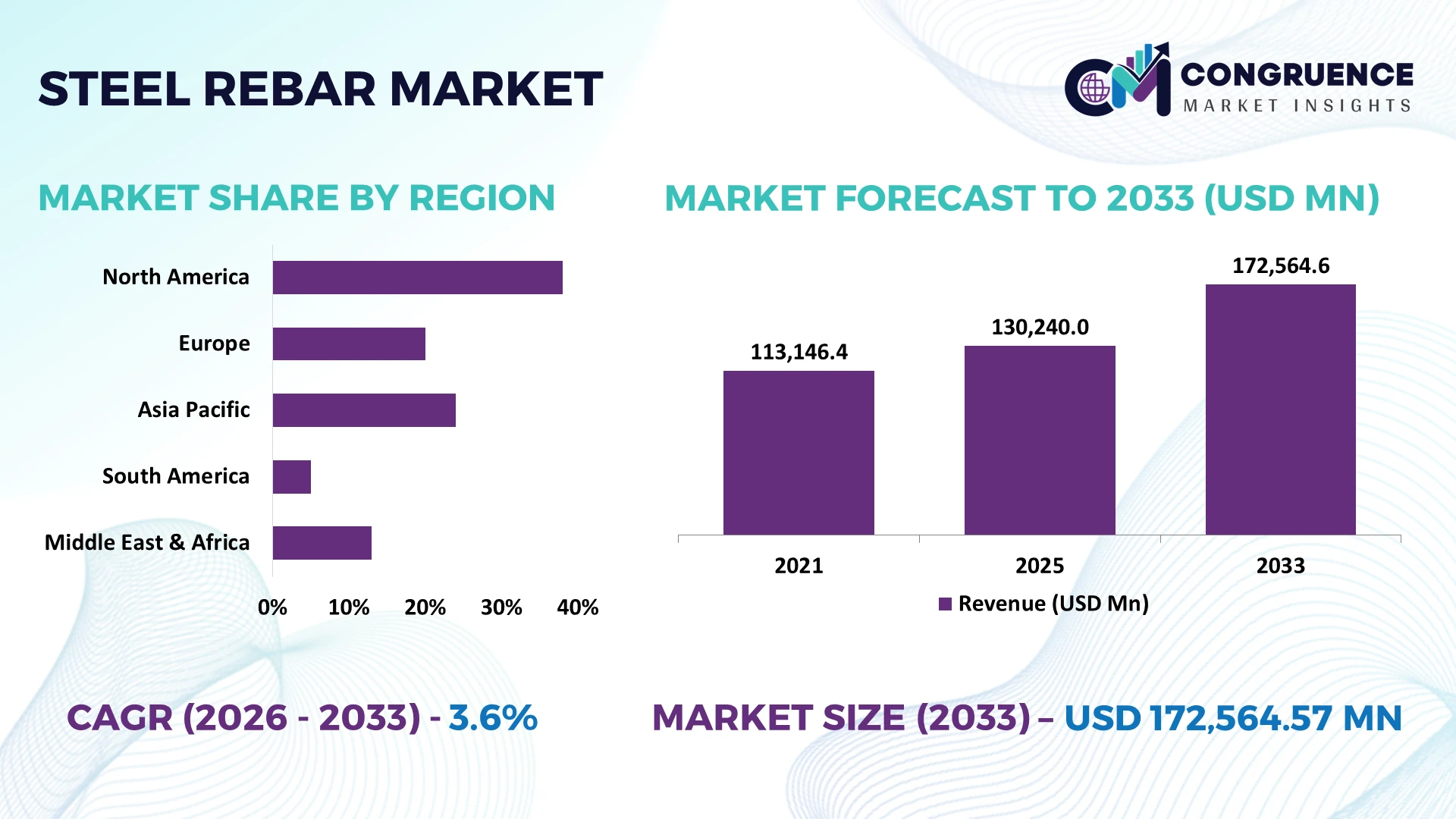
The Global Steel Rebar Market was valued at USD 130240 Million in 2025 and is anticipated to reach a value of USD 172564.57 Million by 2033 expanding at a CAGR of 3.58% between 2026 and 2033. Growth is driven by infrastructure megaprojects, urban transit expansion, seismic-resilient construction, and higher adoption of high-strength, corrosion-resistant rebar that reduces material intensity.
China remains the dominant steel ecosystem, producing 960.8 million tonnes of crude steel in 2025, representing about 52% of global output, while India reached 164.9 million tonnes, growing 10.4% year over year. China therefore produced nearly 5.8 times India’s volume, while India delivered substantially faster expansion.
Strategically, suppliers should prioritize Asia-Pacific capacity, value-added rebar grades, low-carbon production, and digitally controlled fabrication to defend margins and secure infrastructure contracts.
Market Size & Growth: USD 130.24B in 2025 to USD 172.56B by 2033 at 3.58%, supported by infrastructure modernization and high-strength rebar adoption.
Top Growth Drivers: Infrastructure investment 35%; urban construction 28%; replacement demand 18%.
Short-Term Forecast: By 2028, automated fabrication can reduce rebar processing costs by 4% and improve throughput by 7%.
Emerging Technologies: AI quality inspection, robotic bending, and advanced corrosion-resistant alloys are accelerating smart rebar production.
Regional Leaders: Asia-Pacific reaches about USD 112B, North America USD 29B, and Europe USD 19B by 2033, led by infrastructure digitization.
Consumer/End-User Trends: High-strength grades are capturing an estimated 15%+ adoption in advanced construction applications.
Pilot/Case Example: 2024 automated rebar-processing deployments targeted 5–10% lower fabrication waste and faster site delivery.
Competitive Landscape: China-based producers lead supply; Baowu, HBIS, Ansteel, ArcelorMittal, and Tata Steel remain key competitors.
Regulatory & ESG Impact: EU CBAM entered its definitive phase in 2026, increasing pressure for lower-carbon steel and emissions traceability.
Investment & Funding: Global steel decarbonization programs are directing tens of billions of USD toward electric furnaces, hydrogen, efficiency, and recycling.
Innovation & Future Outlook: Next-generation rebar will combine high strength, recycled content, digital traceability, and low-carbon production for competitive infrastructure supply.
Steel rebar demand is concentrating in bridges, rail networks, metro systems, renewable-energy foundations, industrial facilities, and earthquake-resilient buildings. High-strength and corrosion-resistant grades are gaining traction, while digital fabrication can improve material utilization by 5–10%. Asia-Pacific remains the operational center, with India’s 2025 crude-steel output rising 10.4%, reinforcing regional supply-chain expansion and setting the foundation for strategic market positioning.
Steel rebar is becoming strategically important because infrastructure execution, carbon compliance, and material productivity increasingly determine construction competitiveness. India’s steel consumption is being reshaped by rail, metro, highway, and industrial-capacity projects, while China is shifting from volume-led production toward higher-value, lower-emission steel. Supply-chain restructuring is also encouraging contractors to secure localized rebar supply, fabrication capacity, and long-term procurement contracts.
Technology is sharpening this transition. Automated rebar bending and cutting can deliver roughly 5–10% higher processing productivity than conventional manual fabrication while reducing cutting errors and material waste by about 3–5%. In Japan, automated fabrication is more established, whereas India is accelerating deployment through modern reinforcement-processing centers and digital project workflows. Over the next 2–3 years, adoption of automated fabrication, digital bar scheduling, and traceability systems is positioned to expand as contractors target faster project cycles and tighter material control.
A practical deployment is the use of CNC rebar machines in large metro and bridge projects, where prefabricated cages reduce site handling and installation complexity. Producers are responding through electric-arc-furnace investments, recycled-content programs, technology partnerships, and downstream fabrication expansion. Competitive advantage will increasingly depend on combining reliable steel quality, low-carbon production, automated processing, and responsive local supply networks.
India’s infrastructure pipeline is strengthening rebar consumption through highway, metro, railway, and industrial projects, while national steel capacity expansion supports localized supply. Infrastructure investment is estimated to account for more than 30% of incremental rebar demand in major developing markets, with automated fabrication improving productivity by approximately 5–10%. India’s crude-steel production increased 10.4% in 2025, reinforcing domestic availability and downstream processing opportunities. Producers are expanding billet and rolling capacity, strengthening distributor partnerships, and investing in automated bending centers. A non-obvious advantage is project scheduling: prefabricated reinforcement reduces site congestion and improves installation sequencing, allowing suppliers offering engineered rebar services to secure larger infrastructure contracts and deepen customer retention.
Steel rebar producers remain exposed to fluctuations in iron ore, scrap, coking coal, electricity, and freight costs, creating pressure on conversion margins. Raw-material and energy expenses can represent more than 60% of integrated steel production costs, while energy-intensive electric-arc operations face substantial power-price sensitivity. European producers also face additional carbon-compliance costs as CBAM implementation intensifies competitive scrutiny. These pressures can delay capacity expansion and compress contractor margins when fixed-price construction contracts prevent rapid pass-through. Companies are responding through scrap sourcing diversification, long-term raw-material contracts, localized procurement, and energy-efficiency upgrades. The sharpest operational insight is that flexible sourcing increasingly matters as much as installed steelmaking capacity for protecting project profitability.
Digital reinforcement planning presents an underpenetrated opportunity as contractors adopt BIM-linked bar scheduling, automated cutting, robotic bending, and digital traceability. Automated fabrication can reduce processing waste by approximately 3–5% and improve throughput by 5–10%, creating measurable savings on large infrastructure projects. India’s expanding metro and logistics infrastructure provides a strong deployment base, while Japan demonstrates the value of mature automation ecosystems. Low-carbon rebar containing higher recycled content is also gaining procurement relevance as embodied-carbon requirements tighten. Producers are positioning through CNC fabrication partnerships, software integration, recycled-steel R&D, and downstream service centers. The non-obvious opportunity lies in selling engineered reinforcement packages rather than commodity bars, shifting competition toward productivity and project-level value.
Scaling advanced rebar processing requires reliable digital infrastructure, trained operators, standardized fabrication data, and consistent quality control across dispersed construction sites. Manual reinforcement work can still represent a substantial share of site labor, while automated facilities require skilled programming and maintenance capabilities that are unevenly available across developing markets. Digital workflows can improve scheduling accuracy by around 5–8%, but fragmented contractor systems often restrict interoperability and data continuity. Companies therefore face execution pressure when transferring factory-level automation to complex field environments. Producers are investing in workforce training, standardized digital specifications, remote equipment monitoring, and technology partnerships. The strategic priority is integration: automation delivers its strongest advantage only when steelmaking, fabrication, logistics, and site installation operate as one coordinated workflow.
Automation Reshapes Fabrication Workflows: CNC cutting, bending, and automated tying are expanding as contractors address labor shortages, with productivity gains of 5–10% and material-waste reductions of 3–5%. Indian fabricators are scaling centralized processing centers, shifting reinforcement work from construction sites to controlled production environments.
Low-Carbon Rebar Gains Procurement Priority: European buyers are tightening embodied-carbon requirements, while CBAM is increasing pressure for traceable steel inputs. Recycled-content and electric-arc-furnace routes can reduce production emissions substantially versus conventional pathways, pushing producers toward scrap sourcing, renewable electricity contracts, and verified environmental data.
Supply Chains Become More Localized: India produced 164.9 million tonnes of crude steel in 2025, up 10.4%, while China produced 960.8 million tonnes, down 4.4%. This divergence is encouraging regional sourcing, domestic capacity additions, and shorter distributor networks as buyers prioritize delivery reliability over purely lowest-cost procurement.
Digital Traceability Enters Mainstream Projects: BIM-linked bar schedules, QR-based batch identification, and production monitoring are improving reinforcement visibility, with digital workflows targeting 5–8% better scheduling accuracy. Large contractors increasingly integrate fabricators with project-management platforms, creating a non-obvious advantage: fewer coordination delays can matter more than marginal steel-price savings.
Deformed Rebar remains the leading type, estimated at approximately 72% market share, because its ribbed geometry delivers strong concrete bonding, standardized grades, and scalable production across buildings, bridges, and highways. Mild Steel Rebar retains roughly 10–12% share, primarily in applications where lower strength and easier fabrication remain acceptable. Epoxy-Coated Rebar represents about 6–8%, supported by corrosion protection requirements in bridges and marine-adjacent structures. Galvanized Rebar and Stainless Steel Rebar remain smaller premium segments, but their lifecycle-value proposition strengthens where chloride exposure raises maintenance costs.
Stainless Steel Rebar is the fastest-growing type, expanding from a niche base as infrastructure owners prioritize durability and reduced lifecycle intervention. Premium corrosion-resistant grades can command higher upfront costs but reduce replacement exposure, shifting procurement toward total-cost-of-ownership metrics. Producers are therefore expanding coated and specialty-grade portfolios, partnering with fabricators, and targeting infrastructure specifications rather than competing solely on commodity pricing.
Buildings represent the leading application, accounting for an estimated 43% share, supported by residential towers, commercial facilities, warehouses, and industrial buildings requiring standardized reinforcement volumes. High-rise construction increasingly favors prefabricated reinforcement assemblies, improving installation productivity by roughly 5–8% and reducing site congestion. Bridges represent approximately 18% share and remain more specification-intensive because durability, fatigue resistance, and corrosion protection influence material selection. Highways contribute about 20%, supported by continuous pavement, interchange, and barrier construction.
Bridges are emerging as the fastest-growing application, with adoption of corrosion-resistant and engineered reinforcement accelerating as asset owners emphasize longer service intervals. Dams and Industrial Structures remain smaller but strategically important, particularly where seismic loading, heavy equipment, or aggressive environments demand specialized grades. Suppliers are responding by expanding engineered reinforcement services, prefabrication capabilities, and project-specific technical support. The key business shift is from selling standardized bars toward supplying application-specific reinforcement packages that improve installation consistency and lifecycle performance.
Construction Companies lead end-user demand at approximately 38% share because they control large volumes of building and infrastructure procurement and increasingly require scheduled, specification-compliant reinforcement deliveries. Infrastructure Developers account for roughly 22%, with procurement increasingly tied to lifecycle durability and project-financing requirements. Contractors represent around 18%, while Steel Fabricators hold approximately 14% and are gaining influence as reinforcement processing becomes more automated. Government Agencies account for the remaining demand but exert disproportionate influence through technical specifications and public-procurement standards.
Steel Fabricators are the fastest-growing end-user group, with adoption rising as automated bending, cutting, and prefabrication shift reinforcement production away from fragmented job sites. Their technology-led model can improve processing productivity by 5–10% and reduce rework. Companies are therefore forming fabricator partnerships, offering engineered bar schedules, and expanding service-center capacity. The competitive advantage is moving toward integrated supply: producers that connect steel supply, fabrication, logistics, and digital project data can capture greater contract value than commodity-focused suppliers.
Asia-Pacific accounted for the largest market share at 68% in 2025 however, Middle East & Africa is expected to register the fastest growth, expanding at a CAGR of 4.2% between 2026 and 2033.

Domestic Supply Resilience Reshapes Procurement
North America is strengthening domestic rebar supply through infrastructure modernization, mill upgrades, and localized procurement. The United States represents the region’s dominant consumption base, supported by highways, bridges, transit systems, data centers, and manufacturing facilities. Electric-arc-furnace production and recycled scrap are increasingly central to supply strategies, while automated reinforcement fabrication is improving installation productivity by approximately 5–8%. Large contractors are adopting prefabricated reinforcement cages to reduce site labor and scheduling delays. Producers are responding with regional service centers, long-term supply agreements, specialty-grade development, and expanded fabrication partnerships. Infrastructure funding is reinforcing project visibility, while domestic sourcing preferences are increasing the value of reliable regional inventory. The strategic shift is from commodity supply toward integrated steel, fabrication, logistics, and project-support capabilities.
United States Market Outlook: The United States combines extensive electric-arc-furnace capacity, deep scrap availability, advanced logistics, and sophisticated construction procurement. Infrastructure renewal is strengthening demand for standardized and corrosion-resistant reinforcement. Domestic sourcing requirements are encouraging producers to expand regional distribution networks, while automated fabrication centers are improving material handling and installation coordination on large transportation and industrial projects.
Decarbonization Reshapes Steel Procurement
Europe’s steel rebar market is being transformed by decarbonization requirements, infrastructure modernization, and increasingly stringent carbon-accounting practices. Germany, Italy, Spain, and France remain important construction and fabrication centers, while electric-arc-furnace production supports recycled-content strategies. Carbon-border regulation is increasing demand for transparent embedded-emission data and influencing procurement specifications. Producers are investing in renewable electricity, scrap optimization, energy efficiency, and lower-carbon steelmaking routes. Automated bending and fabrication partnerships are also gaining traction, improving reinforcement-processing productivity by approximately 5–8%. Rail modernization, bridge rehabilitation, energy infrastructure, and industrial redevelopment remain important demand channels. Companies with traceable material credentials and flexible production systems are gaining procurement advantages, particularly where contractors must meet environmental requirements alongside structural-performance standards.
Germany Market Outlook: Germany combines advanced engineering capabilities, established steel-processing infrastructure, and strong industrial construction expertise. Infrastructure modernization is encouraging higher-performance reinforcement specifications, while producers are emphasizing electric-arc-furnace production, recycled inputs, and digital quality monitoring. Automated bending and scheduling systems are gaining relevance among fabricators seeking greater dimensional consistency and reduced rework.
Manufacturing Scale Meets Infrastructure Intensification
Asia-Pacific dominates steel rebar through concentrated steelmaking capacity, extensive construction programs, and expanding downstream fabrication. China remains the largest production center, while India is strengthening its position through expanding steel capacity and infrastructure deployment. China produced approximately 960.8 million tonnes of crude steel in 2025, while India reached 164.9 million tonnes. Japan and South Korea contribute advanced processing, quality control, and automation capabilities. India’s crude-steel production increased 10.4% during 2025, supporting domestic reinforcement availability for highways, railways, metros, and industrial facilities. Producers are investing in rolling mills, service centers, automated fabrication, and logistics integration. The region’s key advantage is its combination of manufacturing scale and increasingly sophisticated downstream processing, enabling suppliers to compete on volume, delivery speed, engineered grades, and fabrication services.
China Market Outlook: China remains the region’s strategic anchor because of its integrated steel ecosystem, extensive rolling capacity, raw-material networks, and mature construction supply chain. Large producers are emphasizing operational efficiency, higher-value reinforcement grades, and capacity rationalization. Extensive infrastructure and industrial redevelopment continue to sustain high-volume requirements while encouraging suppliers to improve production flexibility and delivery coordination.
Infrastructure Renewal Drives Selective Expansion
South America’s steel rebar demand is concentrated in Brazil, where transportation infrastructure, housing, mining, energy, and industrial construction provide the strongest procurement base. Brazil’s domestic steel ecosystem supports billet and long-steel availability, while regional producers compete with imports through pricing, delivery reliability, and product availability. Standardized deformed rebar remains dominant, while corrosion-resistant grades are gaining relevance in demanding environments. Automated fabrication remains less developed than in North America, creating opportunities for centralized processing and productivity improvements of approximately 5–10%. Companies are strengthening distributor relationships, improving inventory planning, and aligning production with major infrastructure schedules. Currency volatility, freight constraints, and uneven project execution remain operational pressures. Suppliers with domestic production, flexible inventory, and project-linked contracts are better positioned to protect margins while serving geographically dispersed construction programs.
Brazil Market Outlook: Brazil holds the region’s strongest industrial position through its large construction base, steelmaking capacity, mining infrastructure, and extensive transportation network. Infrastructure projects create recurring reinforcement requirements, encouraging producers to strengthen domestic distribution, long-term supply agreements, and downstream processing capabilities that shorten delivery cycles and improve material availability.
Mega-Projects Accelerate Steel Transformation
Middle East & Africa demand is increasingly shaped by large-scale urban development, transport corridors, energy infrastructure, and industrial diversification programs. Saudi Arabia and the United Arab Emirates represent major deployment centers, with mega-projects requiring high-volume reinforcement and increasingly sophisticated fabrication logistics. Saudi Arabia’s Vision 2030 program is supporting construction activity across urban, tourism, transportation, and industrial developments. Digital project controls, automated bending, and prefabricated reinforcement are becoming increasingly important as contractors manage compressed schedules. Producers and distributors are expanding regional warehouses, project-specific fabrication capacity, and direct procurement relationships. Automated reinforcement workflows can improve processing productivity by approximately 5–10%, creating a measurable advantage where project timelines are tightly controlled. The region’s strategic distinction is schedule sensitivity: reliable delivery and engineered fabrication increasingly outweigh marginal material-price differences on complex projects.
Saudi Arabia Market Outlook: Saudi Arabia holds a strategically significant position because mega-project development and economic diversification are generating substantial reinforcement requirements. Large developments are encouraging centralized fabrication, digital scheduling, and tighter supplier coordination. Steel producers are strengthening domestic distribution and project partnerships, while contractors increasingly prioritize suppliers capable of delivering specification-compliant reinforcement across complex, multi-phase construction programs.
Global steelmakers such as ArcelorMittal, China Baowu, Tata Steel, HBIS Group, and Nippon Steel compete with regional producers including JSW Steel, Nucor, Gerdau, and Steel Dynamics. The top five players collectively represent approximately 20–25% of global rebar supply, leaving a fragmented field of regional mills and fabricators. Competition increasingly centers on price, delivery reliability, specialty grades, recycled content, and fabrication integration. Automated processing can improve throughput by 5–10%, while centralized fabrication can reduce rework by roughly 3–5%. China-based producers emphasize scale and vertical integration, whereas Indian, European, and North American suppliers differentiate through specialty products, decarbonization, and project partnerships. Capacity localization, scrap access, energy costs, and carbon compliance are intensifying competitive pressure. Entry barriers remain high because steelmaking requires substantial capital, reliable energy, technical expertise, and distribution networks. Winning requires cost discipline, dependable supply, engineered products, automation, and verifiable low-carbon credentials.
ArcelorMittal
China Baowu Steel Group
Tata Steel
HBIS Group
Ansteel Group
Nippon Steel Corporation
POSCO
JFE Steel Corporation
JSW Steel
Nucor Corporation
Steel Dynamics, Inc.
Gerdau S.A.
Commercial Metals Company
Emirates Steel Arkan
Current steel rebar production is shifting toward electric arc furnaces, automated rolling controls, CNC cutting, and robotic bending. EAF-based operations can improve energy efficiency by 1–2%, while automated fabrication can raise throughput 5–8%. Deployment is strongest among large mills and fabricators in North America, Japan, and India, improving delivery consistency and reducing labor dependency.
Emerging technologies include AI-enabled quality inspection, digital bar scheduling, machine-vision dimensional control, and IoT-connected fabrication equipment. AI inspection can improve defect-detection performance by 2–3%, while integrated scheduling can reduce processing delays by 3–5%. Adoption remains concentrated in advanced fabrication centers, but contractors are increasingly linking BIM workflows with reinforcement detailing, production planning, and logistics. Companies integrating these systems gain faster project execution and tighter material control.
Disruptive pathways center on low-carbon EAF production, advanced high-strength grades, recycled-content optimization, and digitally traceable reinforcement. New automated fabrication can deliver approximately 5–10% higher productivity than manual cutting and bending, giving technology-led suppliers a measurable advantage. Through 2026–2028, adoption of connected production, robotic handling, and carbon-data systems will intensify. Cost-focused regional mills benefit from automation scale, while premium producers gain through specialty grades and verified sustainability. Acting now secures equipment capability, skilled workforce readiness, and integration advantages before digital fabrication becomes a procurement expectation.
May 2026: Nucor opened its Lexington, North Carolina rebar micro mill, adding 430,000 tons of annual capacity. The $440 million facility uses nearly 100% recycled scrap and strengthens localized East Coast supply while integrating adjacent rebar fabrication capabilities. Source: SteelOrbis
October 2025: Commercial Metals continued construction of its fourth micro mill in West Virginia, targeting 2026 melt-shop production. The facility received $50 million in 2025 government assistance, strengthening regional rebar supply and downstream fabrication connectivity across northeastern U.S. markets. Source: Fintel
February 2025: Gerdau reported R$6.2 billion invested during 2024, with 54% directed toward expansion and technological upgrades. The program included energy-efficiency and emissions-reduction initiatives, strengthening operational competitiveness as Brazilian producers faced heightened imported-steel pressure and changing trade conditions. Source: Gerdau
April 2025: AISI published updated environmental guidelines for North American steel construction products after work involving nearly 30 industry, academic, government, and consulting participants. The five-year framework improves EPD consistency and transparency, strengthening carbon-data comparability for steel construction procurement. Source: AISI
The Steel Rebar Market Report covers Deformed Rebar, Mild Steel Rebar, Epoxy-Coated Rebar, Galvanized Rebar, and Stainless Steel Rebar across Buildings, Bridges, Highways, Dams, and Industrial Structures. End-user coverage includes Construction Companies, Infrastructure Developers, Contractors, Steel Fabricators, and Government Agencies, enabling detailed assessment of procurement concentration and application-specific demand.
Geographic analysis spans North America, Europe, Asia-Pacific, South America, and Middle East & Africa, with country-level assessment of production capacity, infrastructure deployment, supply-chain positioning, and technology adoption. The report evaluates automated fabrication, digital scheduling, electric-arc-furnace production, advanced reinforcement grades, recycled-content strategies, and traceability. With automated processing capable of improving productivity by approximately 5–10%, the analysis supports investment planning, capacity localization, technology adoption, partnership decisions, competitive positioning, and strategic expansion priorities through 2026–2033.
| Report Attribute/Metric | Report Details |
|---|---|
Market Revenue in 2025 | USD 130240 Million |
Market Revenue in 2033 | USD 172564.57 Million |
CAGR (2026 - 2033) | 3.58% |
Base Year | 2025 |
Forecast Period | 2026 - 2033 |
Historic Period | 2021 - 2025 |
Segments Covered | By Type
By Application
By End-User
|
Key Report Deliverable | Revenue Forecast, Growth Trends, Market Dynamics, Segmental Overview, Regional and Country-wise Analysis, Competition Landscape |
Region Covered | North America, Europe, Asia-Pacific, South America, Middle East, Africa |
Key Players Analyzed | ArcelorMittal, China Baowu Steel Group, Tata Steel, HBIS Group, Ansteel Group, Nippon Steel Corporation, POSCO, JFE Steel Corporation, JSW Steel, Nucor Corporation, Steel Dynamics, Inc., Gerdau S.A., Commercial Metals Company, Emirates Steel Arkan |
Customization & Pricing | Available on Request (10% Customization is Free) |




