
Reports
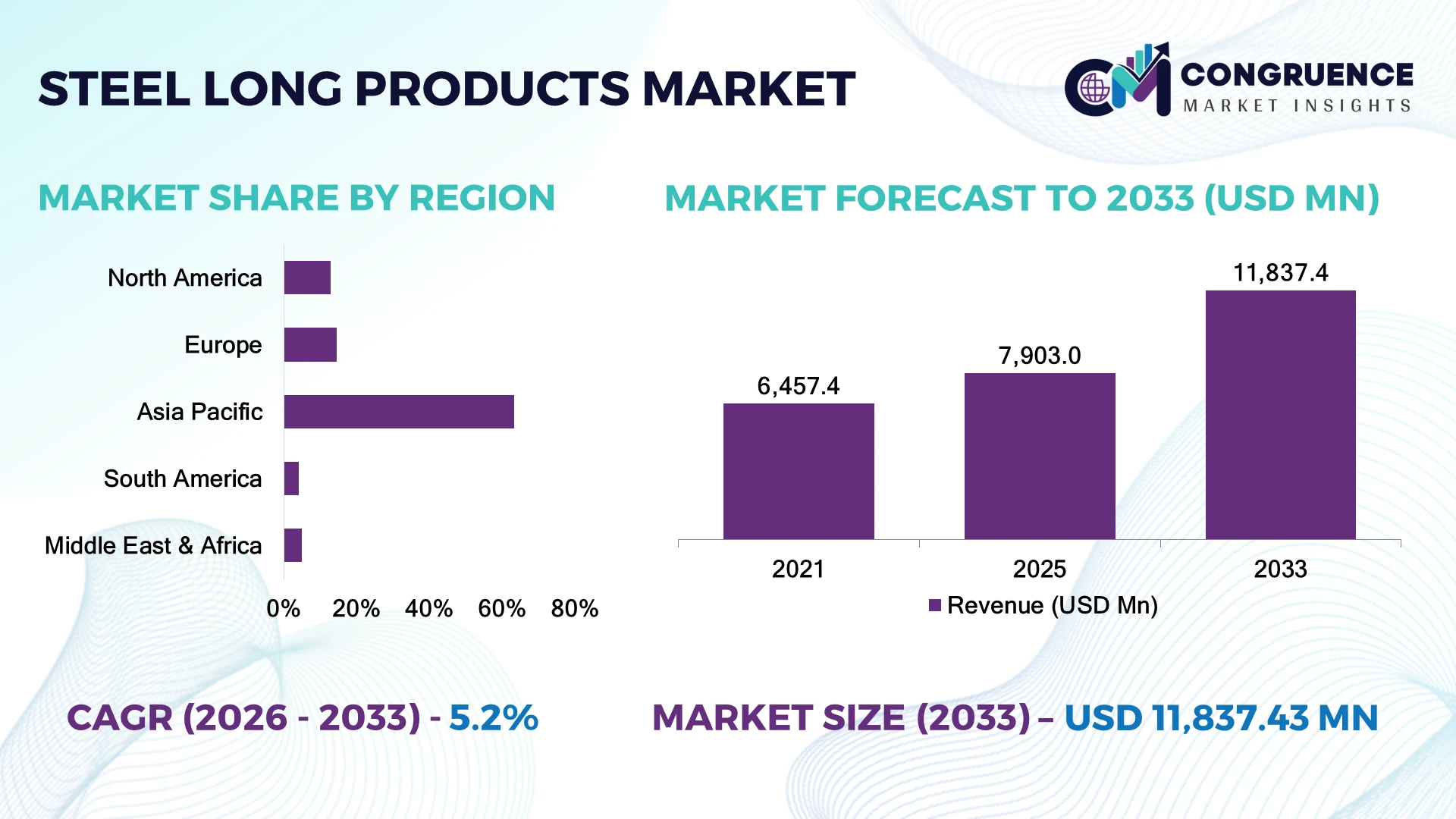
The Global Steel Long Products Market was valued at USD 7,903.0 Million in 2025 and is anticipated to reach a value of USD 11,837.4 Million by 2033 expanding at a CAGR of 5.18% between 2026 and 2033. Growth is being accelerated by large-scale infrastructure modernization programs, electric arc furnace capacity additions, and rising demand for rebar, wire rods, and structural sections across transportation, energy, and industrial construction projects.
China remains the dominant country in the steel long products landscape, accounting for nearly 52% of global crude steel output and operating more than 1.0 billion tons of annual steelmaking capacity. Infrastructure, real estate, and manufacturing collectively consume over 60% of its long steel production. In comparison, India contributes around 9% of global steel output and is expanding capacity through multi-billion-dollar industrial corridor investments. Following supply-chain realignments linked to the Russia–Ukraine conflict, adoption of automated rolling mills and digital quality-control systems increased by over 20% across leading Asian producers.
The strategic implication is clear: producers with low-carbon manufacturing capabilities, efficient rolling operations, and resilient supply networks are securing stronger competitive positioning in high-volume construction and industrial markets.
Market Size & Growth: USD 7,903.0 Million in 2025 progressing toward USD 11,837.4 Million by 2033, supported by infrastructure expansion, electric arc furnace deployment, and advanced mill automation.
Top Growth Drivers: Infrastructure spending (+18%), renewable energy construction (+22%), and industrial manufacturing expansion (+15%) remain the three strongest demand catalysts.
Short-Term Forecast: By 2028, automated rolling operations are expected to improve production efficiency by 12% while reducing material waste by nearly 8%.
Emerging Technologies: AI-driven process control, digital twin manufacturing, and advanced low-carbon steelmaking technologies are improving plant productivity by 10–15%.
Regional Leaders: Asia Pacific exceeds USD 5,000 Million supported by urbanization; Europe surpasses USD 2,100 Million through green steel adoption; North America approaches USD 1,800 Million through infrastructure modernization.
Consumer/End-User Trends: More than 65% of demand originates from construction and infrastructure projects, while renewable energy installations account for over 12% of new consumption.
Pilot/Case Example: In 2024, a smart rolling mill deployment in India improved throughput by 14% and reduced energy consumption by 9%.
Competitive Landscape: The leading producer controls approximately 8% market share, while ArcelorMittal, China Baowu, Nippon Steel, HBIS Group, and JSW Steel continue expanding capacity and product portfolios.
Regulatory & ESG Impact: Green steel initiatives and carbon reduction policies have encouraged over 25% of major producers to accelerate decarbonization investments.
Investment & Funding: More than USD 35 Billion has been committed globally toward steel modernization, low-emission technologies, and capacity upgrades amid supply-chain restructuring.
Innovation & Future Outlook: Hydrogen-based steelmaking, predictive maintenance platforms, and advanced metallurgy solutions are reshaping operational competitiveness and long-term industry strategy.
Steel long products remain essential across construction, transportation, renewable energy, and industrial manufacturing value chains. Producers are increasingly integrating smart rolling technologies, AI-based quality monitoring, and energy-efficient furnace systems to improve operational performance. More than 30% of newly commissioned capacity incorporates advanced automation features. Rising demand for low-carbon steel and evolving procurement standards are also influencing supply-chain strategies, creating a strong foundation for deeper strategic transformation across the industry.
Steel long products have become strategically important because they sit at the center of infrastructure expansion, industrial modernization, energy transition projects, and urban development initiatives. Governments across major economies are prioritizing transportation networks, power transmission systems, industrial parks, and renewable energy facilities, all of which rely heavily on rebar, wire rods, and structural steel. Simultaneously, supply-chain restructuring is encouraging manufacturers to diversify sourcing and strengthen regional production footprints.
Technology is becoming a key differentiator. Advanced automated rolling mills deliver approximately 10–15% higher productivity and reduce energy consumption by nearly 8% compared with conventional systems. China continues to lead in production scale and manufacturing integration, while India is advancing through capacity expansion and digital plant investments. European producers are focusing more aggressively on low-emission steelmaking and green procurement compliance.
A practical example is the deployment of AI-enabled process optimization systems that improve yield consistency and reduce downtime across large rolling facilities. Companies are responding through modernization programs, strategic partnerships, and investments in low-carbon production technologies. Over the next two to three years, digital manufacturing adoption is expected to accelerate significantly, strengthening operational efficiency and production flexibility. Organizations that combine manufacturing scale, sustainability capabilities, and technological sophistication will secure the strongest competitive advantage.
Large-scale infrastructure development remains the primary force shaping steel long product demand. India increased public infrastructure allocations by more than 11% in recent budgets, while global renewable energy installations expanded by over 20%, creating substantial requirements for reinforcing bars, wire rods, and structural sections. Industrial construction activity across Asia continues to account for more than 60% of long steel consumption. The combination of transportation modernization, industrial corridor development, and energy infrastructure expansion directly increases steel intensity across projects. In response, producers are expanding rolling capacities, upgrading manufacturing facilities, and establishing long-term supply agreements with construction and engineering firms. A notable strategic insight is that companies with integrated production and logistics networks are achieving faster project fulfillment and stronger contract retention in high-volume infrastructure markets.
Steel long product manufacturers continue to face significant pressure from fluctuations in iron ore, scrap steel, and energy costs. Energy expenses account for nearly 20–30% of steel production costs in many facilities, while scrap price volatility has exceeded 15% during periods of supply imbalance. Trade restrictions and logistical disruptions linked to geopolitical tensions have further complicated procurement strategies. These factors directly affect production planning, pricing stability, and operating margins. Companies are increasingly adopting diversified sourcing models, localized procurement agreements, and long-term supply contracts to mitigate volatility. An important operational insight is that producers with greater scrap flexibility and diversified feedstock strategies are demonstrating stronger resilience against sudden cost shocks than facilities dependent on a single raw material stream.
The transition toward low-carbon steel production presents a significant opportunity for long product manufacturers. More than 25% of major steel producers have announced decarbonization roadmaps, while smart manufacturing deployments have improved process efficiency by 10–15% in advanced facilities. Hydrogen-based steelmaking, digital quality management systems, and AI-driven predictive maintenance are creating measurable operational advantages. India and the Middle East are emerging as attractive investment destinations due to industrial expansion and favorable manufacturing policies. Companies are increasing R&D spending, forming technology partnerships, and developing premium-grade sustainable steel products. A less obvious opportunity lies in supplying certified low-emission steel to infrastructure and renewable energy projects, where procurement requirements increasingly favor environmentally optimized materials and traceable supply chains.
The industry's long-term challenge extends beyond emissions reduction to the practical execution of large-scale operational transformation. Advanced low-carbon steel technologies often require capital expenditures that are 20–40% higher than conventional upgrades, while skilled digital manufacturing specialists remain in limited supply. Many legacy facilities also face integration complexities when connecting automation platforms, analytics systems, and production equipment. These challenges can slow deployment timelines, reduce implementation consistency, and affect competitiveness. Producers are responding through workforce training initiatives, technology partnerships, and phased modernization programs. A critical strategic insight is that successful transformation increasingly depends on organizational capability rather than equipment investment alone. Companies that simultaneously upgrade infrastructure, digital expertise, and operational processes will achieve stronger sustainability performance and long-term manufacturing resilience.
AI-Enabled Rolling Optimization Advanced process-control systems are being integrated across steel mills to improve rolling precision and reduce operational variability. Leading producers reported yield improvements of 8–12% and downtime reductions of nearly 15% through AI-assisted production scheduling and predictive maintenance. Labor shortages in industrial manufacturing hubs have accelerated deployment. Companies are scaling digital manufacturing platforms, integrating sensor networks, and partnering with industrial software providers to increase throughput consistency while lowering maintenance costs.
Low-Carbon Steel Production Shift Decarbonization mandates and green procurement requirements are reshaping production strategies. Electric arc furnace utilization has increased by approximately 18%, while energy-efficient rolling technologies have lowered power consumption by 10–14% in modern facilities. European carbon regulations and industrial sustainability targets remain key triggers. Producers are expanding scrap-processing capabilities, investing in hydrogen-ready infrastructure, and restructuring supply chains to meet evolving environmental performance requirements.
Infrastructure Supply Chain Localization Supply-chain resilience has become a major operational priority following geopolitical disruptions and logistics volatility. Domestic sourcing programs have increased procurement localization rates by nearly 20% in several major steel-consuming countries. Lead times have improved by approximately 12%, supporting faster project execution. Companies are establishing regional service centers, expanding warehouse networks, and securing long-term raw material contracts to strengthen delivery reliability and project responsiveness.
Specialized High-Strength Grades Growth Demand for advanced structural steel products continues to expand across renewable energy, transportation, and industrial construction projects. Adoption of high-strength long products has increased by over 16%, while material utilization efficiency improved by approximately 9% through lightweight engineering designs. A notable shift is the growing preference for performance-certified steel grades. Manufacturers are expanding premium product portfolios, increasing metallurgical R&D investments, and developing application-specific solutions to differentiate offerings and capture higher-value contracts.
Rebar remains the leading segment, accounting for approximately 46% of global steel long product consumption due to its essential role in residential, commercial, transportation, and industrial infrastructure projects. Its dominance is supported by cost efficiency, structural reliability, and compatibility with modern reinforced concrete systems. Construction-intensive economies such as China and India continue to drive substantial demand through transportation corridors, industrial parks, and urban development initiatives. Wire Rod represents the fastest-growing segment as manufacturers increasingly require high-performance steel inputs for automotive components, fasteners, and industrial machinery applications. Demand for wire rod has expanded by nearly 12% in advanced manufacturing environments.
Structural Sections maintain strong relevance across bridges, logistics facilities, and industrial buildings, while Rails benefit from railway modernization and freight corridor investments. Merchant Bars continue serving fabrication and engineering applications where customization remains important. Leading producers are expanding rolling capacities, introducing higher-strength grades, and optimizing product portfolios toward infrastructure and industrial end markets. Investment priorities increasingly favor specialized products with greater value-added performance characteristics and longer project lifecycles.
Construction remains the dominant application, representing approximately 58% of total steel long product demand. Large-scale infrastructure projects, urban expansion initiatives, and commercial building development continue to create sustained consumption requirements. Reinforcing bars, structural sections, and merchant bars are extensively deployed in transportation networks, residential complexes, and industrial facilities. Infrastructure modernization programs have increased project steel intensity by nearly 10% across several developing economies. Manufacturing is emerging as the fastest-growing application segment as industrial automation, machinery production, and equipment fabrication require greater volumes of precision-engineered steel products. Demand growth in this segment has exceeded 11% through expanded industrial investment.
Energy applications are gaining strategic importance due to transmission network upgrades, renewable energy installations, and industrial power projects. Transportation remains a stable segment supported by railway expansion and freight logistics infrastructure development. Producers are responding through production flexibility, customized product specifications, and expanded service capabilities to address evolving application requirements. Demand is increasingly concentrated in projects requiring durability, strength, and lifecycle performance optimization.
The Construction Industry remains the largest end-user segment, accounting for approximately 55% of market demand due to extensive deployment across commercial buildings, transportation projects, residential developments, and industrial facilities. High project volumes and long-term infrastructure planning continue to sustain procurement activity. Energy & Utilities represents the fastest-growing end-user category as grid expansion, renewable energy facilities, and transmission infrastructure projects accelerate globally. Steel consumption associated with utility infrastructure has increased by nearly 14% in recent project cycles. Manufacturing enterprises continue expanding purchases of wire rods and engineered steel products to support industrial production and equipment fabrication.
Transportation and Logistics operators remain important buyers through railway expansion, freight terminals, and mobility infrastructure investments. Public sector agencies continue influencing procurement through national infrastructure programs and modernization initiatives. Steel producers are targeting these end-user groups through customized grades, long-term supply agreements, project-specific engineering support, and integrated service offerings. Competitive positioning increasingly depends on the ability to meet specialized performance requirements while maintaining delivery reliability across complex project environments.
Asia-Pacific accounted for the largest market share at 63.4% in 2025 however, Middle East & Africa is expected to register the fastest growth, expanding at a CAGR of 6.4% between 2026 and 2033.
North America accounted for approximately 12.8% of the global steel long products market in 2025, supported by infrastructure rehabilitation programs, industrial reshoring initiatives, and transportation network upgrades. Demand remains concentrated in reinforcing bars, structural sections, and wire rods used across bridges, logistics facilities, manufacturing plants, and energy infrastructure. The region continues to benefit from increased domestic steel utilization policies and strategic investments in industrial construction. Steel producers are expanding rolling mill modernization programs and adopting digital manufacturing systems to improve productivity and quality consistency. A notable development includes multiple capacity enhancement projects across the United States, adding over 3 million tons of annual long-product processing capability to strengthen domestic supply resilience and reduce import dependency.
United States Market Outlook: The United States represents the largest steel long products market in North America due to its extensive construction activity, manufacturing base, and transportation infrastructure investments. More than 45,000 infrastructure projects are currently supported through federal and state funding programs, creating sustained demand for reinforcing steel and structural sections. Domestic producers continue investing in electric arc furnace facilities, advanced rolling technologies, and supply-chain localization strategies. Industrial reshoring initiatives and renewable energy infrastructure development are further strengthening long-term steel consumption across strategic sectors.
Europe represented approximately 14.6% of the global market in 2025, characterized by strong sustainability mandates, advanced manufacturing capabilities, and extensive infrastructure modernization programs. Demand remains concentrated in construction, transportation, renewable energy, and industrial engineering sectors. Steelmakers are increasingly transitioning toward electric arc furnace production and low-emission manufacturing technologies to align with environmental regulations and procurement requirements. Structural sections and high-performance long products are experiencing stronger adoption in energy and industrial projects. Recent investments exceeding €5 billion across several major steel facilities are accelerating modernization efforts and improving production efficiency. Companies are also expanding partnerships focused on hydrogen-ready steelmaking technologies and carbon-reduction initiatives.
Germany Market Outlook: Germany remains the most strategically significant steel long products market in Europe due to its industrial manufacturing strength, engineering expertise, and advanced infrastructure ecosystem. The country accounts for a substantial share of regional steel processing capacity and continues investing in low-carbon steel technologies. Automotive, machinery, and industrial equipment sectors maintain strong demand for specialized long products. German manufacturers are increasingly integrating digital quality management systems and energy-efficient production processes, with several large facilities targeting significant reductions in operational emissions through next-generation steelmaking technologies.
Asia-Pacific maintained the leading position with approximately 63.4% market share in 2025, supported by unmatched steel production capacity, extensive urbanization, and large-scale infrastructure development. The region accounts for the majority of global rebar, wire rod, and structural steel consumption due to ongoing transportation, industrial, residential, and energy projects. China, India, Japan, and South Korea continue to dominate production and deployment activity. Infrastructure spending and industrial corridor development remain major demand catalysts. Regional producers are investing heavily in automation, advanced metallurgy, and energy-efficient manufacturing systems. More than 70% of newly commissioned steel processing capacity during recent expansion cycles has been concentrated within Asia-Pacific industrial hubs.
China Market Outlook: China remains the cornerstone of the global steel long products industry, contributing over half of worldwide crude steel production. Large-scale transportation infrastructure, manufacturing expansion, and urban redevelopment programs continue supporting demand across major provinces. The country has accelerated deployment of smart steel manufacturing systems, with digital process-control technologies improving operational efficiency across leading facilities. State-backed industrial modernization initiatives and export competitiveness continue reinforcing China's position as the most influential production and consumption center within the global steel value chain.
South America accounted for approximately 4.2% of the global market in 2025, driven primarily by infrastructure upgrades, residential construction recovery, and industrial development projects. Demand remains concentrated in reinforcing bars and structural steel products used across transportation networks, commercial facilities, and energy infrastructure. While the region presents strong long-term potential, investment cycles and project execution timelines continue influencing consumption patterns. Steel producers are focusing on operational efficiency improvements, localized production strategies, and downstream value-added offerings. Several regional infrastructure programs have increased steel procurement requirements by nearly 10% across transportation and logistics projects, strengthening demand visibility for domestic manufacturers.
Brazil Market Outlook: Brazil represents the largest steel long products market in South America due to its extensive construction sector, industrial capacity, and infrastructure investment pipeline. The country maintains significant steelmaking and rolling capacity supporting domestic demand and regional exports. Transportation modernization projects, mining infrastructure development, and industrial facility expansion continue driving procurement activity. Brazilian producers are enhancing manufacturing efficiency through automation investments and operational optimization initiatives while expanding product offerings tailored to infrastructure and engineering applications.
Middle East & Africa accounted for approximately 5.0% of the global market in 2025 and is emerging as a strategically important destination for steel long product deployment. Demand is being driven by large-scale urban development programs, transportation corridors, industrial diversification projects, and energy infrastructure expansion. Construction-intensive economies are increasing procurement of reinforcing bars, structural sections, and specialty steel products to support national development objectives. Regional producers are investing in advanced rolling facilities and localized manufacturing ecosystems to improve supply-chain resilience. More than USD 1 trillion worth of ongoing infrastructure and urban development projects across key markets continues supporting long-term steel consumption requirements.
Saudi Arabia Market Outlook: Saudi Arabia remains the most influential market within the region due to its extensive infrastructure transformation agenda, industrial diversification initiatives, and large-scale urban development programs. Mega-projects associated with national economic development plans continue generating substantial demand for steel long products across transportation, commercial construction, and industrial facilities. The country is also expanding domestic steel manufacturing capabilities and encouraging private-sector investment in downstream processing operations. Strategic localization programs and industrial cluster development are strengthening the country's role as a major steel consumption and production hub.
The Steel Long Products Market is characterized by competition between global steel leaders such as ArcelorMittal, China Baowu Group, Nippon Steel Corporation, Tata Steel, and JSW Steel, alongside regional producers competing on delivery speed, local supply reliability, and project-specific customization. The top five participants collectively account for approximately 32% of global market activity, creating a moderately consolidated structure. Global producers compete through scale, vertical integration, and technology investments, while regional manufacturers focus on cost efficiency and infrastructure proximity. Production optimization technologies have improved mill productivity by 10–15%, while integrated supply networks reduce logistics costs by nearly 8%. Companies are actively expanding rolling capacities, forming raw-material partnerships, and investing in low-carbon steelmaking platforms. The competitive shift is moving from pure volume leadership toward operational efficiency, decarbonization capability, and supply-chain control. High capital requirements, energy intensity, and raw-material security remain key barriers. Winning requires efficient production, resilient sourcing, premium-grade offerings, and strong infrastructure project relationships.
China Baowu Steel Group
Nippon Steel Corporation
Tata Steel Limited
JSW Steel Limited
HBIS Group
POSCO Holdings
Nucor Corporation
Steel Authority of India Limited (SAIL)
Jindal Steel & Power Limited (JSPL)
Hyundai Steel Company
Gerdau S.A.
Commercial Metals Company (CMC)
EVRAZ plc
Steel long product manufacturing is undergoing rapid technological transformation through automation, digital process control, and advanced metallurgical engineering. AI-enabled rolling mill optimization, predictive maintenance systems, and real-time quality monitoring are now deployed across more than 35% of large integrated facilities. These technologies improve production consistency by approximately 10–15% while reducing unplanned downtime by nearly 12%. Smart manufacturing platforms are becoming a competitive differentiator for producers serving infrastructure and industrial customers requiring tighter quality specifications and faster fulfillment cycles.
Emerging technologies are focused on low-emission steelmaking and advanced production flexibility. Electric Arc Furnace (EAF) operations consume substantially less carbon-intensive inputs than traditional blast furnace routes, while modern EAF facilities can reduce direct emissions by over 50% compared with legacy configurations. Digital twin systems improve operational planning accuracy by nearly 20%, allowing manufacturers to optimize production scheduling, inventory flows, and maintenance activities. Companies investing early in these technologies are strengthening cost competitiveness and regulatory readiness.
The next disruptive phase between 2026 and 2028 will center on hydrogen-assisted steelmaking, AI-driven autonomous operations, and integrated supply-chain intelligence platforms. Producers adopting advanced decarbonization technologies and intelligent manufacturing systems are expected to achieve 15–20% greater operational efficiency than conventional facilities. Competitive advantage is increasingly shifting toward organizations capable of combining sustainability performance, digital manufacturing expertise, and production scalability. The strategic imperative is clear: technology adoption now directly influences market access, operating margins, and long-term industry leadership.
May 2025 – Nippon Steel Corporation approved investment in three new and expanded electric arc furnace projects across Japan with combined production capacity of approximately 2.9 million tons annually. The initiative accelerates decarbonization and strengthens future long-product manufacturing flexibility. Source: nipponsteel.com
October 2024 – JSW Group and POSCO Group signed an agreement to develop an integrated steel plant in India with an initial capacity of 5 million tonnes per annum. The partnership strengthens domestic steel supply and supports industrial infrastructure expansion. Source: jsw.in
June 2025 – Nippon Steel and U.S. Steel advanced a strategic partnership framework that includes approximately USD 14 billion in planned investments, supporting new electric arc furnace deployment and manufacturing modernization within the United States. Source: apnews.com
July 2025 – JSW Steel announced that a significant portion of its ₹20,000 crore capital expenditure program would support expansion of the Dolvi facility from 10 million to 15 million tonnes capacity. The move enhances domestic production scale and downstream integration. Source: economictimes.indiatimes.com
This report provides comprehensive analysis of the global Steel Long Products Market across major product categories, applications, end-user industries, and regional markets. The study evaluates key segments including Rebar, Wire Rod, Structural Sections, Rails, and Merchant Bars, while assessing demand across construction, manufacturing, transportation, and energy applications. Regional coverage includes North America, Europe, Asia-Pacific, South America, and Middle East & Africa, representing more than 95% of global steel consumption activity. The report further examines evolving deployment patterns, production concentration trends, and technology adoption across major steel-producing economies.
The assessment includes competitive benchmarking of leading steel manufacturers, analysis of supply-chain developments, and evaluation of advanced manufacturing technologies including AI-enabled process optimization, electric arc furnace deployment, digital quality control systems, and low-carbon steelmaking initiatives. Strategic insights support investment planning, capacity expansion decisions, market entry evaluation, competitive positioning, procurement strategies, and operational optimization. Particular attention is given to infrastructure-led demand centers, industrial modernization programs, sustainability-driven procurement shifts, and emerging opportunities shaping market direction between 2026 and 2033.
| Report Attribute / Metric | Details |
|---|---|
| Market Revenue (2025) | USD 7,903.0 Million |
| Market Revenue (2033) | USD 11,837.4 Million |
| CAGR (2026–2033) | 5.18% |
| Base Year | 2025 |
| Forecast Period | 2026–2033 |
| Historic Period | 2021–2025 |
| Segments Covered |
By Type
By Application
By End-User
|
| Key Deliverables | Revenue Forecast; Market Trends; Growth Drivers & Restraints; Technology Insights; Segmentation Analysis; Regional Insights; Competitive Landscape; Regulatory & ESG Overview; Recent Developments |
| Regions Covered | North America; Europe; Asia-Pacific; South America; Middle East & Africa |
| Companies Profiled | ArcelorMittal; China Baowu Steel Group; Nippon Steel Corporation; Tata Steel Limited; JSW Steel Limited; HBIS Group; POSCO Holdings; Nucor Corporation; Steel Authority of India Limited (SAIL); Jindal Steel & Power Limited (JSPL); Hyundai Steel Company; Gerdau S.A.; Commercial Metals Company (CMC); EVRAZ plc |
| Customization & Pricing | Available on Request (10% Customization Free) |




