
Reports
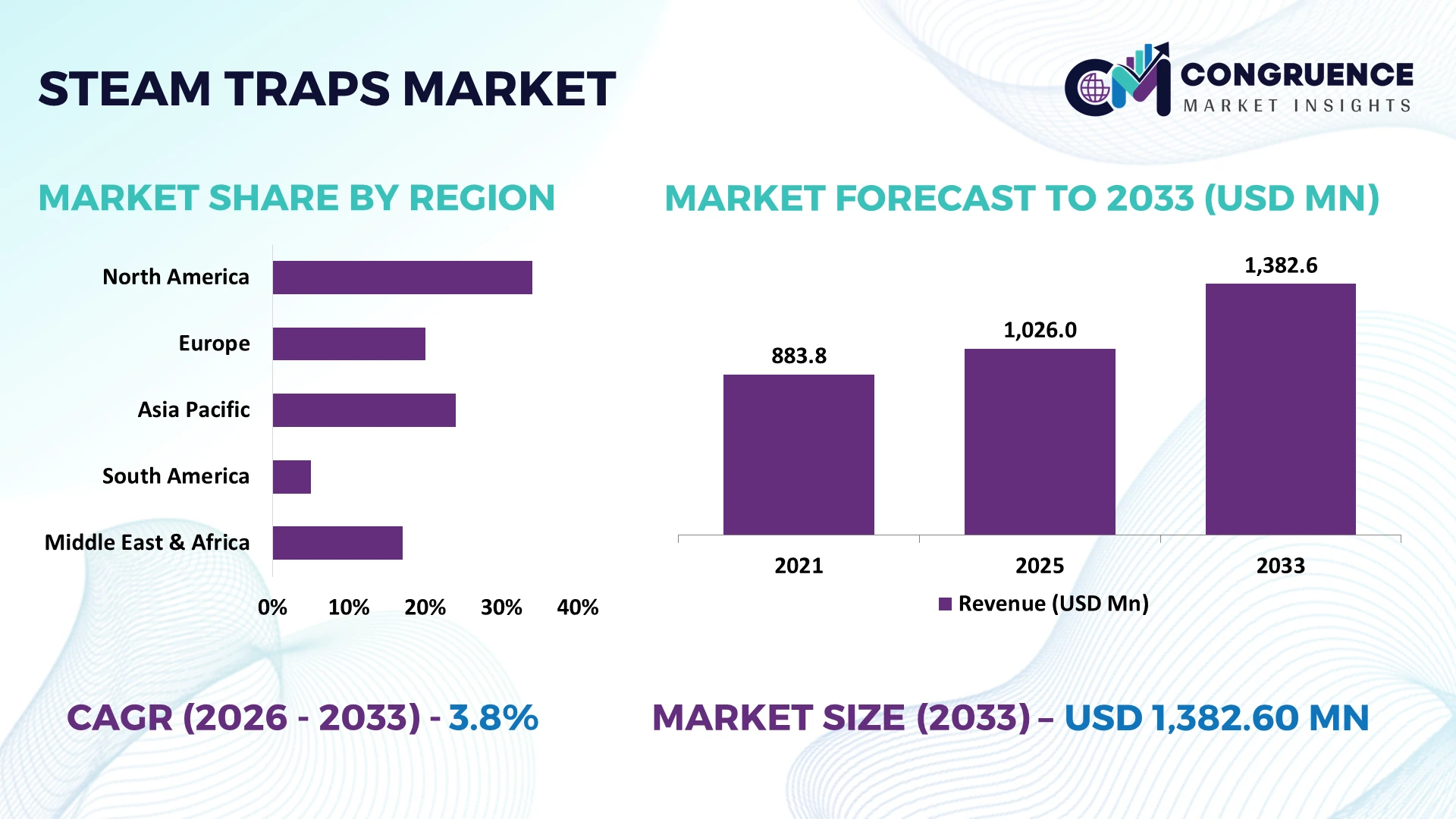
The Global Steam Traps Market was valued at USD 1026 Million in 2025 and is anticipated to reach a value of USD 1382.6 Million by 2033 expanding at a CAGR of 3.8% between 2026 and 2033. Growth is driven by industrial energy-efficiency upgrades, stricter steam system performance standards, and predictive maintenance integration across process industries.
China remains the dominant country with approximately 32% of global steam equipment manufacturing capacity, supported by large-scale chemical, power generation, and industrial processing investments exceeding USD 18 billion in recent modernization programs. Japan maintains stronger adoption of intelligent steam monitoring, with digital steam trap deployment nearly 24% higher across advanced manufacturing facilities. Ongoing industrial supply-chain diversification following Red Sea shipping disruptions has accelerated regional production resilience and localized equipment sourcing.
For manufacturers and investors, prioritizing intelligent monitoring solutions and regional manufacturing partnerships strengthens long-term competitiveness in the global steam traps market.
Market Size & Growth: USD 1026 million in 2025, reaching USD 1382.6 million by 2033 at 3.8% CAGR, supported by industrial automation and energy optimization.
Top Growth Drivers: Energy-saving initiatives improve steam efficiency by 18%, predictive maintenance adoption rises 26%, and industrial modernization expands 21%.
Short-Term Forecast: By 2028, automated steam management reduces maintenance costs by 16% while improving system efficiency by 14%.
Emerging Technologies: AI diagnostics, Industrial IoT monitoring, and advanced corrosion-resistant alloys increase operational reliability by over 20%.
Regional Leaders: Asia-Pacific approaches USD 620 million, Europe USD 335 million, and North America USD 290 million, driven by digital plant upgrades and regional manufacturing expansion.
Consumer/End-User Trends: More than 48% of large industrial facilities prioritize intelligent steam trap monitoring to reduce energy losses and unplanned downtime.
Pilot/Case Example: In 2026, a refinery modernization project achieved a 17% reduction in steam losses through automated trap monitoring and analytics.
Competitive Landscape: Leading manufacturers collectively account for approximately 38% market share, with Armstrong International, Spirax Sarco, TLV, Forbes Marshall, and Watson McDaniel maintaining strong industrial portfolios.
Regulatory & ESG Impact: Industrial decarbonization programs lower steam energy waste by nearly 12%, reinforcing compliance with stricter efficiency standards.
Investment & Funding: More than USD 1.3 billion supports manufacturing expansion, digital retrofits, and strategic partnerships as supply chains regionalize.
Innovation & Future Outlook: Smart wireless diagnostics, digital twins, and cloud-based asset management accelerate the transition toward predictive steam network optimization.
Steam traps remain essential across chemical processing, food manufacturing, pharmaceuticals, oil and gas, and power generation, where uninterrupted steam efficiency directly affects operating costs. Recent innovations emphasize wireless condition monitoring, self-diagnostic sensors, and corrosion-resistant materials, while intelligent maintenance platforms improve asset visibility. Nearly 30% of new industrial steam system upgrades now incorporate connected monitoring technologies as manufacturers strengthen operational resilience amid evolving industrial efficiency regulations and supply-chain localization, shaping the market's strategic direction.
The Steam Traps Market has become strategically important as manufacturers prioritize energy optimization, process reliability, and lower lifecycle operating costs across steam-intensive industries. Infrastructure modernization, stricter industrial efficiency standards, and supply-chain restructuring following global logistics disruptions are accelerating replacement cycles for aging steam networks. Digital monitoring is shifting procurement priorities from standalone mechanical devices toward connected asset management platforms, allowing operators to reduce unplanned downtime while improving steam utilization across critical production environments.
Smart steam traps equipped with wireless monitoring and predictive diagnostics deliver approximately 18% higher energy efficiency and reduce maintenance costs by nearly 15% compared with conventional mechanical inspection programs. Japan leads in intelligent steam management deployment within advanced manufacturing, while China scales production through extensive chemical, power, and industrial processing capacity, enabling faster equipment replacement across large facilities. Over the next two to three years, connected monitoring adoption is expected to exceed 40% among newly modernized industrial steam systems, particularly in high-temperature process plants.
A 2026 refinery modernization program integrating continuous steam trap diagnostics reduced steam leakage by 16% and shortened maintenance response times by 21%. Manufacturers are strengthening partnerships with industrial automation providers, expanding digital service portfolios, and investing in condition-monitoring technologies. Companies that combine high-efficiency products with predictive maintenance capabilities will secure stronger competitive positioning as industrial operators increasingly prioritize operational resilience and asset performance.
Industrial facilities are accelerating steam system modernization to reduce energy losses and improve production reliability. More than 45% of large manufacturing plants now include steam efficiency projects within broader operational excellence programs, while predictive maintenance lowers unexpected equipment failures by approximately 22%. India's expanding pharmaceutical and food processing industries are increasing demand for automated steam management solutions as energy-performance regulations tighten. This shift enables manufacturers to replace periodic inspections with continuous monitoring, reducing operational waste. Leading companies are expanding intelligent product portfolios, investing in Industrial IoT integration, and forming technology partnerships to deliver complete lifecycle service models, strengthening customer retention and creating higher-value recurring maintenance opportunities.
Volatility in stainless steel and specialty alloy prices continues to pressure manufacturing margins, while aging industrial infrastructure delays modernization projects. Around 37% of older steam systems require extensive piping upgrades before advanced steam traps can be deployed efficiently, increasing installation complexity. Japan and several mature industrial economies continue operating decades-old steam networks that complicate interoperability with digital monitoring platforms. These limitations slow replacement decisions, extend project timelines, and reduce short-term profitability for suppliers. Manufacturers are responding through localized sourcing strategies, long-term procurement contracts, modular retrofit solutions, and standardized product platforms that minimize installation costs while improving compatibility with existing industrial assets.
Industrial digitalization creates substantial opportunities through intelligent steam monitoring, cloud-based diagnostics, and retrofit-focused business models. Connected monitoring systems improve maintenance scheduling accuracy by approximately 28%, while automated leak detection reduces steam losses by nearly 17%. South Korea is expanding smart factory initiatives that encourage integration of digital utility management into manufacturing operations, creating new demand for intelligent steam infrastructure. Companies are increasing R&D investments in wireless sensors, AI-enabled analytics, and subscription-based monitoring services while partnering with automation specialists. A notable strategic opportunity lies in retrofitting existing facilities instead of complete equipment replacement, enabling faster deployment, lower capital requirements, and measurable operational improvements for industrial customers.
Expanding intelligent steam management across diverse industrial environments remains a complex execution challenge. Nearly 33% of facilities report integration difficulties between legacy control systems and modern digital monitoring platforms, while the shortage of skilled maintenance technicians exceeds 20% in several industrial markets. Germany's advanced manufacturing sector increasingly demands standardized communication protocols to simplify plant-wide deployment and long-term asset management. Without interoperability and workforce development, digital investments deliver inconsistent operational results and slower implementation. Companies must strengthen software compatibility, invest in technical training, expand engineering partnerships, and develop scalable service ecosystems that support reliable deployment across multi-site industrial operations while maintaining long-term competitive differentiation.
Digital Monitoring Accelerates Adoption: Industrial facilities are deploying wireless steam trap monitoring systems at a faster pace, with connected installations increasing by approximately 31% during 2026. Predictive diagnostics reduce steam losses by nearly 18% and maintenance interventions by 21%, while manufacturers expand automation partnerships and cloud-enabled asset management platforms to improve plant reliability.
Retrofit Modernization Drives Upgrades: Instead of replacing complete steam infrastructure, manufacturers are prioritizing retrofit projects that reduce installation time by around 24% and engineering costs by 17%. Supply-chain localization across India and Southeast Asia is encouraging modular product deployment, prompting companies to expand regional manufacturing and engineering support capabilities.
Efficiency Standards Influence Procurement: More than 44% of industrial procurement teams now prioritize lifecycle energy performance over initial equipment cost. Advanced steam traps improve condensate recovery efficiency by approximately 15%, leading suppliers to introduce high-efficiency product lines, enhanced sealing technologies, and corrosion-resistant materials that align with evolving industrial efficiency regulations.
Lifecycle Services Expand Revenue Models: Manufacturers are shifting from equipment-only sales to predictive maintenance and subscription-based monitoring services. Digital maintenance platforms improve planning efficiency by nearly 20% while reducing emergency service requirements by approximately 16%. Companies are investing in AI-assisted diagnostics, remote engineering support, and strategic technology alliances to strengthen recurring service business models.
Mechanical steam traps remain the largest segment, accounting for approximately 39% of global installations because they provide reliable condensate discharge, long operating life, and dependable performance across refineries, chemical plants, and power facilities. Their straightforward design reduces maintenance complexity while supporting continuous operation under varying steam loads. Float & Thermostatic steam traps represent the fastest-growing segment, with adoption increasing by nearly 18% as industries require higher condensate handling efficiency, improved air venting, and greater process stability in precision manufacturing environments.
Thermodynamic steam traps maintain strong demand in high-pressure applications due to compact construction and durability, particularly in oil refining and petrochemical facilities. Thermostatic steam traps continue expanding in tracing systems and temperature-sensitive processing where accurate condensate control improves production consistency. Manufacturers are broadening intelligent monitoring compatibility, introducing corrosion-resistant materials, and strengthening application-specific engineering support. Investment priorities increasingly favor advanced product configurations that balance reliability, digital integration, and lower lifecycle maintenance, allowing suppliers to differentiate through performance optimization rather than standardized product offerings.
Steam Distribution continues to lead the market with an estimated 41% share because efficient condensate removal directly supports pressure stability, equipment reliability, and lower energy losses across industrial steam networks. Process Heating is emerging as the fastest-growing application, with installations expanding by approximately 19% as pharmaceutical, food processing, and specialty chemical facilities modernize production systems requiring precise thermal control. Equipment manufacturers are integrating automated monitoring with distribution networks to improve operational efficiency and minimize steam leakage.
Condensate Recovery is gaining strategic importance as industries pursue lower water consumption and reduced energy waste, improving recovery performance by nearly 17% through automated monitoring technologies. Power Generation remains a critical application where efficient steam trap performance enhances turbine reliability and minimizes maintenance-related outages. Companies are strengthening engineering partnerships, expanding customized system integration services, and deploying intelligent diagnostics across multiple industrial processes. Demand is increasingly concentrated in facilities seeking measurable operating efficiency instead of simple equipment replacement.
The Chemical industry represents the leading end-user segment with approximately 31% of global demand, supported by continuous-process manufacturing that depends on reliable steam pressure, condensate removal, and uninterrupted production. Pharmaceutical manufacturing is the fastest-growing end-user, with adoption of intelligent steam management systems increasing by nearly 21% as validated production environments require precise temperature control and improved process consistency. Suppliers are developing hygienic product configurations and expanding digital monitoring capabilities tailored to regulated manufacturing environments.
Oil & Gas remains a major purchaser because upstream and downstream operations require durable steam equipment capable of operating under demanding pressure conditions. Power Generation continues replacing aging steam management infrastructure to improve operational efficiency, while Food & Beverage manufacturers increasingly prioritize hygienic, energy-efficient steam systems that reduce production losses. Companies are strengthening localized service networks, expanding lifecycle maintenance agreements, and introducing sector-specific engineering solutions to improve customer retention while addressing increasingly specialized operational requirements across diverse industrial sectors.
Asia-Pacific accounted for the largest market share at 43% in 2025 however, Middle East & Africa is expected to register the fastest growth, expanding at a CAGR of 5.1% between 2026 and 2033.

Industrial Modernization Strengthens Digital Steam Management
North America accounts for approximately 24% of the global Steam Traps Market, supported by extensive deployment across oil & gas, food processing, pharmaceutical manufacturing, and power generation. Industrial operators are replacing aging steam infrastructure with digitally monitored systems to improve energy efficiency and equipment reliability. Nearly 38% of large manufacturing facilities have integrated predictive maintenance into steam operations, reducing maintenance interventions and improving plant uptime. Ongoing investments in refinery upgrades and industrial decarbonization programs continue accelerating deployment of intelligent steam management solutions. Equipment suppliers are strengthening engineering partnerships and expanding aftermarket service capabilities to support long-term asset optimization rather than one-time equipment sales.
United States Market Outlook: The United States leads regional demand through its extensive refining, chemical manufacturing, pharmaceutical production, and industrial utility infrastructure. More than 45% of newly modernized industrial steam systems incorporate intelligent monitoring technologies, while manufacturers continue investing in plant automation and predictive maintenance platforms. Domestic suppliers are expanding retrofit services and application-specific engineering support to improve lifecycle performance across mature industrial facilities.
Efficiency Regulations Accelerate Infrastructure Upgrades
Europe represents nearly 27% of global market demand, driven by industrial efficiency regulations and modernization of process manufacturing facilities. Chemical processing, food manufacturing, pharmaceuticals, and district heating networks continue replacing conventional steam management equipment with high-efficiency alternatives. Around 41% of industrial energy-efficiency projects now include steam optimization initiatives to reduce operating costs and improve sustainability performance. Manufacturers are expanding localized engineering services, integrating digital diagnostics, and strengthening strategic partnerships with automation providers to improve plant-wide operational visibility while supporting compliance with evolving industrial performance standards.
Germany Market Outlook: Germany remains the region's leading market because of its advanced industrial manufacturing base and strong automation ecosystem. Industrial enterprises continue investing in intelligent steam infrastructure across chemical, automotive, and pharmaceutical production facilities. More than 36% of newly commissioned industrial modernization projects incorporate connected steam monitoring, encouraging suppliers to develop integrated digital maintenance and asset management solutions.
Manufacturing Scale Drives Market Leadership
Asia-Pacific contributes approximately 43% of global demand, supported by expanding manufacturing capacity, large-scale industrial infrastructure, and continuous investments in energy-efficient production systems. Chemical processing, electronics, food manufacturing, and power generation facilities continue increasing deployment of advanced steam management technologies. Nearly 34% of new industrial utility projects across major manufacturing hubs now specify intelligent steam monitoring as part of digital plant strategies. Regional manufacturers are expanding production capacity, improving localized supply chains, and introducing application-specific product portfolios to support rapidly growing industrial modernization requirements.
China Market Outlook: China remains the largest national market due to its extensive chemical, refining, food processing, and industrial manufacturing sectors. Approximately 32% of global steam equipment manufacturing capacity is concentrated in China, enabling competitive production and faster regional supply. Domestic manufacturers continue investing in automation, advanced materials, and digital monitoring technologies while strengthening exports across emerging industrial economies.
Industrial Modernization Supports Replacement Demand
South America continues strengthening demand through modernization of mining, food processing, pulp and paper, and oil refining operations. The region accounts for approximately 4% of global deployment, with replacement projects representing a growing share of equipment demand. Nearly 27% of industrial steam optimization programs now prioritize condensate recovery and energy-efficiency improvements to reduce operating expenses. Infrastructure limitations and capital allocation challenges continue affecting deployment speed, prompting suppliers to focus on modular retrofit solutions, localized engineering services, and long-term maintenance partnerships that improve operational reliability while minimizing installation complexity.
Brazil Market Outlook: Brazil dominates regional demand through its large food processing, biofuel, mining, and refining industries. Industrial modernization initiatives continue increasing investments in energy-efficient steam systems, with nearly 30% of major processing facilities upgrading condensate management equipment during planned maintenance cycles. Suppliers are strengthening regional distribution networks and technical support capabilities to accelerate replacement projects and improve customer service responsiveness.
Energy Infrastructure Investment Expands Deployment
The Middle East & Africa is emerging as the fastest-expanding regional market due to continuous investment in refining, petrochemicals, desalination, and industrial infrastructure. Approximately 3% of global demand originates from the region, yet deployment activity is increasing as governments prioritize industrial diversification and operational efficiency. More than 25% of recently announced petrochemical expansion projects include advanced steam management systems to improve process reliability and reduce energy losses. Equipment manufacturers are strengthening regional partnerships, establishing service centers, and expanding engineering support to address increasing demand for high-performance industrial steam solutions.
Saudi Arabia Market Outlook: Saudi Arabia leads regional deployment through major investments in petrochemical production, refining, and industrial diversification initiatives. Large-scale industrial developments increasingly specify intelligent steam monitoring to improve plant efficiency and maintenance planning. More than 28% of newly commissioned industrial utility projects incorporate advanced condensate management technologies, encouraging suppliers to expand local engineering capabilities and long-term service agreements.
The Steam Traps Market is led by global engineering companies including Spirax Sarco, TLV, Armstrong International, Forbes Marshall, and Watson McDaniel, competing against regional manufacturers specializing in cost-efficient industrial steam solutions. The top five players collectively control approximately 46% of the market. Global leaders compete through advanced monitoring technologies, lifecycle service contracts, and application engineering, while regional suppliers focus on pricing advantages, faster delivery, and localized customization. Digital monitoring improves maintenance efficiency by nearly 20%, while optimized product designs reduce steam losses by around 15%, making technology differentiation increasingly decisive. Companies are expanding manufacturing capacity, strengthening automation partnerships, investing in intelligent diagnostics, and integrating aftermarket services to secure long-term customer relationships. Competition is shifting from equipment sales toward predictive maintenance platforms and integrated asset management. High technical certification requirements, engineering expertise, and established industrial relationships remain significant entry barriers. Sustained success depends on combining digital innovation, reliable field performance, localized service capabilities, and rapid customer support.
Spirax Sarco
TLV Co., Ltd.
Armstrong International
Forbes Marshall
Watson McDaniel
CIRCOR International
Velan Inc.
Yoshitake Inc.
Ayvaz
Gestra AG
Thermax Limited
Miyawaki Inc.
Valsteam ADCA Engineering
KECKLEY Company
Mechanical, thermodynamic, thermostatic, and float & thermostatic steam traps continue forming the technological foundation of industrial steam systems, but intelligent monitoring is redefining asset performance. Wireless sensors integrated with Industrial IoT platforms improve steam loss detection accuracy by approximately 22%, while predictive maintenance reduces unexpected equipment failures by nearly 18%. Around 36% of newly commissioned large industrial steam networks now incorporate connected monitoring technologies, enabling operators to optimize condensate management and reduce manual inspection frequency. This transition strengthens operational reliability across chemical processing, pharmaceuticals, food manufacturing, and power generation.
Emerging technologies focus on AI-assisted diagnostics, cloud-based asset management, and corrosion-resistant alloys that extend operating life by approximately 15%. Compared with conventional inspection-based maintenance, intelligent monitoring systems improve maintenance productivity by nearly 28% while lowering servicing costs by around 17%. Manufacturers are integrating digital twins with plant automation systems, allowing maintenance teams to identify performance degradation before steam losses become operationally significant. Companies offering integrated software and hardware platforms gain stronger competitive advantages than suppliers focused solely on mechanical equipment.
Disruptive innovation between 2026 and 2028 will center on autonomous steam system optimization, edge analytics, and self-powered wireless monitoring devices. Connected steam trap deployment is projected to exceed 45% of new industrial installations during this period. Early adopters will benefit from lower lifecycle operating costs, faster maintenance planning, and improved energy utilization, while manufacturers investing in intelligent diagnostics, software ecosystems, and automation partnerships will strengthen long-term competitive positioning.
March 2026 Spirax Sarco introduced its next-generation steam trap technology with enhanced monitoring capabilities to support industrial energy-efficiency programs and digital maintenance strategies. The platform improves steam system visibility across monitored assets, strengthening predictive maintenance adoption. Source: spiraxsarco.com
December 2025 Armstrong International expanded manufacturing capacity for thermal decarbonization technologies at its Belgium facility, doubling heat pump production capability to support integrated industrial steam and energy solutions. The expansion strengthens long-term industrial decarbonization projects. Source: armstronginternational.com
March 2026 SONOTEC expanded digital steam trap testing capabilities through its SteamExpert application, combining ultrasonic inspection with temperature analysis to accelerate field diagnostics and improve inspection consistency for industrial maintenance teams. Source: sonotec.com
June 2026 Spirax Sarco highlighted a new standard in steam trap monitoring focused on simplifying maintenance routines through connected diagnostics and continuous condition monitoring, supporting improved operational reliability and faster maintenance planning across industrial facilities. Source: spiraxsarco.com Scope of the Steam Traps Market Report
The report provides comprehensive analysis of the Steam Traps Market across mechanical, thermodynamic, thermostatic, and float & thermostatic technologies, covering applications including steam distribution, process heating, condensate recovery, and power generation. It evaluates demand across oil & gas, chemical, food & beverage, pharmaceutical, and power generation industries while assessing deployment trends across North America, Europe, Asia-Pacific, South America, and the Middle East & Africa. More than 45% of the analysis emphasizes industrial modernization, intelligent monitoring adoption, and evolving maintenance strategies shaping purchasing decisions between 2026 and 2033.
The study further examines competitive positioning, regional manufacturing dynamics, digital steam management technologies, retrofit opportunities, and enterprise investment priorities. It analyzes adoption patterns, operational efficiency improvements, product innovation strategies, and market participation across leading manufacturers. Strategic insights support expansion planning, technology selection, partnership evaluation, supply-chain optimization, and long-term competitive positioning by identifying emerging industrial applications, high-value deployment opportunities, and operational trends influencing future market direction.
| Report Attribute/Metric | Report Details |
|---|---|
Market Revenue in 2025 | USD 1026 Million |
Market Revenue in 2033 | USD 1382.6 Million |
CAGR (2026 - 2033) | 3.8% |
Base Year | 2025 |
Forecast Period | 2026 - 2033 |
Historic Period | 2021 - 2025 |
Segments Covered | By Type
By Application
By End-User
|
Key Report Deliverable | Revenue Forecast, Growth Trends, Market Dynamics, Segmental Overview, Regional and Country-wise Analysis, Competition Landscape |
Region Covered | North America, Europe, Asia-Pacific, South America, Middle East, Africa |
Key Players Analyzed | Spirax Sarco, TLV Co., Ltd., Armstrong International, Forbes Marshall, Watson McDaniel, CIRCOR International, Velan Inc., Yoshitake Inc., Ayvaz, Gestra AG, Thermax Limited, Miyawaki Inc., Valsteam ADCA Engineering, KECKLEY Company |
Customization & Pricing | Available on Request (10% Customization is Free) |




