
Reports
The Global Stationary Energy Storage Market was valued at USD 63340 Million in 2025 and is anticipated to reach a value of USD 394784.67 Million by 2033 expanding at a CAGR of 25.7% between 2026 and 2033. Growth is driven by grid-scale lithium-ion deployments, renewable intermittency management, peak-shaving requirements, and rising electricity-system flexibility needs as coal-to-clean-energy transitions accelerate.
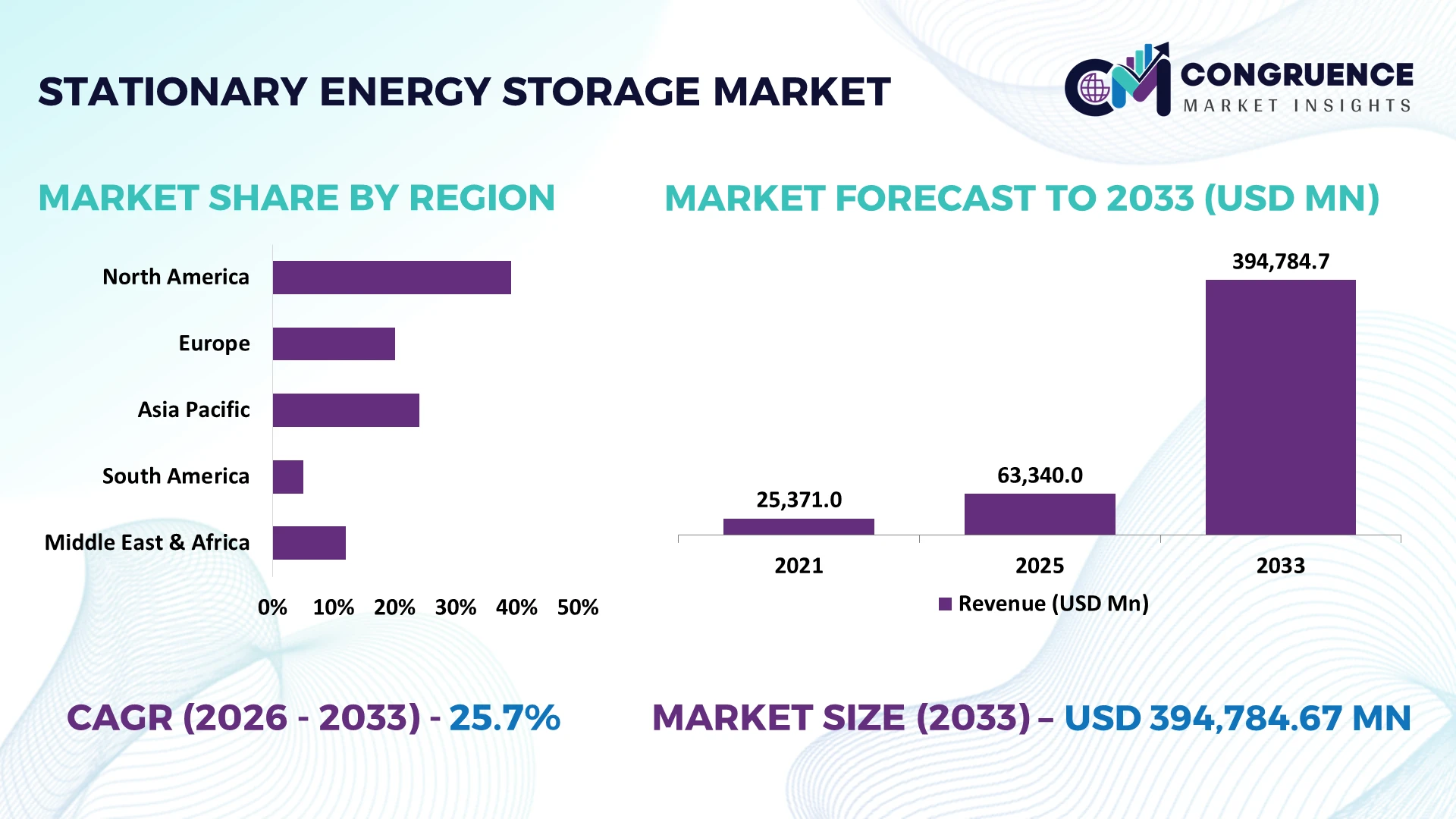
China leads with approximately 45% of global stationary storage capacity, supported by large-scale solar, wind, battery manufacturing, and grid modernization investments; the United States follows at nearly 25%, driven by utility-scale storage and Inflation Reduction Act incentives. China’s deployment volume is roughly 1.8 times U.S. capacity, while flow batteries and sodium-ion systems gain targeted adoption in long-duration applications.
Strategic implication: suppliers combining scalable battery manufacturing, grid software, and long-duration technologies are best positioned to capture high-growth utility and renewable-integration contracts.
Market Size & Growth: USD 63.34 billion in 2025 to USD 394.78 billion by 2033 at 25.7% CAGR, driven by renewable-grid balancing and battery cost optimization.
Top Growth Drivers: Renewable integration 32%; peak-load management 24%; grid modernization 18%.
Short-Term Forecast: By 2028, advanced battery costs are targeted to decline 15%, while system efficiency improves 6%.
Emerging Technologies: AI energy optimization, sodium-ion batteries, solid-state cells, and automated thermal management accelerate high-growth deployments.
Regional Leaders: Asia Pacific reaches approximately USD 185 billion, North America USD 108 billion, and Europe USD 76 billion, supported by utility-scale deployment.
Consumer/End-User Trends: Commercial and industrial storage adoption is approaching 20%, reflecting stronger demand for peak-demand reduction and backup resilience.
Pilot/Case Example: A 2026 grid-storage deployment using AI dispatch optimization reduced peak-load exposure by approximately 12%.
Competitive Landscape: CATL leads with roughly 15% global battery-storage supply share, alongside BYD, Tesla, LG Energy Solution, and Sungrow.
Regulatory & ESG Impact: Clean-energy incentives and grid decarbonization programs are increasing storage-linked renewable projects by approximately 10%.
Investment & Funding: More than USD 30 billion is entering large-scale storage projects, with utilities prioritizing partnerships, manufacturing localization, and regional supply chains.
Innovation & Future Outlook: Next-generation sodium-ion, long-duration flow batteries, AI dispatch, and hybrid storage are shifting competition toward lower lifecycle costs and grid flexibility.
Stationary energy storage is gaining traction across utility-scale renewable integration, commercial peak management, microgrids, and data-center resilience, with advanced lithium-ion systems accounting for over 85% of newly deployed capacity. In 2026, AI-enabled battery management, sodium-ion products, and longer-duration systems are improving dispatch precision and reducing supply-chain exposure. Regulatory pressure for grid flexibility is accelerating procurement, creating a clear transition toward intelligent, diversified storage portfolios.
Stationary energy storage is becoming a strategic infrastructure asset because utilities, data centers, manufacturers, and renewable developers increasingly compete on power reliability, flexibility, and energy-cost control. The shift from standalone batteries toward integrated storage-plus-software platforms is restructuring procurement, while grid-modernization programs are accelerating deployment. By 2028, intelligent battery-management systems are expected to support more than 60% of new large-scale projects, increasing dispatch optimization and reducing operational inefficiencies.
Technology economics are also changing investment priorities. Modern lithium-ion systems deliver approximately 92% round-trip efficiency versus about 80% for older lead-acid configurations, while automated thermal management can reduce maintenance requirements by roughly 10%. China continues to lead deployment scale and battery manufacturing, whereas the United States emphasizes utility-scale projects and digital grid integration; Germany and the United Kingdom are advancing flexibility-focused applications.
Companies are responding through localized battery sourcing, utility partnerships, and investments in sodium-ion and long-duration technologies. A practical deployment model combines solar generation, battery storage, and AI-based dispatch to reduce peak-grid dependence by approximately 10–15%. Over the next 2–3 years, competitive advantage will increasingly depend on lifecycle economics, software intelligence, and reliable grid integration rather than battery capacity alone.
The strongest growth driver is the rapid integration of variable renewable generation into power systems. Utility-scale solar and wind projects increasingly require storage to manage intermittency, with battery deployments supporting peak shifting, frequency regulation, and reserve capacity. Advanced systems can achieve approximately 90–95% round-trip efficiency, while AI-based dispatch can improve energy-utilization efficiency by 5–8%. In the United States, utilities are pairing storage with renewable projects to strengthen grid resilience and reduce curtailment. Manufacturers are responding by expanding high-density battery production, integrating energy-management software, and forming utility partnerships. A non-obvious advantage is that storage enables renewable assets to provide more predictable capacity, improving project economics and grid-value realization.
Battery supply-chain exposure remains a significant constraint because lithium, graphite, nickel, and other critical materials influence system economics and procurement stability. Raw-material price fluctuations can alter battery-system costs by approximately 10–20%, while imported components can account for more than 60% of system value in heavily dependent markets. China's dominant position across battery-cell and processing supply chains creates additional concentration pressure for companies expanding elsewhere. U.S. manufacturers are therefore increasing domestic sourcing, while European developers are pursuing diversified supplier contracts and localized manufacturing partnerships. Companies are also evaluating sodium-ion chemistry to reduce dependence on lithium-based inputs. The key operational insight is that procurement resilience is becoming as important as cell performance when securing multi-year storage projects.
Next-generation chemistry and software create high-value opportunities beyond conventional lithium-ion deployment. Sodium-ion batteries can reduce exposure to lithium supply constraints, while AI-enabled energy-management platforms can improve dispatch efficiency by approximately 5–10%. Commercial facilities with demand charges representing 20–30% of electricity costs offer particularly attractive applications for automated peak shaving. India presents an emerging opportunity as renewable additions, industrial electrification, and distributed storage requirements expand. Companies are increasing R&D spending, developing hybrid lithium-sodium architectures, and partnering with software providers to build integrated storage platforms. A less-visible opportunity lies in repurposing storage assets for multiple revenue streams, combining backup power, frequency services, renewable balancing, and demand-response participation.
Large-scale storage projects face increasing execution complexity as batteries, inverters, energy-management systems, renewable assets, and grid controls must operate through interoperable architectures. Integration failures can reduce usable system performance by approximately 5–10%, while cybersecurity vulnerabilities across connected energy-management platforms create additional operational exposure. Data-center and industrial deployments in the United States are particularly demanding because uptime requirements approach 99.9% and power interruptions carry substantial production or service costs. Companies are responding through standardized control protocols, digital twins, cybersecurity monitoring, and specialized commissioning teams. The strategic challenge is no longer battery installation alone; consistent performance requires software governance, skilled technicians, grid-code compliance, and lifecycle optimization across increasingly complex energy assets.
Utility-Scale Projects Are Expanding: Utility-scale installations accounted for approximately 80% of newly deployed stationary battery capacity in 2025, while annual additions exceeded 100 GW. Larger projects are replacing fragmented installations, allowing developers to standardize procurement, automate commissioning, and improve asset utilization by 8–12%. Companies are responding with multi-year battery contracts, larger manufacturing lines, and utility partnerships.
Storage Duration Is Increasing: Average project duration approached 3 hours in 2025, compared with roughly 2 hours in 2023, while four-hour systems are gaining greater deployment. This shift reflects stronger requirements for renewable shifting and capacity support rather than short-duration balancing alone. Developers are redesigning portfolios around longer-duration assets, while battery suppliers are increasing cell density and modular system configurations.
LFP Chemistry Gains Ground: LFP chemistry represented about 90% of stationary battery deployments in 2025, compared with less than 50% five years earlier. Lower material exposure and stronger cycle performance are reducing lifecycle-cost pressure by approximately 10–15%. Manufacturers are expanding LFP production while diversifying sourcing after supply-chain concentration exposed procurement vulnerabilities.
AI Drives Data-Center Storage: Battery-backed capacity serving data centers reached approximately 45 GW in 2025, increasing around 30% as AI workloads intensified electricity requirements. Operators are connecting UPS batteries with energy-management platforms to optimize backup, peak-load control, and grid interaction. Technology companies are increasingly treating storage as an active energy asset rather than standby infrastructure.
Battery Technology Training remains the leading type, representing approximately 38% of demand, because stationary storage operators require specialized knowledge of cell chemistry, battery-management systems, thermal controls, degradation, and state-of-charge optimization. Its scalability across utility fleets and commercial BESS installations gives it a clear advantage over System Design Training, which accounts for approximately 25% and focuses more heavily on inverter sizing, protection architecture, container configuration, and electrical integration. Companies are expanding battery-focused programs because technical errors during commissioning or operation can materially reduce usable capacity and asset life. Simulation-based learning is increasingly used to improve technical readiness and reduce commissioning-related delays by approximately 8–12%.
Operation & Maintenance Training is the fastest-growing type, with adoption increasing approximately 15% as installed storage fleets require predictive diagnostics, remote monitoring, thermal management, and lifecycle optimization. Safety & Compliance Training represents nearly 20% and is gaining importance as fire-protection requirements and battery-safety procedures become more rigorous. Providers are responding through equipment-specific modules, digital simulations, certification partnerships, and enterprise workforce programs. Investment is consequently shifting from basic theoretical instruction toward hands-on technical capabilities aligned with increasingly automated BESS operations.
Installation Training holds the leading share at approximately 35%, reflecting the rapid deployment of containerized battery systems, inverters, thermal-management equipment, protection systems, and grid-control interfaces. Installation activities remain highly standardized compared with newer digital applications, making them the largest training requirement across utility and commercial projects. Maintenance Training follows at nearly 27%, supported by expanding installed fleets and stronger emphasis on asset availability. Companies are increasingly using digital commissioning tools, augmented technical guidance, and standardized installation workflows, improving commissioning efficiency by approximately 10% while reducing avoidable configuration errors.
Energy Management Training is the fastest-growing application, with adoption increasing around 16% as operators integrate automated dispatch, demand forecasting, state-of-charge optimization, and AI-enabled energy-management systems. Grid Integration Training represents approximately 20% and remains operationally critical as storage participates in frequency regulation, ancillary services, and renewable balancing. Compared with conventional installation-focused programs, these emerging applications require stronger software and grid-control expertise. Companies are therefore expanding specialized modules, integrating real-time simulation platforms, and forming partnerships with utilities and BESS technology providers. The strategic shift is toward training that directly improves dispatch performance and grid interoperability.
Utilities represent the leading end-user group at approximately 42% of demand, reflecting their large project pipelines, grid-balancing responsibilities, infrastructure dependency, and need for standardized workforce capabilities across multiple storage sites. Renewable Energy Companies account for nearly 25%, increasingly combining solar and wind generation with stationary storage to improve dispatchability and reduce curtailment. Utility buyers generally favor enterprise-wide training contracts covering standardized operating procedures, while renewable developers increasingly request project-specific technical programs. Companies are responding through customized curriculum design, fleet-level partnerships, and bundled technical training services. Approximately 30% of utility-focused programs are shifting toward digital or simulation-based delivery, reducing travel requirements and accelerating workforce deployment.
Energy Storage Providers are the fastest-growing end-user group, with adoption increasing approximately 17% as third-party operators expand BESS portfolios and assume greater responsibility for asset optimization. Industrial Facilities account for roughly 18%, emphasizing energy resilience, demand management, and operational continuity. Storage providers are targeting these segments through modular pricing, remote-learning platforms, certification partnerships, and specialized operational training. The competitive shift favors providers capable of serving both centralized utility fleets and distributed industrial assets. This creates a broader ecosystem opportunity around recurring training, software-enabled learning, and lifecycle workforce support.
Asia-Pacific accounted for the largest market share at 60% in 2025 however, Middle East & Africa is expected to register the fastest growth, expanding at a CAGR of 29.1% between 2026 and 2033.
Utility-scale deployment and data-center resilience reshape demand
North America represented approximately 18% of global stationary storage additions in 2025, with the United States accounting for most regional deployment. U.S. battery additions reached nearly 19 GW, including more than 16 GW of utility-scale capacity, as utilities increased procurement for renewable balancing, capacity support, and transmission constraints. Data-center expansion is adding another demand layer, particularly around hyperscale computing corridors where battery systems increasingly support power-quality management rather than backup alone. Developers are also moving toward longer-duration configurations and integrated energy-management platforms. Partnerships between utilities, system integrators, and battery manufacturers are accelerating project execution, while domestic manufacturing incentives are encouraging localized supply chains. The competitive advantage is shifting toward companies that combine project-financing capability, grid-interconnection expertise, and vertically integrated battery systems.
United States Market Outlook: The United States remains North America's primary investment center, supported by large utility procurement pipelines, advanced grid infrastructure, and strong data-center electricity demand. Battery storage additions reached approximately 19 GW in 2025, with utility-scale projects representing more than 16 GW. Developers are prioritizing large-format systems, domestic sourcing, and software-enabled dispatch capabilities.
Utility-scale storage accelerates grid modernization
Europe accounted for approximately 6% of global battery-storage additions in 2025, but its market structure is shifting rapidly toward utility-scale systems. European installations reached about 36 GWh during 2025, while operational battery capacity surpassed 100 GWh. Utility-scale installations became increasingly important as renewable penetration increased and grid flexibility requirements intensified. Germany, Italy, and the United Kingdom remain major deployment centers, with Italy's market increasingly shaped by long-duration procurement mechanisms. Permitting delays and grid-connection constraints continue to influence project schedules, encouraging developers to secure interconnection rights earlier and form partnerships with infrastructure specialists. European manufacturers are also prioritizing supply-chain diversification as dependence on imported cells remains significant. Companies with strong grid-integration capabilities and localized service networks are gaining an advantage over pure hardware suppliers.
Germany Market Outlook: Germany remains a strategically important European storage market because of its large renewable-generation base, distributed energy infrastructure, and sophisticated electricity-market participation. Commercial and residential storage provide a substantial installed base, while utility-scale projects are expanding rapidly. Developers are increasingly integrating batteries with solar assets and intelligent energy-management systems to capture multiple flexibility applications.
Manufacturing scale reinforces regional deployment leadership
Asia-Pacific accounted for approximately 60% of global battery-storage additions in 2025, led overwhelmingly by China, which deployed more than 63 GW during the year. The region combines extensive battery-cell manufacturing, large renewable-energy projects, expanding transmission infrastructure, and rapidly growing electricity demand. China alone represented roughly one-third more annual battery additions than in 2024, reinforcing its supply-chain and deployment advantage. Australia is emerging as another important market, with battery additions approaching 8 GW in 2025 as utility-scale and behind-the-meter systems expanded sharply. Companies are responding by increasing cell and system production, integrating energy-management software, and developing localized partnerships in India, Australia, Japan, and Southeast Asia. The non-obvious advantage is supply-chain proximity: manufacturers located close to cell, cathode, inverter, and power-electronics production can shorten project lead times while controlling procurement risk.
China Market Outlook: China remains the dominant country for stationary storage deployment and manufacturing integration. It added more than 63 GW of battery capacity in 2025, including approximately 55 GW of utility-scale systems. Its advantage extends beyond deployment volume to cell manufacturing, battery-pack integration, power electronics, and large domestic renewable projects, allowing suppliers to scale rapidly and control multiple stages of the value chain.
Solar curtailment creates a strategic storage opening
South America remains an emerging stationary storage market, with Chile establishing the strongest utility-scale position through its high solar penetration and transmission constraints. Regional additions remained below 1 GW in 2025, while Chile approached that level as batteries absorbed surplus solar generation and supported evening peak demand. Brazil is developing a complementary market around industrial facilities, commercial users, and grid-resilience applications where power-quality fluctuations and peak charges influence storage economics. Companies are increasingly combining batteries with solar installations rather than deploying standalone systems, improving asset utilization and reducing dependence on diesel backup. Partnerships with local engineering firms are becoming important because interconnection procedures and project-specific grid requirements vary considerably. The strategic opportunity is concentrated in high-solar corridors and industrial loads where storage can simultaneously address curtailment, demand charges, and reliability.
Chile Market Outlook: Chile holds the region's strongest near-term stationary-storage position because its northern solar belt generates significant midday surpluses while evening electricity demand remains high. Battery additions approached 1 GW in 2025, creating a strong operational case for four-hour systems. Developers are prioritizing solar-plus-storage configurations, transmission support, and dispatchable renewable-power contracts.
Large renewable projects accelerate storage infrastructure
Middle East & Africa is transitioning toward large-scale battery systems as utilities seek greater grid flexibility, renewable integration, and electricity-security capacity. Regional battery additions exceeded 3 GW in 2025, more than three times the previous year's level, with Saudi Arabia accounting for most of the increase. Utility-scale procurement is increasingly connected to large solar developments, while Gulf countries are integrating storage into broader grid-modernization programs. Africa presents a different operating model, with batteries supporting mini-grids, distributed solar, industrial loads, and weak-grid applications. Companies are therefore adopting differentiated deployment strategies rather than relying on a single system configuration. Saudi procurement is favoring very large projects and long-duration capability, whereas African markets emphasize modular systems and localized service. Suppliers with strong financing, project execution, and harsh-climate thermal-management capabilities are gaining an important competitive advantage.
Saudi Arabia Market Outlook: Saudi Arabia is the region's most significant stationary-storage market because of its rapidly expanding renewable pipeline and large-scale electricity infrastructure modernization. Battery additions drove most Middle Eastern deployment growth in 2025, with regional additions exceeding 3 GW. Developers are prioritizing utility-scale systems capable of supporting renewable integration, grid flexibility, and electricity reliability across major infrastructure projects.
The market is led by CATL, BYD, Tesla, Sungrow, and Fluence, with global battery manufacturers competing against system integrators and regional EPC specialists. The top five players collectively command approximately 45% of global stationary-storage supply, reflecting strong scale advantages. Competition centers on battery pricing, cell availability, system efficiency, software integration, and delivery speed, with advanced platforms improving dispatch efficiency by 5–8% and vertically integrated procurement reducing equipment costs by roughly 8–12%. CATL and BYD emphasize manufacturing scale and supply control, while Tesla and Fluence compete through software, project integration, and utility relationships. Sungrow strengthens its position through power-conversion technology and integrated BESS platforms. Chinese suppliers are expanding overseas manufacturing and partnerships to address localization requirements, while Western players emphasize domestic sourcing and grid software. High capital requirements, certification, bankability, and interconnection expertise remain major entry barriers. Winning requires supply security, scalable manufacturing, intelligent controls, and proven large-project execution.
CATL
BYD
Tesla
Sungrow
Fluence
LG Energy Solution
Samsung SDI
Panasonic Energy
Wärtsilä
Saft
EVE Energy
Northvolt
Envision Energy
Trina Storage
Advanced lithium-ion BESS remains the dominant technology, with LFP increasingly preferred for utility-scale applications because of cycle durability, safety, and cost stability. CATL’s TENER achieves 430 Wh/L and raises energy density per unit area by 30% while reducing station footprint by 20%. AI-enabled battery-management systems add approximately 1–2% operational-efficiency gains through predictive monitoring and optimized dispatch.
Emerging technologies are shifting storage economics toward longer-duration and supply-chain diversification. Sodium-ion systems reduce dependence on lithium-based inputs, while liquid cooling, advanced thermal controls, and modular power-conversion systems improve performance by approximately 2% and reduce auxiliary consumption. CATL’s 9 MWh TENER Stack demonstrates the move toward ultra-high-density systems. By 2026, AI-supported monitoring and automated O&M are becoming standard across large utility projects.
From 2026–2028, intelligent BESS platforms, sodium-ion chemistry, advanced LFP cells, and grid-forming inverters will shape competitive differentiation. Fluence benefits from software-led optimization, while CATL, BYD, and Sungrow gain from manufacturing scale and integrated hardware. Companies adopting higher-density systems can reduce land requirements by 20%, while automated controls improve dispatch precision and asset utilization, making technology integration a priority for new projects.
April 2024 — CATL unveiled TENER, a 6.25 MWh system delivering five-year zero degradation, 30% higher energy density per unit area, and a 20% smaller footprint, strengthening the economics of large-scale storage through higher capacity within constrained sites. Source: CATL
February 2025 — Fluence launched Smartstack, a modular AC-based platform offering approximately 30% higher energy density than leading solutions. Commercial availability targeted grid-scale customers, improving land utilization and addressing transportation constraints as project sizes increased. Source: Fluence
July 2025 — Fluence and AGL agreed to develop the 500 MW/2,000 MWh Tomago BESS in Australia. The project became Fluence’s largest transaction globally and brought its Australian project portfolio to 5 GWh, reinforcing utility-scale expansion. Source: Fluence
December 2025 — Sungrow completed grid connection of Saudi Arabia’s 7.8 GWh ESS, using more than 1,500 PowerTitan 2.0 systems manufactured in 58 days. The project established a major benchmark for rapid large-scale deployment and regional renewable-grid integration. Source: Sungrow
The Stationary Energy Storage Market Report evaluates the industry across Battery Technology Training, System Design Training, Operation & Maintenance Training, and Safety & Compliance Training, alongside Installation Training, Maintenance Training, Energy Management Training, and Grid Integration Training. End-user coverage includes Utilities, Energy Storage Providers, Industrial Facilities, and Renewable Energy Companies, capturing differences in procurement priorities, operational requirements, and technology adoption.
The report provides regional analysis across North America, Europe, Asia-Pacific, South America, and the Middle East & Africa, with country-level assessment of deployment activity, manufacturing capacity, grid modernization, and investment positioning. Coverage extends to advanced LFP systems, sodium-ion batteries, AI-enabled energy management, liquid cooling, long-duration storage, and grid-forming technologies. The analysis supports investment planning, market-entry decisions, expansion strategies, technology prioritization, partnership development, and competitive positioning through 2026–2033.
| Report Attribute/Metric | Report Details |
|---|---|
Market Revenue in 2025 | USD 63340 Million |
Market Revenue in 2033 | USD 394784.67 Million |
CAGR (2026 - 2033) | 25.7% |
Base Year | 2025 |
Forecast Period | 2026 - 2033 |
Historic Period | 2021 - 2025 |
Segments Covered | By Type
By Application
By End-User
|
Key Report Deliverable | Revenue Forecast, Growth Trends, Market Dynamics, Segmental Overview, Regional and Country-wise Analysis, Competition Landscape |
Region Covered | North America, Europe, Asia-Pacific, South America, Middle East, Africa |
Key Players Analyzed | CATL, BYD, Tesla, Sungrow, Fluence, LG Energy Solution, Samsung SDI, Panasonic Energy, Wärtsilä, Saft, EVE Energy, Northvolt, Envision Energy, Trina Storage |
Customization & Pricing | Available on Request (10% Customization is Free) |




