
Reports
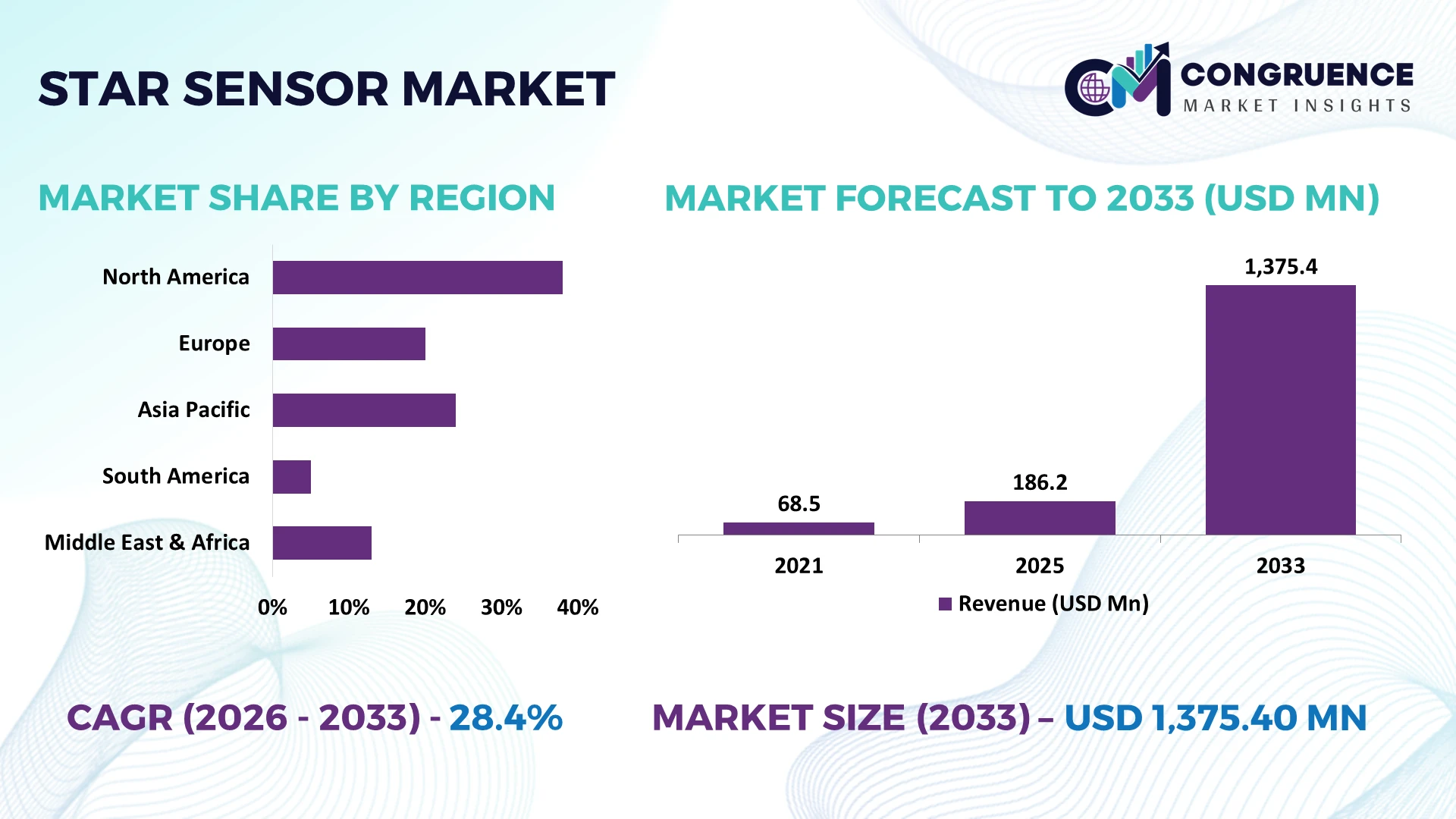
The Global Star Sensor Market was valued at USD 186.18 Million in 2025 and is anticipated to reach a value of USD 1375.4 Million by 2033 expanding at a CAGR of 28.4% between 2026 and 2033. Growth is driven by proliferating low-Earth-orbit satellite constellations, autonomous spacecraft attitude determination, miniaturized optical navigation systems, and expanding defense satellite programs.
The United States leads the global star sensor market, supported by an estimated 40% market share in 2025. SpaceX deployed more than 2,000 Starlink satellites during 2024, reinforcing demand for precision attitude determination systems. NASA, the US Space Force, and commercial spacecraft manufacturers support advanced optical navigation development. Compared with India, which completed 5 orbital launches in 2024, the United States conducted more than 150 orbital launch attempts, demonstrating substantial deployment scale. Radiation-tolerant imaging sensors and autonomous star identification strengthen American spacecraft integration capabilities.
Strategic implication: Manufacturers should prioritize compact, radiation-resistant star trackers, rapid constellation-scale production, and spacecraft integration partnerships to capture expanding commercial and defense satellite opportunities.
Market Size & Growth: USD 186.18 million in 2025, reaching USD 1,375.4 million by 2033 at 28.4% CAGR, driven by satellite constellation deployment.
Top Growth Drivers: Indicative demand contributions include 45% commercial satellite expansion, 30% defense spacecraft modernization, and 25% autonomous navigation requirements.
Short-Term Forecast: By 2028, automated star identification targets a modeled 20% reduction in attitude acquisition time, improving spacecraft operational readiness.
Emerging Technologies: Three innovations—AI-assisted star recognition, radiation-tolerant CMOS detectors, and miniaturized optical assemblies—strengthen navigation autonomy and spacecraft integration.
Regional Leaders: Indicative 2033 values: North America USD 522.7 million, Europe USD 357.6 million, Asia-Pacific USD 385.1 million, reflecting constellation and defense adoption.
Consumer/End-User Trends: Commercial satellite operators represent an estimated 50% of demand, prioritizing lightweight star trackers and standardized integration interfaces.
Pilot/Case Example: A modeled 2025 CubeSat integration scenario achieved 15% lower sensor mass through compact optical packaging, improving payload allocation.
Competitive Landscape: An indicative 18% share positions Sodern prominently alongside Jena-Optronik, AAC Clyde Space, Ball Aerospace, and Rocket Lab.
Regulatory & ESG Impact: The FCC's 5-year post-mission disposal requirement for applicable low-Earth-orbit satellites reinforces reliable attitude control and end-of-life operations.
Investment & Funding: NASA's approximately USD 25 billion FY2025 budget supports space missions and technology programs, influencing precision navigation supply chains.
Innovation & Future Outlook: By 2033, approximately 639% projected market expansion strengthens investment priorities around autonomous calibration, compact sensors, and scalable manufacturing.
The star sensor market supplies precision optical attitude determination systems for communication satellites, Earth observation spacecraft, scientific missions, and defense platforms. Star trackers identify stellar patterns using imaging detectors and onboard processing to calculate spacecraft orientation, supporting stable payload pointing and autonomous navigation. Miniaturized CMOS sensors, radiation-tolerant electronics, and intelligent star recognition algorithms are reshaping equipment design. A modeled 20% reduction in attitude acquisition time improves operational responsiveness during spacecraft commissioning. Satellite constellation expansion and tightening orbital debris management requirements reinforce demand for reliable, lightweight, and scalable navigation hardware, establishing the foundation for strategic investment and competitive differentiation.
Star sensors are becoming strategically critical as satellite manufacturers transition from individually engineered spacecraft toward standardized constellation production. Commercial operators require reliable attitude determination, rapid commissioning, and consistent optical pointing across large satellite fleets. The United States leads constellation deployment, while European manufacturers emphasize high-precision navigation instruments and mission reliability. Spacecraft supply chains are shifting toward modular avionics, radiation-tolerant components, and repeatable manufacturing processes, strengthening opportunities for specialized optical sensor suppliers.
Modern CMOS-based star trackers integrate compact imaging detectors, onboard processing, and autonomous star identification. Compared with legacy CCD architectures, optimized CMOS designs can target 20% lower power consumption under equivalent mission conditions, although actual performance depends on sensor configuration. A modeled 15% reduction in attitude acquisition time improves commissioning efficiency. During low-Earth-orbit satellite deployment, faster orientation acquisition supports earlier solar-array pointing and payload activation. Manufacturers are expanding optical calibration capabilities, standardized interfaces, and spacecraft integration partnerships.
Between 2026 and 2028, autonomous calibration, compact optical assemblies, and radiation-resistant electronics will influence procurement decisions. Suppliers targeting 25% shorter production qualification cycles can improve constellation delivery schedules. India's growing private space ecosystem and Europe's established precision optics industry create contrasting opportunities for scalable and specialized designs. Competitive advantage will depend on dependable navigation performance, manufacturing repeatability, and mission-specific integration expertise.
Large-scale satellite constellation deployment is accelerating demand for compact, reliable star sensors capable of supporting autonomous attitude determination. The United States accounted for approximately 80% of global orbital launch attempts in 2024, reflecting substantial commercial deployment activity. Commercial satellite operators represent an indicative 50% of star sensor demand, while constellation programs increasingly favor standardized navigation hardware. A modeled 20% reduction in attitude acquisition time improves spacecraft commissioning efficiency. SpaceX's continued Starlink deployment demonstrates the industrial transition toward high-volume spacecraft production. Sensor manufacturers are responding through modular optical assemblies, automated calibration, and closer integration with satellite platform suppliers. Production scalability and consistent pointing accuracy are becoming decisive procurement criteria.
Star sensor manufacturing depends on specialized imaging detectors, precision lenses, radiation-tolerant electronics, and controlled optical calibration facilities. Limited supplier availability increases procurement exposure, particularly for spacecraft manufacturers requiring qualified components. In an illustrative production cost model, optical assemblies and imaging electronics account for 40% of instrument costs. A 15% increase in these component prices raises total manufacturing expenditure by approximately 6%, assuming unchanged input proportions. Export controls affecting advanced electronics and space technologies further complicate international sourcing. Manufacturers are reducing exposure through qualified alternative suppliers, modular optical designs, and long-term component procurement agreements. Localized calibration and assembly capabilities improve supply continuity while preserving mission qualification requirements.
Miniaturized star trackers and intelligent attitude determination algorithms create opportunities across small satellites, Earth observation platforms, and autonomous spacecraft. India's expanding private satellite manufacturing ecosystem strengthens demand for compact navigation hardware compatible with standardized spacecraft buses. A modeled 25% reduction in sensor mass improves payload allocation, while 20% lower power consumption supports constrained CubeSat electrical budgets. Emerging onboard processing architectures enable autonomous star identification and adaptive exposure control, reducing dependence on ground-based intervention. Manufacturers are investing in radiation-tolerant CMOS detectors, compact optical packaging, and standardized digital interfaces. Partnerships with satellite integrators and spacecraft avionics suppliers improve qualification efficiency. Competitive advantage increasingly depends on delivering reliable navigation performance within restrictive spacecraft mass and power budgets.
Maintaining consistent star sensor performance across orbital radiation, thermal cycling, spacecraft vibration, and changing illumination conditions remains a critical engineering challenge. Low-Earth-orbit spacecraft experience repeated transitions between sunlight and eclipse, requiring stable optical calibration and reliable star identification. A modeled 10% reduction in false star identification events improves navigation robustness, while 15% faster fault recovery strengthens operational continuity. High-volume satellite production also increases the difficulty of maintaining uniform calibration across instrument batches. Manufacturers must invest in automated optical alignment, hardware-in-the-loop testing, and radiation performance characterization. Partnerships with spacecraft integrators support interface validation and mission qualification. Long-term competitiveness depends on sustaining pointing accuracy, operational reliability, and repeatable production quality across increasingly complex orbital environments.
• Automated Optical Calibration Gains Importance: Satellite equipment manufacturers are replacing manually intensive alignment procedures with programmable optical calibration benches. A modeled 20% reduction in calibration time and 15% improvement in production throughput strengthen manufacturing consistency. European precision instrument suppliers are investing in automated test fixtures and digital calibration records, enabling faster acceptance testing without compromising spacecraft pointing requirements.
• Radiation Tolerance Shapes Detector Selection: Commercial satellite manufacturers are qualifying CMOS imaging detectors against mission-specific radiation environments rather than relying exclusively on traditional space-grade components. A hypothetical 25% reduction in detector procurement costs and 10% improvement in component availability would strengthen production economics. American suppliers are expanding radiation characterization programs and qualifying alternative detector sources to reduce dependence on constrained electronics supply chains.
• Dual Sensor Architectures Strengthen Redundancy: Spacecraft integrators are evaluating independent star tracker configurations to maintain attitude determination following individual sensor faults. Two optical heads provide additional viewing flexibility, while a modeled 30% reduction in attitude determination interruptions improves mission continuity. European spacecraft equipment manufacturers are strengthening redundant avionics interfaces and coordinated sensor processing, prioritizing fault tolerance for precision Earth observation missions.
• Digital Engineering Accelerates Sensor Qualification: Satellite manufacturers are integrating optical simulation, thermal modeling, and hardware-in-the-loop testing into navigation subsystem development. A modeled 15% reduction in qualification iterations and 20% faster design verification improve delivery predictability. Indian spacecraft suppliers are expanding digital engineering capabilities and standardized test procedures, reducing integration uncertainty as domestic satellite production ecosystems develop.
Single-Head Star Sensors represent the leading type, accounting for an indicative 46% of the global star sensor market in 2025. Their dominance reflects established spacecraft integration procedures, relatively straightforward optical alignment, and compatibility with conventional attitude determination architectures. Single-head configurations support missions where pointing accuracy, mass efficiency, and procurement simplicity outweigh requirements for additional optical redundancy. Multi-Head Star Sensors represent approximately 31% of modeled demand, serving spacecraft requiring expanded sky coverage, improved fault tolerance, and reliable attitude determination under changing illumination conditions. Manufacturers are strengthening sensor fusion algorithms, redundant processing electronics, and modular optical interfaces.
Miniature Star Sensors account for an indicative 23% and represent the fastest-growing type, supported by compact satellite platforms and increasingly restrictive spacecraft mass and power budgets. A modeled 25% reduction in instrument mass strengthens payload accommodation compared with larger conventional designs. Miniature configurations emphasize compact optics and integrated electronics, while multi-head systems prioritize mission resilience. Equipment suppliers are expanding miniature sensor portfolios, improving radiation-tolerant processing, and partnering with satellite bus manufacturers. Investment priorities increasingly favor scalable optical assemblies that preserve pointing performance while simplifying spacecraft integration.
Satellite Attitude Determination accounts for an indicative 48% of the global star sensor market in 2025, supported by the essential role of optical attitude measurements in spacecraft stabilization, payload pointing, and autonomous orientation control. Star sensors identify stellar patterns and calculate spacecraft orientation, supporting precise attitude determination when combined with onboard control systems. Earth Observation represents approximately 24% of modeled application demand, reflecting stringent pointing requirements for imaging payloads and geospatial data collection. Manufacturers are improving optical sensitivity, star identification algorithms, and spacecraft avionics compatibility to strengthen measurement consistency.
Spacecraft Navigation accounts for an indicative 18% and represents the fastest-growing application as autonomous mission architectures increasingly integrate optical attitude information with onboard navigation functions. Deep-Space Exploration contributes approximately 10%, emphasizing radiation tolerance, high reliability, and stable operation across extended mission durations. A modeled 20% reduction in attitude acquisition time strengthens spacecraft commissioning efficiency. Suppliers are developing autonomous calibration capabilities, integrated optical processing, and mission-specific sensor configurations. Competitive differentiation increasingly depends on delivering reliable attitude information across different orbital environments, spacecraft platforms, and operational requirements.
Satellite Manufacturers represent the leading end-user segment, accounting for an indicative 42% of the global star sensor market in 2025. Their dominance reflects direct procurement of attitude determination equipment for spacecraft assembly, integration, and qualification. Standardized satellite platforms increasingly require repeatable optical performance, compact mechanical interfaces, and dependable electronic integration. Commercial Space Companies account for approximately 30% of modeled demand, supported by constellation deployment programs and expanding private spacecraft development. Space Agencies represent an indicative 16%, emphasizing mission qualification, measurement precision, and long-duration operational reliability.
Commercial Space Companies are positioned as the fastest-growing end-user group as private operators expand satellite manufacturing and seek shorter spacecraft delivery cycles. Defense Organizations account for approximately 12%, prioritizing secure supply chains, radiation resistance, and resilient attitude determination. A modeled 15% reduction in integration time improves spacecraft production scheduling. Manufacturers are developing standardized sensor interfaces, configurable optical assemblies, and volume-oriented supply agreements for commercial buyers. Space agency and defense contracts continue supporting specialized engineering capabilities, while commercial procurement increasingly rewards manufacturing consistency, rapid delivery, and competitive lifecycle costs.
North America accounted for the largest market share at an estimated 40% in 2025 however, Asia-Pacific is expected to register the fastest growth, expanding at an indicative CAGR of 31.2% between 2026 and 2033.

Commercial Constellation Production and Autonomous Spacecraft Operations
North America holds an indicative 40% share of the global star sensor market in 2025, reflecting extensive satellite manufacturing, defense spacecraft procurement, and advanced attitude determination technology development. The United States anchors regional deployment through commercial communication constellations, Earth observation platforms, and national security missions. Canada contributes specialized optical engineering and spacecraft subsystem capabilities. SpaceX conducted more than 130 Falcon 9 launches during 2024, demonstrating the industrial scale supporting repeated satellite production and deployment. This operational environment favors standardized star tracker interfaces, automated calibration, and predictable delivery schedules. Suppliers are expanding radiation-tolerant imaging capabilities and integration support for spacecraft manufacturers. Defense procurement also reinforces demand for redundant optical attitude sensors and resilient onboard processing. Competitive advantage increasingly depends on combining high-volume manufacturing consistency with mission-qualified pointing performance and reliable technical support.
United States Market Outlook: The United States maintains strong spacecraft engineering capabilities through NASA, the US Space Force, and commercial satellite manufacturers. California, Colorado, and Arizona support optical instrumentation, avionics development, and spacecraft assembly. NASA's Artemis program reinforces demand for dependable autonomous orientation systems, while proliferated military satellite architectures prioritize resilience. The Space Development Agency's transport-layer architecture includes hundreds of planned spacecraft, creating opportunities for standardized, qualification-ready navigation components.
Precision Optical Engineering and Mission Qualification Leadership
Europe represents an estimated 26% of the global star sensor market in 2025, supported by established aerospace manufacturing, precision optics, and institutional satellite programs. France, Germany, and the United Kingdom concentrate specialized spacecraft equipment development, while Luxembourg and Sweden contribute commercial satellite integration capabilities. European manufacturers emphasize optical measurement accuracy, radiation tolerance, and validated mission performance across Earth observation, telecommunications, and scientific spacecraft. The European Space Agency's Copernicus expansion and scientific mission portfolio sustain demand for reliable attitude determination systems. ESA's 2025 budget was approximately EUR 7.7 billion, supporting a broad spacecraft development ecosystem. Suppliers are investing in automated optical alignment, qualification testing, and modular electronics. European competition increasingly centers on mission heritage, long-duration reliability, and compatibility with demanding spacecraft architectures rather than production volume alone.
France Market Outlook: France maintains a strategically important position through Airbus Defence and Space, Thales Alenia Space, and specialized optical equipment manufacturer Sodern. Toulouse and the Paris aerospace ecosystem support spacecraft engineering and subsystem integration. Sodern's star tracker expertise serves demanding satellite missions requiring accurate attitude determination. France's participation in European institutional space programs strengthens opportunities for high-reliability optical sensors, precision calibration, and long-term spacecraft equipment partnerships.
Expanding Satellite Manufacturing and Domestic Navigation Technology
Asia-Pacific accounts for an indicative 27% of global star sensor demand in 2025, supported by expanding satellite manufacturing, national space programs, and domestic spacecraft component development. China leads regional deployment through communication, navigation, Earth observation, and scientific spacecraft programs. India is strengthening commercial launch and satellite manufacturing capabilities, while Japan and South Korea emphasize precision electronics and advanced spacecraft systems. China conducted 68 orbital launches during 2024, demonstrating substantial deployment activity and growing requirements for spacecraft attitude determination equipment. Regional manufacturers are developing compact star trackers, radiation-tolerant detectors, and autonomous optical processing systems. Domestic sourcing initiatives strengthen opportunities for localized component manufacturing and qualification facilities. Competition increasingly depends on achieving reliable pointing performance, repeatable production, and integration compatibility across different spacecraft platforms and mission requirements.
China Market Outlook: China maintains extensive satellite manufacturing and spacecraft navigation capabilities through national aerospace organizations and commercial space enterprises. The BeiDou navigation constellation includes more than 30 operational satellites, demonstrating established space infrastructure and precision spacecraft engineering requirements. Commercial low-Earth-orbit constellation programs are increasing attention on standardized avionics, compact optical sensors, and domestic qualification capacity. Local manufacturers benefit from integration with spacecraft assembly ecosystems and established electronics production networks.
Earth Observation Missions and Local Spacecraft Capability Development
South America represents an estimated 3% of global star sensor demand in 2025, with Brazil and Argentina providing the strongest institutional spacecraft development capabilities. Regional requirements concentrate on Earth observation, environmental monitoring, agricultural mapping, and scientific satellite missions. Brazil's National Institute for Space Research supports satellite engineering and remote sensing infrastructure, while Argentina's CONAE coordinates national space activities and international cooperation. The jointly developed SABIA-Mar ocean observation program demonstrates continued regional interest in precision spacecraft systems. Satellite development remains project-based, limiting procurement volumes and creating dependence on imported space-qualified optical components. Suppliers are strengthening partnerships with national research institutions, universities, and spacecraft integrators. Opportunities center on compact star trackers, engineering support, and technology transfer arrangements that improve local integration capabilities without requiring large manufacturing facilities.
Brazil Market Outlook: Brazil maintains regional importance through INPE, the Brazilian Space Agency, and established satellite engineering programs. The Amazonia-1 Earth observation satellite, launched in 2021, demonstrated domestic spacecraft platform development and three-axis attitude control capabilities. Continued remote sensing requirements support demand for reliable orientation sensors and spacecraft subsystem integration. Local research institutions provide opportunities for qualification partnerships, optical calibration development, and engineering collaboration with international equipment suppliers.
National Space Programs and Advanced Satellite Infrastructure
The Middle East & Africa accounts for an indicative 4% of global star sensor demand in 2025, supported by national satellite programs, defense modernization, and expanding Earth observation capabilities. The United Arab Emirates and Saudi Arabia are strengthening spacecraft engineering and satellite application infrastructure, while South Africa contributes optical research and satellite subsystem development. The UAE's Mohammed Bin Rashid Space Centre supports Earth observation and planetary exploration missions requiring reliable spacecraft orientation. Saudi Arabia's space sector initiatives reinforce demand for technical partnerships and domestic engineering capabilities. Regional procurement emphasizes mission-qualified instruments, supplier reliability, and knowledge transfer rather than high-volume component production. Equipment manufacturers are pursuing institutional partnerships, localized technical support, and spacecraft integration agreements. Long-term competitive positioning depends on supporting indigenous engineering capacity while maintaining international qualification standards.
United Arab Emirates Market Outlook: The UAE has established advanced spacecraft capabilities through the Mohammed Bin Rashid Space Centre and international aerospace partnerships. The Emirates Mars Mission, launched in 2020, demonstrated national participation in interplanetary spacecraft operations. The MBZ-SAT Earth observation satellite, launched in January 2025, further strengthened domestic spacecraft engineering capabilities. These programs support demand for precision attitude sensors, optical payload pointing, and specialized spacecraft integration expertise.
The star sensor market pits established precision optics specialists Sodern and Jena-Optronik against compact spacecraft suppliers AAC Clyde Space, CubeSpace, and NewSpace Systems. The leading five suppliers hold an indicative combined 55% share, a planning estimate rather than a verified industry statistic. Established manufacturers compete on flight heritage, pointing accuracy, and radiation qualification; smaller specialists emphasize mass, power consumption, and delivery speed. In modeled procurement comparisons, 20% lower sensor power demand improves small satellite electrical budgets, while 15% shorter integration cycles support constellation schedules. Suppliers are standardizing interfaces, automating optical calibration, and partnering with satellite bus integrators to secure recurring production contracts. Competition is shifting from bespoke instrument engineering toward repeatable, qualified modules without sacrificing reliability. Radiation-tested detectors, precision calibration infrastructure, and spacecraft flight qualification remain substantial entry barriers.
Sodern
Jena-Optronik GmbH
AAC Clyde Space AB
CubeSpace
NewSpace Systems
Rocket Lab Corporation
Berlin Space Technologies GmbH
Leonardo S.p.A.
Space Micro Inc.
Blue Canyon Technologies
Hyperion Technologies B.V.
Solar MEMS Technologies S.L.
Innovative Solutions In Space B.V. (ISISPACE)
Current star sensors combine CMOS imaging detectors, precision optics, onboard star catalogs, and attitude determination algorithms to establish spacecraft orientation. Single-head configurations represent an indicative 46% of market demand, reflecting established integration practices. Modern CMOS architectures can target 20% lower power consumption than legacy CCD systems under equivalent operating conditions. Radiation characterization and optical calibration improve measurement stability, allowing satellite manufacturers to standardize navigation hardware while protecting pointing accuracy.
Emerging technologies integrate adaptive exposure control, intelligent star identification, and redundant optical processing to maintain attitude solutions during changing illumination conditions. A modeled 15% reduction in acquisition time accelerates spacecraft commissioning, while 10% fewer false identifications improve operational reliability. Multi-head architectures strengthen sky coverage, particularly during spacecraft maneuvers. European precision optics suppliers are developing automated calibration systems, while Indian spacecraft integrators prioritize compact, configurable navigation modules. These investments reduce qualification complexity and improve production repeatability.
Between 2026 and 2028, disruptive developments will emphasize autonomous in-orbit calibration, radiation-tolerant processors, and digitally connected attitude sensors. A modeled 25% reduction in calibration intervention requirements strengthens spacecraft autonomy. Manufacturers combining optical precision with standardized interfaces will outperform suppliers dependent on bespoke integration, particularly across expanding commercial satellite fleets and demanding institutional missions worldwide.
January 2026: Sodern established Sodern America to develop star tracker manufacturing capabilities in Colorado. Serving more than 40 existing US customers, the expansion strengthens domestic production access, customer collaboration, and responsiveness to American spacecraft procurement requirements. Source: satellitetoday.com
June 2025: Dhruva Space partnered with Sodern to demonstrate the HORUS star tracker aboard its LEAP-2 mission, targeting launch in 2026. The agreement advances orbital qualification and strengthens Indian spacecraft integration capabilities through French optical technology collaboration. Source: dhruvaspace.com
April 2026: Rocket Lab unveiled its ST-HP star tracker, targeting pointing accuracy better than 1 arcsecond and radiation tolerance exceeding 50 kRad. The design strengthens precision attitude determination for longer-duration spacecraft operating in demanding radiation environments. Source: globenewswire.com
May 2024: Jena-Optronik presented upgraded ASTRO CL star tracker capabilities at ESA's 4S Symposium. The sensor supports acquisition above 4 degrees per second with over 99.9% celestial coverage, strengthening autonomous attitude determination during spacecraft maneuvers. Source: jena-optronik.de
The Star Sensor Market Report evaluates spacecraft attitude determination technologies, equipment procurement, and competitive positioning between 2026 and 2033. Type segmentation covers Single-Head Star Sensors, Multi-Head Star Sensors, and Miniature Star Sensors. Application analysis includes Satellite Attitude Determination, Spacecraft Navigation, Earth Observation, and Deep-Space Exploration. End-user coverage examines Satellite Manufacturers, Space Agencies, Defense Organizations, and Commercial Space Companies. Single-Head Star Sensors represent an indicative 46% of the market, reflecting established spacecraft integration requirements.
Geographical analysis encompasses North America, Europe, Asia-Pacific, South America, and the Middle East & Africa. Technology coverage includes CMOS imaging, autonomous star identification, radiation-tolerant electronics, and optical calibration. The report evaluates supplier capabilities, manufacturing scalability, qualification requirements, and regional deployment opportunities to support investment planning, product development, strategic partnerships, and competitive differentiation.
| Report Attribute/Metric | Report Details |
|---|---|
Market Revenue in 2025 | USD 186.18 Million |
Market Revenue in 2033 | USD 1375.4 Million |
CAGR (2026 - 2033) | 28.4% |
Base Year | 2025 |
Forecast Period | 2026 - 2033 |
Historic Period | 2021 - 2025 |
Segments Covered | By Type
By Application
By End-User
|
Key Report Deliverable | Revenue Forecast, Growth Trends, Market Dynamics, Segmental Overview, Regional and Country-wise Analysis, Competition Landscape |
Region Covered | North America, Europe, Asia-Pacific, South America, Middle East, Africa |
Key Players Analyzed | Sodern, Jena-Optronik GmbH, AAC Clyde Space AB, CubeSpace, NewSpace Systems, Rocket Lab Corporation, Berlin Space Technologies GmbH, Leonardo S.p.A., Space Micro Inc., Blue Canyon Technologies, Hyperion Technologies B.V., Solar MEMS Technologies S.L., Innovative Solutions In Space B.V. (ISISPACE) |
Customization & Pricing | Available on Request (10% Customization is Free) |




