Global Standardized Plant Extract Manufacturing Market Report Overview
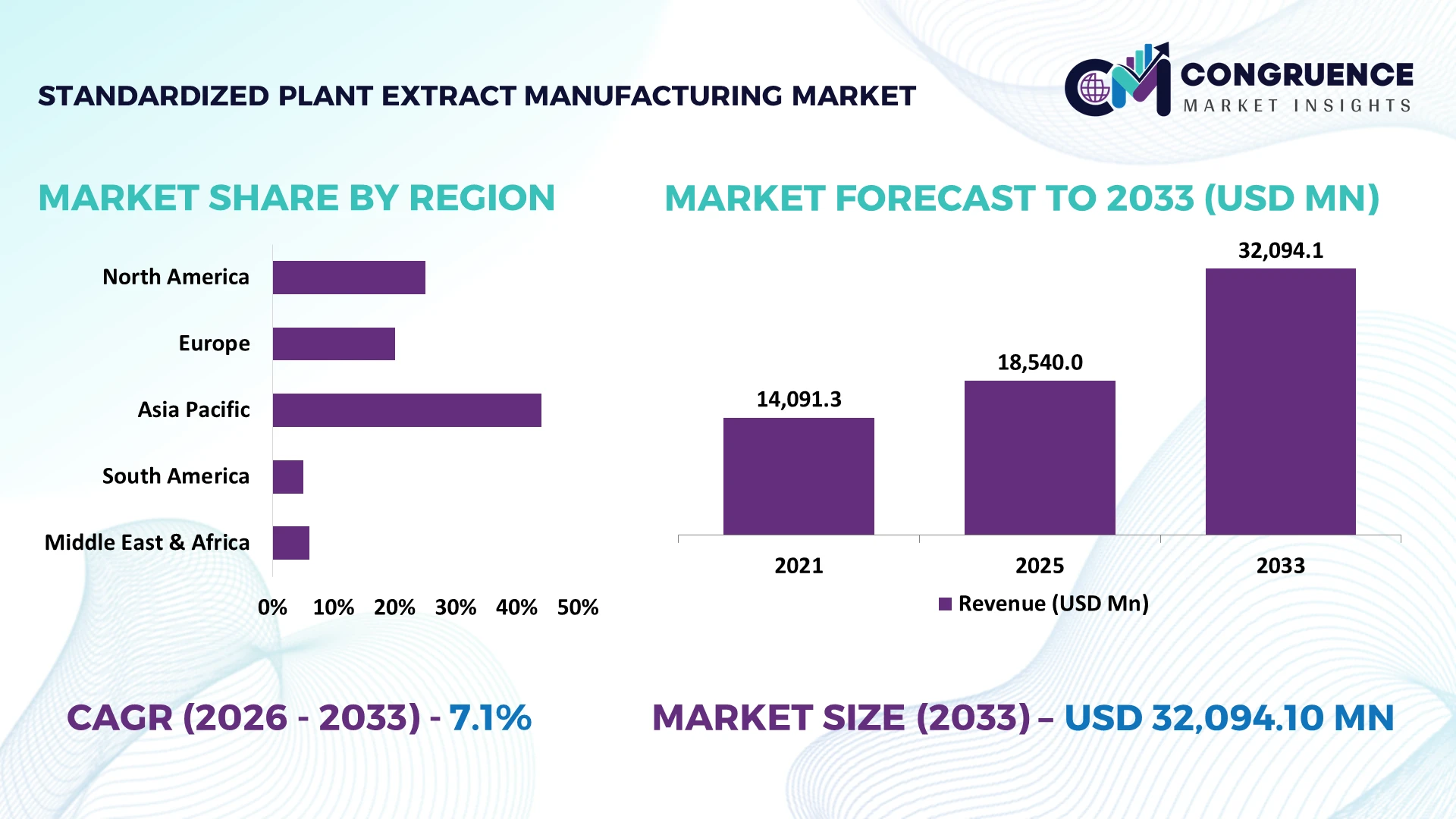
The Global Standardized Plant Extract Manufacturing Market was valued at USD 18540 Million in 2025 and is anticipated to reach a value of USD 32094.1 Million by 2033 expanding at a CAGR of 7.1% between 2026 and 2033. Growth is driven by pharmaceutical botanical ingredient standardization, chromatographic quality control, and increasing use of traceable plant extracts in nutraceutical and functional food formulations.
China holds a strategically important position in standardized plant extract manufacturing through botanical cultivation, extraction capacity, and ingredient exports. Its manufacturing ecosystem supplies pharmaceutical, nutraceutical, cosmetic, and food ingredient companies, supported by ethanol extraction, membrane separation, and HPLC-based active compound verification. India's botanical processing industry offers a competitive alternative through medicinal plant sourcing and established herbal manufacturing. China's 2025 Pharmacopoeia implementation strengthens standardized quality requirements, while the European Union's evolving botanical ingredient oversight increases the commercial importance of traceable manufacturing.
Manufacturers prioritizing validated marker compounds, diversified botanical sourcing, and pharmaceutical-grade analytical capabilities are better positioned to secure international supply agreements.
Key Highlights of the Global Standardized Plant Extract Manufacturing Market
-
Market Size & Growth: USD 18,540 million in 2025, reaching USD 32,094.1 million by 2033 at 7.1% CAGR, driven by validated botanical ingredient standardization.
-
Top Growth Drivers: China's 2025 extract export volumes increased 2.9%; shipments to Japan rose 16.6%, while Indian shipments increased 5.9%.
-
Short-Term Forecast: By 2028, automated extraction optimization targeting 10% lower solvent consumption offers a measurable operational improvement benchmark, not a verified forecast.
-
Emerging Technologies: Three technologies are reshaping processing: supercritical CO₂ extraction, membrane purification, and AI-assisted process control.
-
Regional Leaders: Asia-Pacific, Europe, and North America lead manufacturing activity; separate 2033 regional USD projections remain unverified. Adoption emphasizes production scale, regulatory compliance, and domestic processing, respectively.
-
Consumer/End-User Trends: China's plant extract exports reached 138,000 tonnes in 2025, indicating substantial industrial ingredient demand.
-
Pilot/Case Example: BioVivo Science opened a 100,000-square-foot Indiana facility in 2025 with annual powdered botanical extract capacity of at least 2,000 tonnes.
-
Competitive Landscape: Indena, Martin Bauer, Givaudan, and Kalsec compete through extraction expertise and ingredient specialization; individual global shares remain unverified.
-
Regulatory & ESG Impact: China's 2025 plant extract export unit prices fell from the 2022 peak of USD 32.7/kg to USD 21.6/kg, reinforcing resource efficiency priorities.
-
Investment & Funding: BioVivo Science invested USD 70 million in domestic botanical processing, reflecting supply-chain localization and integrated manufacturing.
-
Innovation & Future Outlook: Three priorities dominate advanced extraction: marker-compound consistency, automated process monitoring, and botanical traceability.
Standardized Plant Extract Manufacturing serves pharmaceutical, nutraceutical, functional beverage, cosmetic, and botanical ingredient producers requiring consistent active-compound concentrations. Manufacturers increasingly integrate chromatographic fingerprinting, selective extraction, membrane concentration, and validated drying processes to control ingredient specifications. China's botanical extract export volumes increased 2.9% during 2025, even as pricing pressure intensified, highlighting the operational importance of yield optimization and differentiated formulations. United States manufacturing localization and stricter international ingredient documentation are encouraging diversified processing capacity. These developments place extraction efficiency, analytical verification, and supply-chain resilience at the center of future competitive positioning.
What Is the Strategic Relevance and Future Pathways of the Standardized Plant Extract Manufacturing Market?
Standardized Plant Extract Manufacturing is becoming strategically important as pharmaceutical, nutraceutical, and functional ingredient manufacturers prioritize reproducible phytochemical concentrations over conventional botanical processing. China's implementation of its 2025 Pharmacopoeia reinforces analytical standardization, while international buyers increasingly require validated botanical identity and contaminant controls. China's reported 2.9% increase in plant extract export volumes during 2025 demonstrates the importance of manufacturing scale. Producers are restructuring procurement around traceable agricultural inputs, qualified extraction facilities, and consistent marker compound specifications.
Technology investment increasingly favors supercritical CO₂ extraction, membrane separation, and automated chromatography. Compared with conventional solvent extraction, optimized membrane concentration systems can target 20% lower thermal energy consumption, subject to process validation. China emphasizes large-scale ingredient processing, India benefits from medicinal plant sourcing and formulation expertise, and Germany competes through pharmaceutical-grade extraction and analytical capabilities. Between 2026 and 2028, manufacturers are expected to prioritize continuous process monitoring, digital batch records, and automated solvent recovery to strengthen production consistency.
BioVivo Science's 100,000-square-foot Indiana botanical processing facility illustrates investment in localized extraction infrastructure and integrated ingredient production. Companies are strengthening cultivation partnerships, expanding analytical laboratories, and qualifying alternative botanical suppliers. Competitive advantage increasingly depends on verified extract potency, reliable batch reproducibility, and resilient international supply networks.
Standardized Plant Extract Manufacturing Market Dynamics
DRIVER:
Pharmaceutical Standardization and Botanical Ingredient Traceability
Pharmaceutical and nutraceutical manufacturers increasingly require standardized extracts with reproducible concentrations of bioactive compounds. China's plant extract export volumes increased 2.9% during 2025, while shipments to Japan rose 16.6% and deliveries to India increased 5.9%, indicating expanding cross-border ingredient requirements. Implementation of China's 2025 Pharmacopoeia strengthens expectations for botanical identity, analytical verification, and manufacturing consistency. This regulatory environment favors producers capable of maintaining validated chromatographic fingerprints and documented marker compound concentrations. Companies including Indena and Martin Bauer are positioned through established extraction expertise and quality management capabilities. Manufacturers are expanding HPLC testing, strengthening cultivation partnerships, and integrating digital batch documentation. The strategic advantage lies in supplying specification-ready extracts that reduce formulation variability and qualification burdens for downstream customers.
RESTRAINT:
Agricultural Supply Volatility and Processing Cost Exposure
Botanical extract manufacturing faces structural constraints arising from seasonal crop availability, inconsistent phytochemical concentrations, and solvent-intensive processing. China's reported plant extract export unit prices declined from USD 32.7 per kilogram in 2022 to USD 21.6 in 2025, representing approximately 34% compression. This pricing shift increases pressure on processing margins and raw material procurement. Conventional ethanol extraction can require solvent concentrations of 50–95%, depending on the botanical material and target compounds, creating substantial recovery and handling requirements. Climate-related agricultural variability further complicates ingredient consistency in India and China. Manufacturers are diversifying cultivation locations, establishing contracted agricultural supply, and investing in solvent recovery systems. Reliable sourcing and extraction yield optimization are increasingly important for protecting profitability.
OPPORTUNITY:
Advanced Extraction and Domestic Processing Localization
Advanced extraction technologies create opportunities to improve compound selectivity, reduce processing losses, and establish regional manufacturing capacity. BioVivo Science's Indiana facility provides approximately 100,000 square feet of processing infrastructure and annual powdered botanical extract capacity of at least 2,000 tonnes. These investments demonstrate opportunities for localized ingredient supply and shorter procurement networks. Supercritical CO₂ extraction operates above carbon dioxide's critical temperature of approximately 31°C and critical pressure of 73.8 bar, enabling selective extraction without conventional organic solvent residues. Manufacturers are exploring automated process optimization, membrane concentration, and integrated drying technologies. Partnerships with botanical cultivators and equipment suppliers strengthen commercialization. The strategic opportunity extends beyond extraction capacity to validated, application-specific ingredients supplied through traceable manufacturing networks.
CHALLENGE:
Industrial Scale Validation and Analytical Method Transfer
Scaling botanical extraction from laboratory development to commercial production presents substantial technical challenges involving mass transfer, compound stability, and analytical reproducibility. Extract concentrations can vary with agricultural origin, harvest timing, and processing conditions, complicating consistent marker compound recovery. Pharmaceutical manufacturers increasingly require validated analytical methods with recovery performance commonly assessed against predefined acceptance criteria, frequently including 80–120% ranges where scientifically appropriate. Chromatographic method transfer also requires evaluation of precision, specificity, and robustness across production laboratories. India's diverse medicinal plant supply base increases the importance of botanical authentication and standardized sampling procedures. Manufacturers must invest in pilot-scale validation, qualified analytical personnel, and digital process monitoring. Companies establishing reliable scale-up protocols and transferable quality specifications will strengthen customer qualification, reduce rejected batches, and maintain long-term manufacturing credibility.
Standardized Plant Extract Manufacturing Market Latest Trends
-
Chromatographic Fingerprinting Strengthens Batch Release: Manufacturers are expanding HPLC and UHPLC testing to verify botanical identity and quantify active marker compounds. Laboratories increasingly combine 2 analytical approaches: chemical fingerprinting and targeted compound quantification. UHPLC systems commonly operate with particles below 2 µm, compared with conventional HPLC columns using 3–5 µm particles. Companies are upgrading analytical workflows to improve separation efficiency, accelerate quality decisions, and reduce inconsistencies between production batches.
-
Low-Temperature Drying Protects Bioactives: Producers are refining spray drying and freeze drying processes to preserve heat-sensitive phytochemicals. Conventional spray drying frequently uses inlet temperatures of 150–220°C, while freeze drying operates under reduced pressure with frozen materials. The different thermal exposures influence compound stability, powder characteristics, and processing costs. Manufacturers are introducing carrier-optimized formulations and controlled drying profiles to balance active ingredient retention against production throughput, particularly for polyphenol-rich botanical extracts.
-
Residue Testing Expands Export Qualification: International botanical ingredient buyers increasingly require documented pesticide residue and contaminant testing. European Union Regulation 2023/915 establishes maximum levels for selected contaminants in foods, while pesticide compliance involves Regulation 396/2005. Laboratories are integrating LC-MS/MS and GC-MS/MS screening to evaluate multiple residue classes. Manufacturers are strengthening agricultural input controls and laboratory partnerships, reducing shipment rejection exposure and improving qualification for regulated food and pharmaceutical applications.
-
Application-Specific Extract Specifications Expand: Botanical suppliers are replacing broad extract descriptions with specifications tailored to downstream formulation requirements. Standardized products increasingly distinguish 2 critical parameters: marker compound concentration and extract solubility. Food manufacturers prioritize dispersibility and sensory performance, while pharmaceutical customers emphasize identity and reproducibility. Companies are restructuring product development around application testing, particle size control, and customized extract ratios. This reduces reformulation work for buyers and strengthens supplier differentiation beyond commodity botanical processing.
Segmentation Analysis
By Type
Standardized Botanical Extracts Lead Product Differentiation
Standardized Botanical Extracts represent the leading category, with an indicative 38% market share in 2025, supported by demand for reproducible phytochemical concentrations and documented analytical specifications. These products are particularly important in pharmaceutical and nutraceutical formulations requiring controlled marker compound levels. Powdered Plant Extracts account for an estimated 29% share, benefiting from established spray drying infrastructure, efficient transportation, and compatibility with capsules, tablets, and dry ingredient blends. Manufacturers emphasize particle size consistency, moisture control, and improved powder flowability to strengthen downstream processing efficiency.
Organic Plant Extracts represent approximately 19% of the market and constitute the fastest-growing type, reflecting increasing demand for certified agricultural inputs and traceable botanical supply chains. Liquid Plant Extracts contribute an estimated 14%, supporting beverage formulations, liquid supplements, and selected cosmetic applications. Organic extraction requires documented cultivation practices and segregation procedures, while liquid formats prioritize solubility and microbial stability. Companies including Martin Bauer and Indena are strengthening application-specific extraction capabilities, supplier qualification, and quality documentation. Investment priorities increasingly favor differentiated botanical specifications rather than undifferentiated extraction capacity.
- The European Commission's 2025 implementation of updated organic production requirements reinforces traceability and certification expectations for botanical ingredients. This supports manufacturers investing in verified agricultural sourcing, controlled processing, and documentation systems suitable for organic extract commercialization.
By Application
Pharmaceuticals Anchor High-Specification Extract Demand
Pharmaceuticals represent the leading application, with an indicative 35% market share in 2025, reflecting stringent requirements for botanical identity, active compound consistency, and validated manufacturing processes. Pharmaceutical extract procurement emphasizes analytical method reproducibility, contaminant controls, and documented raw material specifications. Dietary Supplements account for approximately 30% of demand, supported by standardized herbal formulations and established ingredient distribution networks. Manufacturers increasingly supply quantified marker compounds and application-specific extraction ratios to simplify formulation development and strengthen customer qualification.
Food and Beverages represent an estimated 23% share and constitute the fastest-growing application, supported by botanical flavor systems, functional beverages, and naturally derived ingredient formulations. Extract manufacturers are developing water-dispersible concentrates, improved sensory profiles, and stable powdered ingredients suitable for industrial beverage production. Cosmetics and Personal Care account for approximately 12%, emphasizing antioxidant compounds, botanical actives, and formulation compatibility. Companies including Givaudan, Martin Bauer, and Kalsec are expanding application laboratories and customer development partnerships. Competitive advantage increasingly depends on translating extraction expertise into formulation-ready ingredients with documented quality and predictable processing performance.
- The World Health Organization's 2025 traditional medicine initiatives emphasize evidence generation, quality assurance, and appropriate regulatory oversight for botanical products. These priorities reinforce the importance of standardized extraction processes and scientifically characterized ingredients in pharmaceutical applications.
By End-User
Pharmaceutical Companies Lead Quality-Driven Procurement
Pharmaceutical Companies represent the largest end-user category, with an indicative 36% market share in 2025, reflecting demand for standardized botanical ingredients supported by validated analytical methods and controlled manufacturing documentation. Procurement teams prioritize consistent active compound concentrations, botanical authentication, and qualified supplier systems. Nutraceutical Manufacturers account for approximately 31% of demand, supported by specialized herbal formulations and expanding ingredient portfolios. These buyers increasingly emphasize standardized marker compounds, ingredient traceability, and compatibility with capsules, tablets, and powdered nutritional products.
Food and Beverage Manufacturers represent an estimated 22% share and constitute the fastest-growing end-user group, driven by functional beverage development and demand for botanical ingredients with predictable sensory characteristics. Cosmetics Manufacturers contribute approximately 11%, requiring stable botanical actives and compatibility with emulsions, serums, and other formulations. Extract suppliers are expanding technical support, application testing, and customized ingredient development to address these requirements. Manufacturers investing in cross-industry formulation capabilities can improve customer retention while reducing dependence on individual botanical product categories.
- The United States Food and Drug Administration's 2025 dietary supplement manufacturing framework maintains requirements for ingredient identity, quality controls, and documented production specifications. These obligations reinforce nutraceutical manufacturers' preference for traceable, consistently characterized botanical extracts.
Region-Wise Market Insights
Asia-Pacific accounted for the largest market share at an estimated 42% in 2025 however, Asia-Pacific is expected to register the fastest growth, expanding at an estimated CAGR of 8.4% between 2026 and 2033.
North America Standardized Plant Extract Manufacturing Market
Domestic Extraction Capacity and Pharmaceutical Ingredient Localization
North America represents an estimated 24% of the global Standardized Plant Extract Manufacturing Market in 2025, supported by pharmaceutical ingredient processing, nutraceutical manufacturing, and established botanical formulation infrastructure. The United States dominates regional activity through specialized extraction facilities, contract manufacturing organizations, and advanced analytical laboratories. Canada contributes through botanical ingredient processing and natural health product manufacturing. Increasing demand for domestically processed ingredients is encouraging investment in regional extraction capacity and supply-chain localization. BioVivo Science's Indiana manufacturing facility provides approximately 100,000 square feet of processing infrastructure, demonstrating investment in industrial botanical extraction. Manufacturers increasingly integrate HPLC testing, solvent recovery, and automated drying technologies to improve product consistency. Regional competition emphasizes pharmaceutical-grade quality, validated ingredient specifications, and reliable delivery schedules, while partnerships between cultivators and processors strengthen botanical sourcing.
United States Market Outlook: The United States benefits from established pharmaceutical manufacturing, specialized nutraceutical processing, and advanced analytical testing capabilities. BioVivo Science's Indiana facility targets annual powdered botanical extract capacity of at least 2,000 tonnes, strengthening domestic ingredient availability. The FDA's dietary supplement manufacturing requirements under 21 CFR Part 111 reinforce ingredient identity testing and production documentation. Manufacturers are investing in chromatographic verification, controlled extraction processes, and customer-specific botanical specifications to strengthen competitiveness against imported ingredients.
Europe Standardized Plant Extract Manufacturing Market
Pharmaceutical Quality Standards and Specialized Botanical Processing
Europe accounts for an estimated 27% of global standardized plant extract manufacturing activity in 2025, supported by established pharmaceutical ingredient producers, advanced extraction technologies, and regulated botanical product markets. Germany, Italy, France, and Switzerland contribute through specialized processing capabilities and established ingredient distribution networks. European manufacturers increasingly emphasize phytochemical characterization, validated analytical methods, and controlled agricultural sourcing. European Union Regulation 2023/915 establishes maximum levels for selected contaminants in food products, strengthening downstream quality expectations. Companies including Indena, Martin Bauer, and Givaudan compete through extraction expertise, application development, and specialized botanical ingredient portfolios. Manufacturers are expanding chromatographic testing, improving solvent management, and strengthening supplier qualification programs. Regional competitive advantage depends on delivering consistently characterized extracts that meet pharmaceutical, food, and cosmetic formulation requirements across international markets.
Germany Market Outlook: Germany represents an important European center for botanical ingredient processing through established pharmaceutical manufacturing, analytical laboratories, and specialized extraction expertise. Martin Bauer operates within an extensive botanical sourcing and processing network, supporting pharmaceutical, nutraceutical, and beverage applications. Germany's industrial infrastructure supports advanced extraction equipment, controlled drying, and quality assurance systems. European Union Regulation 1924/2006 governs nutrition and health claims, reinforcing the commercial importance of scientifically substantiated botanical ingredients and compliant product positioning.
Asia-Pacific Standardized Plant Extract Manufacturing Market
Large-Scale Botanical Processing and Export Manufacturing Integration
Asia-Pacific dominates standardized plant extract manufacturing with an estimated 42% global market share in 2025, supported by extensive medicinal plant cultivation, industrial extraction infrastructure, and established botanical ingredient exports. China leads regional production through concentrated processing capabilities, agricultural sourcing networks, and international ingredient distribution. India contributes through Ayurvedic botanical processing, pharmaceutical manufacturing expertise, and expanding nutraceutical ingredient production. Japan emphasizes high-purity botanical ingredients and established quality standards. China's plant extract export volumes reached approximately 138,000 tonnes in 2025, demonstrating substantial manufacturing and international supply capabilities. Regional producers increasingly integrate ethanol extraction, membrane concentration, chromatographic standardization, and industrial drying systems. Competition focuses on extraction yield, raw material availability, and export qualification. Manufacturers are strengthening cultivation partnerships and analytical laboratories to improve specification consistency and maintain international customer relationships.
China Market Outlook: China represents the region's principal botanical extraction manufacturing center through established agricultural supply chains, processing clusters, and international distribution networks. Implementation of the 2025 Chinese Pharmacopoeia strengthens expectations for medicinal botanical identity and quality verification. Manufacturers increasingly use HPLC and mass spectrometry to characterize marker compounds and assess contaminants. China's extensive processing infrastructure supports standardized ingredients for pharmaceutical, dietary supplement, food, and cosmetic applications, while export-oriented producers prioritize traceability and consistent product specifications.
South America Standardized Plant Extract Manufacturing Market
Biodiversity Commercialization and Local Processing Development
South America represents an estimated 5% of global standardized plant extract manufacturing activity in 2025, supported by extensive botanical biodiversity, agricultural production, and emerging ingredient processing capabilities. Brazil leads regional activity through established botanical resources, food ingredient manufacturing, and pharmaceutical research infrastructure. Colombia and Peru contribute through medicinal plant cultivation and specialized botanical ingredient sourcing. Brazil's Amazon biome contains approximately 10% of the world's known species, creating opportunities for differentiated plant-derived ingredients. However, inconsistent agricultural logistics, limited specialized extraction infrastructure, and complex biodiversity access requirements constrain industrial commercialization. Manufacturers are strengthening cultivation partnerships, developing localized processing capabilities, and investing in botanical authentication. Regional competitiveness increasingly depends on transforming biodiversity resources into traceable, standardized ingredients while maintaining regulatory compliance and responsible sourcing practices.
Brazil Market Outlook: Brazil benefits from extensive botanical resources, established agricultural processing, and specialized natural ingredient manufacturers. The country's biodiversity framework, Law 13,123/2015, governs access to genetic heritage and associated traditional knowledge, influencing botanical commercialization agreements. Brazilian manufacturers are developing standardized extracts from locally sourced plant materials while strengthening agricultural traceability and analytical testing. Investment in processing infrastructure and supplier partnerships supports higher-value ingredient manufacturing, particularly for nutraceutical, cosmetic, and pharmaceutical applications.
Middle East & Africa Standardized Plant Extract Manufacturing Market
Medicinal Plant Commercialization and Processing Infrastructure Modernization
The Middle East & Africa accounts for an estimated 2% of global standardized plant extract manufacturing activity in 2025, reflecting developing industrial extraction capacity and established medicinal plant cultivation. South Africa, Morocco, Egypt, and the United Arab Emirates contribute through botanical sourcing, specialized processing, and ingredient distribution. Morocco supports aromatic and medicinal plant cultivation, while South Africa maintains established botanical ingredient commercialization capabilities. Egypt contributes through medicinal herb cultivation and export-oriented agricultural processing. Manufacturers increasingly emphasize botanical authentication, controlled drying, and compliance with international ingredient specifications. Limited specialized processing infrastructure and inconsistent laboratory availability constrain local value addition. Investment priorities include modern extraction equipment, quality testing laboratories, and agricultural processing partnerships. Regional competitiveness depends on increasing domestic processing rather than exporting unprocessed botanical materials.
South Africa Market Outlook: South Africa represents an important botanical ingredient commercialization center through established agricultural capabilities, specialized natural product manufacturing, and internationally recognized medicinal plants. The country's rooibos industry supports cultivation, processing, and export activities, with approximately 20,000 tonnes of rooibos produced annually in recent industry reporting. Manufacturers are developing standardized botanical extracts for food, beverage, cosmetic, and nutraceutical applications. Improved extraction infrastructure, laboratory testing, and sustainable sourcing partnerships support higher-value ingredient development.
Market Competition Landscape
The Standardized Plant Extract Manufacturing Market features competition between established European extraction specialists, multinational ingredient suppliers, and cost-competitive Asian processors. Indena and Martin Bauer emphasize pharmaceutical quality and botanical expertise, while Givaudan and Kalsec compete through application development and specialized ingredients. Chinese and Indian manufacturers challenge established suppliers through production scale and sourcing advantages. The leading five companies' combined market share remains unverified; an indicative 28% concentration assumption suggests fragmentation. China's reported 2.9% increase in botanical extract export volumes demonstrates sustained manufacturing activity, while approximately 34% unit price compression between 2022 and 2025 highlights competitive pressure. Manufacturers are investing in chromatographic standardization, cultivation partnerships, and extraction automation. Regulatory qualification, botanical traceability, and validated compound consistency create significant entry barriers. Competitive positioning increasingly favors suppliers integrating agricultural sourcing, analytical verification, and customized formulation support. Winning requires consistent extract potency, dependable procurement, efficient processing, and differentiated customer applications.
Companies Profiled in the Standardized Plant Extract Manufacturing Market Report
-
Indena S.p.A.
-
Martin Bauer Group
-
Givaudan SA
-
Kalsec Inc.
-
Naturex (Givaudan)
-
Sabinsa Corporation
-
Arjuna Natural Pvt. Ltd.
-
Synthite Industries Pvt. Ltd.
-
Döhler GmbH
-
Euromed S.A.
-
Finzelberg GmbH & Co. KG
-
Xi'an Natural Field Bio-Technique Co., Ltd.
-
Chenguang Biotech Group Co., Ltd.
-
Vidya Herbs Pvt. Ltd.
Technology Insights for the Standardized Plant Extract Manufacturing Market
Standardized plant extract manufacturers increasingly combine pressurized extraction, high-performance liquid chromatography, and automated solvent recovery to maintain consistent phytochemical specifications. Supercritical CO₂ extraction operates above 31°C and 73.8 bar, enabling selective compound recovery without conventional solvent residues. Compared with traditional batch extraction, optimized continuous processing targets 15–20% shorter production cycles, although improvements require botanical-specific validation. Industrial adoption is established among specialized ingredient processors, particularly for pharmaceutical botanicals, flavors, and nutraceutical actives. Integrated analytical testing strengthens batch acceptance and reduces formulation variability for downstream customers.
Emerging technologies include membrane fractionation, ultrasound-assisted extraction, and digital process monitoring. Ultrasound improves solvent penetration and mass transfer, with laboratory studies reporting extraction time reductions exceeding 30% for selected botanicals. Membrane systems separate compounds by molecular characteristics, reducing reliance on thermal concentration. Manufacturers are connecting process sensors with laboratory information systems to monitor extraction yield, solvent consumption, and marker compound consistency. Specialized suppliers benefit from faster troubleshooting and stronger quality documentation.
Between 2026 and 2028, predictive process control and digital batch traceability will become important investment priorities. Manufacturers targeting 10% lower solvent losses through automated recovery can improve operating efficiency. Competitive differentiation will depend on validated yields, reproducible potency, and scalable extraction methods.
Recent Developments in the Global Standardized Plant Extract Manufacturing Market
-
May 2025: BioVivo Science launched a 100,000-square-foot botanical extraction facility in Jeffersonville, Indiana, backed by a $70 million investment. The expansion strengthens domestic extraction capacity, reduces reliance on overseas processing, and supports supply-chain localization for nutraceutical manufacturers. Source: biovivoscience.com
-
May 2025: Indena introduced two specialized nutraceutical ingredients at Vitafoods Europe, including PureBKale and Cronilief P.E.A Indena Phytosome. The portfolio expansion targets differentiated botanical applications, strengthening ingredient innovation and enabling manufacturers to develop specialized nutritional formulations. Source: nutraceuticalbusinessreview.com
-
September 2024: Givaudan introduced its Vibrant Collection comprising five natural botanical extracts produced through green fractionation. Designed for hybrid makeup, these ingredients combine cosmetic performance with botanical functionality, expanding standardized extract applications beyond conventional nutraceutical and pharmaceutical formulations. Source: premiumbeautynews.com
-
October 2025: Indena completed manufacturing upgrades at its Settala facility, installing one advanced filter dryer for highly potent molecules. The equipment strengthens containment, operator protection, and production flexibility, supporting specialized contract manufacturing requirements and more complex pharmaceutical processing operations. Source: manufacturingchemist.com
Scope of the Standardized Plant Extract Manufacturing Market Report
The Standardized Plant Extract Manufacturing Market Report examines industry developments between 2026 and 2033 across four product categories: Standardized Botanical Extracts, Organic Plant Extracts, Liquid Plant Extracts, and Powdered Plant Extracts. Application coverage includes Pharmaceuticals, Dietary Supplements, Food and Beverages, and Cosmetics and Personal Care. End-user analysis evaluates Pharmaceutical Companies, Nutraceutical Manufacturers, Food and Beverage Manufacturers, and Cosmetics Manufacturers, emphasizing procurement requirements, ingredient standardization, and manufacturing integration.
Geographical analysis covers North America, Europe, Asia-Pacific, South America, and the Middle East & Africa, with country-level assessment of production infrastructure, botanical sourcing, and regulatory requirements. Technology coverage includes supercritical CO₂ extraction, membrane purification, chromatographic verification, automated drying, and digital process monitoring. Competitive benchmarking evaluates established ingredient suppliers and specialized processors, supporting manufacturing investment, supplier diversification, geographic expansion, and differentiated product development.
Standardized Plant Extract Manufacturing Market Report Summary
| Report Attribute/Metric | Report Details |
|---|
Market Revenue in 2025 | USD 18540 Million |
Market Revenue in 2033 | USD 32094.1 Million |
CAGR (2026 - 2033) | 7.1% |
Base Year | 2025 |
Forecast Period | 2026 - 2033 |
Historic Period | 2021 - 2025 |
Segments Covered | By TypeStandardized Botanical Extracts
By ApplicationCosmetics and Personal Care
By End-UserNutraceutical Manufacturers Food and Beverage Manufacturers
|
Key Report Deliverable | Revenue Forecast, Growth Trends, Market Dynamics, Segmental Overview, Regional and Country-wise Analysis, Competition Landscape |
Region Covered | North America, Europe, Asia-Pacific, South America, Middle East, Africa |
Key Players Analyzed | Indena S.p.A., Martin Bauer Group, Givaudan SA, Kalsec Inc., Naturex (Givaudan), Sabinsa Corporation, Arjuna Natural Pvt. Ltd., Synthite Industries Pvt. Ltd., Döhler GmbH, Euromed S.A., Finzelberg GmbH & Co. KG, Xi'an Natural Field Bio-Technique Co., Ltd., Chenguang Biotech Group Co., Ltd., Vidya Herbs Pvt. Ltd. |
Customization & Pricing | Available on Request (10% Customization is Free) |





