
Reports
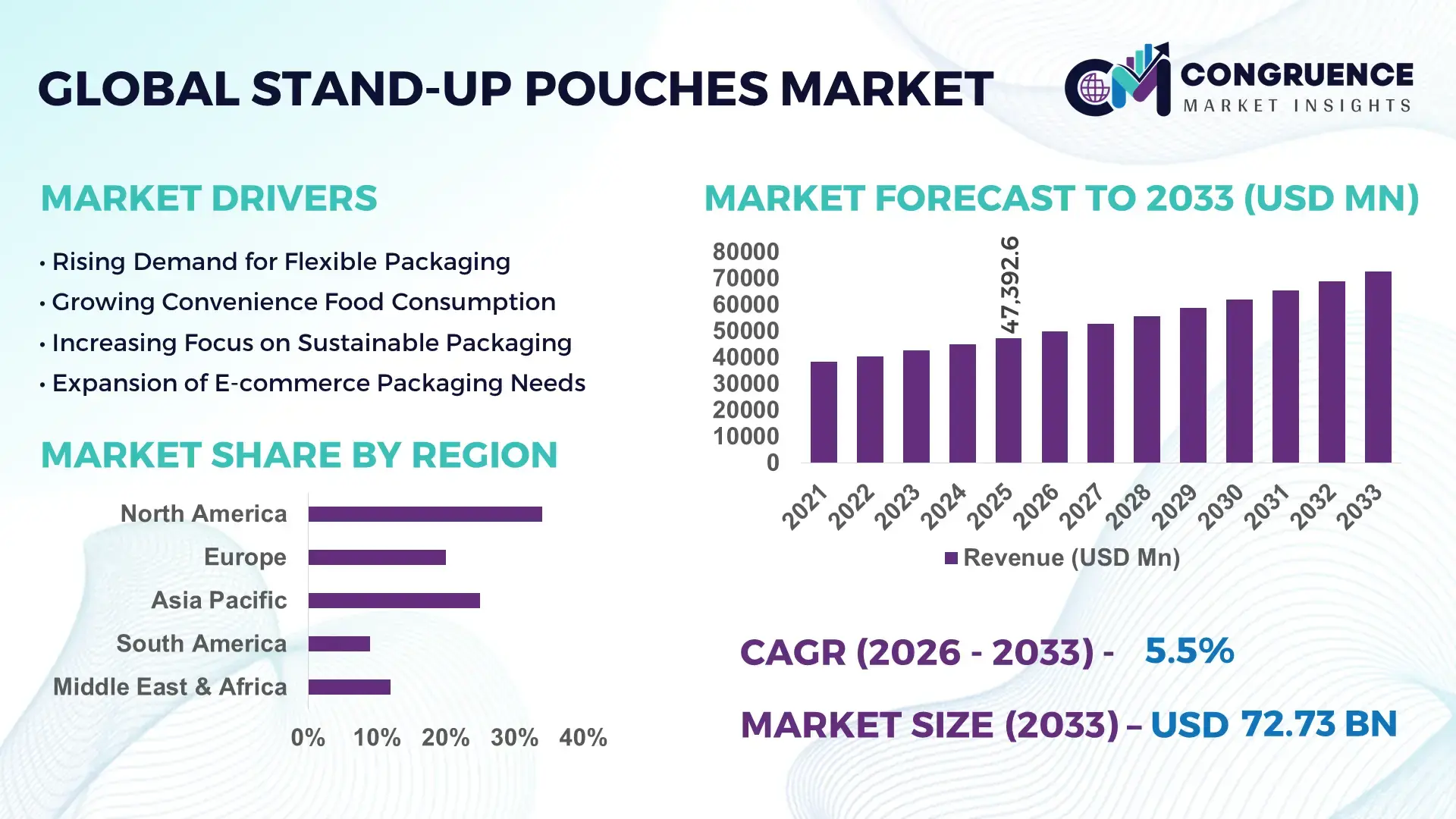
The Global Stand-up Pouches Market was valued at USD 47392.6 Million in 2025 and is anticipated to reach a value of USD 72732.79 Million by 2033 expanding at a CAGR of 5.5% between 2026 and 2033. The growth is primarily driven by increasing demand for lightweight, cost-efficient, and sustainable flexible packaging solutions across food, beverage, and personal care sectors.
The United States leads the stand-up pouches market in terms of production capacity and advanced manufacturing infrastructure. The country hosts over 250 flexible packaging manufacturing facilities, collectively producing more than 4 million tons of flexible packaging annually. Investments exceeding USD 3 billion in automation and high-barrier film technologies have strengthened domestic production capabilities. Stand-up pouches are widely used in packaged food applications, accounting for over 45% of flexible packaging formats in ready-to-eat meals and snacks. Additionally, nearly 60% of consumers in the U.S. prefer resealable pouch packaging due to convenience and extended shelf life. Technological advancements such as digital printing and recyclable mono-material pouches have significantly enhanced product customization and sustainability compliance across industries.
Market Size & Growth: USD 47,392.6 million in 2025, projected to reach USD 72,732.79 million by 2033 at 5.5% CAGR, driven by demand for sustainable and lightweight packaging solutions.
Top Growth Drivers: Flexible packaging adoption increased by 38%, shelf-life extension benefits improved by 25%, and logistics cost reduction achieved up to 30%.
Short-Term Forecast: By 2028, packaging waste reduction is expected to improve by 20% through recyclable pouch innovations.
Emerging Technologies: Digital printing, biodegradable polymer films, and high-barrier multilayer laminates are transforming packaging efficiency.
Regional Leaders: North America projected at USD 21 billion by 2033 with strong retail adoption; Asia-Pacific at USD 28 billion driven by urban consumption; Europe at USD 17 billion with sustainability mandates.
Consumer/End-User Trends: Food and beverage sector accounts for over 50% usage, with rising adoption in pet food and personal care segments.
Pilot or Case Example: In 2024, a packaging firm achieved 18% material reduction using advanced thin-film pouch designs.
Competitive Landscape: Leading player holds approximately 22% share, followed by key competitors including global flexible packaging manufacturers.
Regulatory & ESG Impact: Over 60% of manufacturers are shifting to recyclable materials to meet environmental compliance standards.
Investment & Funding Patterns: More than USD 2.5 billion invested in flexible packaging innovation and sustainable material development in recent years.
Innovation & Future Outlook: Growth in mono-material pouches and smart packaging technologies is expected to reshape market competitiveness.
Stand-up pouches are increasingly penetrating multiple industry verticals, including food, pharmaceuticals, and personal care, with the food sector contributing over half of total demand. Recent innovations such as compostable films and high-barrier oxygen-resistant materials are enhancing product shelf life by up to 40%. Regulatory pressures related to plastic waste reduction are pushing manufacturers toward recyclable and reusable packaging solutions. Asia-Pacific is witnessing rapid consumption growth due to urbanization and rising disposable incomes, while Europe is emphasizing eco-friendly packaging compliance. Emerging trends include smart labeling, QR-enabled traceability, and lightweight packaging designs, positioning the market for sustained technological transformation and operational efficiency improvements.
The stand-up pouches market holds strong strategic relevance as industries prioritize cost efficiency, product differentiation, and sustainability compliance. Advanced flexible packaging solutions are enabling manufacturers to reduce material usage by up to 30% while maintaining structural integrity and product protection. The adoption of digital printing technology delivers a 40% improvement in customization efficiency compared to conventional flexographic printing, allowing brands to respond rapidly to consumer trends and reduce lead times.
Asia-Pacific dominates in production volume due to large-scale manufacturing ecosystems, while Europe leads in sustainable adoption with over 65% of enterprises transitioning to recyclable or biodegradable packaging materials. The integration of smart packaging technologies, including QR codes and freshness indicators, is expected to increase consumer engagement by 25% over the next few years. By 2028, AI-driven packaging optimization is projected to reduce material waste by 18% while improving supply chain efficiency by 22%.
From an ESG perspective, firms are committing to measurable targets such as achieving 50% recyclable packaging by 2030 and reducing carbon emissions associated with packaging production by 20%. In 2024, a leading packaging manufacturer in Germany achieved a 15% reduction in plastic usage through mono-material pouch innovation combined with automated production systems. These developments highlight the market’s transition toward intelligent, sustainable, and scalable packaging solutions. The stand-up pouches market is emerging as a critical enabler of operational resilience, regulatory compliance, and long-term sustainable growth across global industries.
The increasing global emphasis on sustainability is a primary driver of the stand-up pouches market. Flexible pouches use up to 60% less plastic compared to rigid containers, significantly reducing environmental impact. Consumer awareness regarding eco-friendly packaging has risen sharply, with over 70% of buyers preferring products with sustainable packaging features. Manufacturers are investing in recyclable and biodegradable materials, including mono-polymer films that simplify recycling processes. Government regulations in regions such as Europe mandate reductions in single-use plastics, prompting companies to adopt sustainable packaging alternatives. Additionally, the carbon footprint of flexible packaging is approximately 50% lower than traditional packaging formats, further supporting adoption. These factors collectively drive demand for stand-up pouches as industries align with environmental goals.
Despite their advantages, stand-up pouches face significant recycling challenges due to their multi-layered material composition. Traditional pouches often combine plastic, aluminum, and barrier coatings, making separation and recycling difficult. Globally, less than 20% of flexible packaging is effectively recycled, highlighting infrastructure limitations. In many regions, waste management systems lack the capability to process multi-material pouches, leading to environmental concerns. Additionally, transitioning to recyclable alternatives can increase production costs by up to 15%, creating financial constraints for manufacturers. Regulatory scrutiny and consumer pressure are intensifying, forcing companies to invest heavily in research and development to create sustainable solutions. These complexities act as a restraint on market growth and widespread adoption.
The rapid growth of e-commerce presents significant opportunities for the stand-up pouches market, driven by the need for durable, lightweight, and cost-effective packaging. Online retail shipments have increased by over 25% in recent years, creating demand for packaging that minimizes shipping costs while ensuring product safety. Stand-up pouches reduce packaging weight by up to 50%, enabling cost savings in logistics and handling. Additionally, their flexible design allows for efficient storage and space optimization in warehouses. Brands are leveraging digitally printed pouches for enhanced visual appeal and personalized packaging, improving customer engagement. The integration of tamper-evident and resealable features further enhances product security and usability, making stand-up pouches highly suitable for e-commerce applications.
Volatility in raw material prices, particularly for plastics such as polyethylene and polypropylene, presents a major challenge for the stand-up pouches market. Price fluctuations of up to 20% annually impact production costs and profit margins for manufacturers. Supply chain disruptions, geopolitical factors, and fluctuations in crude oil prices directly influence raw material availability and pricing. Additionally, the transition to sustainable materials often involves higher costs and limited supply, further increasing financial pressure. Small and medium-sized manufacturers face difficulties in absorbing these cost variations, affecting competitiveness. The need to balance cost efficiency with sustainability requirements creates operational complexities, making raw material volatility a critical challenge for market stability.
• 48% Surge in Adoption of Recyclable Mono-Material Pouches: The transition toward recyclable mono-material structures is accelerating across the stand-up pouches market, with over 48% of newly developed pouch products now designed using single-polymer compositions such as polyethylene or polypropylene. These materials improve recyclability efficiency by nearly 35% compared to traditional multi-layer laminates. In Europe, more than 62% of packaging manufacturers have already integrated mono-material solutions into their product portfolios to comply with environmental directives. Additionally, packaging waste reduction initiatives have contributed to a 22% decline in landfill contributions from flexible packaging in advanced markets, highlighting a measurable shift toward circular economy practices.
• 37% Increase in Digital Printing Adoption for Custom Packaging: Digital printing technologies are transforming stand-up pouch production, with adoption rates rising by 37% across global packaging facilities. This technology reduces setup times by up to 60% and enables short-run, high-variation production, allowing brands to launch customized packaging campaigns efficiently. Approximately 45% of consumer goods companies now prefer digitally printed pouches for promotional and seasonal products. In North America, over 50% of small and medium packaging firms have invested in digital presses, leading to a 28% improvement in production flexibility and a 19% reduction in material waste during printing processes.
• 42% Growth in High-Barrier Film Integration for Extended Shelf Life: High-barrier films incorporating advanced oxygen and moisture resistance technologies are being increasingly utilized, with a 42% rise in adoption across food and pharmaceutical packaging segments. These films extend product shelf life by up to 50%, reducing food waste and improving supply chain efficiency. In the food sector, more than 55% of ready-to-eat meal packaging now uses high-barrier stand-up pouches. Additionally, multilayer barrier innovations have improved puncture resistance by 30%, ensuring product safety during transportation and storage, particularly in e-commerce distribution channels.
• 33% Expansion in Smart and Interactive Packaging Solutions: Smart packaging features such as QR codes, NFC tags, and freshness indicators are being integrated into stand-up pouches, with adoption increasing by 33% globally. Around 40% of premium food and beverage brands now incorporate interactive elements to enhance consumer engagement and traceability. These technologies have led to a 25% increase in customer interaction rates and improved supply chain transparency by 20%. In Asia-Pacific, nearly 35% of new product launches in the packaged food sector include smart labeling features, reflecting a growing emphasis on digital connectivity and real-time product information.
The stand-up pouches market is segmented based on type, application, and end-user industries, each contributing uniquely to overall demand dynamics. Product types such as flat bottom, round bottom, rollstock, and retort pouches cater to diverse packaging needs, with flat bottom variants gaining traction for their enhanced shelf stability. Applications are dominated by the food and beverage sector, accounting for over 50% of total usage due to convenience and extended shelf life benefits. End-user industries include retail, pharmaceuticals, and personal care, where adoption is influenced by packaging efficiency and sustainability requirements. Regional consumption patterns indicate strong demand growth in Asia-Pacific driven by urbanization, while Europe emphasizes eco-friendly packaging innovations. Increasing technological integration across segments is further enhancing product functionality and market penetration.
Flat bottom stand-up pouches currently dominate the product type segment, accounting for approximately 38% of total adoption due to their superior stability, enhanced branding surface, and efficient shelf utilization. Round bottom pouches follow with a 26% share, widely used in liquid and semi-liquid packaging applications due to their flexibility and durability. Retort pouches represent around 18% of the segment, gaining traction in ready-to-eat meals owing to their ability to withstand high-temperature sterilization processes. Rollstock pouches and other specialized variants collectively contribute nearly 18%, serving niche applications such as industrial and bulk packaging.
Retort pouches are emerging as the fastest-growing type, expanding at an estimated CAGR of 6.8%, driven by increasing demand for convenience foods and long shelf-life packaging solutions. These pouches can extend product shelf life by up to 12 months without refrigeration, making them highly attractive for global food distribution. Additionally, advancements in heat-resistant laminates have improved performance efficiency by 25%, further accelerating adoption.
The food and beverage segment leads the application landscape, accounting for approximately 54% of total stand-up pouch usage, driven by demand for lightweight, resealable, and shelf-stable packaging formats. Pet food applications hold around 18% share, benefiting from increased premiumization and demand for convenient packaging among pet owners. The personal care and cosmetics segment contributes approximately 14%, leveraging stand-up pouches for products such as shampoos and lotions due to cost and material efficiency. Pharmaceutical applications represent nearly 8%, primarily for packaging powders and liquid medications, while other industrial uses account for the remaining 6%.
Pharmaceutical applications are the fastest-growing segment, expanding at an estimated CAGR of 7.2%, supported by rising demand for safe, contamination-resistant packaging solutions. Innovations in barrier films and tamper-evident features have improved product safety by over 30%, making stand-up pouches suitable for sensitive healthcare products.
The retail and consumer goods sector dominates end-user adoption, accounting for approximately 46% of the stand-up pouches market due to high demand for packaged foods, beverages, and household products. The food processing industry follows with a 28% share, utilizing pouches for bulk and processed food packaging applications. The pharmaceutical industry contributes around 12%, driven by increasing requirements for secure and hygienic packaging. Personal care manufacturers represent approximately 9%, while industrial users account for the remaining 5%, leveraging stand-up pouches for chemicals and specialty products.
E-commerce and direct-to-consumer brands are the fastest-growing end-user segment, expanding at an estimated CAGR of 8.1%, fueled by increasing online retail penetration and the need for lightweight, durable packaging. Stand-up pouches reduce shipping weight by up to 50%, enabling significant logistics cost savings and improved delivery efficiency.
Region North America accounted for the largest market share at 34% in 2025 however, Asia-Pacific is expected to register the fastest growth, expanding at a CAGR of 6.8% between 2026 and 2033.
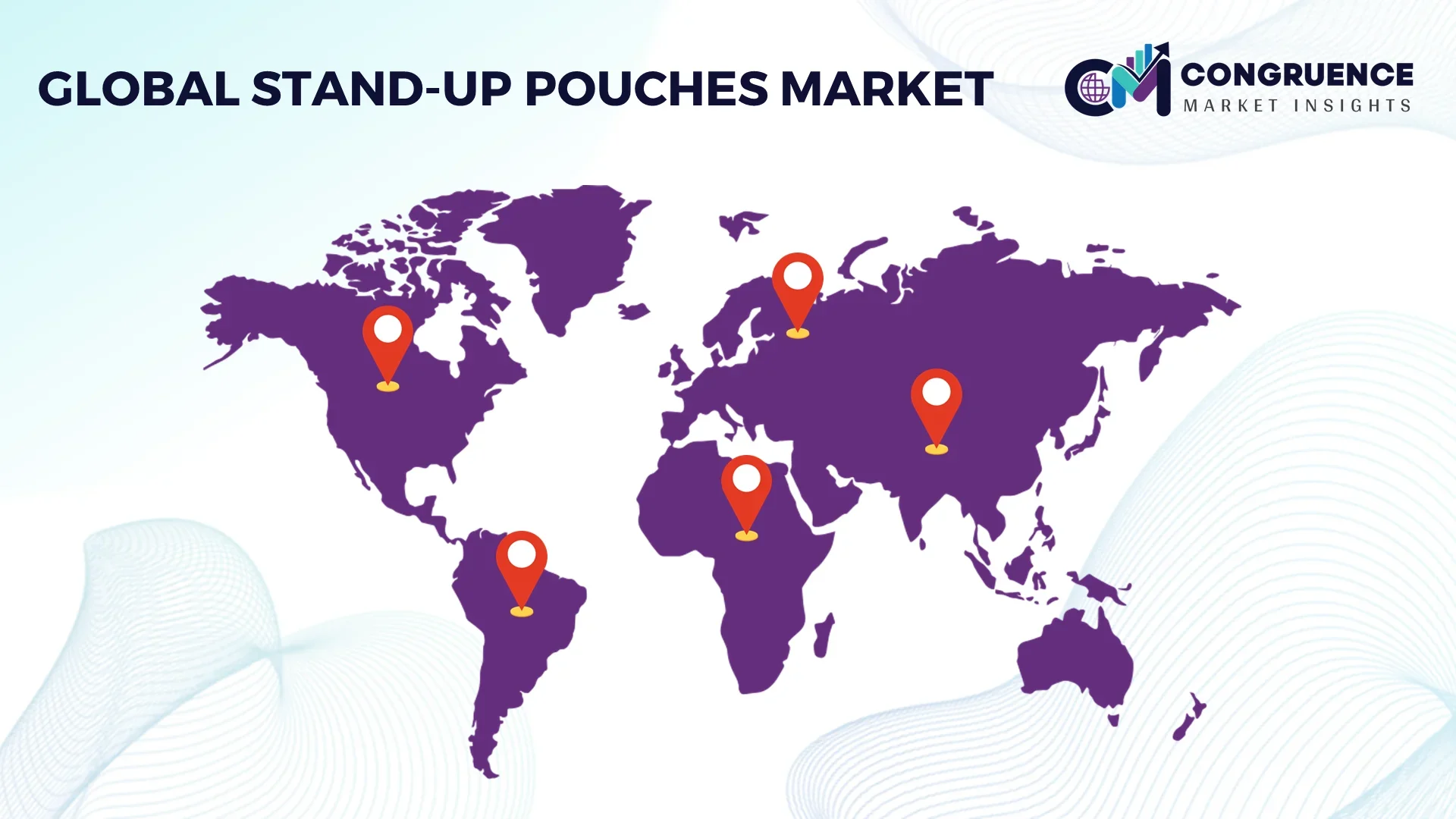
North America’s dominance is supported by advanced packaging infrastructure, with over 60% of manufacturers adopting high-barrier flexible materials and automated filling systems. Europe follows with a 28% share, driven by sustainability regulations where more than 65% of packaging firms have transitioned toward recyclable pouch formats. Asia-Pacific holds approximately 30% of global demand, with production volumes exceeding 2.5 million tons annually, fueled by large-scale manufacturing hubs in China and India. South America contributes around 5%, with Brazil accounting for nearly 40% of regional demand, while the Middle East & Africa region represents about 3%, supported by rising packaged food consumption. Globally, over 55% of stand-up pouch demand originates from food applications, while nearly 25% is linked to personal care and healthcare sectors, reflecting diverse regional consumption patterns and industrial applications.
How are advanced packaging technologies reshaping flexible packaging demand across industries?
North America accounts for approximately 34% of the stand-up pouches market, supported by strong demand across food processing, pharmaceuticals, and personal care industries. The region processes over 1.8 million tons of flexible packaging annually, with stand-up pouches representing nearly 45% of total flexible formats used in retail packaging. Regulatory frameworks promoting sustainable packaging have led to over 58% of manufacturers adopting recyclable or reusable materials. Technological advancements such as digital printing and automated filling lines have improved production efficiency by 30% while reducing operational waste by 20%. Local players are actively investing in sustainable innovation; for instance, a U.S.-based packaging firm introduced a mono-material pouch line in 2024 that reduced plastic usage by 25% while maintaining durability. Consumer behavior in this region reflects high preference for convenience packaging, with over 65% of households opting for resealable pouches for food storage. Additionally, e-commerce growth has driven a 22% increase in demand for lightweight packaging formats, further strengthening regional market expansion.
What role do sustainability mandates play in transforming packaging innovation and adoption trends?
Europe holds around 28% of the stand-up pouches market, with key countries such as Germany, the United Kingdom, and France leading adoption. Germany alone contributes nearly 30% of regional demand due to its advanced manufacturing capabilities and strong export-driven packaging industry. Regulatory initiatives targeting plastic waste reduction have resulted in over 65% of packaging companies shifting toward recyclable and biodegradable pouch materials. Sustainability-focused policies have accelerated the adoption of mono-material films, improving recyclability rates by up to 40%. Emerging technologies such as smart labeling and digital traceability systems are being integrated into packaging solutions, with adoption rates exceeding 35% among premium product manufacturers. A leading European packaging company launched compostable stand-up pouches in 2024, reducing environmental impact by 28% compared to traditional plastic packaging. Consumer behavior in Europe is strongly influenced by environmental awareness, with over 70% of buyers prioritizing eco-friendly packaging, leading to increased demand for sustainable stand-up pouch solutions.
Why is manufacturing expansion accelerating flexible packaging adoption across high-growth economies?
Asia-Pacific ranks as the fastest-growing region and accounts for approximately 30% of global stand-up pouch consumption, with China, India, and Japan serving as major markets. China alone produces over 1.2 million tons of flexible packaging annually, while India has witnessed a 35% increase in demand for packaged food products over recent years. Rapid urbanization and rising disposable incomes have led to a 40% increase in demand for convenient packaging formats across urban populations. The region benefits from strong manufacturing infrastructure, with over 500 large-scale flexible packaging facilities operating across key countries. Technological advancements such as automated pouch filling systems and high-speed printing lines have improved production efficiency by 28%. A prominent packaging manufacturer in India introduced lightweight pouch solutions in 2024, reducing material usage by 20% while maintaining structural strength. Consumer behavior is heavily influenced by e-commerce growth, with online retail contributing to a 30% increase in demand for durable and cost-effective packaging formats.
How are economic shifts and packaging modernization influencing flexible packaging adoption trends?
South America accounts for approximately 5% of the stand-up pouches market, with Brazil and Argentina leading regional consumption. Brazil represents nearly 40% of regional demand due to its strong food processing and agricultural export industries. Infrastructure development and improvements in logistics networks have increased flexible packaging adoption by 18% over recent years. Government initiatives supporting sustainable packaging have encouraged manufacturers to adopt recyclable materials, with nearly 35% of companies transitioning to eco-friendly pouch formats. A regional packaging company in Brazil introduced advanced multilayer pouch technology in 2024, improving product shelf life by 25% while reducing packaging weight by 15%. Consumer behavior in South America reflects growing demand for affordable and convenient packaging, particularly in urban centers, where packaged food consumption has increased by over 20%. Additionally, local demand is influenced by language and product customization needs, driving adoption of digitally printed pouches across consumer goods sectors.
What factors are driving the adoption of modern flexible packaging solutions across emerging economies?
The Middle East & Africa region contributes approximately 3% to the global stand-up pouches market, with key growth observed in countries such as the UAE and South Africa. Demand is largely driven by expanding food and beverage industries, with packaged food consumption increasing by 22% across urban populations. Infrastructure development and trade partnerships have enhanced packaging distribution networks, supporting market expansion. Technological modernization is evident with over 30% of packaging firms adopting automated production systems and high-barrier films to improve product quality and shelf life. A regional packaging manufacturer in the UAE introduced recyclable stand-up pouch solutions in 2024, reducing plastic waste by 18% while improving packaging durability. Consumer behavior in this region is shaped by rising disposable incomes and increasing demand for convenient packaging formats, with over 50% of urban consumers preferring resealable pouch packaging for food and household products.
United States – 31% market share in the stand-up pouches market, driven by high production capacity and advanced flexible packaging technologies.
China – 27% market share in the stand-up pouches market, supported by large-scale manufacturing infrastructure and strong demand from food and e-commerce sectors.
The stand-up pouches market is moderately fragmented, with more than 150 active global and regional competitors operating across different segments of flexible packaging. The top five companies collectively account for approximately 42% of the market share, indicating a competitive yet consolidated structure at the upper tier. Leading players are focusing on strategic initiatives such as mergers, acquisitions, and product innovation to strengthen their market position. Over the past three years, more than 25 strategic partnerships have been formed to expand production capacity and enhance distribution networks.
Innovation remains a key competitive factor, with over 60% of major companies investing in sustainable packaging solutions such as recyclable mono-material pouches and biodegradable films. Digital printing capabilities have been adopted by nearly 45% of leading manufacturers, enabling faster product customization and reduced production cycles. Additionally, investments in automation have improved manufacturing efficiency by up to 30%, allowing companies to scale operations effectively. The market is witnessing increased competition from regional players offering cost-effective solutions, particularly in Asia-Pacific, where production costs are up to 20% lower than in developed regions. Companies are also leveraging advanced barrier technologies and smart packaging features to differentiate their offerings. These competitive dynamics highlight the importance of innovation, sustainability, and operational efficiency in maintaining market leadership.
Amcor Plc
Berry Global Inc.
Mondi Group
Sealed Air Corporation
Sonoco Products Company
Huhtamaki Oyj
Coveris Holdings S.A.
ProAmpac LLC
Clondalkin Group
Glenroy Inc.
Technological advancements are playing a pivotal role in transforming the stand-up pouches market, particularly in materials engineering, digital printing, and smart packaging integration. One of the most impactful innovations is the development of mono-material laminates, which now account for over 45% of newly introduced pouch structures. These materials significantly enhance recyclability by simplifying waste separation processes, improving recycling efficiency by nearly 35% compared to multi-layer composites.
High-barrier film technologies incorporating EVOH and aluminum-free coatings are enabling oxygen and moisture resistance improvements of up to 50%, thereby extending product shelf life for food and pharmaceutical applications. Additionally, retort-compatible pouches have seen a 30% increase in adoption due to their ability to withstand temperatures exceeding 120°C, making them suitable for sterilized and ready-to-eat meals.
Digital printing technology is another critical advancement, with over 40% of packaging manufacturers adopting it to enable short-run, high-quality, and customizable packaging solutions. This technology reduces setup times by approximately 60% and minimizes material waste by nearly 20%. Automation in pouch manufacturing, including robotic filling and sealing systems, has improved production speeds by up to 25%, while reducing labor dependency by 18%.
Emerging smart packaging technologies such as QR codes, NFC tags, and freshness sensors are being integrated into nearly 35% of premium stand-up pouch products. These features enhance supply chain traceability and consumer engagement, increasing interaction rates by 25%. Furthermore, biodegradable and compostable film innovations are gaining traction, with over 28% of new product launches incorporating bio-based materials, aligning with global sustainability targets and regulatory compliance requirements.
• In March 2025, Amcor Plc launched its AmPrima® Plus recyclable stand-up pouch solution designed for high-barrier food applications. The new structure offers up to 30% reduction in carbon footprint while maintaining product shelf life and is compatible with existing recycling streams.
• In September 2024, Mondi Group introduced a fully recyclable mono-material stand-up pouch for dry food products, replacing traditional multi-layer laminates. The innovation improved recyclability efficiency by over 35% and reduced overall packaging weight by 20%.
• In May 2025, Berry Global Inc. expanded its range of sustainable flexible packaging solutions by introducing a new polyethylene-based stand-up pouch with enhanced durability and 25% reduced plastic usage, targeting food and personal care sectors.
• In November 2024, Huhtamaki Oyj launched a paper-based stand-up pouch with a reduced plastic content of less than 10%, designed for dry food packaging. The product supports recyclability in existing paper waste streams and reduces environmental impact significantly.
The stand-up pouches market report provides a comprehensive evaluation of the global flexible packaging landscape, covering multiple dimensions including product types, application areas, end-user industries, and regional performance. The report encompasses detailed segmentation across flat bottom, round bottom, retort, and rollstock pouch formats, collectively representing over 95% of total market offerings. It further examines applications spanning food and beverages, which account for more than 50% of demand, alongside pharmaceuticals, personal care, and industrial packaging segments.
Geographically, the report analyzes key regions including North America, Europe, Asia-Pacific, South America, and the Middle East & Africa, collectively covering over 30 major countries and representing nearly 100% of global demand distribution. It highlights regional consumption patterns, production capacities exceeding 4 million tons annually, and the role of emerging economies in driving future growth.
Technological coverage includes advancements in high-barrier films, digital printing, smart packaging integration, and sustainable material innovations, with over 60% of manufacturers actively investing in eco-friendly solutions. The report also explores niche segments such as biodegradable pouches, compostable materials, and e-commerce-specific packaging formats, which are gaining traction due to increasing environmental regulations and online retail expansion.
Additionally, the scope includes analysis of supply chain dynamics, raw material trends, and manufacturing innovations such as automation and AI-driven production optimization, which have improved operational efficiency by up to 30%. This structured and data-driven approach ensures that the report delivers actionable insights for stakeholders, enabling informed strategic decision-making across the stand-up pouches market ecosystem.
| Report Attribute/Metric | Report Details |
|---|---|
|
Market Revenue in 2025 |
USD V2025 Million |
|
Market Revenue in 2033 |
USD V2033 Million |
|
CAGR (2026 - 2033) |
5.5% |
|
Base Year |
2025 |
|
Forecast Period |
2026 - 2033 |
|
Historic Period |
2021 - 2025 |
|
Segments Covered |
By Types
By Application
By End User
|
|
Key Report Deliverable |
Revenue Forecast, Growth Trends, Market Dynamics, Segmental Overview, Regional and Country-wise Analysis, Competition Landscape |
|
Region Covered |
North America, Europe, Asia-Pacific, South America, Middle East, Africa |
|
Key Players Analyzed |
Amcor Plc, Berry Global Inc., Mondi Group, Sealed Air Corporation, Sonoco Products Company, Huhtamaki Oyj, Coveris Holdings S.A., ProAmpac LLC, Clondalkin Group, Glenroy Inc. |
|
Customization & Pricing |
Available on Request (10% Customization is Free) |




