
Reports
The Global Stainless Steel Kitchen Utensils Market was valued at USD 5760 Million in 2025 and is anticipated to reach a value of USD 8279.5 Million by 2033 expanding at a CAGR of 4.64% between 2026 and 2033. Growth is driven by substitution toward durable food-contact materials, premium multi-ply and induction-compatible products, automated metal forming, and expanding organized foodservice procurement.
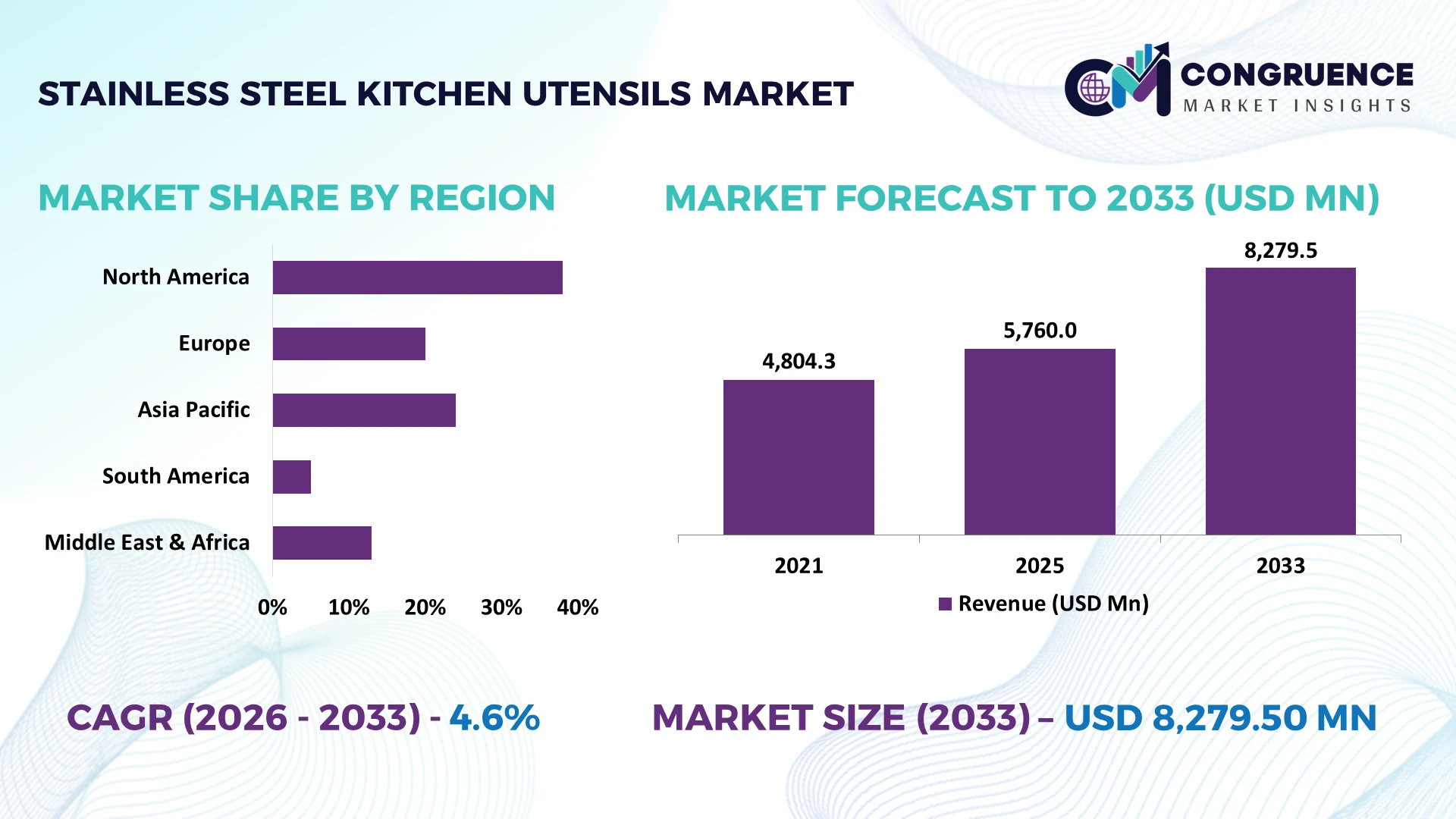
China remains the dominant manufacturing anchor, supported by 40.87 million tonnes of stainless steel melt-shop output in 2025, equivalent to about 63.7% of global production; Q1 2026 output increased another 4.3%. This scale supports utensil, cookware, appliance, and food-equipment supply chains. India is strengthening its position through capacity expansion, while China retains substantially greater upstream scale; Jindal Stainless alone commissioned 1.2 MTPA of new Indonesian melt capacity in 2026 and is expanding downstream capacity in India.
Strategically, brands should diversify sourcing beyond single-country production while securing traceable low-emission stainless steel, particularly as the EU’s definitive CBAM regime has applied to covered iron and steel imports since January 2026.
Market Size & Growth: USD 5.76 billion in 2025 advances to USD 8.28 billion by 2033 at 4.64%, supported by premium stainless grades, durable food-contact products, and automated manufacturing.
Top Growth Drivers: 63.7% of global stainless output originated in China in 2025, Asia produced 55.3 million tonnes, and U.S. stainless output increased 7.6%, strengthening raw-material availability and downstream fabrication.
Short-Term Forecast: By 2027, digitally integrated stainless supply chains provide a benchmark for 10–15% shorter customer lead times, based on advanced planning and production automation already being deployed by major producers.
Emerging Technologies: AI visual inspection, robotic polishing, CNC forming, laser welding, induction-compatible multilayer construction, and IoT-connected production lines are shifting high-volume kitchen utensil manufacturing toward tighter tolerances and lower defect exposure.
Regional Leaders: Using reported 2025 utensil-market shares as a directional allocation of the supplied USD 5.76 billion total, North America represents approximately USD 1.84 billion, Asia-Pacific USD 1.61 billion, and Europe USD 1.27 billion; premiumization and organized retail remain important adoption themes.
Consumer/End-User Trends: Residential buyers remain the principal demand base in the closely related stainless cookware category, where residential applications represented 66.2% in 2025, reinforcing replacement and kitchen-upgrade purchasing.
Pilot/Case Example: In 2025, Jindal Stainless launched Project Pragati at Hisar, integrating advanced planning and execution technologies from casting through finishing with an expected 10–15% reduction in customer lead times.
Competitive Landscape: The broader cookware competitive benchmark places Groupe SEB at approximately 7.9% share, alongside Zhejiang Supor, Tramontina, Meyer Corporation, ZWILLING, and other global and regional kitchenware manufacturers.
Regulatory & ESG Impact: From January 2026, EU CBAM entered its definitive phase for covered iron and steel imports; the simplified framework uses a 50-tonne threshold, increasing the strategic value of emissions-traceable upstream sourcing.
Investment & Funding: Jindal Stainless commissioned 1.2 MTPA of Indonesian capacity in 2026 and committed INR 900 crore to additional Indian downstream capacity, highlighting continued investment in globally integrated stainless supply chains.
Innovation & Future Outlook: Global stainless production reached 64.2 million tonnes in 2025 and Q1 2026 output increased 2.5%; manufacturers combining automated fabrication, material traceability, recycled inputs, and advanced surface finishing gain stronger sourcing and product-positioning advantages.
Stainless steel kitchen utensils demand is increasingly concentrated around durable cooking tools, premium foodservice products, induction-ready designs, and recyclable kitchenware. Stainless steel represents approximately 56% of consumer kitchen-utensil purchases in one recent industry benchmark. Automated finishing and precision forming are strengthening product consistency, while EU carbon-border requirements increase upstream traceability pressure, setting up a sharper strategic focus on materials, sourcing, and manufacturing technology.
Stainless steel kitchen utensils are becoming strategically important as manufacturers compete on material durability, automated fabrication, food-contact safety, and supply-chain resilience rather than basic product availability. China produced about 63.7% of global stainless steel melt-shop output in 2025, creating substantial upstream scale, while the EU’s definitive Carbon Border Adjustment Mechanism is increasing the importance of traceable, lower-emission steel sourcing.
Technology investment is changing factory economics. Automated laser cutting, robotic polishing, machine-vision inspection, and servo-controlled forming can reduce processing or inspection time by roughly 10–20% compared with labor-intensive legacy lines when deployed at scale. China retains unmatched manufacturing depth, whereas India is expanding upstream and downstream capacity; Jindal Stainless commissioned 1.2 million tonnes of Indonesian melt capacity while simultaneously strengthening Indian finishing operations.
Through 2028, procurement will increasingly favor recycled-content steel, automated quality control, induction-compatible products, and digitally traceable materials. A practical example is integrated production planning that targets 10–15% shorter customer lead times from casting through finishing. Producers are consequently investing in automation, capacity diversification, and supplier integration. Competitive advantage will increasingly depend on controlling material provenance, production efficiency, and product consistency simultaneously.
Durability-led replacement and automated fabrication are strengthening stainless steel’s position across household, hospitality, and professional foodservice utensils. China accounted for approximately 63.7% of global stainless steel production in 2025, while U.S. output increased 7.6% and worldwide production advanced 2.1%, expanding the industrial feedstock base for fabricated kitchenware. Automated stamping, laser processing, robotic polishing, and machine-vision inspection can deliver roughly 10–20% faster processing than labor-intensive production configurations. India is also strengthening manufacturing depth through stainless capacity additions and downstream investment. Producers are responding by modernizing forming and finishing lines, developing premium multi-layer and induction-compatible products, and securing closer relationships with steel suppliers. The strategic advantage increasingly comes from manufacturing repeatability: tighter dimensional and surface-finish control supports premium pricing while simultaneously reducing rework.
Nickel-bearing stainless grades expose utensil manufacturers to input-price fluctuations and concentrated upstream supply, creating procurement pressure for producers operating on thin mass-market margins. China supplies approximately 63.7% of global stainless steel output, while Indonesia produced about 4.7 million tonnes in 2025, illustrating the concentration surrounding major Asian stainless and nickel ecosystems. At the same time, the EU’s CBAM definitive regime introduces carbon-accounting obligations for covered imported iron and steel, with a 50-tonne annual threshold simplifying exemptions for smaller importers. These pressures directly increase sourcing complexity, inventory requirements, and compliance costs for internationally distributed kitchenware. Manufacturers are responding through dual sourcing, longer-term steel contracts, localized finishing, and greater use of recycled stainless feedstock. The operational priority is increasingly procurement predictability rather than simply securing the lowest spot-price material.
Low-carbon stainless steel, recycled feedstock, digital traceability, and automated finishing create a differentiated opportunity beyond conventional utensil replacement demand. Stainless steel can be recycled repeatedly, while established production routes already incorporate substantial secondary raw material, giving manufacturers a credible platform for circular kitchenware strategies. Global stainless output reached approximately 64.2 million tonnes in 2025, and production increased another 2.5% in Q1 2026, supporting expanding material availability. India presents a particularly attractive manufacturing opportunity as producers add downstream processing alongside upstream capacity. Through 2028, AI-assisted surface inspection, robotic polishing, laser welding, and digital product passports will strengthen quality and traceability. Manufacturers investing in closed-loop scrap recovery, automated cells, and supplier-data integration can lower material losses while differentiating premium utensils for environmentally scrutinized export markets.
Scaling premium stainless utensils requires consistent alloy chemistry, forming accuracy, weld integrity, surface finishing, and food-contact compliance across increasingly distributed manufacturing networks. China’s approximately 63.7% share of stainless production provides exceptional scale, yet dependence on geographically concentrated processing creates continuity challenges when manufacturers diversify assembly into India, Vietnam, or other sourcing hubs. Automated inspection can improve defect detection, but integrating machine vision, robotics, and production software into legacy factories typically requires substantial process redesign and skilled technicians. Meanwhile, Jindal Stainless’s digital supply-chain program targets 10–15% shorter customer lead times, illustrating the performance gap emerging between digitally coordinated and conventional operations. Kitchenware manufacturers must therefore invest beyond standalone machinery into workforce capability, interoperable production data, supplier qualification, and standardized quality systems. Long-term competitiveness depends on reproducing identical surface finish and dimensional quality across multiple production locations.
Automation Moves Into Finishing Lines: Manufacturers are shifting polishing, stamping, edge finishing, and visual inspection toward robotic cells as consistency becomes a procurement differentiator. Global stainless output increased 2.1% in 2025, U.S. production rose 7.6%, and Chinese output advanced 3.6%. Larger suppliers are matching material availability with automated tooling to reduce manual inspection, accelerate throughput, and standardize surface quality across high-volume utensil ranges.
Commercial Specifications Become More Rigorous: Professional kitchens are standardizing heavier-gauge, corrosion-resistant utensils around repeated washing, high-temperature use, and longer replacement intervals. More than 80% of commercial kitchens reportedly use stainless cooking utensils, while stainless tools can cut breakage by over 35% versus plastic alternatives and ergonomic designs improve handling efficiency by nearly 20%. Suppliers are expanding professional-grade SKUs and foodservice-specific sets.
Retail Mix Shifts Toward Compatibility: Product development is moving from generic utensil bundles toward cookware-compatible tools, coordinated tableware, and premium replacement sets. Non-stick-compatible tools represent about 41% of newly purchased kitchen tools, approximately 76% of households replace frequently used utensils within five years, and stainless represents roughly 51% of cooking-tool demand. Brands are reorganizing portfolios around compatibility, durability, and replacement occasions.
Procurement Becomes More Supply-Aware: Buyers are paying greater attention to stainless grade, production origin, finishing consistency, and supplier continuity as upstream production remains concentrated. China supplied roughly 63.7% of global stainless output in 2025, while Asia produced about 86% and European Union production declined 1.9%. Kitchenware companies are therefore adding alternative processing locations, dual-source contracts, and tighter alloy specifications rather than relying solely on lowest-cost procurement.
Spoons represent the leading type, with an estimated 29–31% share across the specified Stainless Steel Kitchen Utensils Market product set. Their dominance reflects universal household penetration, repeated use across cooking and dining, standardized manufacturing geometry, and efficient high-volume stamping. Forks follow at approximately 22–24%, supported by tableware replacement and hospitality procurement, while knives command roughly 19–21% because higher material, grinding, and edge-finishing requirements constrain unit volumes despite stronger value realization. These mature categories benefit from automated pressing, polishing, and bundled-set merchandising.
Tongs are the fastest-expanding type, estimated near 13–15% of the current mix, as restaurants, barbecue formats, buffet operations, and high-temperature cooking increase demand for hygienic gripping tools. Ladles retain approximately 10–12%, with commercial kitchens favoring thicker gauges and reinforced handles. Manufacturers are prioritizing ergonomic tong mechanisms, welded ladle construction, dishwasher-safe finishes, and premium spoon sets. Investment is shifting from commodity volume alone toward differentiated tools capable of sustaining professional-use cycles and higher retail positioning.
Cooking represents the leading application, estimated at approximately 35–38% of demand across the specified application set, reflecting daily exposure to stirring, turning, lifting, portioning, and high-temperature food handling. Stainless steel benefits from corrosion resistance and compatibility with repeated dishwasher cycles, making cooking utensils operationally attractive in households and professional kitchens. Serving follows at roughly 20–22%, supported by hospitality, buffet, and home-entertaining usage, while food preparation accounts for approximately 17–19% through cutting, mixing, portioning, and ingredient-handling routines.
Tableware is the fastest-strengthening application, estimated at 15–17%, as reusable dining formats, coordinated flatware sets, institutional meal programs, and premium hospitality presentation expand deployment. Baking remains a smaller 8–10% niche because silicone and specialized coated tools retain important functional roles. Manufacturers are responding with coordinated serving collections, heavier-gauge commercial tools, polished tableware finishes, and utensil designs compatible with multiple cookware surfaces. Investment is increasingly concentrating on products crossing cooking, serving, and dining workflows because broader utility raises basket size while simplifying retail assortment and institutional procurement.
Households remain the dominant end-user group, accounting for an estimated 52–55% of demand across the specified buyer categories. Large installed kitchen bases, replacement purchasing, gifting, home renovation, and expanding access to branded kitchenware sustain this concentration. Restaurants represent approximately 20–22%, where higher utilization intensity produces faster physical replacement despite smaller installed unit numbers. Hotels contribute about 10–12%, supported by standardized room-service, banquet, buffet, and restaurant operations requiring consistent product specifications.
Catering services are the fastest-growing buyer group, estimated at approximately 7–9%, as outsourced corporate dining, event catering, central production kitchens, and mobile foodservice increase high-volume utensil deployment. Institutional kitchens account for roughly 8–10%, with schools, hospitals, workplaces, and public dining facilities emphasizing durability and sanitization. Manufacturers are responding with bulk packaging, heavier-gauge specifications, contract pricing, SKU standardization, and distributor partnerships. The non-obvious opportunity lies in replacement intensity: professional buyers represent fewer purchasing locations than households but generate substantially higher utensil cycles, making lifecycle durability, service availability, and procurement consistency strategically important.
Asia-Pacific accounted for the largest market share at 37% in 2025 however, Asia-Pacific is expected to register the fastest growth, expanding at a CAGR of 5.5% between 2026 and 2033.
Premium Replacement and Foodservice Standardization
North America represents approximately 32% of global demand, with the United States providing the region’s deepest household, restaurant, institutional, and specialty-retail purchasing base. Premium stainless utensils benefit from dishwasher compatibility, corrosion resistance, ergonomic redesign, and consumer migration from disposable or lower-durability kitchen tools. Commercial kitchens are simultaneously standardizing heavier-gauge tongs, ladles, serving utensils, and preparation tools to withstand intensive sanitation cycles. The upstream position is improving: U.S. stainless steel melt-shop production reached approximately 2.1 million tonnes in 2025, increasing 7.6% year over year. Suppliers are using this stronger domestic material environment alongside Asian sourcing, automated finishing, private-label manufacturing, and omnichannel distribution. The strategic shift centers on lifecycle economics—retailers and foodservice operators increasingly evaluate replacement frequency and product consistency alongside initial procurement price.
United States Market Outlook: The United States dominates regional consumption through its extensive installed base of residential kitchens and professional foodservice establishments. Stainless production increased another 2.3% year over year in Q1 2026 to approximately 566,000 tonnes. Major kitchenware companies are strengthening premium tool assortments, direct-to-consumer channels, restaurant-grade specifications, and coordinated utensil collections, making brand differentiation and distribution reach increasingly important competitive assets.
Traceability Reshapes Material Procurement
Europe accounts for approximately 22% of global stainless steel kitchen utensils demand, supported by mature household penetration, hospitality infrastructure, premium tableware traditions, and strong food-contact compliance requirements. Procurement is becoming more traceability-intensive as the EU Carbon Border Adjustment Mechanism entered its definitive phase in 2026 for covered upstream iron and steel products. Meanwhile, EU stainless melt-shop production declined 1.9% to approximately 5.7 million tonnes in 2025 and fell another 4.6% year over year in Q1 2026. This divergence between sophisticated downstream demand and constrained upstream output increases the importance of supplier diversification, recycled feedstock, material certification, and inventory planning. European kitchenware groups are emphasizing long-life utensils, refined surface finishes, coordinated flatware systems, and manufacturing automation rather than competing exclusively through volume.
Germany Market Outlook: Germany combines high household purchasing power with demanding professional catering, hotel, restaurant, and institutional-kitchen specifications. Its established metalworking ecosystem supports precision forming, finishing, knife manufacturing, and premium stainless product development. German suppliers increasingly compete through ergonomic engineering, controlled alloy specifications, repairability, and durable designs, positioning higher-quality utensils against lower-priced imported products while tightening material and environmental documentation.
Manufacturing Scale Drives Global Supply
Asia-Pacific holds approximately 37% of market demand while possessing a substantially larger share of upstream stainless manufacturing capacity, giving the region a decisive cost and supply-chain advantage. Asia produced approximately 55.3 million tonnes of stainless steel in 2025, about 86% of worldwide output, and increased production 2.7%. Q1 2026 production advanced another 3.3% to 13.4 million tonnes. This industrial depth supports integrated stamping, forging, polishing, welding, packaging, and export operations for spoons, forks, knives, ladles, and tongs. India is simultaneously strengthening its stainless processing ecosystem and organized kitchenware distribution, reducing the region’s dependence on a single manufacturing geography. Producers are investing in automated presses, robotic polishing, higher-grade finishes, OEM/private-label relationships, and export-oriented capacity. Scale increasingly combines with product sophistication rather than functioning solely as a low-cost advantage.
China Market Outlook: China remains the pivotal manufacturing country, producing approximately 40.9 million tonnes of stainless steel in 2025 and increasing output 3.6%. Q1 2026 production reached roughly 9.84 million tonnes, up 4.3%. Dense clusters of steel processors, tooling companies, utensil factories, packaging suppliers, and export infrastructure allow Chinese manufacturers to compress production cycles while serving both mass-market and increasingly premium global kitchenware programs.
Professional Foodservice Upgrades Product Mix
South America represents approximately 5% of global demand, with Brazil anchoring consumption, manufacturing expertise, hospitality procurement, and branded kitchenware distribution. The market is shifting toward professional-grade stainless products as restaurants, bars, institutional kitchens, and hospitality operators modernize equipment and replace shorter-life utensils. Brazil’s bar and restaurant sector recorded a 14% increase in sales during 2024, providing a tangible operational trigger for kitchen and serving-equipment upgrades. Local manufacturing capability led by established metalworking clusters also reduces dependence on completely imported finished products. Suppliers are expanding hospitality-specific assortments, modular professional-kitchen solutions, and durable food-preparation tools while balancing currency volatility and uneven logistics infrastructure. The strategic advantage lies in serving professional operators with locally available replacement inventory rather than relying solely on imported premium collections.
Brazil Market Outlook: Brazil combines a substantial domestic foodservice system with established stainless kitchenware manufacturing and strong regional distribution. Tramontina’s 2025 expansion of modular stainless equipment for bars illustrates how domestic suppliers are extending beyond household products into professional hospitality workflows. Integrated manufacturing, brand recognition, and local service capability provide Brazilian producers with an important advantage in restaurant and institutional procurement.
Hospitality Investment Elevates Professional Demand
Middle East & Africa represents approximately 4% of global demand, but procurement is increasingly concentrated in hospitality, institutional catering, tourism infrastructure, and premium residential development. Saudi Arabia and the UAE are particularly important because hotel construction, restaurant expansion, airline catering, and large-scale entertainment projects require standardized commercial kitchen equipment and high-throughput serving utensils. Unlike Asia, the region has limited integrated stainless utensil manufacturing, making importer networks, distributors, specification consultants, and hospitality suppliers central to deployment. South Africa contributes an established foodservice and metal-processing base, although worldstainless groups its stainless output with several smaller producing countries. Suppliers are responding through hospitality partnerships, local warehousing, project-based procurement, and commercial-grade product portfolios. Reliable replacement inventory is becoming a competitive differentiator because imported products face longer replenishment cycles than locally stocked standardized utensils.
Saudi Arabia Market Outlook: Saudi Arabia offers the strongest structural hospitality catalyst as Vision 2030 channels investment into tourism, hotels, restaurants, entertainment destinations, and institutional catering. Professional kitchens increasingly require standardized stainless preparation and serving tools capable of intensive sanitation and repeated use. Suppliers with local inventory, hotel-project relationships, specification support, and dependable replacement programs hold a stronger position than exporters operating through transactional shipments alone.
The Stainless Steel Kitchen Utensils Market pits global branded groups such as Groupe SEB, ZWILLING, Tramontina, Lifetime Brands, and Helen of Troy against regional manufacturers and Asian OEM suppliers. The top five players collectively hold an estimated 25–30% share, leaving procurement fragmented across branded, private-label, and professional channels. Premium suppliers compete through durability, ergonomics, surface finishing, and design, while OEM producers defend volume through manufacturing cost advantages estimated at 10–20%. Automated stamping, polishing, and inspection can improve production throughput by roughly 15–25%, pushing established brands toward technology-enabled sourcing. Tramontina emphasizes vertically integrated manufacturing and hospitality solutions; ZWILLING leverages premium metalworking; Groupe SEB scales branded distribution; regional factories compete through customization and shorter order cycles. Supply-chain diversification and traceable stainless procurement are replacing pure price competition. Tooling investment, metallurgy expertise, distribution access, and food-contact compliance remain significant entry barriers. Winning requires manufacturing consistency, procurement resilience, differentiated design, and rapid channel replenishment across retail and professional customers.
Groupe SEB
ZWILLING J.A. Henckels
Tramontina
Lifetime Brands
Helen of Troy Limited
Meyer Corporation
Newell Brands
Conair LLC
Victorinox
Fiskars Group
IKEA
BergHOFF Worldwide
Fackelmann Brands
Vinod Cookware
Current manufacturing technology centers on servo presses, laser cutting, robotic polishing, and machine-vision inspection with MES control. Automated inspection can reduce manual quality-check time by 15–25%, while robotic finishing can improve throughput 10–20%. Deployment is strongest among large OEM and export factories, where automation covers stamping, welding, polishing, and inspection, improving consistency and lowering rework.
Emerging systems combine AI vision, digital twins, cobots, and traceability platforms with advanced 18/10 stainless processing. AI-assisted defect detection can improve inspection efficiency by 20–30%, while digital production scheduling can shorten lead times 10–15%. Compared with conventional manual polishing and inspection, integrated robotic cells deliver roughly 15–25% higher throughput. Adoption remains selective among mid-sized manufacturers but is accelerating as export buyers demand repeatable surface finish, alloy verification, and traceability.
Disruptive development is shifting toward low-carbon metallurgy, recycled feedstock tracking, additive tooling, and adaptive robotic cells capable of handling multiple utensil geometries. Closed-loop scrap recovery can reduce virgin-material requirements by 10–20% in optimized operations, strengthening cost and ESG performance. Through 2026–2028, Chinese, Indian, and European producers will integrate vision, robotics, energy monitoring, and supplier data more deeply. Scale manufacturers benefit first; premium brands gain differentiation through verified material provenance, tighter tolerances, faster launches, and consistent quality.
March 2024 – Tramontina entered India, extending its presence beyond 120 countries and outlining plans for local manufacturing partnerships. The expansion brings cookware, cutlery, tableware, and broader housewares into a major consumption market while diversifying the Brazilian manufacturer’s international production footprint. Source: Business Standard.
December 2024 – Lifetime Brands reported that its Build-a-Board product launch expanded cutlery-category growth by more than 14% during 2024. The performance strengthened market share and demonstrated how adjacent product innovation can accelerate established kitchenware portfolios without relying solely on acquisitions. Source: SEC.
January 2025 – Groupe SEB announced its acquisition of La Brigade de Buyer, adding de Buyer, Sabatier and 32 Dumas. The transaction strengthened professional cookware, pastry and cutlery capabilities, extending Groupe SEB’s premium culinary positioning and chef-oriented product-development network globally. Source: Groupe SEB.
July 2026 – Meyer Services’ stainless-steel Precision Tongs received Red Dot recognition for multifunctional preparation, cooking and plating. Its curved shank reduces material usage while simplifying cleaning, demonstrating how utensil manufacturers are combining functional consolidation, ergonomics and resource-efficient product engineering. Source: Red Dot.
The report evaluates stainless steel kitchen utensils across spoons, forks, knives, ladles, and tongs, with coverage spanning cooking, serving, food preparation, baking, and tableware applications. End-user analysis encompasses households, restaurants, hotels, catering services, and institutional kitchens. Geographic assessment covers North America, Europe, Asia-Pacific, South America, and Middle East & Africa, including country-level manufacturing, procurement, and adoption dynamics.
The scope further examines automated stamping, laser processing, robotic polishing, machine vision, advanced 18/10 stainless processing, digital traceability, and recycled-material integration. Asia-Pacific’s estimated 37% demand share and substantially larger stainless manufacturing footprint illustrate the importance of separating consumption from production positioning. The report also tracks professional-grade utensils, premium finishes, sustainable sourcing, and digitally controlled manufacturing. These insights support investment planning, manufacturing expansion, sourcing diversification, competitive benchmarking, product portfolio decisions, and strategic market positioning through 2026–2033.
| Report Attribute/Metric | Report Details |
|---|---|
Market Revenue in 2025 | USD 5760 Million |
Market Revenue in 2033 | USD 8279.5 Million |
CAGR (2026 - 2033) | 4.64% |
Base Year | 2025 |
Forecast Period | 2026 - 2033 |
Historic Period | 2021 - 2025 |
Segments Covered | By Type
By Application
By End-User
|
Key Report Deliverable | Revenue Forecast, Growth Trends, Market Dynamics, Segmental Overview, Regional and Country-wise Analysis, Competition Landscape |
Region Covered | North America, Europe, Asia-Pacific, South America, Middle East, Africa |
Key Players Analyzed | Groupe SEB, ZWILLING J.A. Henckels, Tramontina, Lifetime Brands, Helen of Troy Limited, Meyer Corporation, Newell Brands, Conair LLC, Victorinox, Fiskars Group, IKEA, BergHOFF Worldwide, Fackelmann Brands, Vinod Cookware |
Customization & Pricing | Available on Request (10% Customization is Free) |




