
Reports
The Global SSD Controllers Market was valued at USD 67120 Million in 2025 and is anticipated to reach a value of USD 294622.3 Million by 2033 expanding at a CAGR of 20.31% between 2026 and 2033. Enterprise AI infrastructure deployment, PCIe 5.0 migration, and hyperscale data center expansion are accelerating demand for high-performance SSD controllers with lower latency, advanced NAND management, and power-efficient architectures.
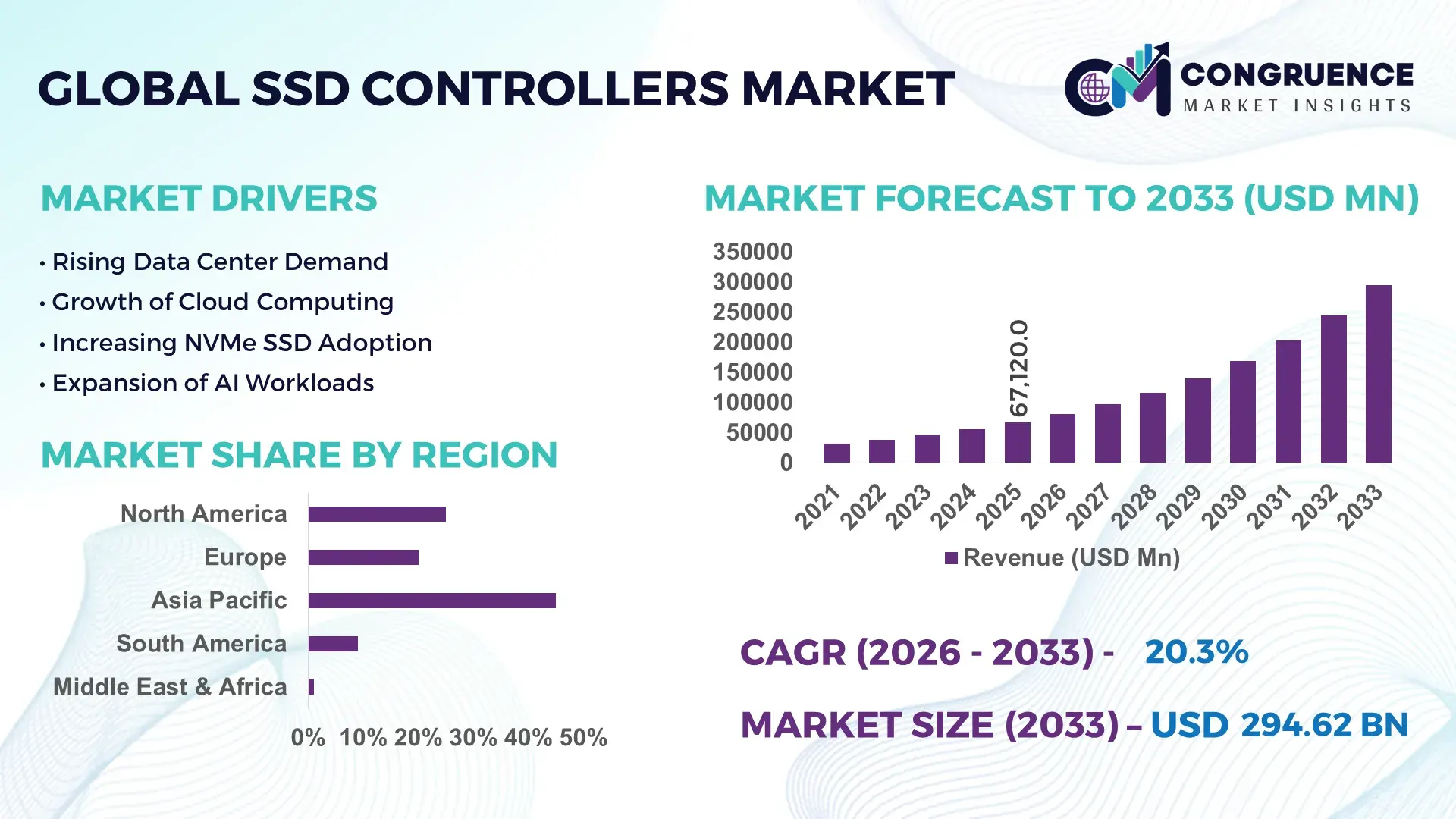
China leads the global SSD controllers ecosystem with nearly 34% manufacturing-linked supply participation, supported by large-scale semiconductor investments exceeding USD 40 billion and strong integration across consumer electronics and cloud infrastructure sectors. The United States maintains technological dominance in enterprise-grade controller design, with AI server SSD adoption surpassing 62% across hyperscale operators in 2026. Export control measures on advanced semiconductor technologies continue reshaping sourcing strategies across East Asia, while South Korea strengthens NAND-linked controller optimization capacity through vertically integrated production models.
Companies prioritizing controller innovation, firmware optimization, and regional supply-chain diversification are securing stronger positioning across high-growth enterprise storage and AI computing deployments.
Market Size & Growth: USD 67120 Million in 2025 reaching USD 294622.3 Million by 2033 at 20.31% growth, driven by AI server storage upgrades and PCIe 5.0 SSD deployment.
Top Growth Drivers: AI data center demand up 41%, enterprise SSD replacement cycles up 28%, and high-capacity NAND integration improving throughput by 35%.
Short-Term Forecast: By 2027, advanced SSD controllers reduce latency by 22% and improve storage power efficiency by 18% across hyperscale infrastructure.
Emerging Technologies: AI-assisted firmware, DRAM-less architectures, and PCIe 6.0 controller platforms increase processing efficiency by over 30% in enterprise workloads.
Regional Leaders: Asia-Pacific exceeds USD 118 billion through semiconductor capacity expansion, North America crosses USD 82 billion via cloud adoption, while Europe surpasses USD 39 billion through industrial automation storage demand.
Consumer/End-User Trends: Over 57% of gaming laptops and premium PCs integrate NVMe SSDs with advanced multi-core controllers for faster application loading.
Pilot/Case Example: In 2026, a hyperscale cloud deployment improved SSD endurance by 26% using AI-optimized wear-leveling controller technology.
Competitive Landscape: Top manufacturers control nearly 49% market share, with leadership concentrated among advanced storage semiconductor and controller solution providers.
Regulatory & ESG Impact: Energy-efficient SSD architectures lowered data center storage power consumption by 16% amid stricter carbon-efficiency compliance targets.
Investment & Funding: Global semiconductor and storage infrastructure investments surpassed USD 70 billion in 2026, supported by regional supply-chain localization initiatives.
Innovation & Future Outlook: Computational storage, edge AI acceleration, and high-density QLC NAND optimization are reshaping advanced SSD controller development strategies.
SSD Controllers Market demand is strengthening across AI servers, enterprise cloud infrastructure, gaming systems, and automotive data storage platforms where low-latency processing remains critical. Advanced PCIe 5.0 controllers now improve sequential read performance by over 40% compared to previous-generation architectures, while firmware-level AI optimization enhances endurance management. Supply-chain localization initiatives across Asia-Pacific and North America are accelerating regional controller manufacturing partnerships, creating a more resilient ecosystem ahead of next-generation enterprise storage expansion.
SSD controllers have become strategically critical as enterprises prioritize AI computing efficiency, low-latency storage infrastructure, and data-intensive workload optimization. The market is increasingly influencing semiconductor competition, cloud infrastructure investment, and sovereign technology strategies, particularly after export restrictions on advanced chips accelerated controller localization efforts across China, South Korea, and the United States. Enterprise NVMe deployments expanded by nearly 38% in 2026, while hyperscale operators intensified procurement of high-endurance controller architectures to support AI training clusters and edge computing scalability.
Advanced PCIe 5.0 SSD controllers now deliver nearly 45% faster sequential throughput and approximately 18% lower power consumption compared to legacy PCIe 4.0 systems, improving server rack density and operational efficiency. The United States continues leading firmware and enterprise controller innovation, while China dominates large-scale SSD assembly integration with over 30% manufacturing-linked participation. Japan and South Korea are accelerating investments in NAND-controller co-optimization platforms to reduce latency instability in AI-driven storage workloads.
In 2026, several hyperscale data center operators deployed AI-assisted wear-leveling firmware that improved SSD endurance cycles by more than 25% in high-volume cloud environments. Storage semiconductor companies are expanding controller R&D partnerships, securing long-term foundry agreements, and prioritizing localized packaging capacity to reduce geopolitical supply exposure. Over the next three years, competitive advantage will increasingly depend on firmware intelligence, controller efficiency, and supply-chain resilience rather than storage hardware scale alone.
AI server deployment and hyperscale infrastructure expansion are significantly increasing demand for advanced SSD controllers with low-latency processing and higher endurance optimization. Enterprise NVMe SSD integration surpassed 61% across cloud infrastructure upgrades in 2026, while PCIe 5.0 controller adoption improved storage throughput by nearly 40% in AI training workloads. The United States and South Korea are accelerating data center modernization through semiconductor and memory ecosystem investments linked to sovereign technology resilience initiatives. Rising enterprise dependence on real-time analytics and AI inference processing is pushing controller manufacturers toward multi-core architectures and firmware-driven workload balancing. In response, companies are expanding ASIC design partnerships, increasing R&D allocation toward computational storage integration, and securing long-term wafer agreements to stabilize controller supply continuity. Firms delivering power-efficient controllers with advanced NAND management are gaining stronger positioning in enterprise procurement cycles.
The SSD controllers market remains exposed to semiconductor fabrication concentration, advanced node shortages, and fluctuating NAND pricing structures that directly impact production planning and profitability. More than 72% of advanced controller chip fabrication remains dependent on a limited number of East Asian foundry ecosystems, increasing operational exposure to geopolitical trade restrictions and logistics disruptions. In 2026, enterprise SSD controller production costs increased by approximately 14% due to higher wafer pricing and advanced packaging constraints. Interoperability challenges between controller firmware and evolving NAND architectures are also extending validation cycles by nearly 20% for enterprise deployments. Companies are mitigating these pressures through localized assembly expansion, multi-foundry sourcing contracts, and firmware standardization initiatives. Businesses with diversified manufacturing partnerships and vertically integrated testing capabilities are reducing supply-chain instability more effectively than smaller independent controller vendors.
Emerging computational storage architectures are creating new opportunities for SSD controllers beyond conventional data management functions. AI-assisted controllers capable of workload acceleration and real-time data processing are reducing server CPU utilization by nearly 27% in enterprise analytics environments. China and the United States are increasing investment in edge AI infrastructure, where low-power SSD controllers improve processing efficiency for autonomous systems, industrial automation, and smart surveillance networks. PCIe 6.0 migration and QLC NAND optimization are also enabling nearly 35% higher storage density within enterprise environments. Controller manufacturers are expanding partnerships with cloud providers, automotive electronics firms, and AI infrastructure developers to capture high-value deployment contracts. Companies investing in firmware-defined storage intelligence and energy-efficient architectures are unlocking competitive advantages in edge computing ecosystems where latency optimization directly impacts operational performance.
Increasing controller sophistication is intensifying firmware validation complexity, cybersecurity exposure, and long-term scalability challenges across enterprise storage environments. AI-driven storage workloads now generate nearly 50% higher random I/O intensity compared to conventional enterprise applications, placing sustained pressure on controller endurance management and thermal stability. In 2026, hyperscale operators reported firmware compatibility delays extending deployment cycles by up to 18% during mixed-NAND integration projects. The United States and Japan are tightening cybersecurity compliance requirements for storage infrastructure, forcing controller vendors to strengthen encryption frameworks and firmware authentication mechanisms. Companies must also address shortages in advanced semiconductor firmware engineering talent as controller architectures become more software-defined. Manufacturers investing in automated validation platforms, secure firmware ecosystems, and collaborative testing alliances with cloud infrastructure providers are improving deployment reliability and protecting long-term competitiveness in high-density AI storage environments.
AI Firmware Optimization Expansion AI-integrated SSD controller firmware is becoming standard across hyperscale and enterprise deployments, with automated wear-leveling systems improving endurance efficiency by nearly 24% and reducing latency spikes by 18% in AI training environments. United States cloud operators accelerated deployment after higher rack-density requirements increased storage thermal pressure in 2026. Controller vendors are scaling firmware engineering teams, integrating predictive error correction algorithms, and forming co-development partnerships with server OEMs to strengthen enterprise retention and reduce infrastructure downtime.
PCIe 5.0 Migration Acceleration PCIe 5.0 controller adoption exceeded 46% across high-performance enterprise SSD deployments as AI inference workloads and real-time analytics intensified bandwidth requirements. Compared to SATA-based systems, advanced PCIe architectures improved sequential transfer efficiency by over 40% while lowering processing bottlenecks in large-scale data operations. South Korean manufacturers are restructuring controller validation workflows and expanding advanced packaging capacity to support faster qualification cycles amid rising demand from cloud and gaming hardware providers.
Supply-Chain Localization Strategies Semiconductor export controls and advanced node concentration are reshaping SSD controller sourcing models across China, Japan, and the United States. Nearly 31% of enterprise storage vendors increased localized controller assembly activity during 2026 to reduce procurement delays and geopolitical exposure. Companies are diversifying foundry relationships, increasing inventory buffers, and investing in regional testing facilities to stabilize delivery timelines. This restructuring is also shortening enterprise procurement cycles for government-linked infrastructure projects requiring supply-chain transparency.
Edge Computing Storage Integration Industrial automation and edge AI deployments are increasing demand for embedded SSD controllers optimized for low-power environments and real-time processing. Embedded controller adoption in smart manufacturing systems rose by approximately 28% in 2026 as factories expanded predictive maintenance and machine-vision operations. Japanese and German industrial equipment manufacturers are integrating compact NVMe-based storage architectures into robotics platforms to improve operational responsiveness. SSD controller suppliers are responding through ruggedized designs, low-power firmware optimization, and partnerships with industrial automation integrators.
NVMe Controllers remain the leading segment due to their superior throughput, low-latency processing, and strong integration across enterprise SSDs, AI servers, and hyperscale storage systems. In 2026, NVMe-based controller deployments accounted for nearly 52% of advanced enterprise SSD configurations as cloud operators prioritized higher IOPS performance and workload optimization. PCIe Controllers represent the fastest-growing segment, supported by PCIe 5.0 migration and increasing AI infrastructure density requirements that improved sequential transfer speeds by more than 40% over legacy SATA architectures. Controller manufacturers are accelerating firmware optimization, multi-core processing integration, and advanced thermal management development to strengthen enterprise deployment reliability.
SATA Controllers continue maintaining strategic relevance in cost-sensitive consumer electronics and legacy enterprise systems where affordability and compatibility remain operational priorities. SAS Controllers retain stable deployment across mission-critical enterprise storage requiring high reliability and redundancy, particularly within financial and government infrastructure. Embedded Controllers are expanding steadily in automotive systems, industrial robotics, and edge computing environments where compact architecture and low-power performance are critical. Companies are increasing investment toward PCIe and NVMe innovation pipelines while gradually repositioning mature SATA portfolios toward entry-level and industrial replacement demand.
Data Centers represent the leading application segment due to sustained hyperscale infrastructure expansion, AI model training workloads, and enterprise cloud migration requirements. In 2026, nearly 64% of newly deployed hyperscale storage systems integrated advanced NVMe SSD controllers to improve processing speed and reduce workload latency. Enterprise Storage is emerging as the fastest-growing application as businesses modernize infrastructure for real-time analytics, virtualization, and AI-assisted operations. Advanced SSD controllers improved enterprise workload efficiency by approximately 22% through faster caching, predictive wear-leveling, and optimized NAND management. Storage semiconductor firms are expanding partnerships with server OEMs and cloud operators to accelerate controller deployment within high-density enterprise environments.
Consumer Electronics continues generating strong controller demand through premium laptops, smartphones, and ultrathin computing systems where compact architecture and power efficiency remain essential. Gaming Systems are adopting high-speed PCIe controllers to support larger game files and faster load performance, while Industrial Systems are integrating ruggedized embedded controllers for machine automation and edge processing applications. Vendors are increasing deployment-focused customization strategies across gaming, industrial, and enterprise segments to strengthen product differentiation and long-term customer integration.
IT and Telecom remains the dominant end-user group due to continuous hyperscale data center expansion, 5G infrastructure scaling, and enterprise cloud workload growth. In 2026, telecom-linked storage modernization projects increased SSD controller deployment intensity by nearly 33% as operators upgraded low-latency data processing capabilities for edge computing and AI-driven network management. The Enterprise Sector represents the fastest-growing end-user category as businesses accelerate digital infrastructure modernization, virtualization adoption, and high-performance analytics integration. Advanced SSD controllers improved enterprise storage responsiveness by approximately 21% in mixed-workload environments, encouraging wider deployment across financial services, retail, and cloud-native operations.
Consumer Electronics Industry demand remains stable through premium device integration, while Automotive Industry adoption is increasing as autonomous systems and connected vehicles require higher endurance embedded storage architectures. Healthcare Industry deployments are strengthening through AI-assisted diagnostics and digital imaging systems demanding secure low-latency storage, whereas Industrial Manufacturing is expanding controller integration within robotics and predictive maintenance environments. Controller suppliers are responding with customized firmware stacks, automotive-grade reliability standards, and ecosystem partnerships targeting sector-specific operational requirements and long-term procurement contracts.
Asia-Pacific accounted for the largest market share at 46% in 2025 however, North America is expected to register the fastest growth, expanding at a CAGR of 21.4% between 2026 and 2033.
AI Infrastructure and Enterprise Storage Acceleration
North America maintains strong SSD controller deployment leadership through hyperscale data center concentration, AI infrastructure modernization, and enterprise cloud expansion. The region accounted for nearly 29% of global enterprise SSD controller deployments in 2025, supported by large-scale procurement from hyperscale operators and advanced semiconductor design ecosystems. PCIe 5.0 controller integration expanded by approximately 43% across enterprise server deployments as AI-driven workloads intensified storage throughput requirements. The United States and Canada are increasing investment in localized semiconductor packaging and storage validation infrastructure to reduce dependence on overseas supply chains. Enterprise storage providers are also strengthening partnerships with controller firmware developers to improve endurance optimization, cybersecurity compliance, and AI workload stability across next-generation cloud environments.
United States Market Outlook: The United States leads the regional SSD controllers market through strong hyperscale infrastructure density, advanced semiconductor design capabilities, and rapid AI server deployment. In 2026, over 62% of enterprise AI storage systems integrated high-performance NVMe controllers optimized for low-latency data processing. Major cloud operators are increasing long-term procurement agreements with controller and NAND ecosystem suppliers while expanding advanced packaging and firmware testing capabilities to strengthen storage reliability and reduce geopolitical sourcing risks.
Energy-Efficient Storage Modernization Expansion
Europe is strengthening its SSD controllers market through industrial digitalization, enterprise storage modernization, and energy-efficient infrastructure upgrades. The region represented nearly 21% of global enterprise SSD integration activity in 2025, supported by strong adoption across industrial automation, automotive electronics, and enterprise cloud environments. Germany, France, and the Netherlands are prioritizing low-power storage architectures to align with stricter carbon-efficiency targets affecting large-scale data center operations. In 2026, enterprise SSD controller deployments linked to energy-efficient infrastructure projects increased by approximately 27%. Storage vendors are expanding regional firmware validation centers and collaborating with industrial automation firms to improve controller reliability for manufacturing, logistics, and edge AI deployment environments.
Germany Market Outlook: Germany remains the most strategically significant SSD controller market in Europe due to its industrial automation leadership, automotive electronics ecosystem, and advanced manufacturing infrastructure. More than 34% of regional industrial edge computing deployments in 2026 integrated embedded SSD controllers for predictive maintenance and robotics applications. German enterprises are increasing investment in localized semiconductor research partnerships and secure storage architectures to strengthen industrial cybersecurity compliance and long-term supply-chain resilience.
Manufacturing Scale and Export Dominance
Asia-Pacific dominates the SSD controllers market through semiconductor manufacturing concentration, NAND ecosystem integration, and large-scale electronics production capacity. The region contributed approximately 46% of global SSD controller-related manufacturing activity in 2025, led by China, South Korea, Taiwan, and Japan. Advanced PCIe controller exports from East Asian production hubs increased by nearly 31% in 2026 as hyperscale infrastructure deployment accelerated globally. Governments across the region are expanding semiconductor incentives, localized fabrication investment, and supply-chain modernization programs to strengthen technology self-sufficiency. Controller manufacturers are scaling wafer procurement agreements, advanced packaging facilities, and firmware engineering capabilities to maintain export competitiveness and enterprise deployment responsiveness.
China Market Outlook: China leads the Asia-Pacific SSD controllers market through extensive electronics manufacturing infrastructure, large-scale data center deployment, and aggressive semiconductor localization initiatives. In 2026, domestic enterprise SSD deployment intensity increased by approximately 37% as AI computing infrastructure and cloud storage capacity expanded rapidly. Chinese storage manufacturers are accelerating partnerships with controller design firms and local foundries to reduce dependence on imported semiconductor technologies while strengthening supply continuity across enterprise and consumer storage ecosystems.
Enterprise Digitization Supporting Demand Expansion
South America is gradually expanding SSD controller adoption through enterprise digitization, cloud infrastructure upgrades, and increasing demand for low-latency storage systems across financial services and telecommunications sectors. The region accounted for nearly 6% of emerging enterprise SSD deployment activity in 2025, with Brazil and Chile leading infrastructure modernization initiatives. In 2026, enterprise NVMe storage integration improved by approximately 24% as businesses accelerated hybrid cloud adoption and data-intensive operational workflows. However, dependence on imported semiconductor components and inconsistent data center infrastructure continue limiting large-scale deployment efficiency. Companies are responding through regional distribution partnerships, localized technical support expansion, and strategic inventory management to reduce procurement delays and improve enterprise integration reliability.
Brazil Market Outlook: Brazil remains the leading SSD controllers market in South America due to its expanding cloud infrastructure ecosystem, enterprise digitization programs, and growing financial technology sector. More than 41% of regional enterprise storage modernization projects in 2026 were concentrated in Brazil, particularly across banking and telecommunications infrastructure. Technology distributors and enterprise storage integrators are increasing local deployment partnerships and technical support capabilities to improve SSD controller integration efficiency for high-volume enterprise workloads.
Digital Infrastructure Investment Momentum
The Middle East & Africa SSD controllers market is advancing through hyperscale data center investment, smart city infrastructure deployment, and enterprise digital transformation initiatives. The region represented nearly 5% of global emerging storage infrastructure deployment activity in 2025, with Gulf countries leading modernization investment. In 2026, enterprise SSD integration across cloud and government infrastructure projects increased by approximately 26% as low-latency data processing became operationally critical for AI-enabled public services and financial systems. Regional operators are expanding partnerships with global storage infrastructure vendors while increasing investment in secure data hosting and energy-efficient computing facilities to support digital sovereignty objectives and long-term infrastructure resilience.
United Arab Emirates Market Outlook: The United Arab Emirates leads the regional SSD controllers market through aggressive smart infrastructure investment, hyperscale data center expansion, and government-backed AI modernization strategies. In 2026, enterprise-grade NVMe deployment across cloud and public-sector infrastructure projects increased by over 32%. UAE-based digital infrastructure operators are strengthening partnerships with storage hardware vendors and semiconductor solution providers to accelerate secure, low-latency storage deployment aligned with national digital transformation priorities.
The SSD controllers market is shaped by competition between global semiconductor leaders, enterprise storage specialists, and cost-focused Asian controller manufacturers. Companies including Phison Electronics, Silicon Motion, Marvell Technology, Western Digital, and Samsung Electronics collectively control nearly 58% of advanced controller shipments, competing across enterprise NVMe, hyperscale AI storage, and consumer SSD ecosystems. Technology leadership and firmware optimization remain the primary differentiators, with PCIe 5.0 controller platforms improving throughput efficiency by over 40% compared to legacy architectures. Enterprise buyers increasingly prioritize endurance stability, low-latency processing, and supply continuity over pricing alone. Leading players are expanding through controller-NAND co-optimization partnerships, localized packaging investments, and AI-assisted firmware development. Chinese manufacturers are strengthening cost competitiveness through domestic semiconductor integration, while United States firms retain an advantage in enterprise firmware ecosystems. High validation complexity, advanced node dependency, and hyperscale qualification standards remain major entry barriers. Winning requires firmware intelligence, scalable manufacturing access, and enterprise-grade reliability consistency.
Samsung Electronics
Western Digital
Micron Technology
SK hynix
Kioxia Corporation
Phison Electronics
Silicon Motion Technology
Marvell Technology
Seagate Technology
Kingston Technology
ADATA Technology
Intel Corporation
Microchip Technology
Realtek Semiconductor
PCIe 5.0 NVMe controllers are redefining enterprise and AI storage performance through higher bandwidth, lower latency, and improved power efficiency. In 2026, more than 46% of hyperscale SSD deployments integrated PCIe 5.0 controllers, improving sequential throughput by over 40% compared to PCIe 4.0 architectures. Advanced 6nm controller designs reduced active power consumption by nearly 30%, enabling denser server configurations and lower thermal management costs. Enterprise storage providers are accelerating firmware optimization and NAND-controller co-engineering to strengthen workload stability in AI training and cloud environments.
DRAM-less controller architectures are emerging as a major cost-efficiency trend across gaming systems, ultrathin laptops, and edge devices. New-generation DRAM-less PCIe 5.0 controllers now achieve nearly 38% higher performance than earlier low-power designs while consuming below 2.5W in compact deployments. Adoption across portable computing platforms exceeded 33% in 2026 as manufacturers prioritized smaller thermal footprints and lower bill-of-material costs. Companies specializing in firmware intelligence and thermal optimization are gaining competitive advantage in mobile and edge storage ecosystems.
Between 2026 and 2028, PCIe 6.0 SSD controllers, computational storage, and AI-assisted firmware management will reshape enterprise storage economics. Next-generation controllers already demonstrate up to 28 GB/s throughput and nearly double the IOPS capability of current high-end PCIe 5.0 systems. AI-driven workload balancing and predictive NAND management are expected to reduce enterprise storage latency variability by approximately 20%, benefiting hyperscale operators, industrial AI deployments, and autonomous edge infrastructure providers that require scalable real-time processing.
June 2026 – Phison Electronics unveiled the PS5303-X3 PCIe 6.0 SSD controller supporting 28 GB/s throughput and 6.8 million IOPS for enterprise AI storage platforms. The launch strengthened Phison’s positioning in next-generation hyperscale infrastructure and accelerated PCIe 6.0 commercialization timelines. Source: tomshardware.com (Tom's Hardware)
January 2026 – Phison Electronics introduced the E37T DRAM-less PCIe 5.0 controller delivering 38% higher performance while operating below 2.3W power consumption. The controller improved thermal efficiency for laptops and gaming systems, enabling compact SSD deployment without active cooling requirements. Source: phison.com
November 2025 – Silicon Motion Technology launched the SM8388 PCIe Gen5 enterprise SSD controller delivering 14.4 GB/s throughput at under 5W power. The development improved storage density economics for AI cloud environments and strengthened enterprise adoption of QLC-based nearline SSD infrastructure. Source: storagenewsletter.com (StorageNewsletter)
July 2025 – Silicon Motion Technology disclosed the MonTitan SM8466 PCIe 6.0 controller supporting up to 7 million IOPS and 512TB SSD capacities. The platform accelerated enterprise transition toward ultra-high-density AI storage architectures and strengthened competitive pressure across hyperscale controller ecosystems. Source: reddit.com (Reddit)
The SSD Controllers Market report delivers detailed analysis across SATA Controllers, NVMe Controllers, PCIe Controllers, SAS Controllers, and Embedded Controllers, covering evolving deployment priorities across enterprise storage, hyperscale infrastructure, consumer electronics, industrial systems, and gaming platforms. The study evaluates operational trends across IT and telecom, enterprise sector, automotive, healthcare, and industrial manufacturing end-users, where NVMe and PCIe-based architectures accounted for over 55% of advanced enterprise SSD integrations in 2026. The report also assesses firmware innovation, computational storage evolution, DRAM-less architectures, and PCIe 6.0 transition strategies shaping next-generation storage performance.
Regional coverage includes North America, Europe, Asia-Pacific, South America, and Middle East & Africa, with analysis of manufacturing concentration, deployment intensity, semiconductor localization, and enterprise modernization activity. The report examines competitive positioning, supply-chain restructuring, AI infrastructure adoption, and controller-NAND integration strategies influencing business expansion between 2026 and 2033. It supports investment planning, product roadmap alignment, procurement strategy, and infrastructure scaling decisions for storage technology stakeholders.
| Report Attribute/Metric | Report Details |
|---|---|
|
Market Revenue in 2025 |
USD 67120 Million |
|
Market Revenue in 2033 |
USD 294622.3 Million |
|
CAGR (2026 - 2033) |
20.31% |
|
Base Year |
2025 |
|
Forecast Period |
2026 - 2033 |
|
Historic Period |
2021 - 2025 |
|
Segments Covered |
By Type
By Application
By End-User
|
|
Key Report Deliverable |
Revenue Forecast, Growth Trends, Market Dynamics, Segmental Overview, Regional and Country-wise Analysis, Competition Landscape |
|
Region Covered |
North America, Europe, Asia-Pacific, South America, Middle East, Africa |
|
Key Players Analyzed |
Samsung Electronics, Western Digital, Micron Technology, SK hynix, Kioxia Corporation, Phison Electronics, Silicon Motion Technology, Marvell Technology, Seagate Technology, Kingston Technology, ADATA Technology, Intel Corporation, Microchip Technology, Realtek Semiconductor |
|
Customization & Pricing |
Available on Request (10% Customization is Free) |




