
Reports
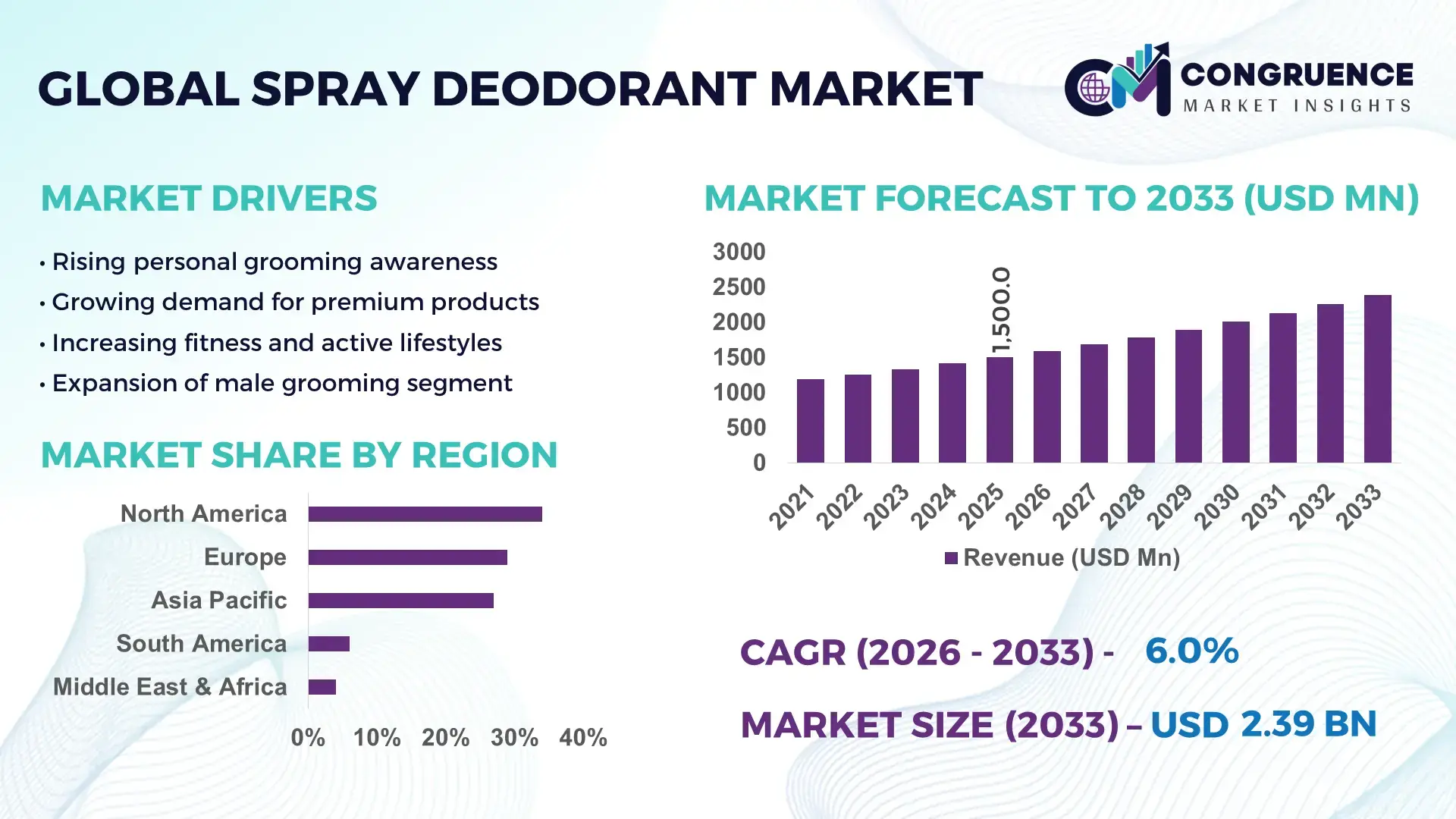
The Global Spray Deodorants Market was valued at USD 1,500.0 Million in 2025 and is anticipated to reach a value of USD 2,390.8 Million by 2033 expanding at a CAGR of 6.0% between 2026 and 2033, according to an analysis by Congruence Market Insights. The growth is primarily driven by rising urban grooming awareness and increasing demand for convenient personal hygiene products.
The United States leads the Spray Deodorants Market with advanced manufacturing ecosystems and strong consumer penetration across retail and e-commerce channels. The country accounts for over 28% of global aerosol personal care production capacity, supported by more than 300 aerosol manufacturing facilities. Consumer adoption remains high, with nearly 72% of adults using deodorants daily, and spray formats capturing over 45% of deodorant usage in urban populations. Investments in sustainable aerosol technologies exceed USD 500 million annually, focusing on low-VOC propellants and recyclable aluminum packaging. Additionally, over 60% of leading brands have integrated smart packaging and dermatologically tested formulations, enhancing product innovation and consumer trust across premium and mass-market segments.
Market Size & Growth: Valued at USD 1,500.0 Million in 2025, projected to reach USD 2,390.8 Million by 2033, expanding at 6.0% CAGR, driven by rising hygiene awareness and urban consumption.
Top Growth Drivers: Urban adoption rates up by 35%, premium product demand increased by 28%, e-commerce sales penetration at 42%.
Short-Term Forecast: By 2028, supply chain efficiency is expected to improve by 22% through automation and localized manufacturing.
Emerging Technologies: Low-emission aerosol propellants, AI-driven fragrance personalization, and recyclable packaging innovations.
Regional Leaders: North America projected at USD 780 Million by 2033 with premiumization trend; Europe at USD 620 Million with sustainability focus; Asia-Pacific at USD 720 Million driven by youth adoption.
Consumer/End-User Trends: Over 65% of Gen Z consumers prefer spray formats for convenience and portability, with rising demand for long-lasting formulations.
Pilot or Case Example: In 2024, a European manufacturer reduced production downtime by 18% using AI-based quality control systems.
Competitive Landscape: Market leader holds approximately 22% share, followed by key players such as Unilever, Procter & Gamble, Beiersdorf, Henkel, and Coty.
Regulatory & ESG Impact: Over 55% of companies have shifted to recyclable packaging, complying with global aerosol emission standards.
Investment & Funding Patterns: More than USD 1.2 Billion invested in sustainable packaging and formulation technologies since 2023.
Innovation & Future Outlook: Integration of smart dispensing systems and skin-sensitive formulations is expected to reshape product development.
The Spray Deodorants Market is influenced by personal care, retail, and FMCG sectors contributing over 80% of total demand, with innovations such as aluminum-free sprays and probiotic formulations gaining traction. Regulatory emphasis on VOC reduction and sustainable packaging is reshaping production, while Asia-Pacific accounts for over 35% of consumption growth, driven by urbanization and rising disposable income.
The Spray Deodorants Market holds strong strategic relevance as consumer lifestyles increasingly prioritize hygiene, convenience, and product performance. The market is evolving with the integration of advanced aerosol delivery systems and skin-friendly formulations. AI-based fragrance personalization delivers 25% higher consumer satisfaction compared to traditional fragrance selection methods, enabling brands to differentiate offerings in competitive retail environments.
North America dominates in volume, while Asia-Pacific leads in adoption with over 48% of new consumers entering the category through digital channels. The market is further shaped by innovations such as compressed aerosol technology, which reduces packaging material usage by nearly 30% compared to conventional aerosol systems. By 2028, smart manufacturing and automation technologies are expected to reduce production inefficiencies by 20%, improving scalability and operational resilience.
Sustainability remains a central theme, with firms committing to 50% recyclable packaging targets by 2030, and reducing propellant emissions by 35% through eco-friendly alternatives. In 2025, a leading European manufacturer achieved 19% reduction in carbon emissions by adopting bio-based propellants and automated filling lines, demonstrating measurable ESG impact.
Looking ahead, the Spray Deodorants Market is positioned as a critical pillar for sustainable personal care innovation, combining regulatory compliance, consumer-centric product development, and technological advancement to ensure long-term resilience and growth.
The Spray Deodorants Market is shaped by evolving consumer preferences, technological advancements, and regulatory frameworks governing aerosol products. Increasing urbanization has led to higher daily usage frequencies, with more than 60% of urban consumers using deodorants regularly. The shift toward premium and dermatologically tested products is influencing brand positioning and product development strategies. Additionally, advancements in aerosol technology, including low-pressure dispensing systems and eco-friendly propellants, are transforming manufacturing processes. The rise of e-commerce platforms has contributed to nearly 40% of total sales channels, enabling wider product accessibility. Environmental concerns regarding VOC emissions and packaging waste are also influencing innovation, pushing companies toward sustainable alternatives and compliance with stricter environmental regulations across developed and emerging markets.
Urban grooming awareness is significantly boosting demand for spray deodorants, particularly among younger demographics. Over 70% of consumers aged 18–35 report daily use of deodorants, with spray formats preferred for their quick application and long-lasting effect. Increasing workforce participation and social interactions have further amplified demand for personal hygiene products. Retail expansion and digital marketing strategies have enhanced product visibility, contributing to a 30% increase in first-time users in emerging economies. Additionally, innovations such as skin-sensitive and alcohol-free formulations are attracting health-conscious consumers, strengthening overall market penetration and product adoption across diverse consumer segments.
Environmental concerns related to aerosol emissions and packaging waste present a significant restraint. Spray deodorants often use propellants that contribute to VOC emissions, accounting for nearly 15% of total emissions in personal care aerosols. Regulatory bodies in Europe and North America have introduced stringent guidelines limiting the use of certain chemicals, increasing compliance costs for manufacturers. Additionally, over 40% of consumers express concerns about environmental impact, influencing purchasing decisions toward roll-ons and natural alternatives. The cost of transitioning to eco-friendly propellants and recyclable packaging remains high, posing operational challenges for small and medium-sized manufacturers.
Sustainable formulations and eco-friendly packaging present significant growth opportunities. Over 55% of consumers prefer products labeled as natural or organic, creating demand for aluminum-free and paraben-free spray deodorants. Innovations in biodegradable packaging and refillable aerosol systems are gaining traction, with adoption increasing by 25% annually in premium segments. Emerging markets offer additional opportunities, where rising disposable incomes and urbanization are driving product adoption. Furthermore, partnerships between manufacturers and sustainability-focused organizations are accelerating the development of green technologies, enabling brands to align with evolving regulatory standards and consumer expectations.
Rising production costs pose a major challenge for the Spray Deodorants Market. The cost of raw materials, including aluminum and propellants, has increased by over 18% in recent years, directly impacting manufacturing expenses. Additionally, the transition to sustainable packaging and low-emission propellants requires significant capital investment. Supply chain disruptions have further increased logistics costs by approximately 12%, affecting product pricing and profitability. Smaller manufacturers face difficulties in adopting advanced technologies, leading to competitive disadvantages. These cost pressures may result in higher product prices, potentially limiting adoption in price-sensitive markets.
• Shift Toward Aluminum-Free Formulations: Over 48% of new product launches now feature aluminum-free compositions, reflecting rising consumer demand for safer and skin-friendly alternatives. Dermatologically tested products have increased consumer trust levels by 32%, particularly in premium segments where ingredient transparency is a key purchasing factor.
• Growth in Sustainable Packaging Solutions: Approximately 60% of manufacturers are transitioning to recyclable aluminum cans and biodegradable packaging. Compressed aerosol technology has reduced packaging material usage by 30%, improving logistics efficiency and reducing environmental impact across supply chains.
• Expansion of E-commerce Distribution Channels: Online sales now contribute to nearly 38% of total market transactions, with mobile commerce accounting for 65% of digital purchases. Personalized recommendations and subscription-based models have improved customer retention rates by 27%.
• Integration of Smart and AI-Driven Product Development: AI-driven fragrance customization tools have improved product acceptance rates by 25%, while automated production systems have enhanced manufacturing efficiency by 20%, enabling faster product launches and improved quality control.
The Spray Deodorants Market is segmented based on type, application, and end-user, each contributing uniquely to overall demand patterns. Product types include mass, premium, and natural variants, reflecting diverse consumer preferences across price points and ingredient compositions. Applications range from personal daily use to sports and medical-grade usage, with personal care dominating due to widespread adoption. End-user segmentation highlights individual consumers, athletes, and institutional buyers such as gyms and wellness centers. Increasing demand for natural and dermatologically tested products is influencing segmentation trends, while regional variations in climate and lifestyle further impact product usage frequency and preferences across different demographic groups.
Mass spray deodorants dominate the segment, accounting for approximately 52% share, driven by affordability and wide availability across retail and online platforms. Premium variants hold around 28%, benefiting from higher demand for long-lasting fragrances and skin-friendly formulations. Natural and organic spray deodorants, although currently representing about 20%, are the fastest-growing segment with an expected growth rate of 7.5%, fueled by increasing consumer awareness of chemical-free products. Other niche types, including medicated and sports-specific deodorants, collectively contribute around 15%, catering to specialized needs such as sweat control and odor management during physical activities.
• A 2025 dermatology association study found that over 40% of consumers shifted to aluminum-free spray deodorants due to skin sensitivity concerns, significantly boosting demand for natural product types.
Personal daily use leads with approximately 68% share, reflecting widespread adoption across urban populations. Sports and fitness applications account for around 20%, driven by increasing gym memberships and active lifestyles. Medical and therapeutic applications hold nearly 12%, focusing on individuals with specific dermatological needs. Sports and fitness applications are the fastest-growing segment with an estimated growth rate of 7.2%, supported by rising health awareness and participation in physical activities. Over 45% of gym users prefer spray deodorants for convenience and hygiene. Additionally, more than 38% of consumers globally reported increased usage during outdoor activities.
• A 2025 health and fitness report indicated that over 50 million gym members globally use spray deodorants regularly to maintain hygiene during workouts, highlighting strong application-specific demand.
Individual consumers dominate the market with approximately 72% share, driven by daily hygiene practices and increasing awareness. Institutional users such as gyms, sports clubs, and wellness centers account for around 18%, while commercial establishments contribute nearly 10%. Institutional users are the fastest-growing segment with an expected growth rate of 6.8%, supported by expansion in fitness and wellness infrastructure. Over 35% of fitness centers provide deodorant products as part of hygiene amenities, boosting institutional demand. Additionally, nearly 60% of Gen Z consumers prefer spray deodorants due to convenience and portability.
• A 2025 industry survey revealed that adoption of hygiene products, including spray deodorants, increased by 22% across wellness centers, improving customer satisfaction and retention rates.
North America accounted for the largest market share at 34% in 2025 however, Asia-Pacific is expected to register the fastest growth, expanding at a CAGR of7.1% between 2026 and 2033.

Europe follows with a 29% share, driven by sustainability regulations and premium product demand. Asia-Pacific contributes approximately 27%, supported by rising urbanization and youth population. South America and Middle East & Africa collectively account for 10%, with growing adoption in emerging economies. Increasing disposable income, expanding retail networks, and rising hygiene awareness are key factors influencing regional market dynamics.
North America holds approximately 34% of the global market, driven by high consumer awareness and strong retail infrastructure. The U.S. dominates regional demand, supported by advanced manufacturing capabilities and widespread product availability. Regulatory frameworks emphasize product safety and environmental compliance, encouraging adoption of low-emission aerosol technologies. Key industries include personal care, retail, and e-commerce, with digital channels contributing over 40% of sales. A leading regional player has introduced AI-based fragrance personalization tools, improving customer engagement by 20%. Consumer behavior reflects strong preference for premium and sustainable products, with higher adoption among urban populations.
Europe accounts for nearly 29% of the market, with key countries including Germany, the UK, and France. Regulatory bodies enforce strict environmental standards, driving adoption of recyclable packaging and low-VOC formulations. Approximately 65% of consumers prefer eco-friendly products, influencing product innovation strategies. Emerging technologies such as compressed aerosol systems are widely adopted, reducing material usage by 30%. A regional manufacturer has invested heavily in biodegradable packaging solutions, enhancing sustainability credentials. Consumer behavior is shaped by regulatory pressure and environmental awareness, leading to increased demand for natural and organic deodorants.
Asia-Pacific ranks as the fastest-growing region, contributing around 27% of global demand. Key markets include China, India, and Japan, with rapid urbanization and rising disposable incomes driving consumption. Manufacturing hubs in China and India support large-scale production, reducing costs and improving accessibility. E-commerce platforms account for over 50% of product distribution, enhancing market penetration. A local player has expanded its digital retail presence, increasing sales by 25%. Consumer behavior is influenced by affordability and convenience, with strong growth in mobile-based purchasing.
South America holds approximately 6% of the global market, led by Brazil and Argentina. Rising urbanization and expanding retail networks are driving demand for personal care products. Government policies supporting local manufacturing have improved product availability and reduced costs. The market is characterized by increasing adoption of affordable spray deodorants, particularly among younger consumers. A regional company has launched cost-effective product lines, boosting sales by 18%. Consumer behavior reflects strong preference for value-based products, with demand influenced by climate and lifestyle factors.
The Middle East & Africa region accounts for around 4% of global demand, with key markets including UAE and South Africa. Rising disposable income and urbanization are driving product adoption, particularly in metropolitan areas. Technological modernization in manufacturing and distribution is improving product availability. A regional player has expanded its retail network, increasing market penetration by 15%. Consumer behavior varies across regions, with higher demand in urban centers and growing preference for premium products influenced by lifestyle changes.
United States – 28% Market share: High production capacity and strong consumer adoption across retail and digital channels.
China – 18% Market share: Large-scale manufacturing ecosystem and rapidly growing urban consumer base.
The Spray Deodorants Market is moderately fragmented, with over 50 active global and regional competitors operating across various price segments. The top five companies collectively account for approximately 58% of the total market share, indicating a competitive yet partially consolidated landscape. Major players focus on product innovation, sustainability, and brand differentiation to maintain competitive positioning. Strategic initiatives such as mergers, acquisitions, and partnerships are common, with companies investing heavily in eco-friendly formulations and packaging technologies.
Product launches remain a key competitive strategy, with over 120 new spray deodorant variants introduced annually, targeting diverse consumer preferences. Digital transformation and e-commerce integration have become critical, with leading brands generating over 40% of their sales through online channels. Additionally, investments in AI-driven product development and automated manufacturing are enhancing operational efficiency and product quality. The competitive environment is further intensified by the entry of niche and organic brands, which are gaining traction among environmentally conscious consumers.
Procter & Gamble
Beiersdorf AG
Henkel AG
Coty Inc.
L'Oréal Group
Reckitt Benckiser
Colgate-Palmolive Company
Church & Dwight Co., Inc.
Edgewell Personal Care
Amway Corporation
Shiseido Company
Avon Products
Natura & Co.
Technological advancements are playing a critical role in shaping the Spray Deodorants Market, particularly in formulation, packaging, and manufacturing processes. One of the most significant developments is the adoption of compressed aerosol technology, which reduces packaging material usage by nearly 30% while maintaining product performance. Low-emission propellants are also gaining traction, helping manufacturers reduce VOC emissions by up to 35%, aligning with global environmental regulations.
AI-driven product development is transforming the market by enabling personalized fragrance creation and improving consumer engagement. Automated manufacturing systems have increased production efficiency by approximately 20%, reducing operational costs and enhancing scalability. Smart packaging technologies, including QR codes and digital tracking systems, are improving product traceability and consumer interaction.
Additionally, innovations in natural and organic formulations are gaining momentum, with over 50% of new products featuring chemical-free ingredients. Biodegradable packaging solutions and refillable aerosol systems are also emerging, addressing sustainability concerns and reducing environmental impact. These technological advancements are enabling companies to enhance product quality, comply with regulations, and meet evolving consumer expectations.
• In August 2025, Unilever reported that its Axe spray deodorant brand significantly boosted Gen Z engagement through its Fine Fragrance collection and social-first campaigns, achieving 33 million organic views and a 300% uplift in UK sales, demonstrating strong performance of premium spray formats. Source: www.unilever.com
• In October 2025, Unilever highlighted the expansion of its deodorant portfolio through premium spray innovations such as Axe Fine Fragrance and whole-body deodorants, now launched across 13 markets, reinforcing product diversification and innovation in aerosol-based formats.
• In April 2025,Unilever announced the acquisition of Wild, a refillable deodorant brand using plant-based formulations and plastic-free packaging, strengthening its sustainability-focused deodorant portfolio and expanding eco-friendly product development capabilities.
• In November 2025, Unilever confirmed that its Rexona deodorant brand expanded global sports partnerships, including activation plans for FIFA World Cup 2026, enhancing brand visibility and consumer engagement for spray deodorant products across multiple international markets.
The Spray Deodorants Market Report provides a comprehensive analysis of industry trends, segmentation, regional dynamics, and competitive landscape. It covers key product types including mass, premium, and natural spray deodorants, along with their applications across personal care, sports, and medical sectors. The report evaluates end-user segments such as individual consumers, institutional buyers, and commercial establishments, offering detailed insights into demand patterns and adoption trends.
Geographically, the report spans major regions including North America, Europe, Asia-Pacific, South America, and the Middle East & Africa, highlighting regional consumption patterns, production capabilities, and technological advancements. It also examines distribution channels such as retail, e-commerce, and direct sales, providing a holistic view of market accessibility and growth drivers.
The scope extends to technological innovations, including sustainable packaging, low-emission propellants, and AI-driven product development, which are shaping the future of the market. Additionally, the report analyzes regulatory frameworks, environmental considerations, and economic factors influencing market dynamics. By integrating quantitative data with qualitative insights, the report offers a strategic perspective for decision-makers, enabling informed business planning and investment decisions across the Spray Deodorants Market ecosystem.
| Report Attribute / Metric | Details |
|---|---|
| Market Revenue (2025) | USD 1,500.0 Million |
| Market Revenue (2033) | USD 2,390.8 Million |
| CAGR (2026–2033) | 6.0% |
| Base Year | 2025 |
| Forecast Period | 2026–2033 |
| Historic Period | 2021–2025 |
| Segments Covered |
By Type
By Application
By End-User Insights
|
| Key Report Deliverables | Revenue Forecast; Market Trends; Growth Drivers & Restraints; Technology Insights; Segmentation Analysis; Regional Insights; Competitive Landscape; Regulatory & ESG Overview; Recent Developments |
| Regions Covered | North America; Europe; Asia-Pacific; South America; Middle East & Africa |
| Key Players Analyzed | Unilever; Procter & Gamble; Beiersdorf AG; Henkel AG; Coty Inc.; L'Oréal Group; Reckitt Benckiser; Colgate-Palmolive Company; Church & Dwight Co., Inc.; Edgewell Personal Care; Amway Corporation; Shiseido Company; Avon Products; Natura & Co. |
| Customization & Pricing | Available on Request (10% Customization Free) |




