
Reports
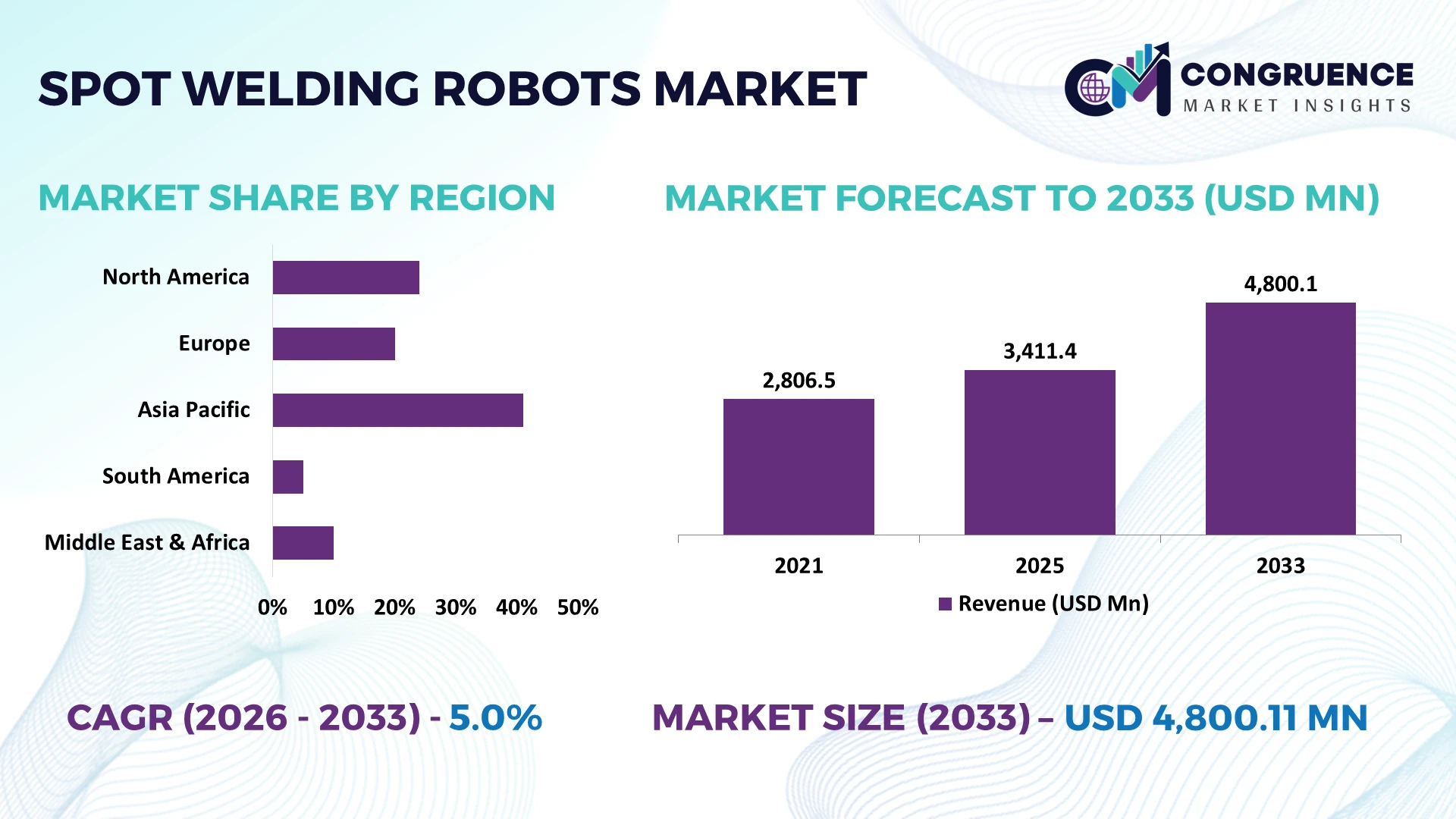
The Global Spot Welding Robots Market was valued at USD 3411.35 Million in 2025 and is anticipated to reach a value of USD 4800.11 Million by 2033 expanding at a CAGR of 5% between 2026 and 2033. Growth is driven by EV body-in-white automation, rising weld-quality requirements, labor shortages, and rapid deployment of high-payload robotic cells across automotive manufacturing.
China holds the dominant position with approximately 20.6% global market share, supported by extensive automotive, EV, and metal-fabrication capacity. The country recorded 602,700 industrial robot units produced during January–October 2025, up 28.8%, reinforcing domestic automation capability. By comparison, Japan represented about 9.9% of the spot welding robots market, while its automotive industry installed nearly 13,000 industrial robots in 2024, an 11% increase. China’s robotics expansion is also accelerating amid US-China supply-chain realignment.
Strategic implication: suppliers should prioritize China and broader Asian EV manufacturing ecosystems while positioning AI-enabled, high-payload welding cells for next-generation production lines.
Market Size & Growth: USD 3,411.35 million in 2025 to USD 4,800.11 million by 2033 at 5% CAGR, driven by EV production automation.
Top Growth Drivers: EV manufacturing 30%, labor-saving automation 25%, precision welding 20%.
Short-Term Forecast: By 2028, robotic cell deployment is positioned to reduce welding labor costs by 15–20% and improve throughput by 10–15%.
Emerging Technologies: AI vision, adaptive welding control, and digital-twin programming are reshaping advanced robotic cells.
Regional Leaders: Asia Pacific reaches USD 3,802.8 million by 2033, North America USD 1,696.2 million, and Europe USD 1,735.7 million.
Consumer/End-User Trends: Automotive remains the core user; Japan installed 13,000 industrial robots in 2024, up 11%.
Pilot/Case Example: In 2022, automated spot-welding motion technology demonstrated up to 70% lower robot programming time.
Competitive Landscape: China leads with 20.6% share; FANUC, ABB, Yaskawa, KUKA, and Kawasaki remain major competitors.
Regulatory & ESG Impact: Automated welding supports safer factories, while shipbuilding programs target up to 70% automation to reduce hazardous manual work.
Investment & Funding: Robotics funding reached nearly USD 200 million for Germany’s RobCo, reflecting stronger capital flows into intelligent industrial automation.
Innovation & Future Outlook: AI-guided welding, self-optimizing cells, cobots, and connected production systems will shift competition toward faster commissioning and flexible multi-model manufacturing.
The Spot Welding Robots Market is increasingly concentrated around automotive body-in-white, EV platforms, battery enclosures, and high-volume metal fabrication, where consistent weld placement and cycle control directly influence production economics. Resistance spot welding represented approximately 74.9% of the market in 2025, reinforcing its role in high-throughput vehicle assembly. AI-based vision, adaptive current control, and simulation-led programming are accelerating cell optimization, while manufacturers are redesigning supply chains around regional EV production to reduce geopolitical exposure. This transition strengthens the strategic case for advanced robotic welding platforms with faster commissioning and flexible production capabilities.
Spot welding robots are becoming strategically important because vehicle manufacturers are shifting from labor-intensive body assembly toward highly automated, flexible production cells. China accounted for 54% of global industrial robot deployments in 2024, while Japan installed about 13,000 robots in automotive manufacturing, up 11%. This scale is reshaping supplier selection, plant localization, and investment priorities as EV platforms require repeatable joining across lightweight steel and aluminum structures.
Technology is also changing the economics of deployment. Advanced servo-controlled spot welding systems can reduce cycle time by about 20% versus conventional motion profiles, while offline simulation has demonstrated a 12.7% cycle-time reduction in an automotive body shop. China is prioritizing scale and domestic equipment penetration, whereas Japan emphasizes precision, robot density, and high-value manufacturing. Over the next 2–3 years, wider AI-based inspection and predictive maintenance deployment will increasingly shift competition toward uptime and first-pass weld quality.
A practical deployment model combines multi-robot body shops with digital simulation, centralized monitoring, and automated quality verification. Manufacturers are directing capital toward modular cells that can accommodate multiple vehicle variants rather than fixed single-model lines. This strengthens the strategic position of suppliers offering integrated robots, controllers, welding guns, vision, and software, making operational flexibility a decisive competitive advantage.
EV platform expansion is strengthening spot welding automation because battery vehicles require high-volume joining across lightweight body structures and battery-related assemblies. China accounted for 54% of global industrial robot deployments in 2024, while Japan’s automotive robot installations increased 11% to approximately 13,000 units. At Wuhan, more than 300 robots perform vehicle-body manufacturing operations within a 43-second process cycle. This concentration of automated production is pushing OEMs and Tier-1 suppliers toward integrated robotic cells. Companies are responding through localized equipment production, software partnerships, and higher-capacity welding-cell investments. The non-obvious advantage is not simply labor reduction: standardized robotic parameters improve repeatability across EV model variants and reduce dependence on scarce skilled welders.
High automation intensity creates a significant deployment barrier when plants require robots, servo welding guns, controllers, safety systems, vision equipment, and integration engineering simultaneously. A typical robotic spot-welding cell involves multiple specialized subsystems, increasing commissioning complexity and exposure to component shortages. China’s domestic robot manufacturers captured 57% of its industrial robot market in 2024, illustrating the competitive pressure created by localization. By contrast, manufacturers dependent on imported controllers or precision components face longer replacement cycles and currency exposure. Companies are mitigating this constraint through dual sourcing, regional production, standardized robot platforms, and longer-term component contracts. The strategic priority is reducing single-vendor dependency without sacrificing weld-control precision or interoperability.
AI-based weld monitoring creates a higher-value opportunity beyond basic robotic automation by converting process data into predictive quality decisions. Machine-learning welding systems have demonstrated anomaly-detection sensitivity of about 95%, while optimized robotic motion can reduce cycle time by 12.7%. These capabilities support real-time detection of electrode wear, force deviations, current instability, and abnormal weld signatures. Japan, South Korea, and Germany are well positioned for premium deployments because of their dense automotive automation ecosystems, while India offers expansion opportunities as vehicle and component manufacturing becomes more automated. Companies are investing in vision systems, edge analytics, digital twins, and predictive-maintenance software. The strongest opportunity lies in upgrading installed robot fleets through software and sensing rather than replacing complete production cells.
Long-term deployment increasingly depends on whether welding systems can handle frequent model changes without extensive reprogramming. Automotive body shops can involve hundreds of weld points across multiple robot stations, creating interference, accessibility, and sequencing constraints. Industrial case analysis has shown that optimized line balancing can improve productivity by 6.6%, demonstrating how small coordination gains become significant at production scale. AI-based predictive maintenance is also adding new data-integration requirements across robots, welding controllers, MES platforms, and quality systems. Companies must therefore invest in interoperable control architectures, offline programming, cybersecurity, and technician training. The critical challenge is shifting from robot installation to maintaining consistent performance across increasingly connected and variable production environments.
AI-Driven Weld Quality Control: Automotive plants are integrating vision-guided inspection and adaptive welding controls, with AI-enabled systems targeting 10–15% fewer weld defects and 5–10% higher first-pass yield. Japanese and Chinese manufacturers are scaling closed-loop monitoring to reduce rework and stabilize quality across high-volume EV lines.
Flexible Multi-Model Production: OEMs are replacing fixed welding cells with reconfigurable robotic stations as vehicle platforms diversify. Modular systems can reduce changeover time by 20–30% and improve equipment utilization by 8–12%. Manufacturers in China are prioritizing flexible cells that accommodate multiple body variants without rebuilding complete production lines.
Localization Reshapes Robot Supply: China’s domestic robot suppliers captured 57% of its industrial-robot installations in 2024, up from 47% in 2023. This shift is accelerating localized controllers, servo systems, and welding equipment, reducing import exposure. Global suppliers are responding through Chinese partnerships, local assembly, and application-specific engineering.
Automation Targets Skilled-Labor Gaps: Japan installed about 13,000 industrial robots in automotive manufacturing during 2024, an 11% increase. Manufacturers are expanding automation where skilled welding labor is constrained, while integrating predictive maintenance to protect uptime. The non-obvious shift is greater investment in software and diagnostics alongside physical robot capacity.
Articulated Robots lead the Spot Welding Robots Market at approximately 68% share because six-axis flexibility, high payload capacity, and mature welding integration support dense automotive body shops. Their reach enables multiple weld points from one station, reducing fixture complexity by roughly 15–20%. Six-Axis Robots remain strategically important for complex geometries, while Gantry Robots serve large-format structures requiring extended horizontal reach. SCARA Robots retain a narrower role where high-speed planar movement is prioritized rather than multi-angle welding.
Collaborative Robots represent the fastest-growing type, with adoption increasing around 18–22% as manufacturers introduce flexible welding cells and safer human-machine workflows. Their lower installation footprint supports smaller component producers, while Articulated Robots remain preferred for high-volume body assembly. Companies are therefore maintaining conventional six-axis fleets while adding cobots for short-run components, model changeovers, and auxiliary welding operations.
Spot Welding accounts for approximately 54% of market demand because automotive body structures require thousands of repeatable resistance welds across high-throughput production lines. Its established tooling ecosystem, rapid cycle capability, and integration with articulated robots support production efficiency improvements of roughly 15–25%. Body Assembly follows closely, while Chassis Assembly and Sheet Metal Welding remain important for structural components requiring controlled joining and dimensional consistency.
Battery Pack Welding is the fastest-growing application, with adoption expanding approximately 20–25% as EV manufacturers increase automated joining across battery housings and structural enclosures. Component Welding provides flexibility for Tier-1 suppliers, while Chassis Assembly benefits from robotic force control. Companies are increasingly integrating welding controllers, vision inspection, and traceability systems into unified cells, shifting investment toward platforms capable of handling both conventional vehicle structures and new EV architectures.
Automotive represents approximately 63% of Spot Welding Robots Market demand because vehicle body manufacturing combines high weld-point density, repetitive cycles, strict dimensional tolerances, and continuous production requirements. Large OEM plants can deploy hundreds of robots across body shops, making automation economics significantly stronger than in lower-volume fabrication. Auto Components follows with approximately 16% share, while Heavy Machinery and Construction Equipment prioritize high-payload systems for larger structures. Aerospace maintains specialized demand where precision and traceability outweigh production volume.
Auto Components is emerging as the fastest-growing buyer group, with automation adoption expanding around 17–20% as suppliers support EV platforms and localized manufacturing. Electronics, Metal Fabrication, and Aerospace increasingly favor compact, programmable systems for specialized production. Companies are responding with application-specific welding packages, financing models, and partnerships with Tier-1 suppliers. India installed nearly 10,500 industrial robots in 2025, up 15%, strengthening its position as an expanding manufacturing base.
Asia Pacific accounted for the largest market share at 44.9% in 2025 however, North America is expected to register the fastest growth, expanding at a CAGR of 7.9% between 2026 and 2033.

EV localization and flexible body-shop automation are reshaping deployment priorities
North America represented approximately 22% of the global Spot Welding Robots Market in 2025, supported by large-scale vehicle assembly, EV manufacturing, and modernization of established production lines. The United States accounts for approximately 82.5% of regional demand, reflecting its concentration of automotive plants, robotics integrators, and advanced manufacturing infrastructure. Automakers are replacing conventional welding stations with servo-controlled guns, machine vision, adaptive process monitoring, and predictive-maintenance systems to improve weld consistency and equipment utilization. Mexico is also attracting manufacturing investment as companies restructure supply chains closer to North American vehicle markets. This is increasing demand for modular robotic cells capable of handling multiple vehicle platforms, shorter production cycles, and changing body configurations. Suppliers are responding through localized engineering, service partnerships, and integrated automation packages that reduce commissioning time and improve production flexibility.
United States Market Outlook: The United States remains the strategic center of North American demand because of its extensive automotive manufacturing base, EV investments, and mature automation ecosystem. Industrial robot installations reached nearly 38,500 units in 2025, up 12%, expanding the installed automation base available for advanced welding-cell integration. Automotive manufacturers are increasingly prioritizing flexible robotic systems that combine welding, inspection, traceability, and production analytics within connected body-shop environments.
Factory modernization and precision automation are strengthening European demand
Europe maintains a mature automation ecosystem supported by automotive manufacturing, engineering-intensive production, and stringent workplace requirements. Germany remains the principal manufacturing hub, while Italy, France, Spain, and the Czech Republic provide additional automotive and industrial deployment centers. European manufacturers are increasingly modernizing existing plants rather than relying exclusively on greenfield facilities, creating demand for robots that can integrate with legacy welding equipment, programmable logic controllers, and manufacturing execution systems. Approximately 80% of European industrial robot installations are concentrated within the European Union, highlighting the importance of established manufacturing clusters. Germany accounted for roughly 41% of EU robot installations in 2025, reinforcing its influence on regional automation purchasing. Companies are combining robotic welding with offline programming, automated tool changing, machine vision, and process monitoring to manage mixed-material vehicle structures and shorter production runs.
Germany Market Outlook: Germany combines high automotive production intensity with advanced industrial automation and strong engineering capabilities, making it the leading European market for sophisticated welding applications. The country installed approximately 27,000 industrial robots in 2024, creating a substantial installed base for welding automation upgrades. Manufacturers are emphasizing connected robotic cells, weld-quality traceability, digital commissioning, and flexible production architectures to improve utilization across increasingly complex vehicle platforms.
Manufacturing scale and localized robotics supply define competitive advantage
Asia Pacific held approximately 44.9% of the global Spot Welding Robots Market in 2025, supported by automotive production, EV manufacturing, electronics, metal processing, and extensive industrial robot deployment. China represents the dominant production and automation center, accounting for approximately 59% of global industrial robot installations in 2025 with more than 350,000 units. Chinese manufacturers also reached about 55% domestic robot share, strengthening localized equipment availability and cost competitiveness. Japan remains a high-precision automation hub, while South Korea maintains strong deployment density across automotive and electronics manufacturing. India is emerging as an additional manufacturing base, with nearly 10,500 industrial robots installed in 2025, representing 15% growth. Suppliers are expanding local engineering capabilities, component sourcing, application partnerships, and after-sales networks to capture demand from expanding vehicle and component production ecosystems.
China Market Outlook: China offers the strongest combination of automotive manufacturing scale, robotics deployment, domestic equipment production, and EV capacity. More than 350,000 industrial robots were installed in 2025, while domestic manufacturers captured approximately 55% of the national market. This localized ecosystem enables suppliers to compete through lower-cost robotic platforms, integrated welding cells, domestic controllers, and application-specific engineering. International players are increasingly strengthening Chinese partnerships and local manufacturing to remain competitive.
Brazilian automotive investment is accelerating localized automation
South America remains a smaller robotic deployment base, but Brazil is creating stronger opportunities through automotive modernization, localized vehicle production, and increasing investment in manufacturing automation. Brazil installed nearly 4,300 industrial robots in 2025, representing approximately 38% growth, while automotive robot installations reached almost 2,100 units, increasing 212%. This sharp automotive acceleration is strengthening demand for robotic body assembly, spot welding, chassis manufacturing, and component production. Chinese automotive manufacturers are also contributing to the restructuring of local production networks, increasing the need for standardized and scalable welding systems. Companies are responding with compact integrated cells, local system integration, technical-service partnerships, and modular equipment that can be installed within existing facilities. A key opportunity lies in retrofitting established production lines rather than focusing only on new factories, allowing manufacturers to increase automation without completely rebuilding existing infrastructure.
Brazil Market Outlook: Brazil is the most strategically significant South American market because its automotive sector is rapidly increasing automation intensity. Automotive robot installations reached almost 2,100 units in 2025, representing a 212% increase. Vehicle manufacturers and component suppliers are expanding automated body and structural production, creating opportunities for spot welding robot suppliers with localized integration, maintenance, programming, and workforce-training capabilities.
Industrial diversification is opening selective automation opportunities
Middle East and Africa adoption remains concentrated in automotive assembly, metal fabrication, construction equipment, heavy industrial production, and manufacturing modernization rather than broad-based robotic deployment. Demand is strongest among facilities requiring consistent weld quality, controlled production cycles, and reduced dependence on manual welding operations. South Africa provides an established automotive manufacturing ecosystem, while Gulf economies are developing advanced manufacturing capacity as part of broader industrial diversification programs. The relatively smaller installed robotics base increases the importance of turnkey system integration, technical training, maintenance capabilities, and localized engineering support. Companies entering these markets are therefore emphasizing complete robotic welding cells that combine robots, welding equipment, fixtures, controllers, programming, inspection, and lifecycle support. This approach lowers integration complexity for manufacturers and creates recurring opportunities for maintenance, software upgrades, and production optimization.
Saudi Arabia Market Outlook: Saudi Arabia offers strategic potential through industrial diversification, manufacturing localization, infrastructure investment, and development of new production capabilities. Its expanding automotive, metal-processing, and industrial ecosystem is creating demand for automated joining technologies where consistency and productivity are critical. Suppliers offering turnkey robotic cells, technical training, localized service, and long-term maintenance agreements can establish stronger positions than equipment-only vendors.
FANUC, ABB, Yaskawa, KUKA, and Kawasaki compete as global automation leaders, while Comau and regional system integrators challenge them through application customization, localized engineering, and cost-focused solutions. The top five players collectively account for approximately 45–50% of the competitive landscape, creating a moderately concentrated structure with strong technology-led rivalry. Competition increasingly centers on integrated welding-cell performance rather than robot hardware alone. Price differences of roughly 10–15% influence standardized procurement, while advanced process control, software integration, and service responsiveness can deliver 5–10% improvements in productivity and utilization. Chinese suppliers are using localized manufacturing to compete aggressively on equipment costs, while Japanese and European leaders emphasize precision, reliability, software, and lifecycle support. Players are expanding regional engineering centers, forming welding-technology partnerships, and integrating machine vision with predictive maintenance. Supply localization is becoming a critical competitive pressure as manufacturers seek shorter lead times and lower component exposure. Winning requires cost competitiveness, rapid commissioning, interoperable technology, localized support, and demonstrable production uptime.
FANUC Corporation
ABB Ltd.
Yaskawa Electric Corporation
KUKA AG
Kawasaki Heavy Industries Ltd.
Comau S.p.A.
DAIHEN Corporation
DENSO Corporation
Mitsubishi Electric Corporation
NACHI-FUJIKOSHI Corporation
Hyundai Robotics
Panasonic Industry Co., Ltd.
Shibaura Machine Co., Ltd.
Current spot welding technology centers on six-axis robots, servo-controlled guns, machine vision, and integrated controllers. ABB’s robots deliver up to 20% lower energy consumption, while coordinated systems increased output from 70 to 80 joints in 15 seconds. Adoption is strongest in high-volume automotive body shops, where robotic cells improve throughput and repeatability. Compared with older fixed automation, modular cells provide roughly 10–15% faster changeovers, giving OEMs and Tier-1 suppliers an operational advantage.
Emerging systems combine digital twins, offline programming, adaptive weld monitoring, predictive maintenance, and edge analytics. KUKA’s KR IONTEC ultra supports 120 kg payloads and 2,700 mm reach, enabling narrower welding cells. Servo-gun control can improve welding efficiency by 3–5% through tighter force management. These technologies benefit manufacturers operating multiple vehicle variants because software-led adjustments reduce engineering intervention and improve equipment utilization.
Disruptive development is shifting toward AI-assisted programming, autonomous process optimization, and Physical AI. FANUC’s 2026 AI Welding Agent demonstrates drawing-based automatic program generation, signaling a move beyond conventional teaching. Through 2026–2028, AI programming, quality inspection, and predictive maintenance will increasingly reduce setup time by an estimated 10–20% in suitable workflows. Companies integrating robotics, welding controls, vision, and production software will gain faster commissioning, quality consistency, and flexibility.
February 2025 KUKA introduced the KR IONTEC ultra, offering 120 kg payload and 2,700 mm reach for compact spot-welding cells. Its smaller footprint and lower maintenance burden support flexible automation, helping automotive suppliers expand capacity where factory space is constrained.
June 2025 ABB launched IRB 6730S, IRB 6750S and IRB 6760 robots, including models supporting 350 kg payloads. The portfolio increases robot density and cuts energy consumption 20%, strengthening welding productivity while improving space utilization and operating economics for manufacturers.
June 2025 FANUC showcased collaborative welding at FABTECH, using two CRX-10iA cobots for coordinated assembly and welding plus a CRX-30iA with 3D vision. The demonstration targets high-mix production, improving redeployment flexibility and reducing dependence on specialized programming expertise across teams.
June 2025 International Federation of Robotics reported 23,000 industrial robots installed across Europe’s automotive industry during 2024, the second-highest result in five years. The deployment reinforces automation investment and strengthens demand for robotic welding infrastructure across established vehicle manufacturing clusters.
The Spot Welding Robots Market Report covers articulated, collaborative, gantry, SCARA, and six-axis robots across spot welding, body assembly, chassis assembly, sheet metal welding, component welding, and battery pack welding. End-user analysis includes automotive, auto components, electronics, heavy machinery, aerospace, metal fabrication, and construction equipment. The scope evaluates deployment intensity, automation maturity, production requirements, and technology adoption across North America, Europe, Asia-Pacific, South America, and the Middle East & Africa.
The report assesses servo-controlled welding, machine vision, digital twins, predictive maintenance, AI-assisted programming, and integrated robotic cells, with particular attention to EV manufacturing and mixed-model production. Coverage of leading manufacturers and emerging suppliers supports benchmarking of technology positioning, customization, integration capabilities, and regional expansion. These insights help decision-makers prioritize investments, evaluate automation upgrades, identify high-potential applications, strengthen competitive positioning, and plan technology deployment strategies through 2026–2033.
| Report Attribute/Metric | Report Details |
|---|---|
Market Revenue in 2025 | USD 3411.35 Million |
Market Revenue in 2033 | USD 4800.11 Million |
CAGR (2026 - 2033) | 5% |
Base Year | 2025 |
Forecast Period | 2026 - 2033 |
Historic Period | 2021 - 2025 |
Segments Covered | By Type
By Application
By End-User
|
Key Report Deliverable | Revenue Forecast, Growth Trends, Market Dynamics, Segmental Overview, Regional and Country-wise Analysis, Competition Landscape |
Region Covered | North America, Europe, Asia-Pacific, South America, Middle East, Africa |
Key Players Analyzed | FANUC Corporation, ABB Ltd., Yaskawa Electric Corporation, KUKA AG, Kawasaki Heavy Industries Ltd., Comau S.p.A., DAIHEN Corporation, DENSO Corporation, Mitsubishi Electric Corporation, NACHI-FUJIKOSHI Corporation, Hyundai Robotics, Panasonic Industry Co., Ltd., Shibaura Machine Co., Ltd. |
Customization & Pricing | Available on Request (10% Customization is Free) |




