
Reports
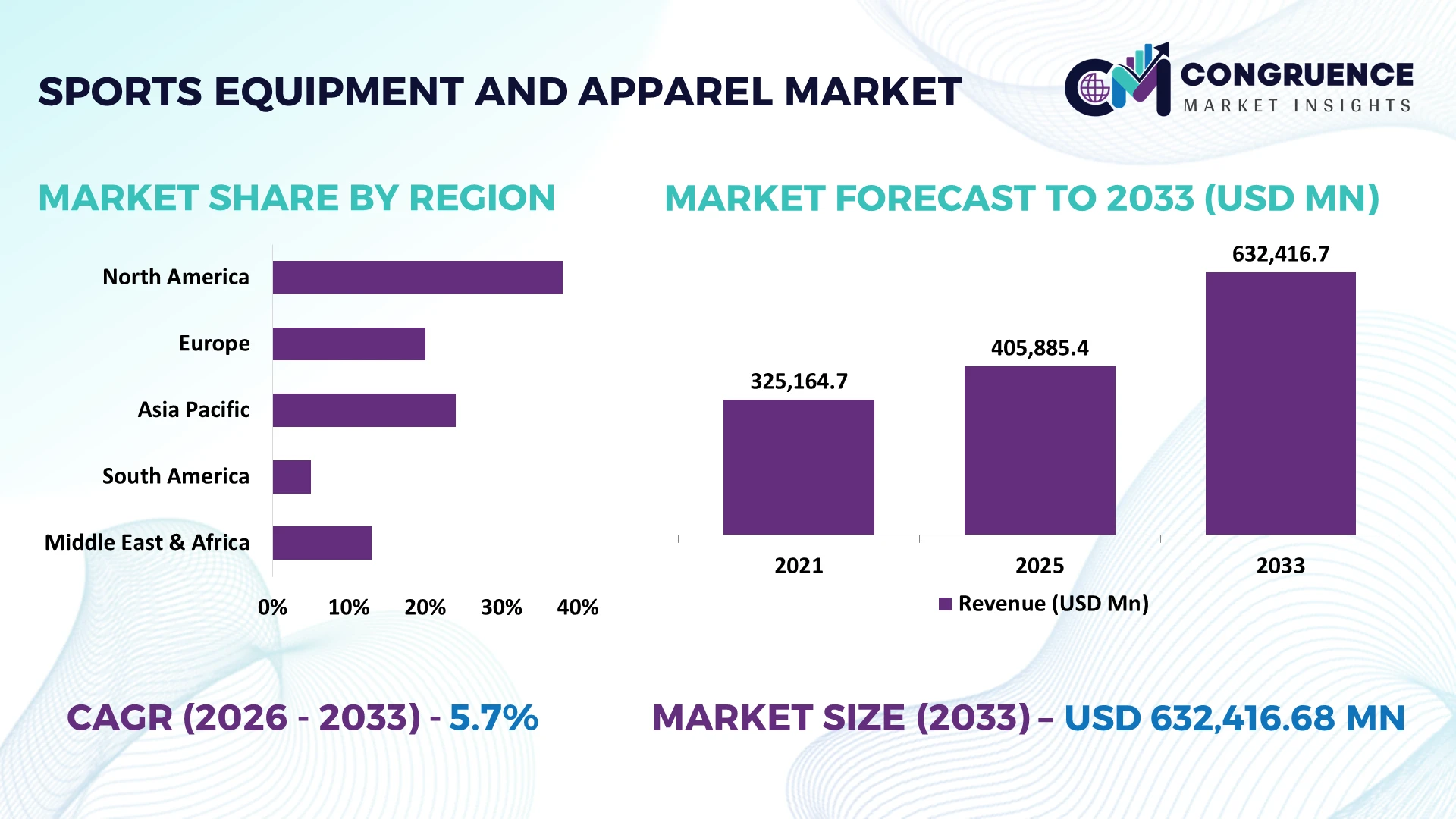
The Global Sports Equipment and Apparel Market was valued at USD 405885.38 Million in 2025 and is anticipated to reach a value of USD 632416.68 Million by 2033 expanding at a CAGR of 5.7% between 2026 and 2033. Growth is driven by rising sports participation, performance-footwear premiumization, direct-to-consumer expansion, technical-material innovation, and faster replacement cycles across running, fitness, outdoor, and team-sport categories.
The United States remains the dominant consumption market, supported by an 80% sports-and-fitness participation rate representing 247.1 million active Americans and deep Nike, adidas, Under Armour, and specialty-retail penetration. China provides the strongest manufacturing-scale comparison: sporting-goods manufacturing contributed 26.5% of national sports-industry value added in 2024, while sports-product manufacturing and sales output increased 3.6%, reinforcing its global sourcing and production advantage. China’s online sports-goods sales expanded 15.89% in 2025, substantially faster than mature physical-retail channels, while 84% of global sporting-goods executives identified geopolitical conditions as a business concern, accelerating supplier diversification toward Vietnam and other Southeast Asian manufacturing hubs.
Strategically, brands that combine U.S.-led premium demand with China-scale manufacturing, diversified Asian sourcing, digital distribution, and performance-material innovation will secure stronger margins and supply resilience through the next investment cycle.
Market Size & Growth: USD 405,885.38 million in 2025 advances toward USD 632,416.68 million by 2033 at 5.7% CAGR, supported by performance footwear, technical apparel, and direct-to-consumer expansion.
Top Growth Drivers: Sports participation contributes approximately 35%, performance-product premiumization 30%, and e-commerce penetration 20% of incremental demand momentum across major categories.
Short-Term Forecast: By 2027, AI-assisted demand planning and automated fulfillment are positioned to reduce inventory mismatches by 8–12% across scaled global sports brands.
Emerging Technologies: AI merchandising, 3D footwear design, carbon-fiber components, digital knitting, and recycled technical fibers are improving product development speed by approximately 10–20%.
Regional Leaders: North America approaches USD 221 billion, Asia-Pacific approximately USD 190 billion, and Europe nearly USD 171 billion by 2033, led respectively by premiumization, digital commerce, and technical-performance adoption.
Consumer/End-User Trends: U.S. sports participation reached 80%, representing 247.1 million active people and strengthening recurring demand across footwear, apparel, fitness equipment, and racquet sports.
Pilot/Case Example: In 2025, China’s sports-goods e-commerce sales increased 15.89%, demonstrating how marketplace integration is accelerating category turnover and widening branded-product access.
Competitive Landscape: Nike leads global branded sportswear with an estimated low-teens share, competing with adidas, Puma, Under Armour, Anta, and Decathlon across performance, lifestyle, and value segments.
Regulatory & ESG Impact: adidas sourced 99% recycled polyester in 2025 and diverted 95% of Tier 1–2 supplier waste from landfill, raising circular-material benchmarks across global sportswear procurement.
Investment & Funding: China recorded 205.86 billion yuan-equivalent sports procurement activity across 9,750 projects in 2025, reinforcing equipment demand linked to venue modernization and public-sports infrastructure.
Innovation & Future Outlook: By 2028, digital product creation, textile-to-textile recycling, personalized fit, and localized production will shift competitive advantage toward faster design cycles and geographically diversified supply networks.
Sports equipment and apparel demand is concentrating around running, fitness, outdoor recreation, football, racquet sports, and performance lifestyle categories as participation intensity rises. U.S. activity participation has reached 80%, strengthening replacement demand for footwear, technical clothing, and specialized equipment. Carbon composites, digitally knitted uppers, AI-assisted fit systems, and recycled performance fibers are reshaping product architecture, while geopolitical sourcing pressure is accelerating supplier diversification beyond China. These shifts make product velocity, material engineering, and supply-chain flexibility central to the market’s strategic direction.
Sports equipment and apparel is becoming strategically critical as participation growth, premium performance products, digital commerce, and supply-chain restructuring reshape where brands invest and how quickly they replenish inventory. U.S. sports participation reached 81.3% by mid-2026, while geopolitical tariff exposure has accelerated sourcing diversification away from concentrated Asian production hubs toward broader supplier networks across Vietnam, Indonesia, India, and other manufacturing bases.
Technology is also changing operating economics. AI-assisted demand planning and digital product development can reduce inventory mismatches by roughly 8–12% versus legacy spreadsheet-led forecasting, while 3D prototyping shortens sampling cycles by approximately 15–20%. The United States leads in premium consumption and organized sports participation, whereas China retains superior manufacturing scale and supplier depth; Europe is advancing fastest in circular-material compliance and traceability requirements.
Through 2026–2028, brands will prioritize localized fulfillment, automated design workflows, recycled-performance materials, and multi-country sourcing. A practical example is footwear companies reallocating production across Vietnam, Indonesia, and China while digitizing product-development processes to protect lead times. Companies are also expanding supplier partnerships and material-traceability systems. Competitive advantage will increasingly depend on synchronizing demand intelligence, product speed, sourcing resilience, and technical-material innovation across global portfolios.
Record sports participation is translating directly into higher equipment replacement, technical-apparel usage, and footwear turnover. U.S. participation reached 81.3% by mid-2026, while team-sport participation increased 3.8%; 250 million Americans participated in at least one sports, fitness, or leisure activity during 2025. This broadening base supports recurring demand across running shoes, racquets, balls, protective equipment, training apparel, and accessories rather than one-time purchases. Rising participation also shifts assortment toward sport-specific products with higher performance requirements. Nike, adidas, Decathlon, Puma, and specialist brands are responding through category expansion, athlete partnerships, technical-material upgrades, and faster replenishment. The strategic insight is participation frequency, not population growth, now determines replacement intensity and inventory productivity, making category-level activity data increasingly important for merchandising and capacity allocation.
The market remains structurally exposed to concentrated Asian sourcing, trade policy, and input-cost volatility. Nike manufactures roughly 50% of its footwear in Vietnam, while adidas sources around 39% of footwear there, creating significant sensitivity to tariff changes and port disruption. In 2025, proposed U.S. tariffs included rates as high as 46% on Vietnam and 32% on Indonesia, exposing sportswear supply chains to abrupt landed-cost inflation. Such concentration compresses margins, complicates seasonal pricing, and raises inventory-planning risk because footwear production cannot be relocated instantly. Global brands are responding by broadening supplier footprints across Indonesia, India, Cambodia, and other manufacturing centers, renegotiating contracts, and increasing near-market inventory buffers. The operational priority is no longer lowest factory cost alone; resilience-adjusted sourcing cost increasingly determines procurement strategy and margin protection.
Digital design, textile-to-textile recycling, and AI-enabled merchandising create a high-value opportunity to shorten development cycles while reducing material waste. 3D product creation can cut physical sampling requirements by roughly 20–30%, while digital demand forecasting can reduce inventory mismatches by 8–12% in scaled deployments. adidas already sources approximately 99% recycled polyester where technically feasible and plans to increase textile-to-textile recycled polyester usage, signaling a shift from bottle-derived recycling toward closed-loop fiber systems. This opens new opportunities for traceability software, recycled yarn suppliers, automated knitting, and low-waste manufacturing. Brands are increasing R&D partnerships with material innovators and integrating digital product passports and supplier-data systems. The non-obvious advantage is working-capital efficiency: fewer samples and more accurate assortment planning reduce both development expense and end-of-season markdown exposure.
The long-term challenge is scaling advanced materials, digital traceability, and customized products across thousands of suppliers without sacrificing consistency. Global footwear and apparel production involves multi-tier networks where recycled fibers, adhesives, foams, trims, and finished goods can originate in different countries. adidas achieved 95% landfill diversion among enrolled Tier 1 and Tier 2 suppliers in 2025, below its 98% target, illustrating the execution difficulty of maintaining uniform standards as new suppliers enter programs. At the same time, product-development teams must integrate AI, 3D design, traceability, and compliance data across legacy enterprise systems. Brands must invest in supplier training, interoperable data architecture, automated quality control, and long-term material partnerships. The strategic pressure is clear: innovation that cannot be replicated reliably across factories creates complexity rather than advantage, making scalable process discipline essential to durable competitiveness.
Performance Categories Regain Momentum: Running, training, football, and basketball are driving assortment resets as consumers prioritize sport-specific functionality over generic athleisure. adidas recorded 15% Performance growth in 2025, with footwear up 12% and apparel up 15%. Brands are reallocating shelf space toward technical footwear, moisture-management fabrics, and discipline-specific kits, improving inventory productivity and reducing dependence on fashion-led cycles.
Live Fitness Rebuilds Equipment Demand: In-person activity is strengthening commercial demand for training apparel, footwear, and gym equipment; 81% of surveyed active consumers attended physical fitness classes, roughly 2.5 times online-class participation. Fitness operators and brands are responding with club partnerships, instructor-led product trials, and facility-focused equipment packages, improving product visibility and accelerating replacement demand.
Circular Materials Move Into Production: Material transformation is shifting from sustainability pilots into mainstream sourcing. adidas used 60% recycled or sustainably sourced renewable materials in products and packaging during 2025, up from 56%, while recycled materials reached 43% of total material inflows. Suppliers are scaling certified polyester, recycled EVA, and traceable inputs to protect compliance readiness and procurement continuity.
Football Demand Accelerates Before 2026: U.S. outdoor soccer participation reached 16.8 million in 2025, rising 15.8% in one year, while indoor soccer reached 6.6 million participants. The 2026 World Cup is accelerating inventory commitments for boots, balls, jerseys, and protective gear. Brands are expanding federation partnerships, localized launches, and tournament-linked distribution ahead of peak demand.
Footwear is the leading type, accounting for approximately 34–36% of the Sports Equipment and Apparel Market, supported by high replacement frequency, sport-specific performance engineering, premium pricing, and extensive direct-to-consumer distribution. Running, football, basketball, and training shoes generate repeat purchases because cushioning, outsole wear, fit, and traction directly affect performance. Sports Apparel follows with roughly 28–30%, benefiting from technical fabrics and crossover usage between sport and daily wear.
Fitness Equipment is the fastest-growing type as gyms, home-training users, and connected-fitness operators increase spending on strength, functional-training, and compact equipment. Sports Equipment remains structurally important across team and racquet sports, while Protective Gear maintains critical demand in contact and high-impact activities despite a smaller share. Companies are increasing investment in foam compounds, carbon plates, engineered knit uppers, smart equipment, and lightweight protection. Portfolio spending is shifting toward categories that combine higher replacement intensity with measurable performance differentiation.
Fitness & Training represents the largest application with approximately 29–31% share, supported by widespread gym participation, running, strength training, functional fitness, and multi-purpose athletic apparel. Its demand base spans footwear, apparel, connected equipment, weights, mats, and accessories, giving manufacturers multiple replacement cycles within one user group. Team Sports follows closely, supported by football, basketball, baseball, and school-level participation.
Outdoor Recreation is the fastest-growing application as hiking, trail running, cycling, camping, and outdoor fitness expand participation beyond formal sports infrastructure. Individual Sports retain strong demand across running, tennis, golf, and racquet categories, while Professional Sports remains smaller by user count but disproportionately influential in premium product validation and sponsorship. Companies are adapting through sport-specific assortment planning, digital coaching integration, localized club partnerships, and faster seasonal replenishment. Demand is becoming operationally critical where participation growth translates directly into recurring footwear, apparel, and equipment replacement.
Amateur Athletes account for approximately 55–60% of end-user demand because recreational participants purchase across footwear, apparel, protective products, and sport-specific equipment without institutional procurement constraints. Their scale gives mass retailers and global brands high-volume replacement opportunities across running, football, fitness, racquet sports, and outdoor activities. Professional Athletes represent a smaller share but strongly influence premium specifications, endorsements, and technology adoption.
Fitness Centers are the fastest-growing end-user as operators invest in strength, functional-training, recovery, and member-experience infrastructure. Sports Clubs maintain recurring institutional demand for uniforms, balls, protective gear, and training equipment, while Educational Institutions provide stable procurement linked to physical education and school competition. Companies are targeting amateur users through accessible performance tiers and digital communities, while institutional buyers receive bulk pricing, customization, and equipment-service packages. Competitive positioning is shifting toward ecosystems that serve both individual participation and organized training environments.
North America accounted for the largest market share at 34% in 2025 however, Asia-Pacific is expected to register the fastest growth, expanding at a CAGR of 7.2% between 2026 and 2033.
Participation Scale Accelerates Performance Spending
North America accounts for approximately 34% of global demand, anchored by extensive sports infrastructure, premium footwear consumption, organized leagues, fitness facilities, and high direct-to-consumer penetration. U.S. sports participation reached 81.3% by mid-2026, giving brands an unusually broad replacement base across running, basketball, football, training, outdoor recreation, and equipment. Digital channels increasingly integrate membership data, personalized recommendations, and inventory visibility, improving full-price conversion. The 2026 FIFA World Cup across the United States, Canada, and Mexico is also accelerating football merchandise, footwear, equipment, and retail deployment. Nike, adidas, Under Armour, New Balance, and specialist suppliers are increasing tournament-linked assortments and localized activations. Operational advantage increasingly comes from combining premium product innovation with rapid omnichannel replenishment rather than relying solely on wholesale scale.
United States Market Outlook: The United States combines 250 million sports, fitness, and outdoor participants with mature specialty retail, collegiate athletics, professional leagues, and extensive fitness infrastructure. Running and team-sport participation provide high-frequency footwear replacement, while domestic digital commerce enables faster product launches. Brands are concentrating investment around performance innovation, athlete partnerships, personalized commerce, and the 2026 World Cup demand cycle.
Circularity Restructures Product Development
Europe holds approximately 27% of global demand, supported by football, running, cycling, outdoor recreation, fitness, and established sporting-goods retail networks. Germany, the United Kingdom, France, Italy, and Spain provide concentrated branded-product consumption, while EU sustainability regulation is changing product engineering and procurement. Ecodesign requirements, textile-waste rules, and digital product traceability are pushing manufacturers toward recycled fibers, repairability, durability, and supplier-level material documentation. adidas reached approximately 99% recycled polyester usage where technically feasible, illustrating how sustainability requirements are entering mainstream production rather than remaining limited to pilot ranges. Brands are deploying digital product-development systems and consolidating material specifications across footwear and apparel. This creates a structural advantage for suppliers capable of delivering traceable technical textiles at scale while maintaining moisture management, abrasion resistance, elasticity, and performance consistency.
Germany Market Outlook: Germany combines strong sporting-goods consumption with technical-textile expertise and major brand infrastructure. adidas provides the country with global product-development influence, while dense club-sport and outdoor participation sustains diversified demand. EU circular-product requirements are strengthening German investment in recycled materials, traceability, lower-waste packaging, and durable construction, giving compliant suppliers an increasingly important procurement advantage.
Manufacturing Scale Meets Consumer Upgrading
Asia-Pacific represents approximately 26% of global demand while remaining the central manufacturing ecosystem for athletic footwear, apparel, protective equipment, and accessories. China retains extensive textile, synthetic-material, component, and equipment capacity, while Vietnam and Indonesia provide large-scale footwear assembly for global brands. China’s online sporting-goods sales increased 15.89% in 2025, showing how digital channels are accelerating branded-product access alongside domestic participation policies. India is expanding sports retail, running, fitness, cricket, badminton, and football consumption, creating additional demand beyond traditional equipment categories. Simultaneously, tariff exposure is forcing Nike, adidas, Puma, and suppliers to rebalance sourcing among Vietnam, Indonesia, China, Cambodia, and India. The region’s strategic advantage is therefore dual-sided: manufacturing density supports cost-efficient production, while expanding consumer markets provide an increasingly important destination for premium performance products.
China Market Outlook: China combines world-scale sports-product manufacturing with an increasingly digital domestic market. Sporting-goods manufacturing contributed 26.5% of national sports-industry value added in 2024, while sports-product manufacturing and sales output increased 3.6%. Government-backed fitness participation, sophisticated e-commerce infrastructure, and domestic brands such as Anta and Li-Ning intensify competition against Western performance leaders.
Football Culture Supports Category Depth
South America accounts for approximately 7% of global demand, led by Brazil and supported by strong football, running, fitness, volleyball, and outdoor-sport participation. Football remains the primary commercial anchor, generating recurring demand for boots, jerseys, balls, protective products, and club merchandise. Brazil’s extensive footwear and textile manufacturing base provides an important localization advantage, allowing suppliers to reduce dependence on imported finished goods and respond faster to domestic assortment requirements. Argentina, Colombia, and Chile provide additional branded-sportswear demand but face greater sensitivity to exchange rates and import costs. Digital marketplaces are improving access outside major metropolitan retail corridors. Global and domestic brands are responding with localized pricing, football partnerships, direct digital distribution, and country-specific product portfolios. Currency volatility remains the key execution constraint, making sourcing flexibility and inventory discipline critical to margin protection.
Brazil Market Outlook: Brazil combines more than 200 million consumers with one of the world’s deepest football cultures and an established footwear-manufacturing ecosystem. Local production supports shorter replenishment cycles for shoes and apparel, while running and fitness diversify demand beyond football. Brands are using club sponsorships, local manufacturing relationships, marketplaces, and accessible performance tiers to broaden participation-driven purchasing.
Sports Infrastructure Unlocks Premium Demand
Middle East & Africa represents approximately 6% of global demand, but investment intensity is highly concentrated in Gulf economies. Saudi Arabia and the UAE are expanding stadiums, fitness facilities, professional leagues, tourism infrastructure, and international sporting events, creating institutional and consumer demand for football products, training equipment, technical apparel, and footwear. Saudi Arabia’s preparations for the 2034 FIFA World Cup reinforce long-term venue and sports-ecosystem investment, while major football and combat-sport events are accelerating branded merchandise exposure. South Africa provides the region’s strongest diversified sporting base across rugby, football, cricket, running, and fitness. Global brands are expanding franchise networks, distributor relationships, localized e-commerce, and federation partnerships. Outside Gulf markets, fragmented retail and import dependence constrain premium penetration, making affordable assortments and distributor execution more important than flagship-store expansion.
Saudi Arabia Market Outlook: Saudi Arabia is emerging as the region’s principal sports-investment hub under Vision 2030, combining professional-league development, international events, fitness participation programs, and preparations for the 2034 FIFA World Cup. New venues and tourism infrastructure expand institutional procurement, while Nike, adidas, Puma, and specialist brands gain opportunities across football, training, lifestyle apparel, and premium retail.
Nike, adidas, Anta Sports, Puma, and Decathlon lead global competition, while Under Armour, New Balance, and specialist brands pressure incumbents across performance categories. The top five capture approximately 35–40% of organized branded demand, leaving substantial space for regional and category specialists. Nike and adidas compete through athlete ecosystems, footwear technology, and distribution scale; Anta challenges through China-led multi-brand expansion, while Decathlon emphasizes vertically integrated value. Premium performance footwear commands roughly 20–35% price uplifts over basic models, while digital product creation can shorten development cycles by 15–20% and automated forecasting reduce inventory mismatches by 8–12%. Players are diversifying Asian sourcing, acquiring technical capabilities, expanding direct channels, and securing federation partnerships. Competition is shifting from wholesale reach toward product velocity, proprietary materials, consumer data, and supply resilience. Brand credibility, technical R&D, sponsorship access, and manufacturing scale remain powerful entry barriers. Winning requires differentiated performance, faster commercialization, disciplined inventory, and resilient sourcing globally.
Nike, Inc.
adidas AG
Anta Sports Products Limited
Puma SE
Decathlon
Under Armour, Inc.
New Balance Athletics, Inc.
ASICS Corporation
Mizuno Corporation
Amer Sports, Inc.
Columbia Sportswear Company
Skechers U.S.A., Inc.
Li-Ning Company Limited
Yonex Co., Ltd.
Digital product creation, automated knitting, carbon-plated footwear, advanced foams, and machine-vision inspection define current sports technology. 3D prototyping can reduce physical sampling by 20–30%, while automated cutting improves material utilization by 8–12%. Adoption is strongest among global footwear and technical-apparel brands, where digital workflows connect design, athlete testing, sourcing, and manufacturing, shortening commercialization cycles and protecting margins.
Emerging technologies combine AI forecasting, body scanning, additive manufacturing, smart textiles, and recycled performance materials. Compared with conventional sample-intensive development, integrated 3D design can shorten iteration cycles by 15–20%. AI forecasting can reduce inventory mismatches by 8–12%, giving vertically integrated brands and digitally connected retailers an advantage through faster assortment decisions. Carbon composites and engineered foams simultaneously improve energy return and reduce component weight.
Between 2026 and 2028, disruptive adoption will center on 3D-printed footwear, personalized fit, textile-to-textile recycling, and sensor-enabled equipment. Additive manufacturing can eliminate multiple assembly steps and cut development waste by 20–30% for suitable products. Brands integrating athlete data with rapid prototyping will move innovations from testing into commercial ranges faster. Investment matters now because proprietary materials, digital design libraries, automated production, and supplier integration create cumulative advantages that slower competitors cannot quickly reproduce across global performance product categories worldwide.
October 2024 Nike extended its NBA, WNBA and NBA G League partnership for 12 additional seasons through 2037, retaining exclusive on-court uniform and apparel rights. The agreement protects elite basketball visibility while expanding grassroots, merchandising and membership integration. Source: NBA.com
March 2025 Nike launched Air Max Dn8 with two Air units and eight tubes, extending Dynamic Air across the full foot for the first time. The architecture strengthens cushioning differentiation and transfers elite performance engineering into everyday sportswear. Source: Nike.com
July 2025 adidas faced approximately €200 million in additional second-half tariff costs as Vietnam and Indonesia supplied 46% of products. The company frontloaded U.S. inventory, lifting inventories 16%, demonstrating how trade policy directly reshaped sourcing and working-capital decisions. Source: Reuters.com
April 2026 ASICS announced its Kobe Technical Lab, scheduled to operate from December 2027, integrating custom elite-athlete footwear and rapid prototyping. The facility connects R&D with manufacturing, accelerating validation and transferring bespoke performance innovation into broader commercial products. Source: ASICS.com
The Sports Equipment and Apparel Market Report covers Sports Equipment, Sports Apparel, Footwear, Protective Gear, and Fitness Equipment across Team Sports, Individual Sports, Fitness & Training, Outdoor Recreation, and Professional Sports. End-user analysis encompasses Professional Athletes, Amateur Athletes, Fitness Centers, Sports Clubs, and Educational Institutions. Footwear represents approximately 34–36% of demand, while amateur athletes contribute an estimated 55–60% of end-user consumption.
Regional coverage spans North America, Europe, Asia-Pacific, South America, and Middle East & Africa, with country-level assessment of participation, manufacturing, sourcing, and distribution dynamics. Technology coverage includes AI forecasting, 3D product creation, additive manufacturing, carbon composites, smart equipment, recycled technical fibers, and automated production. The 2026–2033 framework supports investment planning, sourcing diversification, geographic expansion, portfolio prioritization, competitive benchmarking, partnership strategy, and identification of performance-led and digitally enabled market opportunities.
| Report Attribute/Metric | Report Details |
|---|---|
Market Revenue in 2025 | USD 405885.38 Million |
Market Revenue in 2033 | USD 632416.68 Million |
CAGR (2026 - 2033) | 5.7% |
Base Year | 2025 |
Forecast Period | 2026 - 2033 |
Historic Period | 2021 - 2025 |
Segments Covered | By Type
By Application
By End-User
|
Key Report Deliverable | Revenue Forecast, Growth Trends, Market Dynamics, Segmental Overview, Regional and Country-wise Analysis, Competition Landscape |
Region Covered | North America, Europe, Asia-Pacific, South America, Middle East, Africa |
Key Players Analyzed | Nike, Inc., adidas AG, Anta Sports Products Limited, Puma SE, Decathlon, Under Armour, Inc., New Balance Athletics, Inc., ASICS Corporation, Mizuno Corporation, Amer Sports, Inc., Columbia Sportswear Company, Skechers U.S.A., Inc., Li-Ning Company Limited, Yonex Co., Ltd. |
Customization & Pricing | Available on Request (10% Customization is Free) |




