
Reports
The Global Sports Duffel Bags Market was valued at USD 348.0 Million in 2025 and is anticipated to reach a value of USD 465.4 Million by 2033 expanding at a CAGR of 3.7% between 2026 and 2033. Growth is being driven by rising participation in organized sports, expanding fitness club memberships, and rapid adoption of lightweight recycled-performance fabrics across premium athletic luggage portfolios.
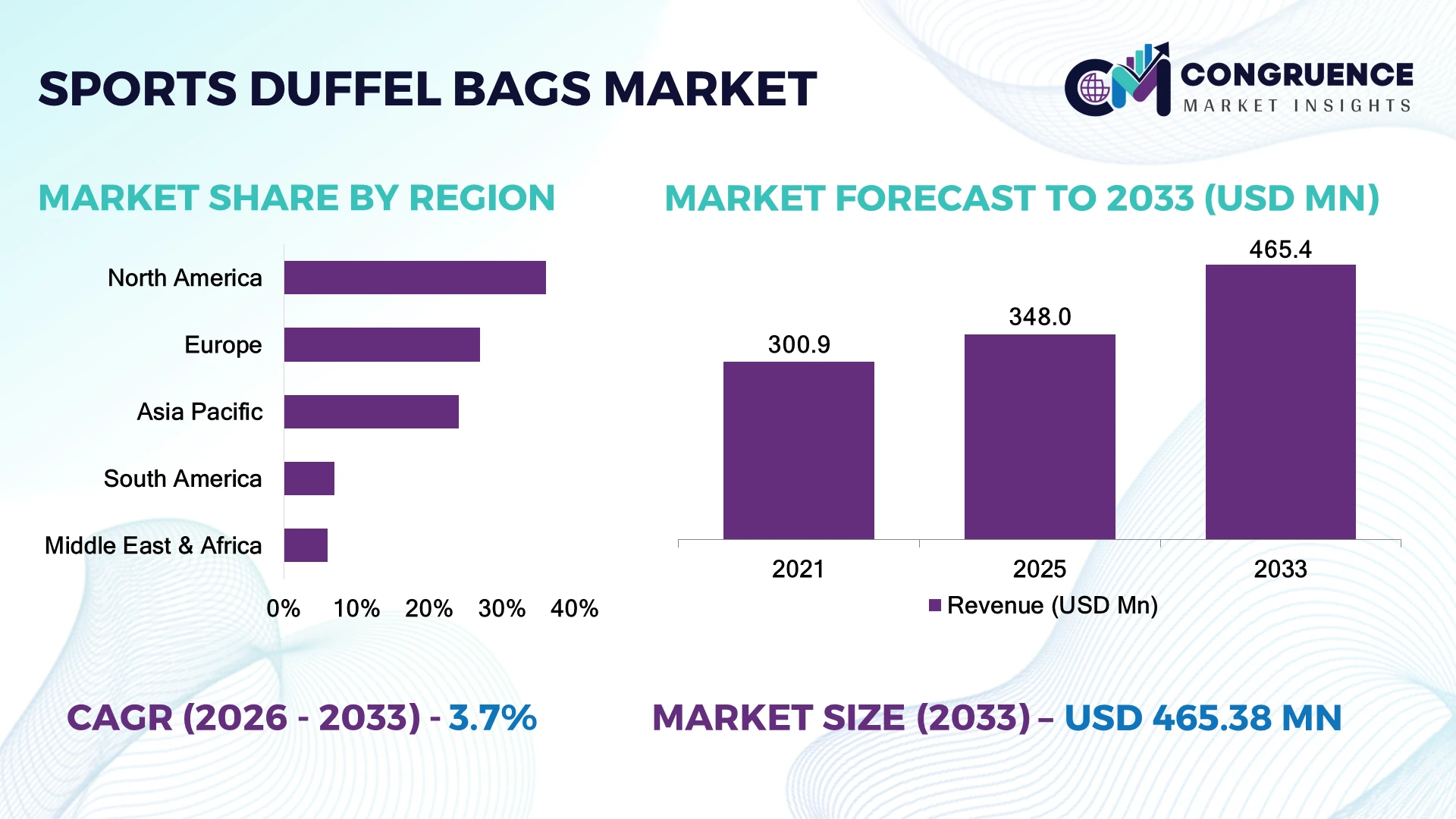
The United States dominates the market with approximately 31% global share, supported by over 242 million active sports and fitness participants and strong spending on athletic accessories. China follows with nearly 18% share, backed by large-scale sporting goods manufacturing clusters and expanding domestic sports programs. Compared with China, the U.S. records higher premium product penetration, while China leads in production volume and export capacity. Major investments in sports infrastructure following global sporting events continue strengthening demand and product innovation pipelines.
This leadership position reinforces the importance of premiumization, supply-chain resilience, and sustainable material sourcing as key competitive priorities.
Market Size & Growth: USD 348.0 Million in 2025, reaching USD 465.4 Million by 2033 at 3.7% CAGR, supported by advanced recycled-material adoption and premium sports gear demand.
Top Growth Drivers: Fitness participation +14%, sports tourism +11%, sustainable fabric adoption +18%.
Short-Term Forecast: By 2028, lightweight material integration is expected to reduce product weight by 12% while improving durability.
Emerging Technologies: AI-assisted design, RFID-enabled tracking, and high-strength recycled polyester are reshaping product development.
Regional Leaders: North America (~USD 118 Million), Asia Pacific (~USD 103 Million), Europe (~USD 87 Million); each benefits from rising organized sports participation.
Consumer/End-User Trends: Nearly 46% of buyers prefer multifunctional bags with dedicated footwear and electronics compartments.
Pilot/Case Example: In 2024, a major sports brand introduced recycled-fabric duffel lines, reducing material waste by 22%.
Competitive Landscape: Nike leads with approximately 14% share, followed by Adidas, Puma, Under Armour, and Decathlon.
Regulatory & ESG Impact: Recycled-content initiatives increased sustainable material usage by over 20% across leading brands.
Investment & Funding: More than USD 300 Million has been directed toward sports apparel and accessories manufacturing expansion projects.
Innovation & Future Outlook: Smart tracking features, modular storage systems, and circular-material strategies are strengthening long-term product differentiation.
Sports Duffel Bags are increasingly serving fitness enthusiasts, amateur athletes, sports teams, and travel-oriented consumers seeking durable and multifunctional carrying solutions. Product innovation is centered on recycled fabrics, waterproof coatings, and ergonomic compartment layouts. More than 35% of premium launches now incorporate sustainable materials. Ongoing supply-chain diversification beyond traditional manufacturing hubs is improving sourcing flexibility and accelerating next-generation product commercialization, setting the stage for broader strategic developments.
The Sports Duffel Bags Market is becoming strategically important as brands compete through product differentiation, sustainability positioning, and direct-to-consumer engagement. Athletic participation rates continue expanding globally, while consumers increasingly prioritize durable, multifunctional gear. At the same time, supply-chain restructuring and diversified sourcing strategies are reducing dependence on single-country manufacturing networks, improving operational resilience and inventory responsiveness.
Advanced recycled-performance fabrics provide a measurable advantage over conventional materials by delivering up to 20% lower material waste and approximately 15% lighter product weight while maintaining durability standards. The United States remains a leader in premium sports accessory consumption, whereas China continues to dominate manufacturing scale and export efficiency. Meanwhile, India is emerging as a production and sourcing hub due to expanding textile capabilities and competitive labor economics.
Leading brands are deploying modular storage designs, RFID-enabled tracking solutions, and sustainable material partnerships to strengthen market positioning. For example, several global athletic equipment manufacturers have expanded supplier partnerships to secure recycled polyester inputs and improve traceability. Over the next two to three years, adoption of sustainable materials and digitally integrated product features is expected to accelerate, reinforcing competitive advantage through operational efficiency, brand differentiation, and supply-chain flexibility.
The market is benefiting from a structural increase in sports participation, fitness memberships, and recreational travel activity. Global fitness club memberships have expanded by more than 12% over the past few years, while organized sports participation among younger consumers has increased by approximately 10%. Growing demand for premium athletic accessories has encouraged manufacturers to introduce lightweight, waterproof, and sustainable duffel bag designs. The United States continues investing heavily in sports infrastructure and community athletics programs, supporting higher equipment purchases. This demand shift is prompting companies to expand production capacity, introduce specialized product lines, and strengthen partnerships with sports organizations. A notable strategic insight is that premiumization is generating higher margins than volume-led competition, encouraging brands to focus on performance-oriented innovation rather than purely price-based positioning.
Fluctuating prices of polyester, nylon, and specialty performance fabrics remain a significant structural limitation. Synthetic textile input costs have experienced periodic swings exceeding 15%, while shipping and logistics expenses have remained elevated compared with pre-disruption levels. China continues to account for a substantial share of global synthetic textile production, creating supply concentration risks for manufacturers dependent on limited sourcing networks. These pressures directly affect product pricing, inventory planning, and profitability. To reduce exposure, companies are diversifying supplier bases, increasing procurement from India and Vietnam, and securing long-term supply contracts. An important operational insight is that firms with localized sourcing strategies are achieving faster replenishment cycles and greater pricing stability, strengthening competitiveness in premium and mid-range product categories.
The transition toward environmentally responsible products is creating new commercial opportunities. More than 35% of newly launched premium sports bags incorporate recycled or low-impact materials, while consumer preference for sustainable products has risen by approximately 20% across major sporting goods markets. Smart features such as RFID tracking, connected inventory management, and modular storage systems are also gaining traction. European sustainability initiatives and growing retailer requirements for traceable sourcing are accelerating adoption. Companies are investing in recycled-polyester partnerships, advanced fabric engineering, and digital product enhancement programs. A notable strategic opportunity lies in combining sustainability credentials with functional innovation, allowing manufacturers to capture premium pricing while simultaneously improving supply-chain transparency and customer loyalty.
Maintaining product quality, sustainability compliance, and operational consistency across global manufacturing networks remains a key challenge. Nearly 28% of consumer complaints in sports luggage categories are linked to durability, zipper performance, or material degradation issues. At the same time, sustainability verification requirements and supplier auditing programs have increased by more than 15% among major retailers. Manufacturers must manage growing complexity across multiple sourcing locations while ensuring uniform product specifications. The pressure is particularly evident as brands expand production beyond traditional manufacturing hubs to diversify risk. Addressing these challenges requires stronger supplier collaboration, digital quality-control systems, and investment in traceability infrastructure. Companies that successfully standardize performance and sustainability metrics across their supplier ecosystems will secure a lasting operational and competitive advantage.
Sustainable Material Integration Accelerates Premium sports duffel bag manufacturers are rapidly increasing the use of recycled polyester, bio-based coatings, and low-impact textile blends. More than 35% of newly launched performance duffel bags now incorporate recycled content, while sustainable-material procurement volumes have increased by approximately 22%. Stricter retailer sustainability requirements and supply-chain transparency initiatives are reshaping sourcing workflows. Companies are expanding certified supplier networks and restructuring procurement strategies to secure long-term access to compliant materials while improving brand positioning and inventory stability.
Multi-Compartment Designs Gain Traction Consumer preference is shifting toward highly organized storage solutions with dedicated footwear, electronics, hydration, and apparel compartments. Demand for multifunctional sports bags has increased by nearly 28%, while premium product attachment rates have risen by approximately 15%. This operational shift is reducing product replacement frequency and improving customer retention. Leading brands are scaling modular product platforms and expanding customization options to address diverse fitness, travel, and team-sports requirements without significantly increasing manufacturing complexity.
Smart Features Enter Premium Segment RFID-enabled tracking, anti-theft compartments, and connected luggage accessories are becoming increasingly common in premium sports gear categories. Smart-enabled product launches have expanded by nearly 18%, while consumer willingness to pay for tracking functionality has increased by approximately 12%. Technology adoption is improving asset visibility for athletes and frequent travelers. Companies are forming partnerships with technology providers and integrating lightweight digital components without compromising portability or durability.
Manufacturing Footprint Diversification Expands Ongoing supply-chain realignment is encouraging manufacturers to diversify production beyond traditional sourcing hubs. Procurement activity in India and Vietnam has increased by more than 20%, while average replenishment lead times have improved by approximately 10%. Labor-cost pressures and logistics resilience requirements are accelerating operational restructuring. Brands are expanding regional supplier ecosystems, increasing near-market inventory placement, and implementing digital supply-chain monitoring systems to strengthen fulfillment performance.
Polyester duffel bags remain the dominant segment, accounting for approximately 46% of market demand due to their durability, lightweight characteristics, moisture resistance, and cost-efficient large-scale manufacturing. Their compatibility with performance sports applications and wide retail availability continues to support strong adoption across athletic, fitness, and recreational categories. Nylon duffel bags follow closely, benefiting from superior abrasion resistance and premium positioning among professional athletes and frequent travelers. Together, polyester and nylon products represent more than 70% of industry volume, reflecting continued preference for high-performance synthetic materials. Recycled-material duffel bags are emerging as the fastest-growing segment, supported by increasing sustainability commitments from global sports brands and retailers. Adoption of recycled textile content has expanded by nearly 20% across premium product portfolios. Canvas duffel bags maintain relevance in lifestyle and casual sports applications, while leather variants serve niche premium buyers seeking durability and brand prestige. Manufacturers are increasing investment in recycled-fabric innovation, lightweight construction technologies, and advanced waterproof treatments to strengthen differentiation and align with evolving purchasing priorities.
Sports and fitness activities represent the leading application segment with approximately 42% market share, supported by rising gym memberships, organized sports participation, and increased spending on athletic accessories. Demand remains concentrated among consumers requiring durable storage solutions for apparel, footwear, and performance equipment. Fitness-focused users increasingly prefer specialized compartment layouts, with multifunctional configurations experiencing adoption gains of nearly 25%. This trend is encouraging manufacturers to optimize product ergonomics, storage efficiency, and portability. Travel and recreational usage is the fastest-growing application segment as consumers seek versatile products capable of supporting both athletic and leisure activities. Demand for hybrid sports-travel bags has increased by approximately 18%, driven by sports tourism and short-duration travel patterns. Team sports, outdoor activities, and school athletics continue contributing steady demand through institutional purchasing and recurring replacement cycles. Companies are expanding product portfolios, integrating modular storage features, and increasing direct-to-consumer distribution to address evolving usage requirements across multiple activity categories.
Individual consumers account for approximately 58% of total demand, making them the dominant end-user segment. Demand concentration is supported by expanding fitness participation, recreational sports engagement, and growing interest in premium athletic accessories. Consumers increasingly prioritize lightweight construction, sustainable materials, and specialized storage functionality. Premium-feature adoption has increased by approximately 16%, while demand for personalized and lifestyle-oriented designs continues to strengthen. Brands are responding through product customization programs, direct-to-consumer platforms, and targeted digital marketing initiatives. Sports clubs and teams represent the fastest-growing end-user segment due to expanding organized sports participation and increasing equipment management requirements. Institutional purchasing activity has risen by nearly 14%, supported by investments in youth sports programs and competitive athletics. Educational institutions maintain stable demand through recurring procurement cycles, while corporate wellness programs are emerging as an additional purchasing channel. Manufacturers are strengthening partnerships with sports organizations, offering bulk procurement models, and developing team-branded solutions to capture expanding institutional demand.
North America accounted for the largest market share at 36% in 2025 however, Asia-Pacific is expected to register the fastest growth, expanding at a CAGR of 5.1% between 2026 and 2033.
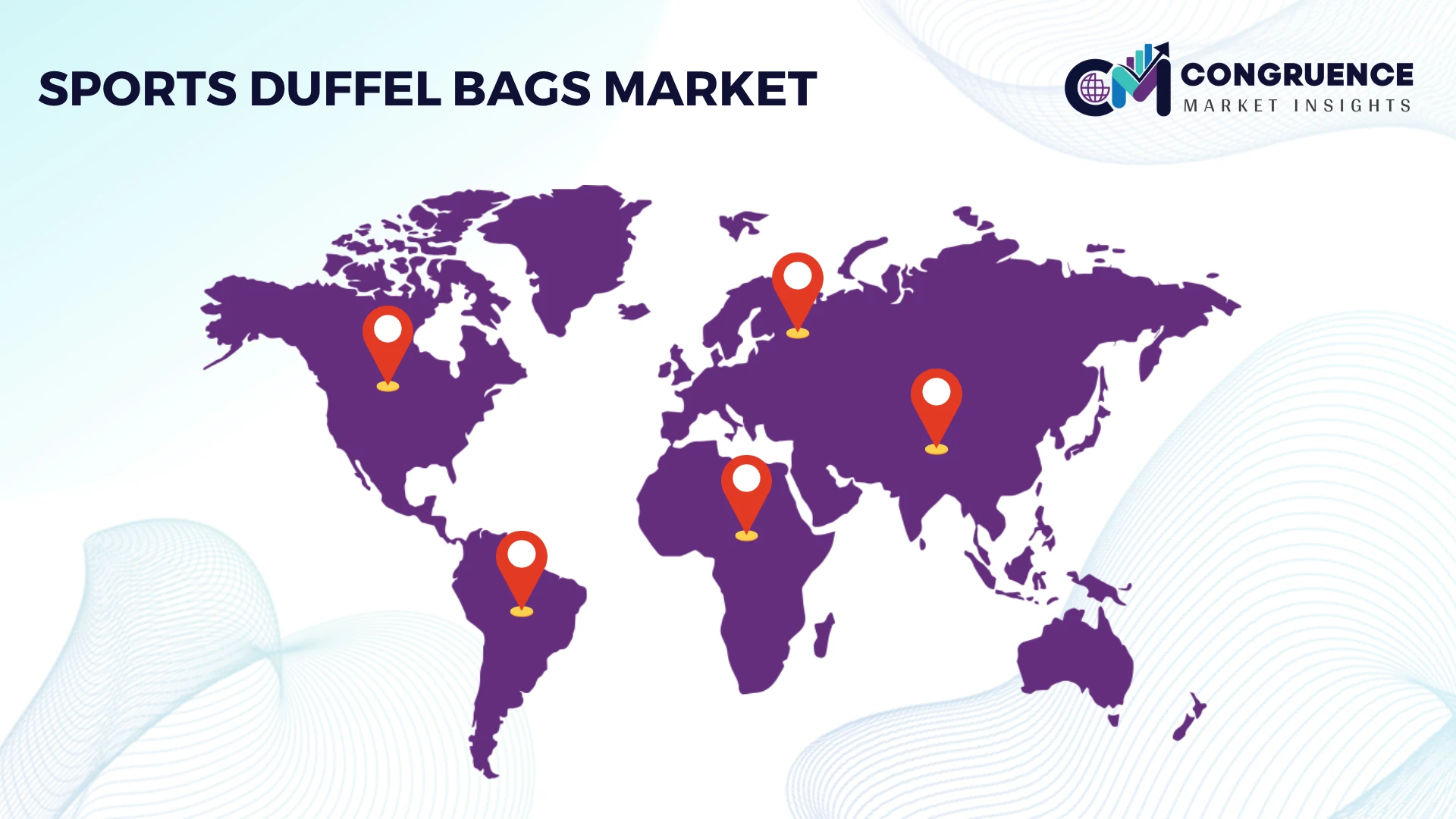
North America represents the largest regional market, supported by strong participation in organized sports, fitness activities, outdoor recreation, and sports travel. The region accounts for approximately 36% of global demand, with the United States serving as the primary consumption and product innovation hub. Premium athletic brands continue expanding advanced duffel bag portfolios featuring recycled materials, waterproof construction, and smart storage configurations. Nearly 48% of premium sports bag purchases in the region occur through direct-to-consumer and digital retail channels, highlighting the growing importance of brand-owned distribution strategies. Investments in sports infrastructure, collegiate athletics, and fitness ecosystems continue supporting replacement demand and product diversification. Companies are increasingly integrating sustainable materials and modular product architectures to improve customer retention and premium positioning across competitive retail channels.
United States Market Outlook: The United States remains the largest national market due to its extensive sports participation base, mature sporting goods ecosystem, and strong consumer spending on athletic accessories. More than 240 million Americans participate in sports and fitness activities annually, creating substantial recurring demand for performance-oriented luggage products. Leading athletic brands continue expanding domestic distribution networks, digital commerce capabilities, and sustainable product portfolios. The country's advanced retail infrastructure and strong adoption of premium sports gear support continued innovation in multifunctional, travel-ready, and environmentally responsible duffel bag solutions.
Europe accounts for approximately 27% of global market demand and remains a critical center for premium sports accessory consumption and sustainable product innovation. Growing emphasis on environmentally responsible materials and circular manufacturing practices is influencing procurement, design, and production decisions across the industry. More than 40% of newly introduced premium sports bags in the region incorporate recycled or low-impact materials. Demand is supported by active participation in football, cycling, running, and outdoor recreation activities. Companies are investing in traceable supply chains, recycled-fabric partnerships, and product durability improvements to align with evolving consumer and retailer expectations. Sports tourism and cross-border athletic events further contribute to demand for versatile, high-performance duffel bag solutions.
Germany Market Outlook: Germany serves as the most strategically important market in Europe due to its strong sporting goods industry, advanced logistics infrastructure, and leadership in sustainable manufacturing practices. The country benefits from high sports participation rates and a well-established outdoor recreation culture. German consumers demonstrate strong preference for durable and environmentally responsible products, encouraging brands to accelerate adoption of recycled textiles and low-impact production methods. The market also benefits from extensive specialty retail networks and growing demand for multifunctional sports-travel equipment designed for both athletic and leisure applications.
Asia-Pacific accounts for approximately 24% of global demand while maintaining a dominant position in manufacturing, sourcing, and export activity. The region benefits from large-scale textile production capabilities, expanding middle-class consumer spending, and increasing participation in organized sports and fitness programs. Manufacturing output of sports accessories has increased by more than 18% across major production hubs during recent years. Strong growth in e-commerce and digital retail channels is improving product accessibility and accelerating premium segment penetration. Companies are expanding regional production facilities, strengthening supplier ecosystems, and increasing investment in sustainable material processing to support evolving global sourcing requirements. The combination of production scale and rising domestic consumption continues to strengthen the region's strategic importance.
China Market Outlook: China remains the most influential country within the regional market due to its extensive manufacturing infrastructure, textile production capabilities, and export-oriented sporting goods ecosystem. The country is estimated to contribute more than 30% of global sports bag manufacturing capacity. Investments in advanced textile processing, automation technologies, and sustainable material development are enhancing production efficiency and quality consistency. At the same time, growing domestic participation in fitness and recreational sports is creating additional demand, encouraging manufacturers to balance export production with expanding local market opportunities.
South America accounts for approximately 7% of global market demand, supported by strong sports culture, increasing fitness awareness, and gradual modernization of retail infrastructure. Football remains a major demand catalyst, creating sustained purchasing activity for athletic accessories and sports equipment. Organized sports participation and fitness club enrollment have increased by nearly 12% in major urban markets over recent years. Expanding e-commerce penetration is improving access to premium international brands while enabling domestic manufacturers to broaden distribution reach. Although infrastructure and logistics constraints remain present in certain markets, growing investment in sports facilities and retail expansion continues supporting market development. Companies are prioritizing affordable performance products and localized distribution strategies to strengthen competitiveness.
Brazil Market Outlook: Brazil is the largest and most influential market in South America due to its extensive sports participation base and strong consumer affinity for athletic products. The country benefits from a mature football ecosystem, expanding fitness culture, and increasing online retail adoption. Demand for multifunctional sports bags continues rising among recreational athletes and fitness enthusiasts. Manufacturers are strengthening local partnerships and distribution networks to improve product availability, while retailers are expanding digital sales channels to capture growing demand from urban consumers across multiple sports categories.
The Middle East & Africa region accounts for approximately 6% of global demand and is increasingly benefiting from investments in sports infrastructure, fitness facilities, and recreational development programs. Large-scale sporting events and national wellness initiatives are driving participation in organized sports and active lifestyles. Fitness center memberships have increased by more than 15% across several key urban markets, contributing to higher demand for sports accessories. Premium international brands are expanding regional distribution partnerships while introducing products tailored to climate conditions and travel-oriented usage patterns. Although market penetration remains lower than in mature regions, infrastructure modernization and consumer lifestyle shifts continue creating new opportunities for category expansion.
Saudi Arabia Market Outlook: Saudi Arabia represents the most strategically significant market in the region due to extensive investment in sports development, recreational infrastructure, and wellness initiatives. The country is rapidly expanding sports participation through new facilities, community programs, and international sporting events. Demand for premium athletic accessories is increasing alongside rising gym memberships and recreational activity levels. Retail modernization, digital commerce growth, and expanding partnerships between global sports brands and local distributors are strengthening market accessibility while supporting broader adoption of performance-oriented sports luggage products.
Competition is led by global athletic brands including Nike, Adidas, Puma, Under Armour, and Decathlon, which compete directly against regional sporting goods manufacturers and private-label retailers. The top five players collectively control approximately 48% of the market, creating a moderately concentrated structure where brand equity and distribution scale remain decisive advantages. Nike and Adidas compete on innovation, sustainability, and premium positioning, while Decathlon and regional brands emphasize affordability and volume-driven expansion. Product launches using recycled materials have increased by more than 20%, while direct-to-consumer sales channels account for over 35% of premium category purchases. Supply-chain responsiveness has become a critical differentiator, with leading companies reducing replenishment cycles by nearly 15% through sourcing diversification and inventory digitization. Competition is increasingly shaped by sustainable-material adoption, omnichannel retail expansion, and customization capabilities. Rising compliance requirements and supplier qualification standards create significant entry barriers. Winning requires strong brand credibility, agile supply networks, sustainable product innovation, and efficient multi-channel distribution execution.
Adidas AG
Puma SE
Under Armour, Inc.
Decathlon S.A.
New Balance Athletics, Inc.
ASICS Corporation
Mizuno Corporation
Yonex Co., Ltd.
Lululemon Athletica Inc.
The North Face
Patagonia, Inc.
Columbia Sportswear Company
Fila Holdings Corp.
Material innovation is currently the most influential technology trend shaping the Sports Duffel Bags Market. Advanced recycled polyester fabrics, high-tenacity nylon composites, and lightweight waterproof laminates are replacing conventional textile constructions. Modern performance fabrics reduce product weight by approximately 15% while improving abrasion resistance by nearly 20% compared with older material systems. More than 35% of premium sports duffel bag launches now incorporate recycled-content textiles, providing manufacturers with sustainability and durability advantages while supporting retailer compliance requirements.
Emerging technologies are focused on smart functionality and digital integration. RFID-enabled tracking systems, anti-theft compartments, and connected inventory solutions are gaining adoption across premium segments. Smart-enabled products improve asset visibility by approximately 12% and reduce item misplacement risks in travel and team-sports environments. Brands with strong direct-to-consumer ecosystems benefit most because connected products generate additional customer engagement and strengthen retention strategies.
Between 2026 and 2028, disruptive developments will center on circular-material platforms, digital product passports, and AI-assisted product design. AI-driven design workflows can reduce development cycles by nearly 25% compared with traditional prototyping methods. Adoption of traceability technologies is expected to exceed 40% among leading global brands, enabling improved supply-chain transparency, faster compliance verification, and stronger competitive differentiation. Companies that accelerate deployment now will gain operational efficiency, sourcing flexibility, and premium market positioning.
March 2026 – Adidas reported that 60% of materials used across products and packaging were recycled or sustainably sourced, while recycled materials represented 43% of total material inputs. This strengthens sustainable bag development capabilities and supply-chain resilience. Source: www.report.adidas-group.com
February 2026 – Adidas maintained 99% recycled polyester utilization across its product portfolio and advanced textile-to-textile recycling initiatives targeted for commercial scaling. The development improves long-term sustainable material availability for accessories and sports luggage categories. Source: www.report.adidas-group.com
January 2025 – Adidas completed the T-REX circularity project, creating a scalable textile waste sorting and recycling blueprint across Europe. The initiative supports closed-loop material systems and enhances future recycled-fabric sourcing efficiency for sports accessories. Source: www.adidas.co.in
June 2024 – Adidas expanded its “Choose to Repair” pilot program to extend product lifespan through repair-focused service models. The initiative supports circular consumption strategies, reduces replacement frequency, and strengthens sustainability-focused customer engagement.
This report provides comprehensive analysis of the Sports Duffel Bags Market across major product categories, applications, end-user groups, and geographic regions. Coverage includes polyester, nylon, canvas, recycled-material, and premium specialty duffel bags, along with applications spanning sports, fitness, travel, recreational activities, and institutional usage. Regional assessment covers North America, Europe, Asia-Pacific, South America, and the Middle East & Africa, with detailed country-level operational insights and competitive positioning.
The study evaluates manufacturing trends, sustainable-material adoption, smart-product integration, supply-chain restructuring, and direct-to-consumer distribution strategies. More than 35% of premium product launches now incorporate sustainable materials, while multifunctional designs account for a growing share of consumer purchases. The report delivers actionable intelligence for investment planning, market entry evaluation, expansion prioritization, supplier strategy, competitive benchmarking, and long-term positioning. Strategic analysis highlights emerging demand centers, technology adoption pathways, and evolving operational requirements expected to influence industry direction between 2026 and 2033.
| Report Attribute / Metric | Details |
|---|---|
| Market Revenue (2025) | USD 348.0 Million |
| Market Revenue (2033) | USD 465.4 Million |
| CAGR (2026–2033) | 3.7% |
| Base Year | 2025 |
| Forecast Period | 2026–2033 |
| Historic Period | 2021–2025 |
| Segments Covered |
By Type
By Application
By End-User
|
| Key Deliverables | Revenue Forecast; Market Trends; Growth Drivers & Restraints; Technology Insights; Segmentation Analysis; Regional Insights; Competitive Landscape; Regulatory & ESG Overview; Recent Developments |
| Regions Covered | North America; Europe; Asia-Pacific; South America; Middle East & Africa |
| Companies Profiled | Nike, Inc.; Adidas AG; Puma SE; Under Armour, Inc.; Decathlon S.A.; New Balance Athletics, Inc.; ASICS Corporation; Mizuno Corporation; Yonex Co., Ltd.; Lululemon Athletica Inc.; The North Face; Patagonia, Inc.; Columbia Sportswear Company; Fila Holdings Corp. |
| Customization & Pricing | Available on Request (10% Customization Free) |




