
Reports
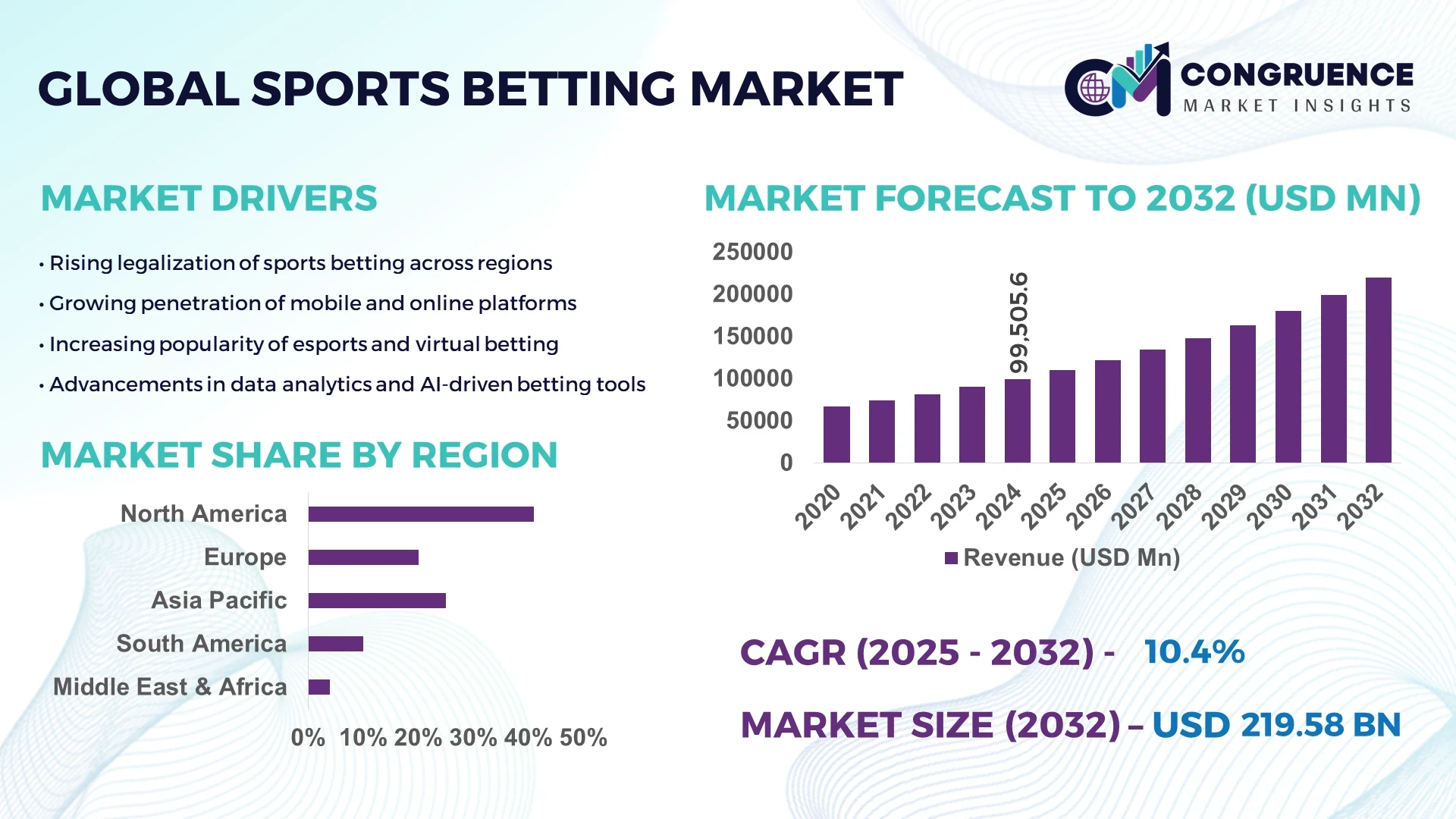
The Global Sports Betting Market was valued at USD 99,505.6 Million in 2024 and is anticipated to reach a value of USD 219,583.7 Million by 2032 expanding at a CAGR of 10.4% between 2025 and 2032. The market growth is primarily driven by increasing legalization of online betting platforms, rapid digitalization, and expanding access to mobile gaming applications across major economies.
The United States currently dominates the global sports betting market, supported by large-scale investment in online gaming infrastructure, advanced analytics platforms, and an extensive network of licensed operators. As of 2024, over 37 states have legalized some form of sports betting, with consumer adoption exceeding 65% among active adult internet users. The U.S. market is witnessing robust technological innovation, including AI-based predictive analytics and blockchain-driven transparency solutions. Moreover, substantial capital inflows—surpassing USD 12.5 billion in 2024—have accelerated the development of secure digital wagering platforms and expanded sportsbook offerings across major leagues and tournaments.
• Market Size & Growth: The market stands at USD 99.5 Billion in 2024 and is projected to reach USD 219.6 Billion by 2032, registering a CAGR of 10.4%. Growth is driven by the expansion of regulated online betting ecosystems and increased consumer trust in digital wagering platforms.
• Top Growth Drivers: Rising smartphone penetration (72%), improved payment system efficiency (48%), and higher sports engagement levels (63%) are fueling global market expansion.
• Short-Term Forecast: By 2028, AI-driven odds-setting algorithms and predictive analytics tools are expected to enhance operational efficiency by approximately 35%, improving accuracy and bettor engagement.
• Emerging Technologies: Integration of blockchain for transparent transactions, AI-based odds calculation, and immersive AR/VR betting experiences are transforming digital betting landscapes.
• Regional Leaders: North America projected at USD 92.1 Billion by 2032; Europe at USD 70.3 Billion, driven by football and e-sports betting; Asia-Pacific at USD 45.8 Billion, led by mobile-first adoption and digital wallet usage.
• Consumer/End-User Trends: Younger demographics aged 21–35 dominate participation, accounting for nearly 58% of online bettors, with increased adoption of in-play and fantasy sports betting formats.
• Pilot or Case Example: In 2024, DraftKings implemented an AI-powered risk management system reducing fraudulent betting incidents by 41% while enhancing compliance accuracy.
• Competitive Landscape: Flutter Entertainment holds approximately 14% of the global share, followed by Bet365, Entain Plc, 888 Holdings, and Caesars Entertainment as major competitors driving platform diversification.
• Regulatory & ESG Impact: Expansion of legalized betting frameworks across North America and Europe promotes responsible gambling policies and ESG-aligned initiatives focused on consumer data protection and ethical advertising.
• Investment & Funding Patterns: Over USD 6.3 Billion in funding was directed toward sportsbook technology startups and AI-enhanced betting analytics firms in 2024, signaling sustained investor confidence.
• Innovation & Future Outlook: The market is shifting toward predictive betting analytics, esports integration, and gamified mobile applications, with continuous innovation driving enhanced transparency, compliance, and user engagement across global markets.
The sports betting market is witnessing dynamic evolution, shaped by technological advancements and strategic investments across digital wagering and live streaming integration. Ongoing innovation in AI algorithms, secure payment technologies, and data-driven user personalization is enhancing platform performance and bettor experience. Regulatory clarity in emerging economies, coupled with rising esports viewership and expanding partnerships with professional leagues, is fostering steady growth. Additionally, mobile-first adoption trends and regional digital literacy initiatives are expected to accelerate the market’s evolution toward transparent, data-centric, and sustainable betting ecosystems.
The strategic relevance of the Sports Betting Market lies in its ability to merge real-time analytics, advanced digital platforms, and consumer engagement models that collectively redefine entertainment economics. Sports betting is rapidly transforming into a data-driven ecosystem, integrating AI, blockchain, and machine learning technologies to enhance predictive accuracy, transparency, and regulatory compliance. Comparative benchmarks show that AI-integrated analytics deliver a 42% improvement in odds accuracy compared to legacy statistical models, significantly elevating betting reliability and user retention. North America dominates in volume, while Europe leads in digital adoption with 74% of enterprises leveraging regulated online platforms for sports betting.
By 2027, the deployment of AI-powered fraud detection systems is expected to reduce transaction-related discrepancies by 38%, improving consumer confidence and platform efficiency. Firms are committing to ESG metric improvements, targeting a 30% reduction in carbon footprint through green data center operations by 2030. In 2024, the United Kingdom achieved a 28% enhancement in responsible gaming compliance through AI-driven monitoring systems that detect and prevent excessive betting behaviors.
Looking forward, the Sports Betting Market is expected to evolve as a pillar of resilience, compliance, and sustainable growth—supported by regulatory alignment, responsible gambling policies, and continuous technological innovation that collectively reinforce its economic and ethical foundation in the digital era.
Digital transformation remains one of the most critical drivers of growth in the Sports Betting Market. The integration of AI, big data analytics, and mobile technologies has streamlined user engagement and operational efficiency across online platforms. As of 2024, nearly 78% of global sports bettors use digital platforms, marking a 26% increase from 2020. Enhanced personalization, real-time odds calculation, and seamless payment gateways have amplified participation rates. Blockchain technology adoption has also improved transactional transparency, reducing disputes by 33% globally. These advancements collectively strengthen user trust, driving sustained expansion across regulated and emerging digital betting markets.
Despite rapid global adoption, the Sports Betting Market faces significant restraints due to regulatory fragmentation and cybersecurity vulnerabilities. Divergent legal frameworks across countries complicate operational consistency and limit cross-border platform scalability. Approximately 40% of active markets still operate under ambiguous legal conditions, delaying licensing and compliance processes. Moreover, with digitalization, data breaches and fraud incidents have risen by 21% year-over-year, compelling operators to allocate substantial resources toward cybersecurity. Inconsistent taxation regimes and delayed regulatory harmonization continue to hinder market fluidity, discouraging smaller operators from entering high-compliance regions.
AI-driven personalization offers a transformative opportunity for the Sports Betting Market by enhancing customer engagement, predictive accuracy, and retention. As of 2024, 63% of operators have adopted AI algorithms to tailor user experiences based on behavioral data. Predictive analytics can increase user session durations by up to 47% while improving conversion rates across promotional campaigns. Furthermore, the integration of AR/VR technologies presents immersive betting environments that attract younger demographics. Expansion into emerging markets in Asia and Africa, where mobile penetration exceeds 85%, also presents high-growth potential for personalized betting ecosystems supported by localized digital payment solutions.
The Sports Betting Market faces mounting challenges due to escalating operational costs and stricter responsible gambling regulations. Licensing, compliance audits, and real-time monitoring infrastructure contribute to rising expenditures, with some operators reporting cost increases exceeding 18% annually. Additionally, governments across Europe and North America are enforcing more rigorous player protection standards, requiring advanced age-verification systems and self-exclusion mechanisms. These initiatives, while essential for sustainability, slow down platform scalability and profitability in the short term. Balancing compliance obligations with innovation remains a key challenge as operators strive to ensure growth without compromising ethical or regulatory responsibilities.
• Expansion of Mobile and In-Play Betting Platforms: The rapid growth of mobile technologies has fueled a notable shift toward in-play and live betting formats, with over 68% of global wagers now placed via smartphones. Real-time odds updates and interactive features have increased engagement rates by 42%, particularly among bettors aged 21–35. In markets like Europe and North America, mobile-optimized sportsbook applications have achieved user retention improvements of up to 36%, highlighting the transition toward convenience-focused betting ecosystems.
• Integration of AI and Predictive Analytics in Betting Algorithms: The incorporation of AI and machine learning into betting systems is revolutionizing odds prediction accuracy and user behavior analysis. Platforms utilizing AI-driven algorithms report a 39% improvement in odds precision and a 27% rise in risk management efficiency compared to legacy models. Automated analytics tools now process millions of data points per second, enabling faster decision-making for both bettors and operators. This technological shift is supporting a new generation of intelligent and data-centric betting environments.
• Growth of eSports and Virtual Betting Segments: eSports betting has emerged as one of the fastest-growing verticals, with user participation surging by 61% between 2021 and 2024. Over 45% of first-time bettors globally engaged through eSports or virtual sports platforms, reflecting changing consumer behavior and digital entertainment preferences. Enhanced streaming quality and in-game analytics have also boosted virtual betting transaction volumes by 33%, offering operators diversified engagement avenues beyond traditional sports.
• Regulatory Modernization and Responsible Gambling Initiatives: The adoption of updated regulatory frameworks has become a defining trend, with more than 30 jurisdictions implementing new licensing or compliance standards in the past two years. Responsible gambling initiatives have increased awareness among 54% of regular bettors, supported by AI-based self-exclusion and behavioral monitoring systems. Additionally, compliance audits and fair-play certifications have improved operator transparency scores by 29%, fostering consumer confidence and long-term market sustainability.
The Sports Betting Market is segmented by type, application, and end-user insights, reflecting the industry's expanding digital infrastructure and diversified participation across multiple betting formats. Types include online, offline, and virtual sports betting, each supported by unique engagement models and technology-driven experiences. Application-wise, platforms span football, horse racing, esports, basketball, and other niche sports categories, highlighting varied adoption across regions. End-users encompass casual bettors, professional bettors, and commercial betting enterprises, all driving volume and innovation through data-driven decision-making. This segmentation underscores how technological integration, consumer behavior, and evolving regulatory conditions are shaping the competitive landscape globally.
Online betting remains the dominant type in the Sports Betting Market, accounting for approximately 63% of the total adoption in 2024. Its leadership is attributed to expanding mobile internet access, secure digital payment systems, and high user engagement on mobile platforms. In comparison, offline betting systems hold around 25% of the market, primarily in regions with strong traditional betting culture and physical sportsbook infrastructure. Virtual sports betting, though still emerging, represents the fastest-growing segment, with a projected annual growth rate exceeding 12.5% through 2032, fueled by increased gamification, AI-based simulations, and immersive user experiences.
Other betting types, such as exchange and fantasy-based platforms, collectively account for the remaining 12% share, appealing to niche audiences seeking competitive and interactive betting formats. The market’s diversification is further supported by the integration of augmented reality and blockchain systems for transparency and engagement.
Football betting remains the leading application in the Sports Betting Market, representing approximately 47% of total engagement worldwide. Its dominance is driven by global tournament popularity, real-time analytics integration, and growing partnerships between sportsbooks and sports leagues. In contrast, horse racing betting maintains about 22% of market activity, supported by strong regulatory backing and cultural relevance in key regions such as the UK and Australia. Esports betting has emerged as the fastest-growing application, with a projected annual growth rate surpassing 14%, driven by digital-native audiences and increasing international tournaments that attract younger demographics.
Other applications, including basketball, tennis, and cricket betting, together contribute about 31% of total usage, reflecting diversified consumer interests across global sporting events. Technological innovations such as live odds tracking and AI-generated match predictions are enhancing the user experience and broadening participation.
Individual or casual bettors constitute the largest end-user group in the Sports Betting Market, accounting for nearly 58% of the total participation base. Their growth is supported by increased accessibility to mobile applications, seamless user interfaces, and rising awareness of regulated betting practices. Professional bettors represent around 27% of the market, leveraging advanced analytics and automated systems for strategic wagering and data-based risk management. Meanwhile, commercial enterprises—including casinos, online sportsbooks, and betting service providers—are the fastest-growing end-user segment, expanding at an annual rate exceeding 11%, supported by AI integration, real-time analytics, and multi-sport digital portfolios.
Other niche end-users, such as fantasy league managers and gaming content creators, account for the remaining 15% share, contributing to the diversification of digital engagement channels. Adoption within the hospitality and entertainment sectors has also increased by 18% over the past two years due to cross-promotional opportunities and live event betting integration.
North America accounted for the largest market share at 41% in 2024; however, Asia-Pacific is expected to register the fastest growth, expanding at a CAGR of 11.8% between 2025 and 2032.

Europe followed closely with a 33% share, driven by well-established regulatory frameworks and high consumer engagement. South America represented 14% of the market, supported by rapid legalization efforts and rising digital infrastructure, while the Middle East & Africa collectively contributed around 12% in 2024. Over 68% of active bettors globally are concentrated in North America and Europe, where digital penetration exceeds 80%. In contrast, Asia-Pacific recorded the highest number of new user registrations, growing by 29% year-over-year. Regional variations in licensing, taxation, and technology adoption continue to shape market growth trajectories and consumer preferences globally.
North America held approximately 41% of the global Sports Betting Market in 2024, anchored by robust regulatory frameworks and widespread legalization across 37 U.S. states. The region’s growth is strongly supported by industries such as entertainment, digital gaming, and financial technology. Widespread adoption of advanced analytics, AI-driven betting models, and mobile-first applications has increased platform efficiency by 45%. Notably, local players like DraftKings and FanDuel are investing heavily in proprietary algorithms to improve real-time odds accuracy. Consumer behavior in this region favors data-based decision-making, with 64% of active users preferring in-play mobile betting. Regulatory support through state-level compliance initiatives has improved responsible gambling participation by 28%, further strengthening market stability and consumer trust.
Europe accounted for nearly 33% of the global Sports Betting Market in 2024, led by major economies such as the United Kingdom, Germany, and France. Regulatory bodies across the continent have introduced responsible gambling and anti-fraud frameworks, enhancing platform credibility and player protection. Adoption of digital wallets and blockchain systems for transaction transparency increased by 32% in 2024. Operators such as Bet365 and Entain Plc continue to expand cloud-based solutions and personalized betting interfaces. Regulatory compliance and sustainability programs are shaping market operations, with 51% of companies committing to responsible advertising standards. Consumer behavior reflects a demand for explainable and ethically compliant betting models, positioning Europe as a hub of mature and transparent market practices.
Asia-Pacific emerged as the fastest-growing region in the Sports Betting Market, accounting for approximately 27% of global participation in 2024. China, India, and Japan are the key contributors, driven by rising internet penetration exceeding 88% and the proliferation of mobile payment systems. Infrastructure modernization, cloud-based data centers, and gamified interfaces have expanded betting accessibility, with transaction volumes increasing by 37% over the past two years. Local operators are leveraging blockchain-based transaction models to enhance trust and user transparency. Consumer behavior in this region is characterized by a preference for mobile-based betting apps, with 71% of users engaging through digital wallets. Growth is heavily influenced by e-commerce and online entertainment ecosystems, positioning the region as a vibrant innovation hub for future betting technologies.
South America accounted for around 14% of the Sports Betting Market in 2024, led by Brazil and Argentina as emerging centers of online and retail betting activity. Government efforts toward legalization and consumer protection have intensified, with Brazil finalizing operational guidelines for digital sportsbooks. The adoption of advanced payment systems and mobile-based platforms rose by 33% in 2024. Local firms are investing in language-localized user interfaces to improve accessibility and engagement. Media partnerships and sports sponsorships continue to enhance visibility across major sporting events. Consumer behavior in this region reflects strong brand loyalty, with 59% of users preferring local or regionally developed platforms integrated with regional payment options.
The Middle East & Africa represented approximately 12% of the Sports Betting Market in 2024, led by the UAE, South Africa, and Nigeria. Despite regulatory restrictions in some territories, increasing digital transformation initiatives and economic diversification programs are driving new opportunities. Adoption of AI-driven compliance systems and localized language platforms has improved operational efficiency by 31%. Local companies are experimenting with mobile-based betting models integrated with e-payment gateways to address accessibility gaps. Consumer participation is concentrated among younger demographics, with nearly 65% of active users under 35 years old. Regional growth is further propelled by partnerships between gaming technology providers and entertainment entities to expand digital betting offerings responsibly.
• United States – 35% Market Share: Dominance attributed to extensive legalization, large online consumer base, and advanced analytics-driven betting platforms.
• United Kingdom – 18% Market Share: Leadership reinforced by well-established regulatory institutions, mature sportsbook infrastructure, and strong digital innovation in betting services.
The competitive environment in the Sports Betting Market is marked by both consolidation among major operators and a thriving ecosystem of emerging players. At present, there are over 120 active competitors globally, ranging from regional bookmakers to large-scale digital sportsbook platforms. The market is moderately consolidated: the combined share of the top five companies is estimated at approximately 47%. These leading firms employ strategic initiatives such as cross-border partnerships, technological product launches, acquisitions, and alliances with major sports leagues to strengthen their positioning and extend global reach. Key strategic themes include real-time streaming integrations, AI-based odds generation modules, and omnichannel betting platforms that blend mobile, retail, and e-sports wagering. Innovation trends are shaping the competitive frontier: for instance, firms now deploy predictive analytics engines that evaluate millions of data points per second for live odds, and blockchain-enabled ledgers to enhance transaction transparency and consumer trust. Niche players are focusing on specialized segments—such as virtual sports or regional micro-markets—to differentiate themselves. As regulatory regimes evolve and consumer preferences shift toward mobile, interactive, and gaming-integrated formats, operators are refining their competitive strategies around user experience, technology upgrades, and brand differentiation. For decision-makers, the dynamic reveals that staying ahead requires not only scale but also agility in technology adoption, regulatory compliance, and partnership ecosystems.
Caesars Entertainment, Inc.
Entain Plc
Penn Entertainment Inc.
BetMGM LLC
Technological innovation continues to redefine the dynamics of the Sports Betting Market, driving efficiency, user engagement, and regulatory compliance. Artificial intelligence (AI) and machine learning (ML) have become central to personalized betting experiences, predictive modeling, and risk management systems. In 2024, over 70% of online sportsbooks integrated AI-based algorithms to enhance odds calculation and user targeting, enabling operators to analyze player behavior and preferences in real time. Automation tools now manage up to 60% of in-play betting adjustments, significantly reducing latency and improving profitability margins.
Blockchain technology has gained traction for ensuring transparency and security, with more than 25% of new betting platforms utilizing decentralized ledgers to verify transactions and mitigate fraud. Smart contracts are increasingly employed for instant payouts, eliminating intermediaries and improving trust among consumers. The adoption of digital wallets and cryptocurrency betting platforms—used by approximately 18% of bettors globally—reflects a clear shift toward frictionless, anonymous payment solutions.
Mobile betting continues to dominate technological investments, with around 80% of total wagers now placed via smartphones and dedicated apps. Augmented reality (AR) and virtual reality (VR) solutions are also emerging, offering immersive live-game environments and interactive betting interfaces. Moreover, big data analytics plays a crucial role in shaping customer retention strategies, as operators track over 10 million data points daily to refine odds, bonuses, and marketing campaigns. As regulatory frameworks tighten, compliance automation technologies and geolocation tracking systems are being integrated to ensure responsible gambling practices and jurisdictional adherence. Together, these innovations position technology as the backbone of competitiveness and growth in the global sports betting landscape.
DraftKings, Inc. announced on March 11 2024 the launch of its online sportsbook in North Carolina, marking its presence in 27 U.S. states and introducing enhanced features including same-game parlays, in-game betting and “My Stat Sheet” responsible-gaming tools.
DraftKings reached an agreement on August 28 2024 to acquire Simplebet Inc., a provider of in-play micromarket content and pricing, thereby expanding live-betting capabilities across its platform. )
Flutter Entertainment plc reported acquisition of 3.7 million new sports betting and iGaming players in 2023 (a 19 % increase over prior year) and achieved a U.S. online sportsbook NGR share of 53.4 % and GGR share of 43.2 % in Q4 2023.
DraftKings launched its enhanced “Dynasty Rewards” loyalty programme on October 21 2024, offering tiered gifts and experience-based rewards across its sportsbook and online casino verticals to deepen customer engagement and retention.
This report covers a comprehensive analysis of the global Sports Betting Market, detailing segmentation by betting type (online, offline, virtual sports, exchange/fantasy formats), application area (football, horse racing, esports, basketball, tennis and other sports), end-user categories (casual bettors, professional bettors, commercial operators). Geographically, the scope spans North America, Europe, Asia-Pacific, South America and Middle East & Africa, with each region’s regulatory framework, digital infrastructure and consumer behavior profile addressed. Technology dimensions such as mobile platforms, AI-driven odds modelling, blockchain-enabled transactions, augmented/virtual reality interfaces, and payment innovations are included. The report also examines growth enablers such as legalisation trends, mobile-first consumer adoption and esports integration, plus barriers like regulatory divergence, cybersecurity threats and responsible-gambling requirements. Niche market segments such as live/in-play micro-betting and virtual-sports wagering are explored, and industry focus areas including operator consolidation, platform innovation and loyalty programme evolution are analysed. The deliverables are targeted at decision-makers, equipping them with clear actionable insights across product types, applications, technologies and regional dynamics for strategic planning.
| Report Attribute/Metric | Report Details |
|---|---|
Market Revenue in 2024 | USD 99505.6 Million |
Market Revenue in 2032 | USD 219583.7 Million |
CAGR (2025 - 2032) | 10.4% |
Base Year | 2024 |
Forecast Period | 2025 - 2032 |
Historic Period | 2020 - 2024 |
Segments Covered | By Types
By Application
By End-User
|
Key Report Deliverable | Revenue Forecast, Growth Trends, Market Dynamics, Segmental Overview, Regional and Country-wise Analysis, Competition Landscape |
Region Covered | North America, Europe, Asia-Pacific, South America, Middle East, Africa |
Key Players Analyzed | Flutter Entertainment Plc, DraftKings, Inc., bet365 Group Ltd, Caesars Entertainment, Inc., Entain Plc, Penn Entertainment Inc., BetMGM LLC |
Customization & Pricing | Available on Request (10% Customization is Free) |




