
Reports
The Global Spodumene Concentrate Market was valued at USD 2,390.8 Million in 2025 and is anticipated to reach a value of USD 4,263.9 Million by 2033 expanding at a CAGR of 7.5% between 2026 and 2033. Growth is being driven by accelerating lithium-ion battery demand, mine restarts, and renewed investment in diversified non-China lithium supply chains.
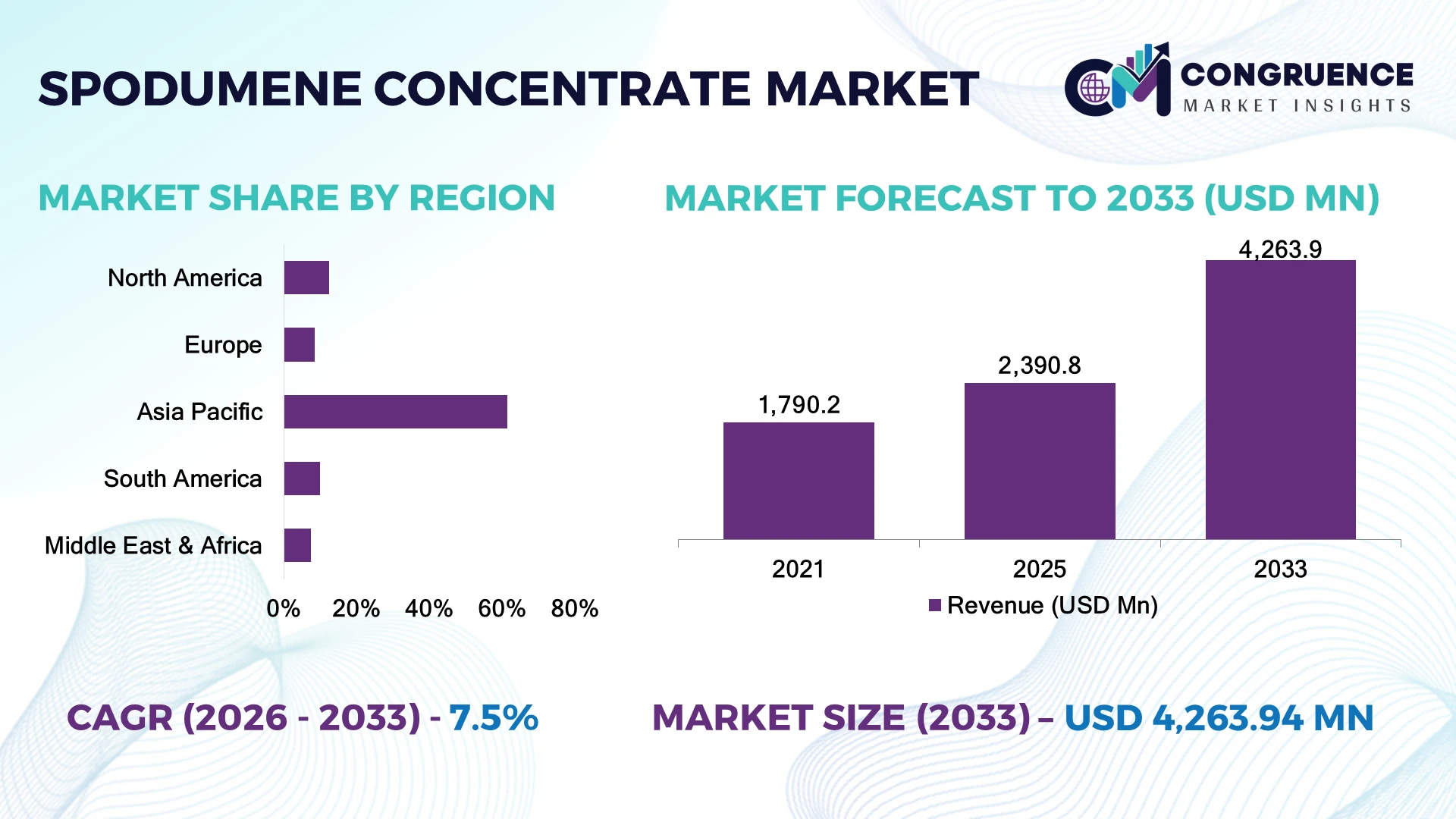
Australia remains the dominant spodumene concentrate producer, contributing roughly 45–50% of global mined lithium supply, with Greenbushes, Pilgangoora, Wodgina, and Kathleen Valley anchoring commercial output. Australian mine output is projected to grow about 8% annually through 2031, while Canada and Africa are expanding alternative supply. The 2026 geopolitical focus on critical-mineral security is accelerating Western sourcing diversification, with processing projects increasingly targeting 5.5–6.0% Li₂O concentrate specifications.
Strategically, buyers should prioritize producers combining high recovery, scalable mine plans, infrastructure access, and downstream conversion partnerships.
Market Size & Growth: USD 2,390.8 million in 2025 to USD 4,263.9 million by 2033 at 7.5% CAGR, driven by EV and battery-storage demand.
Top Growth Drivers: EV batteries 45–50%, energy storage 15–20%, and downstream lithium conversion 10–15%.
Short-Term Forecast: By 2028, optimized beneficiation can improve lithium recovery 5–10% while reducing processing losses.
Emerging Technologies: DMS, flotation, ore sorting, and AI-enabled grade control are raising recovery and concentrate consistency.
Regional Leaders: Asia-Pacific is projected near USD 2.1 billion, North America USD 1.0 billion, and Europe USD 0.7 billion.
Consumer/End-User Trends: Battery-grade lithium conversion consumes roughly 80–85% of high-quality spodumene concentrate.
Pilot/Case Example: 2026 DMS testing achieved 89% lithium recovery and 6.09% Li₂O concentrate at Shaakichiuwaanaan.
Competitive Landscape: Pilbara Minerals, Mineral Resources, Albemarle, Arcadium Lithium, and Tianqi-linked supply collectively represent a highly concentrated producer base.
Regulatory & ESG Impact: New critical-mineral policies are strengthening non-China sourcing, while advanced processing can improve recovery by 10–20%.
Investment & Funding: Kathleen Valley attracted approximately USD 316 million in 2026 funding, supporting mine development and processing optimization.
Innovation & Future Outlook: Higher-recovery beneficiation, ore sorting, integrated conversion, and diversified offtake structures will reshape supply competition.
The Spodumene Concentrate market is increasingly defined by battery-grade quality, recovery efficiency, and supply-chain diversification. High-grade pegmatite operations targeting 5.5–6.0% Li₂O concentrate are gaining strategic importance, while 2026 supply disruptions and renewed lithium-price strength are encouraging producers to optimize existing plants rather than rely solely on greenfield capacity. This creates a stronger link between metallurgical performance, mine economics, and downstream customer security.
Spodumene concentrate has become strategically important because it provides a direct upstream route into lithium chemicals required for EV batteries and energy-storage systems. In 2026, supply-chain restructuring is accelerating as battery manufacturers and governments seek greater geographic diversification of lithium feedstock. Australia remains the largest established supplier, while Canada, Africa, and emerging U.S. projects are building alternative sources.
Processing technology is becoming a decisive differentiator. Conventional DMS can deliver approximately 70–80% lithium recovery at suitable feed grades, while DMS combined with flotation has demonstrated recovery approaching 89%, creating a measurable advantage in lithium utilization. Automated grade control, ore sorting, and geometallurgical modeling further improve feed consistency. North American projects increasingly emphasize domestic supply security, whereas Australian operations prioritize scale, plant utilization, and export logistics.
Over the next 2–3 years, producers will focus on improving recovery, concentrate quality, and plant utilization rather than simply expanding tonnage. A 2026 North American Lithium operation achieved a record 94% mill utilization in one quarter, demonstrating the value of operational optimization. Companies with integrated mining, beneficiation, logistics, and downstream partnerships will gain stronger bargaining power and more resilient customer relationships.
Battery-grade lithium conversion remains the primary demand engine, with EV batteries absorbing approximately 45–50% of spodumene-derived lithium demand and energy storage accounting for another 15–20%. Automotive electrification is pushing converters to secure consistent 5.5–6.0% Li₂O concentrate specifications, making high-grade feedstock increasingly valuable. Australia continues expanding mine and beneficiation capacity, while Canada and Africa are developing alternative supply to reduce geographic concentration. Chinese converters are also securing long-term offtake agreements with overseas producers. Companies are responding through mine expansions, DMS optimization, offtake partnerships, and integrated conversion projects. The strategic shift is significant: concentrate quality and recovery now influence downstream conversion economics almost as strongly as mined tonnage.
Spodumene producers face substantial exposure to lithium-price volatility, with concentrate prices capable of moving more than 30% across market cycles and project operating margins often changing by 15–25% with realized pricing. High-cost operations are particularly vulnerable because mining, crushing, beneficiation, freight, and sustaining capital represent substantial fixed commitments. Australian producers also face elevated labor and energy costs, while African projects encounter infrastructure and logistics constraints that can add 10–20% to delivered costs. Companies are reducing exposure through staged expansions, long-term offtake contracts, lower-cost processing circuits, and tighter mine planning. The non-obvious constraint is that higher concentrate prices do not automatically improve producer economics when conversion capacity and downstream lithium prices remain under pressure.
Advanced beneficiation offers a significant opportunity to increase lithium output without proportionally expanding mine throughput. DMS combined with flotation can push lithium recovery toward 85–90% at suitable ore bodies, compared with approximately 70–80% for conventional gravity-based concentration. Sensor-based ore sorting can additionally remove 10–20% of waste before intensive processing, lowering energy and water requirements. Canada and Australia are prioritizing geometallurgical modeling, automated grade control, and modular processing to improve resource utilization. Companies are investing in pilot circuits, technology partnerships, and brownfield expansions rather than relying exclusively on new mines. A key opportunity lies in treating lower-grade satellite ore through flexible beneficiation circuits, converting previously marginal material into economically useful feedstock.
Scaling spodumene supply requires coordinated mine development, beneficiation, logistics, and lithium-conversion capacity, creating execution complexity across geographically separated assets. Processing plants targeting 5.5–6.0% Li₂O must maintain tight concentrate specifications, while recovery fluctuations of 5–10% can materially alter payable lithium output. Remote Australian and African operations also face infrastructure constraints, with transport interruptions capable of extending shipment schedules by 10–20%. Workforce availability, water management, tailings handling, and increasingly stringent environmental approvals add further execution pressure. Companies are responding through integrated project planning, digital mine-to-mill systems, local infrastructure partnerships, and staged commissioning. The critical challenge is synchronizing mine throughput with converter demand; excess concentrate without qualified conversion capacity creates working-capital pressure rather than strategic advantage.
Higher Recovery Becomes Operational Priority: Producers are increasingly optimizing DMS, flotation, and ore-sorting circuits rather than simply increasing mined tonnage. Combined beneficiation can lift recovery toward 85–90%, while pre-concentration can remove approximately 10–20% of waste before intensive processing. Australian operators are prioritizing brownfield modifications because incremental recovery improvements can generate additional lithium output without equivalent mine expansion.
Concentrate Quality Tightens Procurement: Battery-grade converters are placing greater emphasis on consistent 5.5–6.0% Li₂O specifications and lower impurity levels. Variations of 3–5% in concentrate quality can affect downstream conversion efficiency and blending requirements. Producers are therefore strengthening automated grade control, stockpile management, and laboratory testing, while converters increasingly favor suppliers capable of delivering consistent chemistry rather than simply the highest nominal grade.
Supply Chains Become More Diversified: North American and European battery ecosystems are increasing non-China sourcing as critical-mineral security becomes a strategic procurement consideration. Australian supply remains dominant, while Canadian and African projects are developing alternative feedstock. Long-term offtake arrangements can cover approximately 50–80% of planned production for financing-stage projects, improving bankability while reducing downstream converter exposure to spot-market volatility.
Mine Logistics Gain Strategic Weight: Remote operations are increasingly using digital fleet monitoring, predictive maintenance, and integrated mine-to-port scheduling to protect shipment reliability. Automated dispatch can improve equipment utilization by approximately 5–10%, while predictive maintenance can reduce unplanned equipment downtime by 10–15%. Australian producers are pairing operational analytics with port and rail coordination, recognizing that a high-grade concentrate is commercially valuable only when it reaches converters consistently.
6% Li₂O spodumene concentrate represents approximately 60–65% of global traded supply, reflecting its suitability for conventional lithium conversion and stronger downstream economics. Its higher lithium content reduces the amount of concentrate required per unit of converted lithium, while established processing routes support predictable qualification. Standard 5.5–6.0% concentrates account for another 25–30%, particularly from Australian hard-rock operations. Lower-grade concentrates remain strategically relevant where beneficiation capacity and ore economics support upgrading.
The fastest-growing type is premium low-impurity concentrate, expanding as converters tighten feedstock specifications and seek improved conversion consistency. Demand for higher-quality material is increasing by approximately 8–12% in procurement programs, while impurity-control requirements can reduce downstream processing losses by 5–10%. Producers are investing in DMS, flotation, ore sorting, and automated grade control to improve consistency. Companies with high-grade resources and flexible beneficiation circuits are therefore directing capital toward recovery optimization rather than simply increasing mined volumes.
The International Energy Agency reported in 2025 that lithium demand from clean-energy applications increased by approximately 30% in 2024, reinforcing the importance of consistent battery-grade feedstock for downstream conversion capacity.
Lithium carbonate production represents approximately 50–55% of spodumene concentrate consumption, reflecting its established role in lithium-ion battery supply chains. Lithium hydroxide conversion accounts for roughly 35–40%, supported by high-nickel cathode chemistries, while glass, ceramics, and specialty applications represent approximately 8–12%. Carbonate remains the mature application because of extensive conversion infrastructure, whereas hydroxide demand is shifting toward higher-purity concentrate and tighter impurity control.
Lithium hydroxide production is the fastest-growing application, with demand for suitable feedstock increasing approximately 10–15% as battery manufacturers prioritize high-nickel cathode technologies. Integrated converters are investing in improved roasting, leaching, purification, and reagent-control systems to increase conversion efficiency by approximately 5–10%. Australian and Canadian producers are also establishing offtake relationships directly with converters to secure predictable downstream demand. The strategic shift is toward vertically coordinated mine-to-chemical supply chains, reducing exposure to spot concentrate availability.
The International Energy Agency reported in 2025 that battery demand for electric cars reached approximately 1 TWh globally in 2024, highlighting the continuing scale of lithium chemical requirements across carbonate and hydroxide conversion routes.
Battery and lithium-chemical producers represent approximately 75–80% of global spodumene concentrate demand, reflecting the material's direct role as a lithium feedstock. Cathode-material manufacturers and integrated battery groups account for much of the downstream purchasing influence, while glass, ceramics, and specialty-material producers collectively represent approximately 20–25%. Battery-linked procurement is more specification-driven, with buyers prioritizing 5.5–6.0% Li₂O concentrate, controlled impurities, and long-term supply security.
The fastest-growing end-user group is integrated battery and energy-storage supply chains, where procurement increasingly connects mining, conversion, cathode production, and cell manufacturing. These buyers are pursuing long-term offtake arrangements covering approximately 50–80% of planned production at selected new projects, reducing exposure to spot-market volatility. Companies are responding through direct partnerships, equity investments, and vertically integrated processing strategies. Established industrial users remain more price-sensitive, while battery-linked buyers increasingly pay for consistency and traceability, shifting investment toward mine-to-converter integration.
The International Energy Agency reported in 2025 that global battery manufacturing capacity exceeded 3 TWh in 2024, with more than 85% concentrated in China, reinforcing the dominant influence of battery supply chains on lithium raw-material procurement.
Asia-Pacific accounted for the largest market share at 61.5% in 2025 however, North America is expected to register the fastest growth, expanding at a CAGR of 9.2% between 2026 and 2033.
Domestic lithium supply development accelerates mine-to-converter integration
North America represents approximately 12.5% of global spodumene concentrate demand, with Canada emerging as the principal regional production center and the United States providing the strongest downstream pull. Regional projects increasingly emphasize integrated mining, beneficiation, logistics, and lithium-chemical conversion to reduce dependence on imported feedstock. Canadian hard-rock developments are targeting 5.5–6.0% Li₂O concentrate, while U.S. battery and cathode investments are strengthening local offtake requirements. North American producers are also prioritizing DMS, flotation, geometallurgical modeling, and automated grade control to improve recovery by approximately 5–10%. Strategic partnerships between miners, converters, and battery-material producers are becoming increasingly important as critical-mineral policies encourage domestic sourcing and supply-chain localization.
Canada Market Outlook: Canada is the region's principal spodumene production hub, supported by substantial pegmatite resources and growing critical-mineral infrastructure. Projects in Quebec are integrating mining and beneficiation with planned downstream lithium processing. Advanced geological modeling and modular processing can improve resource utilization by approximately 10–15%, strengthening Canada's position as a non-China battery-material supply source.
Strategic sourcing shifts toward domestic critical-mineral supply
Europe represents approximately 8.5% of global spodumene concentrate demand, with limited domestic production but significant downstream lithium-conversion and battery-material requirements. Germany, France, and Central European manufacturing clusters are strengthening demand for traceable, lower-risk lithium feedstock. European procurement is increasingly influenced by critical-raw-material security, carbon intensity, and supply-chain transparency. Domestic and neighboring hard-rock projects are targeting commercial production while recyclers and converters improve feedstock flexibility. Producers able to demonstrate consistent 5.5–6.0% Li₂O concentrate quality and documented processing characteristics gain stronger qualification prospects. European battery investments are consequently encouraging longer-term offtake structures rather than dependence on spot-market purchases.
Germany Market Outlook: Germany represents Europe's strongest downstream demand center because of its concentration of automotive OEMs, battery plants, and cathode-material investments. More than 1 million electric vehicles are now incorporated into the country's passenger-car fleet, strengthening the strategic requirement for secure lithium inputs. German buyers increasingly prioritize traceability, consistent chemistry, and lower supply-chain exposure when qualifying raw-material suppliers.
Australian mine scale anchors regional supply dominance
Asia-Pacific accounts for approximately 61.5% of global spodumene concentrate demand and remains the dominant production and conversion ecosystem. Australia supplies the majority of regional hard-rock concentrate, while China represents the largest downstream lithium-conversion center. Australian operations increasingly deploy DMS optimization, ore sorting, and automated grade control to maintain 5.5–6.0% Li₂O specifications. Chinese converters continue securing overseas offtake and equity-linked supply agreements, strengthening vertical integration. The region's scale advantage is reinforced by established ports, rail infrastructure, conversion plants, and battery-material manufacturing. Producers are prioritizing recovery optimization and mine-life extensions as downstream buyers demand predictable feedstock rather than simply higher shipment volumes.
Australia Market Outlook: Australia remains the world's leading spodumene concentrate production base, with major operations including Greenbushes, Pilgangoora, Wodgina, and Kathleen Valley. The country's mature mining infrastructure supports large-scale beneficiation and export logistics. High-quality hard-rock resources commonly support concentrates around 5.5–6.0% Li₂O, while established port and rail networks enable efficient delivery to Asian conversion centers.
Brazil builds a differentiated hard-rock lithium export platform
South America represents approximately 10% of global spodumene concentrate supply and demand, with Brazil accounting for the overwhelming majority of regional hard-rock activity. Minas Gerais has become the principal lithium-producing cluster, supported by expanding mine, beneficiation, and export infrastructure. Brazilian producers increasingly target premium concentrate specifications for Asian and European converters, with 5.5–6.0% Li₂O material commanding greater strategic attention. Export-oriented projects are strengthening port connectivity and long-term offtake relationships, while regional producers focus on minimizing processing losses and improving logistics reliability. Brazil's established mining expertise provides an advantage, although permitting, infrastructure development, and community engagement remain important determinants of project execution.
Brazil Market Outlook: Brazil is the region's leading spodumene producer, centered on Minas Gerais, where hard-rock lithium projects benefit from established mining contractors and export infrastructure. Commercial operations increasingly target battery-grade concentrate for international converters. Expanding processing capacity and export logistics can improve shipment reliability by approximately 10–15%, strengthening Brazil's role as a diversified supply source outside Australia and China.
African lithium projects attract strategic investment and processing partnerships
Middle East & Africa represents approximately 7.5% of global spodumene concentrate supply and demand, with Zimbabwe emerging as the region's most significant hard-rock lithium producer. African projects are increasingly attracting Chinese and international investment focused on mine development, beneficiation, and export infrastructure. Zimbabwe has introduced restrictions on exports of unprocessed lithium, encouraging domestic beneficiation and concentrate production. New processing facilities are increasingly designed around DMS and gravity separation, targeting commercially saleable concentrate while reducing transport of low-value ore. Companies are responding through infrastructure partnerships, local processing investments, and vertically coordinated offtake agreements. The strategic opportunity lies in converting resource abundance into consistent, specification-controlled concentrate rather than relying solely on raw mineral exports.
Zimbabwe Market Outlook: Zimbabwe is the region's most significant spodumene-producing market, supported by large hard-rock lithium deposits and rapidly expanding beneficiation infrastructure. Government policy restricting exports of unprocessed lithium has accelerated domestic processing investment. Major projects increasingly target 5.0–6.0% Li₂O concentrate, while Chinese-linked processing investments strengthen export connectivity and create a more integrated mine-to-concentrate supply chain.
Pilbara Minerals, Mineral Resources, Albemarle, Tianqi Lithium, and Ganfeng Lithium compete through scale, integrated processing, and downstream relationships, while Sigma Lithium and African producers pressure established Australian suppliers on cost and geographic diversification. The top five players are estimated to control roughly 45–50% of global spodumene concentrate supply, creating a concentrated producer structure. Competition centers on grade, recovery, logistics, and offtake security: processing optimization can improve recovery 5–10%, while integrated logistics can lower delivered costs 8–15%. Producers are expanding beneficiation, securing long-term offtake agreements, and forming strategic partnerships; MinRes’s POSCO transaction demonstrates increasing vertical coordination between mining and downstream conversion. Pilbara Minerals is advancing mid-stream processing, while Sigma is doubling concentrate capacity. The competitive shift is toward supply-chain integration, higher recovery, and geographic diversification. Entry barriers include resource quality, permitting, infrastructure, capital intensity, and converter qualification. Winning requires high-grade resources, reliable logistics, superior recovery, secured customers, and disciplined expansion globally.
Pilbara Minerals
Mineral Resources
Albemarle Corporation
Tianqi Lithium
Ganfeng Lithium
Sigma Lithium
Liontown Resources
IGO Limited
Sayona Mining
Atlantic Lithium
Patriot Battery Metals
Zhejiang Huayou Cobalt
Sinomine Resource Group
Chengxin Lithium Group
Current spodumene processing relies on dense media separation (DMS), crushing, screening, magnetic separation, and flotation to produce 5.5–6.0% Li₂O concentrate. Modern automated sensors and process controls can improve recovery by 5–10% and reduce grade variability by 3–5%. Adoption is strongest at large Australian operations where throughput and consistent concentrate chemistry directly influence converter acceptance and realized pricing.
Emerging systems combine ore sorting, geometallurgical modeling, AI grade prediction, and automated stockpile blending. Sensor-based pre-concentration can remove 10–20% waste before intensive processing, reducing energy and water requirements. Compared with conventional manual grade control, AI-assisted ore classification can improve feed consistency by roughly 5–10%. Pilbara Minerals, Mineral Resources, and Sigma Lithium benefit from integrating beneficiation analytics with mine planning, while smaller producers can deploy modular sorting technologies to improve economics without plant reconstruction.
During 2026–2028, flotation upgrades, predictive maintenance, digital twins, and mine-to-port optimization will become increasingly important. Predictive systems can reduce equipment downtime by 10–15%, while integrated logistics platforms can improve shipment scheduling efficiency by 5–10%. The competitive advantage shifts toward producers combining high-grade resources with flexible processing and downstream partnerships. Technology adoption matters now because recovery gains increase saleable concentrate without proportional mine expansion, strengthening margins, resource utilization, and customer reliability.
September 2026 Mineral Resources reported record FY26 sales of 559,000 tonnes of spodumene concentrate from Wodgina and Mt Marion, with Wodgina contributing 317,000 tonnes. Higher utilization strengthened production economics and reinforced Australia’s position in global hard-rock lithium supply. Source: mineralresources.com.au
April 2026 Pilbara Minerals reported record quarterly spodumene production of 232,436 dry metric tonnes, up 86% year-on-year, while unit operating costs fell 11% to A$520 per tonne. Higher recovery strengthened Pilgangoora competitiveness and supported additional offtake expansion further. Source: reuters.com
August 2025 Sigma Lithium produced 68,368 tonnes of lithium concentrate, up 38% year-on-year, while CIF China cash costs reached $442 per tonne, 12% below target. Plant expansion remained on track toward 520,000 tonnes annual capacity, strengthening supply scalability. Source: sigmalithiumresources.com
February 2026 Zimbabwe increased spodumene exports 11% in 2025 to 1.128 million tonnes, despite flat export revenue near $514 million. The government’s planned 2027 raw-concentrate export restrictions are accelerating domestic value-addition investments and processing capacity locally. Source: reuters.com
The report evaluates the global Spodumene Concentrate market across concentrate grades, lithium oxide specifications, beneficiation routes, lithium carbonate and lithium hydroxide conversion, battery materials, glass and ceramics, and specialty applications. End-user coverage includes lithium converters, cathode-material producers, battery manufacturers, and industrial consumers, with emphasis on procurement specifications, offtake structures, and mine-to-converter integration.
Regional analysis covers Asia-Pacific, North America, Europe, South America, and Middle East & Africa, including major production and emerging supply hubs. The study examines DMS, flotation, ore sorting, automated grade control, geometallurgical modeling, digital mine planning, and logistics optimization. With battery-linked applications representing approximately 75–80% of concentrate demand and 5.5–6.0% Li₂O material dominating premium procurement, the report supports mine investment decisions, processing expansion, offtake strategy, geographic diversification, competitive positioning, and supply-chain planning through 2033.
| Report Attribute/Metric | Report Details |
|---|---|
|
Market Revenue in 2025 |
USD 2,390.8 Million |
|
Market Revenue in 2033 |
USD 4,263.9 Million |
|
CAGR (2026 - 2033) |
7.5% |
|
Base Year |
2025 |
|
Forecast Period |
2026 - 2033 |
|
Historic Period |
2021 - 2025 |
|
Segments Covered |
By Type
By Application
By End-User
|
|
Key Report Deliverable |
Revenue Forecast, Growth Trends, Market Dynamics, Segmental Overview, Regional and Country-wise Analysis, Competition Landscape |
|
Region Covered |
North America, Europe, Asia-Pacific, South America, Middle East, Africa |
|
Key Players Analyzed |
Pilbara Minerals, Mineral Resources, Albemarle Corporation, Tianqi Lithium, Ganfeng Lithium, Sigma Lithium, Liontown Resources, IGO Limited, Sayona Mining, Atlantic Lithium, Patriot Battery Metals, Zhejiang Huayou Cobalt, Sinomine Resource Group, Chengxin Lithium Group |
|
Customization & Pricing |
Available on Request (10% Customization is Free) |




