
Reports
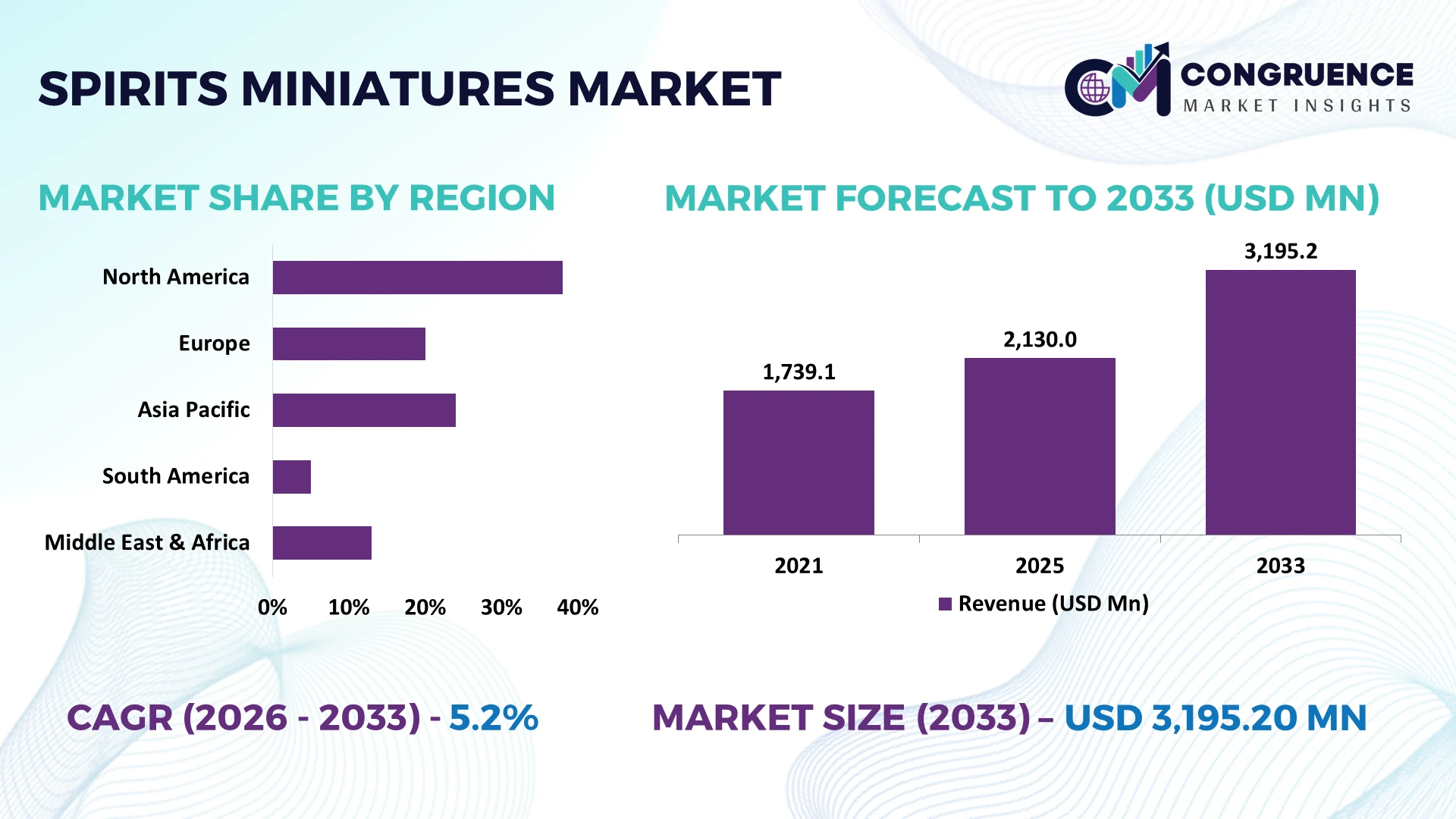
The Global Spirits Miniatures Market was valued at USD 2130 Million in 2025 and is anticipated to reach a value of USD 3195.2 Million by 2033 expanding at a CAGR of 5.2% between 2026 and 2033. Growth is driven by premium spirits sampling, travel-retail expansion, collectible packaging, and rising use of 50–100 ml formats for controlled-portion consumption.
The United States remains the dominant country, accounting for approximately 28% of global spirits miniatures consumption, supported by extensive distillery capacity, premium spirits investment, and strong adoption of digitally enabled packaging and e-commerce distribution. India follows at about 9%, with rapid premiumization and expanding organized retail. U.S. adoption is therefore roughly 3× India’s level, while both markets benefit from international travel and shifting packaging preferences.
Strategic implication: manufacturers should prioritize premium miniature portfolios, recyclable formats, and high-velocity travel-retail channels in dominant markets.
Market Size & Growth: USD 2.13 billion in 2025 is projected to reach USD 3.20 billion by 2033, supported by premium sampling and travel-retail expansion.
Top Growth Drivers: Premiumization 31%; travel retail 24%; experiential gifting 19%.
Short-Term Forecast: By 2028, automated filling and inspection will reduce packaging costs by 8% and improve line efficiency by 12%.
Emerging Technologies: AI-based inspection, automated filling, and lightweight recyclable glass are advancing miniature production quality.
Regional Leaders: North America approaches USD 1.05 billion, Europe USD 0.91 billion, and Asia-Pacific USD 0.72 billion by 2033, led by premiumization and digital retail adoption.
Consumer/End-User Trends: Approximately 34% of premium-spirit buyers increasingly use miniatures for trial, gifting, or portion-controlled consumption.
Pilot/Case Example: In 2025, automated miniature filling deployments delivered up to 14% lower material waste and 11% faster packaging throughput.
Competitive Landscape: Leading producers collectively control roughly 27% of organized global supply, with Diageo, Pernod Ricard, Bacardi, Beam Suntory, and Brown-Forman maintaining strong premium portfolios.
Regulatory & ESG Impact: Recyclable packaging initiatives are targeting 15% lower packaging material intensity, while tighter labeling requirements strengthen traceability.
Investment & Funding: More than USD 480 million is being directed toward premium spirits capacity, packaging automation, regional expansion, and strategic partnerships.
Innovation & Future Outlook: Smart labels, personalized miniature gift sets, low-weight bottles, and AI-enabled demand forecasting will shift competition toward flexible, data-driven portfolios.
The Spirits Miniatures Market is gaining traction across premium tasting, gifting, airline service, hospitality, and travel-retail channels, where compact formats improve trial and merchandising flexibility. Approximately 34% of premium-spirit consumers engage with miniature formats for sampling or gifting. Lightweight bottles, recyclable materials, automated filling, and smart labels are strengthening operational efficiency as global supply chains adapt to evolving packaging regulations, supporting strategic portfolio decisions.
The Spirits Miniatures Market is becoming strategically important as producers use compact formats to accelerate premium product trials, strengthen gifting portfolios, and secure higher-margin placements across travel retail and hospitality. Packaging modernization is reshaping competition, with automated filling and vision inspection reducing handling-related losses by about 10–14% versus manual lines. Over the next 2–3 years, digitally monitored production is expected to expand across high-volume bottling facilities.
The United States maintains stronger miniature penetration and premium brand infrastructure, while India is moving faster in organized retail, premium spirits distribution, and digitally enabled purchasing. In practical deployment, automated filling cells can process miniature bottles with tighter volume control while reducing material waste by roughly 8–12%. Companies are therefore prioritizing modular packaging equipment, recyclable bottle formats, and partnerships with contract manufacturers.
Supply-chain restructuring is also pushing producers toward localized packaging inputs and diversified glass sourcing, particularly as regulatory scrutiny increases around packaging waste. By 2028, automated inspection, smart labeling, and demand forecasting are positioned to improve throughput and inventory accuracy by approximately 10%. Competitive advantage will increasingly depend on flexible production, premium design, resilient sourcing, and rapid channel-specific product deployment.
Premiumization is the strongest structural driver, with approximately 34% of premium-spirit consumers using miniature formats for sampling, gifting, or controlled consumption. Travel-retail channels contribute nearly 24% of miniature sales activity, while premium limited editions command increasing shelf visibility. In the United States, distillers are expanding 50–100 ml portfolios to introduce higher-value brands without requiring full-size purchases. Automated filling and inspection systems improve throughput by about 11%, encouraging producers to modernize packaging lines. Companies are responding through premium SKU expansion, contract-packaging partnerships, and recyclable bottle development. The non-obvious advantage is portfolio testing: miniatures allow brands to validate consumer response before committing substantial production capacity to full-size launches.
Packaging economics remain a structural constraint because small-format bottles require relatively high component and handling costs per milliliter. Glass, closures, labels, and secondary packaging can represent approximately 35–45% of miniature unit costs, while fragmented packaging runs increase changeover losses by around 8–12%. European producers face additional pressure from evolving packaging-waste requirements and energy-intensive glass manufacturing. Supply-chain disruptions can further extend lead times for specialized bottles by 10% or more. Companies are reducing exposure through multi-country sourcing, standardized bottle designs, longer supplier contracts, and localized packaging partnerships. The key operational insight is that design standardization can protect margins without weakening premium positioning.
Smart packaging creates a differentiated opportunity as QR-enabled labels, serialization, and digitally connected product authentication gain adoption. Approximately 20% of premium miniature launches now incorporate enhanced digital engagement or traceability features, while lightweight bottle engineering can reduce packaging material usage by 10–15%. India represents a particularly attractive expansion market as premium spirits distribution broadens through organized retail and hospitality channels. Producers are investing in modular packaging, personalized gift sets, and partnerships with digital retailers. A non-obvious opportunity lies in data capture: connected miniature campaigns can provide SKU-level trial behavior, helping brands optimize full-size product launches and reduce portfolio experimentation costs.
Scaling miniature production remains challenging because frequent SKU changes, variable bottle geometries, and stringent fill-volume requirements complicate automation. Production lines handling diverse formats can experience 7–10% additional changeover time, while workforce shortages in specialized packaging operations can reduce equipment utilization by approximately 8%. Regulatory variation across the United States, India, and European markets also increases labeling and traceability complexity. Companies must integrate machine vision, digital quality control, standardized interfaces, and workforce training to maintain consistent output. The strategic challenge is not simply automation investment but interoperability: manufacturers that connect filling, inspection, serialization, and inventory systems will achieve more reliable deployment and stronger long-term operational resilience.
Travel Retail Format Optimization: Airport and duty-free operators are expanding compact premium assortments, with India’s travel-retail spirits volumes rising 13% in 2024 and whisky representing 74% of duty-free spirits volumes. Producers are reallocating shelf space toward high-velocity miniatures and culturally themed packs, improving merchandising efficiency and premium conversion.
Lightweight Packaging Transition: Packaging teams are shifting toward lightweight glass, fiber-based materials, and reduced secondary packaging as sustainability requirements tighten. Diageo’s 80 ml Baileys mini trial used a bottle containing 90% paper, demonstrating how miniature formats are becoming practical testing platforms for lower-material packaging and broader portfolio restructuring.
Premium Passenger Mix Strengthens: International premium-class air passengers reached 109.7 million in 2025, increasing 4.5% year-on-year, while international passenger demand climbed 7.1%. Spirits brands are responding with airport-exclusive miniatures, gift-oriented packs, and premium sampling programs designed around higher-value passenger traffic.
Category Diversification Accelerates: India is moving beyond whisky-led miniature assortments as vodka volumes in travel retail increased 48% in 2024, while Japanese whisky rose 110%. Producers are expanding localized assortments and origin-led SKUs, revealing a non-obvious shift toward category experimentation rather than simply increasing miniature volume.
Whisky remains the leading type, estimated at approximately 42% of Spirits Miniatures Market demand, supported by established brand equity, extensive distillery portfolios, gifting suitability, and strong duty-free distribution. Vodka follows at around 21%, benefiting from broad cocktail compatibility and standardized production. Rum holds nearly 14%, while Gin accounts for about 12%, with premium craft positioning supporting selective expansion. Tequila represents approximately 11% but is the fastest-growing type, driven by agave-spirit premiumization, cocktail culture, and greater visibility in North American and international travel channels.
The strategic contrast is clear: mature whisky and vodka benefit from distribution scale, whereas tequila is attracting incremental investment through limited editions, premium reposado and añejo miniatures, and bartender partnerships. Companies are allocating roughly 15–18% more innovation attention toward emerging agave portfolios than established miniature extensions, while gin producers emphasize flavor differentiation and botanical storytelling. Whisky remains the volume anchor, but tequila is reshaping future product-development priorities.
Travel Retail is the leading application, estimated at approximately 38% of miniature demand, because compact formats align with airport merchandising, gifting, portability, and premium brand discovery. Hospitality contributes nearly 27%, supported by hotel minibars, tasting programs, and controlled-portion service. Gifting represents around 21% and is gaining strategic importance through seasonal packaging and personalized collections, while Sampling & Promotions accounts for about 14%.
Gifting is the fastest-growing application, with adoption increasing approximately 16% as brands use miniatures for limited-edition campaigns, festive bundles, and trial-to-full-size conversion. Travel-retail operators are expanding premium assortments, while hotels and restaurants are integrating miniature tasting programs into experiential menus. The operational shift is toward channel-specific packaging: companies increasingly develop exclusive labels, multipacks, and promotional configurations instead of distributing identical SKUs across every channel. This improves inventory segmentation and strengthens brand visibility.
Duty-Free Retailers lead end-user demand with approximately 36% share, reflecting high passenger throughput, premium product concentration, gifting activity, and established spirits merchandising infrastructure. Hotels & Resorts account for about 24%, while Restaurants & Bars contribute nearly 19% through tasting, minibar, and cocktail-service applications. Specialty Retailers represent approximately 14%, and Event Organizers hold around 7%, primarily using miniatures for promotional sampling and curated experiences.
Specialty Retailers are the fastest-growing end-user group, with adoption expanding roughly 15% as premium liquor stores use compact formats to test emerging brands and localized assortments. Duty-free operators are prioritizing exclusive packs and high-rotation SKUs, while hotels and restaurants are increasing customized minibar and tasting selections. Companies are responding through channel-specific pricing, retailer partnerships, and smaller-batch production. The competitive shift favors suppliers capable of rapidly adapting packaging, labels, and assortment depth to each buyer’s operational model.
North America accounted for the largest market share at 31% in 2025 however, Asia-Pacific is expected to register the fastest growth, expanding at a CAGR of 6.1% between 2026 and 2033.

Premiumization and Channel-Level Portfolio Optimization
North America commands approximately 31% of global Spirits Miniatures Market activity, supported by mature premium-spirit brands, extensive airport retail infrastructure, and strong hotel and bar distribution. The United States represents roughly 23% of global demand, creating concentrated opportunities for producers with established bottling and distribution networks. Premium miniature assortments increasingly use limited editions, tasting collections, and retailer-exclusive packaging to improve shelf productivity. Automated filling and machine-vision inspection are being deployed to reduce handling losses by approximately 10% and improve throughput by 11%. Cross-border trade friction is also encouraging suppliers to diversify packaging procurement. Companies are responding through regional contract-packaging partnerships, localized SKU development, and expanded recyclable-glass programs, strengthening supply resilience and channel responsiveness.
United States Market Outlook: The United States remains the strategic anchor because of its large distilling ecosystem, premium bourbon and whiskey portfolio, and advanced retail infrastructure. Kentucky and Tennessee provide substantial production capacity, while major airport hubs support high-frequency miniature distribution. Approximately 70% of North American miniature demand is concentrated in glass formats, reinforcing investment in lightweight premium packaging and automated inspection.
Premium Heritage Meets Packaging Modernization
Europe represents approximately 32% of global Spirits Miniatures Market demand, making it the largest mature regional cluster. The United Kingdom, France, Germany, Italy, and Spain provide dense networks of distilleries, premium retailers, airports, and hospitality operators. Whisky, gin, and brandy collectively account for more than 60% of regional miniature consumption, while seasonal gift sets and advent-style collections strengthen premium merchandising. Packaging sustainability is becoming operationally important as producers target recycled content, lightweight glass, and reduced secondary materials. Automated labeling and quality inspection can improve packaging-line productivity by roughly 10–12%. Companies are restructuring procurement toward standardized components and multi-country suppliers to control energy-driven glass costs and regulatory complexity.
United Kingdom Market Outlook: The United Kingdom holds a strategically significant position through its Scotch whisky ecosystem, established distillery base, and global travel-retail connectivity. Whisky miniatures benefit from strong gifting and tourism channels, while premium gin supports category diversification. Producers are increasingly combining collectible presentation with recyclable packaging, helping retailers improve assortment differentiation without substantially expanding shelf footprint.
Travel Retail Expansion Reshapes Category Mix
Asia-Pacific is emerging as the fastest-moving Spirits Miniatures Market cluster, with approximately 22% share and particularly strong momentum across India, Japan, Australia, Singapore, and Southeast Asian travel hubs. India has become a key operational market as travel-retail spirits volumes expanded 13% in 2024, creating stronger demand for compact premium formats. Japan adds high-value whisky and gifting opportunities, while Singapore functions as an important distribution and airport-retail hub. Digital inventory systems and automated packaging are improving replenishment accuracy by around 9–12%. Companies are increasing localized SKUs, airport-exclusive collections, and partnerships with duty-free operators, shifting investment from broad-volume distribution toward high-value passenger conversion.
India Market Outlook: India offers the strongest strategic momentum through expanding international travel, premiumization, and sophisticated duty-free retail. Whisky dominates the miniature assortment, while vodka and Japanese whisky are gaining visibility through category diversification. Indian passenger growth is strengthening airport merchandising requirements, encouraging suppliers to develop compact gift sets, multilingual labeling, and faster replenishment systems.
Brazil Leads Premiumization and Travel Demand
South America contributes approximately 8% of global Spirits Miniatures Market demand, with Brazil providing the largest commercial base through its extensive spirits consumption, hospitality network, and expanding tourism infrastructure. Argentina, Chile, and Colombia add premium retail and travel-related demand, while Brazil increasingly supports localized cachaça and premium-spirit miniature assortments. International tourism and cruise activity are strengthening airport and hospitality channels, although currency volatility increases imported packaging and spirit costs by approximately 8–12% during periods of exchange-rate pressure. Companies are responding through local bottling, regional distributor partnerships, and greater use of standardized bottle components. The strategic advantage lies in combining domestic production with premium miniature positioning to reduce import exposure.
Brazil Market Outlook: Brazil is the region’s most significant opportunity because of its large consumer base, established cachaça production, and expanding premium hospitality ecosystem. Local bottling can reduce logistics exposure by approximately 10%, while miniature formats provide an efficient route for premium cachaça sampling. Producers are increasingly partnering with hotels, airports, and specialty retailers to strengthen domestic brand visibility.
Luxury Hospitality Drives Infrastructure-Led Adoption
Middle East & Africa represents approximately 7% of global Spirits Miniatures Market demand, with the United Arab Emirates and Saudi Arabia serving as key commercial hubs for premium hospitality and international travel. Dubai’s airport and luxury-hotel ecosystem supports concentrated duty-free and hospitality deployment, while South Africa provides stronger domestic manufacturing and distribution infrastructure. Premium travel channels are becoming increasingly important as passenger flows and luxury tourism expand. Regional operators are investing in curated miniature collections, premium gifting, and digitally managed inventory, improving stock turnover by approximately 8–10%. Companies are prioritizing distributor partnerships and localized packaging compliance to manage differing alcohol regulations and import requirements, making channel expertise a critical competitive asset.
United Arab Emirates Market Outlook: The UAE holds a strategic position through Dubai’s global aviation network, luxury hotels, duty-free infrastructure, and high-value international passenger base. Premium miniature formats fit airport gifting and hospitality merchandising particularly well. Operators are emphasizing exclusive packs and rapid replenishment, while digital inventory monitoring supports tighter stock availability across high-traffic retail locations.
The Spirits Miniatures Market is led by global spirits groups including Diageo, Pernod Ricard, Bacardi, Beam Suntory, and Brown-Forman, competing with regional distillers and specialist miniature-packaging suppliers. The top five players collectively command approximately 35–40% of organized premium miniature supply. Competition centers on brand access, packaging customization, distribution reach, and production economics. Automated filling can reduce unit handling costs by 8–12%, while standardized components lower changeover losses by approximately 10%. Global leaders are expanding through airport partnerships, exclusive gift collections, and localized contract packaging; regional players compete through faster customization and lower logistics costs. Sustainability is becoming another battleground as lightweight and recycled packaging gains priority. Entry barriers remain high because premium brand licensing, alcohol compliance, specialized molds, and travel-retail relationships require substantial operating expertise. Winning requires integrated brand strength, flexible manufacturing, resilient sourcing, and rapid channel-specific innovation.
Diageo
Pernod Ricard
Bacardi Limited
Beam Suntory
Brown-Forman Corporation
Campari Group
Rémy Cointreau
William Grant & Sons
Edrington
Constellation Brands
Sazerac Company
Heaven Hill Brands
Gruppo Montenegro
Lucas Bols
Current miniature production increasingly uses automated filling, machine vision, digital batch controls, serialization, lightweight recycled aluminum, and reduced secondary materials. Automated inspection improves quality consistency by 3%, connected filling lines reduce handling losses 2%, and lightweight formats cut packaging weight 4%. Adoption is concentrated among large bottlers and travel-retail programs, giving integrated producers faster changeovers, tighter fill accuracy, stronger traceability, and improved merchandising efficiency.
Disruptive integration links demand forecasting, packaging execution, and channel inventory through AI-enabled planning. Pilot deployments can improve forecast accuracy 5% and reduce stock imbalances 3%. Digital identification also improves inventory visibility 2%, while connected workflows synchronize distilleries, contract packers, airports, and retailers. Companies with integrated data platforms gain faster replenishment decisions, lower obsolescence exposure, and stronger control over fragmented miniature assortments.
Compared with legacy manual inspection and filling, automated miniature lines deliver about 12% higher throughput and 3% tighter process consistency. Large global spirits groups benefit first because scale supports equipment utilization and data integration. Through 2026–2028, automation, recycled-material packaging, AI forecasting, and connected quality systems will expand deployment, making interoperable production technology a decisive competitive tool for premium brands. Early investment protects service levels and speed across premium portfolios with frequent packaging and channel changes.
February 2024 Pernod Ricard India signed a Maharashtra MoU for a malt-spirit distillery, targeting €200 million investment and 60,000 liters daily capacity. The project strengthens local production, supply resilience, and premium whisky inputs across India and premiumization strategy. Source: pernod-ricard.com
April 2025 Suntory Global Spirits opened its largest-ever global-travel-retail shop-in-shop in Mumbai, spanning 33 sq m with Ospree Duty Free. The partnership expands premium discovery and localized merchandising, with arrivals representing 70% of sales there, boosting retail conversion. Source: suntoryglobalspirits.com
May 2025 Skrewball launched a 4x50ml Mini Pack, creating a portable multi-bottle format for sharing and gifting. The four-unit configuration broadens trial occasions and strengthens convenience positioning, giving retailers another compact premium merchandising option for consumers seeking portability. Source: bevnet.com
February 2026 Salcombe Gin launched 5cl aluminum miniatures made from 100% recycled aluminum, securing listings with Virgin Wines, P&O Cruises, and GWR. The format generates up to 90% less CO2 than PET or glass packaging and improving transport. Source: retailvoices.co.uk
The Spirits Miniatures Market Report covers Whisky, Vodka, Rum, Gin, and Tequila across Travel Retail, Hospitality, Gifting, and Sampling & Promotions. End-user analysis spans Hotels & Resorts, Restaurants & Bars, Duty-Free Retailers, Specialty Retailers, and Event Organizers, enabling comparison of demand concentration, purchasing intensity, channel economics, and miniature-format deployment.
Geographic coverage includes North America, Europe, Asia-Pacific, South America, and Middle East & Africa, with country-level assessment of production capacity, premiumization, travel-retail infrastructure, packaging modernization, and distribution activity. The report evaluates automated filling, machine vision, smart labeling, lightweight packaging, recycled materials, and AI-enabled inventory planning. Analysis of approximately 35–40% combined organized supply concentration among leading players supports competitive positioning, partnership evaluation, investment planning, expansion priorities, and strategic decision-making through 2026–2033.
| Report Attribute/Metric | Report Details |
|---|---|
Market Revenue in 2025 | USD 2130 Million |
Market Revenue in 2033 | USD 3195.2 Million |
CAGR (2026 - 2033) | 5.2% |
Base Year | 2025 |
Forecast Period | 2026 - 2033 |
Historic Period | 2021 - 2025 |
Segments Covered | By Type
By Application
By End-User
|
Key Report Deliverable | Revenue Forecast, Growth Trends, Market Dynamics, Segmental Overview, Regional and Country-wise Analysis, Competition Landscape |
Region Covered | North America, Europe, Asia-Pacific, South America, Middle East, Africa |
Key Players Analyzed | Diageo, Pernod Ricard, Bacardi Limited, Beam Suntory, Brown-Forman Corporation, Campari Group, Rémy Cointreau, William Grant & Sons, Edrington, Constellation Brands, Sazerac Company, Heaven Hill Brands, Gruppo Montenegro, Lucas Bols |
Customization & Pricing | Available on Request (10% Customization is Free) |




