
Reports
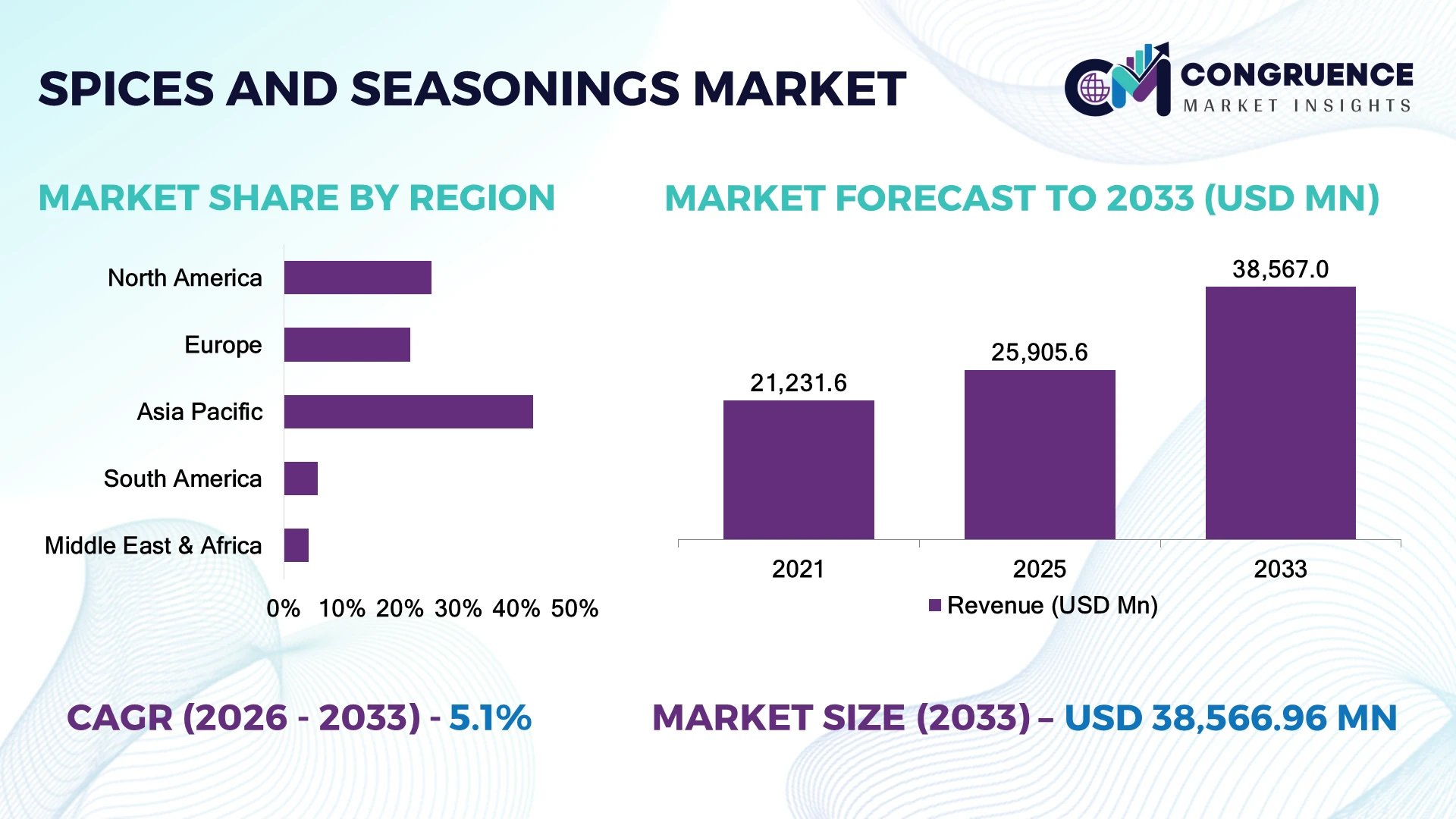
The Global Spices and Seasonings Market was valued at USD 25,905.6 Million in 2025 and is anticipated to reach a value of USD 38,567.0 Million by 2033 expanding at a CAGR of 5.1% between 2026 and 2033. Growth is driven by clean-label seasoning reformulation, processed-food diversification, ethnic flavor expansion, convenience-food consumption, and greater demand for traceable, standardized spice ingredients.
India remains the dominant production and processing hub, accounting for roughly 45% of global spice production, while China represents a major competing supply base for pepper, garlic, ginger, and dehydrated ingredients. India's organized spice-processing sector is increasingly investing in steam sterilization, oleoresin extraction, automated grinding, and traceability, with processed and value-added exports commanding substantially higher margins than bulk whole spices. Red Sea shipping disruptions in 2024–2026 have further encouraged inventory diversification and regional sourcing.
Suppliers with integrated sourcing, sterilization, standardized formulations, and traceable processing capacity are best positioned to capture premium global food-manufacturing demand.
The spices and seasonings market is expanding across packaged foods, sauces, snacks, meat products, ready meals, bakery, and foodservice. Chili, pepper, turmeric, cumin, garlic, ginger, and mixed seasonings remain core demand categories, while clean-label blends are gaining traction. Approximately 30–35% of premium food formulations increasingly emphasize recognizable natural ingredients. Steam sterilization, optical sorting, automated blending, and traceability are strengthening quality control as shipping disruptions encourage diversified sourcing.
Spices and seasonings are becoming strategically important food ingredients because manufacturers increasingly use flavor systems to differentiate products while controlling formulation complexity and label requirements. Demand is shifting from bulk commodities toward standardized blends, extracts, sterilized ingredients, and application-specific seasoning systems. In 2026, supply-chain resilience is also becoming a procurement priority as weather variability, freight disruptions, and geopolitical tensions affect origin availability and lead times.
Technology is widening the gap between commodity processing and high-value ingredient manufacturing. Automated optical sorting can improve foreign-material and quality detection while reducing manual inspection requirements by roughly 20–30%; automated blending can additionally improve formulation consistency by 8–12%. India retains strong upstream advantages, while the U.S. and Europe emphasize formulation technology, food safety, and premium clean-label applications.
Over the next 2–3 years, processors are expected to increase investment in sterilization, traceability, extraction, and automated packaging. A practical deployment is a fully integrated turmeric or chili line combining optical sorting, controlled drying, microbial treatment, grinding, and automated filling. Companies are responding through contract farming, multi-origin sourcing, processing expansion, and partnerships with food manufacturers. Competitive advantage will increasingly depend on controlling quality from farm to finished ingredient rather than simply securing low-cost raw material.
Clean-label reformulation is shifting food manufacturers from commodity spices toward standardized, traceable, and minimally processed ingredients. Natural seasoning systems now represent an estimated 30–35% of premium formulation demand, while demand for steam-sterilized ingredients has increased roughly 10–15% among industrial food processors. In the U.S. and Germany, tighter expectations around contaminant control are accelerating supplier qualification and validated processing. Indian processors are responding by expanding steam treatment, automated sorting, and controlled grinding capacity. The strategic advantage extends beyond food safety: standardized particle size and microbial control can reduce batch rejection by approximately 8–12%, allowing ingredient suppliers to compete on consistency and formulation performance rather than raw-material price alone.
Spice processors remain exposed to concentrated agricultural origins, creating substantial cost and availability pressure when weather disrupts harvests. India supplies a significant share of global chili, turmeric, cumin, and pepper requirements, while Vietnam is particularly important for pepper; adverse weather can produce 10–20% seasonal price movements in individual commodities. Imported raw material can also represent 50–70% of procurement costs for processors lacking integrated cultivation networks. Freight disruptions around the Red Sea have further complicated replenishment schedules. Companies are reducing exposure through multi-origin sourcing, contract farming, strategic inventories, and regional processing. A key operational insight is that supplier diversification increasingly protects production continuity even when diversified sourcing carries a modest procurement premium.
Advanced processing is opening higher-margin opportunities beyond conventional ground spices. Oleoresins, essential oils, sterilized powders, and application-specific seasoning blends can command 15–30% higher value than basic commodity formats, while automated optical sorting can improve defect detection by roughly 20–30%. India, Indonesia, and Vietnam offer strong opportunities for origin-linked processing, while U.S. and European food manufacturers increasingly seek customized flavor systems. Companies are investing in extraction units, low-temperature drying, AI-assisted sorting, and formulation laboratories. The less obvious opportunity is converting agricultural variability into standardized ingredient specifications: processors that control moisture, particle size, microbial load, and flavor intensity can secure longer-term contracts with multinational food manufacturers.
End-to-end traceability is becoming increasingly difficult as spice supply chains combine smallholder farms, aggregators, exporters, processors, and multiple trading jurisdictions. Digitized traceability coverage remains uneven, while manual documentation can account for 10–15% of procurement administration in fragmented sourcing networks. Residue, adulteration, and microbial testing requirements can add 5–10% to processing workflows for high-risk ingredients. India and Southeast Asian origins face particular complexity when suppliers operate across dispersed agricultural communities. Companies must invest in digital supplier mapping, rapid testing, batch-level serialization, and farmer partnerships. The strategic challenge is integrating traceability without making premium ingredients prohibitively expensive; efficient digital documentation and centralized quality laboratories will determine scalability.
Steam Sterilization Becomes Standardized: Food processors are increasing use of validated steam treatment as microbial-control expectations tighten, with sterilized spice demand estimated to rise 10–15% across industrial applications. Indian and European processors are expanding treatment capacity, while automated moisture monitoring helps limit post-treatment quality losses to below 5%.
Optical Sorting Replaces Manual Inspection: Automated cameras and machine-vision systems are increasingly deployed for color, foreign-material, size, and defect detection. Modern systems can improve inspection throughput by 20–30% while reducing manual sorting requirements by roughly 15–20%. Processors in India and Vietnam are scaling automation to improve consistency and labor productivity.
Blends Become More Application-Specific: Food manufacturers are shifting from generic seasoning mixes toward customized formulations for snacks, sauces, meat alternatives, and ready meals. Customized blends can command 10–20% higher ingredient value, encouraging processors to establish dedicated formulation laboratories and smaller flexible production lines. This shift also strengthens supplier relationships with packaged-food manufacturers.
Origin Diversification Reshapes Procurement: Weather volatility and shipping disruptions are encouraging buyers to qualify multiple origins for pepper, chili, cumin, and turmeric. Multi-origin procurement can reduce disruption exposure by approximately 15–20%, although maintaining equivalent flavor specifications remains difficult. Large processors are responding through contract farming, regional inventories, and standardized raw-material testing across sourcing locations.
Whole and ground spices collectively represent the leading type, accounting for approximately 55–60% of global spices and seasonings demand because they offer broad culinary applicability, established sourcing networks, and comparatively straightforward processing. Ground spices hold the larger portion within this category, while whole spices remain important for foodservice and traditional cooking. Spice blends are the fastest-growing type, with an estimated 10–15% adoption increase across packaged foods as manufacturers seek consistent flavor profiles and shorter formulation cycles. Herbs, extracts, oleoresins, and specialty seasoning systems remain smaller but generate higher value through standardized flavor intensity and application-specific performance.
Food manufacturers are shifting investment toward blended and processed formats because customized systems can command roughly 15–25% higher value than commodity spice inputs. Extracts and oleoresins also reduce formulation variability by approximately 10–15%. Companies are expanding blending facilities, formulation laboratories, and contract-farming networks, particularly in India, China, Vietnam, and the U.S., where supply assurance increasingly determines premium ingredient contracts.
Processed foods represent the leading application, accounting for approximately 38–42% of global spices and seasonings consumption, supported by snacks, sauces, ready meals, processed meats, bakery products, and convenience foods. Manufacturers increasingly use standardized seasoning systems to maintain flavor consistency across high-volume production. Foodservice follows with roughly 25–29%, while household cooking remains important but is more fragmented. Packaged-food applications in the U.S., Germany, India, and China increasingly favor clean-label blends and reduced-sodium formulations, encouraging suppliers to develop application-specific flavor systems.
Snacks and ready-to-eat meals represent the fastest-growing application cluster, with seasoning intensity and flavor experimentation driving approximately 10–15% higher formulation activity than traditional packaged-food categories. Sauces, meat products, bakery, beverages, and frozen foods continue generating diversified demand. Companies are responding with automated micro-dosing, customized blending, and co-development programs that can shorten seasoning reformulation cycles by 15–20%. The strategic shift is from selling individual spices toward integrated flavor solutions that improve consistency, speed commercialization, and simplify ingredient procurement.
Food and beverage manufacturers account for approximately 55–60% of global spices and seasonings demand, reflecting their large-scale use in snacks, sauces, prepared foods, meat products, bakery, and beverage formulations. Procurement is increasingly specification-driven, with multinational manufacturers requiring consistent microbial limits, moisture, particle size, color, and flavor intensity. Foodservice represents approximately 25–30%, while household consumption accounts for the remaining share. Industrial buyers typically prioritize supply continuity and standardized blends, whereas restaurants and catering operators place greater emphasis on flavor customization and menu differentiation.
Foodservice is the fastest-growing end-user group, supported by restaurant expansion, delivery-oriented menus, and demand for standardized seasoning across multi-location operations. Premium foodservice buyers can spend approximately 10–20% more on customized blends and portion-controlled formats. Retail households remain strategically important for branded spice companies, particularly in India and the U.S. Suppliers are responding through private-label partnerships, chef-developed blends, foodservice packs, and direct formulation support. This is shifting competitive advantage toward suppliers capable of serving both high-volume industrial contracts and smaller customized orders.
Asia-Pacific accounted for the largest market share at 42.8% in 2025 however, Middle East & Africa is expected to register the fastest growth, expanding at a CAGR of 5.9% between 2026 and 2033.

Clean-label reformulation strengthens demand for standardized seasoning systems
North America accounted for approximately 25.4% of the global spices and seasonings market in 2025, with the U.S. representing the dominant demand center through packaged foods, foodservice, snacks, sauces, and processed meat applications. Industrial buyers increasingly specify steam-sterilized, traceable, low-contaminant ingredients, strengthening demand for processed rather than bulk spices. Clean-label seasoning systems account for an estimated 35–40% of premium food formulation activity. Automated blending and optical sorting are also expanding across large processing facilities, improving batch consistency and reducing manual inspection requirements by approximately 15–20%. Companies are strengthening domestic inventory positions and qualifying alternative origins to manage freight volatility and agricultural supply disruptions.
U.S. Market Outlook:
The U.S. remains the region's principal commercial market because of its extensive packaged-food manufacturing base and sophisticated ingredient procurement infrastructure. Large processors increasingly require documented allergen controls, microbial specifications, and batch-level traceability from spice suppliers. Customized seasoning blends are gaining importance in snacks, sauces, meat alternatives, and ready meals. Suppliers with formulation laboratories and rapid prototyping capabilities can shorten customer reformulation cycles by approximately 15–20%, creating a strong advantage in private-label and multinational food accounts.
Food-safety compliance and clean-label reformulation reshape sourcing
Europe represented approximately 21.7% of global spices and seasonings demand in 2025, with Germany, the U.K., France, the Netherlands, and Spain forming major processing and consumption centers. Stringent contaminant controls and traceability expectations are pushing food manufacturers toward validated sterilization, controlled sourcing, and standardized ingredient specifications. Natural spice-based flavor systems increasingly replace synthetic flavoring components in selected formulations, while demand for reduced-sodium blends is expanding product development activity. European processors are also strengthening supplier audits and multi-origin procurement, with diversified sourcing reducing exposure to individual origin disruptions by an estimated 15–20%.
Germany Market Outlook:
Germany represents a strategically important market because of its large packaged-food, meat-processing, bakery, and convenience-food industries. Industrial buyers emphasize microbiological safety, pesticide-residue compliance, and consistent flavor intensity, favoring suppliers with advanced testing and sterilization infrastructure. Automated grinding and blending systems are increasingly deployed in large processing operations, improving production consistency by roughly 10–15%. German food manufacturers are also expanding clean-label and reduced-sodium product lines, creating opportunities for customized seasoning suppliers.
Processing scale and origin integration reinforce regional supply leadership
Asia-Pacific accounted for approximately 42.8% of global spices and seasonings demand in 2025, supported by India's dominant cultivation and processing base and substantial food-manufacturing capacity in China, Indonesia, Vietnam, Japan, and Thailand. India remains a critical source for turmeric, chili, cumin, and coriander, while Vietnam is strategically important for pepper. Processing investments are shifting toward steam sterilization, optical sorting, oleoresin extraction, and automated packaging. Large processors increasingly integrate sourcing and processing to improve traceability and reduce intermediate handling losses by approximately 10–15%.
India Market Outlook:
India is the region's most strategically significant market because it combines extensive spice cultivation with established export-processing infrastructure and a rapidly expanding packaged-food industry. Major processing centers across Kerala, Andhra Pradesh, Telangana, Gujarat, Rajasthan, and Karnataka support diverse spice categories. Value-added exports, sterilized ingredients, oleoresins, and customized blends are gaining importance. Automated sorting and quality-control systems can reduce manual inspection requirements by approximately 20–30%, encouraging processors to invest in higher-throughput facilities and integrated farmer-sourcing networks.
Food processing expansion strengthens demand for value-added flavor systems
South America accounted for approximately 5.8% of global spices and seasonings demand in 2025, with Brazil representing the region's principal consumption and processing center. Demand is concentrated in packaged foods, sauces, meat products, snacks, and foodservice, while Argentina and Chile provide additional opportunities for processed-food applications. Brazil's large meat-processing industry creates substantial demand for paprika, pepper, garlic, onion, and customized seasoning blends. Local processors are increasing automated grinding, blending, and packaging capacity, reducing manual handling requirements by approximately 10–15%. Currency volatility and imported-input exposure remain operational considerations, encouraging distributors to maintain larger inventories and establish multi-origin procurement arrangements.
Brazil Market Outlook:
Brazil offers the strongest commercial opportunity because of its extensive processed-meat, snack, sauce, and convenience-food industries. São Paulo, Paraná, Santa Catarina, and Minas Gerais form important food-processing clusters where industrial seasoning demand is concentrated. Meat processors increasingly require standardized blends that deliver consistent flavor across high-volume production. Customized seasoning systems can generate approximately 10–20% higher ingredient value than basic commodity spices, encouraging suppliers to establish application laboratories, technical sales teams, and direct partnerships with major food manufacturers.
Foodservice modernization and local processing strengthen premium demand
Middle East & Africa represented approximately 7.3% of global spices and seasonings demand in 2025, with Saudi Arabia, the UAE, Egypt, South Africa, and Morocco forming major commercial centers. Rapid hospitality development, modern retail expansion, and food-processing investments are increasing demand for standardized blends, dried herbs, pepper, chili, turmeric, and specialty seasoning systems. Gulf markets are particularly receptive to premium imported ingredients, while Egypt and Morocco provide stronger processing and agricultural linkages. Large foodservice operators are adopting centralized seasoning specifications, potentially reducing flavor inconsistency across locations by 10–15%. Suppliers are responding with regional warehouses, foodservice partnerships, and localized blending facilities.
Saudi Arabia Market Outlook:
Saudi Arabia is the region's most strategically important market due to expanding hospitality infrastructure, foodservice modernization, and domestic food-production investment. Riyadh, Jeddah, and major tourism-development zones are creating demand for standardized seasoning systems across hotels, restaurants, catering operations, and packaged foods. Large-scale foodservice procurement increasingly favors portion-controlled and customized blends that simplify kitchen operations. Suppliers with regional warehousing and application support can reduce replenishment lead times by approximately 15–20%, strengthening their position in institutional and hospitality contracts.
McCormick, Olam Food Ingredients, Kerry, Ajinomoto, and Symrise compete as global flavor and ingredient leaders, while regional spice processors compete through cost, origin access, and customization. The top five hold an estimated 18% combined share. Competition centers on sourcing, processing, formulation technology, and supply reliability: customized blends command 15–25% premiums, automated sorting improves throughput 20–30%, and diversified sourcing can reduce disruption exposure 15–20%. McCormick is strengthening vertical integration, Ajinomoto is expanding Asian production, Kerry is combining flavor science with biotechnology, and Symrise is investing in precision fermentation. The competitive shift is moving from commodity spice trading toward standardized, traceable, application-specific flavor systems. Entry pressure remains high because food-safety validation, farmer networks, processing infrastructure, formulation expertise, and customer qualification require substantial investment. Winning requires secure origin access, validated processing, rapid formulation support, differentiated flavor technology, and the ability to deliver consistent ingredients at industrial scale across multiple markets.
Spice processing is shifting toward optical sorting, automated grinding, steam sterilization, precision drying, and digital batch monitoring. Machine-vision sorting can improve defect-detection throughput by roughly 20–30%, while automated blending improves formulation consistency by 8–12%. Adoption is strongest among large processors serving multinational food manufacturers, where traceability and microbial specifications increasingly determine supplier qualification.
Advanced extraction, oleoresin production, controlled-atmosphere storage, and AI-assisted formulation are expanding the value of processed ingredients. Compared with manual sorting and inspection, automated optical systems can reduce labor requirements by approximately 15–20% while increasing processing consistency. Kerry, Symrise, and other formulation specialists benefit from combining flavor science with biotechnology and predictive analytics, while origin-focused processors gain advantage from integrated sorting, sterilization, and packaging lines.
Between 2026 and 2028, precision fermentation, digital traceability, automated quality control, and AI-supported flavor development will become more commercially relevant. Precision processing can reduce batch rejection by approximately 8–12%, while digitally connected production improves documentation speed by 10–15%. Companies investing now in integrated processing and formulation platforms will gain faster product-development cycles, stronger supply resilience, and greater ability to convert variable agricultural inputs into standardized, higher-value ingredients.
January 2026 McCormick increased its ownership in McCormick de Mexico to 75%, investing $750 million. The transaction strengthens control of spices, sauces, and condiments, providing a platform for Latin American expansion and deeper regional supply-chain integration capabilities now. Source: mccormickcorporation.com
August 2025 Ajinomoto announced a Philippines factory with PHP9.1 billion investment, scheduled for April 2028 operation. The facility will produce flavored seasonings and breading mixes, using automation and digital transformation to improve labor and logistics efficiency across lines. Source: ajinomoto.com
October 2025 Symrise invested in U.S. biotechnology company Cellibre to commercialize fermentation-derived natural flavor ingredients. The partnership provides preferred access to precision-fermentation technology, improving supply resilience and supporting scalable, lower-impact alternatives to cultivation-dependent flavor inputs across global markets. Source: symrise.com
September 2025 Kerry launched Smart Taste, integrating flavor science, biotechnology, and AI-enabled development to address cost, supply, nutrition, and regulatory pressures. Its solutions can reduce cocoa usage up to 50%, demonstrating a shift toward efficient formulations. Source: kerry.com Kerry Group
The Spices and Seasonings Market Report covers whole spices, ground spices, spice blends, herbs, extracts, oleoresins, and specialty seasoning systems across processed foods, foodservice, household cooking, meat, snacks, sauces, bakery, and ready-to-eat applications. End-user analysis includes food and beverage manufacturers, foodservice operators, retailers, and households across North America, Europe, Asia-Pacific, South America, and Middle East & Africa.
The report evaluates steam sterilization, optical sorting, automated blending, precision drying, extraction, digital traceability, and emerging biotechnology applications. Whole and ground spices account for approximately 55–60% of demand, while customized blends and processed ingredients are gaining value through higher formulation specificity. Competitive coverage assesses major global suppliers, regional processors, sourcing models, technology adoption, and supply-chain integration. The findings support investment planning, geographic expansion, product development, sourcing strategy, competitive positioning, and strategic decision-making through 2026–2033.
| Report Attribute/Metric | Report Details |
|---|---|
|
Market Revenue in 2025 |
USD 25,905.6 Million |
|
Market Revenue in 2033 |
USD 38,567.0 Million |
|
CAGR (2026 - 2033) |
5.1% |
|
Base Year |
2025 |
|
Forecast Period |
2026 - 2033 |
|
Historic Period |
2021 - 2025 |
|
Segments Covered |
By Type
By Application
By End-User
|
|
Key Report Deliverable |
Revenue Forecast, Growth Trends, Market Dynamics, Segmental Overview, Regional and Country-wise Analysis, Competition Landscape |
|
Region Covered |
North America, Europe, Asia-Pacific, South America, Middle East, Africa |
|
Key Players Analyzed |
McCormick & Company, Inc., Olam Food Ingredients, Kerry Group plc, Ajinomoto Co., Inc., Symrise AG, International Flavors & Fragrances Inc., Givaudan SA, Sensient Technologies Corporation, Döhler GmbH, Nedspice Group, Everest Spices, DS Group, Bart Ingredients Company, Fuchs Gruppe |
|
Customization & Pricing |
Available on Request (10% Customization is Free) |




