
Reports
The Global Spend Analytics Market was valued at USD 2851.8 Million in 2025 and is anticipated to reach a value of USD 8845.8 Million by 2033 expanding at a CAGR of 15.2% between 2026 and 2033. Growth is accelerating through enterprise AI procurement platforms, supplier risk monitoring, ESG-driven sourcing requirements, and digital procurement modernization across manufacturing, healthcare, retail, and financial services.
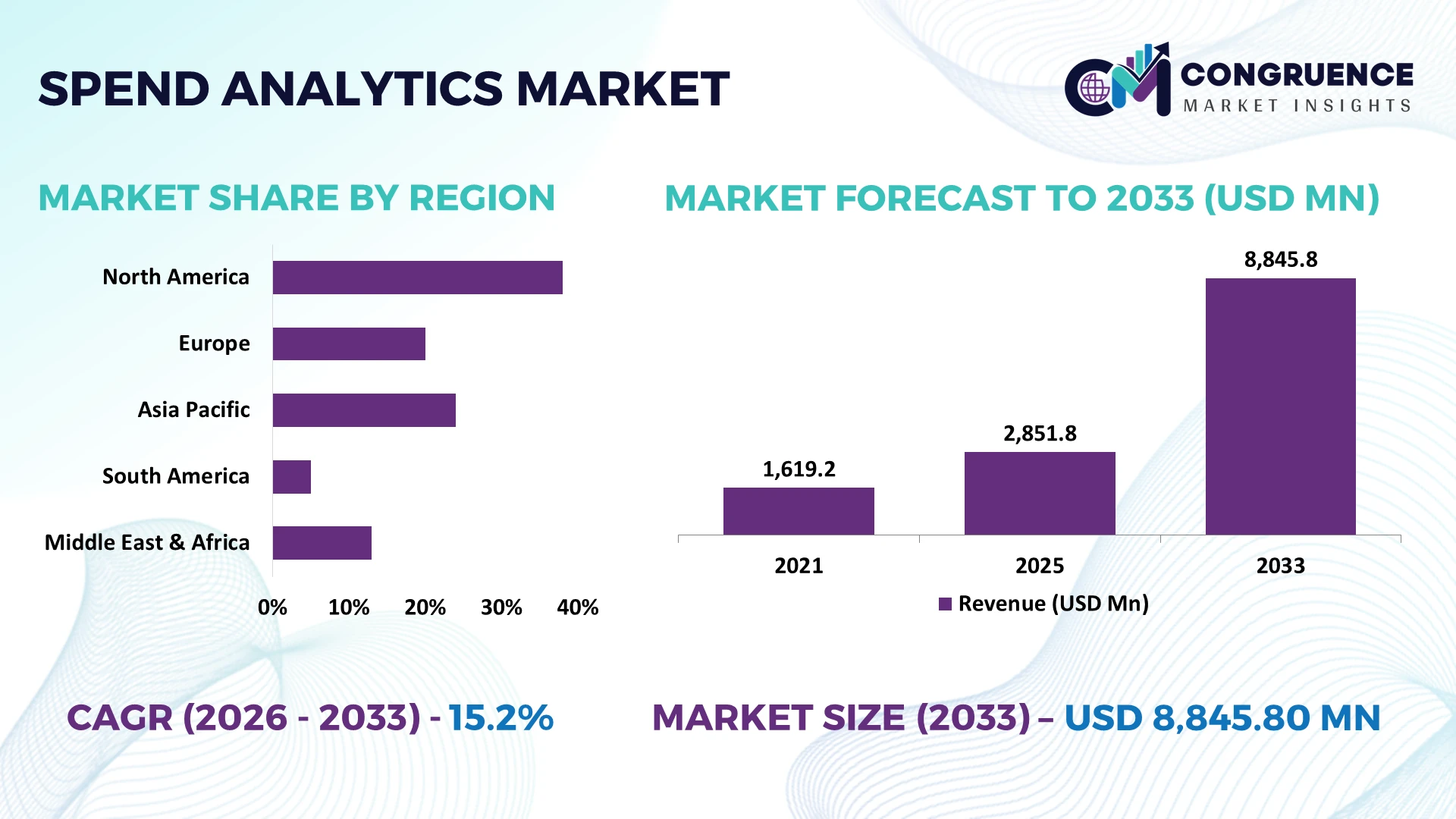
The United States leads the global spend analytics market with approximately 36% share, supported by enterprise-scale procurement transformation, AI deployment exceeding 68% among large organizations, and sustained investment across healthcare, aerospace, retail, and government procurement. Compared with Germany, where manufacturing-led procurement digitization remains strong at nearly 24% enterprise adoption growth, the U.S. benefits from broader cloud integration following supply-chain diversification strategies shaped by post-Red Sea logistics disruptions and resilient sourcing initiatives in 2026.
Organizations prioritizing AI-powered spend visibility, supplier intelligence, and procurement automation gain stronger cost control, compliance, and sourcing resilience in an increasingly competitive global market.
Market Size & Growth: USD 2851.8 Million in 2025 is projected to reach USD 8845.8 Million by 2033 at 15.2% CAGR, driven by AI-enabled procurement transformation and supplier intelligence.
Top Growth Drivers: AI-based spend classification improves accuracy by 40%, cloud procurement adoption exceeds 62%, and supplier risk monitoring increases sourcing efficiency by 28%.
Short-Term Forecast: By 2028, enterprises reduce procurement cycle times by 30% while increasing spend visibility by over 35% through advanced analytics.
Emerging Technologies: Generative AI, predictive analytics, and process automation improve procurement productivity by nearly 32% across global enterprises.
Regional Leaders: North America approaches USD 3.2 Billion, Europe exceeds USD 2.1 Billion, and Asia-Pacific nears USD 2.6 Billion, supported by rapid enterprise cloud procurement expansion.
Consumer/End-User Trends: More than 65% of large enterprises integrate spend analytics with ERP and sourcing platforms for centralized procurement intelligence.
Pilot/Case Example: In 2026, enterprise procurement modernization projects delivered supplier onboarding improvements of 27% and purchasing cost reductions of 18%.
Competitive Landscape: SAP holds roughly 17% market presence alongside Oracle, Coupa, Ivalua, and Jaggaer, competing through AI-driven procurement innovation.
Regulatory & ESG Impact: ESG reporting requirements improve supplier transparency by approximately 30%, strengthening compliance across international procurement operations.
Investment & Funding: More than USD 1.8 Billion supports platform expansion, AI integration, strategic partnerships, and procurement technology modernization amid global supply-chain realignment.
Innovation & Future Outlook: Autonomous sourcing, real-time supplier intelligence, and embedded AI accelerate strategic procurement decisions while strengthening enterprise resilience.
Enterprise demand for spend analytics is expanding across procurement optimization, supplier performance management, contract compliance, and financial planning. AI-powered spend classification and predictive sourcing tools improve analytical accuracy by nearly 35%, enabling faster procurement decisions. Increasing regulatory reporting requirements and continued supply-chain diversification in 2026 are accelerating adoption of integrated spend intelligence platforms, setting the foundation for the following strategic market assessment.
Spend analytics has become a strategic capability as enterprises prioritize procurement resilience, supplier transparency, and cost optimization amid supply-chain restructuring and stricter procurement governance. Organizations are shifting from reactive purchasing to predictive spend intelligence, enabling faster sourcing decisions and stronger contract compliance. Digital procurement integration has exceeded 65% among large enterprises, while supplier risk monitoring has become a core investment priority following continued global logistics disruptions in 2026.
AI-powered spend analytics platforms process procurement data approximately 45% faster than legacy spreadsheet-based systems while improving spend classification accuracy by nearly 35%, reducing manual intervention and contract leakage. The United States leads enterprise-scale deployment through cloud-based procurement ecosystems, whereas Germany emphasizes manufacturing-focused supplier analytics integrated with Industry 4.0 operations. This contrast highlights differences between digital procurement maturity and industrial specialization. Over the next two to three years, automated supplier intelligence is expected to exceed 70% adoption among large multinational procurement organizations.
A practical example is multinational manufacturers integrating spend analytics with ERP and supplier management platforms to identify sourcing risks before procurement cycles begin, reducing purchasing delays by nearly 25%. Companies are expanding AI capabilities, strengthening strategic technology partnerships, and investing in procurement automation to improve operational resilience. Organizations that combine real-time supplier intelligence with predictive procurement analytics will secure stronger competitive positioning, lower sourcing costs, and greater long-term procurement agility.
Enterprise procurement transformation remains the strongest growth catalyst as organizations replace fragmented purchasing systems with AI-driven spend intelligence platforms. More than 68% of large enterprises have accelerated procurement digitization, while automated spend classification improves analytical accuracy by approximately 35% and reduces sourcing cycle times by nearly 30%. The United States continues expanding digital procurement frameworks following supply-chain diversification initiatives triggered by global logistics disruptions. This structural shift enables procurement teams to identify supplier risks earlier and negotiate stronger contracts. Technology providers are responding through AI platform expansion, cloud-based procurement partnerships, and embedded predictive analytics. A notable strategic advantage is that organizations using unified spend intelligence increasingly shift procurement teams from transactional purchasing toward value-driven supplier portfolio management.
Fragmented procurement data and limited interoperability continue restricting enterprise-scale spend analytics deployment. Nearly 42% of organizations still operate multiple disconnected ERP, finance, and procurement systems, while inconsistent supplier master data reduces analytical accuracy by almost 28%. Large manufacturing enterprises in Japan frequently encounter integration complexity across legacy procurement environments, increasing implementation costs and slowing operational standardization. These structural limitations reduce visibility into enterprise-wide spending, delaying sourcing decisions and compliance monitoring. Companies are addressing the issue through standardized data governance, supplier master-data harmonization, cloud migration, and long-term software integration partnerships. Organizations that establish unified procurement data architectures achieve stronger purchasing transparency and significantly improve enterprise-wide decision consistency.
Predictive analytics combined with generative AI is creating new value beyond traditional spend reporting. Automated supplier intelligence can improve sourcing efficiency by approximately 32%, while predictive procurement models reduce contract leakage by nearly 20% through proactive purchasing recommendations. India is emerging as an important deployment hub as enterprises accelerate digital procurement modernization and AI-enabled finance transformation. Government-supported digital business infrastructure and expanding cloud adoption continue strengthening enterprise software implementation. Technology vendors are investing in AI research, ecosystem partnerships, and intelligent procurement assistants capable of recommending sourcing strategies in real time. A significant strategic opportunity lies in transforming spend analytics from a reporting application into an autonomous procurement decision-support platform that continuously optimizes supplier performance.
Long-term market expansion depends on securely scaling analytics across complex enterprise ecosystems. Around 57% of procurement leaders identify cybersecurity and third-party data governance as major deployment concerns, while integrating hundreds of supplier databases can increase implementation timelines by nearly 30%. Enterprises in the United Kingdom face increasing pressure to strengthen procurement transparency alongside evolving digital compliance requirements. As AI adoption expands, maintaining data quality, explainable analytics, and secure cross-platform integration becomes increasingly important for enterprise trust. Companies are investing in zero-trust security frameworks, advanced data governance, workforce upskilling, and secure API architectures to support scalable deployment. Organizations that successfully balance AI automation with robust governance will establish sustainable operational advantages and maintain long-term procurement competitiveness.
AI-Native Procurement Intelligence Enterprise procurement teams are replacing rule-based analytics with AI-native spend intelligence capable of classifying transactions nearly 35% faster while improving supplier matching accuracy by approximately 30%. More than 65% of large enterprises now integrate procurement analytics with ERP platforms to automate purchasing workflows. Technology vendors are expanding strategic AI partnerships and embedding predictive recommendations into procurement suites, enabling faster sourcing decisions and measurable reductions in manual processing amid continued digital procurement transformation.
Supplier Risk Visibility Expansion Ongoing supply-chain restructuring and stricter supplier governance are driving wider deployment of real-time supplier monitoring. Around 58% of multinational organizations now evaluate geopolitical, financial, and ESG risks during sourcing, while continuous supplier monitoring reduces procurement disruptions by almost 22%. Companies in the United States and Japan are restructuring supplier portfolios, expanding regional sourcing networks, and deploying integrated risk dashboards to strengthen operational resilience against logistics uncertainty and evolving compliance expectations.
Embedded Analytics Across Operations Spend analytics is moving beyond procurement into finance, operations, and strategic planning. Cross-functional analytics deployments have increased by approximately 40%, while integrated workflow automation shortens purchasing approval cycles by nearly 27%. Organizations are standardizing enterprise data models and adopting cloud-native procurement ecosystems. Software providers continue expanding interoperability through API partnerships, allowing finance and procurement teams to generate unified spending intelligence without duplicating operational processes.
Sustainability-Driven Procurement Decisions Procurement organizations increasingly combine spend visibility with sustainability metrics as supplier transparency requirements intensify. More than 52% of enterprise sourcing programs now incorporate ESG performance into supplier evaluations, reducing compliance reporting effort by approximately 20%. European manufacturers are aligning procurement strategies with evolving sustainability regulations, while technology providers integrate carbon reporting, supplier scorecards, and automated compliance monitoring to strengthen long-term sourcing governance and procurement accountability.
Cloud-Based solutions lead the spend analytics market with an estimated 46% market share because they provide scalable deployment, centralized data management, and seamless integration with ERP, procurement, and finance platforms. Organizations increasingly prefer cloud deployments to support global supplier networks and real-time analytics without maintaining complex infrastructure. Software remains a core segment by delivering advanced analytics, AI-driven classification, and reporting capabilities, while Services continue supporting implementation, customization, integration, and managed optimization across enterprise procurement environments.
Cloud-Based deployment also represents the fastest-growing type as enterprises accelerate digital procurement modernization and multi-location sourcing visibility. Adoption of cloud procurement platforms has exceeded 64% among large organizations, while implementation timelines are approximately 30% shorter than traditional On-Premises deployments. On-Premises solutions remain strategically relevant for highly regulated industries requiring greater data control. Vendors are expanding AI functionality, strengthening cloud partnerships, and enhancing managed services to improve customer retention and enterprise scalability, shifting investment priorities toward subscription-based procurement intelligence ecosystems.
Procurement Analytics accounts for approximately 38% of application demand as organizations prioritize supplier performance, purchasing efficiency, and enterprise-wide cost visibility. Companies increasingly deploy predictive procurement intelligence to identify spending patterns, negotiate stronger supplier agreements, and automate sourcing decisions. Spend Visibility remains a mature application supporting centralized financial oversight, while Contract Management improves compliance monitoring and purchasing governance across complex supplier ecosystems.
Cost Optimization represents the fastest-growing application as enterprises seek measurable operational savings through AI-enabled purchasing recommendations and automated spend controls. Organizations deploying advanced procurement analytics report purchasing efficiency improvements of nearly 29%, while integrated supplier management platforms reduce sourcing delays by approximately 24%. Supplier Management continues expanding through real-time performance monitoring and supplier risk evaluation. Technology providers are enhancing workflow automation, embedded AI capabilities, and procurement integrations, allowing enterprises to scale intelligent purchasing operations while strengthening long-term supplier collaboration and operational discipline.
Manufacturing represents the largest end-user segment with an estimated 34% market share because of its extensive supplier ecosystems, multi-tier sourcing operations, and continuous procurement requirements. Manufacturers depend on spend analytics to optimize raw material purchasing, improve supplier performance, and strengthen inventory planning. BFSI remains a significant adopter through centralized procurement governance, while Government organizations increasingly deploy analytics to improve procurement transparency and contract oversight across public-sector purchasing programs.
Healthcare is the fastest-growing end-user segment as hospitals and healthcare networks modernize procurement systems to manage medical supplies, pharmaceutical sourcing, and supplier compliance. Healthcare organizations have increased digital procurement investments by approximately 31%, while Retail enterprises improve purchasing agility through AI-enabled demand forecasting and supplier optimization. More than 62% of large procurement-intensive organizations now integrate spend analytics into enterprise procurement workflows. Vendors are responding through industry-specific solutions, strategic partnerships, and customized deployment models that address unique procurement requirements across healthcare, manufacturing, retail, BFSI, and government sectors.
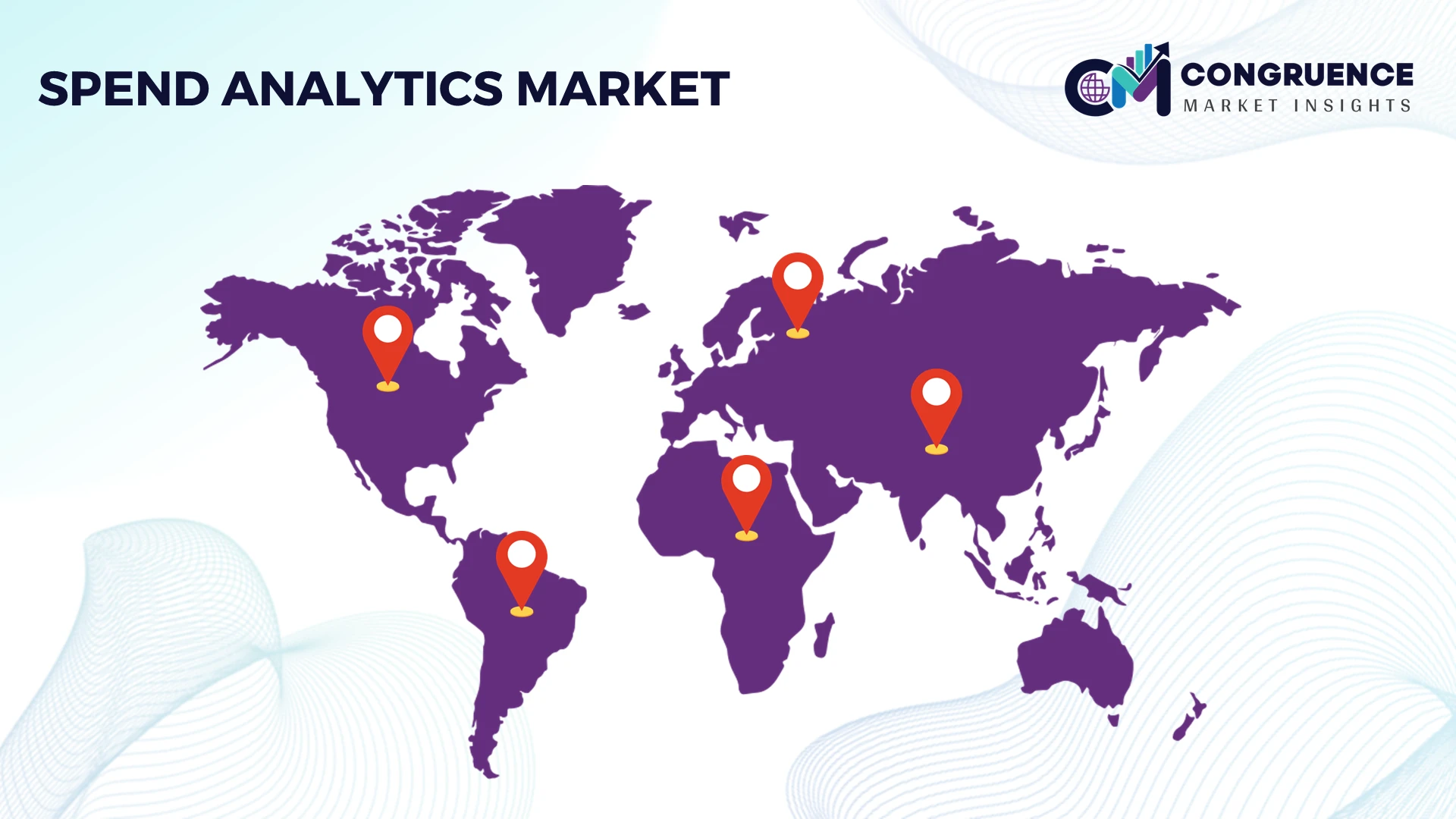
North America accounted for the largest market share at 39.2% in 2025 however, Asia-Pacific is expected to register the fastest growth, expanding at a 17.4% between 2026 and 2033.
Enterprise AI Procurement Leadership and Cloud Integration
North America remains the leading regional market due to widespread deployment of AI-enabled procurement platforms, mature cloud infrastructure, and large-scale enterprise digital transformation. Approximately 72% of Fortune 1000 organizations have integrated spend analytics into procurement and finance operations, strengthening supplier governance and purchasing transparency. The region contributes nearly 39.2% of global market demand, supported by healthcare, manufacturing, retail, and financial services. Procurement automation continues reducing sourcing cycle times by almost 30%, while enterprise investments increasingly focus on predictive supplier intelligence and contract optimization. Technology vendors are expanding strategic alliances with ERP providers and cloud platforms to accelerate implementation. Continued supply-chain resilience initiatives and procurement modernization programs are strengthening enterprise adoption across both private and public sectors, reinforcing North America's operational leadership in advanced procurement intelligence.
United States Market Outlook: The United States leads regional deployment through extensive enterprise software adoption, advanced cloud infrastructure, and strong procurement digitalization across manufacturing, healthcare, defense, and financial services. More than 68% of large enterprises utilize AI-supported procurement analytics to improve supplier performance and purchasing decisions. Organizations continue investing in intelligent sourcing platforms, integrated ERP ecosystems, and predictive procurement technologies, strengthening operational efficiency while supporting resilient domestic and international supplier networks.
Regulatory Compliance Driving Intelligent Procurement
Europe continues strengthening its position through procurement transparency initiatives, sustainability reporting requirements, and enterprise digital modernization. The region accounts for approximately 28.1% of global market activity, supported by strong adoption across manufacturing, automotive, pharmaceuticals, and public procurement. More than 61% of large organizations have expanded digital procurement programs to improve supplier compliance and contract governance. ESG-focused procurement strategies are accelerating demand for integrated supplier monitoring and spend visibility platforms. Technology providers are increasing partnerships with enterprise software vendors to deliver automated compliance capabilities and AI-driven procurement analytics. Modernization of procurement operations remains closely aligned with evolving regulatory frameworks, encouraging organizations to standardize purchasing processes while improving supplier accountability.
Germany Market Outlook: Germany remains the region's technology leader through its advanced manufacturing base, Industry 4.0 integration, and enterprise procurement digitization. Nearly 64% of major industrial companies have adopted cloud-enabled procurement platforms supporting supplier analytics and purchasing optimization. Manufacturers continue integrating spend intelligence with production planning systems to improve sourcing efficiency, strengthen supplier collaboration, and reduce procurement complexity across global industrial supply networks.
Rapid Enterprise Digital Procurement Expansion
Asia-Pacific is becoming the fastest-expanding regional market as enterprises accelerate cloud adoption, procurement modernization, and AI-enabled business transformation. The region represents approximately 23.4% of current global demand while recording the highest deployment momentum across manufacturing, technology, retail, and logistics sectors. Enterprise procurement digitization has increased by nearly 33% during the past two years, supported by expanding cloud infrastructure and digital business initiatives. Companies are deploying centralized spend intelligence platforms to improve supplier visibility and purchasing consistency across geographically dispersed operations. Software providers continue expanding regional partnerships and localized implementation capabilities to address increasing enterprise demand for scalable procurement automation.
China Market Outlook: China leads regional adoption through its extensive manufacturing ecosystem, digital enterprise investments, and large supplier networks. More than 66% of leading industrial enterprises have accelerated procurement digitalization initiatives integrating AI-powered spend analytics with ERP platforms. Domestic technology providers and multinational software companies continue expanding localized cloud services, strengthening procurement visibility while supporting complex manufacturing and export-oriented supply chains.
Enterprise Modernization Supporting Procurement Visibility
South America is experiencing steady adoption of spend analytics as enterprises modernize procurement functions across manufacturing, mining, retail, and financial services. The region contributes approximately 5.4% of global market demand, supported by increasing cloud deployment and procurement process standardization. Enterprise software implementation has expanded by nearly 24%, enabling better supplier monitoring and centralized purchasing oversight. Infrastructure limitations and uneven digital maturity continue affecting implementation speed, prompting organizations to prioritize phased deployment strategies. Technology providers are strengthening regional partnerships and expanding managed services to simplify adoption while improving procurement governance and operational transparency across large enterprises.
Brazil Market Outlook: Brazil represents the largest national market due to its diversified industrial economy, expanding enterprise software adoption, and growing procurement modernization initiatives. Around 58% of large corporations are integrating cloud-based procurement platforms with finance systems to improve purchasing efficiency and supplier visibility. Investments in digital transformation and enterprise automation continue strengthening procurement intelligence across manufacturing, retail, and financial services.
Digital Transformation Accelerates Procurement Investment
The Middle East & Africa market is strengthening through government-led digital transformation, enterprise modernization, and expanding cloud infrastructure investments. The region accounts for approximately 3.9% of global demand, with procurement digitization increasing across energy, government, healthcare, and financial services. Cloud procurement deployments have increased by nearly 29% as organizations seek improved supplier governance and purchasing transparency. Digital procurement initiatives are encouraging greater integration of AI-enabled analytics with enterprise resource planning systems. Software vendors are expanding regional implementation partnerships and investing in localized support capabilities to accelerate enterprise adoption while improving procurement efficiency across strategically important industries.
Saudi Arabia Market Outlook: Saudi Arabia leads regional momentum through large-scale digital transformation programs, smart government initiatives, and enterprise modernization across energy and public-sector procurement. Nearly 60% of major government organizations have expanded digital procurement capabilities supporting supplier transparency and purchasing efficiency. Continued investment in cloud infrastructure and enterprise technology ecosystems is strengthening demand for advanced spend analytics solutions across both public and private organizations.
The spend analytics market is led by SAP, Oracle, Coupa Software, Ivalua, and Jaggaer, while specialized analytics providers compete through AI innovation against enterprise software leaders with integrated procurement ecosystems. The top five players collectively control approximately 58% of the market, creating strong competition between full-suite procurement platforms and agile cloud-native vendors. Technology leadership, deployment speed, customization, and ERP interoperability determine competitive success more than pricing alone. AI-driven automation improves procurement efficiency by nearly 35%, while cloud-native implementation shortens deployment timelines by approximately 30%, strengthening competitive differentiation. Vendors continue expanding through strategic acquisitions, ecosystem partnerships, embedded generative AI, and deeper supplier intelligence capabilities. Competition is shifting toward unified procurement platforms combining spend visibility, contract intelligence, and predictive sourcing within a single workflow. High enterprise integration complexity and switching costs remain major entry barriers. Sustained success depends on delivering scalable AI, seamless interoperability, rapid implementation, and measurable procurement outcomes.
SAP
Oracle
Coupa Software
Jaggaer
Ivalua
Zycus
GEP
Proactis
Rosslyn Data Technologies
Sievo
SAS Institute
IBM
SynerTrade
Corcentric
AI-powered spend classification, cloud-native procurement platforms, and real-time supplier intelligence are redefining spend analytics across global enterprises. Machine learning improves transaction classification accuracy by approximately 35%, while intelligent data harmonization reduces manual cleansing effort by nearly 30%. More than 68% of large organizations now deploy cloud-integrated spend analytics connected with ERP, finance, and sourcing systems, enabling continuous spend visibility, stronger supplier governance, and faster procurement decisions across distributed operations.
Emerging technologies between 2026 and 2028 include generative AI procurement assistants, autonomous sourcing recommendations, graph-based supplier intelligence, and predictive contract analytics. These capabilities improve sourcing productivity by around 28% while reducing procurement cycle times by nearly 25%. Adoption of AI-assisted procurement workflows is expected to exceed 72% among multinational enterprises as organizations integrate spend analytics with contract management, supplier risk monitoring, and ESG reporting platforms. This convergence strengthens operational resilience while enabling procurement teams to shift from historical reporting toward real-time strategic decision support.
Compared with legacy spreadsheet-driven analysis, AI-enabled spend analytics delivers approximately 45% faster insight generation and 32% better supplier opportunity identification through automated pattern recognition. Global technology leaders benefit from scalable cloud ecosystems and embedded AI, while specialized procurement software vendors compete through faster deployment and industry-specific analytics. Organizations investing now secure stronger procurement agility, lower operating costs, and sustainable competitive differentiation before autonomous procurement becomes mainstream.
June 2025 Ivalua announced an independent Total Economic Impact study by Forrester showing customers achieved a 393% ROI, 80% faster supplier onboarding, and payback in under six months, reinforcing enterprise adoption of unified spend management platforms. Source:https://www.ivalua.com
December 2025 Coupa reported that organizations processed more than $425 billion in business spend during Q3 FY26, while AI-driven procurement generated almost $15 billion in customer savings through expanded deployment of Coupa Navi AI capabilities.
April 2026 Coupa signed a five-year strategic collaboration agreement with Amazon Web Services to accelerate AI-driven spend management, combining AWS AI services with Coupa's Business Trade Network to automate procurement workflows and strengthen multi-tier supply-chain visibility.
May 2026 SAP introduced its Autonomous Enterprise strategy, integrating SAP Business AI Platform with procurement and spend management workflows alongside partnerships with NVIDIA, Microsoft, Google Cloud, and AWS to improve enterprise automation and governance. Source: https://news.sap.com
This report provides a comprehensive assessment of the global spend analytics market, covering Cloud-Based, On-Premises, Software, and Services across Procurement Analytics, Supplier Management, Spend Visibility, Contract Management, and Cost Optimization applications. It evaluates adoption across BFSI, Healthcare, Manufacturing, Retail, and Government while analyzing competitive positioning, enterprise deployment strategies, procurement modernization, AI integration, and supplier intelligence. More than 65% enterprise cloud adoption and increasing AI-enabled procurement deployment are incorporated into the strategic assessment.
The report delivers detailed regional analysis across North America, Europe, Asia-Pacific, South America, and the Middle East & Africa, highlighting operational trends, technology adoption, enterprise investment priorities, and country-level market dynamics. It also examines emerging procurement technologies, ecosystem partnerships, competitive differentiation, and deployment models, enabling stakeholders to strengthen investment planning, expansion strategies, procurement transformation, and long-term competitive positioning throughout the 2026–2033 outlook period.
| Report Attribute/Metric | Report Details |
|---|---|
Market Revenue in 2025 | USD 2851.8 Million |
Market Revenue in 2033 | USD 8845.8 Million |
CAGR (2026 - 2033) | 15.2% |
Base Year | 2025 |
Forecast Period | 2026 - 2033 |
Historic Period | 2021 - 2025 |
Segments Covered | By Type
By Application
By End-User
|
Key Report Deliverable | Revenue Forecast, Growth Trends, Market Dynamics, Segmental Overview, Regional and Country-wise Analysis, Competition Landscape |
Region Covered | North America, Europe, Asia-Pacific, South America, Middle East, Africa |
Key Players Analyzed | SAP, Oracle, Coupa Software, Jaggaer, Ivalua, Zycus, GEP, Proactis, Rosslyn Data Technologies, Sievo, SAS Institute, IBM, SynerTrade, Corcentric |
Customization & Pricing | Available on Request (10% Customization is Free) |




