
Reports
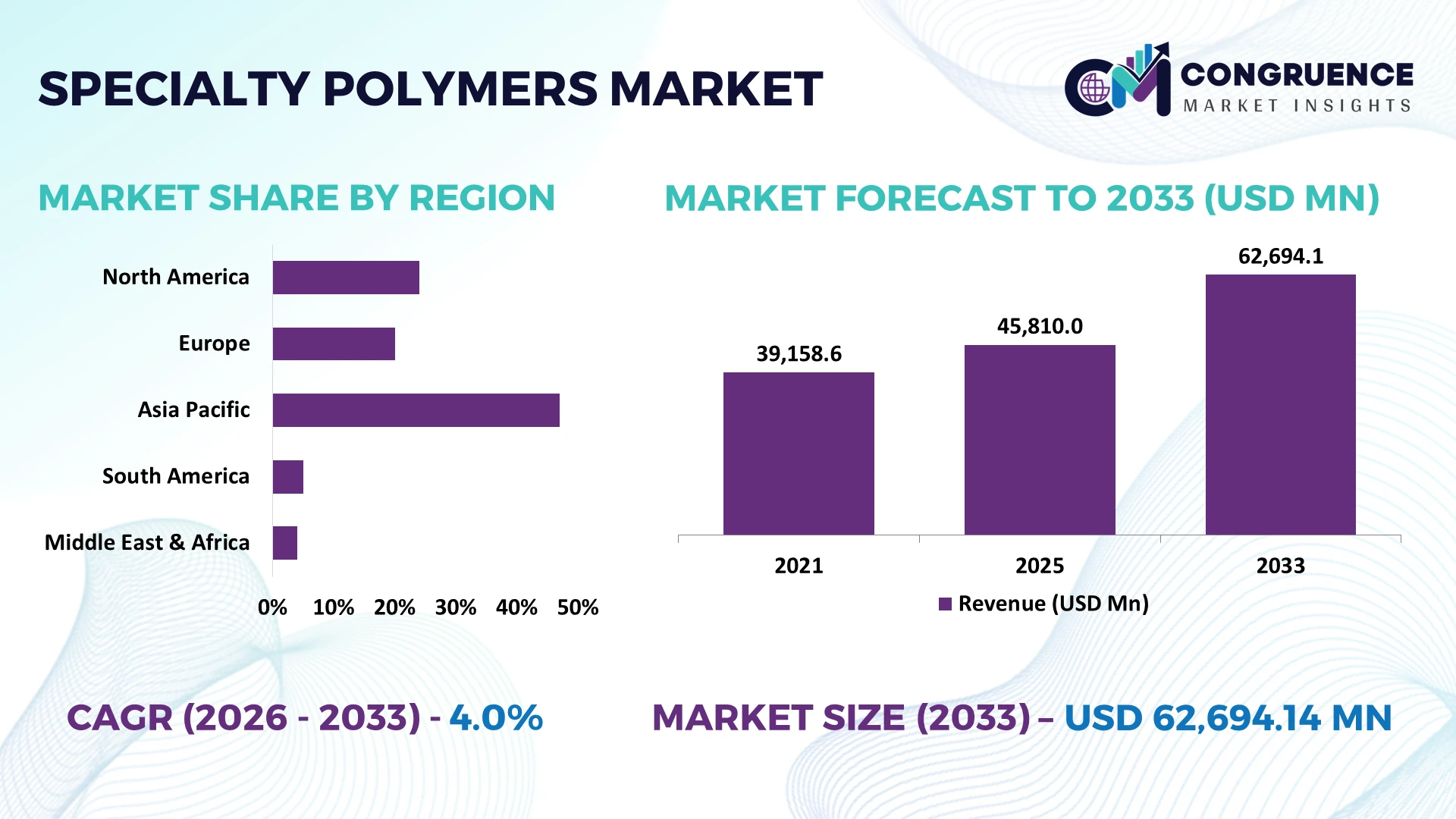
The Global Specialty Polymers Market was valued at USD 45810 Million in 2025 and is anticipated to reach a value of USD 62694.14 Million by 2033 expanding at a CAGR of 4% between 2026 and 2033. Growth is supported by rising deployment of high-performance polymers in electric vehicles, semiconductor manufacturing, medical devices, aerospace components, and advanced electronics requiring superior thermal, chemical, and mechanical performance.
The United States leads the global specialty polymers market with approximately 27% of global production capacity, supported by sustained investments in aerospace, semiconductor fabrication, and medical technology manufacturing. Japan accounts for nearly 15% of advanced polymer innovation, driven by precision electronics and high-performance engineering materials, while the U.S. maintains around 1.8× greater production capacity. Ongoing supply-chain diversification following global trade realignments continues to accelerate domestic manufacturing and advanced material adoption across strategic industries.
Businesses should prioritize regional manufacturing partnerships and high-value application segments to strengthen long-term competitiveness and supply resilience.
Market Size & Growth: USD 45810 Million in 2025 is projected to reach USD 62694.14 Million by 2033 at a CAGR of 4%, driven by expanding semiconductor, EV, and aerospace material requirements.
Top Growth Drivers: EV material demand contributes about 18% growth momentum, semiconductor applications 16%, and lightweight industrial components 14% through advanced polymer adoption.
Short-Term Forecast: By 2028, production efficiency improves nearly 12% while processing waste declines around 9% through digital manufacturing and process optimization.
Emerging Technologies: AI-enabled material design, advanced polymer compounding, and automated extrusion improve product development cycles by approximately 20%.
Regional Leaders: North America approaches USD 18.5 Billion, Asia-Pacific exceeds USD 23 Billion, and Europe reaches nearly USD 15 Billion, supported by regional manufacturing expansion and supply-chain localization.
Consumer/End-User Trends: More than 52% of advanced electronics and medical manufacturers prioritize specialty polymers for lightweight, heat-resistant, and chemically stable components.
Pilot/Case Example: In 2026, advanced automated polymer processing projects improved production throughput by approximately 15% while reducing material defects by nearly 10%.
Competitive Landscape: Leading manufacturers collectively account for approximately 42% market share, with Solvay, Arkema, BASF, Celanese, and SABIC strengthening portfolios through advanced material innovation.
Regulatory & ESG Impact: Sustainable manufacturing initiatives reduce production emissions by nearly 14% while supporting compliance with stricter industrial material regulations across major economies.
Investment & Funding: More than USD 4 Billion in manufacturing expansion and strategic partnerships accelerates high-performance polymer capacity amid global supply-chain diversification.
Innovation & Future Outlook: Next-generation recyclable specialty polymers, bio-based formulations, and high-temperature engineering materials strengthen long-term competitive positioning across high-growth industrial sectors.
Specialty Polymers Market demand continues to expand across electric mobility, advanced healthcare, semiconductor packaging, and aerospace manufacturing as manufacturers introduce recyclable high-performance formulations and AI-assisted material development. Nearly 22% of new product launches emphasize enhanced thermal stability and chemical resistance, while ongoing supply-chain regionalization and evolving environmental compliance standards accelerate localized production strategies, setting the stage for broader competitive and strategic market assessment.
Specialty polymers have become a strategic material platform as manufacturers compete to improve product performance, localize supply chains, and secure advanced manufacturing capabilities. Industries including semiconductors, aerospace, medical devices, and electric mobility increasingly rely on high-performance polymers to replace conventional materials while meeting stricter performance specifications. The ongoing restructuring of global supply chains since recent geopolitical trade shifts has accelerated investments in domestic production, creating stronger procurement resilience and reducing dependence on single-country sourcing.
Advanced polymer processing integrated with AI-assisted formulation reduces product development cycles by nearly 20% compared with conventional trial-and-error methods while lowering material waste by approximately 12%. The United States maintains leadership in high-value aerospace and medical polymer applications, whereas Japan demonstrates stronger specialization in precision electronic materials and ultra-high-performance engineering resins. Over the next two to three years, automated quality inspection and digital manufacturing platforms are expected to exceed 45% deployment among leading specialty polymer producers, improving production consistency and operational efficiency.
A practical example is the expansion of localized polymer compounding facilities supporting semiconductor and electric vehicle manufacturers, enabling shorter delivery cycles and improved inventory control. Companies are strengthening partnerships with raw-material suppliers, investing in advanced production lines, and expanding technical service capabilities. Organizations that combine manufacturing flexibility with material innovation will secure stronger competitive positioning and greater long-term operational resilience.
Growing demand for lightweight, heat-resistant, and chemically stable materials is accelerating specialty polymer adoption across strategic industries. More than 48% of newly designed electric vehicle components now incorporate advanced engineering polymers, while automated polymer processing improves manufacturing efficiency by approximately 15% and reduces production defects by nearly 10%. The United States continues expanding domestic semiconductor manufacturing through industrial investment initiatives, increasing demand for high-purity polymer materials. In response, manufacturers are expanding specialty resin capacity, strengthening technology partnerships, and introducing customized formulations for electronics and healthcare applications. Companies focusing on application-specific innovation rather than commodity production are achieving stronger customer retention and higher operational differentiation.
Price fluctuations for specialty monomers and fluorinated feedstocks continue to pressure manufacturing economics and procurement planning. Raw material costs fluctuate by approximately 12–18% annually, while imported specialty intermediates account for nearly 35% of supply requirements for several advanced polymer grades. Continued logistics disruptions and trade restrictions affecting selected chemical supply routes increase lead times and inventory costs for manufacturers. Companies are reducing exposure through multi-country sourcing strategies, long-term procurement agreements, localized compounding operations, and greater use of alternative high-performance formulations. Businesses with diversified supplier networks and integrated production planning maintain stronger profitability and greater operational continuity during supply disruptions.
Bio-based engineering polymers, recyclable high-performance materials, and AI-driven material discovery are creating new commercial opportunities beyond conventional industrial applications. Digital formulation platforms shorten material development timelines by around 20%, while recyclable specialty polymer adoption has increased by approximately 16% among advanced manufacturing programs. Japan continues expanding research into ultra-high-performance polymers for electronics, while India is strengthening specialty chemical manufacturing capabilities through industrial investment and production-linked initiatives. Companies are increasing R&D spending, forming university collaborations, and establishing innovation ecosystems that accelerate commercialization. The strongest competitive advantage will come from combining sustainable material design with high-value application engineering rather than competing primarily on production volume.
Expanding specialty polymer production requires consistent process control, highly skilled technical personnel, and advanced manufacturing infrastructure. Nearly 30% of producers report workforce shortages in specialized polymer engineering, while qualification cycles for aerospace and medical-grade materials extend product commercialization timelines by approximately 25%. Maintaining identical material performance across multiple manufacturing locations remains a significant operational challenge, particularly for high-specification semiconductor applications. Companies are investing in digital process monitoring, predictive quality analytics, workforce development programs, and global technical partnerships to improve production consistency. Organizations that successfully standardize manufacturing quality across international facilities will strengthen customer confidence and sustain long-term competitive leadership.
Localized Production Networks Expand Supply-chain restructuring continues to reshape specialty polymer manufacturing, with over 32% of global producers increasing localized compounding capacity and nearly 24% expanding dual-sourcing strategies. Trade policy adjustments and logistics uncertainty are encouraging production closer to semiconductor and automotive clusters in the United States and India. Companies are restructuring supplier agreements and establishing regional processing facilities, reducing lead times by approximately 15% while improving inventory stability and customer responsiveness.
Digital Material Development Accelerates AI-assisted formulation platforms and digital simulation tools have reduced material qualification cycles by nearly 20% while improving formulation accuracy by approximately 16%. More than 45% of leading specialty polymer manufacturers have integrated predictive analytics into product development workflows. Enterprises are investing in digital laboratories, automation software, and collaborative research partnerships, enabling faster commercialization of high-performance polymer grades with lower development costs and improved manufacturing consistency.
Sustainability Moves Into Production Demand for recyclable and lower-emission specialty polymers is transforming manufacturing operations as nearly 28% of new industrial projects include sustainable material objectives. Process optimization has lowered production waste by approximately 11%, while energy-efficient polymer processing reduces operating energy consumption by almost 9%. Companies are redesigning production lines, adopting closed-loop material recovery systems, and expanding bio-based polymer portfolios to satisfy procurement requirements from aerospace, healthcare, and electronics manufacturers.
Application-Specific Product Customization Manufacturers are shifting from standardized resin portfolios toward application-engineered specialty polymers, with customized material demand increasing by approximately 18%. More than 37% of new product launches target semiconductor packaging, electric mobility, and advanced medical devices requiring specialized thermal and chemical performance. Companies are strengthening technical partnerships with OEMs, expanding customer engineering teams, and accelerating collaborative product development, creating stronger long-term contracts and reducing qualification delays for mission-critical applications.
Fluoropolymers remain the leading product category, accounting for approximately 31% of the specialty polymers market due to outstanding chemical resistance, thermal stability, and widespread use across semiconductor processing, chemical equipment, and electrical insulation. Their proven scalability and long operational lifespan continue to support adoption in demanding industrial environments. Polyimides and Polyphenylene Sulfide (PPS) retain strong positions in electronics and automotive systems where dimensional stability and heat resistance are essential. Liquid Crystal Polymers (LCP) continue expanding within miniaturized electronic connectors because of superior flow characteristics and precision molding performance.
Polyether Ether Ketone (PEEK) represents the fastest-growing type as medical implants, aerospace structures, and lightweight transportation components increasingly replace metal with advanced engineering polymers. Adoption has increased by nearly 17% in high-value manufacturing applications, while demand for lightweight materials improves component weight by approximately 30% compared with conventional metals. Companies are expanding production capacity, investing in advanced compounding technologies, and introducing application-specific polymer grades to strengthen differentiation and support higher-value industrial applications.
Electrical & Electronics remains the largest application, representing approximately 34% of specialty polymer consumption as semiconductor devices, connectors, flexible circuits, and high-frequency communication systems require exceptional thermal and dielectric performance. Increasing chip complexity and electronic miniaturization continue strengthening demand for high-purity polymer materials. Automotive Components remain a mature application supported by lightweight structural parts and battery systems, while Industrial Equipment benefits from corrosion-resistant processing components operating in aggressive chemical environments.
Medical Devices represent the fastest-growing application as sterilization-resistant and biocompatible polymers become increasingly important for surgical instruments, implants, and diagnostic equipment. Adoption of specialty polymers in advanced medical manufacturing has increased by nearly 16%, while automated polymer processing improves production consistency by approximately 14%. Aerospace Components continue expanding through lightweight composite integration, prompting manufacturers to increase specialized production lines, automation investments, and collaborative engineering programs with equipment manufacturers.
Electronics remains the dominant end-user, accounting for approximately 36% of specialty polymer demand due to extensive deployment in semiconductor manufacturing, communication equipment, sensors, and advanced consumer electronics. Continuous investment in chip manufacturing and electronic component miniaturization reinforces procurement of high-performance polymer materials with superior thermal and dielectric characteristics. Automotive and Industrial Manufacturing continue generating stable purchasing volumes through lightweight engineering components, fluid management systems, and high-temperature industrial equipment requiring long operational lifecycles.
Healthcare is the fastest-growing end-user as hospitals and medical equipment manufacturers increasingly adopt sterilization-resistant engineering polymers for implantable devices and diagnostic technologies. Procurement of specialty polymers for healthcare applications has increased by nearly 15%, while customized material solutions improve manufacturing efficiency by approximately 12%. Aerospace & Defense buyers continue prioritizing lightweight, flame-resistant materials, encouraging suppliers to expand customized product portfolios, strengthen OEM partnerships, and develop application-focused pricing strategies to secure long-term procurement agreements.
North America accounted for the largest market share at 36% in 2025 however, Asia-Pacific is expected to register the fastest growth, expanding at a 5.2% CAGR between 2026 and 2033.
Advanced Manufacturing and Domestic Supply Expansion
North America maintains leadership through its strong semiconductor, aerospace, medical technology, and defense manufacturing ecosystem. Approximately 36% of global specialty polymer demand is concentrated in the region, supported by advanced R&D capabilities and localized production strategies. Manufacturers continue expanding high-performance polymer capacity to strengthen supply resilience following global supply-chain restructuring. More than 48% of specialty polymer deployments in the region support electronics and transportation applications requiring high thermal stability and chemical resistance. Automation across polymer processing facilities has improved production efficiency by nearly 14%, while strategic partnerships between material producers and OEMs continue accelerating product qualification for mission-critical applications. Companies are prioritizing customized engineering materials over standardized grades to secure long-term contracts and strengthen technical differentiation.
United States Market Outlook: The United States leads regional demand through extensive semiconductor fabrication, aerospace manufacturing, and medical device production. Nearly 60% of North America's specialty polymer consumption originates from domestic industrial operations, supported by expanding advanced manufacturing facilities and federal industrial investment programs. Companies continue increasing local compounding capacity, automation deployment, and collaborative material development to reduce import dependency while supporting high-value industrial applications.
Sustainability-Led Industrial Modernization
Europe continues strengthening specialty polymer deployment through industrial decarbonization, advanced manufacturing modernization, and circular economy initiatives. The region contributes approximately 28% of global specialty polymer demand, with engineering plastics increasingly replacing conventional materials across transportation, healthcare, and industrial equipment. More than 30% of newly commissioned manufacturing upgrades incorporate energy-efficient polymer processing technologies, improving operational productivity while reducing material losses. Automotive electrification and precision engineering continue driving investments in high-performance polymer formulations. Manufacturers are expanding technical partnerships and introducing recyclable specialty polymer grades to comply with evolving environmental standards while maintaining product performance.
Germany Market Outlook: Germany remains Europe's largest specialty polymer manufacturing hub because of its globally competitive automotive, machinery, and specialty chemical industries. Approximately 35% of regional advanced engineering polymer production is associated with German industrial facilities. Companies continue investing in automated production systems, application-specific polymer innovation, and collaborative research programs supporting lightweight mobility, industrial automation, and advanced electronics manufacturing.
Manufacturing Scale Drives Competitive Advantage
Asia-Pacific is emerging as the fastest-expanding specialty polymers market through extensive manufacturing capacity, electronics production, and industrial investment. The region represents approximately 33% of global demand while maintaining the highest concentration of electronics and precision manufacturing facilities. Polymer production capacity has expanded by nearly 18% across key manufacturing hubs during recent industrial modernization programs. Growing semiconductor fabrication, electric vehicle production, and advanced consumer electronics continue strengthening demand for engineering polymers. Companies are expanding localized production, strengthening supply-chain integration, and investing in digital manufacturing systems that improve quality consistency and production flexibility.
China Market Outlook: China remains the region's largest specialty polymer producer through integrated electronics, automotive, and industrial manufacturing ecosystems. More than half of Asia-Pacific's semiconductor-related polymer processing capacity is linked to Chinese manufacturing operations. Domestic companies continue expanding high-performance polymer production, automation capabilities, and technical partnerships while strengthening local raw-material integration to improve supply reliability and industrial competitiveness.
Industrial Diversification Supports Material Demand
South America continues expanding specialty polymer utilization through automotive production, mining equipment, industrial processing, and healthcare manufacturing. The region accounts for approximately 6% of global demand, supported by gradual modernization of industrial infrastructure and increased adoption of corrosion-resistant engineering materials. Manufacturing investments have improved processing efficiency by nearly 10%, particularly within industrial equipment applications. Although logistics constraints and limited local specialty resin production remain operational challenges, companies are strengthening regional distribution networks, forming technical partnerships, and expanding localized compounding operations to improve product availability and customer support.
Brazil Market Outlook: Brazil represents the largest specialty polymer market in South America through its automotive manufacturing base, industrial processing sector, and expanding healthcare industry. Approximately 45% of regional industrial polymer demand is generated within Brazil. Manufacturers continue strengthening domestic processing capabilities, improving technical service networks, and supporting localized manufacturing strategies to reduce import dependence while increasing product availability for industrial customers.
Industrial Investment Strengthens Advanced Materials
The Middle East & Africa specialty polymers market is expanding through petrochemical diversification, industrial modernization, and strategic infrastructure investment. The region contributes approximately 5% of global demand while increasing deployment across energy infrastructure, water treatment, industrial processing, and transportation sectors. More than 20% of recent industrial material investments include advanced engineering polymers designed for harsh operating environments. Companies continue expanding regional partnerships, localized processing capabilities, and technical service operations to support industrial diversification beyond conventional petrochemical activities.
Saudi Arabia Market Outlook: Saudi Arabia leads regional specialty polymer development through integrated petrochemical production, industrial diversification initiatives, and advanced manufacturing investments. Industrial projects continue increasing demand for high-performance engineering materials across energy, construction, and manufacturing applications. Domestic producers are expanding downstream specialty polymer processing, strengthening technology partnerships, and investing in advanced production infrastructure that supports higher-value industrial material manufacturing and improved regional supply capability.
The specialty polymers market is led by BASF, Solvay, Arkema, Celanese, and SABIC, competing directly with regional engineering polymer producers and application-focused compounders. The top five companies collectively control approximately 42% of the market, while regional manufacturers compete through localized production and customer-specific formulations. Competition centers on material performance, supply-chain reliability, processing speed, and technical customization rather than price alone. Advanced manufacturing technologies reduce production defects by nearly 10%, while integrated digital formulation shortens development cycles by approximately 20%, giving technology leaders a measurable advantage. Companies continue expanding production facilities, pursuing strategic partnerships with OEMs, investing in high-performance polymer innovation, and strengthening vertical integration to secure critical feedstocks. Market competition is shifting toward proprietary material platforms and localized manufacturing capabilities as customers prioritize resilient supply chains. High qualification requirements, specialized processing expertise, and capital-intensive production facilities remain significant entry barriers. Sustainable competitive advantage depends on continuous innovation, application engineering expertise, dependable supply networks, and rapid commercialization of advanced polymer solutions.
BASF SE
Solvay SA
Arkema S.A.
Celanese Corporation
SABIC
Evonik Industries AG
Covestro AG
DuPont
Victrex plc
Daikin Industries, Ltd.
Kuraray Co., Ltd.
Toray Industries, Inc.
Mitsubishi Chemical Group Corporation
Sumitomo Chemical Co., Ltd.
Advanced polymer synthesis, precision compounding, and continuous extrusion remain the core technologies shaping specialty polymer manufacturing. AI-assisted formulation platforms are now deployed by approximately 45% of leading manufacturers, reducing formulation development time by nearly 20% while improving first-pass material qualification by around 12%. Automated inline quality inspection improves defect detection by approximately 15%, enabling tighter process control for semiconductor, aerospace, and medical-grade polymer applications. These technologies strengthen manufacturing consistency while lowering production losses across high-value product lines.
Emerging technologies between 2026 and 2028 include digital twin-enabled process optimization, machine learning-driven molecular design, and advanced recycling platforms for high-performance polymers. Digital twins improve production efficiency by approximately 10%, while AI-based molecular modeling reduces laboratory validation cycles by nearly 18%. Around 35% of new specialty polymer production projects are integrating smart manufacturing systems, giving manufacturers faster commercialization, improved traceability, and greater flexibility for customized engineering materials serving electric vehicles, electronics, and healthcare industries.
Disruptive technologies are shifting competition toward intelligent manufacturing rather than production scale alone. Compared with conventional trial-and-error material development, AI-assisted material discovery shortens innovation cycles by approximately 25% while reducing development costs by nearly 15%. Companies investing early in digital manufacturing, advanced recycling, and application-specific polymer engineering gain stronger customer retention, faster qualification, and superior competitive positioning as industrial demand becomes increasingly performance driven through 2028.
March 2024 Arkema expanded its Agiplast recycling platform by introducing more than 15 certified recycled high-performance polymer grades under the Virtucycle® program, including products with at least 30% recycled content, strengthening circular material supply for specialty polymers. Business impact: broader sustainable portfolio.
January 2025 Arkema partnered with ALBIS to expand distribution of Pebax® MED, Rilsan® MED, and Kynar® MED specialty polymers across Europe, North Africa, and the Middle East, improving regional market access for medical-grade materials. Business impact: stronger healthcare supply coverage. Source: https://hpp.arkema.com
January 2026 Arkema started production at its Singapore Rilsan® Clear transparent polyamide facility, tripling global production capacity while establishing the largest transparent polyamide manufacturing capacity in Asia. Business impact: enhanced regional supply resilience for electronics and healthcare customers. Source: https://live.euronext.com
June 2026 Arkema completed a 15% PVDF capacity expansion at its Calvert City, Kentucky facility to support batteries, semiconductors, and data center infrastructure. Business impact: stronger North American supply capability and shorter customer lead times. Source: https://www.specialchem.com
This report provides comprehensive analysis of specialty polymers across five major product types, five key application segments, and five primary end-user industries, covering strategic developments across North America, Europe, Asia-Pacific, South America, and the Middle East & Africa. It evaluates manufacturing trends, material innovation, production deployment, supply-chain evolution, automation, and advanced processing technologies while assessing adoption patterns exceeding 45% in digitally enabled production environments and expanding application-specific polymer development.
The study delivers competitive intelligence covering leading manufacturers, technology positioning, regional manufacturing capabilities, investment priorities, and emerging high-performance material opportunities between 2026 and 2033. It examines deployment strategies across automotive, electronics, aerospace, healthcare, and industrial manufacturing while highlighting niche opportunities in semiconductor materials, recyclable engineering polymers, and advanced medical applications. The report supports expansion planning, product portfolio optimization, partnership evaluation, procurement strategy, and long-term competitive positioning through detailed segmentation, operational benchmarking, and evolving technology adoption trends.
| Report Attribute/Metric | Report Details |
|---|---|
|
Market Revenue in 2025 |
USD 45810 Million |
|
Market Revenue in 2033 |
USD 62694.14 Million |
|
CAGR (2026 - 2033) |
4% |
|
Base Year |
2025 |
|
Forecast Period |
2026 - 2033 |
|
Historic Period |
2021 - 2025 |
|
Segments Covered |
By Type
By Application
By End-User
|
|
Key Report Deliverable |
Revenue Forecast, Growth Trends, Market Dynamics, Segmental Overview, Regional and Country-wise Analysis, Competition Landscape |
|
Region Covered |
North America, Europe, Asia-Pacific, South America, Middle East, Africa |
|
Key Players Analyzed |
BASF SE, Solvay SA, Arkema S.A., Celanese Corporation, SABIC, Evonik Industries AG, Covestro AG, DuPont, Victrex plc, Daikin Industries, Ltd., Kuraray Co., Ltd., Toray Industries, Inc., Mitsubishi Chemical Group Corporation, Sumitomo Chemical Co., Ltd. |
|
Customization & Pricing |
Available on Request (10% Customization is Free) |




