
Reports
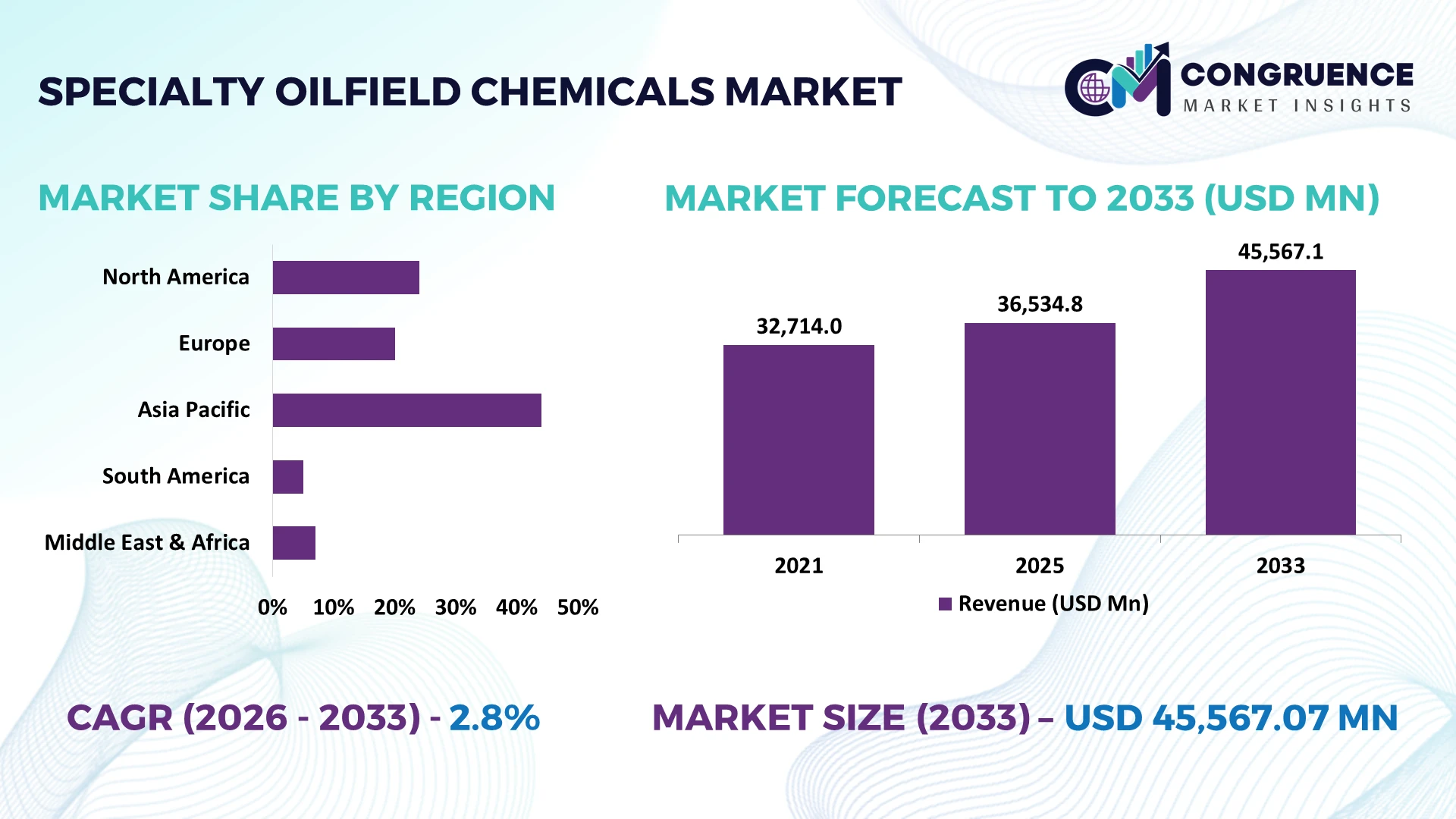
The Global Specialty Oilfield Chemicals Market was valued at USD 36534.75 Million in 2025 and is anticipated to reach a value of USD 45567.07 Million by 2033 expanding at a CAGR of 2.8% between 2026 and 2033. Growth is supported by rising enhanced oil recovery activities, increasing deployment of high-performance production chemicals in mature wells, and stricter asset integrity requirements across offshore and unconventional drilling operations.
The United States dominates the global specialty oilfield chemicals market with approximately 31% share, supported by extensive shale production, over USD 12 billion in upstream chemical and production optimization investments, and digital chemical monitoring adopted across nearly 45% of large field operations in 2026. Compared with Saudi Arabia, where large-scale conventional production drives higher treatment volumes, the U.S. records faster adoption of intelligent chemical injection systems. Ongoing geopolitical uncertainty affecting global energy supply chains continues to reinforce investment in production efficiency and chemical optimization.
For industry participants, expanding localized manufacturing, advanced production chemistry, and digital field service capabilities remains the strongest strategy for sustaining competitive advantage.
Market Size & Growth: USD 36534.75 Million in 2025, reaching USD 45567.07 Million by 2033 at a CAGR of 2.8%, driven by advanced production optimization and enhanced recovery technologies.
Top Growth Drivers: Enhanced oil recovery demand (+18%), digital chemical monitoring adoption (+22%), and offshore production optimization (+15%) continue strengthening global market expansion.
Short-Term Forecast: By 2028, automated chemical dosing systems improve treatment efficiency by 20% while reducing chemical consumption by 12% across major producing assets.
Emerging Technologies: AI-based dosage optimization, automated injection systems, and advanced corrosion inhibitors improve operational performance by 15% while supporting predictive maintenance.
Regional Leaders: North America exceeds USD 14.2 Billion, Middle East reaches USD 9.8 Billion, and Asia Pacific approaches USD 8.6 Billion, supported by regional expansion and digital field adoption.
Consumer/End-User Trends: More than 48% of large upstream operators deploy integrated specialty chemical management platforms to improve production reliability.
Pilot/Case Example: A 2026 offshore chemical optimization project lowered scale formation by 24% and reduced maintenance interventions by 17%.
Competitive Landscape: The leading supplier holds approximately 13% market share, with Baker Hughes, SLB, Halliburton, Clariant, and Nouryon maintaining strong global positions.
Regulatory & ESG Impact: Low-toxicity formulations reduce environmental discharge by nearly 20%, aligning with tighter offshore environmental compliance requirements.
Investment & Funding: More than USD 2.4 Billion supports manufacturing expansion, regional partnerships, and specialty formulation facilities amid ongoing supply chain diversification.
Innovation & Future Outlook: Next-generation multifunctional chemicals, digital production analytics, and customized reservoir-specific formulations accelerate strategic differentiation across high-value oilfield operations.
Specialty oilfield chemicals are experiencing stronger demand across enhanced oil recovery, offshore production, shale developments, and well integrity management. Advanced multifunctional formulations and AI-enabled chemical optimization platforms improve treatment precision, while low-impact production chemistries gain wider acceptance. More than 30% of new product development focuses on environmentally compatible formulations, supported by evolving operational standards and resilient regional supply-chain localization, creating a strong foundation for strategic market expansion.
Specialty oilfield chemicals have become strategically important as operators prioritize higher production efficiency from existing assets instead of relying solely on new field discoveries. Supply-chain restructuring after recent geopolitical disruptions has accelerated localized chemical manufacturing and diversified procurement strategies, reducing lead times while strengthening operational resilience. Digital chemical management platforms and real-time reservoir monitoring are also reshaping competitive differentiation by enabling data-driven production optimization and lower unplanned downtime.
Modern AI-assisted chemical injection systems improve treatment accuracy by nearly 18% and reduce chemical consumption by approximately 12% compared with conventional manual dosing methods. The United States leads in digital deployment across unconventional shale operations, while Saudi Arabia emphasizes large-scale integrated production chemistry for conventional reservoirs. During the next two to three years, automated chemical monitoring is expected to exceed 50% adoption among large upstream operators, supported by stricter asset integrity standards and expanded industrial digitalization programs.
A 2026 offshore production project integrating intelligent corrosion inhibitors with automated monitoring reduced maintenance interventions by 16% while extending equipment service intervals. Leading companies are expanding regional formulation facilities, strengthening technology partnerships, and investing in reservoir-specific chemical portfolios. Competitive advantage will increasingly depend on integrated chemical intelligence, localized manufacturing capabilities, and operational adaptability across diverse production environments.
Growing investment in mature oilfield optimization is accelerating demand for specialty oilfield chemicals that improve production reliability and asset longevity. Enhanced oil recovery programs have expanded by approximately 17% across major producing countries, while intelligent chemical injection systems improve production efficiency by nearly 15% and lower maintenance requirements by 12%. The United States continues expanding shale production using advanced production chemistry, while Saudi Arabia is increasing deployment of integrated reservoir management technologies. In response, chemical manufacturers are investing in localized blending facilities, digital monitoring platforms, and strategic partnerships with upstream operators. This shift strengthens supply security while enabling customized formulations that deliver measurable operational performance and longer equipment life.
Feedstock price fluctuations and dependence on specialty chemical intermediates continue to pressure manufacturing economics and procurement planning. Certain formulation components have experienced price variability exceeding 20%, while international logistics disruptions have extended delivery schedules by nearly 15% for selected additives. China remains a critical supplier of several specialty chemical ingredients, creating sourcing concentration challenges during trade or transportation disruptions. Companies are reducing operational exposure through regional sourcing strategies, long-term procurement contracts, and localized production investments. Strengthening supplier diversification not only improves production continuity but also enhances inventory flexibility and customer service reliability under changing global supply conditions.
Digital production optimization is creating new opportunities for intelligent specialty oilfield chemical solutions. AI-enabled formulation management improves treatment precision by approximately 18%, while predictive analytics reduces unnecessary chemical usage by nearly 14%. Norway is expanding digital offshore field operations alongside stricter environmental performance standards, encouraging adoption of biodegradable production chemicals and advanced monitoring systems. Companies are increasing R&D investment, collaborating with software providers, and developing reservoir-specific formulations that combine operational efficiency with environmental performance. A key strategic opportunity lies in integrating digital field analytics with customized chemical programs, allowing suppliers to transition from product vendors into long-term performance partners.
Integrating advanced specialty chemicals with digital production infrastructure remains a significant execution challenge for operators managing diverse field conditions. More than 35% of legacy production assets still rely on conventional monitoring systems, while integration projects can increase implementation timelines by approximately 20% due to compatibility and workforce limitations. Offshore operations in the United Kingdom require complex coordination between chemical suppliers, automation vendors, and production teams to maintain consistent field performance. Companies must strengthen workforce training, expand digital engineering capabilities, and invest in interoperable monitoring platforms. Organizations that successfully standardize digital chemical management across multiple assets will secure stronger operational consistency, improved production reliability, and sustainable competitive positioning.
Digital Chemical Management Expansion Intelligent chemical management platforms are becoming standard across large upstream assets, with deployment increasing by approximately 24% since 2025 and automated dosage optimization improving treatment precision by nearly 18%. Rising labor constraints and stricter operational monitoring are accelerating workflow automation in the United States. Chemical suppliers are expanding digital partnerships and integrating real-time production analytics to reduce intervention frequency while improving field reliability.
Localized Manufacturing and Supply Resilience Supply-chain restructuring continues to reshape specialty oilfield chemical production as manufacturers establish regional blending and formulation facilities. Local procurement has increased by nearly 20%, while average chemical delivery times have declined by approximately 15% through localized inventories. Middle Eastern producers are prioritizing domestic manufacturing capacity to strengthen supply security, prompting global suppliers to expand regional production networks, strategic alliances, and inventory optimization programs.
Advanced Sustainable Chemical Formulations Low-toxicity corrosion inhibitors, biodegradable surfactants, and multifunctional production chemicals now represent more than 30% of newly introduced formulations. Environmental compliance requirements and offshore discharge regulations are encouraging formulation redesign without sacrificing operational performance. Companies are accelerating specialty chemistry development through collaborative research, portfolio restructuring, and process optimization, delivering lower treatment frequency alongside improved equipment protection and operational efficiency.
Integrated Performance-Based Service Models Chemical suppliers are increasingly offering performance-based contracts supported by digital monitoring and predictive maintenance. More than 35% of large operators now evaluate suppliers using production performance metrics rather than product pricing alone, while integrated service agreements reduce operational disruptions by approximately 14%. Norway and the United States continue leading this transition, encouraging companies to strengthen technical service capabilities, reservoir-specific formulation expertise, and long-term customer partnerships.
Corrosion Inhibitors remain the leading segment, accounting for approximately 33% of the specialty oilfield chemicals market due to their essential role in protecting pipelines, production equipment, and offshore infrastructure from aggressive operating conditions. Their broad compatibility with mature and unconventional oilfields, combined with lower maintenance costs and extended asset life, continues to strengthen adoption. Scale Inhibitors follow as another mature segment, supporting uninterrupted production by minimizing mineral deposition, while Demulsifiers remain indispensable for efficient oil-water separation across high-volume production facilities.
Surfactants are the fastest-growing type as operators increasingly deploy advanced formulations for enhanced oil recovery and complex reservoir stimulation. Adoption has expanded by nearly 19%, while multifunctional surfactant technologies improve recovery efficiency by approximately 14% compared with conventional formulations. Biocides continue gaining importance for microbial control in water-intensive operations. Manufacturers are expanding specialty formulation portfolios, increasing regional production capacity, and collaborating with upstream operators to develop reservoir-specific chemical solutions that improve operational performance while supporting long-term asset integrity.
Production remains the dominant application, representing approximately 41% of overall demand because specialty chemicals are continuously required for corrosion prevention, flow assurance, emulsion control, and production optimization throughout the asset lifecycle. Operators increasingly integrate automated chemical injection systems, improving production efficiency by nearly 16% while reducing unplanned maintenance interventions. Drilling and Cementing continue supporting stable demand as well construction programs require specialized additives to maintain borehole stability and cement integrity under increasingly complex operating environments.
Enhanced Oil Recovery is the fastest-growing application, with adoption increasing by approximately 18% as operators maximize output from mature reservoirs instead of expanding greenfield developments. Advanced surfactant systems and customized production chemistries improve recovery performance by nearly 15%, encouraging wider deployment across the United States and the Middle East. Companies are expanding technical service capabilities, investing in digital production monitoring, and developing integrated chemical programs that improve field performance while reducing overall operating complexity.
Oil & Gas companies account for approximately 62% of specialty oilfield chemical consumption because of extensive upstream production, drilling intensity, and continuous well maintenance requirements. Large integrated operators increasingly deploy customized chemical programs supported by digital monitoring, improving production stability by nearly 17% while reducing chemical waste by approximately 12%. Offshore Operators remain significant buyers due to demanding operating conditions that require advanced corrosion protection, scale management, and production assurance technologies throughout asset lifecycles.
Offshore Operators represent the fastest-growing end-user segment as deepwater developments accelerate in countries including Brazil and Norway. Deployment of intelligent production chemistry has increased by approximately 20%, supported by automation and stricter offshore operating standards. Petrochemical companies continue purchasing production chemicals for hydrocarbon processing integration, while broader Energy enterprises increasingly emphasize operational efficiency through long-term supply agreements and technology partnerships. Suppliers are responding with customized formulations, performance-based service models, localized technical support, and collaborative product development to strengthen customer retention and long-term competitiveness.
North America accounted for the largest market share at 36.8% in 2025 however, Asia-Pacific is expected to register the fastest growth, expanding at a CAGR of 3.5% between 2026 and 2033.
Advanced Production Optimization and Digital Field Integration
North America maintains the largest share of the specialty oilfield chemicals market through extensive shale development, mature field optimization, and advanced production infrastructure. The region accounts for nearly 37% of global demand, supported by widespread deployment of corrosion inhibitors, demulsifiers, and intelligent chemical injection systems. More than 48% of large upstream operators utilize digital chemical monitoring platforms to improve production stability and reduce operating costs. Ongoing investment in unconventional resource development and localized specialty chemical manufacturing strengthens supply reliability. Strategic collaborations between chemical suppliers and oilfield service providers continue accelerating customized formulation development while supporting predictive production management and equipment integrity across high-output assets.
United States Market Outlook: The United States remains the region's largest market due to its extensive shale basins, integrated oilfield service ecosystem, and rapid digital technology deployment. Nearly 45% of large production sites have adopted automated chemical management systems, improving treatment precision and reducing maintenance frequency. Domestic manufacturers continue expanding formulation facilities and technical service centers to support unconventional drilling, enhanced oil recovery, and intelligent production optimization while strengthening supply-chain resilience.
Sustainable Offshore Operations Drive Innovation
Europe emphasizes operational efficiency through offshore modernization, stricter environmental compliance, and advanced production chemistry. The region contributes approximately 22% of global specialty oilfield chemical demand, supported by mature offshore assets requiring continuous corrosion control and flow assurance solutions. Digital asset monitoring has expanded by nearly 21% across major offshore installations, improving maintenance planning and equipment performance. Companies increasingly invest in biodegradable specialty formulations and integrated production management technologies while strengthening regional technical partnerships to meet evolving operational and environmental requirements.
Norway Market Outlook: Norway leads the European market through advanced offshore production infrastructure, digital oilfield deployment, and strong investment in sustainable production technologies. Automated chemical optimization systems are now integrated across many offshore platforms, improving production efficiency while supporting stricter environmental performance targets. Operators continue partnering with specialty chemical suppliers to develop customized low-impact formulations for complex offshore reservoirs.
Industrial Expansion and Energy Security Accelerate Deployment
Asia-Pacific is emerging as the fastest-growing regional market due to expanding upstream investment, rising domestic energy demand, and increasing deployment of advanced production chemicals. The region represents approximately 24% of global demand, with national oil companies strengthening exploration and production capabilities. Regional chemical manufacturing capacity has expanded by nearly 18% since 2025, reducing import dependency while improving supply responsiveness. Companies continue investing in localized blending facilities, technical laboratories, and integrated production support to strengthen long-term competitiveness across developing upstream projects.
China Market Outlook: China dominates the regional market through large-scale upstream investment, expanding domestic specialty chemical manufacturing, and increasing digital oilfield implementation. More than 40% of newly upgraded production sites incorporate intelligent chemical monitoring systems to improve operational efficiency. Domestic enterprises continue expanding specialty formulation capabilities while strengthening partnerships with upstream operators to support conventional and unconventional resource development.
Deepwater Development Supports Chemical Demand
South America continues strengthening its position through offshore exploration, deepwater production, and modernization of mature oilfields. The region accounts for approximately 9% of global specialty oilfield chemical demand, with offshore developments driving increasing requirements for corrosion inhibitors, demulsifiers, and scale management solutions. Deepwater infrastructure investment has increased by nearly 16%, supporting higher deployment of specialized production chemicals designed for challenging operating environments. Chemical suppliers are expanding regional service capabilities while balancing logistics efficiency with infrastructure limitations across emerging production hubs.
Brazil Market Outlook: Brazil remains the region's strategic leader because of extensive offshore pre-salt developments and continuous investment in production optimization technologies. Advanced production chemistry deployment has increased by approximately 19% across major offshore assets, encouraging suppliers to establish localized technical support, customized formulation services, and long-term operational partnerships that improve production reliability.
Integrated Upstream Expansion Strengthens Chemical Consumption
The Middle East & Africa market benefits from large-scale upstream modernization, sustained production capacity expansion, and integrated investment across conventional oilfields. The region contributes approximately 17% of global specialty oilfield chemical demand, supported by extensive use of production chemicals for asset integrity and enhanced recovery. Intelligent production monitoring deployment has increased by nearly 20% across major operators, improving operational reliability and optimizing chemical utilization. Companies continue investing in regional manufacturing facilities, localized supply networks, and strategic partnerships that improve delivery speed while supporting national industrial localization initiatives.
Saudi Arabia Market Outlook: Saudi Arabia leads regional demand through large-scale production infrastructure, integrated refining operations, and continuous investment in advanced reservoir management. Automated chemical injection technologies are increasingly deployed across major production facilities, improving operational efficiency and extending equipment service life. The country continues attracting specialty chemical manufacturers through localization programs, strategic industrial investments, and technology-focused collaboration with global suppliers.
The competitive landscape is led by Baker Hughes, SLB, Halliburton, Clariant, Nouryon, and BASF, competing directly with regional specialty formulators and localized chemical manufacturers for high-value production contracts. The top five players collectively control approximately 48% of the market through integrated product portfolios, technical services, and established upstream relationships. Competition is increasingly driven by formulation performance, digital production optimization, supply-chain responsiveness, and customized reservoir solutions rather than price alone. AI-assisted chemical management improves treatment efficiency by nearly 18%, while localized manufacturing reduces delivery times by approximately 15%, creating measurable competitive advantages. Global leaders continue expanding regional production facilities, forming technology partnerships, and strengthening vertical integration to secure supply continuity and technical differentiation. Regional companies compete through faster customer response, localized formulations, and lower logistics costs. The principal entry barrier remains the combination of regulatory qualification, application expertise, and long-term operator trust. Winning requires digital capability, customized chemistry, resilient supply networks, and proven field performance.
Baker Hughes
SLB
Halliburton
Clariant
BASF
Nouryon
Solenis
Kemira
Ecolab
Innospec
Croda International
Chevron Phillips Chemical Company
Dorf Ketal
Thermax Limited
Digital production chemistry is redefining specialty oilfield chemical deployment through AI-enabled dosage optimization, real-time corrosion monitoring, and automated injection systems. Nearly 46% of large upstream operators now integrate digital chemical management platforms, improving treatment efficiency by approximately 16% while reducing chemical consumption by 11%. Cloud-connected monitoring enables faster production adjustments, allowing operators to minimize downtime and extend equipment life across complex onshore and offshore assets.
Emerging technologies focus on multifunctional chemical formulations, biodegradable inhibitors, nanotechnology-based scale control, and predictive reservoir analytics. Advanced multifunctional chemistries reduce treatment frequency by nearly 14% compared with conventional single-function products, while nanostructured additives improve deposition control by approximately 12%. Around 32% of newly introduced specialty oilfield formulations now incorporate environmentally optimized chemistry. Companies combining digital monitoring with customized formulations achieve faster field optimization, giving technology leaders a measurable operational advantage over suppliers competing primarily on price.
Between 2026 and 2028, autonomous production optimization platforms, digital twins, and machine learning-assisted formulation design will become mainstream across large upstream operations. Modern intelligent chemical management delivers approximately 18% higher operational efficiency than legacy manual chemical treatment programs while lowering maintenance interventions by nearly 15%. Suppliers investing in integrated software, localized manufacturing, and performance-based service models will strengthen long-term customer retention, whereas companies relying on conventional product portfolios risk losing competitiveness as operators increasingly prioritize measurable production performance and intelligent field automation.
February 2024 Baker Hughes and Dussur inaugurated the Saudi Petrolite Chemicals manufacturing facility in Jubail, exceeding 70% Saudization while localizing oilfield chemical production and shortening customer lead times across Saudi Arabia. Business impact: stronger regional supply resilience.
February 2025 Baker Hughes secured a multi-year specialty chemicals contract from ExxonMobil Guyana covering two FPSOs with a combined production capacity of 500,000 barrels per day. Business impact: expanded offshore chemicals deployment and long-term production support. Source: https://investors.bakerhughes.com
July 2025 Baker Hughes received a multi-year award from Genesis Energy to supply drag-reducing agents for two U.S. Gulf offshore pipelines while deploying Leucipa™ digital field solutions. Business impact: increased pipeline throughput and optimized chemical management. Source: https://www.bakerhughes.com
February 2026 Baker Hughes became Marathon Petroleum's preferred downstream chemicals provider, deploying digital monitoring tools across 12 refineries and two renewable fuels facilities. Business impact: broader enterprise-scale chemical optimization and operational efficiency improvements.
This report delivers comprehensive strategic coverage of the specialty oilfield chemicals market across corrosion inhibitors, demulsifiers, scale inhibitors, biocides, and surfactants, with detailed analysis of drilling, cementing, production, and enhanced oil recovery applications. It evaluates demand across oil & gas companies, petrochemical producers, energy enterprises, and offshore operators while assessing market dynamics throughout North America, Europe, Asia-Pacific, South America, and the Middle East & Africa. More than 45% of large operators now incorporate digital chemical management, making technology adoption a core evaluation criterion.
The report further examines intelligent production chemistry, automated chemical injection, predictive monitoring, and environmentally optimized formulations alongside competitive positioning, regional manufacturing strategies, and supply-chain localization. It provides business-focused insights into deployment trends, investment priorities, innovation strategies, and emerging operational models between 2026 and 2033, enabling stakeholders to strengthen expansion planning, technology selection, portfolio optimization, and long-term competitive decision-making across mature and developing upstream energy markets.
| Report Attribute/Metric | Report Details |
|---|---|
Market Revenue in 2025 | USD 36534.75 Million |
Market Revenue in 2033 | USD 45567.07 Million |
CAGR (2026 - 2033) | 2.8% |
Base Year | 2025 |
Forecast Period | 2026 - 2033 |
Historic Period | 2021 - 2025 |
Segments Covered | By Type
By Application
By End-User
|
Key Report Deliverable | Revenue Forecast, Growth Trends, Market Dynamics, Segmental Overview, Regional and Country-wise Analysis, Competition Landscape |
Region Covered | North America, Europe, Asia-Pacific, South America, Middle East, Africa |
Key Players Analyzed | Baker Hughes, SLB, Halliburton, Clariant, BASF, Nouryon, Solenis, Kemira, Ecolab, Innospec, Croda International, Chevron Phillips Chemical Company, Dorf Ketal, Thermax Limited |
Customization & Pricing | Available on Request (10% Customization is Free) |




