
Reports
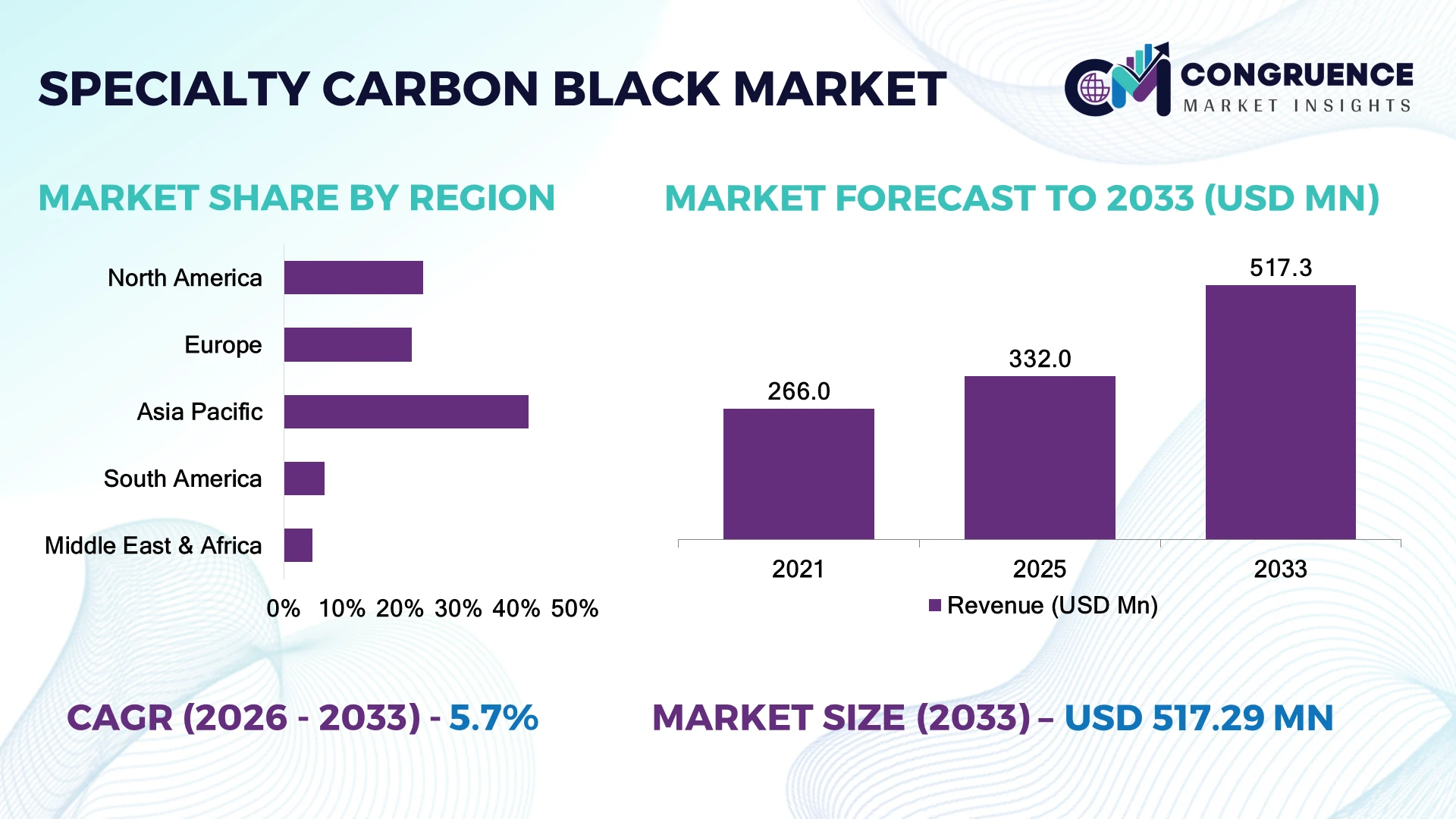
The Global Specialty Carbon Black Market was valued at USD 332.0 Million in 2025 and is anticipated to reach a value of USD 517.3 Million by 2033 expanding at a CAGR of 5.7% between 2026 and 2033. Growth is being driven by rising adoption of specialty carbon black in lithium-ion batteries, conductive plastics, advanced coatings, and high-performance automotive components requiring enhanced conductivity and UV protection.
China dominates the global specialty carbon black landscape with approximately 38% of installed production capacity, supported by over USD 1.5 billion in advanced materials investments and a strong electronics and EV manufacturing base. The country accounts for more than 55% of global battery production, compared with Germany’s 7%, enabling faster adoption of conductive carbon additives. Ongoing supply-chain realignment following global trade disruptions has accelerated domestic material sourcing and technology localization across major industrial clusters.
Strategic implication companies securing battery-material partnerships and high-purity specialty carbon black capacity are positioned to capture premium-margin opportunities across advanced manufacturing value chains.
Market Size & Growth: The market expands from USD 332.0 Million in 2025 to USD 517.3 Million by 2033 at 5.7% growth, supported by accelerating conductive material demand in EV batteries and advanced polymers.
Top Growth Drivers: Battery applications contribute over 30% demand growth, conductive plastics adoption exceeds 18%, and specialty coatings usage rises by nearly 15% across industrial sectors.
Short-Term Forecast: By 2028, conductive compound manufacturing efficiency is expected to improve by 12% through advanced dispersion technologies and process optimization.
Emerging Technologies: AI-driven process control, nanostructured carbon formulations, and automated quality monitoring are reducing defect rates by up to 20%.
Regional Leaders: Asia Pacific exceeds USD 220 Million, Europe approaches USD 110 Million, and North America surpasses USD 90 Million, driven by EV, electronics, and industrial coatings adoption.
Consumer/End-User Trends: More than 45% of conductive plastic manufacturers are shifting toward high-purity grades to meet performance and sustainability requirements.
Pilot/Case Example: In 2024, a battery-material integration project improved electrical conductivity by 18% while reducing additive consumption by 10%.
Competitive Landscape: Top five companies collectively control nearly 48% of global supply, led by Orion Engineered Carbons, Cabot Corporation, Birla Carbon, Tokai Carbon, and Phillips Carbon Black.
Regulatory & ESG Impact: Low-emission production technologies have reduced process-related emissions by nearly 12%, aligning with tightening industrial sustainability standards.
Investment & Funding: More than USD 2 billion has been directed toward specialty carbon material expansion, battery supply-chain localization, and advanced manufacturing projects.
Innovation & Future Outlook: Next-generation conductive additives, circular-carbon feedstocks, and battery-grade formulations are reshaping competitive strategies across high-growth industrial markets.
Specialty carbon black is increasingly utilized across battery electrodes, conductive polymers, high-performance coatings, and electronics applications where precision conductivity and durability are critical. Manufacturers are introducing ultra-low impurity grades and advanced dispersion technologies to improve material performance. More than 35% of new product development initiatives target energy-storage applications, while ongoing supply-chain localization efforts are strengthening procurement resilience and accelerating innovation across strategic industrial sectors.
Specialty carbon black has evolved into a strategically important material for advanced manufacturing, electrification, and high-performance industrial applications. As battery production, conductive plastics, and electronic components become increasingly critical to industrial competitiveness, demand for high-purity conductive additives continues to intensify. Supply-chain restructuring following geopolitical trade tensions has encouraged manufacturers to localize sourcing and establish closer partnerships with downstream battery and electronics producers.
Technological advancement is strengthening the market’s strategic role. Advanced nanostructured specialty carbon black formulations deliver up to 15% higher conductivity and improve material dispersion efficiency by nearly 20% compared with conventional grades. China maintains leadership through large-scale battery manufacturing integration, while Germany and South Korea emphasize premium specialty formulations and process innovation. Over the next two to three years, battery-grade material adoption is expected to accelerate as energy-storage deployment expands across transportation and industrial sectors.
A practical example is the integration of specialty carbon black into lithium-ion battery cathode and conductive polymer systems, improving electrical performance while reducing additive loading requirements. Companies are responding through capacity expansions, joint development agreements, and technology-focused partnerships. Organizations that secure advanced production capabilities and downstream integration will strengthen competitive positioning, improve operational resilience, and capture long-term value across evolving advanced-material ecosystems.
The rapid expansion of electric vehicle manufacturing and energy-storage deployment is accelerating demand for specialty carbon black as a critical conductive additive. Battery-sector consumption has increased by more than 25% over the past three years, while conductive polymer adoption has risen approximately 18% across electronics and automotive applications. China currently contributes over 55% of global battery output, creating a substantial demand base for advanced conductive materials. This shift improves conductivity, durability, and performance consistency in high-value industrial applications. In response, major producers are expanding conductive-grade production lines, investing in purification technologies, and establishing strategic supply agreements with battery manufacturers. A notable strategic insight is that battery-grade specialty carbon black commands significantly higher margins than traditional industrial grades, encouraging portfolio shifts toward advanced material applications.
Specialty carbon black production remains highly sensitive to fluctuations in carbon-rich feedstocks and industrial energy costs. Raw material prices have experienced swings exceeding 20% in certain procurement cycles, while energy expenses account for nearly 30% of manufacturing costs in several production facilities. European producers have faced additional pressure from industrial energy constraints and environmental compliance requirements. These factors compress margins and create pricing uncertainty for downstream industries such as coatings, polymers, and electronics. Companies are mitigating risk through long-term supply contracts, diversified sourcing networks, and localized procurement strategies. An important operational insight is that producers with integrated feedstock access maintain stronger cost control and supply reliability than competitors dependent on external sourcing, creating a significant competitive advantage.
Emerging opportunities are being created by next-generation batteries, conductive composites, and sustainable material innovation. More than 40% of advanced material research programs now include conductive carbon technologies, while recycled carbon feedstock utilization has increased by approximately 15% across pilot-scale projects. Japan and South Korea are investing heavily in high-purity conductive additives for semiconductor packaging and energy-storage systems. Circular production technologies and low-emission processing methods are gaining traction as industrial sustainability targets become stricter. Companies are positioning themselves through R&D partnerships, technology licensing agreements, and specialized product development programs. A particularly attractive opportunity lies in ultra-high-purity conductive grades that enable improved battery efficiency while reducing material loading requirements, creating measurable performance and cost advantages.
Maintaining consistent quality while scaling specialty carbon black production remains a significant long-term challenge. High-performance applications often require impurity levels below strict industrial thresholds, while batch-to-batch performance variations can affect electrical conductivity by more than 10%. Nearly 35% of advanced-material buyers now require enhanced traceability and process verification before supplier qualification. As electronics and battery manufacturers tighten performance specifications, production complexity increases substantially. Companies must invest in advanced process controls, automated quality monitoring systems, and specialized workforce development programs. A key strategic challenge is balancing rapid capacity expansion with precision manufacturing requirements. Organizations that fail to maintain consistent product quality risk losing access to premium markets where performance reliability and technical certification determine supplier selection.
Battery Grade Capacity Expansion Battery-material supply chains are driving a sharp shift toward conductive specialty carbon black production. Conductive-grade capacity additions increased by nearly 22% during the past two years, while battery-sector consumption volumes expanded by more than 25%. Chinese and South Korean producers are integrating carbon additives directly into battery-material ecosystems to reduce procurement lead times by approximately 15%. This transition is improving supply reliability and accelerating qualification cycles for cell manufacturers. Companies are responding through dedicated battery-grade production lines, technical partnerships, and downstream integration strategies.
Low-Emission Manufacturing Transition Regulatory pressure and customer sustainability requirements are reshaping production workflows. Industrial emission-reduction programs have lowered process-related emissions by around 12%, while energy-efficiency upgrades improved furnace utilization rates by nearly 10%. European producers are adopting advanced recovery systems and digital process monitoring to meet stricter environmental standards. Beyond compliance, lower energy intensity is strengthening cost competitiveness. Manufacturers are increasing investments in cleaner production technologies and circular feedstock initiatives to maintain preferred supplier status among global industrial buyers.
Advanced Dispersion Technology Adoption Specialty compound producers are prioritizing dispersion performance to improve material efficiency. New dispersion technologies reduce additive loading requirements by 8–15% while maintaining conductivity and pigmentation performance. Automated quality-control systems have lowered batch variability by nearly 20%, supporting tighter specifications in electronics and engineering plastics. The non-obvious shift is that buyers increasingly value formulation efficiency over simple material volume. Producers are deploying AI-assisted process optimization and application-specific product development to differentiate performance in premium segments.
Supply Chain Localization Strategies Global manufacturers are restructuring sourcing networks following logistics disruptions and geopolitical trade pressures. Regional procurement programs have increased local sourcing activity by approximately 18%, while inventory planning cycles have shortened by nearly 10%. India, Germany, and the U.S. are expanding advanced-material production ecosystems to reduce dependency on single-country supply chains. Companies are establishing long-term procurement agreements, regional warehousing networks, and strategic partnerships to improve operational resilience and reduce supply volatility.
Conductive Carbon Black holds the largest share of the specialty carbon black market at approximately 36%, supported by strong adoption across lithium-ion batteries, conductive polymers, electronics housings, and antistatic applications. Its ability to deliver consistent electrical conductivity, lower resistance, and superior dispersion characteristics makes it the preferred choice for high-performance industrial formulations. Food Contact Carbon Black follows closely, benefiting from expanding packaging requirements and regulatory-compliant material demand. Fiber Carbon Black maintains a stable position due to its role in technical textiles, synthetic fibers, and reinforced polymer systems. Conductive grades continue gaining preference as manufacturers prioritize functional performance over conventional pigmentation applications.
The fastest-growing segment is Conductive Carbon Black, with adoption accelerating through battery manufacturing and advanced electronics production. More than 30% of new specialty carbon black product development programs now focus on conductivity enhancement and energy-storage applications. Companies are expanding conductive-grade capacity, investing in purification technologies, and forming partnerships with battery manufacturers. Investment priorities increasingly favor high-purity formulations capable of supporting advanced mobility, energy-storage, and electronics ecosystems, while mature grades remain essential for packaging, textile, and industrial applications.
Plastics represent the leading application segment with approximately 32% market share, driven by extensive use in automotive components, electronics housings, consumer products, and packaging materials. Specialty carbon black provides UV resistance, conductivity, coloration, and durability enhancements that are increasingly required in advanced polymer formulations. Printing Inks and Paints & Coatings remain established applications where dispersion quality and pigmentation performance are critical. Battery Electrodes are emerging as a high-priority application area as electrification initiatives accelerate globally. Plastics continue attracting investment because they combine large-scale demand with diverse performance requirements across multiple industries.
Battery Electrodes are the fastest-growing application segment, supported by expanding EV and stationary energy-storage manufacturing. Battery-related consumption volumes have increased by more than 25% in recent years, while advanced conductive additive usage has risen by nearly 18% across high-performance cell designs. Producers are scaling application engineering capabilities, expanding technical support programs, and developing specialized formulations optimized for next-generation batteries. Demand is becoming increasingly operationally critical as manufacturers seek conductivity improvements without compromising efficiency or material consistency.
Automotive is the largest end-user segment, accounting for approximately 34% of total demand. The sector utilizes specialty carbon black across coatings, battery components, conductive plastics, under-the-hood applications, and lightweight engineered materials. Large production volumes, stringent durability requirements, and increasing electrification have concentrated demand within automotive manufacturing ecosystems. Printing & Packaging remains a major consumer due to food-contact materials and premium packaging requirements, while Construction and Industrial sectors continue adopting specialty formulations for durability and weather-resistance performance. Automotive manufacturers increasingly prioritize advanced conductive materials that support both functional performance and production efficiency.
Electrical & Electronics is the fastest-growing end-user group, supported by rising semiconductor production, consumer electronics manufacturing, and energy-storage deployment. Conductive material usage has expanded by nearly 20% across several electronics applications, while demand for electrostatic discharge protection solutions continues increasing. Companies are responding through customized product portfolios, technical partnerships, and application-focused innovation programs. Competitive positioning is shifting toward specialized performance requirements rather than volume-based supply strategies, creating opportunities for premium-grade manufacturers.
Asia-Pacific accounted for the largest market share at 42% in 2025 however, North America is expected to register the fastest growth, expanding at a CAGR of 6.4% between 2026 and 2033.
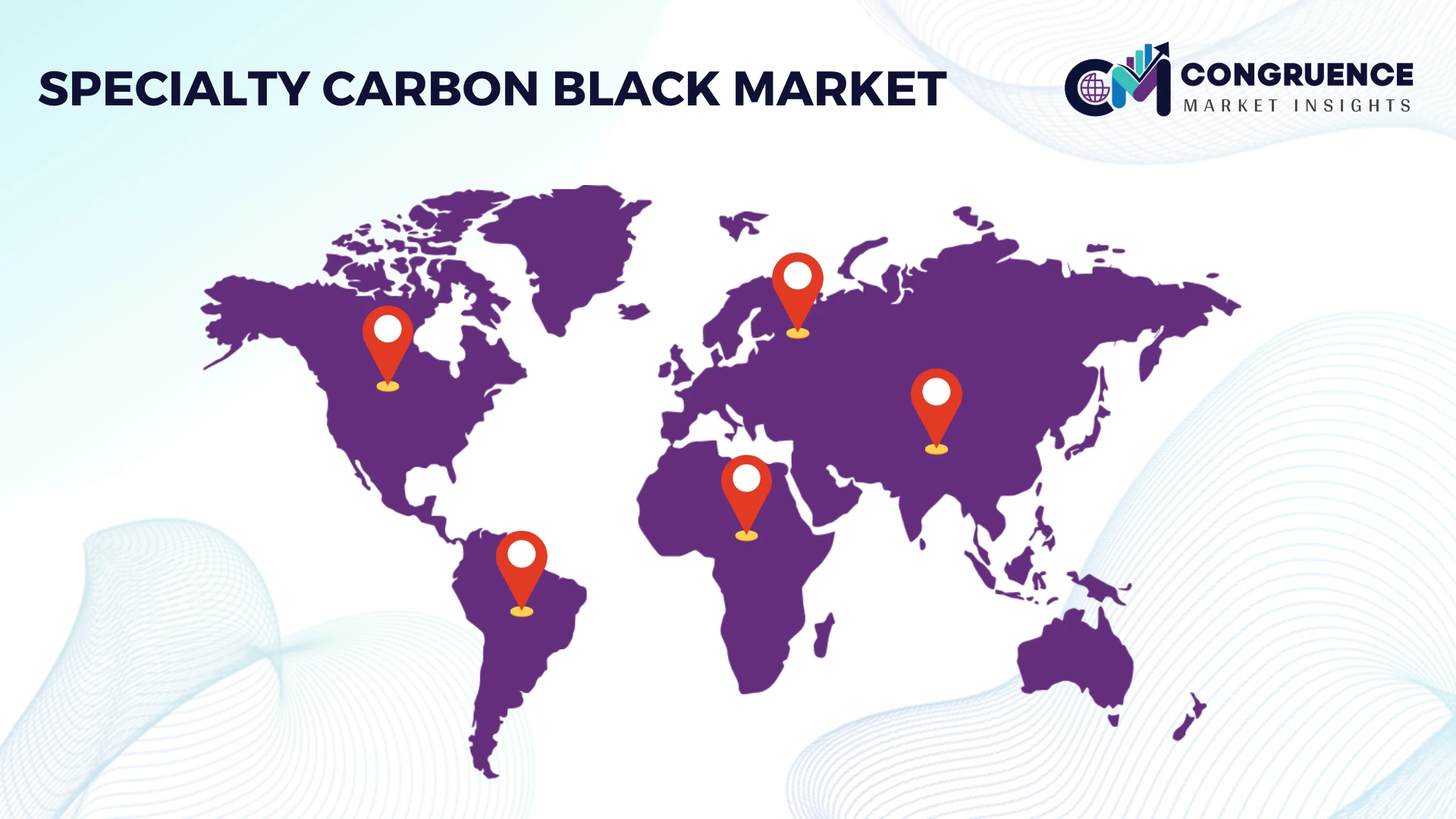
North America accounts for approximately 24% of the global specialty carbon black market, supported by expanding battery manufacturing, conductive polymer adoption, and advanced electronics production. The region is increasingly prioritizing localized material sourcing as automotive and energy-storage manufacturers seek supply-chain resilience. The U.S. and Canada have witnessed growing investments in battery-material ecosystems, creating new opportunities for conductive-grade specialty carbon black suppliers. More than 30 large-scale battery and energy-storage facilities are under development or expansion across the region, increasing demand for high-purity conductive additives. Strategic partnerships between material producers and battery manufacturers are strengthening qualification processes and accelerating deployment timelines. Companies are also investing in advanced process automation to improve product consistency and meet stricter technical specifications required by automotive and electronics customers.
United States Market Outlook: The United States remains the dominant market within North America due to its strong battery manufacturing pipeline, advanced materials research ecosystem, and growing domestic supply-chain strategy. The country hosts a significant share of regional energy-storage projects and continues attracting investments in battery-cell production facilities. More than 40% of announced North American battery-related manufacturing investments are concentrated in the U.S., creating substantial downstream demand for conductive specialty carbon black. Strong collaboration between material suppliers, automotive manufacturers, and technology developers is accelerating product qualification and commercialization activities.
Europe represents approximately 22% of global market demand and is characterized by advanced manufacturing standards, sustainability-focused production, and premium specialty material applications. Automotive electrification, industrial coatings, and engineering plastics remain key consumption areas. Environmental regulations are encouraging manufacturers to adopt lower-emission production technologies and improve resource efficiency. Several producers have implemented energy-efficiency upgrades capable of reducing operational emissions by more than 10%, strengthening competitiveness while meeting regulatory requirements. The region also benefits from strong collaboration between specialty chemical producers and industrial end-users, supporting innovation in conductive materials and advanced polymer applications. Investment activity increasingly focuses on cleaner production systems, circular-material initiatives, and high-performance specialty formulations.
Germany Market Outlook: Germany serves as the region’s strategic center for advanced manufacturing, automotive engineering, and specialty chemical innovation. Its strong industrial base supports demand across electric mobility, industrial electronics, and engineered polymer applications. The country accounts for a significant share of European battery manufacturing projects and remains a leading adopter of sustainable industrial technologies. German manufacturers continue investing in precision production systems and material-performance optimization, strengthening demand for specialty carbon black products capable of meeting stringent industrial and environmental requirements.
Asia-Pacific holds approximately 42% of global market share, making it the largest regional market for specialty carbon black. The region benefits from extensive battery manufacturing, electronics assembly, polymer processing, and specialty chemical production networks. China, South Korea, Japan, and India collectively account for a substantial portion of global conductive material consumption. More than half of worldwide lithium-ion battery production capacity is concentrated within Asia-Pacific, creating sustained demand for conductive-grade specialty carbon black. Manufacturers continue expanding production capacity and strengthening integration with downstream battery and electronics supply chains. Export-oriented industrial ecosystems, lower manufacturing costs, and strong domestic demand provide significant operational advantages for regional producers.
China Market Outlook: China remains the most influential country in the global specialty carbon black industry due to its unmatched battery manufacturing scale, advanced materials ecosystem, and industrial integration capabilities. The country contributes over 55% of global battery production and maintains extensive conductive material processing infrastructure. Large-scale investments in electric vehicles, energy storage, and advanced electronics continue driving specialty carbon black consumption. Domestic manufacturers are increasingly focusing on higher-purity conductive grades and technology upgrades, improving competitiveness in premium industrial applications while strengthening supply-chain self-sufficiency.
South America accounts for approximately 7% of global demand, supported by growth in packaging, automotive components, industrial coatings, and polymer manufacturing activities. Regional manufacturers are gradually increasing adoption of specialty materials to improve product performance and meet evolving industrial requirements. Brazil and Argentina remain important industrial centers, while investments in manufacturing modernization continue creating opportunities for specialty carbon black suppliers. Several industrial expansion projects have improved domestic processing capacity, reducing reliance on imported specialty materials. However, logistics constraints and infrastructure limitations still influence procurement efficiency and operational costs. Companies are responding through localized distribution strategies and stronger partnerships with regional converters and compounders.
Brazil Market Outlook: Brazil represents the largest specialty carbon black market in South America due to its diversified manufacturing base and strong industrial sector. Automotive production, packaging demand, and polymer processing industries remain key consumption drivers. The country accounts for a major share of regional industrial output and continues investing in manufacturing modernization initiatives. Growing adoption of advanced plastics and industrial coatings is increasing demand for performance-enhancing additives, while local producers are expanding technical capabilities to support higher-value specialty material applications.
The Middle East & Africa region contributes approximately 5% of global market demand and is gradually strengthening its position through industrial diversification and downstream manufacturing investments. Petrochemical integration provides a favorable foundation for specialty material production, while infrastructure modernization programs are supporting broader industrial development. Countries across the Gulf region are increasing investments in advanced manufacturing, specialty chemicals, and industrial processing facilities. Several industrial projects announced over recent years are enhancing local material-processing capabilities and creating new demand channels for specialty carbon black applications. While market scale remains smaller than other regions, long-term industrial development strategies continue improving the business environment for specialty material suppliers.
Saudi Arabia Market Outlook: Saudi Arabia is the region’s most strategically significant market due to its petrochemical strength, industrial diversification agenda, and expanding manufacturing infrastructure. The country is investing heavily in downstream industrial development and advanced material production capabilities. Large-scale industrial zones and manufacturing projects are creating opportunities for specialty chemical and conductive material suppliers. Strong feedstock availability, infrastructure investment, and industrial policy support provide a competitive advantage for future specialty carbon black deployment across automotive, packaging, and advanced manufacturing applications.
The Specialty Carbon Black Market is led by Orion Engineered Carbons, Cabot Corporation, Birla Carbon, Tokai Carbon, and Phillips Carbon Black, which collectively account for approximately 48% of global market share. Competition is primarily between global technology leaders and regional cost-focused suppliers, while battery-grade specialists increasingly compete with conventional pigment-focused producers. Technology performance, product purity, supply-chain reliability, and application-specific customization define competitive positioning. Conductive-grade products command premiums exceeding 15%, while advanced dispersion technologies improve formulation efficiency by nearly 10%. Companies compete through capacity expansion, battery-material partnerships, circular-material innovation, and vertical integration into downstream conductive applications. Orion and Cabot emphasize conductive additives and localization strategies, whereas Birla Carbon focuses on sustainable carbon solutions and specialty portfolio expansion. The competitive shift is moving toward battery-grade conductivity, circular feedstocks, and localized supply security. High qualification requirements, stringent purity standards, and customer certification processes remain major entry barriers. Winning requires scalable high-purity production, application expertise, and resilient customer-integrated supply networks.
Cabot Corporation
Birla Carbon
Tokai Carbon Co., Ltd.
Phillips Carbon Black Limited
Omsk Carbon Group
Jiangxi Black Cat Carbon Black Inc., Ltd.
Longxing Chemical Stock Co., Ltd.
OCI Company Ltd.
Imerys S.A.
Asahi Carbon Co., Ltd.
China Synthetic Rubber Corporation (CSRC)
Himadri Speciality Chemical Ltd.
Continental Carbon Company
Advanced conductive carbon technologies are becoming central to specialty carbon black development as battery manufacturers, electronics producers, and engineered polymer suppliers demand higher performance. High-purity conductive grades deliver conductivity improvements of 12–18% compared with conventional specialty carbon black formulations, supporting better electrical performance and lower additive loading. More than 35% of new conductive-material qualification programs now focus on battery and energy-storage applications. Companies with specialized conductive technologies benefit through stronger margins, longer supply agreements, and faster integration into next-generation manufacturing ecosystems.
Digital manufacturing technologies are transforming production consistency and operational efficiency. AI-enabled process control systems reduce batch variability by nearly 20% while improving yield performance by approximately 8%. Automated quality-monitoring platforms are increasingly deployed across premium manufacturing facilities to meet stricter purity requirements. Compared with traditional manual process optimization, advanced digital production environments improve process stability by over 15%, creating significant competitive advantages for producers supplying battery, semiconductor, and electronics industries.
Between 2026 and 2028, circular carbon technologies and sustainable feedstock integration will become major differentiators. Circular carbon black produced from pyrolysis-derived feedstocks can lower lifecycle emissions by more than 20% while supporting sustainability targets. Adoption is accelerating among automotive, battery, and advanced-material manufacturers seeking resilient and compliant supply chains. Early adopters gain stronger customer access, sustainability credentials, and premium-market positioning.
October 2024 – Birla Carbon launched its first Asia Post Treatment Plant in India, expanding specialty carbon material processing capabilities and strengthening regional supply flexibility. The facility supports higher-value performance grades and improves product customization for industrial applications. Business impact: enhanced premium-product penetration and application support. Source: birlacarbon.com
November 2024 – Orion Engineered Carbons announced pricing actions across European specialty carbon black grades and NEROX® products manufactured in South Korea to support continued development of differentiated specialty solutions amid rising operational costs. Business impact: strengthened investment capacity for advanced specialty product portfolios. Source: orioncarbons.com
March 2025 – Orion Engineered Carbons received European Commission Innovation Radar recognition for producing circular carbon black from 100% tire pyrolysis oil, creating a fossil-based alternative for specialty applications. Business impact: accelerated commercialization of circular-material technologies and stronger sustainability positioning. Source: orioncarbons.com
November 2025 – Orion Engineered Carbons reported commercial traction for conductive additives used in battery energy storage systems and high-voltage cable compounds, with additional battery-system qualification activity underway. Business impact: expanded participation in grid modernization and electrification supply chains. Source: orioncarbons.com
This report provides a comprehensive assessment of the Specialty Carbon Black Market across key product categories, applications, end-user industries, and major geographic regions. Coverage includes conductive carbon black, food-contact grades, fiber applications, advanced pigments, and emerging specialty formulations. The analysis evaluates deployment trends across plastics, coatings, printing inks, battery electrodes, electronics, and other industrial applications. Regional assessment spans North America, Europe, Asia-Pacific, South America, and the Middle East & Africa, capturing production concentration, supply-chain positioning, technology adoption, and industrial demand patterns.
The study examines competitive positioning across leading manufacturers, specialty innovators, and regional suppliers while assessing technology evolution, conductive-material adoption, circular carbon initiatives, and digital manufacturing trends. More than 30% of current innovation activity is concentrated in battery-related and conductive-material applications, highlighting strategic market shifts. The report supports investment planning, expansion strategy development, supplier evaluation, partnership decisions, and long-term competitive positioning by identifying operational trends, adoption patterns, emerging opportunities, and market direction through 2033.
| Report Attribute / Metric | Details |
|---|---|
| Market Revenue (2025) | USD 332.0 Million |
| Market Revenue (2033) | USD 517.3 Million |
| CAGR (2026–2033) | 5.7% |
| Base Year | 2025 |
| Forecast Period | 2026–2033 |
| Historic Period | 2021–2025 |
| Segments Covered |
By Type
By Application
By End-User
|
| Key Deliverables | Revenue Forecast; Market Trends; Growth Drivers & Restraints; Technology Insights; Segmentation Analysis; Regional Insights; Competitive Landscape; Regulatory & ESG Overview; Recent Developments |
| Regions Covered | North America; Europe; Asia-Pacific; South America; Middle East & Africa |
| Companies Profiled | Orion Engineered Carbons; Cabot Corporation; Birla Carbon; Tokai Carbon Co., Ltd.; Phillips Carbon Black Limited; Omsk Carbon Group; Jiangxi Black Cat Carbon Black Inc., Ltd.; Longxing Chemical Stock Co., Ltd.; OCI Company Ltd.; Imerys S.A.; Asahi Carbon Co., Ltd.; China Synthetic Rubber Corporation (CSRC); Himadri Speciality Chemical Ltd.; Continental Carbon Company |
| Customization & Pricing | Available on Request (10% Customization Free) |




