
Reports
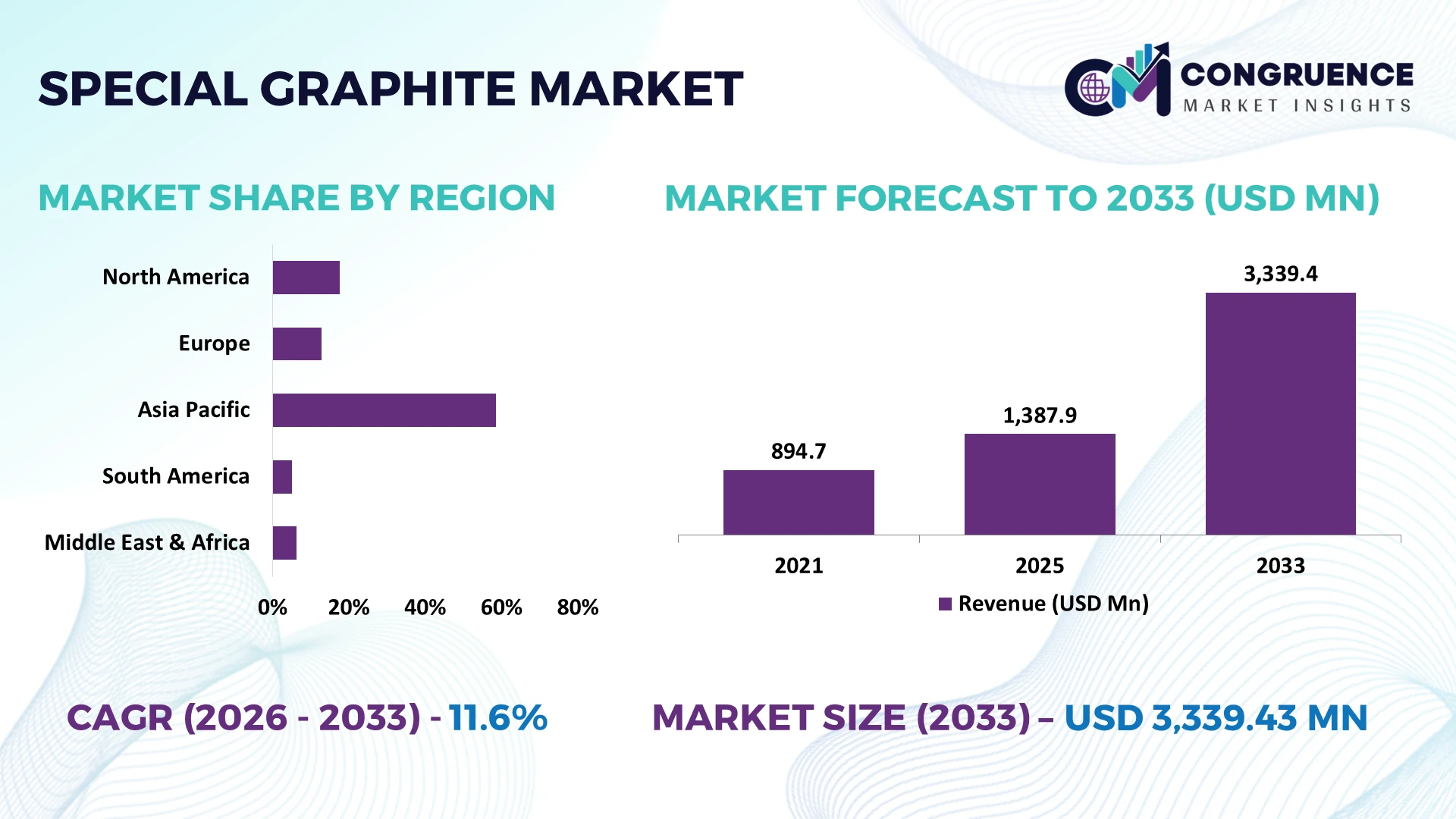
The Global Special Graphite Market was valued at USD 1,387.9 Million in 2025 and is anticipated to reach a value of USD 3,339.4 Million by 2033 expanding at a CAGR of 11.6% between 2026 and 2033. Growth is driven by semiconductor wafer production, SiC crystal growth, photovoltaic manufacturing, and increasing use of ultra-high-purity graphite components in high-temperature industrial processes.
China remains the dominant graphite production and processing hub, accounting for approximately 77.8% of global natural graphite mine output, with major applications spanning semiconductors, photovoltaics, metallurgy, and energy storage. Japan has a smaller resource base but stronger specialization in high-purity isotropic graphite and precision components. China therefore holds greater upstream scale, while Japan emphasizes advanced processing and technology-intensive applications. China's graphite export controls have accelerated supply-chain diversification across the United States, Japan, and Europe, increasing investment in local purification, machining, coating, and qualified supplier networks.
Strategically, securing high-purity production capacity and diversified regional processing will become essential for manufacturers seeking reliable supply, tighter quality control, and stronger positioning in advanced semiconductor and energy applications.
Market Size & Growth: USD 1,387.9 Million in 2025 is projected to reach USD 3,339.4 Million by 2033 at a CAGR of 11.6%, supported by semiconductor, photovoltaic, and SiC manufacturing expansion.
Top Growth Drivers: Semiconductor manufacturing, photovoltaic production, and SiC applications represent the three strongest growth drivers, with advanced electronics requiring graphite purity levels above 99.9%.
Short-Term Forecast: By 2028, automated machining and advanced coating processes are expected to improve manufacturing efficiency by approximately 10–15%, reducing material waste and improving component consistency.
Emerging Technologies: SiC-coated graphite, TaC-coated graphite, ultra-high-purity isotropic grades, and automated precision machining are accelerating adoption across semiconductor and crystal-growth equipment.
Regional Leaders: Asia Pacific leads manufacturing deployment, North America is expanding localized high-purity processing, and Europe is strengthening lower-carbon and diversified graphite supply chains.
Consumer/End-User Trends: Semiconductor and photovoltaic manufacturers increasingly prioritize purity, dimensional stability, coating uniformity, and traceability, with critical-component qualification cycles commonly lasting 18–36 months.
Pilot/Case Example: In 2026, specialty graphite manufacturers expanded coated and high-purity processing capabilities to support semiconductor-grade components, targeting approximately 10% lower supply-chain exposure through regional sourcing.
Competitive Landscape: SGL Carbon, Toyo Tanso, Tokai Carbon, Mersen, and Entegris maintain significant positions, with leading manufacturers competing through purity, coating technologies, machining precision, and application-specific engineering.
Regulatory & ESG Impact: Graphite export controls and critical-mineral policies are accelerating localization, recycling, and dual sourcing, while China accounts for approximately 77.8% of global natural graphite mine output.
Investment & Funding: More than USD 1 billion in announced and planned specialty graphite-related capacity and processing investments are supporting regional purification, coating, machining, and semiconductor supply-chain expansion.
Innovation & Future Outlook: Next-generation SiC and TaC coatings, ultra-fine-grain graphite, recycled feedstocks, and digitally controlled machining are shifting competition toward yield, qualification speed, purity, and application-specific performance.
Special Graphite Market demand is concentrating around semiconductor fabrication, photovoltaic crystal growth, SiC power-device manufacturing, and precision high-temperature processing. High-purity grades exceeding 99.9% carbon are increasingly important for electronics applications, while graphite export controls are encouraging localized processing and dual sourcing. The emerging trend is a shift toward application-specific graphite with tighter purity, coating, and dimensional specifications, strengthening the strategic importance of qualified suppliers.
Special graphite is becoming strategically important because semiconductor fabrication, SiC power electronics, photovoltaic crystal growth, and advanced thermal-processing equipment increasingly depend on materials capable of maintaining dimensional stability and purity at extreme temperatures. Supply-chain restructuring following graphite export restrictions is also pushing manufacturers toward localized purification, coating, and machining capacity.
Compared with conventional graphite components, SiC- and TaC-coated grades provide substantially stronger oxidation and contamination resistance, extending component life and improving process stability by approximately 15–25% in demanding thermal environments. Japan emphasizes precision manufacturing and semiconductor applications, while China maintains greater upstream production scale and processing capacity. North American manufacturers are increasingly developing regional supply arrangements.
Over the next 2–3 years, qualification of high-purity and coated components is expected to expand, with automated machining and digital process monitoring targeting 10–15% improvements in production efficiency. Companies are responding through capacity expansion, technology partnerships, regional sourcing, and application-specific R&D. Competitive positioning will increasingly depend on purity consistency, coating performance, delivery reliability, and the ability to integrate graphite engineering directly into advanced manufacturing ecosystems.
The rapid expansion of semiconductor and SiC manufacturing is increasing requirements for high-purity graphite susceptors, crucibles, carriers, and heater components. Semiconductor fabrication uses graphite grades exceeding 99.9% purity, while advanced coated components can improve thermal-process stability by approximately 15–25%. China's large electronics manufacturing base and Japan's precision-material ecosystem are accelerating supplier qualification. The expansion of SiC wafer production is also increasing demand for specialized graphite components capable of operating under extreme temperatures. Companies are responding through coated-graphite R&D, localized machining facilities, and long-term partnerships with semiconductor-equipment manufacturers. The non-obvious advantage is that component qualification creates recurring replacement demand because performance consistency is critical to maintaining production yields.
Special graphite production remains constrained by high purification, graphitization, coating, and precision-machining costs. Advanced grades can require purity levels above 99.9%, while specialized coating processes can increase component manufacturing costs by approximately 20–30%. Qualification cycles for semiconductor-grade components frequently extend 18–36 months, delaying supplier switching and limiting rapid capacity expansion. China's dominance in upstream graphite processing also exposes manufacturers to export-policy changes and logistics disruptions. Companies are reducing exposure through regional inventories, multi-year procurement contracts, supplier diversification, and localized machining. The key operational constraint is that replacing a qualified graphite component requires extensive process validation, so customers often retain incumbent suppliers even when alternative materials offer lower nominal costs.
SiC and TaC coatings create opportunities for specialty graphite suppliers as semiconductor, SiC, and photovoltaic manufacturers demand longer component life and lower contamination. Advanced coating technologies can deliver approximately 15–25% improvements in thermal-process durability, while automated machining can reduce material waste by 10–15%. The United States, Japan, and Germany are strengthening domestic processing capabilities in response to critical-material supply-chain restructuring. Companies are positioning through coating R&D, regional purification plants, equipment partnerships, and closed-loop recycling programs. A significant opportunity lies in engineered graphite assemblies rather than standalone material sales, allowing suppliers to combine substrate design, coating, machining, and maintenance into higher-value contracts.
Scaling specialty graphite production requires consistent raw-material quality, high-temperature processing capacity, advanced machining, and skilled technical labor. Manufacturing tolerances for semiconductor components can reach sub-millimeter levels, while coating defects of even 1–2% can create significant quality-control issues in high-value processing environments. Japan's precision manufacturing model demonstrates the technical intensity required, whereas rapidly expanding production hubs must replicate these quality systems at greater scale. Companies must invest in automated inspection, digital process monitoring, workforce training, and application-specific engineering partnerships. The long-term competitive challenge is not simply increasing graphite volume; it is maintaining purity, dimensional accuracy, coating uniformity, and repeatable performance across high-volume production without increasing defect rates.
High-Purity Grades Gain Priority: Semiconductor and SiC equipment manufacturers are increasing use of graphite above 99.9% purity, while precision components increasingly require sub-10 µm grain structures and tighter dimensional tolerances. Japan and the United States are expanding qualified supplier networks as manufacturers reduce single-source exposure. Companies are prioritizing purification, coating, and automated inspection to improve yield by approximately 10–15%.
Coating Technology Reshapes Components: SiC and TaC coatings are gaining adoption for high-temperature semiconductor and crystal-growth equipment, improving oxidation resistance and extending component operating life by approximately 15–25%. Manufacturers are shifting from conventional graphite components toward engineered coated assemblies. This transition is increasing component value while reducing replacement frequency, prompting producers to expand coating capacity and establish technology partnerships with equipment manufacturers.
Supply Chains Become More Regional: Export controls and processing concentration are accelerating dual sourcing, regional inventories, and localized machining. Chinese processing still represents more than 95% of battery-grade graphite processing capacity, increasing procurement sensitivity to policy and logistics changes. U.S., Japanese, and European manufacturers are responding with supplier qualification programs and local processing agreements, creating a less centralized procurement model.
Digital Machining Improves Consistency: Automated CNC machining, in-process metrology, and digital quality monitoring are expanding across specialty graphite production, reducing material waste by approximately 10–15% and shortening repeat-production cycles. The non-obvious shift is that digital inspection is becoming a qualification tool rather than simply a productivity measure. Companies are integrating automated inspection with production databases to maintain traceability across semiconductor and photovoltaic supply chains.
Isostatic graphite represents the leading type with approximately 48.0% of the 2025 market, supported by high strength, fine grain structure, thermal-shock resistance, and dimensional stability. Its performance makes it particularly suitable for semiconductor susceptors, wafer-processing components, photovoltaic equipment, and other precision applications. Molded graphite follows as a mature, cost-efficient option for larger components, while extruded graphite remains important where electrical conductivity, scalability, and lower processing costs are prioritized. Vibrated graphite retains a specialized position in applications requiring economical large-format components.
Isostatic graphite is also the fastest-shifting premium category as semiconductor and SiC manufacturing moves toward tighter contamination and thermal-control requirements. Demand for high-performance grades is strengthening by approximately 8–12% across selected electronics applications, compared with roughly 4–6% growth in conventional industrial grades. Companies are increasing investment in isostatic pressing, purification, precision machining, and coating capabilities. The business implication is a gradual shift from volume-based graphite competition toward engineered materials where purity, grain size, consistency, and component qualification command higher margins.
Photovoltaic and solar energy represents the leading application at approximately 31.8% of 2025 demand, closely followed by semiconductor manufacturing at around 29.2%. Photovoltaic producers use specialized graphite crucibles, heaters, susceptors, and other thermal-processing components, while semiconductor manufacturers require highly controlled graphite components for wafer and crystal-processing equipment. EDM and tooling accounts for approximately 17.1%, maintaining steady demand where machining precision and electrode stability remain critical. Aerospace and nuclear applications contribute approximately 13.2%, supported by stringent thermal and reliability requirements.
Semiconductor manufacturing is the fastest-growing strategic application as advanced-node fabrication and SiC power-device production increase requirements for ultra-clean, high-temperature materials. Demand for precision graphite components in electronics applications is strengthening by approximately 10–15% in expanding manufacturing hubs, while photovoltaic equipment remains heavily concentrated in large-scale Chinese production. Companies are responding with higher-purity grades, SiC and TaC coatings, localized machining, and longer-term supply agreements. The operational implication is that graphite suppliers increasingly compete on qualification reliability and process consistency rather than material availability alone.
Foundry and metallurgy represents the dominant end-user group at approximately 44.1% of 2025 demand, reflecting extensive use of specialty graphite in molds, casting systems, thermal-processing equipment, and metal-production operations. Electronics follows as a strategically important segment, supported by semiconductor fabrication and precision thermal-processing requirements. Photovoltaic users form another substantial demand base as solar-wafer and crystal-growth capacity expands. Other end-users include specialized industrial applications where thermal conductivity, corrosion resistance, and dimensional stability provide advantages over conventional materials.
Electronics is the fastest-growing end-user category, with demand expanding approximately 10–15% in advanced semiconductor and SiC manufacturing applications, compared with roughly 5–7% growth across mature metallurgical uses. Photovoltaic purchasing is also becoming more specification-driven, with buyers increasingly requiring purity, coating consistency, and traceability. Companies are responding through customized graphite grades, application engineering, regional partnerships, and dedicated production capacity. The strategic shift is moving purchasing decisions from material price toward total process performance, particularly where component failure can interrupt high-value production lines.
Asia-Pacific accounted for the largest market share at 58.4% in 2025 however, South America is expected to register the fastest growth, expanding at a CAGR of 13.2% between 2026 and 2033.
North America accounted for approximately 17.6% of the global Special Graphite Market in 2025, supported by semiconductor fabrication, aerospace, defense, nuclear processing, and advanced-material manufacturing. The United States dominates regional consumption because domestic semiconductor investment is increasing demand for high-purity susceptors, crucibles, heaters, and coated graphite components. The region is also strengthening domestic processing to reduce exposure to concentrated Asian graphite supply chains. U.S. semiconductor manufacturing investments under the CHIPS framework are supporting new fabrication capacity and increasing requirements for qualified specialty-material suppliers. Companies are responding by expanding purification and precision-machining capabilities, establishing long-term procurement agreements, and developing SiC- and TaC-coated components. Approximately 15–20% of regional specialty graphite procurement is increasingly linked to advanced electronics and semiconductor equipment applications, making supplier qualification and delivery reliability central competitive factors.
United States Market Outlook: The United States remains the principal North American demand center because of its semiconductor, aerospace, defense, and nuclear manufacturing infrastructure. Semiconductor fabrication expansion is creating sustained requirements for ultra-high-purity graphite components, while domestic critical-mineral policies are encouraging localized processing. More than USD 50 billion in announced semiconductor manufacturing incentives and investments are reinforcing the industrial ecosystem and creating opportunities for specialty graphite suppliers with qualified domestic production.
Europe represented approximately 12.8% of the global Special Graphite Market in 2025, with Germany, France, Italy, and the United Kingdom providing major industrial demand. Semiconductor equipment, automotive electrification, photovoltaics, metallurgy, aerospace, and nuclear applications are strengthening requirements for high-performance graphite. European manufacturers are increasingly emphasizing traceability, energy efficiency, recycled feedstocks, and lower-emission processing as critical-material policies encourage resilient supply chains. Germany's advanced machinery and automotive ecosystem supports precision graphite consumption, while France provides additional demand through nuclear and aerospace industries. Companies are developing dual-sourcing arrangements and increasing investment in recycling and localized processing. Approximately 20% of new European specialty-material procurement programs increasingly incorporate sustainability or traceability requirements, shifting supplier selection toward documented lifecycle performance rather than purchase price alone.
Germany Market Outlook: Germany represents Europe's most significant industrial hub for specialty graphite applications, supported by advanced machinery, automotive manufacturing, semiconductor equipment, and chemical-processing infrastructure. The country's industrial base creates demand for precision-machined graphite components with controlled thermal and mechanical properties. Germany's semiconductor expansion plans are also strengthening the regional equipment ecosystem, encouraging suppliers to establish closer technical partnerships and shorter qualification-to-production cycles.
Asia-Pacific held approximately 58.4% of global Special Graphite Market demand in 2025, led by China, Japan, South Korea, and Taiwan. China combines extensive graphite processing capacity with large photovoltaic, metallurgy, electronics, and battery industries, while Japan and South Korea contribute advanced semiconductor and precision-material expertise. Taiwan's semiconductor manufacturing base creates concentrated demand for high-purity graphite components used in wafer-processing equipment. China accounted for approximately 77.8% of global natural graphite mine production, reinforcing its upstream supply advantage. Export controls are nevertheless prompting Japanese, Korean, Taiwanese, and Western buyers to diversify qualified suppliers. Companies are expanding purification, coating, machining, and recycling capacity, while long-term contracts increasingly protect critical semiconductor and photovoltaic supply.
China Market Outlook: China remains the central country for specialty graphite because it combines upstream resources, purification, graphitization, precision processing, and large downstream manufacturing clusters. Its photovoltaic and electronics industries provide substantial captive demand, while extensive processing infrastructure supports cost-efficient production at scale. Export controls introduced for graphite products have encouraged domestic value-chain integration and prompted international customers to develop alternative suppliers, increasing the strategic value of China's established processing ecosystem.
South America accounted for approximately 5.0% of global Special Graphite Market activity in 2025, with Brazil representing the region's principal production and industrial center. The country's established mining sector, renewable-energy development, metallurgy, and expanding battery-material ecosystem create opportunities for specialty graphite processing. Brazil has substantial natural graphite resources, but regional value capture remains constrained by limited high-purity purification, graphitization, coating, and precision-machining infrastructure. New investments are therefore moving beyond raw-material extraction toward downstream processing. Companies are evaluating integrated mine-to-material models that can reduce dependence on Asian processing hubs. Brazil's graphite industry has reported production capacity exceeding 100,000 tonnes annually across major operations, creating a foundation for downstream specialty-grade expansion. The strategic opportunity lies in converting resource availability into qualified high-purity material rather than increasing concentrate exports alone.
Brazil Market Outlook: Brazil is the region's key specialty graphite opportunity because of its established graphite mining base, industrial infrastructure, and access to expanding battery and advanced-material supply chains. Its mining ecosystem provides a platform for downstream purification and value-added processing. Companies developing local graphitization and high-purity processing capabilities can shorten export chains while improving supply security for domestic and international advanced-material customers.
Middle East & Africa represented approximately 6.2% of global Special Graphite Market demand in 2025, with consumption concentrated in metallurgy, energy, industrial processing, construction materials, and emerging advanced-manufacturing projects. Gulf countries are expanding non-oil industrial capacity, creating requirements for high-temperature components, heat-treatment systems, and specialized manufacturing equipment. Saudi Arabia and the United Arab Emirates are investing heavily in industrial diversification, while African mining economies are evaluating graphite resources for battery and advanced-material supply chains. The region's graphite ecosystem remains more import-dependent than China, Japan, or Europe, increasing exposure to logistics costs and procurement lead times. Companies are responding through distributor partnerships, regional inventory hubs, and direct supply agreements. Industrial diversification programs exceeding USD 100 billion across major Gulf economies are strengthening the long-term environment for advanced-material processing and specialty graphite consumption.
Saudi Arabia Market Outlook: Saudi Arabia represents the region's strongest industrial opportunity because its diversification strategy is expanding metals processing, manufacturing, energy infrastructure, and advanced industrial projects. Large-scale industrial zones and new manufacturing investments are increasing demand for high-temperature materials and precision components. Companies entering the market are emphasizing local partnerships, technical service capabilities, and regional inventory to reduce lead times and align specialty graphite supply with expanding industrial clusters.
SGL Carbon, Toyo Tanso, Tokai Carbon, Mersen, and IBIDEN compete as global specialty-graphite leaders, while regional processors and precision-machining suppliers compete for localized semiconductor and industrial contracts. The top five players collectively account for approximately 49% of market revenue, indicating a concentrated but contestable structure. Competition centers on purity, coating performance, customization, supply reliability, and qualification speed. Premium suppliers increasingly differentiate through ultra-high-purity grades and coated components, while regional producers compete on cost and delivery. Mersen is strengthening vertical integration through U.S. acquisitions, while Toyo Tanso is expanding special-graphite applications across semiconductor, metallurgy, and nuclear markets. SGL Carbon emphasizes diversified sourcing and capacity optimization. Technology differentiation commands approximately 15–25% performance advantages for advanced coated components, while localized processing can reduce logistics exposure by 10–20%. The competitive shift is toward supply-chain control and application engineering rather than commodity pricing. High qualification barriers protect incumbents. Winning requires certified quality, regional capacity, proprietary coatings, and customer-specific engineering.
SGL Carbon SE
Toyo Tanso Co., Ltd.
Tokai Carbon Co., Ltd.
Mersen
IBIDEN Co., Ltd.
Entegris, Inc.
Morgan Advanced Materials plc
Nippon Graphite Industries, Ltd.
SEC Carbon, Ltd.
Schunk Group
GrafTech International Ltd.
Fangda Carbon New Material Co., Ltd.
High-purity isotropic graphite remains the core technology for semiconductor, photovoltaic, nuclear, and precision thermal applications. Modern purification processes increasingly deliver graphite above 99.9% carbon purity, reducing contamination and improving process stability by approximately 10–15% versus conventional industrial grades. Cold-isostatic pressing creates more uniform microstructures than conventional forming, improving dimensional consistency by roughly 10% in demanding applications. Adoption is strongest among semiconductor-equipment and crystal-growth manufacturers, where repeatable thermal performance directly affects yield and component life.
SiC and TaC coating technologies are becoming the principal advanced-material transition. Compared with uncoated graphite, coated components can improve oxidation resistance and operating durability by approximately 15–25%, particularly in high-temperature SiC wafer and epitaxial processes. Automated CNC machining, laser inspection, and digital metrology are also increasing manufacturing consistency by approximately 10–15%. Toyo Tanso, Mersen, SGL Carbon, and IBIDEN benefit from combining material engineering with precision processing and customer qualification.
Between 2026 and 2028, digitally monitored machining, advanced coatings, recycled feedstocks, and application-specific graphite architectures will increasingly define competitiveness. Companies that integrate purification, forming, coating, machining, and inspection can shorten qualification cycles and reduce external supply exposure. The strategic advantage is shifting from graphite volume toward controlled purity, coating uniformity, traceability, and engineered component performance.
January 2025 — SGL Carbon strengthened natural-graphite supply diversification after Chinese export-control changes, maintaining sourcing across China, North and South America, Africa, and Europe. The multi-region model reduces single-source exposure and supports continuity for graphite-based products. Source: sglcarbon.com
February 2025 — Toyo Tanso launched its 2025–2029 management plan, identifying special graphite as a core growth driver and targeting stronger semiconductor, metallurgy, and nuclear applications. The company also expects SiC semiconductor demand to recover from 2026, supporting longer-term capacity planning. Source: toyotanso.com
October 2024 — Mersen agreed to acquire Bar-Lo Carbon Products for approximately USD 20 million, adding U.S. precision machining capability for graphite and ceramics. Bar-Lo contributes approximately USD 15 million in annual sales and strengthens Mersen's access to semiconductor customers and downstream processing. Source: mersen.com
2025 — IBIDEN reported Graphite Specialty demand supported by Si and SiC semiconductor applications, while capacity-expansion investments increased depreciation costs. Its 2025 operating strategy targets continued graphite expansion, with graphite-related market activity showing a 100% growth measure versus the prior-year comparison. Source: ibiden.com
The Special Graphite Market Report covers the industry across type, application, and end-user dimensions, including isostatic graphite, molded graphite, extruded graphite, and vibrated graphite; photovoltaic and solar energy, semiconductor manufacturing, EDM and tooling, aerospace and nuclear, and other applications; and foundry and metallurgy, electronics, photovoltaic, and other end-user groups. Regional coverage spans North America, Europe, Asia Pacific, South America, and Middle East & Africa, with country-level analysis of major production and consumption hubs.
The report evaluates high-purity processing, isotropic forming, SiC and TaC coatings, precision machining, digital inspection, and recycling technologies alongside supply-chain restructuring and localization. Analysis supports investment planning, capacity expansion, supplier qualification, technology prioritization, competitive positioning, and partnership decisions through 2033, with particular attention to semiconductor, SiC, photovoltaic, nuclear, and advanced industrial applications.
| Report Attribute / Metric | Details |
|---|---|
| Market Revenue (2025) | USD 1,387.9 Million |
| Market Revenue (2033) | USD 3,339.4 Million |
| CAGR (2026–2033) | 11.6% |
| Base Year | 2025 |
| Forecast Period | 2026–2033 |
| Historic Period | 2021–2025 |
| Segments Covered |
By Type
By Application
By End-User
|
| Key Deliverables | Revenue Forecast; Market Trends; Growth Drivers & Restraints; Technology Insights; Segmentation Analysis; Regional Insights; Competitive Landscape; Regulatory & ESG Overview; Recent Developments |
| Regions Covered | North America; Europe; Asia Pacific; South America; Middle East & Africa |
| Companies Profiled | SGL Carbon SE; Toyo Tanso Co., Ltd.; Tokai Carbon Co., Ltd.; Mersen; IBIDEN Co., Ltd.; Entegris, Inc.; Morgan Advanced Materials plc; Nippon Graphite Industries, Ltd.; SEC Carbon, Ltd.; Schunk Group; GrafTech International Ltd.; Fangda Carbon New Material Co., Ltd. |
| Customization & Pricing | Available on Request (10% Customization Free) |




