
Reports
The Global Sparkling Bottled Water Market was valued at USD 44,905.7 Million in 2025 and is anticipated to reach a value of USD 74,878.8 Million by 2033 expanding at a CAGR of 6.6% between 2026 and 2033. Growth is being driven by premiumization, zero-sugar beverage substitution, functional formulations, and rapid expansion of flavored and mineral sparkling water across modern retail and foodservice channels.
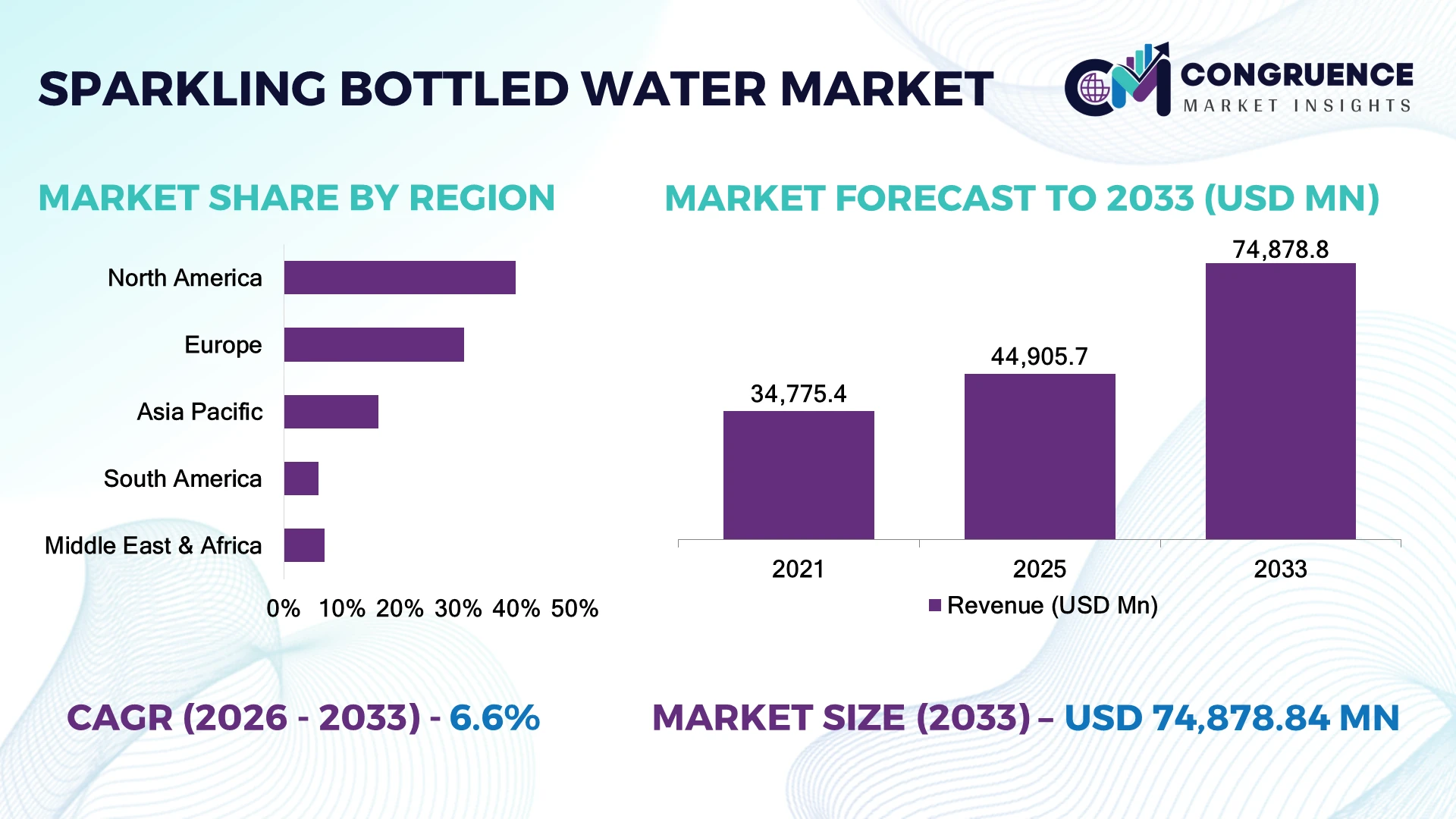
The United States remains the dominant country, representing roughly 27% of global sparkling-water market value, supported by established brands, high supermarket penetration, and strong convenience-channel turnover. Europe remains a major premium market, with Italy, France, and Germany anchoring mineral-water consumption. Meanwhile, Asia-Pacific is accelerating through urban retail expansion and premium hydration adoption. The 2026 EU packaging regime is pushing producers toward higher recycled-content packaging and reshaping procurement decisions.
Strategically, winners will combine premium product differentiation with packaging efficiency, resilient sourcing, and scalable distribution.
Market Size & Growth: USD 44.9 billion in 2025 to USD 74.9 billion by 2033 at 6.6% CAGR, driven by premiumization and soda substitution.
Top Growth Drivers: Zero-sugar substitution 31%; premium mineral positioning 24%; flavored and functional innovation 19%.
Short-Term Forecast: By 2028, lightweight packaging and line automation are positioned to reduce packaging-related costs by 5–8% and improve filling efficiency by 3–5%.
Emerging Technologies: AI demand forecasting, automated filling, digital quality monitoring, and lightweight rPET packaging are reshaping production and inventory management.
Regional Leaders: North America approaches USD 29 billion, Europe approximately USD 31 billion, and Asia-Pacific more than USD 10 billion by 2033, with premiumization strongest in mature markets.
Consumer/End-User Trends: Natural and mineral sparkling water represented approximately 63% of global category value in 2025, while zero-sugar positioning continues gaining mainstream adoption.
Pilot/Case Example: 2025 Nestlé Waters process automation reduced cleaning-cycle production downtime by 20% while saving approximately 340 tonnes of CO₂ during the first year.
Competitive Landscape: North America leads global scale, with Nestlé, Coca-Cola, PepsiCo, Keurig Dr Pepper, and National Beverage competing through flavor innovation, distribution reach, and brand positioning.
Regulatory & ESG Impact: EU requirements already mandate 25% recycled plastic in PET beverage bottles, increasing to 30% for plastic beverage bottles from 2030 and accelerating rPET procurement.
Investment & Funding: Large beverage groups continue directing billions of dollars across bottling capacity, brand expansion, packaging modernization, and distribution infrastructure rather than relying solely on product launches.
Innovation & Future Outlook: Functional sparkling water, electrolytes, botanical infusions, premium mineral sourcing, lightweight containers, and digitally optimized production will shift competition toward higher-value, differentiated hydration.
The Sparkling Bottled Water Market is increasingly concentrated around flavored, mineral, zero-sugar, and functional formulations, with natural/mineral products representing approximately 63% of category value. Lightweight PET, recycled-content packaging, and automated filling are gaining operational relevance as European packaging rules tighten and beverage companies restructure packaging procurement. These shifts are creating a stronger transition toward premium, sustainable, and digitally managed sparkling-water portfolios.
Sparkling bottled water is becoming strategically important because it sits at the intersection of beverage substitution, premiumization, packaging transformation, and health-oriented consumption. Established beverage companies are using sparkling water to capture consumers moving away from sugary carbonated drinks while protecting shelf presence across supermarkets, convenience stores, restaurants, and hospitality. Natural and mineral sparkling water already represents approximately 63% of category value, reinforcing premium product positioning.
Production technology is also becoming a competitive differentiator. Automated clean-in-place monitoring has demonstrated approximately 20% lower production downtime versus conventional cleaning operations, while digital diagnostics improve traceability and process control. The comparison is increasingly shifting from basic bottling efficiency toward integrated automation, predictive maintenance, and packaging optimization.
Regional strategies differ materially. North America prioritizes scale, flavor innovation, and convenience distribution, while Europe emphasizes mineral provenance and packaging circularity. Asia-Pacific is building premium distribution and modern retail penetration. Through 2026–2028, companies are expected to prioritize lightweight packaging, higher recycled content, functional formulations, and localized production. The practical advantage will favor operators that integrate product innovation with resilient packaging supply chains and efficient bottling infrastructure rather than competing on brand visibility alone.
Premium mineral positioning and zero-sugar substitution are shifting sparkling bottled water toward higher-value beverage occasions. Natural and mineral products represent approximately 63% of category value, while flavored variants account for nearly 30% of new product activity. In the United States, premium sparkling formats are expanding across convenience and foodservice channels as consumers replace conventional soft drinks. European producers are simultaneously emphasizing provenance and mineral composition. Packaging automation and smaller-format filling lines are allowing manufacturers to broaden SKU portfolios without proportionally increasing labor requirements. Companies are responding through premium brand extensions, flavor innovation, and targeted distribution partnerships. The non-obvious advantage is higher revenue density per shelf position, allowing premium sparkling water to compete for space traditionally controlled by carbonated soft drinks.
Packaging remains a structural cost constraint as PET, aluminum, recycled resin, energy, and transport prices fluctuate simultaneously. Packaging can represent roughly 20–30% of bottled-water production costs, while lightweighting typically delivers only 5–10% material savings before equipment adjustments. European producers face additional pressure from mandatory recycled-content requirements, increasing competition for food-grade rPET. Cross-border supply disruptions can further raise delivered packaging costs by 8–12% during constrained periods. Companies are responding through multi-supplier contracts, local resin sourcing, higher recycled-content integration, and bottle redesign. The operational pressure is particularly acute for smaller producers, where procurement volumes lack the negotiating leverage of multinational beverage groups. Strategic localization of packaging supply is therefore becoming as important as beverage formulation.
Functional sparkling water is opening a higher-margin space through electrolytes, minerals, botanicals, vitamins, and low-calorie flavor systems. Functional variants already represent roughly 10–15% of new sparkling-water launches, while enhanced hydration products are gaining particular traction among younger consumers. Japanese and South Korean beverage companies are advancing compact functional formats, while U.S. brands increasingly combine carbonation with electrolyte positioning. A key opportunity lies in ambient-stable functional formulations that avoid cold-chain dependence and can reduce distribution complexity by approximately 5–8%. Companies are investing in formulation R&D, contract manufacturing, and retail partnerships to accelerate launches. The strongest strategic opportunity is not simply adding ingredients; it is building differentiated hydration platforms that support repeat consumption without competing directly on commodity water pricing.
Maintaining carbonation, dissolved-gas stability, package integrity, and sensory consistency becomes increasingly difficult as producers expand lightweight packaging and high-speed filling. Carbonation losses of even 2–3% can affect consumer perception, while lightweight PET bottles can require tighter pressure-control tolerances than legacy formats. High-speed lines operating above 1,000 bottles per minute intensify quality-control requirements and amplify small process deviations. European manufacturers additionally face evolving packaging standards that require redesign without compromising pressure resistance. Companies are deploying inline pressure sensors, automated inspection, predictive maintenance, and digital batch monitoring to stabilize output. The long-term competitive issue is integration: packaging lightweighting, carbonation control, and line speed must be optimized together rather than treated as separate engineering projects.
Lightweight Packaging Moves Mainstream: Bottle-weight reductions of 5–10% are becoming increasingly common as producers respond to resin costs and packaging regulations. European manufacturers are simultaneously increasing recycled-content usage, with 25% recycled plastic required for PET bottles under current EU rules. Companies are redesigning preforms and upgrading blow-molding equipment.
Functional Carbonation Gains Shelf Space: Functional sparkling formats now account for roughly 10–15% of new product launches, incorporating electrolytes, minerals, botanicals, and vitamins. U.S. beverage companies are using these formulations to capture hydration occasions previously served by sports drinks. Contract manufacturers are expanding small-batch capabilities to shorten launch cycles.
Automation Tightens Filling Economics: High-speed bottling lines exceeding 1,000 bottles per minute are increasing the importance of inline carbonation, pressure, and fill-level monitoring. Automated inspection can reduce manual quality checks by approximately 30–40%. Large producers are integrating machine vision and predictive maintenance to reduce downtime and stabilize multi-SKU production.
Mineral Provenance Becomes Differentiator: European brands are increasingly emphasizing source identity, mineral composition, and protected water origins, with premium natural-mineral products representing approximately 63% of category value. This creates a non-obvious competitive barrier: source qualification and geographic authenticity can be harder to replicate than flavor innovation, encouraging long-term spring-rights and distribution partnerships.
Flavored sparkling water is the leading type, accounting for approximately 56% of global market value in 2025, supported by citrus, berry, botanical, and tropical variants that deliver sensory differentiation without conventional soft-drink sugar levels. Unflavored sparkling water remains strategically important at roughly 44%, particularly across premium mineral-water portfolios and European foodservice. Flavored products also support faster SKU rotation, seasonal launches, and stronger shelf differentiation, encouraging beverage companies to allocate greater innovation budgets toward flavor architecture and limited-edition formats.
Functional sparkling water is the fastest-shifting segment, representing an estimated 10–15% of new product activity as electrolytes, minerals, botanicals, vitamins, and digestive-health positioning enter mainstream beverage portfolios. Its smaller installed base contrasts with stronger innovation intensity, creating premiumization opportunities. Companies are increasingly using contract manufacturing and modular filling lines to test functional formulations before committing to dedicated capacity.
Direct consumption for everyday hydration remains the leading application, representing approximately 58% of sparkling bottled water demand. Household and on-the-go consumption benefit from single-serve formats, resealable packaging, and zero-sugar positioning. Meal accompaniment represents roughly 24%, supported by restaurant, café, and hospitality usage where sparkling water functions as a premium alternative to soft drinks. Mixer applications account for about 10%, while wellness, sports, and specialized uses comprise the remaining share.
Wellness-oriented and functional hydration is the fastest-changing application, with approximately 15% of recent product innovation incorporating electrolytes, minerals, botanicals, or vitamin positioning. This shift is moving sparkling water beyond refreshment into routine-based consumption. Companies are responding with smaller functional SKUs, multipacks, and foodservice partnerships. The strategic implication is that application growth increasingly depends on occasion-specific positioning rather than carbonation alone.
Household consumers represent approximately 64% of sparkling bottled water demand, reflecting supermarket purchases, convenience formats, multipacks, and home consumption. Foodservice and hospitality account for roughly 23%, while offices, institutions, and other commercial users contribute approximately 13%. Household purchasing emphasizes price, flavor variety, package convenience, and repeat availability, whereas hospitality buyers place greater weight on presentation, provenance, bottle format, and reliable replenishment.
Foodservice and hospitality are the fastest-changing end-user group, supported by premium dining, hotels, cafés, and alcohol-substitution occasions. Their smaller volume base generates stronger value per unit and encourages glass-bottle and premium mineral formats. Companies are therefore separating channel strategies: multipack and PET optimization for households, while hospitality portfolios emphasize premium glass, differentiated provenance, and dedicated distributor relationships. This creates a non-obvious advantage for producers able to operate dual packaging and fulfillment models without fragmenting manufacturing efficiency.
North America accounted for the largest market share at 39.8% in 2025 however, Asia-Pacific is expected to register the fastest growth, expanding at a CAGR of 8.1% between 2026 and 2033.
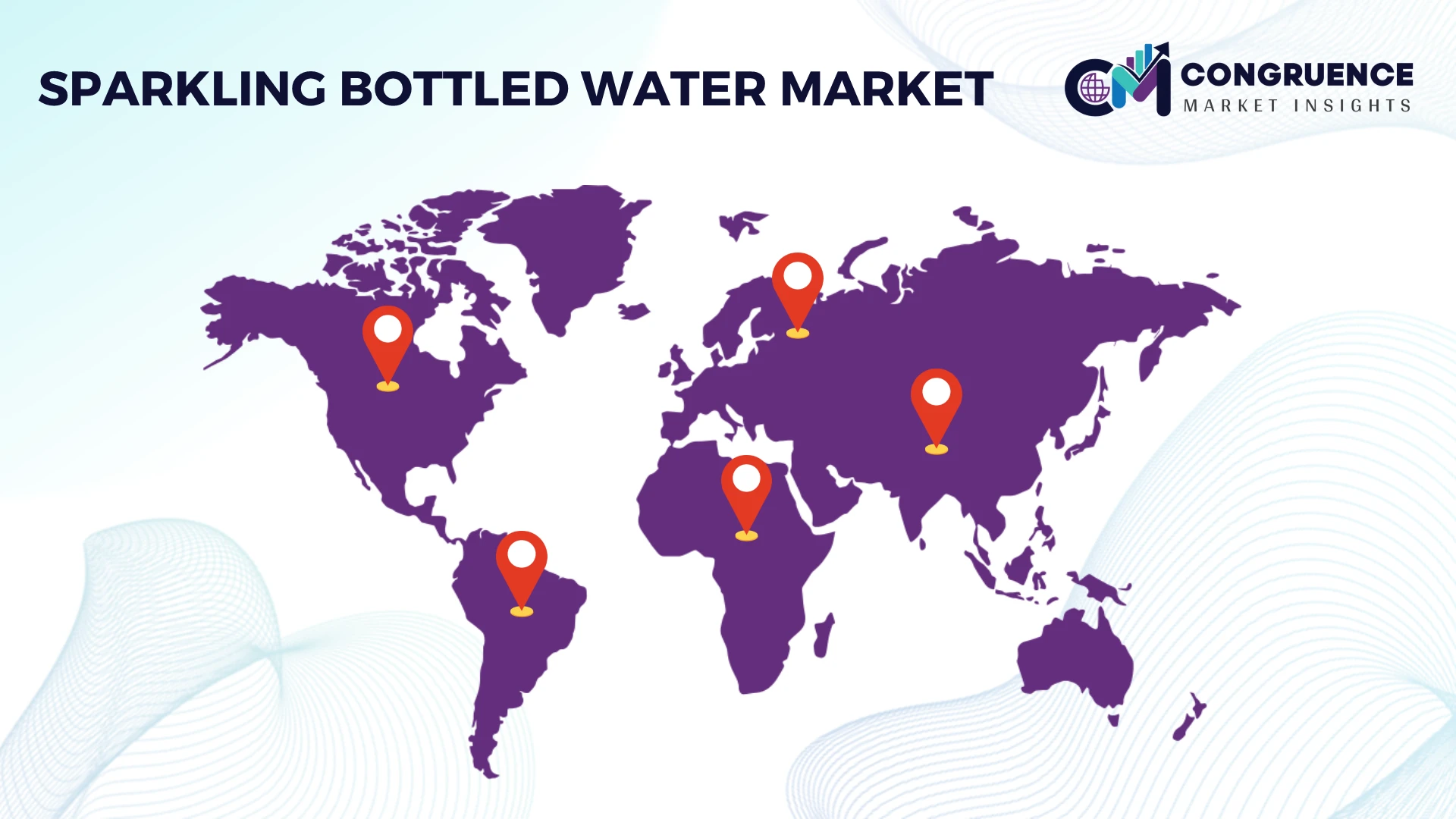
Premium carbonation is moving deeper into mainstream beverage portfolios
North America remains the largest regional market, supported by high penetration of sparkling water across supermarkets, convenience stores, foodservice, and direct-to-consumer channels. The United States contributes approximately 88% of regional demand, making it the primary center for brand launches, contract bottling, and distribution investment. Sparkling water has increasingly replaced conventional carbonated soft drinks in zero-sugar consumption occasions, while flavored variants account for more than half of category sales. Major producers are expanding aluminum-can, PET, and premium glass formats to address different consumption occasions. Automated high-speed bottling and multipack production are also improving SKU flexibility. Beverage companies are increasingly using established soft-drink distribution networks to accelerate sparkling-water penetration without building separate logistics infrastructure.
United States Market Outlook: The United States remains the principal global demand center, supported by extensive modern-retail infrastructure and a highly developed beverage distribution system. National brands operate across thousands of grocery, convenience, restaurant, and foodservice locations, while regional craft producers differentiate through mineral provenance and functional formulations. Approximately 60% of U.S. sparkling-water purchasing is linked to flavored or differentiated formats.
Mineral provenance and packaging circularity define premium competition
Europe represents approximately 31% of global sparkling bottled water demand, supported by established mineral-water consumption in Italy, France, Germany, and Switzerland. Unlike North America, European competition places greater emphasis on source identity, mineral composition, glass packaging, and protected water origins. More than 70% of European consumers encounter sparkling mineral water through established retail and hospitality channels, supporting resilient premium positioning. Packaging regulation is simultaneously reshaping production economics, with EU recycled-content requirements increasing pressure on PET procurement and bottle redesign. Producers are investing in lightweight containers, closed-loop packaging systems, and energy-efficient bottling lines. The strategic advantage increasingly rests on combining authentic source differentiation with compliant, lower-material packaging.
Italy Market Outlook: Italy is the region's most significant sparkling mineral-water market, supported by deep household penetration, extensive spring-water infrastructure, and strong hospitality consumption. Sparkling formats represent a substantial portion of packaged-water purchasing, while domestic producers maintain extensive bottling networks close to mineral sources. Investments in lightweight PET, returnable glass, and automated filling are improving plant productivity while preserving premium source positioning.
Urban premiumization is converting sparkling water into a lifestyle category
Asia-Pacific is the fastest-developing market, supported by urbanization, premium beverage retail, modern trade expansion, and growing exposure to Western-style dining. China, Japan, Australia, and South Korea account for the strongest commercial activity, while India is emerging from a relatively smaller base. China represents approximately 35% of regional sparkling-water consumption, with premium imported and domestic brands expanding through supermarkets, cafés, hotels, and e-commerce. Functional sparkling beverages are particularly relevant, with electrolyte and botanical formulations gaining traction among younger consumers. Producers are responding through localized flavors, smaller package formats, digital-first launches, and partnerships with modern retailers. The region's opportunity is increasingly tied to premium urban consumers rather than mass bottled-water substitution.
China Market Outlook: China provides the strongest combination of manufacturing scale, urban retail infrastructure, and premium beverage distribution in Asia-Pacific. Major beverage producers can leverage extensive PET, aluminum-can, and filling infrastructure to introduce sparkling products alongside existing portfolios. Approximately one-third of Asia-Pacific category demand is concentrated in China, while premium convenience and e-commerce channels are expanding product visibility in major cities.
Premium hydration is expanding through hospitality and urban retail
South America represents approximately 6% of global sparkling bottled water demand, with Brazil and Argentina accounting for most commercial activity. Brazil provides the largest consumer base and extensive beverage manufacturing infrastructure, while Argentina benefits from established mineral-water consumption and hospitality demand. Sparkling water remains particularly relevant in restaurants, hotels, cafés, and premium household channels, creating higher-value consumption occasions than conventional still water. Producers are expanding flavored and premium formats while using established beverage distributors to limit incremental logistics costs. PET and aluminum formats are gaining relevance where transportation efficiency is critical, although inflation and packaging-input volatility remain operational constraints. Companies with localized bottling and flexible procurement are better positioned to protect margins.
Brazil Market Outlook: Brazil is the region's largest strategic market, combining a population exceeding 200 million with extensive beverage manufacturing and distribution infrastructure. Large producers can integrate sparkling-water production into existing bottling networks, reducing incremental logistics requirements. Urban supermarkets, convenience outlets, restaurants, and hospitality venues provide the strongest commercial channels, while premium flavored formats support higher-value positioning.
Premium hospitality investment is accelerating differentiated hydration
Middle East & Africa accounts for approximately 7% of global sparkling bottled water demand, with the Gulf states representing the strongest premium-consumption cluster. Saudi Arabia, the UAE, and Qatar benefit from high-end hospitality, tourism infrastructure, international restaurants, and premium retail development. Dubai and Riyadh are particularly important for imported and locally bottled sparkling formats, while hotels increasingly use glass packaging for premium table service. Water scarcity also encourages investment in efficient bottling, filtration, and packaging operations. Producers are responding with localized bottling partnerships, premium glass portfolios, and hospitality-focused distribution agreements. The region's competitive structure favors brands capable of maintaining consistent quality while managing desalination-related production economics and long-distance logistics.
United Arab Emirates Market Outlook: The UAE is the region's strongest premium sparkling-water hub because Dubai and Abu Dhabi combine high hotel density, international foodservice, luxury retail, and substantial expatriate consumption. Hospitality represents a particularly important channel, encouraging glass-bottle deployment and premium mineral positioning. Tourism and hotel expansion continue strengthening demand for differentiated sparkling formats, while local bottling partnerships can reduce import dependence and improve supply reliability.
Coca-Cola competes with PepsiCo, Nestlé, Danone, National Beverage, and regional mineral-water specialists, combining global distribution against provenance-led brands. The top five are estimated at roughly 28% share. Competition centers on flavor innovation, packaging, retail reach, and pricing, with 5–10% lightweighting reducing material intensity. Functional launches represent roughly 10–15% of new product activity. Players compete through bottling expansion, retail partnerships, limited editions, localized flavors, and portfolio integration. Coca-Cola leverages bottling reach, PepsiCo combines sparkling-water brands with broader beverage distribution, while Nestlé emphasizes mineral provenance and premium positioning. Regional specialists compete through source authenticity and hospitality relationships. The competitive shift is toward premium, functional, and sustainable formats, raising barriers around source access, bottling scale, packaging procurement, and distribution density. Entry pressure is strongest where private-label and local brands can undercut branded pricing. Winning requires differentiated formulations, reliable supply, efficient packaging, and omnichannel execution backed by sufficient marketing scale across major consumption occasions.
The Coca-Cola Company
PepsiCo, Inc.
Nestlé S.A.
Danone S.A.
Keurig Dr Pepper Inc.
National Beverage Corp.
Primo Brands Corporation
Gerolsteiner Brunnen GmbH & Co. KG
Spindrift Beverage Co., Inc.
Waterloo Sparkling Water
Sanpellegrino S.p.A.
Mineracqua Group
Ferrarelle Società Benefit S.p.A.
Sparkling bottled water production is moving toward automated carbonation control, machine vision, predictive maintenance, and digitally integrated filling lines. Inline inspection can reduce manual quality checks by roughly 30–40%, while automated process control improves filling consistency by 1–2%. Adoption is highest among multinational bottlers operating high-speed, multi-SKU plants, where downtime directly affects utilization, quality, and changeover economics.
Lightweight PET, recycled-content packaging, and advanced preform engineering are becoming commercially important. Lightweighting typically cuts packaging material by 5–10% versus older bottles, while modern blow-molding systems improve material utilization by about 1–2%. Large producers benefit most because scale justifies equipment upgrades and closed-loop resin procurement. European regulatory pressure is accelerating deployment of recycled-content packaging and more efficient bottle designs.
By 2026–2028, integrated digital twins, AI demand forecasting, automated inspection, and connected carbonation systems will increasingly link production with inventory and distribution. Plants combining predictive maintenance with machine vision can target 2–3% higher line availability. Competitive advantage will favor operators able to reduce material intensity while preserving carbonation stability, package integrity, premium sensory quality, and fast multi-SKU changeovers. This favors large integrated bottlers and technically advanced regional producers that can amortize automation while responding faster to packaging regulation and volatile input costs across markets.
July 2026 Nestlé and Platinum Equity announced Peranel, a 50:50 joint venture covering over 30 water and premium beverage brands sold in 120 countries. The transaction creates a platform for expansion across sparkling and premium hydration categories. Source: nestle.com
September 2026 PepsiCo’s bubly launched two mocktail-inspired sparkling-water flavors nationwide in the United States, extending its zero-calorie portfolio. The rollout followed seasonal innovation and strengthens flavor-led differentiation as brands target alcohol-reduction occasions through sparkling-water formats. Source: pepsico.com
March 2024 Hindustan Coca-Cola Beverages committed INR 350 crore to two new manufacturing lines at its Rajgarh facility in Madhya Pradesh. The expansion includes affordable small sparkling packs and strengthens localized beverage capacity within India’s packaged-drink market. Source: hccb.in
2024 Spritzer commissioned three modern bottling lines, including one dedicated to carbonated sparkling products and flavored beverages. The Malaysian producer reported a 25% increase in production capacity to 1.25 billion liters annually, strengthening manufacturing flexibility and supporting category expansion. Source: spritzer.com.my
The Sparkling Bottled Water Market Report covers flavored and unflavored sparkling water, mineral and functional formats, and applications spanning everyday hydration, meal accompaniment, foodservice, hospitality, wellness, and mixer occasions. End-user coverage includes households, foodservice and hospitality operators, offices, institutions, and commercial buyers. Regional analysis encompasses North America, Europe, Asia-Pacific, South America, and Middle East & Africa, with country-level assessment of major consumption and production centers.
The report evaluates carbonation systems, automated filling, machine vision, predictive maintenance, lightweight PET, recycled-content packaging, aluminum formats, and emerging functional formulations. More than half of category activity is concentrated in differentiated flavored formats, while functional products represent approximately 10–15% of new product activity. The analysis supports investment planning, bottling-capacity expansion, packaging procurement, channel strategy, partnership decisions, competitive positioning, and technology prioritization across 2026–2033, including premium mineral, functional, sustainable, and emerging-market opportunities.
| Report Attribute/Metric | Report Details |
|---|---|
|
Market Revenue in 2025 |
USD 44,905.7 Million |
|
Market Revenue in 2033 |
USD 74,878.8 Million |
|
CAGR (2026 - 2033) |
6.6% |
|
Base Year |
2025 |
|
Forecast Period |
2026 - 2033 |
|
Historic Period |
2021 - 2025 |
|
Segments Covered |
By Type
By Application
By End-User
|
|
Key Report Deliverable |
Revenue Forecast, Growth Trends, Market Dynamics, Segmental Overview, Regional and Country-wise Analysis, Competition Landscape |
|
Region Covered |
North America, Europe, Asia-Pacific, South America, Middle East, Africa |
|
Key Players Analyzed |
The Coca-Cola Company, PepsiCo, Inc., Nestlé S.A., Danone S.A., Keurig Dr Pepper Inc., National Beverage Corp., Primo Brands Corporation, Gerolsteiner Brunnen GmbH & Co. KG, Spindrift Beverage Co., Inc., Waterloo Sparkling Water, Sanpellegrino S.p.A., Mineracqua Group, Ferrarelle Società Benefit S.p.A. |
|
Customization & Pricing |
Available on Request (10% Customization is Free) |




