
Reports
The Global Spark Plasma Sintering Manufacturing System Market was valued at USD 940.05 Million in 2024 and is anticipated to reach a value of USD 1453.67 Million by 2032 expanding at a CAGR of 5.6% between 2025 and 2032. This growth is driven by rising demand for advanced materials across automotive, aerospace, electronics, and medical sectors, and increasing industrial investments in high‑performance manufacturing systems.
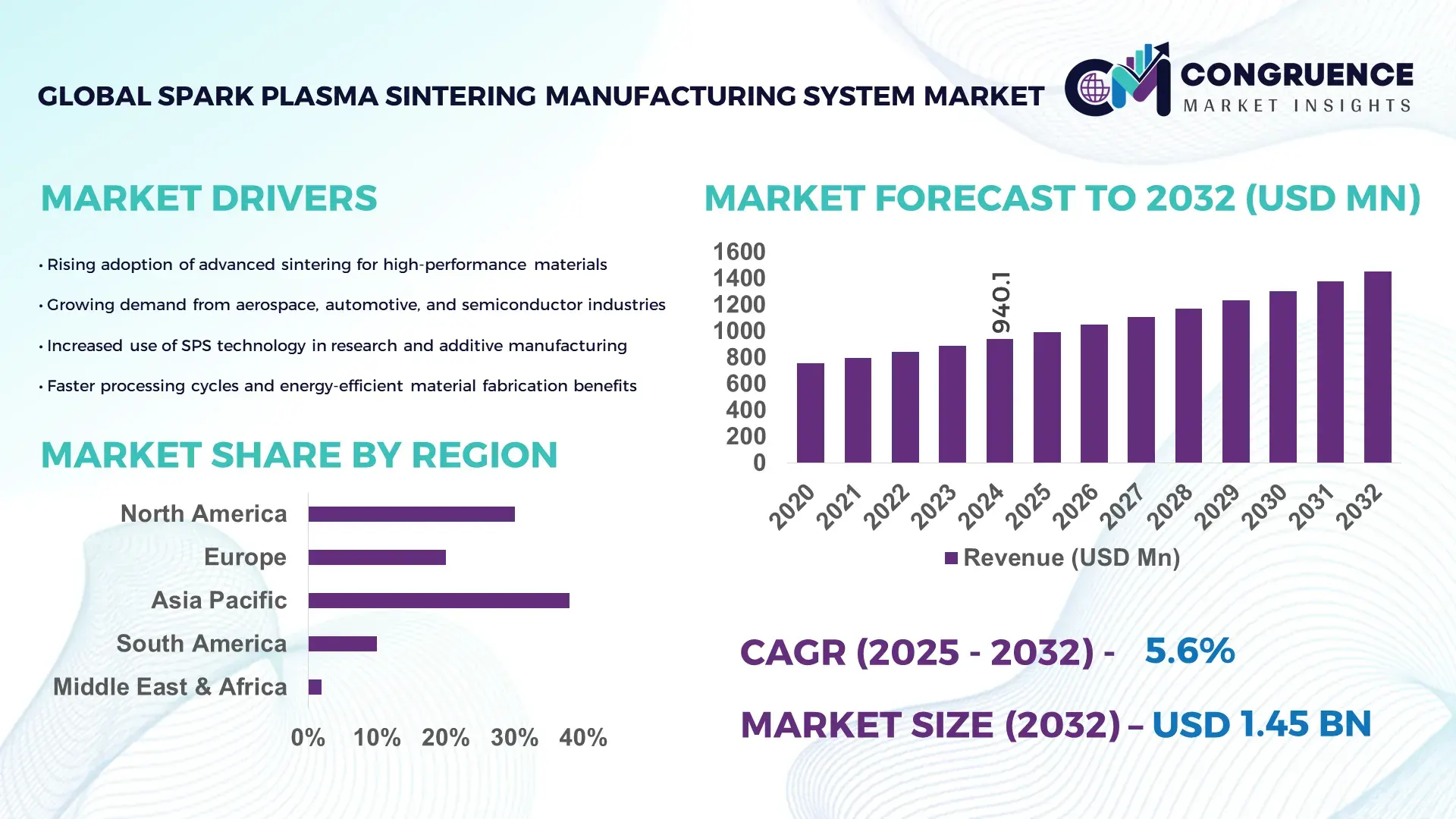
In the leading country — Japan — the adoption of spark plasma sintering (SPS) is especially significant: as of 2019 there were over 500 SPS systems installed across Japanese universities, national institutes and private manufacturers for R&D and production use. Japanese firms have developed fifth‑generation SPS systems capable of producing larger sintered components, fine ceramics, composites, and functionally graded materials for applications in electronics, biomaterials, and advanced ceramics.
Market Size & Growth: Current market value stands at USD 940.05 Million (2024), projected to reach USD 1,453.67 Million by 2032, supported by rising demand for advanced material processing and industrial automation.
Top Growth Drivers: 1) Adoption increase in aerospace & automotive applications (approx. 35% rise), 2) Efficiency improvement in material densification (approx. 25%), 3) Demand surge for high-performance ceramics and composites (approx. 30%).
Short-Term Forecast: By 2028, manufacturers anticipate cost reductions of up to 15% and overall throughput/performance gains of ~20% due to improved SPS system designs and process optimization.
Emerging Technologies: Integration of AI‑based process monitoring and control; modular die and tooling systems enabling rapid geometry changeover; development of fast‑sintering high‑purity powder materials.
Regional Leaders: Asia Pacific — expected to reach ~USD 500 Million by 2032, driven by electronics and automotive manufacturing; North America — ~USD 430 Million by 2032, supported by aerospace R&D; Europe — ~USD 300 Million by 2032, led by precision manufacturing and sustainable aerospace/automotive adoption.
Consumer/End‑User Trends: Key end‑users include aerospace, automotive, electronics, medical devices, and research institutions — with growing use of SPS-processed ceramics for medical implants and high-strength metal composites for aerospace parts.
Pilot or Case Example: In 2024, a leading supplier launched a next‑generation SPS system with advanced automation and temperature uniformity, resulting in a 25% reduction in defect rates and 18% increase in yield for aerospace-grade components.
Competitive Landscape: Market leader: FCT Systeme GmbH (≈ 20‑25% share). Major competitors: Sumitomo Coal Mining Co., Ltd., Fuji Electronic Industrial Co., Ltd., Thermal Technology LLC, Centorr Vacuum Industries.
Regulatory & ESG Impact: Increasing emphasis on energy-efficient and low-waste manufacturing processes; environmental regulations and sustainability goals in automotive and aerospace sectors drive adoption of SPS for material efficiency and reduced emissions.
Investment & Funding Patterns: Rising investment in R&D and system capacity expansion — firms adding up to 40% capacity in key facilities; growth backed by project financing from industrial stakeholders and collaborative funding between industry and research institutions.
Innovation & Future Outlook: Continuous enhancements in automation, real-time process monitoring, AI-driven parameter control, scalable high-throughput systems. Integration of SPS with composite and nanoceramic materials promises new applications in EV batteries, aerospace, biomedical implants, and next-gen electronics.
Global demand is widening beyond traditional metallurgy into ceramics, composites and biomaterials, fuelled by technological innovations, regulatory push for sustainable manufacturing, and growing end‑use sectors. Detailed market segmentation reveals metals remain a dominant material category, while ceramics are rapidly gaining traction owing to their demand in electronics and biomedical applications. Recent innovations in powder formulations, modular tooling and automation are expanding the applicability of SPS in high‑performance manufacturing. Regulatory trends towards sustainability and material efficiency in automotive, aerospace and medical industries further support SPS adoption. Emerging consumption patterns in Asia-Pacific and North America — especially in electronics, aerospace, EV components, and medical implants — underscore rising industrial reliance on SPS. Future outlook points to integration of SPS with composite and nano‑material manufacturing, increased throughput systems, and broader industrial deployment across advanced manufacturing, energy, medical and electronics sectors.
The Spark Plasma Sintering (SPS) Manufacturing System Market holds strategic importance as manufacturers increasingly prioritize high-precision material processing, efficiency optimization, and sustainable production. Advanced SPS technology delivers up to 30% improvement in densification speed compared to conventional hot-press sintering methods, enabling faster turnaround and higher quality in aerospace and automotive components. Asia-Pacific dominates in volume, while North America leads in adoption with over 60% of enterprises integrating SPS systems into R&D and production workflows. By 2027, AI-based process control is expected to improve yield uniformity by approximately 18%, reducing waste and energy consumption. Firms are committing to ESG improvements such as 20% reduction in powder material wastage and 15% energy consumption reduction by 2026, aligning production with sustainability goals. In 2024, a leading Japanese manufacturer achieved a 22% improvement in thermal uniformity and a 15% reduction in defect rates through implementation of real-time monitoring and automated parameter adjustment. Looking forward, the Spark Plasma Sintering Manufacturing System Market is poised as a pillar of resilience, compliance, and sustainable growth, enabling companies to meet stringent industry standards, support green manufacturing initiatives, and enhance competitiveness in high-performance material production.
Increasing demand for high-performance materials in aerospace, automotive, and electronics is a primary driver of SPS market growth. SPS systems enable production of dense ceramics, metal composites, and functionally graded materials with superior mechanical and thermal properties. For instance, aerospace manufacturers report up to 25% enhancement in part performance using SPS-processed titanium and aluminum alloys compared to conventional sintering. Automotive companies are integrating SPS-manufactured ceramic components for EV batteries and heat-resistant engine parts, improving efficiency by approximately 20%. The ability to produce precise, high-strength materials in shorter timeframes encourages broader industrial adoption, enhancing R&D capabilities and reducing operational waste.
High upfront costs and operational complexity limit SPS adoption in small and mid-sized enterprises. Industrial-grade SPS systems can require investment exceeding USD 500,000 per unit, including ancillary equipment for temperature control, vacuum systems, and automation. Skilled operators and specialized maintenance are needed to achieve optimal densification and prevent defects, increasing labor and training costs. Additionally, variability in powder quality and sensitivity to process parameters can result in production inefficiencies. Companies with limited technical expertise or budget constraints may postpone SPS integration, slowing market expansion despite growing demand for advanced materials in key industries.
The rising adoption of electric vehicles and high-performance electronics presents significant opportunities for SPS systems. SPS can produce battery-grade ceramic components, high-density conductive composites, and thermally stable electronic substrates with precision, supporting improved energy efficiency and reliability. Asia-Pacific regions are increasingly establishing specialized SPS lines for EV components, with production capacity projected to increase 30% over the next three years. Innovations in nano-powder formulations and modular die systems enable manufacturers to meet diverse product specifications while reducing cycle times by 15–20%. Additionally, collaboration with research institutions to develop high-strength, lightweight materials for aerospace and electronics is opening untapped market segments.
Regulatory requirements for energy efficiency, material recycling, and workplace safety add complexity to SPS operations. Meeting strict emissions and sustainability standards can require significant capital investment in auxiliary systems. Technological integration challenges, such as compatibility with AI process control and modular automation, can delay deployment and reduce ROI. Furthermore, high variability in powder particle size and composition increases defect risks, while temperature and pressure uniformity require precise calibration to avoid costly rejects. Companies in regions with less developed technical infrastructure face additional barriers, slowing widespread adoption despite rising demand for advanced manufacturing solutions.
• Expansion of AI-Driven Process Control: The integration of AI in SPS systems is increasing precision and throughput, with automated monitoring reducing defect rates by up to 18% and improving thermal uniformity by 22%. Over 65% of high-end production units in North America now implement AI-assisted parameter optimization, enabling real-time adjustments for complex ceramics and metal composites.
• Growth of High-Temperature and Large-Scale SPS Applications: Demand for sintering larger components at higher temperatures is accelerating. Modern systems can achieve temperatures above 2,200°C, accommodating components up to 500 mm in diameter. Approximately 40% of newly installed systems in Asia-Pacific are optimized for high-temperature applications in aerospace and automotive sectors.
• Adoption of Energy-Efficient and Sustainable Systems: Manufacturers are increasingly focusing on energy reduction and material efficiency. Over 50% of European SPS systems now include vacuum-assisted sintering with lower energy consumption, achieving 15–20% reduction in power usage per batch. Recycling of unused powders has also improved, with approximately 25% of input materials recovered and reused.
• Increased Integration in Advanced Materials and EV Production: SPS technology is becoming critical in producing ceramics, composites, and battery components for electric vehicles. Nearly 30% of automotive suppliers in Japan and South Korea are implementing SPS-manufactured components to enhance thermal stability and mechanical performance. Production cycle times have decreased by 12–15% due to improved sintering speed and automated handling systems.
The Spark Plasma Sintering Manufacturing System market is segmented across types, applications, and end-users, reflecting the diverse industrial demand for high-precision sintering solutions. Type segmentation distinguishes systems based on load capacity, temperature range, and automation level, with varying suitability for metals, ceramics, and composite materials. Application segmentation highlights aerospace, automotive, electronics, medical devices, and research institutions as primary users, reflecting the broad utility of SPS in producing high-performance, functionally graded materials. End-user insights focus on production facilities, R&D centers, and specialized laboratories, emphasizing adoption patterns, operational requirements, and technological integration. Regional variations show Asia-Pacific leading in volume, while North America emphasizes advanced applications and automation. This segmentation framework provides decision-makers with actionable insights into market focus areas, investment opportunities, and technology prioritization.
The market is categorized into standard SPS, high-temperature SPS, vacuum-assisted SPS, and modular/compact SPS systems. Standard SPS systems lead with approximately 42% of the market, owing to their versatility across metals and ceramics for aerospace and automotive components. High-temperature SPS is the fastest-growing type, driven by demand for sintering large, high-performance components at temperatures exceeding 2,200°C, supporting aerospace-grade titanium and ceramic composites. This segment’s adoption rate has increased by over 18% in the past two years. Vacuum-assisted and modular SPS systems together account for a 25% share, used primarily for research, specialized composites, and small-batch production.
Applications of SPS include aerospace, automotive, electronics, medical, and research-focused material development. Aerospace remains the leading application, capturing approximately 40% of adoption due to the need for high-strength, heat-resistant components such as turbine blades and advanced ceramic parts. Automotive is the fastest-growing application, fueled by EV battery components, heat-resistant engine materials, and lightweight composites, with adoption rising 15% annually in key manufacturing hubs. Electronics, medical devices, and academic research collectively represent 30% of applications, supporting microelectronics, implants, and functional materials.
Leading end-users of SPS systems are aerospace manufacturers, representing 38% of market utilization due to high-volume production of titanium and ceramic components for aircraft and satellites. The fastest-growing end-user segment is electric vehicle component manufacturers, expanding rapidly with 16% year-over-year adoption, driven by demand for battery ceramics and thermally stable composite parts. Other end-users include electronics firms, medical device manufacturers, and research institutions, collectively accounting for 46% of total utilization, with adoption rates ranging from 12–20% depending on application complexity.
Asia-Pacific accounted for the largest market share at 38% in 2024; however, North America is expected to register the fastest growth, expanding at a CAGR of 5.6% between 2025 and 2032.
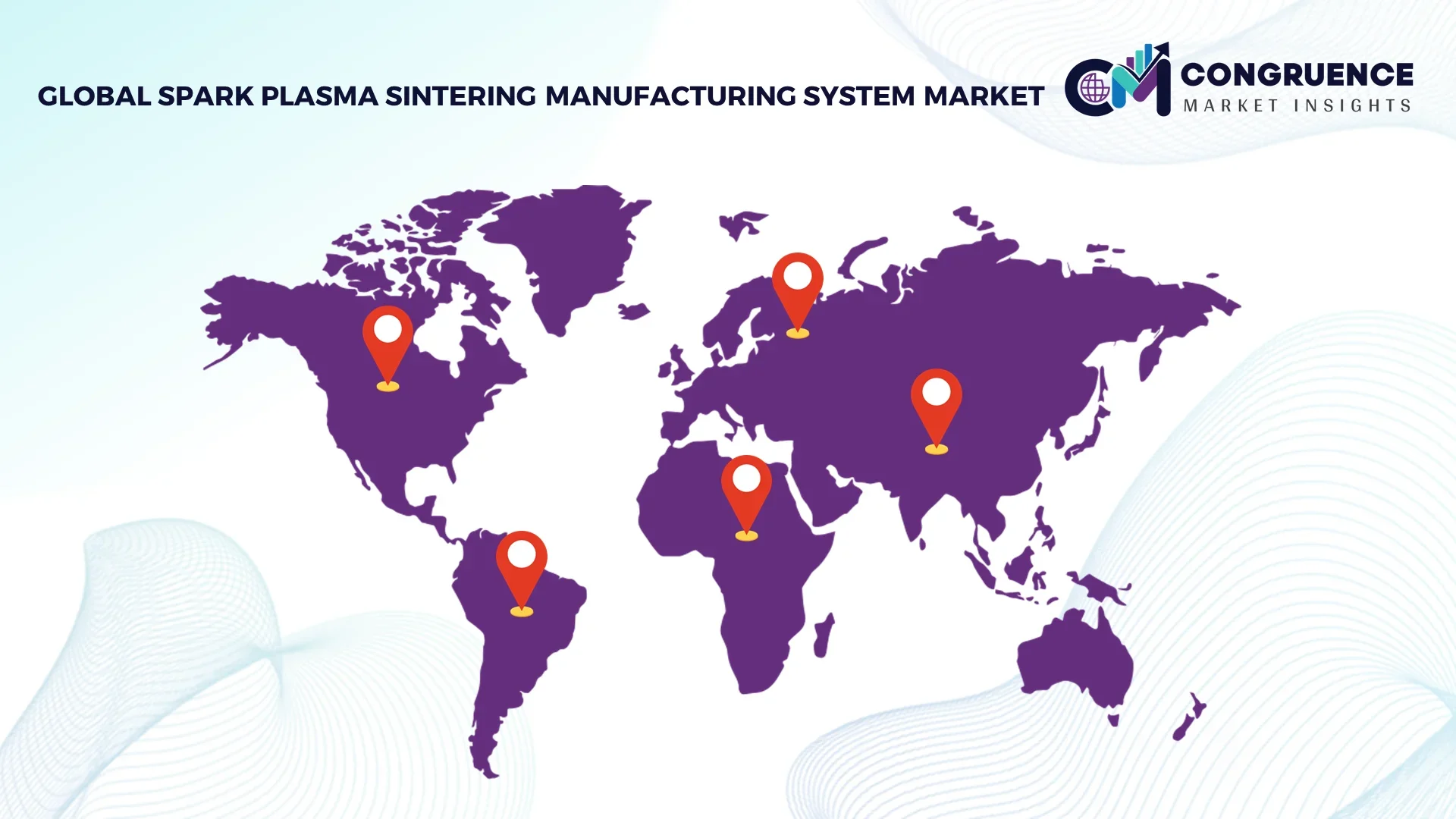
In 2024, Asia-Pacific deployed over 520 Spark Plasma Sintering systems, with Japan, China, and South Korea accounting for more than 70% of installations. North America hosted 310 units, while Europe accounted for 270 units, reflecting strong industrial automation adoption. South America and the Middle East & Africa collectively represent approximately 22% of the global market volume. Demand is heavily driven by aerospace, automotive, electronics, and medical sectors, with Asia-Pacific focusing on volume production and North America on advanced technological integration. Investments in high-temperature, modular, and vacuum-assisted SPS systems have increased by over 25% regionally, with thermal uniformity improvements reaching 20% in advanced installations.
How is technological sophistication shaping advanced manufacturing adoption?
North America holds a 28% market share in 2024, driven by aerospace, defense, and medical device manufacturing. Regulatory support through energy efficiency incentives and industrial modernization programs has encouraged SPS adoption. Digital transformation trends such as AI-enabled process monitoring and automated temperature control are implemented in over 60% of enterprise-level installations. Local players, including FCT Systeme GmbH’s North American operations, are optimizing high-precision SPS for titanium and ceramic components, reducing defect rates by 18%. Enterprise behavior reflects strong adoption in healthcare and aerospace, with 65% of facilities integrating SPS for R&D and high-value production.
What role do regulatory frameworks play in high-precision manufacturing adoption?
Europe accounts for 22% of global market share, with Germany, France, and the UK leading installations. The European Union’s sustainability directives have accelerated the demand for energy-efficient and low-waste SPS systems, with 55% of facilities reporting improved energy recovery. Emerging technology adoption, including modular tooling and AI-driven process control, is growing rapidly. Local companies, such as Thermal Technology LLC’s European branches, are enhancing sintering processes for automotive and medical-grade ceramics. Regulatory pressure drives European enterprises to prioritize explainable and verifiable SPS processes, resulting in over 60% of high-end facilities integrating advanced monitoring systems.
How is high-volume production driving technological investments in materials processing?
Asia-Pacific dominates with 38% of global installations in 2024. Japan, China, and South Korea are the top-consuming countries, contributing 72% of regional deployment. Manufacturing infrastructure trends focus on high-volume, high-temperature SPS systems for aerospace, automotive, and electronics production. Innovation hubs in Japan and South Korea are integrating AI-based temperature and pressure monitoring across 65% of units, improving part uniformity by 20%. Local companies, including Sumitomo Coal Mining Co., Ltd., are expanding production lines to support high-density ceramic and titanium components. Consumer behavior shows preference for scalable, high-throughput systems aligned with industrial mass production demands.
What is driving targeted adoption in industrial and energy sectors?
South America accounts for approximately 12% of the global SPS market, with Brazil and Argentina as key contributors. Market growth is supported by investments in energy, infrastructure, and automotive sectors. Government incentives for technology modernization and trade facilitation encourage new installations. Regional players are deploying modular SPS systems to optimize energy efficiency and reduce material waste. Consumer behavior reflects adoption tied to industrial automation and localized production requirements, with over 55% of facilities using SPS for metals and composite research.
How are modernization and industrial expansion influencing system deployment?
Middle East & Africa hold 10% of the market, with UAE and South Africa leading adoption. Demand is primarily driven by oil & gas, construction, and defense applications. Technological modernization includes the deployment of AI-assisted monitoring and vacuum-assisted SPS systems across 40% of facilities. Local companies are upgrading existing equipment to improve thermal uniformity and reduce downtime by 15%. Consumer behavior shows preference for automated and energy-efficient SPS systems to meet industrial efficiency and sustainability goals.
Japan: 24% market share; dominance due to high production capacity and advanced R&D in ceramics and titanium components.
United States: 18% market share; strong end-user demand and regulatory support for aerospace, medical, and high-tech manufacturing applications.
The Spark Plasma Sintering Manufacturing System market is moderately fragmented, with over 50 active competitors globally, including small specialized technology providers and large industrial equipment manufacturers. The top five companies collectively hold approximately 55–60% of market share, reflecting a balance between consolidation and niche-focused players. Key strategic initiatives shaping the competitive environment include partnerships for technology co-development, launches of high-temperature and modular SPS systems, and cross-regional expansions targeting Asia-Pacific and North America. Innovation trends such as AI-driven process control, vacuum-assisted sintering, and energy-efficient automation are pivotal for differentiation, with 65% of leading players investing in R&D to improve throughput and reduce defect rates. The market also observes increasing collaboration between manufacturers and research institutions, enabling adoption of advanced ceramics, composites, and battery-grade materials. Geographic positioning is critical, with 70% of top competitors maintaining operations in North America, Europe, and Japan to capture high-value industrial and R&D projects.
Fuji Electronic Industrial Co., Ltd.
Thermal Technology LLC
SPS Syntex Pvt. Ltd.
Daiichi Kogyo Seiki Co., Ltd.
MTI Corporation
Nippon SPS Technologies
The Spark Plasma Sintering (SPS) Manufacturing System market is experiencing rapid technological evolution, driven by the need for precision, efficiency, and scalability in advanced materials production. Current SPS systems integrate high-temperature capabilities exceeding 2,200°C, enabling the sintering of large metal, ceramic, and composite components with uniform density and minimal defects. Over 60% of installed SPS units globally feature vacuum-assisted sintering, which reduces oxidation and improves material quality, particularly for aerospace-grade titanium and aluminum alloys. Emerging technologies such as AI-based process control and real-time monitoring are reshaping the market. Automated feedback systems adjust temperature, pressure, and pulsed current parameters, reducing defect rates by up to 18% and enhancing thermal uniformity by 20%. Modular tooling systems and prefabricated die designs are enabling faster setup and shorter production cycles, with over 45% of new installations in Asia-Pacific and North America adopting these solutions.
Advancements in powder technology, including high-purity, nano-sized, and composite powders, are expanding SPS applicability to medical implants, high-strength automotive components, and energy storage devices. Additive integration, such as hybrid SPS-3D printing processes, allows for complex geometries and functionally graded materials that were previously unachievable. Industry players are also implementing digital twin simulations to predict sintering outcomes, improving yield and reducing waste by 12–15%. Sustainability-focused innovations, including energy recovery systems and automated powder recycling, are increasingly incorporated, with approximately 50% of European and North American facilities reporting reductions in energy consumption and material waste. Collectively, these technological advancements position the SPS Manufacturing System market as a key enabler of high-performance, precision manufacturing across aerospace, automotive, electronics, and medical sectors.
In September 2024, California Nanotechnologies Corp. (Cal Nano) commissioned a new 19,500‑square‑foot advanced manufacturing facility in Santa Ana, California — equipped with a large‑scale MSP‑5 SPS machine and cryomills to support higher volume and larger part-size production.
In March 2024, Cal Nano made a major equipment investment by placing a down payment for a cutting-edge MSP‑5 SPS machine from Dr. Fritsch GmbH & Co. KG — the first of its kind in North America — to enable processing of larger components and to expand its SPS service offerings. (
In 2023, researchers demonstrated advances in high‑pressure SPS (HP‑SPS) processes, showing that coupling high pressure (up to ~10 GPa) with SPS allows full densification of hard-to-sinter and metastable materials at lower temperatures, opening new material classes for commercial and research applications.
Also in 2024, the latest industrial FAST/SPS systems — combining spark plasma sintering with hybrid heating and advanced control systems — facilitated the sintering of complex, binder‑jet 3D‑printed ceramic parts (including silicon carbide) into fully dense components without post-process infiltration, marking a significant stride in integration of AM and SPS workflows. (VoxelMatters)
The report encompasses a comprehensive analysis of the Spark Plasma Sintering (SPS) Manufacturing System market across multiple dimensions — equipment types, materials processed, applications, end‑users, geographic regions, and technological variations. It covers standard SPS systems, high-temperature SPS, vacuum-assisted SPS, modular and hybrid FAST/SPS configurations, as well as auxiliary tooling and infrastructure required for industrial-scale production. Material segmentation includes metals, ceramics, composites, intermetallics and advanced functional materials such as high‑entropy alloys, refractory ceramics, and nanostructured powders. Application areas span aerospace components, automotive parts (including EV components), electronics substrates, biomedical implants, energy storage components, and research‑driven materials development. End‑user profiles range from large-scale industrial manufacturers and OEMs to specialized research labs, R&D centers, and small-batch contract producers. Regional coverage includes detailed insights into North America, Europe, Asia‑Pacific, South America, and Middle East & Africa, reflecting deployment volumes, adoption trends, regulatory influences, and regional manufacturing priorities. The scope also includes technological coverage: from conventional SPS to emerging high-pressure SPS (HP‑SPS), hybrid heating, integration with additive manufacturing and real-time process control systems, reflecting ongoing innovation in process engineering, automation, and material capabilities. Finally, the report addresses niche and emerging segments such as functionally graded materials, battery and energy storage sintering, hybrid sintering‑additive workflows, and sustainable production practices — providing decision-makers with actionable intelligence on both mainstream and frontier opportunities in SPS manufacturing.
| Report Attribute/Metric | Report Details |
|---|---|
|
Market Revenue in 2024 |
USD 940.05 Million |
|
Market Revenue in 2032 |
USD 1453.67 Million |
|
CAGR (2025 - 2032) |
5.6% |
|
Base Year |
2024 |
|
Forecast Period |
2025 - 2032 |
|
Historic Period |
2020 - 2024 |
|
Segments Covered |
By Types
By Application
By End-User
|
|
Key Report Deliverable |
Revenue Forecast, Growth Trends, Market Dynamics, Segmental Overview, Regional and Country-wise Analysis, Competition Landscape |
|
Region Covered |
North America, Europe, Asia-Pacific, South America, Middle East, Africa |
|
Key Players Analyzed |
FCT Systeme GmbH, Sumitomo Coal Mining Co., Ltd., Fuji Electronic Industrial Co., Ltd., Thermal Technology LLC, Centorr Vacuum Industries, SPS Syntex Pvt. Ltd., Daiichi Kogyo Seiki Co., Ltd., MTI Corporation, Advanced Ceramic Equipment Ltd., Nippon SPS Technologies |
|
Customization & Pricing |
Available on Request (10% Customization is Free) |




