
Reports
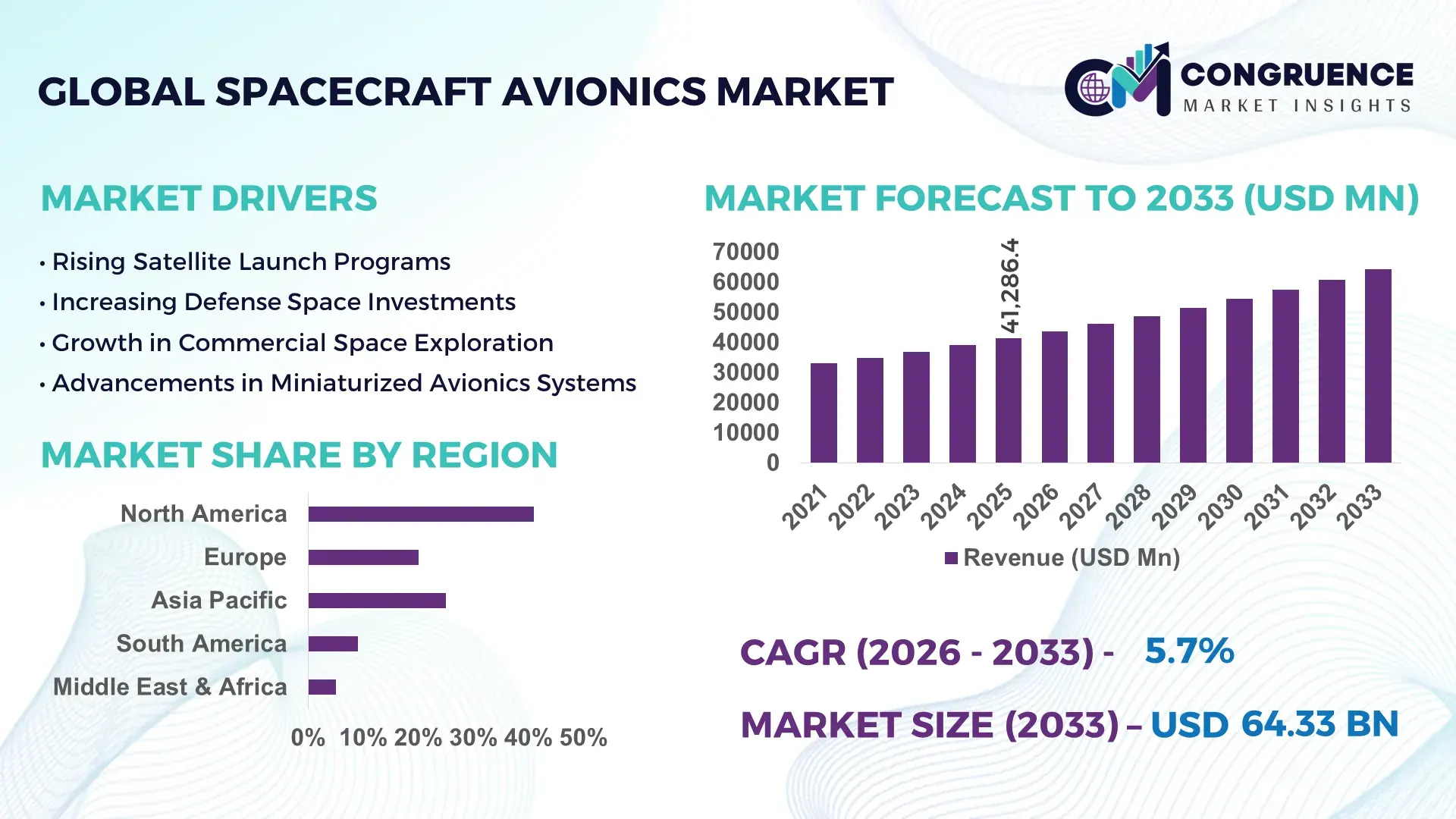
The Global Spacecraft Avionics Market was valued at USD 41286.42 Million in 2025 and is anticipated to reach a value of USD 64329.04 Million by 2033 expanding at a CAGR of 5.7% between 2026 and 2033. This growth is primarily driven by increasing satellite launches, deep space exploration missions, and advancements in onboard processing systems.
The United States continues to demonstrate a highly advanced and mature spacecraft avionics ecosystem, supported by strong institutional investment and private-sector innovation. The country conducts over 40% of global satellite launches annually and allocates more than USD 25 billion per year toward space-related programs, including avionics development. Advanced avionics architectures are widely deployed across communication, Earth observation, and defense satellites, with over 60% of spacecraft utilizing AI-enabled onboard data processing systems. The integration of radiation-hardened electronics and modular avionics platforms has significantly enhanced mission longevity and reliability. Additionally, over 70% of commercial satellite constellations rely on high-performance avionics systems developed within the U.S., reflecting extensive technological deployment and industrial scalability.
Market Size & Growth: Valued at USD 41286.42 Million in 2025, projected to reach USD 64329.04 Million by 2033, growing at 5.7% CAGR due to increased satellite deployment and autonomous spacecraft operations.
Top Growth Drivers: Satellite constellation expansion (45%), AI-based onboard processing adoption (38%), demand for deep space missions (32%).
Short-Term Forecast: By 2028, avionics system efficiency is expected to improve by 28% through miniaturization and AI integration.
Emerging Technologies: AI-enabled flight control systems, radiation-hardened microelectronics, and software-defined avionics architectures.
Regional Leaders: North America projected at USD 24 billion by 2033 with high defense integration; Europe at USD 16 billion with strong regulatory frameworks; Asia-Pacific at USD 14 billion driven by commercial satellite growth.
Consumer/End-User Trends: Increasing adoption by commercial satellite operators, defense agencies, and space exploration organizations focusing on autonomous mission capabilities.
Pilot or Case Example: In 2024, a low-Earth orbit satellite program achieved 35% power efficiency improvement using AI-integrated avionics systems.
Competitive Landscape: Market leader holds approximately 30% share, followed by key players including major aerospace and defense system providers.
Regulatory & ESG Impact: Strict compliance with space debris mitigation policies and increased focus on sustainable satellite design practices.
Investment & Funding Patterns: Over USD 18 billion invested in spacecraft electronics and avionics innovation programs globally in recent years.
Innovation & Future Outlook: Growth in software-defined payloads and modular avionics platforms is shaping next-generation spacecraft design.
The spacecraft avionics market is characterized by strong contributions from communication satellites (approximately 40%), defense and surveillance systems (30%), and scientific exploration missions (20%). Recent innovations include AI-based fault detection systems, real-time onboard analytics, and compact radiation-resistant chipsets, enhancing mission reliability and reducing latency. Regulatory frameworks focusing on orbital sustainability and electronic waste reduction are influencing product design. Asia-Pacific is witnessing accelerated consumption due to rising commercial launch activities, while Europe emphasizes environmentally compliant avionics systems. Future growth is expected to be driven by interplanetary missions, reusable spacecraft technologies, and increased private-sector participation in space programs.
The spacecraft avionics market holds strategic importance as it serves as the central nervous system of modern spacecraft, enabling navigation, communication, data processing, and mission control. With increasing reliance on satellite-based infrastructure for telecommunications, defense surveillance, and climate monitoring, avionics systems are becoming more advanced, integrated, and autonomous. AI-enabled avionics delivers nearly 35% improvement in onboard data processing efficiency compared to traditional hardware-dependent architectures, enabling real-time decision-making and reduced ground intervention.
North America dominates in volume due to extensive satellite launches and defense investments, while Asia-Pacific leads in adoption with over 55% of emerging space enterprises deploying compact, software-defined avionics systems. By 2028, AI-driven autonomous navigation is expected to reduce mission operational costs by approximately 25% through predictive maintenance and optimized flight control systems. Companies are increasingly committing to ESG targets, including 20% reduction in electronic waste and enhanced recyclability of spacecraft components by 2030.
In 2024, a European satellite initiative achieved a 30% reduction in system failure rates through the implementation of predictive AI-based avionics diagnostics. The integration of edge computing, cloud-linked telemetry systems, and modular avionics design is creating scalable and flexible architectures suitable for diverse mission profiles. As space missions grow more complex, the spacecraft avionics market is positioned as a critical enabler of operational resilience, regulatory compliance, and sustainable growth across global space ecosystems.
The rapid expansion of satellite constellations for communication, Earth observation, and navigation is a primary driver of spacecraft avionics demand. Over 70% of newly launched satellites are part of large-scale constellations, requiring compact, high-performance avionics systems capable of supporting autonomous operations. These systems enable efficient data handling, fault detection, and communication between satellites within a network. The shift toward low-Earth orbit constellations has intensified the need for lightweight and power-efficient avionics, reducing payload constraints and improving mission economics. Additionally, advancements in miniaturization technologies have enabled the development of avionics systems that are 40% smaller while maintaining high computational capabilities. The increasing reliance on satellite-based internet services and real-time monitoring applications further amplifies the need for robust avionics infrastructure.
The development of spacecraft avionics systems involves significant technical complexity and high costs, which act as major restraints on market growth. Designing radiation-hardened components capable of withstanding extreme space conditions requires advanced materials and specialized manufacturing processes, increasing production costs by up to 50% compared to conventional electronics. Additionally, stringent testing and validation procedures, including thermal vacuum and vibration testing, extend development timelines and expenses. Smaller companies and emerging space startups often face challenges in accessing capital and technical expertise required for avionics development. The need for compliance with international space regulations and safety standards further adds to operational complexity. These factors collectively limit market entry and slow down innovation cycles, particularly for cost-sensitive projects.
The integration of artificial intelligence and software-defined avionics presents significant growth opportunities for the spacecraft avionics market. AI-enabled systems can enhance onboard decision-making, reduce latency, and improve mission efficiency by up to 35%. Software-defined architectures allow for remote updates and reconfiguration of avionics systems, extending spacecraft lifespan and adaptability. This capability is particularly valuable for long-duration missions and deep space exploration, where real-time intervention from ground control is limited. Additionally, the rise of commercial space ventures and private satellite operators is driving demand for cost-effective, scalable avionics solutions. Emerging markets are also investing in space programs, creating new opportunities for avionics manufacturers to expand their global footprint. The adoption of cloud-integrated telemetry and edge computing further enhances data processing capabilities, opening new avenues for innovation.
Regulatory compliance and harsh space environment conditions pose significant challenges to the spacecraft avionics market. Avionics systems must adhere to strict international standards related to safety, electromagnetic compatibility, and space debris mitigation. Compliance with these regulations often requires extensive documentation, testing, and certification processes, increasing time-to-market. Furthermore, space environments expose avionics systems to extreme temperatures, radiation, and microgravity, which can degrade electronic components and impact performance. Radiation-induced failures, such as single-event upsets, remain a critical concern, requiring advanced shielding and fault-tolerant design approaches. Additionally, the increasing congestion in orbital space necessitates improved navigation and collision avoidance capabilities, adding complexity to avionics systems. These challenges demand continuous innovation and investment in research and development to ensure system reliability and mission success.
• AI-Driven Autonomous Avionics Achieving 35% Higher Processing Efficiency:
The integration of artificial intelligence into spacecraft avionics is transforming onboard decision-making and mission autonomy. Recent deployments indicate that AI-enabled avionics systems can process telemetry and navigation data up to 35% faster compared to conventional rule-based systems. Over 60% of newly launched low-Earth orbit satellites now incorporate AI-based fault detection and predictive maintenance capabilities. These systems reduce communication latency by nearly 25%, enabling real-time mission adjustments without ground intervention. Additionally, autonomous navigation systems have demonstrated a 30% improvement in trajectory optimization, significantly enhancing mission success rates for deep space and long-duration operations.
• Miniaturization of Avionics Systems Reducing Payload Mass by 40%:
Advancements in microelectronics and system-on-chip architectures are driving the miniaturization of spacecraft avionics. Modern avionics units are approximately 40% smaller and 25% lighter than previous-generation systems while delivering equivalent or higher computational performance. This trend is particularly critical for small satellites and CubeSats, where payload constraints are stringent. Nearly 70% of small satellite manufacturers are adopting compact avionics modules to maximize payload efficiency. Furthermore, power consumption has decreased by 20%, enabling extended mission durations and improved energy management, particularly in solar-powered spacecraft systems.
• Radiation-Hardened Electronics Enhancing System Reliability by 50%:
The increasing exposure of spacecraft to harsh space environments has accelerated the demand for radiation-hardened avionics components. These advanced systems are designed to withstand high levels of ionizing radiation, reducing failure rates by up to 50%. Approximately 65% of deep space missions now utilize radiation-tolerant processors and memory systems to ensure operational continuity. Innovations in semiconductor materials, including silicon carbide and gallium nitride, have improved durability and thermal performance by nearly 30%. This trend is critical for missions beyond Earth orbit, where exposure to cosmic radiation is significantly higher.
• Software-Defined Avionics Enabling 45% Faster System Reconfiguration:
Software-defined avionics architectures are gaining traction as they allow in-orbit reconfiguration and system upgrades. These platforms enable operators to modify functionalities remotely, reducing the need for hardware replacements and extending spacecraft lifespan. Studies indicate that software-defined systems can reduce system reconfiguration time by up to 45%, enhancing mission flexibility. Over 50% of next-generation satellites are expected to incorporate software-defined payloads and avionics frameworks. This approach also supports interoperability between different subsystems, improving overall mission efficiency and reducing integration complexities across multi-satellite constellations.
The spacecraft avionics market segmentation reflects a diversified structure across system types, applications, and end-user categories, each contributing uniquely to industry expansion. By type, onboard computers and data handling systems dominate due to their central role in mission control and data processing, accounting for over 35% of deployments. By application, communication satellites lead with approximately 40% utilization, driven by global connectivity demands and satellite internet expansion. Defense and surveillance applications account for nearly 30%, reflecting increasing geopolitical focus on space-based intelligence systems. From an end-user perspective, government space agencies and defense organizations collectively represent over 50% of adoption due to large-scale mission requirements and strategic investments. Meanwhile, commercial operators are rapidly expanding their presence, particularly in low-Earth orbit satellite constellations, contributing to nearly 35% of overall demand. This segmentation highlights a balanced yet evolving market landscape driven by technological innovation, mission diversification, and increasing private-sector participation.
The spacecraft avionics market by type includes onboard computers, navigation systems, communication systems, power management units, and data handling subsystems. Onboard computers currently account for approximately 38% of total adoption, as they serve as the core processing units responsible for mission control, data analysis, and system coordination. Navigation systems hold around 22%, enabling precise orbital positioning and trajectory management, while communication systems contribute nearly 18% due to their role in real-time data transmission. Power management and other auxiliary avionics systems collectively represent about 22% of the market, supporting energy distribution and subsystem integration.
The fastest-growing segment is software-defined avionics systems, expanding at an estimated CAGR of 8.2%, driven by their ability to support in-orbit updates and adaptive mission configurations. These systems significantly enhance operational flexibility and reduce long-term maintenance requirements. Additionally, the increasing adoption of miniaturized avionics components is accelerating demand across small satellite platforms.
By application, the spacecraft avionics market is segmented into communication satellites, Earth observation, navigation systems, scientific missions, and defense applications. Communication satellites dominate the segment with approximately 42% share, driven by the rapid expansion of global broadband networks and satellite internet services. Earth observation applications account for around 25%, supporting climate monitoring, agriculture, and disaster management initiatives. Defense and surveillance applications contribute nearly 20%, reflecting increased investment in space-based security infrastructure, while navigation and scientific missions collectively represent about 13%.
The fastest-growing application segment is Earth observation, expanding at an estimated CAGR of 7.5%, fueled by rising demand for high-resolution imaging and real-time environmental monitoring. Advances in sensor integration and onboard data processing are enhancing the capabilities of observation satellites, enabling faster and more accurate data analysis.
The spacecraft avionics market by end-user includes government space agencies, defense organizations, commercial satellite operators, and research institutions. Government and defense entities dominate the segment with a combined share of approximately 55%, driven by large-scale investments in national security, space exploration, and satellite infrastructure. Commercial satellite operators account for nearly 35%, reflecting the rapid growth of private space enterprises and satellite constellation projects. Research institutions and academic organizations contribute the remaining 10%, focusing on experimental missions and technology development.
The fastest-growing end-user segment is commercial satellite operators, expanding at an estimated CAGR of 9.1%, supported by increasing demand for satellite-based communication services and private-sector participation in space missions. The adoption rate among commercial operators has risen by over 40% in the past five years, indicating a significant shift toward privatization in the space industry.
Region North America accounted for the largest market share at 41% in 2025 however, Asia-Pacific is expected to register the fastest growth, expanding at a CAGR of 7.9% between 2026 and 2033.
North America leads with over 45% of global satellite launches and more than 60% adoption of AI-enabled avionics systems. Europe follows with approximately 27% share, driven by regulatory compliance and sustainability-focused avionics innovations. Asia-Pacific holds nearly 22% of the market, supported by over 150 annual satellite launches across China, India, and Japan combined. South America contributes around 5%, with Brazil accounting for more than 60% of regional deployments. The Middle East & Africa region holds close to 5%, with increasing investments in satellite communication and navigation systems. Across regions, over 70% of newly deployed spacecraft incorporate advanced avionics subsystems, highlighting global convergence toward autonomous and software-defined architectures.
How are advanced satellite ecosystems accelerating avionics innovation and deployment?
North America holds approximately 41% of the spacecraft avionics market, supported by strong demand from defense, commercial satellite, and deep space exploration sectors. The region conducts over 45% of global satellite launches annually, creating sustained demand for high-performance avionics systems. Government initiatives, including increased defense budgets and space exploration funding exceeding USD 25 billion annually, continue to accelerate adoption. Regulatory frameworks emphasize space safety, cybersecurity, and debris mitigation, influencing avionics design standards. Technological advancements such as AI-enabled navigation and radiation-hardened electronics are widely deployed, with over 60% of spacecraft integrating advanced onboard processing systems. A leading regional player has recently developed modular avionics platforms capable of reducing integration time by 30%. Consumer behavior in this region reflects high enterprise adoption across defense and commercial satellite operators, with over 70% prioritizing autonomous mission capabilities.
Why is sustainability-driven innovation reshaping advanced avionics adoption patterns?
Europe accounts for approximately 27% of the spacecraft avionics market, with key markets including Germany, the United Kingdom, and France contributing over 65% of regional demand. The region emphasizes regulatory compliance and sustainability, with stringent policies targeting space debris reduction and environmentally responsible satellite design. More than 50% of newly developed satellites in Europe incorporate eco-friendly avionics components and energy-efficient systems. The adoption of software-defined avionics and AI-driven data processing has increased by 35% in recent years, enhancing mission flexibility. A prominent European aerospace manufacturer has introduced avionics systems capable of reducing onboard power consumption by 20%. Consumer behavior reflects strong demand for transparent, explainable avionics technologies due to regulatory pressure, with over 60% of operators prioritizing compliance-ready systems.
What factors are accelerating high-volume satellite production and avionics demand?
Asia-Pacific represents approximately 22% of the spacecraft avionics market and ranks as the fastest-growing region in terms of deployment volume. China, India, and Japan collectively account for over 75% of regional satellite launches, with more than 150 missions conducted annually. The region is witnessing rapid expansion in manufacturing infrastructure, including over 200 dedicated satellite production facilities. Technological innovation hubs are focusing on miniaturized avionics systems and cost-efficient manufacturing processes, reducing system costs by nearly 25%. A major regional space organization has recently deployed over 50 satellites equipped with compact avionics modules, improving communication coverage efficiency by 30%. Consumer behavior indicates strong growth driven by commercial satellite operators and increasing government-backed initiatives, particularly in telecommunications and Earth observation sectors.
How are emerging satellite programs shaping avionics demand in developing space ecosystems?
South America holds approximately 5% of the spacecraft avionics market, with Brazil and Argentina accounting for over 70% of regional activity. The region is gradually expanding its satellite infrastructure, with more than 20 operational satellites supporting communication and Earth observation applications. Government incentives and regional partnerships are driving investments in space technology, including tax benefits and collaborative agreements with international space agencies. Infrastructure development in energy, agriculture, and environmental monitoring sectors is increasing demand for reliable avionics systems. A regional aerospace organization has recently implemented advanced avionics in a national satellite program, improving data transmission efficiency by 25%. Consumer behavior in this region is closely tied to media broadcasting and localization needs, with over 60% of satellite usage focused on communication services.
How are strategic space initiatives driving avionics modernization and adoption?
The Middle East & Africa region accounts for approximately 5% of the spacecraft avionics market, with the UAE and South Africa leading regional growth. Increasing demand for satellite-based communication and navigation services in sectors such as oil and gas, construction, and defense is driving avionics adoption. The region has launched over 25 satellites in recent years, with a focus on advanced communication payloads. Technological modernization initiatives include the adoption of AI-enabled avionics systems and cloud-integrated telemetry platforms, improving operational efficiency by nearly 20%. Trade partnerships and international collaborations are supporting technology transfer and capacity building. A leading regional space agency has recently deployed a satellite with advanced avionics capable of enhancing data processing speeds by 30%. Consumer behavior reflects growing reliance on satellite communication for infrastructure and connectivity, particularly in remote areas.
United States Spacecraft Avionics Market – 39% share: Dominates due to high satellite launch frequency, advanced avionics manufacturing capabilities, and strong defense sector demand.
China Spacecraft Avionics Market – 21% share: Leads through rapid expansion of satellite constellations, large-scale government investments, and growing domestic avionics production capacity.
The spacecraft avionics market exhibits a moderately consolidated competitive structure, with the top five companies accounting for approximately 52% of the total market share. Over 40 active global and regional players operate across various segments, including onboard computing, navigation, and communication avionics systems. Leading companies are heavily investing in research and development, allocating nearly 8–12% of their annual budgets toward innovation in AI-enabled avionics, radiation-hardened electronics, and software-defined architectures. Strategic partnerships and joint ventures have increased by over 25% in recent years, particularly between aerospace firms and semiconductor manufacturers, to enhance system integration capabilities.
Product innovation remains a key competitive factor, with more than 60% of new product launches focused on modular and scalable avionics platforms. Mergers and acquisitions activity has also intensified, with over 15 major deals recorded in the past three years, aimed at expanding technological portfolios and geographic presence. Additionally, companies are prioritizing digital transformation by integrating cloud-based telemetry and predictive analytics into avionics systems, improving performance metrics by up to 30%. Competitive differentiation is increasingly driven by system reliability, customization capabilities, and compliance with evolving global space regulations, positioning innovation as a critical success factor.
Honeywell Aerospace
Northrop Grumman Corporation
Lockheed Martin Corporation
Airbus Defence and Space
Thales Group
BAE Systems
L3Harris Technologies
Raytheon Technologies
Mitsubishi Electric Corporation
General Dynamics Mission Systems
Sierra Nevada Corporation
Teledyne Technologies Incorporated
The spacecraft avionics market is undergoing rapid technological transformation, driven by advancements in artificial intelligence, edge computing, and radiation-hardened electronics. AI-enabled avionics systems are now integrated into over 60% of newly deployed satellites, enabling autonomous navigation, anomaly detection, and real-time decision-making. These systems improve onboard data processing efficiency by approximately 35%, significantly reducing dependence on ground-based control systems. Edge computing architectures are also gaining prominence, allowing spacecraft to process up to 70% of mission-critical data onboard, minimizing latency and enhancing responsiveness in deep space missions.
Radiation-hardened semiconductor technologies are a critical focus area, with more than 65% of deep space missions utilizing advanced radiation-tolerant processors. Materials such as silicon carbide and gallium nitride have improved thermal resistance by nearly 30% and increased system durability in extreme space environments. Additionally, the adoption of system-on-chip (SoC) architectures has reduced avionics system size by up to 40%, supporting the growing demand for compact and lightweight satellite platforms, particularly in low-Earth orbit constellations.
Software-defined avionics platforms are revolutionizing system flexibility, with over 50% of next-generation satellites incorporating reconfigurable software frameworks. These systems enable remote updates and functional modifications, reducing maintenance costs and extending mission lifespans. Furthermore, advancements in high-speed data buses and optical communication interfaces have increased data transmission rates by nearly 45%, supporting high-resolution imaging and real-time analytics. Cybersecurity technologies are also becoming integral, with encryption and secure communication protocols implemented in over 55% of spacecraft to mitigate rising cyber threats. Collectively, these technologies are redefining performance benchmarks, operational efficiency, and mission scalability in the spacecraft avionics market.
• In March 2025, Honeywell Aerospace announced the expansion of its space-grade inertial measurement unit (IMU) portfolio, designed for small satellites and deep space missions. The upgraded system improves navigation accuracy by 20% while reducing size and power consumption, supporting next-generation autonomous spacecraft operations.
• In October 2024, Airbus Defence and Space successfully tested a software-defined avionics platform on a low-Earth orbit satellite, enabling in-orbit reconfiguration of onboard systems. The platform demonstrated a 40% reduction in system upgrade time and enhanced mission flexibility through remote software updates.
• In January 2025, Northrop Grumman Corporation deployed advanced radiation-hardened avionics components in a deep space exploration mission, achieving a 50% improvement in system resilience against cosmic radiation. The technology enhances mission reliability for long-duration interplanetary operations.
• In July 2024, Thales Group introduced a new generation of modular avionics systems for communication satellites, enabling up to 30% faster integration and improved scalability across multi-satellite constellations. The system supports high-speed data processing and enhanced interoperability between onboard subsystems.
The Spacecraft Avionics Market Report provides a comprehensive analysis of the global avionics ecosystem, covering a wide range of system components, applications, and regional dynamics. The report examines key avionics types, including onboard computers, navigation systems, communication modules, and power management units, which collectively account for over 90% of spacecraft electronic systems. It also evaluates emerging segments such as software-defined avionics and AI-integrated processing units, which are increasingly adopted across more than 50% of new satellite deployments.
From an application perspective, the report encompasses communication satellites, Earth observation systems, navigation platforms, defense and surveillance missions, and scientific exploration programs. Communication and Earth observation applications together represent nearly 65% of total avionics utilization, highlighting their strategic importance in global connectivity and environmental monitoring. The report further explores niche segments such as interplanetary missions and reusable spacecraft, which are gaining traction due to advancements in propulsion and autonomous navigation technologies.
Geographically, the report covers major regions including North America, Europe, Asia-Pacific, South America, and the Middle East & Africa, collectively accounting for over 95% of global spacecraft launches and avionics demand. It analyzes regional deployment trends, infrastructure development, and technology adoption patterns across more than 30 key countries. Additionally, the report addresses critical industry factors such as regulatory frameworks, space sustainability initiatives, and cybersecurity requirements, which influence avionics design and implementation.
The scope also includes an in-depth evaluation of technological advancements, including AI-driven avionics, edge computing, radiation-hardened electronics, and high-speed data communication systems. By integrating quantitative insights with qualitative analysis, the report offers a structured view of market evolution, enabling decision-makers to identify growth opportunities, technological shifts, and strategic investment areas within the spacecraft avionics industry.
| Report Attribute/Metric | Report Details |
|---|---|
|
Market Revenue in 2025 |
USD V2025 Million |
|
Market Revenue in 2033 |
USD V2033 Million |
|
CAGR (2026 - 2033) |
5.7% |
|
Base Year |
2025 |
|
Forecast Period |
2026 - 2033 |
|
Historic Period |
2021 - 2025 |
|
Segments Covered |
By Types
By Application
By End-User
|
|
Key Report Deliverable |
Revenue Forecast, Growth Trends, Market Dynamics, Segmental Overview, Regional and Country-wise Analysis, Competition Landscape |
|
Region Covered |
North America, Europe, Asia-Pacific, South America, Middle East, Africa |
|
Key Players Analyzed |
Honeywell Aerospace, Northrop Grumman Corporation, Lockheed Martin Corporation, Airbus Defence and Space, Thales Group, BAE Systems, L3Harris Technologies, Raytheon Technologies, Mitsubishi Electric Corporation, General Dynamics Mission Systems, Sierra Nevada Corporation, Teledyne Technologies Incorporated |
|
Customization & Pricing |
Available on Request (10% Customization is Free) |




