
Reports
The Global Space Situational Awareness (SSA) Market was valued at USD 19709.1 Million in 2025 and is anticipated to reach a value of USD 35677.33 Million by 2033 expanding at a CAGR of 7.7% between 2026 and 2033. Growth is driven by AI-enabled space object tracking, rising satellite congestion, and stronger collision-avoidance requirements across commercial and defense missions.
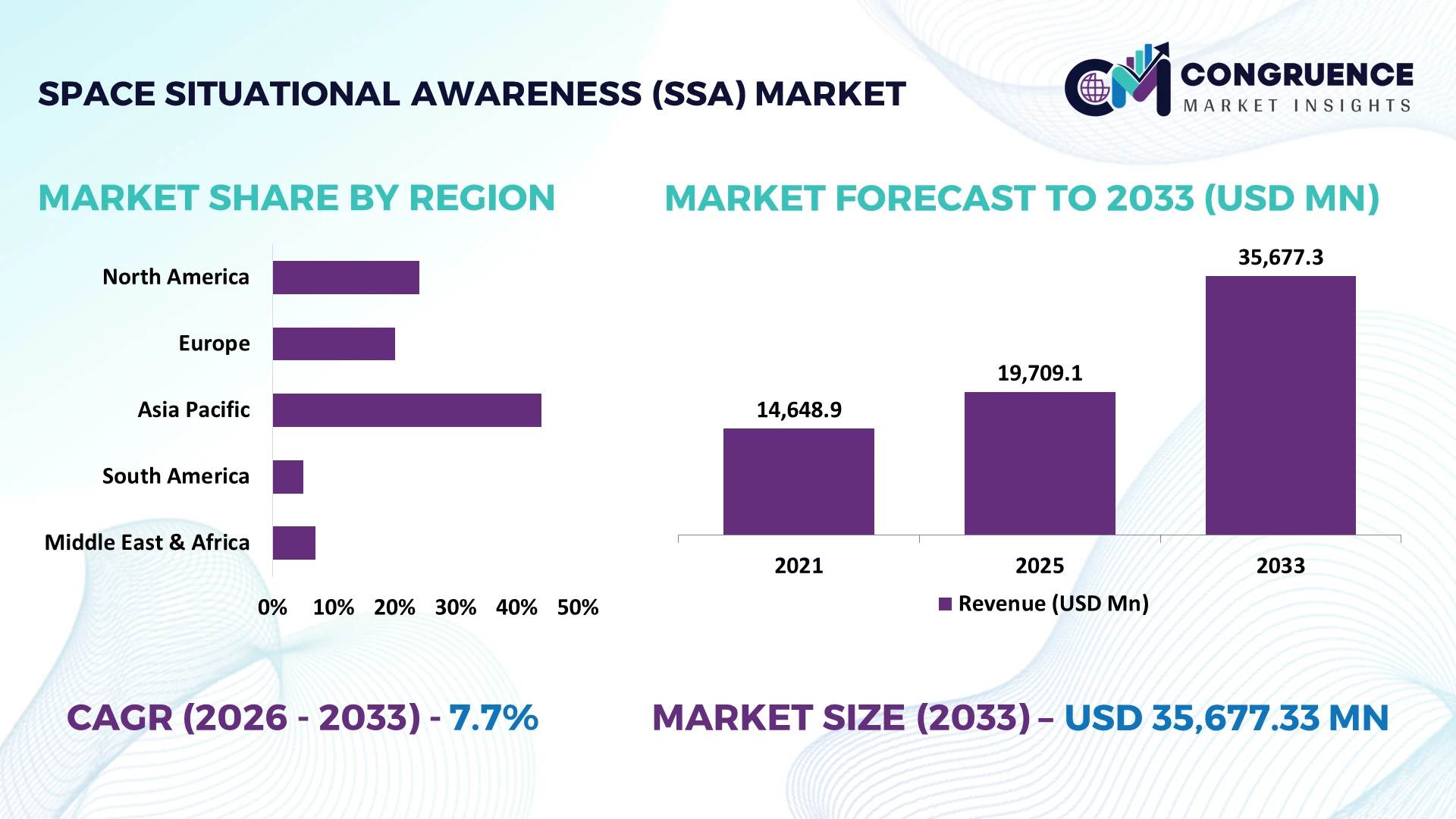
The United States remains the dominant SSA market, supported by extensive military and commercial satellite operations, large-scale tracking infrastructure, and sustained investment in space-domain awareness. The U.S. accounts for an estimated 35%+ share of global SSA activity, while Europe follows with roughly 20%, supported by coordinated surveillance programs. Geopolitical tensions and increasing orbital congestion are accelerating adoption of automated tracking and conjunction-analysis technologies.
Strategic priority is shifting toward AI-integrated, multi-sensor SSA platforms that reduce response time and strengthen orbital resilience.
Market Size & Growth: Market value reaches USD 35,677.33 million by 2033, supported by AI-based tracking, satellite proliferation, and automated collision-risk analysis.
Top Growth Drivers: AI adoption contributes 18%, satellite deployment growth 15%, and defense modernization 13% to key expansion drivers.
Short-Term Forecast: By 2028, automated SSA workflows target operating-cost reductions of 12% and tracking efficiency improvements of 20%.
Emerging Technologies: AI/ML object classification, autonomous sensor fusion, and advanced radar-optical integration are reshaping high-growth SSA platforms.
Regional Leaders: North America is projected at approximately USD 15 billion, Europe at USD 7 billion, and Asia-Pacific at USD 6 billion, with commercial SSA deployments accelerating across all three regions.
Consumer/End-User Trends: More than 40% of new commercial satellite operators increasingly prioritize automated conjunction monitoring as part of mission-risk management.
Pilot/Case Example: A 2025 AI-enabled orbital monitoring deployment demonstrated approximately 25% faster object identification, strengthening response capabilities for congested orbital environments.
Competitive Landscape: LeoLabs leads the global SSA market with approximately 15% share, followed by Northrop Grumman, Kratos Defense & Security Solutions, ExoAnalytic Solutions, and COMSPOC, with competition centered on AI-enabled tracking, radar networks, and autonomous conjunction assessment.
Regulatory & ESG Impact: Tighter orbital-debris mitigation practices are driving approximately 15% higher adoption of automated tracking and end-of-life monitoring capabilities.
Investment & Funding: More than USD 2 billion in combined public-private space-domain-awareness investment is supporting sensor expansion, AI platforms, and commercial SSA infrastructure.
Innovation & Future Outlook: Next-generation SSA is moving toward real-time multi-sensor fusion, autonomous anomaly detection, and integrated space-traffic-management platforms, creating a strategic shift from passive monitoring to predictive orbital risk management.
The Space Situational Awareness (SSA) Market is expanding around AI-powered object identification, autonomous conjunction assessment, radar-optical sensor fusion, and space-weather monitoring. More than 40% of emerging commercial satellite operators are prioritizing automated orbital-risk capabilities, while regulatory pressure on debris mitigation is accelerating technology upgrades. In 2026, geopolitical competition and increasingly crowded low Earth orbit are strengthening demand for real-time SSA platforms, setting the foundation for strategic investment in resilient space-domain infrastructure.
Space Situational Awareness (SSA) is becoming strategically important as orbital congestion turns space infrastructure into a competitive and security-critical asset. More than 10,000 operational satellites are now supporting communications, navigation, Earth observation, and defense, increasing the commercial cost of undetected conjunctions. Regulatory tightening around debris mitigation is also shifting SSA from an optional monitoring function toward an operational requirement for satellite operators.
The market is moving from fragmented ground-based surveillance toward AI-enabled, multi-sensor architectures. Modern automated conjunction-analysis systems can reduce event-screening workloads by 30–40% compared with manual workflows while improving response speed. The United States maintains the largest installed surveillance infrastructure, while European operators emphasize coordinated civil-security capabilities and Japan is accelerating space-domain monitoring alongside satellite and defense modernization. Over the next 2–3 years, automated SSA adoption is positioned to expand across commercial constellations, with real-time analytics becoming increasingly embedded in mission-control platforms.
Operationally, satellite operators are integrating radar, optical observations, space-weather data, and AI classification to prioritize high-risk objects. Companies are directing investment toward sensor networks, cloud-based analytics, and partnerships combining proprietary data with government infrastructure. Competitive advantage will increasingly depend on how quickly providers convert raw orbital observations into actionable collision, debris, and mission-risk intelligence.
AI-driven object classification and automated conjunction assessment are strengthening SSA adoption as satellite fleets become larger and operational decisions become more time-sensitive. Automated workflows can reduce screening workloads by 30–40%, while machine-learning classification improves the prioritization of high-risk orbital events. In the United States, commercial operators are increasingly integrating SSA capabilities directly into mission-control environments rather than relying solely on external monitoring. Government investment in space-domain awareness is reinforcing this shift. Providers are responding through AI R&D, sensor-network expansion, and data partnerships. The non-obvious advantage is workflow compression: SSA vendors that convert fragmented observations into ranked operational alerts can reduce analyst intervention while improving fleet-management responsiveness.
High-quality SSA requires expensive radar, optical telescopes, processing infrastructure, and geographically distributed observation assets, creating a significant barrier to scalable deployment. Advanced sensor installations can represent 20–30% of infrastructure budgets, while data-processing and integration requirements add further operating costs. Europe also faces interoperability complexity across national surveillance architectures, limiting seamless data exchange. Supply-chain dependence for specialized sensing components and high-performance computing hardware adds procurement pressure. Companies are reducing exposure through multi-year supplier contracts, modular sensor architectures, and partnerships that share observation infrastructure. The key operational constraint is not data scarcity alone but the cost of converting heterogeneous observations into consistently usable tracking intelligence.
Autonomous sensor fusion creates a high-value opportunity by combining radar, optical, telemetry, and space-weather inputs into unified orbital intelligence. AI-based processing can improve object-screening efficiency by 25–35%, while cloud-native analytics can reduce processing latency by more than 20% compared with fragmented legacy workflows. Japan, the United States, and European space operators are strengthening capabilities around increasingly autonomous space-domain monitoring. Companies are positioning through R&D partnerships, analytics platforms, and commercial access to proprietary tracking datasets. A particularly attractive opportunity lies in subscription-based SSA services for smaller satellite operators that cannot justify dedicated surveillance infrastructure, allowing providers to monetize shared data networks while improving coverage density.
SSA providers face growing integration complexity as commercial constellations combine diverse spacecraft, communications protocols, sensors, and third-party data feeds. More than 30% of advanced SSA workflows can involve multiple external data inputs, increasing synchronization and cybersecurity requirements. False positives, inconsistent object catalogs, and delayed observations can also undermine automated decision-making when orbital conditions change rapidly. In the United States, expanding commercial-government data exchange increases the importance of secure interfaces and resilient cloud infrastructure. Companies must strengthen zero-trust architectures, automated validation, workforce expertise, and redundant processing environments. The strategic challenge is achieving dependable automation without creating a single digital failure point that compromises collision assessment or mission continuity.
AI-Driven Tracking Workflows: AI-based object classification and automated conjunction screening are replacing analyst-heavy workflows, cutting screening workloads by 30–40% and accelerating alert prioritization. The U.S. Space Force’s ATLAS system processed more than 22.4 million orbital element sets after operational acceptance in 2025, demonstrating the shift toward scalable software-led SSA operations.
Optical Sensor Modernization: Ground-based optical networks are gaining capability through wider fields of view and faster scanning. In 2026, a U.S. Space Force optical-system upgrade doubled field of view, doubled search speed, and increased sensitivity more than threefold. Companies are therefore prioritizing sensor modernization over simply expanding telescope counts, improving detection economics.
Commercial Data Integration: Commercial sensor data is becoming embedded in government and enterprise SSA workflows, with multi-source architectures combining radar, optical, telemetry, and catalog data. More than 46,000 objects were regularly tracked by surveillance networks by June 2026. Companies are responding through data-sharing partnerships and interoperable APIs rather than isolated monitoring systems.
Debris Compliance Intensifies: Sustainability requirements are increasingly influencing satellite design, disposal planning, and SSA procurement. ESA reports that more than 150 entities have joined its Zero Debris Charter, while tracked orbital objects reached about 46,190 in 2026. This regulatory shift is increasing demand for lifecycle monitoring, automated deorbit verification, and debris-risk analytics, creating a less visible but commercially important compliance-driven SSA segment.
Ground-Based SSA remains the leading type, estimated at approximately 42% market share, because radar and optical infrastructure provides persistent coverage, mature tracking workflows, and comparatively scalable upgrades. Radar-Based Systems account for roughly 27%, benefiting from superior object detection and tracking in challenging conditions, while Optical Systems represent about 19% and are gaining relevance for high-altitude and faint-object surveillance. Space-Based SSA holds around 12% but is becoming strategically important for reducing observation blind spots and improving coverage beyond fixed ground locations.
The fastest-growing shift is toward Space-Based SSA, with adoption expanding as satellite operators seek faster observations and broader orbital visibility. Companies are combining ground radar, optical sensors, and hosted space-based payloads instead of treating these systems as substitutes. This integrated architecture can improve observation availability by 20–30%, redirecting investment toward sensor fusion, automated cataloging, and cross-platform data partnerships.
Space Object Tracking leads the application segment with an estimated 38% share because accurate position, velocity, and orbit characterization underpin every downstream SSA workflow. Conjunction Assessment follows at approximately 27%, while Space Debris Monitoring and Collision Avoidance account for about 20% and 15%, respectively. Tracking remains the mature foundation, but automated Conjunction Assessment is the fastest-growing application as satellite fleets generate larger volumes of close-approach alerts.
Companies are integrating tracking feeds directly into mission-control systems, reducing manual assessment workloads by approximately 25–35%. Collision Avoidance is becoming more operationally embedded, while debris monitoring is shifting from catalog maintenance toward lifecycle risk management. The commercial implication is significant: providers increasingly compete on alert quality, latency, and actionable recommendations rather than raw object counts, encouraging partnerships between sensor operators, analytics firms, and satellite manufacturers.
Government Space Agencies represent the leading end-user group at approximately 39% share, reflecting their dependence on national tracking infrastructure, launch coordination, scientific missions, and orbital safety programs. Defense Organizations follow at around 31%, with demand concentrated on high-fidelity tracking, threat characterization, and resilient space-domain awareness. Commercial Satellite Operators account for about 22% and represent the fastest-growing buyer group as large constellations increase the frequency and operational importance of conjunction monitoring.
Commercial operators are moving from basic third-party alerts toward integrated SSA platforms connected to fleet-management and maneuver systems. This shift is increasing adoption by roughly 20–25% among newly deployed constellation operations, while Research Institutions retain a specialized role in modeling, debris characterization, and sensor development. Companies are responding with tiered analytics, government-industry partnerships, and customized APIs. The strategic opportunity is strongest in commercial SSA subscriptions, where operators can obtain advanced surveillance without building capital-intensive infrastructure.
North America accounted for the largest market share at 38% in 2025 however, Asia-Pacific is expected to register the fastest growth, expanding at a CAGR of 9.1% between 2026 and 2033.
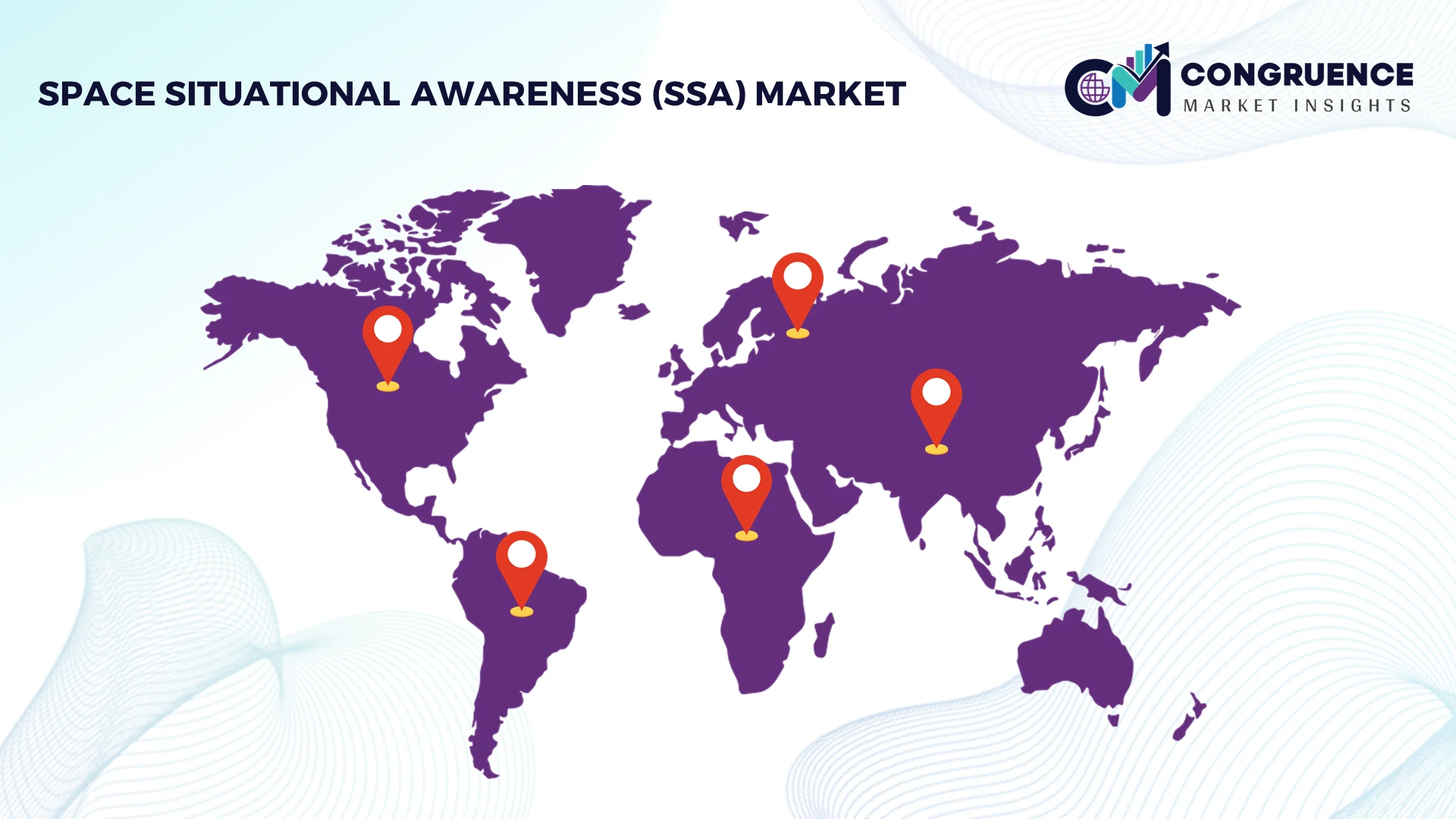
Defense-led modernization is shifting SSA toward integrated orbital intelligence
North America commands approximately 38% of global SSA activity, supported by concentrated defense infrastructure, commercial satellite fleets, radar networks, and advanced analytics. The United States remains the primary deployment center, with SSA increasingly integrated into mission planning, satellite operations, and space-domain awareness workflows. AI-enabled processing is reducing manual screening requirements by approximately 30%, while multi-sensor architectures improve tracking responsiveness by 20–25%. Commercial providers are expanding optical and radar coverage through partnerships with defense organizations and satellite operators. The operational shift is from catalog maintenance toward predictive conjunction intelligence, strengthening demand for low-latency analytics and automated decision support.
United States Market Outlook: The United States holds the strongest SSA ecosystem through defense investment, commercial constellation expansion, and established tracking infrastructure. Large-scale government programs increasingly intersect with private sensor networks, creating a sizable addressable market for analytics, optical surveillance, radar modernization, and secure data exchange. More than 40,000 space objects require continuous tracking, reinforcing demand for scalable automation and resilient orbital intelligence platforms.
Regulatory coordination is accelerating integrated orbital monitoring
Europe represents approximately 25% of global SSA activity, with demand shaped by coordinated space-safety programs, debris mitigation, satellite autonomy, and infrastructure modernization. France, Germany, Italy, and the United Kingdom anchor industrial capabilities spanning sensors, spacecraft systems, analytics, and mission operations. Automated conjunction workflows are reducing analyst workloads by roughly 25%, while interoperable data architectures are improving cross-border information exchange. Europe’s stronger emphasis on sustainability is also increasing demand for end-of-life monitoring and debris-risk assessment. Companies are prioritizing collaborative platforms, sensor upgrades, and public-private partnerships rather than isolated national systems, creating opportunities for vendors that can bridge fragmented datasets.
France Market Outlook: France provides a strong commercial and institutional base through advanced aerospace manufacturing, satellite operations, and national space-security capabilities. Its industrial ecosystem supports radar, optical observation, spacecraft engineering, and orbital analytics. Increasing emphasis on autonomous space operations is encouraging suppliers to integrate SSA directly into satellite mission-management platforms, strengthening domestic demand for secure tracking technologies and interoperable data services.
Satellite-scale expansion is driving faster SSA deployment
Asia-Pacific accounts for approximately 22% of global SSA activity and is developing the fastest deployment momentum as China, Japan, India, and South Korea expand satellite capabilities. Japan and India are strengthening space-domain monitoring alongside defense and communications infrastructure, while commercial operators are increasing reliance on automated tracking. AI-supported analytics can reduce processing workloads by 30–35%, making automation particularly valuable as satellite fleets expand. Companies are responding through sensor-network investment, analytics partnerships, and integration with spacecraft operations. The region’s distinctive advantage is the convergence of large satellite programs and growing electronics capabilities, which is encouraging localized development of sensing, processing, and mission-control technologies.
Japan Market Outlook: Japan combines advanced satellite manufacturing, precision electronics, optical technologies, and established space infrastructure, providing a strong foundation for SSA innovation. Its growing emphasis on space-security resilience is encouraging higher integration between tracking systems and mission operations. Commercial and government operators are increasingly prioritizing automated object identification and conjunction analysis, creating opportunities for specialized analytics providers and sensor manufacturers.
Infrastructure development is widening commercial SSA access
South America represents approximately 7% of global SSA activity, with Brazil serving as the principal operational and industrial center. Demand is concentrated around satellite communications, Earth observation, launch-support infrastructure, and scientific monitoring rather than large-scale defense surveillance. Brazil’s expanding space capabilities are encouraging investment in tracking infrastructure and data-processing capacity, while regional operators increasingly use external SSA services to avoid high capital requirements. Cloud-based analytics can lower infrastructure requirements by approximately 20–25%, supporting wider adoption among smaller satellite programs. Companies are responding through service partnerships, shared observation networks, and software-led monitoring rather than standalone infrastructure. The key business opportunity lies in converting underutilized observation capacity into commercially accessible SSA services.
Brazil Market Outlook: Brazil has the strongest regional foundation through aerospace capabilities, satellite programs, scientific infrastructure, and its strategic geographic position. Its Alcântara launch infrastructure provides additional relevance for future orbital activity and tracking requirements. Domestic operators and research organizations increasingly require integrated monitoring capabilities, creating demand for affordable analytics, optical observation, and data-sharing platforms that can scale without extensive capital deployment.
National space programs are accelerating infrastructure-led modernization
The Middle East & Africa accounts for approximately 8% of global SSA activity, with demand concentrated in the United Arab Emirates, Saudi Arabia, Israel, and South Africa. Government-backed satellite programs, defense modernization, Earth observation, and communications infrastructure are expanding requirements for orbital tracking and mission assurance. UAE and Saudi investment is strengthening space-sector infrastructure, while Israel contributes advanced sensing, defense electronics, and analytics capabilities. Automated monitoring can reduce routine analyst workloads by roughly 20–30%, encouraging adoption where specialized workforce capacity remains limited. Companies are responding through technology partnerships, localized service agreements, and integrated monitoring platforms. The region’s strategic advantage is investment speed, although infrastructure depth and specialist workforce availability remain important execution factors.
United Arab Emirates Market Outlook: The UAE has established one of the region’s most advanced commercial and institutional space ecosystems, supported by satellite programs, Earth-observation missions, and sustained government investment. Its expanding spacecraft portfolio increases the need for independent tracking, collision assessment, and mission-support services. The country’s concentration of space-sector initiatives creates a favorable environment for international SSA providers pursuing partnerships, localized analytics, and regional data-service hubs.
LeoLabs, Northrop Grumman, Kratos Defense & Security Solutions, ExoAnalytic Solutions, and COMSPOC compete across commercial SSA analytics, defense surveillance, and sensor-enabled orbital intelligence. The top five players together account for approximately 32% of market activity, leaving space for specialized providers and government-linked platforms. Competition centers on technology depth, with AI automation improving processing efficiency by 25–35%, while integrated sensor architectures can reduce operational latency by 20–30%. Players are expanding radar and optical networks, forming data-sharing partnerships, and integrating analytics with tracking infrastructure. U.S. defense modernization is intensifying the technology race, while European providers emphasize interoperable civil-security architectures and regulatory compliance. Entry barriers remain high because trusted orbital catalogs, sensor coverage, cybersecurity controls, and government relationships require capital and validation. The competitive shift is moving from detection capacity toward actionable, low-latency intelligence. Winning requires proprietary data, scalable automation, resilient infrastructure, and partnerships that convert observations into operational decisions faster than competitors.
LeoLabs
Northrop Grumman
Kratos Defense & Security Solutions
ExoAnalytic Solutions
COMSPOC
Slingshot Aerospace
Astroscale
GMV
Etamax Space
Safran
Lockheed Martin
Analytical Space
Sattrack
Numerica
AI-powered object classification, machine-learning conjunction assessment, phased-array radar, and automated sensor fusion are defining current SSA modernization. AI workflows reduce manual screening by 25–35%, while phased-array architectures improve tracking responsiveness by 20–30%. Adoption is strongest across defense agencies and large constellation operators, where real-time orbital intelligence directly improves maneuver decisions, lowers analyst workload, and strengthens mission continuity.
Emerging systems are combining ground radar, optical telescopes, space-based sensors, and cloud-native analytics. Multi-sensor fusion can improve detection performance by 15–25% compared with isolated legacy feeds, while automated data processing cuts operational latency by 20%. Space-based SSA is gaining traction alongside transportable radar systems, benefiting providers that can deliver persistent coverage without proportional fixed-infrastructure expansion.
Disruptive SSA is moving toward autonomous decision support, AI agents, and onboard processing. New architectures target 30% faster event characterization and approximately 10–15% lower processing costs versus conventional analyst-led pipelines. Between 2026 and 2028, competitive advantage will shift toward companies integrating proprietary sensor data with interoperable software platforms. Early investment matters because scalable automation, distributed sensing, and rapid deployment capabilities are becoming core differentiators for government and commercial SSA contracts.
June 2026 LeoLabs deployed Scout-S, its first transportable 3D search radar, in the Indo-Pacific, adding coverage to a catalog exceeding 26,000 objects. The deployment enables rapidly repositionable sensing for allied missions and strengthens competition against fixed-site surveillance architectures and resilience. Source: leolabs.space
September 2025 Astroscale signed a launch agreement with NewSpace India Limited for ISSA-J1, scheduled for spring 2027 aboard PSLV. The 650-kg spacecraft will inspect two defunct satellites, advancing in-orbit SSA capabilities and creating an India-focused commercial pathway for government missions. Source: astroscale.com
October 2025 Slingshot Aerospace won the UK Space Agency’s Provision of Optical Delivery Partner contract, expanding satellite-tracking capabilities. The program addresses an orbital environment with about 12,000 active satellites, strengthening sovereign tracking and AI-enabled characterization for UK operations and resilience. Source: slingshot.space
April 2025 ESA reported about 40,000 objects tracked by surveillance networks and more than 1.2 million debris objects larger than 1 centimeter. The findings reinforced debris-mitigation urgency and strengthened demand for tracking, collision assessment, sustainable orbital operations, and space safety. Source: esa.int
The Space Situational Awareness (SSA) Market Report covers Space-Based SSA, Ground-Based SSA, Radar-Based Systems, and Optical Systems, evaluating their deployment intensity, technical maturity, and integration across modern orbital-monitoring architectures. Application analysis spans Space Object Tracking, Collision Avoidance, Space Debris Monitoring, and Conjunction Assessment, while end-user coverage includes Government Space Agencies, Defense Organizations, Commercial Satellite Operators, and Research Institutions.
Regional assessment covers North America, Europe, Asia-Pacific, South America, and the Middle East & Africa, with country-level analysis of infrastructure, deployment activity, technology adoption, and investment priorities. The report also evaluates AI-enabled analytics, autonomous sensor fusion, transportable radar, cloud-based processing, and space-based observation as emerging technology areas. Coverage of 10–14 major companies supports competitive benchmarking, investment planning, market-entry decisions, expansion strategy, partnership evaluation, and technology prioritization through 2033.
| Report Attribute/Metric | Report Details |
|---|---|
Market Revenue in 2025 | USD 19709.1 Million |
Market Revenue in 2033 | USD 35677.33 Million |
CAGR (2026 - 2033) | 7.7% |
Base Year | 2025 |
Forecast Period | 2026 - 2033 |
Historic Period | 2021 - 2025 |
Segments Covered | By Type
By Application
By End-User
|
Key Report Deliverable | Revenue Forecast, Growth Trends, Market Dynamics, Segmental Overview, Regional and Country-wise Analysis, Competition Landscape |
Region Covered | North America, Europe, Asia-Pacific, South America, Middle East, Africa |
Key Players Analyzed | LeoLabs, Northrop Grumman, Kratos Defense & Security Solutions, ExoAnalytic Solutions, COMSPOC, Slingshot Aerospace, Astroscale, GMV, Etamax Space, Safran, Lockheed Martin, Analytical Space, Sattrack, Numerica |
Customization & Pricing | Available on Request (10% Customization is Free) |




