
Reports
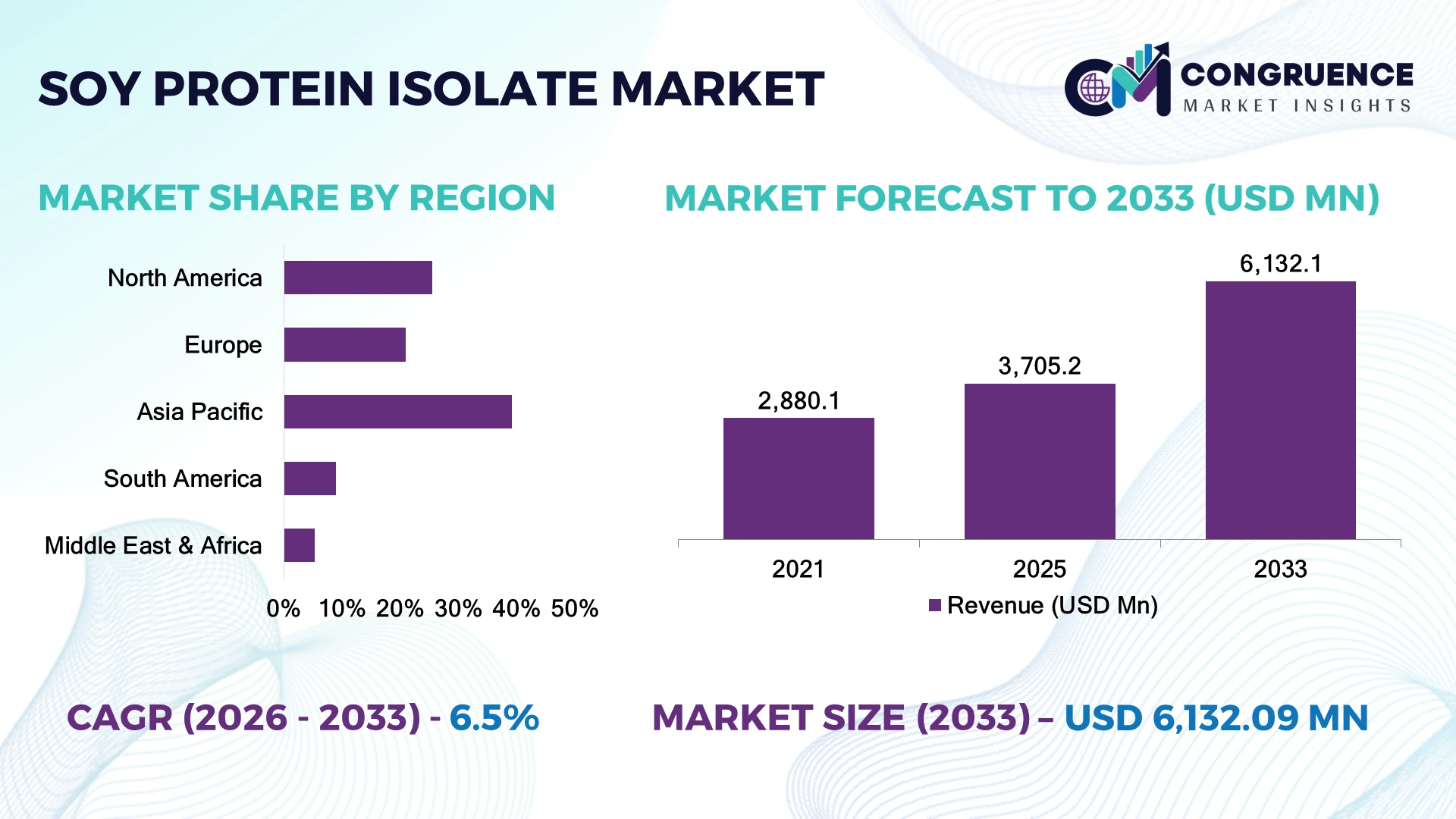
The Global Soy Protein Isolate Market was valued at USD 3,705.2 Million in 2025 and is anticipated to reach a value of USD 6,132.1 Million by 2033 expanding at a CAGR of 6.5% between 2026 and 2033. Growth is being driven by high-protein food reformulation, expansion of plant-based meat and dairy alternatives, improved soy-protein functionality, and food manufacturers replacing higher-cost animal proteins with scalable plant-based formulations.
China remains the dominant country market, supported by approximately 28% of global soy-processing capacity, extensive food and feed infrastructure, and rapid investment in plant-protein processing. The United States follows with advanced ingredient manufacturing and strong sports-nutrition demand, while Brazil benefits from expanding soybean production and processing. China's soy crushing capacity exceeds 120 million tonnes annually, reinforcing its supply-chain advantage amid shifting global agricultural trade flows and tighter traceability requirements.
Strategic implication: prioritize integrated soy sourcing, high-purity processing, texturization, and application-specific protein systems near major food-manufacturing clusters.
Market Size & Growth: USD 3.71 billion in 2025 to USD 6.13 billion by 2033 at 6.5% CAGR, driven by plant-based food reformulation and protein fortification.
Top Growth Drivers: Plant-based meat 32%, sports nutrition 24%, dairy alternatives 18%.
Short-Term Forecast: By 2028, advanced extraction and membrane filtration can improve protein recovery efficiency by 8–12%.
Emerging Technologies: Enzyme-assisted extraction, precision fermentation integration, membrane filtration, and improved texturization are upgrading ingredient functionality.
Regional Leaders: Asia Pacific approaches USD 2.45 billion; North America USD 1.55 billion; Europe USD 1.25 billion by 2033, with Asia Pacific leading processing expansion.
Consumer/End-User Trends: Food and beverage manufacturers account for approximately 62% of isolate consumption, prioritizing clean-label, high-protein formulations.
Pilot/Case Example: 2026 formulation programs targeting meat alternatives achieve approximately 10–15% improvement in texture and protein dispersion through optimized isolate systems.
Competitive Landscape: ADM leads with approximately 14% share, followed by Cargill, Bunge, Fuji Oil, and Wilmar across ingredient supply and processing.
Regulatory & ESG Impact: Traceability and deforestation-related requirements are increasing supply-chain documentation workloads by approximately 10–20% for exporters.
Investment & Funding: More than USD 1 billion is being directed toward plant-protein processing, alternative-protein capacity, and ingredient innovation across major producing markets.
Innovation & Future Outlook: High-solubility isolates, low-beany formulations, hybrid proteins, and application-specific texturization are shifting competition toward functional performance rather than protein content alone.
The Soy Protein Isolate Market is concentrated in meat alternatives, dairy alternatives, sports nutrition, bakery, beverages, and functional foods, with food and beverage manufacturers representing approximately 62% of consumption. In 2026, manufacturers are prioritizing improved solubility, reduced beany flavor, and higher protein functionality, while traceability requirements are reshaping sourcing from China, Brazil, and the United States.
Soy protein isolate is becoming strategically important as food manufacturers balance protein density, formulation cost, sensory performance, and supply-chain resilience. Its ability to deliver approximately 90% protein on a dry basis makes it particularly valuable in high-protein formulations, while established processing infrastructure provides an advantage over newer plant-protein sources. Competition is shifting from basic protein supply toward functionality, flavor management, and application-specific performance.
Processing technology is creating measurable differentiation. Modern membrane filtration and optimized extraction can improve protein recovery by approximately 8–12% compared with conventional processing configurations, while advanced deodorization reduces off-notes and lowers formulation rework. China and the United States emphasize large-scale ingredient manufacturing, whereas Brazil increasingly combines soybean production with downstream processing, creating opportunities for localized value addition.
Over the next 2–3 years, manufacturers are expected to prioritize high-solubility isolates, neutral-flavor systems, improved emulsification, and hybrid formulations. A practical deployment pathway is the integration of soy isolate into ready-to-drink protein beverages, where dispersion and mouthfeel directly influence repeat purchases. Companies are responding through regional sourcing contracts, processing-capacity expansion, application laboratories, and partnerships with food manufacturers. Competitive advantage will increasingly depend on controlling both soybean supply and the final ingredient's functional performance.
Food manufacturers are increasing soy isolate usage as protein fortification moves into mainstream beverages, meat alternatives, and functional foods. Plant-based meat represents approximately 32% of isolate demand, while sports nutrition contributes about 24% and dairy alternatives around 18%. U.S. and European formulators are prioritizing isolates with higher solubility and neutral flavor to improve ready-to-drink performance. Manufacturers are investing in deodorization, membrane filtration, and application laboratories to reduce formulation failures. The non-obvious advantage is ingredient versatility: one isolate platform can serve beverages, bakery, meat analogues, and nutrition products, improving manufacturing utilization and reducing qualification costs across product portfolios.
Soybean procurement remains a major cost variable because raw material represents approximately 60–70% of isolate production economics, while energy and processing can contribute another 15–20%. Weather disruptions in Brazil and Argentina, combined with changing Chinese import requirements, can rapidly alter global availability and crush margins. Producers exposed to spot purchasing face greater input volatility than vertically integrated processors. Companies are responding through multi-origin sourcing, forward contracts, inventory buffers, and direct farmer relationships. China-based processors retain scale advantages, while U.S. and Brazilian suppliers increasingly emphasize traceability. The strategic pressure point is not soybean availability alone but consistent protein quality, because variation in cultivar, storage, and processing conditions can increase downstream formulation adjustments.
High-solubility, neutral-flavor, and application-specific soy isolates create opportunities beyond conventional protein powders. Improved processing can raise protein recovery efficiency by approximately 8–12%, while optimized deodorization can reduce undesirable flavor intensity by 20–30% in selected formulations. U.S. beverage manufacturers are expanding ready-to-drink protein products, while Asian food producers are incorporating soy isolate into fortified foods and dairy alternatives. Companies are investing in enzyme-assisted extraction, membrane separation, and customized particle-size engineering. A less obvious opportunity is industrial foodservice: standardized isolates can simplify centralized formulation and reduce batch-to-batch variability. Suppliers that provide formulation support alongside ingredients can capture greater customer value than commodity-focused processors.
Scaling soy isolate production across facilities remains difficult because protein solubility, dispersibility, flavor, and emulsification can vary with soybean variety and processing conditions. Commercial formulations can experience 5–10% variation in selected functional parameters when raw-material specifications are inconsistent. Brazil's expanding processing base and China's large-scale crushing infrastructure create strong capacity, but international buyers increasingly require standardized quality documentation and traceability. Manufacturers must invest in inline quality monitoring, standardized protein specifications, advanced drying, and technical application teams. The long-term challenge is maintaining identical functionality across geographically diversified production. Companies that solve cross-site consistency can qualify faster with multinational food manufacturers and reduce costly reformulation during supply-chain transitions.
Neutral-Flavor Formulations Accelerate: Food manufacturers are prioritizing low-beany soy isolates as sensory acceptance becomes a stronger purchase criterion. Advanced deodorization can reduce selected off-flavor intensity by 20–30%, while high-solubility grades improve beverage dispersion by approximately 10–15%. U.S. ingredient suppliers are expanding application laboratories and customized formulation support to capture premium contracts.
Traceability Becomes Commercial Requirement: Deforestation and supply-chain due-diligence requirements are increasing documentation workloads by approximately 10–20% for internationally traded soy ingredients. Brazilian processors are strengthening farm-level traceability and segregation systems, while European buyers increasingly require documented sourcing. Suppliers with auditable origin data are gaining an advantage in multinational procurement.
Processing Moves Toward Efficiency: Membrane filtration, optimized extraction, and improved drying are being deployed to raise protein recovery by approximately 8–12% while controlling energy intensity. Chinese processors are scaling integrated facilities, whereas U.S. manufacturers emphasize specialized functionality. Equipment upgrades increasingly focus on yield and consistency rather than simply increasing plant capacity.
Application Engineering Gains Importance: Isolate suppliers are moving beyond commodity powder sales toward customized particle size, dispersibility, emulsification, and protein concentration specifications. Application-specific grades can reduce downstream formulation adjustments by approximately 10–15%. The shift is particularly visible in ready-to-drink beverages and meat alternatives, where suppliers increasingly partner directly with food manufacturers during product development.
Conventional soy protein isolate remains the leading type, accounting for approximately 68% of market demand, supported by established processing infrastructure, broad food-industry compatibility, and comparatively predictable procurement economics. Specialized and functional isolates represent the fastest-growing segment as manufacturers seek higher solubility, improved emulsification, neutral flavor, and application-specific performance. High-solubility grades are gaining particular traction in beverages, where dispersion and mouthfeel directly influence product acceptance. Functional grades can command approximately 10–20% higher pricing than standard material, encouraging processors to invest in advanced filtration, deodorization, and particle engineering.
Standard isolates remain dominant in meat alternatives, bakery, and nutrition products because qualification is mature and supply is broad. Companies are nevertheless reallocating investment toward specialty grades, with functional formulations potentially reducing downstream processing adjustments by 10–15%. Chinese and U.S. processors are expanding application-specific production, while Brazilian suppliers increasingly integrate traceable soybean sourcing with downstream isolate manufacturing.
A 2025 food-industry survey found that approximately 62% of manufacturers prioritizing plant-protein innovation identified improved sensory performance as a key formulation objective, reinforcing investment in neutral-flavor and functional soy ingredients.
Meat alternatives represent the leading application, accounting for approximately 32% of soy protein isolate consumption, supported by soy's established texturization capability, protein density, and compatibility with extrusion processing. Sports nutrition follows at approximately 24%, while dairy alternatives contribute around 18%. Ready-to-drink protein beverages represent the fastest-developing application as manufacturers demand highly soluble isolates that disperse rapidly in cold formulations. Beverage-grade isolates increasingly require tighter control of particle size, flavor, and sedimentation.
Mature applications such as bakery, nutrition bars, and meat analogues benefit from established formulation protocols, whereas beverages and dairy alternatives require more specialized functionality. High-solubility formulations can improve dispersion efficiency by approximately 10–15%, reducing processing adjustments and improving production consistency. Companies are responding with application laboratories, customized grades, direct formulation partnerships, and regional production capacity. The commercial implication is clear: suppliers with application-engineering capabilities are capturing greater value than commodity-oriented processors.
In 2026, plant-based product developers continue prioritizing protein content and sensory quality simultaneously, with high-protein formulations increasingly positioned across beverages, meat alternatives, and dairy-free categories rather than isolated niche applications.
Food and beverage manufacturers represent the leading end-user group, accounting for approximately 62% of soy protein isolate consumption. Their purchasing concentration reflects high-volume requirements across meat alternatives, beverages, bakery, and functional foods, with specifications increasingly covering protein purity, dispersibility, flavor, and traceability. Ingredient processors and specialized nutrition manufacturers form the fastest-growing buyer group as they develop customized formulations and higher-value protein blends. Sports-nutrition producers maintain strong demand but generally purchase more specification-focused grades than mainstream food manufacturers.
Large multinational food companies prioritize supply continuity, standardized functionality, and multi-country qualification, whereas smaller specialist manufacturers emphasize formulation flexibility and shorter development cycles. Customized isolate grades can reduce downstream reformulation requirements by approximately 10–15%, creating a clear economic rationale for technical partnerships. Suppliers are therefore expanding application centers, contract-development programs, and direct technical support. The strategic shift is toward solution-based ingredient supply, where processors compete through formulation expertise and reliable quality rather than protein concentration alone.
A 2025 industry assessment identified food and beverage manufacturers as the principal commercial users of soy protein ingredients, with protein fortification and plant-based formulation among the strongest drivers of ingredient-development activity.
Asia-Pacific accounted for the largest market share at approximately 39.2% in 2025 however, North America is expected to register the fastest growth, expanding at a CAGR of 7.2% between 2026 and 2033.
North America represents approximately 25.5% of global soy protein isolate demand, supported by established sports-nutrition, meat-alternative, functional beverage, and food-processing industries. The United States accounts for the majority of regional consumption, with manufacturers increasingly specifying high-solubility and neutral-flavor isolates rather than standard protein grades. Ready-to-drink protein products and reformulated foods are increasing demand for ingredients capable of rapid dispersion and stable emulsification. U.S. processors are investing in deodorization, membrane filtration, and application laboratories, while ingredient suppliers are expanding direct formulation partnerships with food manufacturers. Premium functional grades can achieve approximately 10–20% higher pricing than conventional material, shifting processor investment toward value-added production rather than basic volume expansion.
U.S. Market Outlook: The United States remains the region's primary commercial hub because of its large sports-nutrition industry, sophisticated food-processing base, and established plant-based product ecosystem. Manufacturers increasingly require isolates with protein content around 90% on a dry basis, strong dispersibility, and controlled flavor. Investment is therefore moving toward specialized processing and application-specific ingredient development.
Europe accounts for approximately 21% of global soy protein isolate demand, with Germany, France, the United Kingdom, Italy, and the Netherlands forming major food-manufacturing markets. Procurement is increasingly influenced by deforestation-risk documentation, origin traceability, and environmental credentials alongside protein functionality. European food manufacturers are expanding plant-based formulations while demanding consistent solubility and neutral flavor. Supply-chain due diligence can increase supplier documentation and verification workloads by approximately 10–20%, favoring processors with segregated sourcing and auditable logistics. Companies are responding through certified soybean procurement, regional warehousing, and long-term supplier contracts. The competitive advantage is shifting toward verified supply plus technical functionality rather than ingredient price alone.
Germany Market Outlook: Germany is a strategically significant market because of its large food-processing industry, established meat-alternative manufacturing, and sophisticated ingredient procurement systems. Manufacturers increasingly integrate soy isolate into high-protein foods, beverages, and meat substitutes. Suppliers with traceable sourcing and consistent functional specifications are better positioned for multinational qualification, particularly where customers require documented origin and standardized protein performance.
Asia-Pacific commands approximately 39.2% of global demand, with China representing the largest consumption and processing base. The region benefits from extensive soybean crushing, food manufacturing, meat-alternative production, and established soy-based food consumption. China processes more than 100 million tonnes of soybeans annually, providing substantial feedstock and downstream infrastructure. Japan, South Korea, and India contribute through specialized nutrition and food applications. Chinese processors are increasingly integrating extraction, isolation, drying, and application development, improving supply-chain control. Companies are investing in higher-purity isolates, improved deodorization, and application-specific grades as international buyers demand tighter quality specifications. The region's structural advantage is vertical integration from soybean procurement through finished protein ingredients.
China Market Outlook: China is the most strategically significant country because of its enormous soybean-processing infrastructure and extensive domestic food industry. Annual soybean crushing capacity exceeds 120 million tonnes, creating a strong feedstock platform for protein-isolate production. Manufacturers are increasingly moving beyond commodity soy ingredients toward high-solubility and neutral-flavor grades for beverages, nutrition products, and meat alternatives, strengthening domestic value addition.
South America is a strategically important supply-side market because Brazil and Argentina provide substantial soybean feedstock for global processing. Brazil is increasingly strengthening downstream agricultural value capture rather than relying solely on raw soybean exports. Soy protein isolate production remains smaller than conventional crushing, creating opportunities for investment in extraction, isolation, drying, and ingredient formulation. Brazilian processors benefit from proximity to soybean-producing regions and expanding food-processing infrastructure. Traceability requirements are becoming commercially important for European and North American buyers, encouraging segregation and documentation systems. Companies are responding through vertically integrated processing, export partnerships, and investments in higher-value protein ingredients. The principal opportunity is converting agricultural scale into specialty ingredient capacity.
Brazil Market Outlook: Brazil is the region's strongest strategic market because it combines enormous soybean production with expanding food-processing infrastructure. Its position as a leading global soybean exporter provides processors with substantial feedstock availability. Investments in downstream isolation and specialty protein production can improve value capture while reducing dependence on commodity exports. Traceable sourcing is increasingly important for premium international contracts.
Middle East & Africa remains a developing soy protein isolate market, with demand concentrated in the Gulf states, South Africa, Egypt, and major urban food-processing centers. The region relies heavily on imported soy ingredients, making logistics, currency exposure, and inventory planning important procurement considerations. Saudi Arabia and the UAE are expanding food-manufacturing and food-security programs, creating opportunities for plant-protein formulation and regional distribution. Imported ingredient costs can represent a significant share of finished-product economics, encouraging manufacturers to secure longer-term contracts and regional inventories. Companies are prioritizing distributor partnerships, local blending, application support, and selective processing investments rather than immediate large-scale isolate production.
Saudi Arabia Market Outlook: Saudi Arabia offers the strongest Gulf opportunity because food-security initiatives and domestic food-manufacturing expansion are encouraging greater local value addition. Food and beverage companies are increasingly developing high-protein and functional products, creating demand for standardized plant-protein ingredients. Suppliers with regional warehousing and technical formulation support can reduce import lead times and improve supply reliability for large food manufacturers.
ADM and IFF compete globally against Bunge, Fuji Oil, Wilmar, and Chinese producers, with multinational integrated suppliers contesting regional cost leaders on functionality, sourcing, and application support. The top five players command about 49% of global share, leaving substantial room for specialists. Price remains decisive in standard grades, where delivered-cost differences of 5–10% can influence procurement, while premium isolates compete through solubility, neutral taste, and formulation performance. Supply-chain integration can reduce sourcing exposure by roughly 10–15%, strengthening vertically integrated producers with soybean origination, processing, and distribution. ADM and IFF are expanding application-specific portfolios; Bunge is adding large-scale U.S. protein capacity while Chinese suppliers sharpen pricing. Competition is shifting from commodity volume toward customized functionality, traceability, and dependable regional supply. High capital requirements, process expertise, qualification cycles, and raw-material access constrain new entrants. Winning requires scale plus differentiated isolates, verified sourcing, rapid formulation support, and reliable delivery across major food-manufacturing markets.
Membrane filtration is becoming a critical upgrade in soy protein isolate production, supporting native protein retention, high purity, and cleaner sensory performance; advanced systems can improve recovery or processing efficiency by roughly 5–10%. Adoption is strongest in new greenfield plants and premium-grade production where functionality justifies higher equipment intensity. Automated PLC-SCADA controls, inline monitoring, and precision separation are replacing labor-intensive batch handling, improving consistency by approximately 2–5% and reducing process variability. Greenfield facilities increasingly combine membrane concentration, automated precipitation, and spray drying.
Application-engineered isolates now combine solubility, dispersibility, viscosity, and flavor optimization rather than selling protein concentration alone. High-solubility grades can improve beverage processing performance by around 5–10%, while customized specifications reduce downstream reformulation. Compared with conventional commodity isolates, these systems can deliver roughly 5–15% better application efficiency. Integrated automation benefits large producers most because higher throughput and standardized quality strengthen qualification with multinational food manufacturers.
Through 2026–2028, membrane processing, digital controls, and application-specific formulation platforms should accelerate premium-grade adoption, favoring suppliers with integrated R&D, manufacturing, and customer technical support. Early movers can capture qualification advantages before application-specific grades become standardized across beverage, nutrition, dairy-alternative, and meat-alternative formulations. This shifts purchasing toward performance contracts, technical collaboration, and regional supply assurance.
May 2026 ADM launched eight soy and pea protein products across North America and Europe, including two soy isolates targeting clean taste, solubility, dispersibility, and dairy alternatives. The portfolio broadens application-specific offerings and strengthens ADM’s premium ingredient positioning. Source: adm.com
March 2026 IFF secured Australia and New Zealand acceptance for a heart-health claim covering isolated soy protein, enabling qualifying foods to communicate cholesterol benefits. The regulatory milestone expands commercialization opportunities and strengthens SUPRO positioning in functional nutrition products. Source: iff.com
February 2025 Alfa Laval reported commissioning a complete soy protein isolate plant for an Indian producer, incorporating 9 decanters, 4 separators, 3 membrane systems, and 1 evaporator. The installation demonstrates rising investment in integrated SPI processing capacity commercially. Source: alfalaval.com
December 2025 Bunge launched a soy protein concentrate line backed by its Morristown, Indiana facility, representing a $550 million investment. The expansion adds high-purity protein capability, strengthens U.S. supply security, and increases Bunge’s value-added position in plant-based ingredients. Source: Mordor Intelligence
The Soy Protein Isolate Market Report covers conventional and specialized isolates across beverages, meat alternatives, dairy alternatives, sports nutrition, bakery, supplements, and other food applications. End-user analysis spans food and beverage manufacturers, nutrition companies, ingredient processors, foodservice, and emerging specialty users. Regional coverage includes North America, Europe, Asia Pacific, South America, and Middle East & Africa, with country-level analysis of major production and consumption markets. The report evaluates conventional versus functional grades, powder formats, high-solubility and neutral-flavor variants, and emerging application-specific formulations.
Technology coverage assesses membrane filtration, extraction and precipitation, spray drying, process automation, sensory optimization, and traceability systems. Quantitative analysis includes segment shares, adoption patterns, supplier participation, capacity expansion, and competitive concentration. Strategic insights support investment planning, regional expansion, supplier selection, product positioning, partnership decisions, and technology priorities through 2026–2033.
| Report Attribute/Metric | Report Details |
|---|---|
|
Market Revenue in 2025 |
USD 3,705.2 Million |
|
Market Revenue in 2033 |
USD 6,132.1 Million |
|
CAGR (2026 - 2033) |
6.5% |
|
Base Year |
2025 |
|
Forecast Period |
2026 - 2033 |
|
Historic Period |
2021 - 2025 |
|
Segments Covered |
By Type
By Application
By End-User
|
|
Key Report Deliverable |
Revenue Forecast, Growth Trends, Market Dynamics, Segmental Overview, Regional and Country-wise Analysis, Competition Landscape |
|
Region Covered |
North America, Europe, Asia-Pacific, South America, Middle East, Africa |
|
Key Players Analyzed |
ADM, International Flavors & Fragrances (IFF), Fuji Oil Holdings, Cargill, Bunge, Wilmar International, Shandong Yuxin Bio-Tech, Crown Soya Protein Group, Foodchem International, Burcon NutraScience, Gushen Biological Technology Group, Shandong Yuwang Group |
|
Customization & Pricing |
Available on Request (10% Customization is Free) |




