
Reports
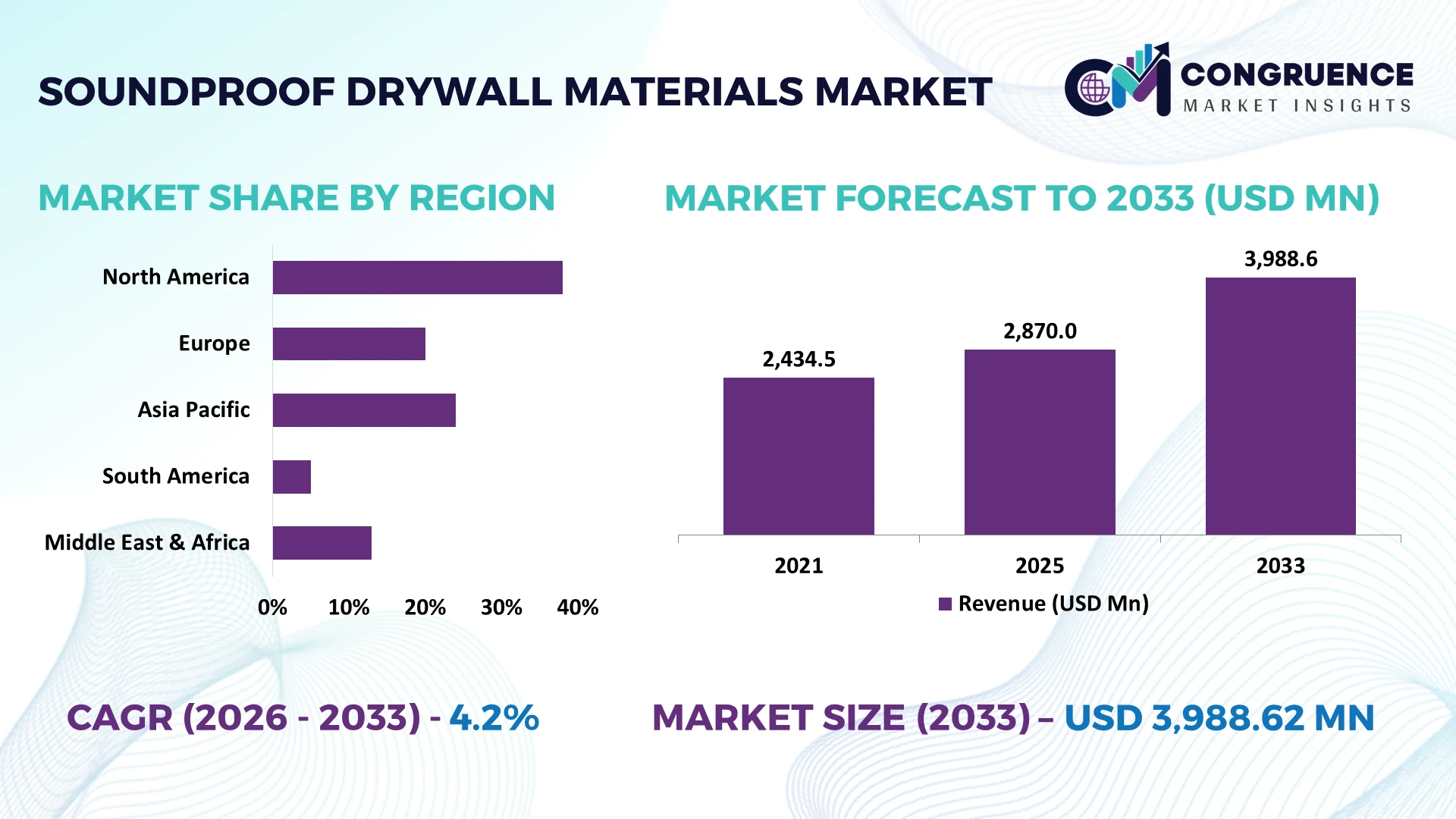
The Global Soundproof Drywall Materials Market was valued at USD 2870 Million in 2025 and is anticipated to reach a value of USD 3988.62 Million by 2033 expanding at a CAGR of 4.2% between 2026 and 2033. Growth is driven by stricter building acoustics requirements, increasing multifamily residential construction, and greater adoption of high density gypsum boards incorporating advanced sound damping technology.
The United States represents a major market for soundproof drywall materials, supported by residential renovation, commercial construction, healthcare infrastructure, and educational facilities. In 2025, annual private residential construction spending reached approximately USD 905 billion, creating a substantial addressable construction market for acoustic building materials. Advanced gypsum wall assemblies achieve Sound Transmission Class ratings of 50 or higher when appropriately designed and installed. Compared with India, the United States has more established acoustic building specifications, while India's expanding urban residential construction creates opportunities for specialized acoustic drywall manufacturers.
Manufacturers should prioritize certified acoustic performance, recycled gypsum integration, and partnerships with commercial construction contractors to strengthen competitive positioning.
Market Size & Growth: The global market reached USD 2,870 million in 2025 and is projected to reach USD 3,988.62 million by 2033, registering a CAGR of 4.2%, supported by acoustic building regulations and construction modernization.
Top Growth Drivers: Three principal growth drivers include multifamily residential construction, commercial acoustic retrofitting, and increasing adoption of advanced sound insulation materials. Acoustic wall assemblies commonly target STC ratings of 50 or higher.
Short Term Forecast: By 2028, product development will increasingly emphasize lightweight acoustic drywall, improved installation efficiency, and certified wall assemblies achieving STC ratings of 50 or above.
Emerging Technologies: Three significant innovations include viscoelastic damping layers, recycled gypsum manufacturing, and digitally optimized multilayer acoustic wall assemblies designed to improve sound transmission performance.
Regional Leaders: North America benefits from established acoustic construction standards, Europe emphasizes sustainable gypsum manufacturing, and Asia Pacific presents expanding opportunities through residential urbanization and commercial infrastructure development.
Consumer and End User Trends: Multifamily housing developers, healthcare operators, educational institutions, and commercial property owners increasingly specify acoustic wall assemblies targeting STC ratings between 45 and 60.
Pilot and Case Example: In 2025, Saint Gobain introduced Gyproc SoundBloc Infinaé 100 in the United Kingdom, incorporating 100% recycled gypsum into acoustic plasterboard manufacturing and demonstrating the commercial potential of circular construction materials.
Competitive Landscape: Major manufacturers include Saint Gobain, Knauf, USG Corporation, National Gypsum, and Georgia Pacific. Competition increasingly emphasizes certified acoustic performance, installation compatibility, and sustainable manufacturing.
Regulatory and ESG Impact: Acoustic construction specifications increasingly reference STC 50 performance thresholds, while recycled gypsum integration supports waste reduction and circular construction objectives across major building markets.
Investment and Funding: Manufacturing investments increasingly target gypsum recycling infrastructure, automated board production, and specialized acoustic product development. Regional production expansion supports supply chain localization and improved material availability.
Innovation and Future Outlook: Advanced multilayer drywall, integrated damping technology, and recycled gypsum formulations will shape product differentiation through 2033, encouraging manufacturers to combine measurable acoustic performance with sustainable material sourcing.
The global soundproof drywall materials market is experiencing increased product specialization across residential construction, healthcare facilities, hospitality properties, and commercial office development. Manufacturers are integrating viscoelastic damping compounds, dense gypsum cores, and multilayer board configurations to improve acoustic performance without substantially increasing wall thickness. Properly engineered acoustic assemblies achieve STC ratings exceeding 50, supporting demanding building specifications. European construction policies encouraging circular material use are also accelerating interest in recycled gypsum products. These developments are shifting competition toward certified acoustic performance, installation efficiency, sustainable manufacturing, and differentiated product portfolios.
Soundproof drywall materials are becoming strategically important as construction companies prioritize acoustic comfort, regulatory compliance, and efficient building design. The transition toward performance certified wall assemblies is changing procurement strategies across residential, healthcare, hospitality, and commercial construction. Acoustic wall systems achieving Sound Transmission Class ratings of 50 or higher support increasingly demanding building specifications. Manufacturers are restructuring product portfolios around specialized gypsum cores, integrated damping compounds, and sustainable material sourcing. This shift creates competitive advantages for suppliers offering verified acoustic performance and consistent installation quality.
Advanced soundproof drywall combines dense gypsum layers with viscoelastic damping technology, delivering higher sound isolation than conventional single layer plasterboard. Depending on assembly design, specialized systems achieve STC ratings exceeding 55, compared with approximately 33 for basic drywall partitions. The United States emphasizes certified acoustic assemblies and renovation applications, while Germany prioritizes building efficiency and recyclable construction materials. India presents opportunities through expanding urban housing and commercial infrastructure development.
During 2026 to 2028, manufacturers will prioritize automated production, acoustic testing, and installation partnerships. Healthcare construction provides a practical example, with specialized partitions supporting patient privacy and controlled noise environments. Companies investing in certified acoustic systems, contractor training, and localized manufacturing will strengthen project specification access and operational competitiveness.
Stricter acoustic specifications in multifamily housing, healthcare facilities, and commercial buildings are strengthening demand for specialized soundproof drywall materials. In the United States, building regulations commonly reference Sound Transmission Class ratings of 50 for separating residential units, with certain field testing provisions permitting ratings of 45. Advanced acoustic wall assemblies achieve STC ratings of 50 to 60, depending on their configuration. Increasing urban residential density and expanding healthcare infrastructure are encouraging developers to prioritize effective sound isolation. Manufacturers are responding by introducing high density gypsum boards, integrated damping technologies, and certified acoustic systems. Suppliers offering independently tested assemblies gain advantages during architectural specification and institutional construction procurement.
Higher manufacturing costs and installation complexity restrict the adoption of advanced soundproof drywall, particularly in price sensitive construction projects. Specialized acoustic gypsum boards incorporate additional material processing, damping compounds, and multilayer configurations that increase costs compared with conventional drywall. Standard gypsum boards typically measure approximately 12.5 mm to 15.9 mm thick, while specialized acoustic systems frequently require multiple layers and additional insulation. In India, cost sensitive residential developers often prioritize conventional partitions, limiting premium acoustic product penetration. Installation errors involving perimeter sealing and structural connections can compromise acoustic performance. Manufacturers are addressing these limitations through simplified assembly designs, contractor training, standardized installation systems, and localized material procurement.
Growing interest in high performance building materials creates opportunities for manufacturers developing thinner acoustic systems and sustainable gypsum formulations. Advanced damping technologies enable wall assemblies to achieve STC ratings above 50 without relying exclusively on substantially thicker partitions. In the United Kingdom, the introduction of acoustic plasterboard incorporating 100% recycled gypsum demonstrates opportunities to combine sound insulation performance with circular manufacturing. India's expanding healthcare, hospitality, and premium residential construction sectors offer additional applications for specialized acoustic materials. Manufacturers are investing in recycled gypsum processing, advanced composite formulations, and partnerships with architectural specification firms. Integrating acoustic performance certification with sustainable product documentation strengthens access to institutional construction projects.
Achieving reliable acoustic performance across different construction environments remains a significant execution challenge. Laboratory tested wall assemblies achieving STC ratings of 55 or higher do not automatically deliver equivalent performance after installation. Residential building codes in the United States commonly distinguish between laboratory STC requirements of 50 and field tested performance thresholds of 45. Structural connections, electrical penetrations, ventilation openings, and improper perimeter sealing introduce sound transmission pathways that compromise installed performance. Complex acoustic systems also require coordination between drywall installers, mechanical contractors, and architectural teams. Manufacturers must invest in standardized installation procedures, verified assembly documentation, contractor certification, and field testing partnerships. Consistent installation performance strengthens specification credibility and reduces costly construction rework.
Integration of Prefabricated Acoustic Wall Systems: Construction companies are increasingly incorporating acoustic drywall into prefabricated building components to simplify installation and improve quality consistency. Standard gypsum boards typically measure 12.5 mm to 15.9 mm, while specialized assemblies achieve STC ratings exceeding 50. Prefabrication reduces dependence on complex installation procedures and improves coordination between construction trades. Manufacturers are developing standardized acoustic assemblies and expanding partnerships with modular construction companies to improve project delivery efficiency.
Expansion of Digital Acoustic Performance Testing: Manufacturers are integrating digital acoustic simulation into product development and architectural specification workflows. Advanced simulation evaluates wall assemblies against STC 45 and STC 50 performance requirements before physical testing. Digital modeling also identifies potential sound transmission pathways around structural connections and service penetrations. Companies are strengthening acoustic engineering capabilities and collaborating with architectural software providers to reduce design revisions and improve specification accuracy.
Increasing Focus on Lightweight Assembly Engineering: Manufacturers are optimizing acoustic performance through material combinations rather than relying exclusively on additional drywall thickness. Conventional partitions frequently use 12.5 mm gypsum boards, while specialized systems combine multiple layers with damping membranes to achieve STC ratings above 55. This transition supports improved space utilization in commercial renovation projects. Suppliers are restructuring product portfolios around compact acoustic assemblies and standardized installation accessories.
Greater Emphasis on Verified Installation Performance: Construction contractors are strengthening field inspection procedures as laboratory performance increasingly influences procurement decisions. American building specifications commonly reference laboratory STC 50 and field performance thresholds of 45 for residential separation assemblies. Improperly sealed penetrations and structural connections create performance inconsistencies. Manufacturers are expanding technical training, installation documentation, and contractor partnerships to improve completed assembly performance and reduce corrective construction work.
Acoustic Drywall represents an estimated 35% of the global soundproof drywall materials market, supported by established manufacturing processes, broad construction compatibility, and its suitability for residential and commercial acoustic applications. Manufacturers benefit from the ability to integrate specialized gypsum boards into conventional framing systems without extensive construction redesign. Standard Drywall remains relevant in cost sensitive projects where sound insulation performance depends primarily on complete wall assembly design. Sound-Dampening Drywall is gaining attention for applications requiring higher acoustic isolation within limited wall thickness.
Sound-Dampening Drywall is positioned as the fastest expanding product category as developers increasingly specify advanced damping layers and specialized gypsum formulations. Properly configured acoustic assemblies achieve STC ratings between 50 and 60, compared with approximately 33 for basic drywall partitions. Resilient Drywall supports vibration isolation, while Cement-Based Drywall addresses applications requiring enhanced durability. Fiberglass-Reinforced Drywall provides additional structural stability and moisture resistance. Manufacturers are prioritizing advanced damping technologies, certified assembly testing, and differentiated acoustic product portfolios to strengthen project specification opportunities.
Wall Systems account for an estimated 38% of the global soundproof drywall materials market, supported by extensive deployment across residential construction, commercial properties, and institutional buildings. Large installation areas and established drywall construction practices create consistent demand for acoustic wall materials. Partition Systems represent another important application, particularly in offices and healthcare environments where internal sound separation supports privacy and operational efficiency. Ceiling Systems address sound transmission between building floors, while Hospitality Rooms increasingly incorporate specialized acoustic assemblies to improve occupant comfort and reduce noise complaints.
Office Spaces are emerging as a rapidly expanding application as workplace operators redesign interiors around private meeting rooms, collaborative environments, and flexible occupancy arrangements. Specialized partition assemblies commonly target STC ratings between 45 and 55, depending on privacy requirements. Home Theater Rooms and Recording Studios require higher acoustic isolation and frequently incorporate multilayer damping configurations. Manufacturers are expanding application specific product portfolios, standardized partition systems, and architectural specification partnerships. Suppliers offering compact assemblies with verified acoustic performance are strengthening their positioning in renovation projects where installation space remains constrained.
Residential Buildings represent an estimated 42% of global soundproof drywall materials demand, supported by extensive wall installation requirements across multifamily housing, apartment renovations, and premium residential construction. Developers increasingly incorporate specialized acoustic partitions to improve separation between adjoining residential units. Commercial Buildings represent another established customer group, with acoustic drywall supporting meeting rooms, enclosed workspaces, and interior renovation projects. Hotels prioritize guest privacy, while Educational Institutions require controlled acoustic environments for classrooms, administrative facilities, and specialized learning spaces.
Hospitals represent an emerging high priority end-user category because patient privacy, consultation confidentiality, and controlled interior noise directly influence facility design. Acoustic wall assemblies targeting STC ratings of 50 or higher support demanding healthcare construction specifications. Recording Studios require specialized isolation systems, while Industrial Facilities utilize acoustic partitions to separate administrative spaces from operational noise. Manufacturers are strengthening relationships with healthcare construction contractors, architectural consultants, and specialized installation companies. Product customization, independently tested assemblies, and technical specification support are becoming important competitive differentiators across institutional procurement channels.
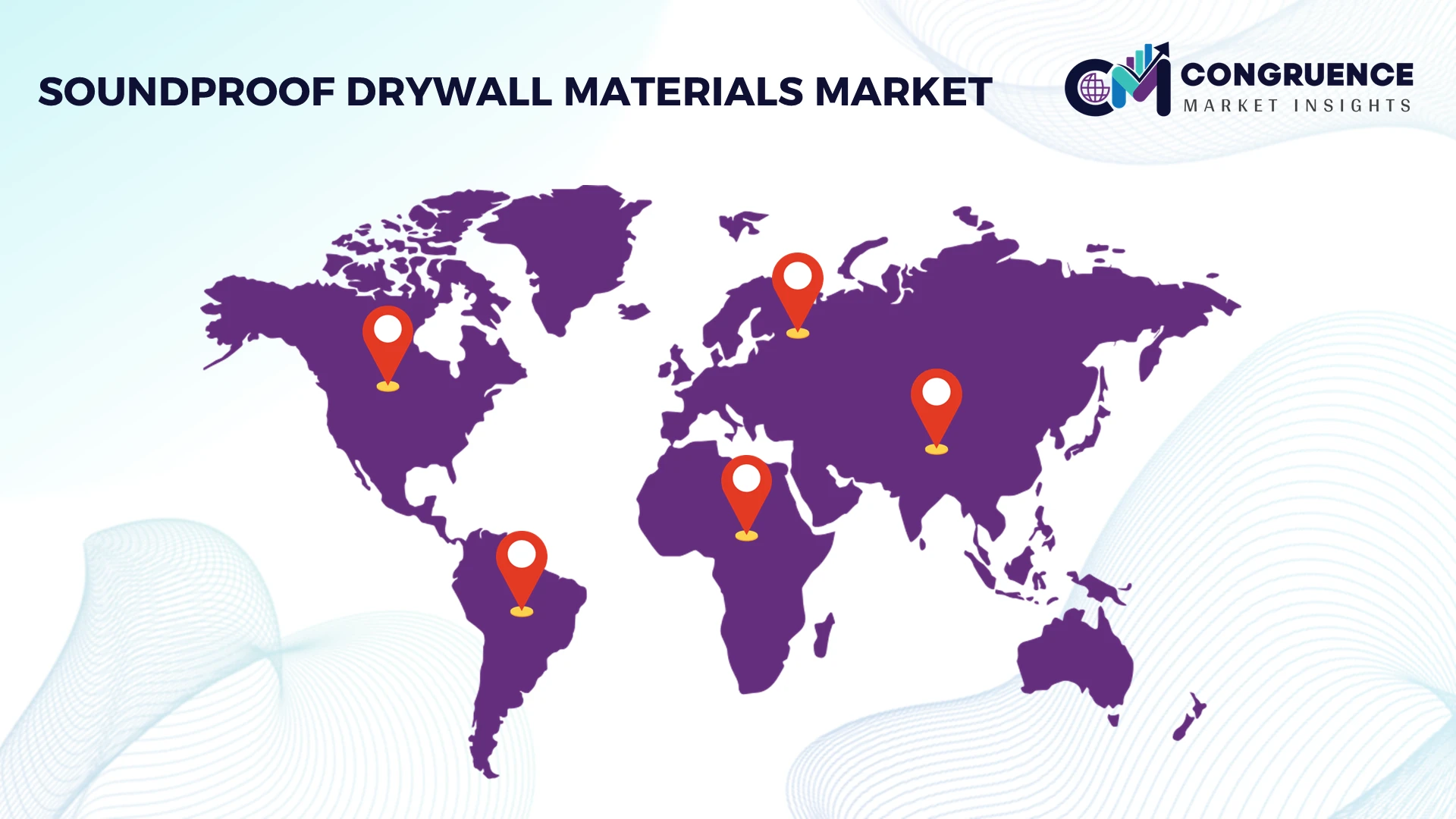
North America accounted for the largest estimated market share at 35% in 2025; however, Asia Pacific is expected to register the fastest growth between 2026 and 2033, supported by urban construction, expanding manufacturing capacity, and increasing adoption of acoustic building materials.
Advanced Acoustic Construction and Established Manufacturing Infrastructure
North America accounts for an estimated 35% of the global soundproof drywall materials market, supported by established gypsum manufacturing infrastructure, residential renovation, and specialized commercial construction. The United States represents the principal demand center, with Canada contributing through multifamily residential development and institutional construction. Acoustic wall assemblies targeting Sound Transmission Class ratings of 50 or higher are particularly relevant to apartment buildings, hospitals, and educational facilities. Manufacturers are integrating specialized gypsum cores, damping compounds, and standardized installation accessories to address increasingly detailed architectural specifications. Established distribution networks provide advantages in product availability and contractor support. Regional manufacturers are strengthening relationships with construction contractors and architectural consultants while improving production automation and acoustic testing capabilities. The increasing importance of verified assembly performance is shifting procurement toward technically supported product systems rather than individual drywall boards.
United States Market Outlook: The United States benefits from extensive gypsum production, established building material distribution networks, and specialized construction expertise. Residential building regulations commonly reference STC 50 for separating dwelling units, supporting demand for tested acoustic assemblies. Manufacturers are expanding technical specification services and contractor training to improve installation consistency. Healthcare construction and commercial property renovation provide additional opportunities for specialized soundproof drywall products.
Circular Gypsum Manufacturing and Acoustic Building Modernization
Europe represents an estimated 28% of the global soundproof drywall materials market, supported by established acoustic construction standards, extensive renovation activity, and specialized gypsum manufacturing. Germany, France, and the United Kingdom are important markets for advanced acoustic plasterboard and certified partition systems. European construction companies increasingly integrate acoustic performance requirements with environmental product documentation and material recycling strategies. In 2025, the introduction of acoustic plasterboard incorporating 100% recycled gypsum demonstrated progress in circular manufacturing. Manufacturers are improving gypsum recovery processes, optimizing production energy consumption, and expanding specialized acoustic product portfolios. Building renovation also creates demand for compact acoustic assemblies that improve sound isolation without substantially reducing usable interior space. Partnerships between manufacturers, recycling operators, and construction contractors are strengthening material recovery networks and supporting greater production efficiency.
Germany Market Outlook: Germany represents an important European market because of its established construction materials industry, technical building standards, and emphasis on acoustic engineering. DIN 4109 provides a regulatory framework for sound insulation in buildings. Manufacturers are developing certified gypsum assemblies and collaborating with architectural engineering firms to address demanding residential and institutional specifications. Renovation projects provide opportunities for compact acoustic systems that integrate with existing structures.
Urban Construction Expansion and Localized Acoustic Material Production
Asia Pacific accounts for an estimated 25% of the global soundproof drywall materials market, supported by extensive urban construction activity and expanding gypsum manufacturing capabilities. China, India, Japan, and Australia represent important markets with different acoustic construction requirements. China benefits from large construction material production networks, while Japan emphasizes precision manufacturing and specialized acoustic engineering. India presents opportunities through commercial property development, healthcare infrastructure, and premium residential construction. Manufacturers are strengthening localized production and distribution to improve material availability and reduce transportation costs. Standardized acoustic drywall systems are becoming increasingly relevant to large construction projects requiring consistent installation quality. Regional suppliers are developing specialized gypsum formulations and expanding partnerships with architectural consultants, construction companies, and building material distributors to improve access to institutional and commercial procurement channels.
China Market Outlook: China benefits from extensive gypsum processing infrastructure, established construction material manufacturing networks, and large urban development programs. Domestic manufacturers have opportunities to integrate acoustic board production with existing plasterboard manufacturing facilities. Commercial buildings, hospitals, and residential developments provide applications for specialized sound insulation systems. Automated manufacturing and domestic material sourcing support production efficiency, while differentiated acoustic products offer opportunities beyond conventional gypsum board manufacturing.
Commercial Renovation and Expanding Drywall Construction Adoption
South America represents an estimated 7% of the global soundproof drywall materials market, with Brazil contributing substantially to regional construction material consumption. Expanding drywall adoption in commercial interiors, healthcare facilities, hospitality properties, and residential developments creates opportunities for specialized acoustic products. Brazil has established gypsum resources and domestic plasterboard manufacturing infrastructure, providing advantages for localized material processing. However, conventional masonry remains widely used in residential construction, creating competition for acoustic drywall systems. Manufacturers are expanding distribution partnerships and providing technical support to contractors adopting lightweight partition construction. Product strategies increasingly emphasize installation efficiency, certified acoustic performance, and compatibility with established construction practices. Local gypsum processing and standardized product configurations help manufacturers manage logistics expenses and improve access to projects outside major metropolitan construction centers.
Brazil Market Outlook: Brazil represents a strategically important South American market because of its gypsum resources, established construction industry, and expanding commercial building requirements. São Paulo provides substantial opportunities through office renovation, healthcare construction, and hospitality development. Manufacturers are strengthening relationships with drywall installation contractors and construction distributors. Technical training and standardized acoustic assemblies are important for improving installation consistency and expanding adoption beyond premium construction projects.
Hospitality Infrastructure Investment and Specialized Acoustic Construction
The Middle East and Africa account for an estimated 5% of the global soundproof drywall materials market. Saudi Arabia and the United Arab Emirates represent important demand centers because of large hospitality, commercial, healthcare, and infrastructure construction programs. Specialized acoustic drywall is relevant to hotels, entertainment facilities, healthcare buildings, and premium residential developments where interior sound isolation influences building performance. Saudi Arabia's Vision 2030 development programs are creating opportunities for specialized construction materials and advanced interior building systems. Manufacturers are strengthening relationships with engineering consultants, construction contractors, and regional building material distributors. Local production and regional warehousing help improve material availability and reduce dependence on imported finished boards. Suppliers are also developing acoustic assemblies compatible with fire resistance requirements and demanding commercial construction specifications.
Saudi Arabia Market Outlook: Saudi Arabia represents a significant market for specialized acoustic building materials because of its extensive hospitality, entertainment, and infrastructure development programs. Projects associated with NEOM and other Vision 2030 initiatives create opportunities for advanced interior construction systems. Manufacturers are establishing distribution partnerships and strengthening technical specification capabilities. Acoustic assemblies combining sound isolation with fire resistance and installation efficiency are particularly relevant to large institutional and hospitality developments.
The global soundproof drywall materials market features competition between established gypsum manufacturers, specialized acoustic material developers, and regional construction material suppliers. Saint Gobain, Knauf, USG Corporation, National Gypsum, and Georgia Pacific represent important participants, although a verified combined market share for these manufacturers is unavailable. Competition centers on acoustic performance, manufacturing efficiency, distribution coverage, and architectural specification access. Specialized wall assemblies commonly target STC ratings between 45 and 60, creating opportunities for suppliers offering certified performance. Established manufacturers benefit from integrated gypsum processing, extensive contractor networks, and established production infrastructure. Specialized developers compete through damping technology, compact assembly configurations, and application specific engineering. Manufacturers are expanding recycling capabilities, improving automated production, and strengthening installation partnerships. The competitive landscape increasingly emphasizes complete acoustic systems rather than individual board specifications. Manufacturing investment, certification expenses, and distribution access create entry barriers. Sustainable differentiation requires verified performance, reliable supply, and installation support.
Saint Gobain
Knauf
National Gypsum
Georgia Pacific
Etex Group
Yoshino Gypsum
CSR Limited
PABCO Building Products
CertainTeed
Siniat
QuietRock
USG Corporation
Advanced gypsum core engineering and viscoelastic damping technologies are transforming acoustic drywall manufacturing. High density gypsum boards improve sound isolation by increasing material mass, while integrated damping layers reduce vibration transmission through partition assemblies. Specialized systems achieve acoustic ratings exceeding 50 STC, compared with approximately 35 STC for conventional lightweight partitions, representing a substantial improvement in sound isolation. Manufacturers are integrating these technologies into residential, healthcare, and commercial construction systems to strengthen acoustic performance without extensive structural modifications.
Emerging technologies include recycled gypsum processing, automated board manufacturing, and digitally optimized acoustic assembly design. Modern production facilities incorporate automated material handling and advanced quality monitoring to improve manufacturing consistency. Recycled gypsum technology enables manufacturers to replace up to 100% of virgin gypsum in selected plasterboard formulations. Digital acoustic modeling supports earlier identification of transmission pathways, reducing expensive physical design iterations. Established manufacturers benefit from integrated recycling infrastructure, while specialized suppliers differentiate through proprietary damping formulations.
Between 2026 and 2028, manufacturing investment will increasingly prioritize circular material processing, automated production, and multifunctional acoustic boards. Advanced products combining sound insulation, fire resistance, and moisture protection will simplify construction material selection. Integrated acoustic design platforms will strengthen collaboration between manufacturers, architects, and contractors. Companies combining verified acoustic performance with localized production and installation support will secure competitive advantages in technically demanding construction projects.
June 2024: Knauf highlighted its Soundshield Plus acoustic plasterboard technology, offering sound reduction of up to 54 dB and 120 minutes of fire protection within tested assemblies. This multifunctional product strengthens specification opportunities across residential and commercial construction projects. )
January 2025: Saint Gobain launched Gyproc SoundBloc Infinaé 100 in the United Kingdom, incorporating 100% recycled gypsum into acoustic plasterboard. Developed through British Gypsum, the innovation integrates recovered construction waste into manufacturing, reducing dependence on virgin gypsum resources.
March 2025: Etex opened its expanded plasterboard manufacturing facility in Bristol, doubling production capacity through an investment of approximately EUR 200 million. The expansion strengthens domestic manufacturing, improves supply chain resilience, and supports production of specialized Siniat plasterboard products.
April 2025: Etex introduced RECYPLAC through its Siniat brand, developing plasterboard manufactured from 100% recycled gypsum. Validated at its Carpentras pilot facility, the innovation supports circular material processing and demonstrates the technical feasibility of replacing virgin gypsum in production.
The Soundproof Drywall Materials Market Report provides comprehensive analysis of material technologies, construction applications, competitive positioning, and regional market developments between 2026 and 2033. Product coverage includes Standard Drywall, Acoustic Drywall, Sound-Dampening Drywall, Resilient Drywall, Cement-Based Drywall, and Fiberglass-Reinforced Drywall. Application analysis examines Wall Systems, Ceiling Systems, Partition Systems, Home Theater Rooms, Recording Studios, Office Spaces, and Hospitality Rooms. End-user coverage includes residential and commercial buildings, hotels, hospitals, educational institutions, recording studios, and industrial facilities.
Regional analysis covers North America, Europe, Asia Pacific, South America, and the Middle East and Africa. The report evaluates advanced damping technologies, recycled gypsum manufacturing, automated production, and certified acoustic assemblies achieving STC ratings above 50. Competitive assessment examines manufacturing expansion, product differentiation, distribution strategies, and emerging opportunities supporting investment planning and strategic market positioning.
| Report Attribute/Metric | Report Details |
|---|---|
Market Revenue in 2025 | USD 2870 Million |
Market Revenue in 2033 | USD 3988.62 Million |
CAGR (2026 - 2033) | 4.2% |
Base Year | 2025 |
Forecast Period | 2026 - 2033 |
Historic Period | 2021 - 2025 |
Segments Covered | By Type
By Application
By End-User
|
Key Report Deliverable | Revenue Forecast, Growth Trends, Market Dynamics, Segmental Overview, Regional and Country-wise Analysis, Competition Landscape |
Region Covered | North America, Europe, Asia-Pacific, South America, Middle East, Africa |
Key Players Analyzed | Saint Gobain, Knauf, National Gypsum, Georgia Pacific, Etex Group, Yoshino Gypsum, CSR Limited, PABCO Building Products, CertainTeed, Siniat, QuietRock, USG Corporation |
Customization & Pricing | Available on Request (10% Customization is Free) |




