
Reports
The Global Solid Wood Flooring Market was valued at USD 1,235.0 Million in 2025 and is anticipated to reach a value of USD 1,852.6 Million by 2033 expanding at a CAGR of 5.2% between 2026 and 2033. Premium renovation demand and supply-chain localization are reshaping competitive dynamics across mature and emerging markets.
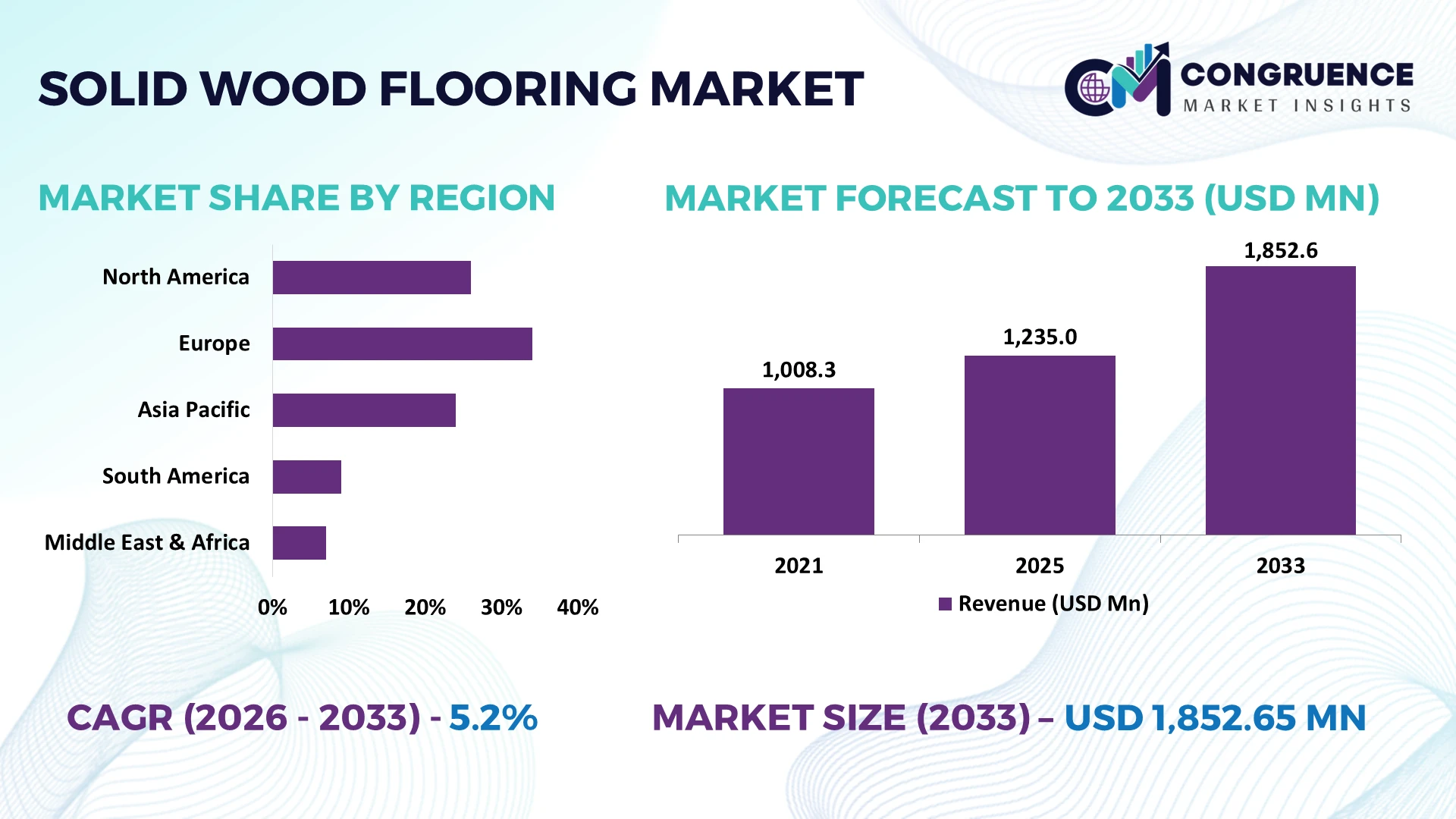
Europe anchors global dominance with an estimated 22.0% share of solid wood flooring demand, supported by Germany, France, and Nordic renovation markets where certified hardwood procurement and multi-layer parquet production account for 83% of regional output. The United States commands a contrasting position: engineered products capture 75% of domestic wood flooring demand, reflecting a structural preference for dimensional stability over solid plank in residential and commercial installations.
This divergence signals that solid wood flooring growth hinges on premium restoration and heritage-fitout segments rather than volume-driven new construction, making certification-led differentiation and installer capability the decisive strategic levers for manufacturers targeting high-value European and North American channels.
Market Size & Growth: Valued at USD 1,235.0 Million in 2025, projected to reach USD 1,852.6 Million by 2033, driven by premium residential renovation and certified hardwood supply-chain localization.
Top Growth Drivers: Renovation activity contributes 55–65% of demand; FSC/PEFC-certified sourcing influences 83% of European parquet procurement; solid-wood restoration in heritage-fitout projects supports 22% of premium segment growth.
Short-Term Forecast: By 2027, installer training programs targeting solid-plank adhesive systems aim to reduce callback rates by 15% and expand concrete-slab installation capability across 30% of North American contractors.
Emerging Technologies: Low-gloss prefinished surface treatments, 5/16-inch thin-profile solid planks compatible with concrete substrates, and geolocation-backed chain-of-custody documentation for EUDR compliance.
Regional Leaders: Europe at 22.0% share (USD ~272 Million equivalent) with certified renovation demand; North America driven by 75% engineered preference creating solid-wood niche positioning; Asia-Pacific expanding through Vietnam’s 47% share of Southeast Asian engineered exports to EU/North America.
Consumer/End-User Trends: 83% of European parquet production is multi-layer, indicating solid wood competes on authenticity and refinishability rather than installation convenience; North American homeowners show 31% preference for prefinished surfaces.
Pilot/Case Example: AHF Products’ 2026 launch of 5/16-inch solid Appalachian hardwood in 3¼-inch widths with 100% RH adhesive achieved concrete-slab installation capability, opening markets previously inaccessible to solid plank.
Competitive Landscape: European parquet producers hold approximately 22% collective share; key players include major European parquet manufacturers, AHF Products (Bruce), and certified hardwood specialists competing on species traceability and FSC documentation.
Regulatory & ESG Impact: EUDR shipment-level geolocation requirements raise fixed compliance costs for suppliers with diverse sourcing pools, pushing 34% of German softwood import volume toward certified Nordic and domestic supply chains.
Investment & Funding: Capital flows toward installer training infrastructure, adhesive-system R&D for concrete compatibility, and county-level geolocation documentation systems covering 33 U.S. states for EU-facing sales.
Innovation & Future Outlook: Next-generation solid plank engineering prioritizes substrate versatility and low-gloss finishes; strategic shift from volume distribution toward specification-led premium renovation and heritage restoration channels.
Solid wood flooring demand concentrates in European heritage renovation and North American premium custom residential projects, where authenticity and refinishability outweigh engineered convenience. Product innovation centers on thin-profile solid planks compatible with concrete substrates and adhesive systems that reduce installation barriers. A measurable insight: 83% of European parquet production is multi-layer, meaning solid wood’s addressable market is defined by differentiation rather than direct competition with engineered formats. Operationally, EUDR chain-of-custody requirements are restructuring sourcing toward certified Nordic and domestic supply, with compliance documentation becoming a procurement gatekeeper. This regulatory and product-evolution context frames the strategic pathways examined below.
Solid wood flooring is transitioning from a commodity building material into a specification-driven premium asset, where competitive advantage depends on certification integrity, installation ecosystem control, and substrate versatility. The EUDR compliance regime now functions as a market-access filter, favoring producers with verifiable chain-of-custody records and penalizing fragmented sourcing operations. This regulatory shift coincides with a product-level breakthrough: thin-profile solid planks paired with high-performance adhesives now enable concrete-slab installation, expanding addressable applications beyond traditional wood-subfloor environments.
A measurable technology comparison illustrates the operational gap. Legacy solid plank installations typically require plywood subfloor preparation and nail-down systems, adding 15–20% to project timelines and limiting applicability in slab-on-grade construction. The adhesive-compatible thin-profile approach reduces substrate preparation steps and enables direct-to-concrete deployment, compressing installation timelines and opening renovation segments previously served exclusively by engineered products. Regionally, Europe leads in certified solid-wood specification for heritage and high-end residential renovation, while North America channels solid wood toward custom residential and restoration niches where the 75% engineered market share leaves a defensible premium segment.
Operationally, manufacturers are adjusting investment priorities toward installer certification programs and adhesive-system partnerships rather than volume capacity expansion. AHF Products’ Bruce Natural Choice line exemplifies this pivot: wider solid plank formats with concrete-compatible adhesive systems target markets where solid wood was previously excluded. Over the next 2–3 years, success will be measured by contractor adoption rates for adhesive-based solid installation and the proportion of solid-wood inventory carrying verifiable EUDR-compliant geolocation data. Competitive positioning will favor brands that control both the product specification and the installation methodology, converting solid wood from a material sale into a systems-led premium proposition.
European renovation markets and North American premium residential segments are driving solid wood flooring demand through a quality-over-volume shift. Renovation activity accounts for approximately 55–65% of solid hardwood demand, with 83% of European parquet production oriented toward multi-layer formats that position solid plank as a differentiated authenticity product . The EUDR regulatory framework has accelerated this dynamic by elevating certified sourcing from marketing preference to procurement requirement, with shipment-level geolocation documentation now mandatory for EU market access. Companies are responding through vertical documentation investments: American Hardwood Assured now provides county-level geolocation data across 33 U.S. states, reducing friction for exporters targeting European specification channels. The strategic implication is clear: solid wood’s growth trajectory depends on premium restoration and heritage-fitout demand rather than new construction volume, making certification infrastructure and installer capability the primary competitive moats.
EUDR compliance and species-specific sourcing constraints are imposing structural cost burdens on solid wood flooring supply chains. The European Commission’s shipment-level geodata requirements raise fixed costs for suppliers managing diverse sourcing pools, with Germany’s softwood import volume declining 34% in 2024 as certification filters restructured procurement patterns . U.S. antidumping and countervailing duty actions on hardwood plywood from China, Indonesia, and Vietnam add tariff-layer uncertainty to input costs, compounding margin pressure for manufacturers dependent on imported components . These constraints directly impact scalability: smaller producers lack the compliance infrastructure to maintain EU market access, while larger operators face inventory carrying costs from extended verification timelines. Companies are mitigating exposure through localization strategies, with Nordic and domestic suppliers gaining preference, and through long-term certified supply contracts that stabilize both pricing and documentation continuity. The operational insight is that compliance capability is becoming a market-structure determinant, not merely a cost line.
The development of thin-profile solid planks compatible with high-performance adhesive systems represents a non-obvious growth avenue, unlocking concrete-slab residential and commercial renovation segments historically dominated by engineered products. AHF Products’ 2026 Bruce Natural Choice expansion to 3¼-inch widths with 100% RH adhesive capability demonstrates the commercial viability of this approach. Vietnam’s position as supplier of 47% of Southeast Asian engineered exports to EU and North America signals manufacturing capability concentration that solid-wood producers can leverage for regional customization. Companies positioning through installer certification programs and adhesive-system partnerships are converting product innovation into specification control. The untapped opportunity lies in retrofit renovation: aging housing stock in Germany, France, and the U.S. Northeast presents slab-accessible renovation demand that solid wood previously could not address without costly subfloor modification.
The solid wood flooring industry faces an execution barrier in installer capability: adhesive-based solid plank installation requires skill sets distinct from traditional nail-down methods, and the workforce trained in these techniques remains concentrated in mature European markets. North American contractors familiar with engineered click-lock systems represent 75% of the wood flooring installation base, creating a training bottleneck for solid-wood expansion. This skill gap directly constrains deployment consistency and risks callback rates that erode premium positioning. Companies must solve this through structured installer certification pipelines and digital installation guidance tools, not through product claims alone. The long-term sustainability risk is that without workforce development infrastructure, solid wood’s product innovations will outpace installation capacity, limiting market penetration to geographies with established parquet trades. Investment in training academies and specification-support teams becomes a prerequisite for scaling, not a discretionary marketing expense.
Adhesive Systems Rewrite Installation Logic High-performance adhesive systems now enable solid plank deployment over concrete slabs, eliminating plywood subfloor requirements that previously added 15–20% to project timelines. Manufacturers are responding by reformulating product lines for adhesive compatibility, with AHF Products leading the shift toward 5/16-inch solid profiles in wider formats. This operational change compresses installation cycles and opens slab-on-grade renovation demand previously inaccessible to solid wood.
EUDR Documentation Becomes Procurement Gatekeeper Shipment-level geolocation requirements under EUDR have transformed certification from a marketing asset into a market-access requirement, pushing Germany’s softwood imports down 34% as uncertified supply chains exit. Companies are investing in county-level traceability systems, with American Hardwood Assured covering 33 U.S. states to reduce documentation friction for EU-bound sales. The business impact is a bifurcation between compliant suppliers with stable EU channel access and non-compliant operators facing exclusion.
Prefinished Surface Technology Targets Premium Renovation Low-gloss and matte finish technologies are gaining specification share in European heritage and high-end residential projects, where 83% of parquet production is multi-layer and solid wood competes on refinishability and authenticity. Manufacturers are expanding color palettes and texture options while maintaining solid-wood refinishing capability, targeting renovation buyers who prioritize aesthetic longevity over installation speed.
Vietnam Manufacturing Concentration Reshapes Export Flows Vietnam supplied 47% of Southeast Asian engineered wood flooring exports to the EU and North America in 2024, signaling manufacturing capability concentration that solid-wood producers are monitoring for regional supply partnerships. This shift creates an emerging operational consideration: solid-wood manufacturers evaluating Southeast Asian finishing capacity for cost-competitive EU and North American distribution, while maintaining certified hardwood sourcing integrity through documentation systems linked to origin forests.
The solid wood flooring type landscape is defined by a clear premium-versus-volume split. Premium-grade solid plank commands approximately 30% of segment value, sustained by heritage restoration and luxury residential specification in Germany and France where full-body hardwood construction and multiple refinishing cycles justify price premiums. Mid-grade solid formats represent the volume core at roughly 45% of installations, benefiting from broader species availability and competitive pricing against engineered alternatives.
Base-grade solid products account for the remaining 25%, concentrated in price-sensitive renovation channels where refinishing capability remains the primary purchase rationale. The fastest-growing type dynamic favors mid-grade wide-plank formats, where 38% growth in residential wide-plank demand signals a shift toward design-forward solid products that bridge premium aesthetics and accessible pricing. Companies are responding by streamlining SKU counts while deepening inventory in high-velocity widths, with AHF Products expanding unfinished solid offerings to capture specification-driven renovation demand.
Residential applications dominate solid wood flooring demand with approximately 55% of global installation volume, driven by single-family renovation activity that represents 41% of residential installations and sustained homeowner preference for refinishable surfaces . Within residential, premium new construction requires solid wood in 65% of high-end developments, creating a specification pipeline that stabilizes demand despite engineered product competition. The fastest-growing application is commercial hospitality, where hotels specify premium solid materials in 48% of luxury projects and thermally modified solid wood installations grew 22% year-over-year.
Retail environments seeking brand-enhancing aesthetics increased solid wood usage by 31%, signaling commercial adoption beyond traditional hospitality channels. Office and boutique segments remain smaller but specification-led, with acoustic flooring systems gaining traction. Companies are adapting through commercial specification teams and thermally modified product lines, targeting hospitality projects in the UAE and Saudi Arabia where imported European white oak captures 57% of luxury commercial demand.
The family end-user segment represents the dominant buyer group, accounting for an estimated 60–65% of solid wood flooring consumption through residential renovation and new home construction decisions . This concentration reflects the operational reality that solid wood remains a homeowner-driven specification, with replacement and restoration cycles rather than new-build volume determining demand rhythm. The fastest-growing end-user group is the building segment—commercial and multi-family construction—where solid wood specification is expanding in boutique hospitality, premium retail, and high-end multi-family amenity spaces.
Building-sector adoption is accelerating through thermally modified solid products that address dimensional stability concerns in commercial environments, with 22% year-over-year growth in this product category. Park and other end-users remain niche, primarily serving municipal and landscape architectural applications with limited volume contribution. Companies are positioning competitively by developing builder-direct programs and commercial specification support, recognizing that family-segment loyalty depends on installer availability while building-segment growth requires technical documentation and performance warranties.
Europe accounted for the largest market share at 34% in 2025 however, Asia-Pacific is expected to register the fastest growth, expanding at a CAGR of 6.1% between 2026 and 2033.
North America contributes 26% of global solid wood flooring consumption, anchored by U.S. residential renovation activity where solid hardwood retains specification dominance in high-end projects despite engineered products capturing 75% of the broader wood flooring market. Deployment concentration sits in the U.S. Northeast and Midwest, where aging housing stock drives restoration demand for refinishable solid plank. A measurable operational development: NWFA’s 2026 industry survey found 60% of contractors reported installation sales growth in 2024, with larger builder projects cited as a primary driver. Tariff volatility on imported hardwood components is pushing manufacturers toward domestic Appalachian sourcing and inventory pre-positioning strategies.
United States Market Outlook: The U.S. solid wood flooring segment benefits from vertical integration across Appalachian hardwood supply chains, with producers like Mullican and Somerset operating sawmill-to-finish-floor operations. White oak remains the dominant species, and the premium renovation segment shows resilience against wood-look alternatives, with high-end consumers relatively unaffected by broader economic pressures .
Europe commands 34% of global solid wood flooring demand, functioning as the premium anchor for the category through heritage restoration and high-end residential specification in Germany, France, and the Nordic markets. Solid parquet operates as a deliberately small, stable premium niche competing almost exclusively in upscale housing, with demand concentrated in wide oak planks for new luxury homes and historic plank restoration in older buildings. A measurable regulatory development: EUDR shipment-level geolocation requirements are restructuring sourcing toward certified Nordic and domestic supply, with compliance documentation becoming a procurement gatekeeper. German producers are investing in chain-of-custody systems that integrate forest-origin data directly into product specification sheets.
Germany Market Outlook: Germany’s solid parquet market is characterized by a stable premium niche with demand driven by upscale residential new construction and Altbausanierung historic floor restoration. The country’s precision manufacturing culture and FSC/PEFC certification infrastructure position German producers as compliance leaders for EU-wide distribution, though the segment remains intentionally limited in scale relative to engineered formats .
Asia-Pacific accounts for 24% of global solid wood flooring consumption, with the region’s strategic significance concentrated in manufacturing and export capability rather than domestic solid-wood demand. Vietnam supplied 47% of Southeast Asian engineered wood flooring exports to the EU and North America, signaling production concentration that solid-wood producers monitor for finishing capacity partnerships. A measurable operational development: Vietnam’s wood exports reached USD 18.5 billion in 2025, with over 520,000 hectares of plantation forest achieving FSC certification as EUDR compliance becomes a market-access prerequisite. Chinese and Vietnamese producers are expanding prefinished solid capacity targeting European specification channels.
China Market Outlook: China’s solid wood flooring sector is pivoting from volume export orientation toward certified, traceable production for EU-bound premium channels. Domestic consumption remains concentrated in tier-1 city high-end residential, while export-oriented manufacturers invest in FSC documentation systems and low-gloss prefinished technologies to meet European buyer specifications .
South America holds 9% of global solid wood flooring consumption, with Brazil serving as the region’s production and demand anchor through its plantation hardwood resource base and growing wood-frame construction sector. Brazil’s plantation estate includes 8.8 million hectares of eucalyptus and 1.9 million hectares of pine, providing raw material security that few regions can match. However, the region’s solid wood flooring footprint remains constrained by limited domestic premium demand and certification infrastructure gaps relative to European standards. A measurable development: Brazil’s wood product exports declined 34% year-over-year in March 2026, reflecting tariff and demand pressures in key markets . Producers are prioritizing certification investments to access EU premium channels.
Brazil Market Outlook: Brazil’s solid wood flooring capability centers on Paraná and Santa Catarina states, where plantation hardwood supply and established sawmill infrastructure support production for domestic high-end residential and export markets. The country’s certification coverage remains below EU benchmarks, creating a compliance gap that limits premium channel access .
Middle East & Africa represents 7% of global solid wood flooring consumption, with demand highly concentrated in Gulf luxury hospitality and premium residential projects where imported European white oak captures the majority of specification volume. The region’s solid wood market is import-dependent, with domestic production limited to small-scale operations in Turkey and South Africa. A measurable investment development: Gulf hospitality projects increasingly specify thermally modified solid wood for dimensional stability in climate-controlled luxury environments. Companies are positioning through specification partnerships with European producers and regional distributors capable of providing installation expertise for premium projects.
UAE Market Outlook: The UAE functions as the Gulf’s solid wood specification hub, with Dubai and Abu Dhabi luxury hospitality projects driving demand for European-sourced white oak and thermally modified solid plank. Import-dependent procurement means certification documentation and installer availability are decisive competitive factors for specification wins.
The competitive structure pits vertically integrated North American manufacturers—Mohawk, Shaw, AHF Products, and Mannington—against European premium specialists like Kährs, Boen, and Bauwerk, with Chinese producers such as Jiusheng and Nature competing on domestic scale and cost. The top five players collectively hold approximately 18–22% of global solid wood flooring value, indicating a fragmented but consolidating landscape. Competition hinges on three axes: domestic manufacturing footprint (AHF’s U.S.-made solid lines command shorter lead times, insulating customers from tariff volatility), certification depth for EUDR-bound channels, and installation-system innovation. AHF’s Bruce Natural Choice 5/16-inch solid plank paired with SUMMIT SELECT adhesive enables glue-down over concrete, directly attacking the installer-skill barrier that constrains solid wood expansion. The decisive competitive shift is from product-centric selling to specification-and-systems control: winners will be those who own both the plank and the installation methodology, converting solid wood from a commodity material into a defensible premium platform. Entry barriers remain moderate for low-grade production but severe for EUDR-compliant, installer-certified premium channels.
Mohawk Industries
Shaw Industries
AHF Products
Mannington Mills
Mullican Flooring
Somerset Hardwood Flooring
Kährs Group
Boen Hardwood Flooring
Bauwerk Parkett
Barlinek
Junckers
Lauzon Distinctive Hardwood Flooring
Mirage / Boa-Franc
Jiusheng Flooring
Nature Home Holding
Adhesive-compatible thin-profile solid plank represents the most commercially significant technology shift. AHF’s 5/16-inch Bruce Natural Choice with SUMMIT SELECT 100% RH adhesive eliminates moisture and pH testing, reducing subfloor prep time and enabling glue-down installation over concrete—a configuration previously inaccessible to solid wood. This delivers a measurable operational improvement: installation cycles compress by an estimated 15–20% versus legacy nail-down systems requiring plywood subfloor preparation. Adoption is accelerating across North American remodel channels, where contractors familiar with engineered click-lock systems represent 75% of the installation base and now gain a viable solid-wood pathway.
Microwave-controlled wood stabilization, commercialized by Jiusheng in 2026, addresses dimensional movement in solid plank without chemical treatment, supporting wider format viability and underfloor heating compatibility. This technology benefits premium European and Chinese producers targeting renovation segments where authenticity and refinishability justify price premiums.
Between 2026 and 2028, the competitive advantage will shift toward manufacturers who pair product engineering with installer certification ecosystems. Companies investing in adhesive-system R&D and training infrastructure—rather than capacity expansion alone—will capture specification control in concrete-slab renovation, the fastest-opening addressable segment for solid wood.
August 2026 – AHF Products: Expanded Bruce Natural Choice solid hardwood to 3¼-inch widths with SUMMIT SELECT adhesive, enabling glue-down over concrete and compressing subfloor prep by an estimated 15–20% versus nail-down systems. Business impact: opens concrete-slab renovation demand previously closed to solid wood. Source: woodfloorbusiness.com
November 2026 – Jiusheng Flooring: Commercialized “Libra” microwave-controlled wood stabilization and “Taurus” self-supporting reverse-lock technologies for pure solid wood flooring, targeting dimensional stability and full-scenario applications including underfloor heating. Business impact: extends solid plank addressable applications beyond traditional wood-subfloor environments. Source: app.xinhuanet.com
April 2026 – AHF Products: Introduced Bruce Dundee in low-gloss finish and expanded unfinished solid program (White Oak, Red Oak in 2¼-inch and 3¼-inch) with NOFMA certification, targeting custom stain/finish specification work. Business impact: captures specification-driven renovation demand requiring on-site color matching and premium visual consistency. Source: fcw1.com
July 2026 – Tongue & Groove: Launched GridWork collection with Established & Sons and Raw-Edges at Milan Salone del Mobile, featuring three-layer solid European oak with multidirectional tongue-and-groove connection enabling tile-like installation patterns. Business impact: repositions solid-engineered oak into design-led specification channels and expands architectural application beyond plank formats. Source: australiandesignreview.com
This report delivers a structured assessment of the global solid wood flooring market across type, application, and end-user segments, with regional granularity spanning North America, Europe, Asia-Pacific, South America, and the Middle East & Africa. Coverage includes premium solid plank, mid-grade formats, and base-grade products, alongside application-level analysis of residential renovation, commercial hospitality, retail, and office specification. End-user segmentation examines family, building, and institutional purchasing patterns, with adoption metrics and deployment concentration indicators where relevant.
The report integrates competitive intelligence on fifteen profiled manufacturers, technology adoption pathways including adhesive-compatible solid systems and microwave stabilization, and regulatory compliance dynamics under EUDR. Strategic insights support investment prioritization, expansion targeting, and specification-channel positioning through 2033. Quantitative indicators include segment distribution shares, installer adoption rates, and certification coverage benchmarks, enabling decision-makers to align product development and channel investment with the highest-value demand pockets in premium renovation and concrete-slab-accessible applications.
| Report Attribute / Metric | Details |
|---|---|
| Market Revenue (2025) | USD 1,235.0 Million |
| Market Revenue (2033) | USD 1,852.6 Million |
| CAGR (2026–2033) | 5.2% |
| Base Year | 2025 |
| Forecast Period | 2026–2033 |
| Historic Period | 2021–2025 |
| Segments Covered |
By Type
By Application
By End-User
|
| Key Report Deliverables | Revenue Forecast; Market Trends; Growth Drivers & Restraints; Technology Insights; Segmentation Analysis; Regional Insights; Competitive Landscape; Regulatory & ESG Overview; Recent Developments |
| Regions Covered | North America; Europe; Asia-Pacific; South America; Middle East & Africa |
| Key Players Analyzed | Mohawk Industries; Shaw Industries; AHF Products; Mannington Mills; Mullican Flooring; Somerset Hardwood Flooring; Kährs Group; Boen Hardwood Flooring; Bauwerk Parkett; Barlinek; Junckers; Lauzon Distinctive Hardwood Flooring; Mirage / Boa-Franc; Jiusheng Flooring; Nature Home Holding |
| Customization & Pricing | Available on Request (10% Customization Free) |




