
Reports
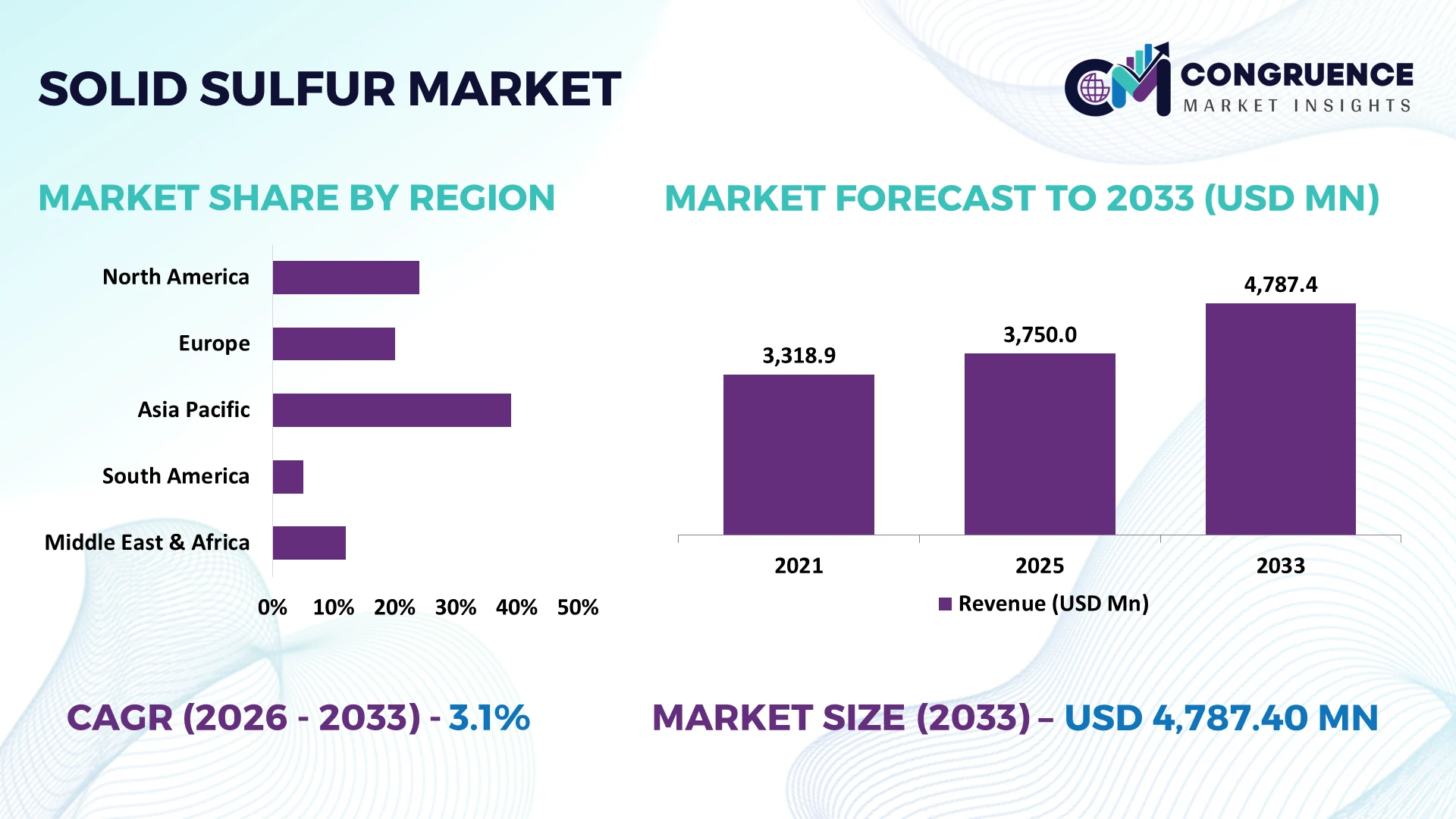
The Global Solid Sulfur Market was valued at USD 3750 Million in 2025 and is anticipated to reach a value of USD 4787.4 Million by 2033 expanding at a CAGR of 3.1% between 2026 and 2033. Growth is anchored in phosphate-fertilizer processing, sulfuric-acid production, expanding sour-gas treatment, and sulfur-intensive high-pressure acid leach nickel projects supplying battery-material value chains.
China anchors the global solid sulfur market, producing approximately 19.4 million metric tons and accounting for about 23% of worldwide sulfur output, supported by large refining, chemicals, phosphate, and fertilizer industries. Saudi Arabia contributes roughly 8.6% of global production, while more than USD 25 billion in gas-expansion contracts reinforces future recovered-sulfur availability as Middle Eastern processing infrastructure expands.
Strategically, buyers should diversify procurement across Chinese and Middle Eastern supply hubs as fertilizer capacity, battery-material processing, and geopolitical trade-route exposure increasingly determine solid sulfur availability and delivered costs.
Market Size & Growth: USD 3.75 billion in 2025 advances to USD 4.79 billion by 2033 at 3.1% CAGR, supported by fertilizer, refining, and sulfuric-acid requirements.
Top Growth Drivers: Phosphate fertilizers account for the largest sulfur-linked demand base, China represents approximately 23% of production, and Saudi Arabia contributes about 8.6% globally.
Short-Term Forecast: By 2027, expanded Middle Eastern sour-gas processing will strengthen recovered-sulfur availability as major Saudi gas facilities progressively increase processing throughput.
Emerging Technologies: Advanced sulfur recovery units, digital process controls, automated granulation, and predictive maintenance are increasing recovery efficiency while improving product consistency and plant utilization.
Regional Leaders: Asia-Pacific leads global consumption, the Middle East strengthens export supply, and North America maintains approximately 8 million tons of annual production supported by refining and gas processing.
Consumer/End-User Trends: Fertilizer and chemical producers remain dominant users, with approximately 90% of sulfur ultimately converted into sulfuric acid across major industrial applications.
Pilot/Case Example: In 2025, Saudi Arabia’s Jafurah development entered production, establishing new gas-processing infrastructure that incorporates sulfur handling and supports progressively higher recovered-sulfur availability.
Competitive Landscape: China controls approximately 23% of global sulfur production, while major supply participants include Saudi Aramco, ADNOC, Sinopec, Gazprom, and large international refining groups.
Regulatory & ESG Impact: Modern sulfur-recovery systems routinely target above 99% sulfur recovery, making emissions compliance and tail-gas treatment decisive requirements for advanced refining and sour-gas facilities.
Investment & Funding: More than USD 25 billion of Saudi gas-expansion contracts strengthens upstream processing infrastructure, including gas treatment, sulfur facilities, pipelines, compression, and export capabilities.
Innovation & Future Outlook: High-growth nickel HPAL projects, automated sulfur forming, enhanced recovery systems, and Middle Eastern gas expansion are shifting competitive advantage toward integrated, low-cost sulfur suppliers.
The Solid Sulfur Market is increasingly shaped by phosphate fertilizers, sulfuric acid, metal processing, petroleum refining, and battery-material supply chains. China’s approximately 23% production share highlights concentrated global supply, while advanced sulfur recovery and automated granulation improve operational consistency. Middle Eastern sour-gas expansion is simultaneously creating a stronger export-oriented supply base, establishing the foundation for deeper strategic market assessment.
Solid sulfur is becoming strategically important as fertilizer security, critical-mineral processing, and sour-gas development tighten links between sulfur availability and industrial competitiveness. Roughly 90% of sulfur is ultimately converted into sulfuric acid, making reliable supply essential for phosphate fertilizers, metal leaching, refining, and chemicals. The market is shifting toward integrated supply chains where recovered sulfur from oil and gas processing increasingly complements conventional refinery output.
Technology is strengthening this transition. Modern Claus units combined with tail-gas treatment can exceed 99% sulfur recovery, versus roughly 94–97% for less sophisticated configurations, reducing atmospheric sulfur losses while increasing saleable output. China operates at unmatched production and consumption scale, while Saudi Arabia and the UAE are expanding recovered-sulfur capacity through sour-gas infrastructure. Canada, meanwhile, retains established sulfur-handling and export expertise but operates at smaller scale than leading Asian producers.
Through 2026–2028, fertilizer capacity additions and nickel-processing projects will reinforce sulfur logistics investment, storage requirements, and long-term contracting. Saudi Arabia’s Jafurah gas development illustrates the pathway: expanding sour-gas processing simultaneously creates commercial sulfur supply. Producers are prioritizing recovery upgrades, granulation capacity, terminals, and integrated logistics partnerships. Competitive advantage will increasingly belong to suppliers combining high recovery efficiency, dependable transport infrastructure, and proximity to sulfur-intensive industries.
Phosphate fertilizer production remains the strongest structural driver because approximately 90% of sulfur is converted into sulfuric acid, with fertilizer manufacturing representing its largest downstream application. China contributes about 23% of global sulfur production while simultaneously operating the world’s largest phosphate-fertilizer industry, creating substantial captive consumption. India imports around 90% of its phosphate-rock requirements, reinforcing exposure to sulfur-intensive fertilizer supply chains. Food-security policies and fertilizer-capacity investments are consequently strengthening sulfur procurement requirements. Producers and traders are responding through larger storage terminals, granulation facilities, long-term offtake agreements, and integrated logistics. A critical strategic advantage lies with suppliers positioned near phosphate conversion hubs: proximity reduces handling complexity and provides fertilizer manufacturers greater protection against maritime disruptions and sudden sulfur-price movements.
Solid sulfur availability remains structurally tied to petroleum refining and sour-gas processing because most commercial sulfur is recovered as an unavoidable hydrocarbon-processing by-product rather than produced according to sulfur demand. China accounts for roughly 23% of global output, while Saudi Arabia contributes around 9%, creating meaningful geographic concentration. Meanwhile, approximately 90% of sulfur enters sulfuric-acid production, limiting substitution possibilities for major consumers. Refinery configuration changes, sanctions affecting trade corridors, and Red Sea shipping disruptions can therefore alter delivered availability independently of downstream fundamentals. Fertilizer and mining operators face higher inventory requirements and working-capital exposure when supply becomes constrained. Companies are reducing vulnerability through multi-origin procurement, strategic inventories, longer contracts, localized storage, and supplier diversification. The operational priority is increasingly supply reliability rather than simply securing the lowest spot-market sulfur price.
Battery-material processing creates a less obvious opportunity beyond conventional fertilizer demand. Nickel laterite projects using high-pressure acid leach require substantial sulfuric-acid inputs, making integrated sulfur-to-acid production strategically attractive in Indonesia’s expanding nickel-processing clusters. Indonesia accounts for more than 60% of global mined nickel supply, while several new HPAL facilities incorporate captive acid production to reduce imported reagent dependence. Simultaneously, advanced Claus and tail-gas treatment configurations can push sulfur recovery above 99%, compared with approximately 94–97% for conventional configurations. This converts environmental compliance into incremental saleable sulfur output. Suppliers are positioning through acid plants, recovery upgrades, sulfur-forming systems, and partnerships with mineral processors. Co-locating sulfur conversion beside nickel operations offers a particularly strong advantage by eliminating portions of hazardous-acid transportation while improving reagent security and processing economics.
Long-term competitiveness depends on moving growing recovered-sulfur volumes safely from inland gas-processing facilities to global consumers. Solid sulfur requires forming, storage, dust control, fire management, rail or truck connections, and specialized port handling, creating execution complexity beyond production itself. Modern recovery plants exceed 99% sulfur capture, meaning large sour-gas projects generate correspondingly higher physical volumes requiring downstream infrastructure. China produces about 23% of global sulfur, while expanding Saudi and Emirati gas projects are increasing export-oriented supply, intensifying pressure on terminal capacity and trade logistics. Sulfur dust is combustible, and poorly managed stockpiles create corrosion and environmental risks. Producers must therefore synchronize recovery capacity with granulation, covered storage, transport corridors, and marine terminals. The strategic challenge is preventing sulfur-handling infrastructure from becoming the bottleneck that limits monetization of technically recoverable supply.
Granulation Becomes Export Standard: Large gas processors are shifting recovered sulfur toward uniform granular output because it reduces breakage, dust formation, and bulk-handling losses during long-distance transport. ADNOC’s Shah complex can process 1.28 billion standard cubic feet of ultra-sour gas daily and produce 4.2 million tons of sulfur annually, approximately 5% of global output. Producers are scaling granulation, rail loading, and automated terminal systems.
Import Strategies Become More Defensive: Industrial consumers are carrying greater procurement exposure as sulfur pricing and physical availability diverge from downstream demand. U.S. sulfur prices moved from about USD 46 per ton in 2024 to USD 180 in 2025, while imports supplied approximately 34% of domestic consumption. Fertilizer and chemical companies are increasing contract coverage, inventories, and multi-origin sourcing rather than depending heavily on spot cargoes.
Phosphate Hubs Intensify Sulfur Logistics: Morocco imported approximately 8.3 million tons of sulfur in 2024, up 28% from 6.5 million tons, while phosphoric-acid production increased 20% to 7.4 million tons. This linkage is forcing tighter synchronization between vessel scheduling, sulfur storage, acid plants, and fertilizer lines. Integrated phosphate producers are expanding terminals and inventory buffers to protect continuous conversion operations.
Recovery Assets Become Digitally Integrated: Sulfur recovery operations increasingly combine advanced process control, tail-gas treatment, online analyzers, and predictive maintenance around recovery rates exceeding 99%. The shift is operational rather than purely environmental: higher capture increases saleable sulfur while reducing process instability. Gas processors in the UAE and Saudi Arabia are integrating recovery, forming, storage, and export infrastructure instead of treating sulfur handling as a secondary refinery function.
Granular Sulfur represents an estimated 60–65% of solid sulfur demand within large-volume traded markets, supported by high mechanical strength, consistent particle sizing, reduced handling losses, and suitability for automated conveyors and ship-loading systems. Its advantage is strongest across fertilizer and sulfuric-acid complexes requiring uninterrupted bulk feed. Prilled Sulfur follows as an increasingly important segment, with an estimated 18–22% share, benefiting from controlled particle geometry, lower dust generation, and easier dosing in plants requiring cleaner material handling.
Prilled Sulfur is emerging as the fastest-growing type as refiners and gas processors prioritize safer handling and product uniformity. Lump Sulfur remains relevant where forming infrastructure is limited but carries higher crushing and dust requirements. Flaked Sulfur serves smaller chemical-processing applications requiring rapid melting, while Powdered Sulfur retains strategic importance in rubber compounding and specialty chemical formulations. Producers are therefore concentrating capital on granulators and prilling lines while retaining flexible crushing, flaking, and milling capacity for specialized customers.
Sulfuric Acid Production dominates the application structure, accounting for an estimated 55–60% of directly classified solid sulfur demand because elemental sulfur provides a scalable, high-purity feedstock for continuous acid plants. Fertilizer Production represents approximately 25–30%, supported by phosphoric-acid manufacturing for phosphate fertilizers. The two segments remain operationally interconnected, but acid producers increasingly optimize sulfur melting, filtration, combustion, and heat-recovery systems to increase throughput and reduce conversion interruptions.
Fertilizer Production is the fastest-strengthening application as countries expand domestic phosphate-processing capabilities and reduce reliance on finished fertilizer imports. Chemical Manufacturing maintains steady requirements across intermediates, detergents, pigments, and inorganic chemicals, while Rubber Vulcanization remains a smaller but technically critical outlet requiring tightly controlled sulfur grades. Petroleum Refining uses sulfur-based chemistry selectively while simultaneously remaining a major recovered-sulfur source. Suppliers are responding through specification-controlled grades, automated bulk handling, longer supply agreements, and closer integration with acid plants, strengthening demand visibility around high-utilization industrial clusters.
Fertilizer Manufacturers form the dominant end-user group, representing an estimated 45–50% of solid sulfur consumption within the defined buyer structure because phosphate conversion requires continuous sulfuric-acid availability and large feedstock inventories. Chemical Producers represent approximately 20–25%, purchasing sulfur for acid, intermediates, and specialty chemical operations. Their procurement emphasizes consistency, purity, logistics reliability, and compatibility with automated sulfur-melting systems rather than solely lowest delivered price.
Mining Companies are the fastest-expanding buyer group as nickel laterite processing increases acid-intensive hydrometallurgical capacity, particularly in Indonesia. Oil Refineries occupy a specialized position because they both recover sulfur and consume sulfur-based intermediates in selected processes, while Rubber Manufacturers purchase smaller volumes but demand tightly controlled particle size and purity for vulcanization. Suppliers are targeting fertilizer complexes through long-term bulk contracts, mining customers through integrated sulfur-to-acid solutions, and rubber producers through customized powdered grades. Competitive positioning is consequently shifting from commodity selling toward application-specific logistics and processing support.
Asia-Pacific accounted for the largest market share at 42% in 2025 however, Middle East & Africa is expected to register the fastest growth, expanding at a CAGR of 4.2% between 2026 and 2033.

Refinery Recovery Meets Fertilizer Logistics
North America represents approximately 17% of the global solid sulfur market, supported by extensive petroleum refining, natural-gas processing, phosphate fertilizer production, and established rail-terminal infrastructure. The United States produced approximately 8.1 million metric tons of sulfur in 2025, while Canada contributed about 5.0 million tons, giving the region a substantial recovered-sulfur base. U.S. output is concentrated around Gulf Coast refining and gas-processing assets, whereas western Canadian production remains connected to sour-gas and oil-processing operations. Supply is increasingly managed through integrated forming, storage, rail, and marine distribution systems as fertilizer producers seek greater delivery reliability. Approximately one-third of U.S. sulfur consumption is import-dependent, reinforcing contract diversification. Operators are consequently prioritizing recovery efficiency, terminal flexibility, inventory management, and logistics integration to protect downstream sulfuric-acid and phosphate operations.
United States Market Outlook: The United States combines 8.1 million tons of annual sulfur production with one of the world’s largest refining networks and significant phosphate-processing capacity in Florida and adjacent industrial corridors. Gulf Coast infrastructure provides access to domestic fertilizer plants and international trade, while advanced sulfur-recovery and tail-gas treatment systems support recovery efficiencies above 99% at modern facilities.
Refinery Rationalization Reshapes Supply Balance
Europe holds approximately 13% of global solid sulfur demand, with consumption anchored in fertilizer chemicals, sulfuric acid, metals processing, and specialty manufacturing. The structural shift is increasingly supply-side: refinery rationalization, decarbonization policies, and changing petroleum throughput constrain traditional recovered-sulfur availability, encouraging greater reliance on imports and optimized cross-border logistics. Germany, Finland, Poland, Italy, and the Netherlands remain strategically important through refining, chemicals, fertilizer production, and port infrastructure. European operators are simultaneously modernizing sulfur-recovery units to achieve above 99% recovery while tightening sulfur-dioxide emissions management. Rotterdam, Antwerp-Bruges, and Baltic logistics corridors provide flexible access to internationally traded granular sulfur. Chemical companies are responding with longer procurement contracts, diversified import origins, higher inventory coverage, and improved sulfur-melting efficiency, making supply-chain resilience increasingly important as conventional refining capacity gradually restructures.
Germany Market Outlook: Germany remains strategically significant through its integrated chemical clusters, refineries, sulfuric-acid plants, and fertilizer-linked industrial consumers. The country’s chemical sector represents roughly one-quarter of European chemical sales, creating concentrated sulfur-derived chemical requirements. Industrial users increasingly emphasize high-purity feedstock, energy-efficient acid production, emissions control, and multimodal logistics rather than relying exclusively on domestic refinery-derived sulfur availability.
China Anchors Production and Consumption Scale
Asia-Pacific controls approximately 42% of the solid sulfur market, reflecting unmatched concentration across refining, phosphate fertilizers, chemicals, metals, and industrial acid production. China produced about 19 million metric tons of sulfur in 2025, representing roughly 23% of worldwide output, while its extensive phosphate-processing and chemical infrastructure simultaneously creates substantial internal consumption. India adds significant import-driven demand through fertilizer manufacturing and sulfuric-acid production, while Indonesia is strengthening consumption around nickel laterite processing and integrated hydrometallurgical facilities. Chinese refiners are expanding recovery efficiency and forming capacity, whereas Indian buyers increasingly diversify procurement among Middle Eastern and Central Asian suppliers. Indonesia’s HPAL expansion adds a different demand pathway because nickel processing requires substantial sulfuric-acid availability. Consequently, suppliers are aligning granular sulfur logistics, acid conversion capacity, terminals, and long-term contracts with major industrial clusters rather than competing primarily through spot-market pricing.
China Market Outlook: China is the region’s decisive production center, generating approximately 19 million tons of sulfur in 2025. Its advantage extends beyond scale into integrated refining, petrochemicals, phosphate processing, and sulfuric-acid manufacturing. Domestic suppliers increasingly deploy high-efficiency recovery units and automated forming systems, while large industrial consumers secure feedstock through integrated refinery relationships and diversified imported sulfur to maintain plant utilization.
Brazilian Fertilizer Demand Reshapes Imports
South America represents approximately 9% of the global solid sulfur market, with Brazil and Chile driving distinct demand structures. Brazil’s fertilizer industry relies heavily on imported elemental sulfur for phosphate processing, while Chile combines smelter-derived sulfuric acid with imported acid and sulfur-linked supplies supporting copper operations. Brazil imported approximately 2.3 million tons of sulfur in 2025, with about 95% directed toward phosphate fertilizer production. New phosphate capacity is intensifying port, storage, and inland logistics requirements; the Serra do Salitre complex alone adds roughly 330,000 tons of annual sulfur consumption at full operation. Import dependence remains the principal execution constraint, exposing processors to freight and global availability shifts. Producers and fertilizer companies are responding with diversified supplier portfolios, expanded inventories, port agreements, and integrated sulfuric-acid capacity near phosphate deposits.
Brazil Market Outlook: Brazil is the region’s strategic demand center because its agricultural system requires large phosphate-fertilizer volumes while domestic sulfur availability remains limited. Sulfur imports increased materially with phosphate-processing expansion, and February 2026 imports alone reached approximately 151,000 tons, 24% above the prior-year month. Fertilizer producers are prioritizing procurement diversification and localized acid production to reduce feedstock disruption.
Sour-Gas Investment Expands Export Capacity
Middle East & Africa accounts for approximately 19% of the solid sulfur market and possesses the strongest structural supply-expansion pathway through sour-gas processing and phosphate development. The UAE has become a critical export hub: its Shah facility can produce 4.2 million tons of sulfur annually, equivalent to approximately 5% of global production, supported by 1.28 billion standard cubic feet per day of ultra-sour gas processing capacity. Saudi Arabia is simultaneously expanding gas-processing infrastructure, strengthening future recovered-sulfur availability. On the demand side, Morocco imported 8.3 million tons of sulfur in 2024, up approximately 28% from 6.5 million tons, as phosphate conversion expanded. Companies are integrating sulfur recovery, granulation, rail transport, storage, and marine terminals, transforming sulfur from a refinery by-product into a strategically managed export commodity.
United Arab Emirates Market Outlook: The UAE combines world-scale sour-gas processing with integrated sulfur logistics. ADNOC Sour Gas operates four major sulfur-recovery units at Shah, with granulated output transported by rail to Ruwais for export. The country accounted for approximately 7.5% of worldwide sulfur production in 2024, giving it exceptional supply concentration and direct access to fertilizer and industrial customers across Asia and Africa.
Solid sulfur competition centers on Sinopec, Saudi Aramco, ADNOC, Suncor Energy, and ExxonMobil, where integrated refiners and sour-gas processors compete against regional suppliers through production scale and logistics control. The top five producers collectively represent an estimated 30–35% of globally recoverable commercial supply, leaving significant volumes distributed across national refiners and gas processors. China alone contributes about 23% of global sulfur production, while ADNOC’s Shah complex supplies approximately 5%, demonstrating the importance of asset concentration. Competition increasingly depends on recovery efficiency above 99%, granular-product consistency, freight economics, and uninterrupted terminal access. Saudi Aramco and ADNOC expand through sour-gas integration, while Sinopec leverages domestic refining and chemical networks; Canadian suppliers exploit established rail infrastructure. The competitive shift favors vertically integrated producers controlling recovery, forming, storage, and export logistics. Capital-intensive recovery units, environmental compliance, and specialized terminals restrict entry. Winning requires dependable volume, efficient logistics, specification consistency, and proximity to fertilizer and sulfuric-acid customers.
Saudi Aramco
ADNOC
Sinopec
China National Petroleum Corporation
Suncor Energy
ExxonMobil
Shell
QatarEnergy
Tengizchevroil
Petrobras
Pemex
Kuwait Petroleum Corporation
Sonatrach
Indian Oil Corporation
Current solid sulfur technology centers on advanced Claus recovery, tail-gas treatment, automated granulation, and digital process control. Modern integrated units routinely exceed 99% sulfur recovery, versus roughly 94–97% for older configurations, improving recoverable output by 3–5 percentage points while lowering sulfur-oxide losses. Adoption is highest across sour-gas and refinery complexes, where automated forming and rail-loading systems improve handling efficiency by 10–15% and reduce dust-related operating disruptions.
Emerging systems combine online sulfur analyzers, predictive maintenance, AI-assisted combustion control, and enclosed material handling. Digital optimization can reduce unplanned downtime by 5–10%, while improved granulation controls lower off-specification product generation by 3–6%. Deployment is accelerating in new Middle Eastern gas-processing assets and export terminals because integrated recovery, forming, storage, and logistics improve throughput reliability. Integrated producers benefit most because higher utilization spreads technology costs across sulfur volumes and strengthens delivery consistency.
Disruptive pathways include sulfur-based construction materials, advanced batteries, polymer-modified sulfur, and circular sulfur reuse from industrial waste streams. Commercial deployment remains limited, but pilot-scale adoption is expanding. Between 2026 and 2028, recovery automation, predictive control, and low-dust forming will become investment priorities. Suppliers acting now gain higher plant availability, cleaner logistics, specification consistency, and stronger positioning with fertilizer, chemical, and mining customers.
June 2024 Saudi Aramco awarded contracts advancing Jafurah phase two, including sulfur and export facilities, within a gas expansion package exceeding USD 25 billion. The buildout strengthens future recovered-sulfur supply and integrates processing, logistics, and export capacity globally. Source: aramco.com
March 2025 NEXTCHEM secured a three-year engineering services contract from SATORP for its Jubail sulfur recovery complex, covering three process units. The program targets higher energy efficiency, improved operational performance, and lower carbon intensity across sulfur-recovery operations directly.
July 2025 Indian Phosphate commenced commercial production at its Cuddalore sulfuric-acid plant with 200 metric tons per day installed capacity. The backward-integration move secures acid availability for downstream LABSA production and reduces exposure to external supply disruptions materially. Source: nseindia.com
April 2026 Ecopetrol commissioned Colombia’s first wet sulfur pelletizing plant at Cartagena Refinery, rated at 1,000 tons daily. The unit converts refinery-generated liquid sulfur into solid pellets, enabling cleaner handling, broader domestic distribution, and direct export opportunities internationally. Source: ecopetrol.com.co
The Solid Sulfur Market Report covers Granular Sulfur, Prilled Sulfur, Lump Sulfur, Flaked Sulfur, and Powdered Sulfur across sulfuric acid production, fertilizer production, rubber vulcanization, petroleum refining, and chemical manufacturing. End-user analysis evaluates fertilizer manufacturers, oil refineries, chemical producers, rubber manufacturers, and mining companies, while regional coverage spans North America, Europe, Asia-Pacific, South America, and Middle East & Africa.
The report examines advanced Claus recovery, tail-gas treatment, automated granulation, predictive maintenance, digital process control, and emerging sulfur-based materials. With granular sulfur representing roughly 60–65% of traded solid volumes and fertilizer-related demand remaining dominant, the analysis identifies deployment concentration, supply-chain exposure, and changing buyer priorities. Strategic findings support 2026–2033 investment planning, capacity expansion, sourcing decisions, competitive positioning, technology selection, and evaluation of emerging demand from nickel processing and integrated sulfur-to-acid operations.
| Report Attribute/Metric | Report Details |
|---|---|
Market Revenue in 2025 | USD 3750 Million |
Market Revenue in 2033 | USD 4787.4 Million |
CAGR (2026 - 2033) | 3.1% |
Base Year | 2025 |
Forecast Period | 2026 - 2033 |
Historic Period | 2021 - 2025 |
Segments Covered | By Type
By Application
By End-User
|
Key Report Deliverable | Revenue Forecast, Growth Trends, Market Dynamics, Segmental Overview, Regional and Country-wise Analysis, Competition Landscape |
Region Covered | North America, Europe, Asia-Pacific, South America, Middle East, Africa |
Key Players Analyzed | Saudi Aramco, ADNOC, Sinopec, China National Petroleum Corporation, Suncor Energy, ExxonMobil, Shell, QatarEnergy, Tengizchevroil, Petrobras, Pemex, Kuwait Petroleum Corporation, Sonatrach, Indian Oil Corporation |
Customization & Pricing | Available on Request (10% Customization is Free) |




