
Reports
The Global Solid State Batteries Market was valued at USD 450.7 Million in 2025 and is anticipated to reach a value of USD 8,904.7 Million by 2033 expanding at a CAGR of 45.2% between 2026 and 2033. Commercialization of electric vehicles, high-energy-density battery architectures, and large-scale investments in next-generation battery manufacturing are accelerating deployment across automotive, aerospace, and premium consumer electronics.
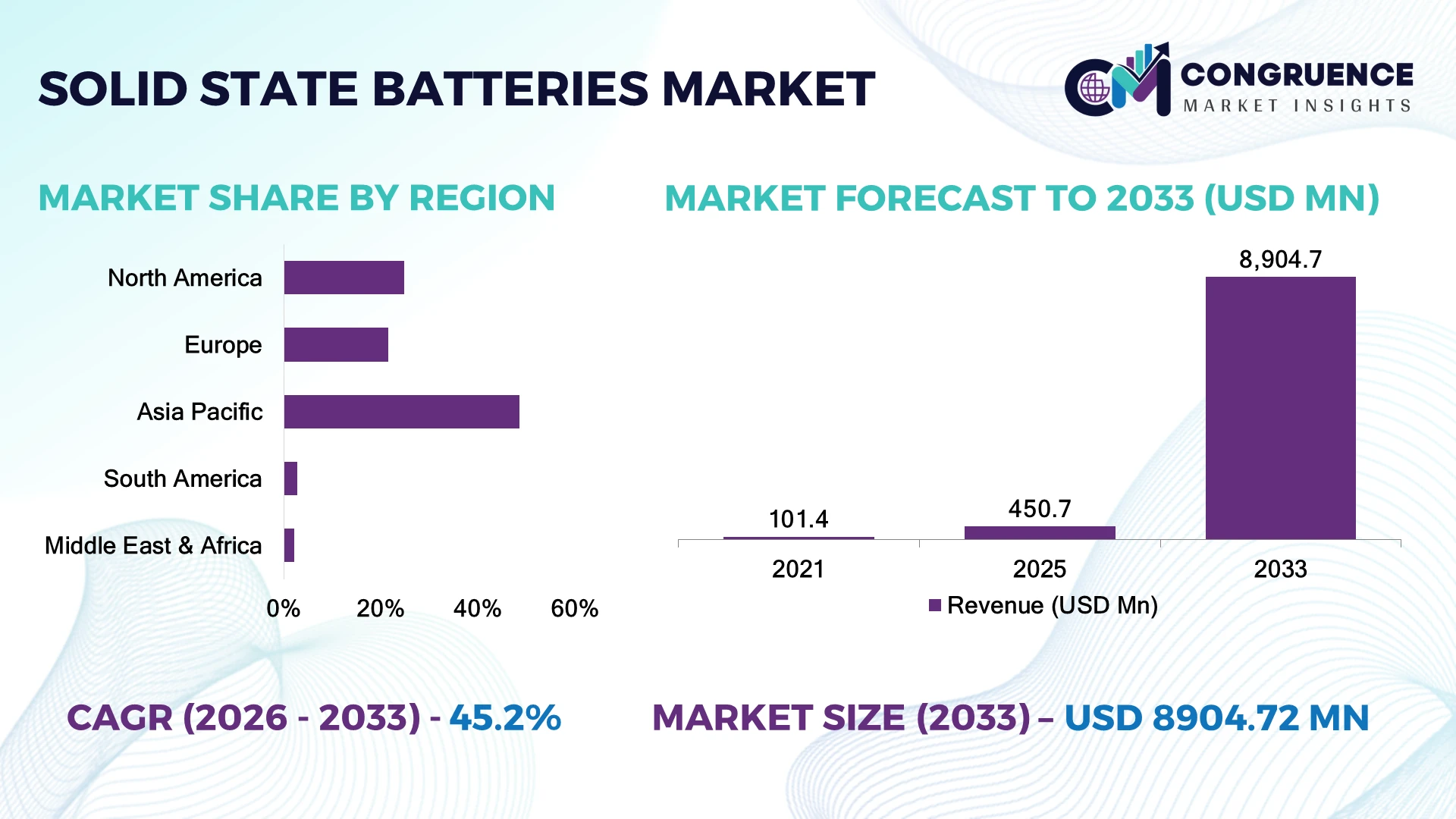
Japan remains the dominant country, accounting for approximately 34% of global solid-state battery development capacity, supported by established battery manufacturers, advanced materials expertise, and long-term investments exceeding USD 6 billion in next-generation energy storage programs. Japanese companies continue leading patent activity and pilot-scale production, while China is expanding manufacturing capacity at a faster pace through aggressive industrial investment and localized supply chains. By 2026, more than 55% of announced automotive solid-state battery pilot projects are concentrated across Japan and China, reflecting intensified competition amid global supply-chain diversification beyond conventional lithium-ion ecosystems.
Strategically, companies securing advanced electrolyte technology, scalable manufacturing capability, and critical material partnerships will establish long-term competitive leadership as commercial production expands.
Market Size & Growth: Valued at USD 450.7 million in 2025 and projected to reach USD 8,904.7 million by 2033 at a CAGR of 45.2%, driven by EV electrification and advanced battery manufacturing.
Top Growth Drivers: Higher energy density (40%), charging time reduction (up to 60%), and improved battery safety through solid electrolytes.
Short-Term Forecast: By 2028, commercial production yields are expected to improve by nearly 30%, while manufacturing costs decline by approximately 20%.
Emerging Technologies: Sulfide-based electrolytes, oxide ceramics, AI-assisted battery design, and dry-electrode manufacturing are reshaping commercialization.
Regional Leaders: Asia-Pacific exceeds USD 4.3 billion, Europe approaches USD 2.2 billion, and North America surpasses USD 1.8 billion, supported by localized battery supply chains.
Consumer/End-User Trends: Nearly 68% of automotive battery investments target next-generation solid-state technologies for premium electric vehicles.
Pilot/Case Example: 2026 pilot production programs demonstrated over 35% improvement in energy density versus conventional lithium-ion batteries.
Competitive Landscape: Top five companies control approximately 66% of market activity, led by Toyota, QuantumScape, Solid Power, Samsung SDI, and ProLogium.
Regulatory & ESG Impact: Battery localization policies support over 40% of announced gigafactory investments while reducing dependence on imported components.
Investment & Funding: Global investments exceed USD 15 billion, driven by automotive partnerships, government incentives, and strategic manufacturing expansion.
Innovation & Future Outlook: Silicon-rich anodes, lithium-metal technologies, and scalable solid electrolyte production are becoming decisive competitive differentiators.
Solid-state batteries are rapidly becoming a strategic technology for premium electric vehicles, aerospace systems, medical devices, and advanced consumer electronics requiring higher energy density and improved operational safety. Nearly 45% of next-generation battery development programs now prioritize lithium-metal architectures, while manufacturing ecosystems increasingly emphasize localized material sourcing to strengthen supply resilience. These developments are redefining battery commercialization and setting the stage for broader strategic transformation.
Solid-state batteries are becoming strategically important as governments and manufacturers accelerate the transition toward high-performance electrification while reducing dependence on conventional lithium-ion technologies. Supply-chain restructuring across North America, Europe, and Asia is encouraging localized production of battery materials, advanced electrolytes, and lithium-metal components. Automotive manufacturers are increasingly aligning long-term procurement strategies with next-generation battery developers to strengthen technology leadership and supply security.
Compared with conventional lithium-ion batteries, solid-state designs deliver approximately 35–50% higher energy density while reducing charging time by nearly 40% under optimized operating conditions. Japan continues leading commercialization through advanced material innovation and pilot manufacturing, whereas China is rapidly expanding industrial-scale production capacity supported by integrated battery manufacturing ecosystems. Over the next two to three years, commercial demonstration programs are expected to shift toward higher-volume automotive deployment as production yields continue improving.
Automotive manufacturers are expanding joint ventures with battery technology companies to accelerate industrialization, while aerospace and defense sectors are adopting solid-state batteries for applications requiring superior thermal stability and operational reliability. Companies investing in scalable manufacturing, electrolyte innovation, and vertically integrated supply chains will strengthen competitive positioning as the industry transitions from pilot production toward commercial deployment, establishing durable advantages in the global advanced battery ecosystem.
The transition toward long-range electric vehicles is accelerating investment in solid-state battery commercialization as automakers seek higher energy density, improved safety, and faster charging performance. Solid-state batteries deliver approximately 40% higher energy density and reduce charging time by nearly 50% compared with conventional lithium-ion technologies. By 2026, more than 60% of leading automotive OEMs have expanded pilot or joint-development programs for solid-state battery integration. Japan's battery innovation initiatives and the United States' battery localization policies are reinforcing domestic manufacturing capabilities. These developments are driving strategic partnerships between automakers, battery developers, and material suppliers, while companies continue investing in pilot production, lithium-metal technologies, and scalable electrolyte manufacturing to secure long-term competitive positioning.
Commercial deployment remains constrained by limited high-volume manufacturing capacity, expensive solid electrolyte materials, and complex production processes. Current pilot manufacturing costs remain approximately 45% higher than conventional lithium-ion battery production, while manufacturing yields are typically 25% lower during early commercialization. Germany and South Korea continue expanding advanced battery manufacturing infrastructure, yet production equipment and specialized material supply remain concentrated among relatively few industrial suppliers. These structural constraints increase production costs and delay commercial scalability for automotive manufacturers. Companies are mitigating operational risk through localized electrolyte production, long-term material procurement agreements, strategic manufacturing partnerships, and investments in automated production systems to improve yield consistency and reduce unit costs.
Artificial intelligence and digital battery engineering are transforming material discovery, cell optimization, and manufacturing efficiency across the solid-state battery value chain. AI-assisted material screening reduces development cycles by approximately 35%, while digital manufacturing simulation improves production efficiency by nearly 22%. The United States is expanding battery innovation ecosystems through collaborations between technology companies, research institutions, and automotive manufacturers. Companies are investing in digital twin technologies, automated quality inspection, and advanced electrolyte research to accelerate commercialization. A significant strategic opportunity lies in licensing proprietary electrolyte formulations and manufacturing platforms, enabling technology providers to generate value beyond direct battery production while strengthening ecosystem partnerships.
Transitioning from pilot-scale manufacturing to stable mass production remains the industry's most significant long-term execution challenge. More than 55% of announced projects remain at demonstration or validation stages, while manufacturing defect rates during scale-up can exceed 18% before process optimization. Maintaining consistent solid electrolyte interfaces and lithium-metal stability across high-volume production requires specialized manufacturing expertise and precision equipment. Companies must strengthen workforce capabilities, automate inspection systems, and invest in advanced process control technologies to achieve commercial reliability. Strategic collaboration between equipment manufacturers, battery developers, and automotive OEMs will be essential to establish repeatable manufacturing standards and maintain competitiveness as global production capacity expands.
Dry Electrode Manufacturing Expands Dry-electrode production is gaining momentum as manufacturers reduce energy consumption by approximately 30% and shorten production cycles by nearly 20%. Equipment suppliers are redesigning manufacturing lines to eliminate solvent-intensive processes, improving operational efficiency while supporting localized battery manufacturing strategies in major automotive markets.
Lithium-Metal Integration Advances Battery developers are accelerating lithium-metal anode deployment, improving cell-level energy density by approximately 35% while reducing battery weight by nearly 18%. Growing demand for premium electric vehicles is encouraging strategic partnerships between automakers and battery innovators to accelerate validation and industrial-scale production of advanced cell architectures.
Localized Material Supply Strengthens Battery manufacturers are restructuring procurement strategies by expanding regional sourcing of solid electrolytes and specialty materials. Localized supply agreements have reduced expected logistics dependency by approximately 28% while improving inventory resilience by nearly 20%. This operational shift is enhancing production continuity amid evolving geopolitical trade conditions.
Automated Quality Inspection Grows Artificial intelligence and machine vision are increasingly deployed across battery manufacturing, reducing defect detection time by approximately 40% and improving production yield by nearly 16%. Manufacturers are integrating automated inspection platforms with real-time manufacturing analytics, enabling faster process optimization and improving consistency as pilot facilities transition toward commercial-scale production.
Asia-Pacific accounted for the largest market share at 48.6% in 2025 however, North America is expected to register the fastest growth, expanding at a CAGR of 47.1% between 2026 and 2033.
Advanced Battery Manufacturing Reshapes Regional Supply Chains
North America is strengthening its position through rapid expansion of domestic battery manufacturing, advanced materials innovation, and large-scale automotive electrification programs. The region benefits from strong collaboration between automotive OEMs, battery developers, and technology companies accelerating commercial validation of solid-state batteries. More than 35% of announced next-generation battery pilot facilities are under development across the United States and Canada, supported by localized supply-chain initiatives and manufacturing incentives. Battery manufacturers are expanding lithium-metal processing capabilities, automated production lines, and electrolyte research facilities to improve commercialization readiness. Enterprise investment increasingly focuses on vertically integrated battery ecosystems capable of reducing import dependency while improving production resilience for electric mobility and defense applications.
United States Market Outlook: The United States leads the regional market through its extensive battery innovation ecosystem, strong automotive manufacturing base, and growing network of pilot-scale production facilities. More than 40% of North America's announced solid-state battery manufacturing projects are concentrated within the country, supported by strategic partnerships between automotive OEMs, battery technology developers, and advanced material suppliers. Continued investment in localized battery supply chains and automated manufacturing technologies is strengthening commercial readiness and accelerating deployment across electric vehicles, aerospace, and defense industries.
Industrial Decarbonization Drives Battery Innovation
Europe is accelerating solid-state battery development through industrial decarbonization strategies, localized battery manufacturing, and coordinated investment in advanced energy storage technologies. Automotive manufacturers are strengthening partnerships with battery developers to secure regional supply while reducing dependence on imported battery components. Approximately 32% of new battery manufacturing investments are directed toward advanced cell technologies, supported by expanding pilot production facilities and specialized materials research. Companies are prioritizing sustainable manufacturing, recyclable battery materials, and integrated production ecosystems to strengthen long-term competitiveness across the European battery value chain.
Germany Market Outlook: Germany remains the leading market owing to its advanced automotive industry, battery engineering expertise, and established industrial infrastructure. Major automotive manufacturers continue investing in solid-state battery development alongside domestic production facilities and research partnerships. More than 45% of Europe's automotive-related solid-state battery pilot initiatives involve German manufacturers or technology partners, reinforcing the country's leadership in commercialization, manufacturing integration, and industrial-scale validation.
Manufacturing Scale Creates Competitive Advantage
Asia-Pacific dominates the global market through extensive battery manufacturing capacity, vertically integrated supply chains, and strong government-backed industrial investment. The region accounts for approximately 48.6% of global market activity, supported by established battery manufacturers and large-scale electric vehicle production. Nearly 60% of announced pilot manufacturing capacity for solid-state batteries is concentrated across Japan, China, and South Korea. Battery companies continue expanding electrolyte production, lithium-metal processing, and automated manufacturing systems to improve production efficiency while strengthening export competitiveness across global automotive and electronics industries.
Japan Market Outlook: Japan leads the regional market through decades of battery innovation, strong intellectual property portfolios, and advanced material science capabilities. The country continues to host many of the world's leading solid-state battery research and commercialization programs, with more than 55% of domestic automotive battery development projects incorporating solid-state technologies. Strategic collaboration between automotive manufacturers, chemical companies, and battery developers continues reinforcing Japan's leadership in advanced battery commercialization.
Electric Mobility Investment Supports Market Development
South America is gradually expanding solid-state battery adoption through growing electric mobility initiatives, modernization of energy infrastructure, and increasing investment in battery research partnerships. Brazil and Chile are strengthening their participation across the battery value chain through critical mineral resources and industrial collaboration. Approximately 18% of regional advanced battery projects are linked to electric mobility demonstration programs and localized energy storage initiatives. Although manufacturing infrastructure remains limited, governments and private enterprises are expanding partnerships with international battery technology companies to accelerate technology transfer and industrial capability development.
Brazil Market Outlook: Brazil represents the region's most significant market due to its expanding electric vehicle ecosystem, industrial manufacturing base, and growing investment in battery research. The country is leveraging domestic mineral resources while strengthening collaboration between automotive manufacturers, universities, and battery developers. Continued investment in advanced manufacturing infrastructure and localized battery supply chains is improving long-term readiness for commercial deployment of next-generation solid-state battery technologies.
Strategic Energy Diversification Expands Battery Deployment
The Middle East & Africa market is evolving through investments in clean energy infrastructure, grid modernization, and industrial diversification initiatives. Governments are increasingly supporting advanced battery technologies to strengthen renewable energy integration and long-duration energy storage capabilities. Approximately 20% of newly announced utility-scale battery initiatives across leading Gulf economies are evaluating next-generation battery technologies for future deployment. International technology partnerships and infrastructure investment continue improving regional readiness for advanced battery manufacturing and commercial energy storage applications.
Saudi Arabia Market Outlook: Saudi Arabia leads the regional market through large-scale industrial diversification programs, renewable energy investment, and advanced manufacturing initiatives. National strategies supporting electric mobility, clean energy infrastructure, and industrial localization are creating favorable conditions for solid-state battery deployment. Continued expansion of research partnerships, technology transfer agreements, and advanced industrial zones is positioning the country as the leading regional hub for future battery manufacturing and high-performance energy storage solutions.
Global technology leaders including Toyota, QuantumScape, Solid Power, ProLogium, and Factorial Energy compete directly with integrated battery manufacturers and automotive OEM-backed developers, while Chinese battery producers challenge innovation-focused firms through manufacturing scale and cost efficiency. The top five participants collectively account for approximately 66% of industry activity. Competition centers on energy density, production scalability, charging performance, and manufacturing yield rather than pricing alone. Advanced solid-state cells improve energy density by nearly 35%, automated manufacturing increases production efficiency by approximately 20%, and localized supply chains reduce logistics exposure by almost 25%. Companies are expanding pilot facilities, forming strategic automotive partnerships, vertically integrating electrolyte production, and accelerating lithium-metal innovation. Competitive advantage is shifting from laboratory breakthroughs toward industrial-scale manufacturing and validated automotive deployment. High capital requirements, proprietary electrolyte technologies, and complex qualification processes create substantial entry barriers. Winning requires scalable manufacturing, proven automotive partnerships, protected intellectual property, and consistent high-yield production instead of isolated technological breakthroughs.
Toyota Motor Corporation
QuantumScape Corporation
Solid Power, Inc.
ProLogium Technology Co., Ltd.
Factorial Energy
SES AI Corporation
Blue Solutions
Ilika plc
Ion Storage Systems
Cymbet Corporation
Ampcera Inc.
StoreDot Ltd.
Current technology development focuses on sulfide-based electrolytes, lithium-metal anodes, and automated dry-electrode manufacturing that improve battery safety and energy density while supporting commercial-scale production. Sulfide electrolytes enhance ionic conductivity, increasing cell performance by approximately 30%, while automated manufacturing reduces production energy consumption by nearly 25%. More than 60% of advanced automotive battery development programs now prioritize solid-state architectures, reflecting growing confidence in commercial deployment. These technologies improve operational reliability and strengthen competitive positioning for manufacturers capable of industrial-scale production.
Emerging innovations include AI-assisted material discovery, composite solid electrolytes, digital manufacturing twins, and advanced interface engineering. Compared with conventional lithium-ion batteries, next-generation solid-state cells deliver approximately 40% higher energy density while reducing charging time by nearly 50%. Automotive manufacturers and technology innovators such as Toyota, QuantumScape, ProLogium, and Factorial Energy benefit most because they combine proprietary cell chemistry with integrated manufacturing strategies and long-term OEM collaborations.
Between 2026 and 2028, commercial differentiation will increasingly depend on scalable electrolyte manufacturing, automated quality inspection, and high-yield lithium-metal production. Manufacturing digitization is expected to improve production consistency by approximately 20%, while automated defect detection can reduce quality deviations by nearly 18%. Companies investing now in integrated production ecosystems, proprietary materials, and industrial partnerships will establish durable advantages as commercial validation transitions into high-volume manufacturing and automotive deployment.
April 2025 Factorial Energy and Stellantis successfully validated 77Ah automotive solid-state battery cells delivering 375 Wh/kg energy density with charging from 15% to 90% in 18 minutes, advancing demonstration fleet deployment planned for 2026. Source: Stellantis
July 2025 ProLogium introduced its fourth-generation Superfluidized Inorganic Solid-State Electrolyte, designed to improve ionic conductivity, manufacturing efficiency, and interfacial stability while eliminating pressurized battery module requirements, strengthening commercialization readiness for next-generation electric vehicles. Source: ProLogium
June 2026 ProLogium signed a memorandum of understanding with OPmobility to jointly develop solid-state battery modules and packs for electric vehicles, expanding collaboration from cell technology to complete battery systems targeting future OEM deployment. Source: ProLogium
June 2026 Stellantis integrated Factorial Energy's FEST solid-state battery technology into a Dodge Charger Daytona development vehicle, launching real-world road testing to validate performance, safety, and reliability before commercial automotive deployment. Source: PR Newswire
The report provides comprehensive analysis of the Solid State Batteries market across sulfide-, oxide-, and polymer-based battery technologies, covering applications including electric vehicles, consumer electronics, energy storage systems, aerospace, medical devices, and industrial equipment. End-user evaluation spans automotive manufacturers, electronics companies, utilities, aerospace organizations, and industrial enterprises across North America, Europe, Asia-Pacific, South America, and the Middle East & Africa. The assessment includes technology adoption patterns, manufacturing deployment, competitive participation, and commercialization trends across more than 60% of announced pilot production initiatives.
The study evaluates lithium-metal anodes, advanced solid electrolytes, dry-electrode manufacturing, AI-assisted battery development, and automated production technologies while assessing supply-chain evolution and industrial-scale manufacturing readiness. Strategic intelligence supports investment prioritization, partnership evaluation, manufacturing expansion, technology benchmarking, and competitive positioning between 2026 and 2033. The report also examines deployment trends, enterprise procurement strategies, regional manufacturing ecosystems, and emerging niche opportunities shaping the commercialization of next-generation solid-state battery technologies.
| Report Attribute/Metric | Report Details |
|---|---|
|
Market Revenue in 2025 |
USD 450.7 Million |
|
Market Revenue in 2033 |
USD 8,904.7 Million |
|
CAGR (2026 - 2033) |
45.2% |
|
Base Year |
2025 |
|
Forecast Period |
2026 - 2033 |
|
Historic Period |
2021 - 2025 |
|
Segments Covered |
By Type
By Application
By End-User
|
|
Key Report Deliverable |
Revenue Forecast, Growth Trends, Market Dynamics, Segmental Overview, Regional and Country-wise Analysis, Competition Landscape |
|
Region Covered |
North America, Europe, Asia-Pacific, South America, Middle East, Africa |
|
Key Players Analyzed |
Toyota Motor Corporation, QuantumScape Corporation, Solid Power, Inc., ProLogium Technology Co., Ltd., Factorial Energy, SES AI Corporation, Blue Solutions, Ilika plc, Ion Storage Systems, Cymbet Corporation, Ampcera Inc., StoreDot Ltd. |
|
Customization & Pricing |
Available on Request (10% Customization is Free) |




