
Reports
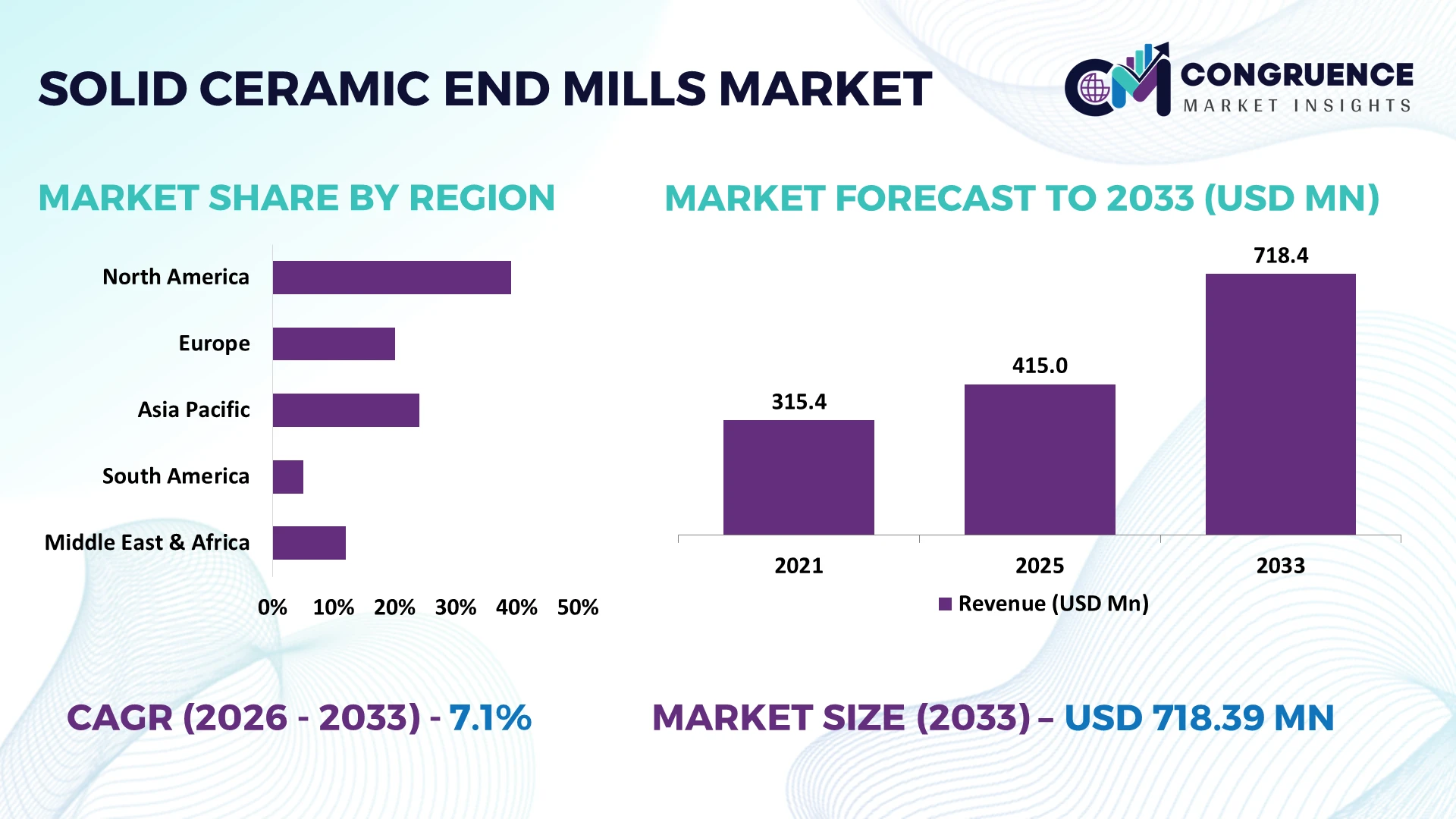
The Global Solid Ceramic End Mills Market was valued at USD 415 Million in 2025 and is anticipated to reach a value of USD 718.39 Million by 2033 expanding at a CAGR of 7.1% between 2026 and 2033. Growth is being driven by high-speed rough milling of nickel-based heat-resistant superalloys, where advanced SiAlON ceramic end mills operate at cutting speeds approaching 600 m/min and deliver substantially higher material-removal productivity than conventional carbide tooling.
China is the strongest manufacturing-demand anchor: it accounted for about 33% of global machine-tool production value in 2024, versus roughly 9% for Japan, while its 2024–2025 equipment-renewal program supported more than RMB 1.8 trillion in total investment. Aerospace, automotive, energy, and precision engineering benefit directly; by 2027, policy targets over 75% numerical-control penetration in key industrial processes, reinforcing high-speed ceramic tooling adoption. Japan provides a useful demand comparison: 2024 machine-tool orders from aircraft, shipbuilding, and transportation machinery increased 20.1%, while automotive orders declined 9.5%, confirming a shift toward high-value aerospace machining. Global production decentralization amid geopolitical and supply-chain uncertainty further strengthens demand for localized, productive cutting-tool systems.
Strategically, suppliers positioned around aerospace-grade SiAlON materials, application engineering, and digitally controlled high-speed machining will capture the strongest specification-driven opportunities as manufacturers prioritize throughput over conventional tool-cost comparisons.
Market Size & Growth: USD 415 million in 2025 reaches USD 718.39 million by 2033 at 7.1%, supported by HRSA machining adoption.
Top Growth Drivers: China equipment investment +15.7%; Japan aircraft/transport machine-tool orders +20.1%; Asia foreign machine-tool orders +21.0%.
Short-Term Forecast: By 2027, China targets more than 75% numerical-control penetration across key industrial processes, accelerating advanced tooling deployment.
Emerging Technologies: SiAlON ceramics, variable-pitch geometry, dry high-speed milling, and CAM optimization push cutting speeds toward 600 m/min.
Regional Leaders: Indicative 2033 allocations equal North America USD 251.4 million, Asia-Pacific USD 215.5 million, and Europe USD 179.6 million using a published 35%/30%/25% regional benchmark.
Consumer/End-User Trends: Aerospace represented 40% in one 2023 market benchmark, reflecting concentrated demand around superalloy turbine and structural machining.
Pilot/Case Example: A 2021 SiAlON/TiN trial recorded 7.1-minute commercial tool life versus 5.0 minutes experimentally, a 42% advantage.
Competitive Landscape: Sandvik is estimated near 22% share; Mitsubishi Materials, Kennametal, OSG, and Greenleaf intensify high-speed ceramic competition.
Regulatory & ESG Impact: China’s 2027 program targets 25%+ higher equipment investment versus 2023 and over 90% digital-design-tool penetration.
Investment & Funding: Kennametal plans approximately USD 90 million fiscal-2026 capital spending as tooling producers prioritize automation, consolidation, and productivity.
Innovation & Future Outlook: Ceramic roughing delivers up to 10× carbide productivity in HRSA machining, shifting competitive value toward application engineering and digital process control.
Solid ceramic end mills are gaining traction in aerospace, power-generation, automotive, and precision engineering applications where nickel superalloys constrain carbide productivity. SiAlON grades, variable-pitch geometries, dry high-speed milling, and optimized toolpaths are advancing adoption, with ceramic systems delivering up to 10× carbide productivity in HRSA roughing. China’s equipment-renewal push and tighter tungsten supply conditions strengthen demand, framing the strategic discussion.
Solid ceramic end mills are becoming strategically important as aerospace, defense, energy, and high-performance manufacturing shift toward nickel-based superalloys that punish conventional carbide tooling. China’s industrial equipment-renewal program reinforces this transition: by 2027, equipment investment is targeted to rise more than 25% from 2023, while numerical control penetration in key processes exceeds 75%.
Technology economics provide the strongest competitive argument. Modern SiAlON ceramic end mills can rough heat-resistant superalloys at cutting speeds up to 600 m/min and achieve approximately 10 times the productivity of conventional carbide tools, reducing machining time per component despite higher application-engineering requirements. China combines manufacturing scale with rapid automation, while Japan shows concentrated high-value demand, with aircraft and transportation-related machine-tool orders rising 20.1% during 2024.
Through 2027–2028, manufacturers will increasingly connect ceramic tooling with high-speed CNC platforms, CAM optimization, tool-condition monitoring, and dry-machining strategies. A turbine-component producer replacing carbide roughing with ceramic tooling can increase material-removal throughput without adding equivalent spindle capacity. Toolmakers are therefore prioritizing application centers, aerospace partnerships, specialized geometries, and localized technical support. Competitive advantage will increasingly depend on selling validated machining productivity rather than individual cutting tools.
Aerospace-engine and energy-component production is the strongest structural driver because nickel-based superalloys require extreme material-removal productivity while resisting conventional cutting. Ceramic end mills can deliver machining speeds up to 10 times those of carbide, while Japanese aircraft and transportation-related machine-tool orders increased 20.1% during 2024. China is simultaneously targeting more than 75% numerical control penetration in key industrial processes and over 90% digital R&D-tool adoption by 2027. This combination shifts procurement from lowest tool price toward cost-per-component and spindle utilization. Toolmakers are responding with SiAlON grades, reinforced cutting geometries, application laboratories, and partnerships with CNC and CAM providers. The non-obvious advantage is capacity creation: faster roughing effectively increases factory output without proportional investment in additional machine tools.
Solid ceramic end mills remain constrained by a narrower operating window than carbide because ceramic materials favor high-speed, stable roughing conditions and are less tolerant of interrupted cuts, vibration, incorrect engagement, or underpowered machines. Japan illustrates this demand concentration: machine-tool orders from automotive manufacturers declined 9.5% in 2024 while aircraft and transportation-related orders increased 20.1%, creating sharply different tooling requirements across customer groups. China’s target of more than 75% CNC penetration also implies that roughly one-quarter of key processes can remain outside advanced numerical control even after modernization. This limits universal substitution. Suppliers are mitigating adoption barriers through application-specific geometries, optimized CAM parameters, operator training, and controlled field trials. Strategically, ceramic tooling wins where process stability is engineered first; indiscriminate replacement of carbide increases breakage risk and weakens customer economics.
Critical-mineral disruption creates an underappreciated opportunity for ceramic tooling because conventional cemented carbide depends heavily on tungsten. China represented approximately 82% of global mined tungsten production in 2024 and introduced export controls on selected tungsten products in February 2025; global tungsten prices subsequently rose sharply. Alternative supply remains limited: development of three modeled Uzbekistan deposits would raise global tungsten output by only about 2.7%. SiAlON ceramic end mills therefore offer aerospace and energy manufacturers both productivity improvement and partial exposure reduction to tungsten-linked tooling costs. The opportunity expands further when high-speed ceramic milling is integrated with adaptive CAM, digital twins, spindle monitoring, and automated toolpath optimization. Toolmakers are investing in R&D, localized application engineering, and OEM partnerships to position ceramic tooling as a strategic machining platform rather than a specialty consumable.
The long-term challenge is reproducing ceramic-tool productivity consistently across machines, operators, workpiece geometries, and factories. Cutting speeds approaching 600 m/min and productivity gains of up to 10 times carbide require rigid CNC platforms, stable workholding, controlled radial engagement, reliable spindle performance, and accurately programmed toolpaths. China’s industrial modernization target—over 90% digital R&D-tool penetration and more than 75% numerical control of key processes by 2027—shows how rapidly machining environments are digitalizing, but also highlights the integration burden facing less automated plants. Companies must connect tooling selection with CAM databases, process simulation, machine monitoring, and operator capability rather than treating the end mill independently. The critical competitive issue is repeatability: suppliers that convert laboratory-level ceramic performance into standardized production recipes will secure stronger customer retention and broader multi-site deployment.
Dry Machining Moves Mainstream: Ceramic end mills are increasingly deployed without conventional flood coolant in nickel-alloy roughing because ceramics retain cutting capability at extreme temperatures. High-speed applications reach approximately 600 m/min, while optimized ceramic processes deliver up to 10× carbide productivity. Manufacturers are redesigning toolpaths and chip evacuation around dry cutting, lowering coolant handling requirements and increasing spindle utilization.
Application Engineering Becomes Differentiator: Tool selection is shifting from catalogue-based purchasing toward workpiece-specific process validation. Aerospace manufacturers increasingly require cutting parameters optimized for Inconel 718 and similar heat-resistant alloys, where nickel can exceed 50% of alloy composition. Toolmakers are expanding technical centers, simulation support, and customer trials because a 20–30% change in radial engagement can materially alter ceramic-tool stability and usable life.
Geometry Optimization Accelerates Deployment: Variable-helix, multi-flute, corner-protected, and purpose-engineered ceramic geometries are replacing standardized designs in high-value machining. Five-axis machining centers can reduce multiple setups to 1–2 clamping operations, while optimized toolpaths maintain more consistent engagement through complex profiles. Suppliers are combining geometry development with CAM partnerships and digital cutting-data libraries, making process repeatability an increasingly important competitive differentiator.
Tooling Inventories Become More Strategic: Manufacturers are tightening management of critical cutting-tool inventories as geopolitical controls reshape tungsten availability and carbide input exposure. China accounted for roughly 82% of mined tungsten output in 2024 before imposing controls on selected tungsten exports in 2025. Aerospace and energy machine shops are consequently qualifying ceramic alternatives, dual-sourcing specialized tooling, and increasing application-specific inventory rather than relying exclusively on carbide platforms.
Square End Mills represent the leading type, with an estimated 38–42% share of solid ceramic end-mill demand, supported by extensive use in shoulder milling, face-related roughing, pocket machining, and high-volume material removal. Their comparatively straightforward geometry supports stable engagement and scalable production across aerospace and general manufacturing. Ball Nose End Mills account for an estimated 22–26%, with demand concentrated in three-dimensional surfaces and complex component geometries. Manufacturers are expanding flute optimization and ceramic-grade portfolios to improve cutting stability at elevated spindle speeds.
Corner Radius End Mills are the fastest-growing type, supported by stronger edge integrity when machining difficult nickel alloys and by increasing use in aerospace components requiring transitions between aggressive roughing and controlled profiling. Their share is estimated near 18–22%. Tapered End Mills remain more specialized at approximately 10–14%, serving deep cavities, angled walls, and mold-related geometries. Investment priorities are therefore moving toward reinforced corner designs and application-specific geometries rather than broad commodity portfolios, giving suppliers with strong process-engineering capability a commercial advantage.
Milling remains the largest application, representing an estimated 40–44% of solid ceramic end-mill usage because the technology’s primary economic advantage appears during high-speed removal of heat-resistant superalloys. Ceramic milling can operate at cutting speeds approaching 600 m/min in suitable nickel-alloy applications, allowing manufacturers to compress roughing cycles and release machine capacity. Profiling follows at approximately 20–24%, benefiting from five-axis machining and increasingly sophisticated toolpaths that maintain controlled cutter engagement across aerospace components.
Contouring is the fastest-growing application, estimated at 14–18% of demand, as turbine, impeller, and complex structural components require simultaneous multi-axis movement and more consistent surface generation. Slotting retains a narrower 8–12% position because full-width engagement creates demanding thermal and mechanical conditions for brittle ceramic substrates. Finishing contributes roughly 10–14%, with carbide and other tooling materials remaining competitive where surface integrity outweighs removal rate. Suppliers are responding by integrating cutting-data libraries, CAM recommendations, variable geometries, and application engineering, shifting competitive differentiation from tool supply toward validated machining processes.
Aerospace is the dominant end-user, accounting for an estimated 40–45% of solid ceramic end-mill consumption because turbine engines, hot-section components, and structural systems contain difficult-to-machine nickel superalloys. Global airline traffic measured in revenue passenger kilometres increased 5.3% during 2025, sustaining aircraft production and aftermarket pressure across major manufacturing hubs. Automotive represents approximately 17–21%, primarily through performance components, tooling, and specialized high-temperature applications rather than broad vehicle-part machining.
Energy-related work captured within General Manufacturing is emerging as the fastest-growing buying area as turbine, power-generation, and advanced industrial equipment producers increase machining of heat-resistant alloys. General Manufacturing represents approximately 16–20%, while Mold & Die and Medical Devices collectively account for roughly 15–20%. Medical demand favors precision and repeatability, whereas mold producers prioritize complex profiling and finishing flexibility. Toolmakers are therefore targeting aerospace through application partnerships and customized SiAlON solutions while offering narrower geometry portfolios to medical and mold customers. Competitive investment is concentrating where expensive machine capacity makes higher material-removal productivity economically decisive.
North America accounted for the largest market share at approximately 35% in 2025 however, Asia-Pacific is expected to register the fastest growth, expanding at a CAGR of approximately 8.4% between 2026 and 2033.

Aerospace Machining Drives Premium Tooling Adoption
North America represents approximately 35% of global solid ceramic end-mill demand, led by high-value aerospace, defense, power-generation, and precision-machining applications. The United States provides the strongest operational base, where manufacturing-technology orders increased 22.5% in 2025 and contract machine-shop orders rose 19%. Aerospace machinery investment increased 45%, strengthening the installed base capable of exploiting high-speed SiAlON tooling. Ceramic end mills are increasingly integrated with five-axis machining, CAM optimization, and dry HRSA roughing to release constrained spindle capacity. Canada contributes through aerospace clusters in Québec and Ontario, while Mexico supports automotive and expanding aerospace supply chains. Suppliers are responding by strengthening application engineering, localized inventory, and customer validation programs because North American buyers increasingly evaluate ceramic tools on cycle-time reduction and cost per component rather than purchase price.
United States Market Outlook: U.S. demand is moving further toward sophisticated machining assets: during January–February 2026, aerospace-equipment manufacturers’ machine-tool order value surged 233% year-on-year, while ordered machine units increased 125%. This capital intensity creates a favorable operating environment for ceramic tooling capable of exploiting high spindle speeds. Tool suppliers are consequently prioritizing aerospace qualification, field engineering, and production-ready machining parameters.
Precision Manufacturing Shifts Toward Automation
Europe accounts for an estimated 25% of global solid ceramic end-mill demand, anchored by Germany, Italy, France, the United Kingdom, and Central European precision-manufacturing clusters. Aerospace, defense, medical technology, turbines, and advanced mechanical engineering increasingly offset weaker automotive tooling activity. In 2025, German machine-tool domestic orders fell 16%, but international orders increased 3%; by the fourth quarter, overall orders had returned to 4% growth. The divergence is accelerating supplier emphasis on automation, digitalization, retrofitting, and specialized machining rather than standardized automotive tooling. Ceramic end mills fit this transition where nickel-based alloys require high thermal resistance and rapid roughing. European producers and distributors are combining cutting tools with process simulation, digital machining data, and technical support, while localized supply networks become more important amid tariff uncertainty and changing industrial partnerships.
Germany Market Outlook: Germany remains the strategic technology center because of its dense machine-tool, aerospace, defense, medical, and precision-engineering ecosystem. Although its global machine-tool consumption share stood near 5.7% in 2025, defense and aviation customers continued investing while automotive remained weak. This mix favors high-performance ceramic tools designed for difficult alloys, automated machining cells, and tightly controlled production processes.
Manufacturing Scale Meets High-Speed Modernization
Asia-Pacific holds approximately 30% of global solid ceramic end-mill demand and combines unmatched manufacturing scale with rapidly improving CNC capability. China alone represented approximately 32% of worldwide machine-tool consumption in 2025, while its machine-tool exports increased 13%, overtaking Germany globally. Japan contributes advanced cutting-tool engineering and aerospace manufacturing, while South Korea adds precision demand from machinery, energy, and high-technology production. India is emerging as an additional consumption center as aerospace, defense localization, and industrial-capital investment deepen. This scale encourages faster qualification of ceramic tools for high-speed nickel-alloy roughing, especially where factories need higher output from existing machining centers. Suppliers are localizing application support, extending SiAlON portfolios, and integrating tooling recommendations with CAM workflows. The competitive shift increasingly favors companies able to combine material science with locally available technical service.
China Market Outlook: China has the strongest scale advantage, accounting for almost 34% of worldwide machinery production in 2025 and approximately one-third of global machine-tool consumption. Its designation of machine tools as critical core technology reinforces domestic CNC modernization. Ceramic-tool suppliers therefore face both substantial demand and intensifying local competition, making technical differentiation, localized production, and application partnerships increasingly important.
Aerospace Concentration Shapes Premium Demand
South America represents approximately 5% of global solid ceramic end-mill demand, with Brazil accounting for the clear majority of high-performance machining activity. Demand centers on aerospace, automotive, energy equipment, mold and die, and contract precision machining rather than broad-based ceramic-tool deployment. Brazil’s aerospace manufacturing base creates an unusually high-value niche: Embraer delivered 91 aircraft during the fourth quarter of 2025, compared with 75 one year earlier, a 21% increase. This production intensity supports advanced five-axis machining and difficult-alloy tooling requirements. Argentina and other markets remain smaller because advanced CNC infrastructure and specialized application support are less extensive. Suppliers are therefore concentrating technical resources around Brazilian industrial clusters, using distributor partnerships and targeted application trials rather than large-scale regional expansion. Imported-tool dependence also makes inventory availability and technical service critical purchasing factors.
Brazil Market Outlook: Brazil combines aircraft manufacturing, automotive production, oilfield equipment, and established precision-machining expertise. Embraer delivered 78 commercial jets during 2025, creating recurring requirements across component and supplier networks. Ceramic-tool vendors can capture higher-value applications by supporting local machining trials, operator training, and HRSA process optimization rather than competing primarily through catalogue breadth or low pricing.
Industrial Localization Creates New Tooling Nodes
Middle East & Africa represents approximately 5% of global solid ceramic end-mill demand, but industrial localization is creating concentrated opportunities in Saudi Arabia, the UAE, Türkiye, and South Africa. Aerospace maintenance, defense production, energy equipment, and precision engineering form the most relevant addressable applications. Saudi Arabia’s 2025 introduction of dedicated industrial licenses for aircraft and drone maintenance, navigation systems, and comprehensive overhaul strengthens the local machining ecosystem. In February 2026, the National Industrial Development Center and Airbus also agreed to explore an integrated Saudi aviation industrial base covering manufacturing, assembly, maintenance, engineering, and logistics. These initiatives progressively expand requirements for sophisticated CNC tooling and difficult-material machining. Suppliers are entering through technical distributors, OEM relationships, training programs, and localized inventories rather than standalone manufacturing plants, reflecting the region’s still-developing specialist machining capabilities.
Saudi Arabia Market Outlook: Saudi Arabia provides the strongest structural opportunity because aviation localization is being linked directly with technology transfer, engineering capability, supplier investment, and workforce development. The Airbus cooperation framework extends across manufacturing, assembly and MRO, broadening the potential user base for advanced ceramic tooling. Vendors that establish application engineering early can influence tool qualification as new production processes are standardized.
Sandvik, Mitsubishi Materials, Greenleaf Corporation, Kennametal, and NTK compete for premium solid ceramic end-mill applications, while OSG, ISCAR, and TaeguTec challenge through specialized geometries and established machining networks. The top five are estimated to control approximately 55–60% of global demand, creating a moderately concentrated technology-led structure. Competition centers on material-removal productivity, tool life, application support, and HRSA process reliability rather than price alone. Leading ceramic systems deliver up to 10× carbide productivity, while newer ceramic-tip hybrid designs demonstrate up to 50% longer tool life and 90% cycle-time reductions in validated applications. Players are expanding SiAlON portfolios, application centers, CAM support, and aerospace partnerships while hybrid ceramic-carbide architectures disrupt conventional solid-tool positioning. Ceramic formulation expertise, precision grinding, customer qualification cycles, and high-speed machining know-how remain formidable entry barriers. Winning requires repeatable productivity at customer machines, localized engineering support, dependable supply, and demonstrably lower cost per finished component.
Mitsubishi Materials Corporation
Greenleaf Corporation
Sandvik AB
OSG Corporation
Kennametal Inc.
ISCAR Ltd.
NTK Cutting Tools
TaeguTec Ltd.
OPT Cutting Tools
RocCera
CeramTec GmbH
Fullanti
SiAlON-based solid ceramic end mills are the current productivity benchmark for roughing nickel-based heat-resistant superalloys. High-temperature hardness permits cutting near 600–1,000 m/min, while optimized flute geometries improve material-removal efficiency by roughly 50–90% in suitable aerospace operations. Deployment remains concentrated in advanced five-axis machining centers, with adoption strongest in turbine, blisk, combustion-casing, and energy-component production where stable dry cutting provides measurable spindle-capacity advantages.
Emerging technology is shifting toward brazed ceramic tips, carbide shanks, unequal flute spacing, reinforced corner radii, and digitally optimized toolpaths. Hybrid ceramic-carbide designs have demonstrated up to 50% longer tool life and around 70% lower cost per part than conventional carbide in validated applications. Compared with legacy solid-carbide end mills, modern ceramic systems can reduce cycle time by as much as 90%, turning expensive machine availability into a competitive differentiator for aerospace suppliers.
Disruptive integration will increasingly combine ceramic tooling with CAM databases, digital twins, spindle monitoring, and adaptive machining between 2026 and 2028. Adoption should broaden from specialist aerospace cells into power-generation and advanced contract machining as process recipes become standardized. Suppliers with application engineering, localized trials, and machine-tool partnerships benefit most; acting now secures qualification experience before ceramic workflows become embedded in next-generation automated production globally.
April 2025 – TaeguTec expanded CERAMIC-SFEED with brazed ceramic end mills and MAXI-RUSH heads for HRSA machining, supporting cutting speeds above 700 m/min. The expansion improves vibration resistance and application flexibility for nickel-alloy roughing and supports deeper machining. Source: TaeguTec
July 2025 – Greenleaf Corporation launched Capstone-360 ceramic-tip end mills with carbide shanks for HRSAs, reporting up to 90% cycle-time reduction and 70% lower cost per part. The hybrid architecture broadens ceramic milling economics across aerospace applications worldwide. Source: Greenleaf
June 2026 – NTK Cutting Tools highlighted CERAMATIC Brazed technology for deep HRSA machining, using ceramic cutting edges with carbide shanks and achieving machining efficiency up to 15 times carbide. The design reduces breakage risk during extended-overhang operations. Source: Fujisan
July 2026 – Sandvik Coromant highlighted CoroMill 316 brazed ceramic exchangeable-head milling for aerospace engines, with ceramic technology delivering 20–30 times carbide machining speed. Four- and six-flute geometries expand face and side-milling productivity in nickel-based alloys at scale. Source: MMIndia
The report evaluates the Solid Ceramic End Mills Market across Square End Mills, Ball Nose End Mills, Corner Radius End Mills, and Tapered End Mills, covering Milling, Slotting, Profiling, Contouring, and Finishing applications. End-user analysis spans Aerospace, Automotive, Medical Devices, Mold & Die, and General Manufacturing, with aerospace representing the strongest concentration of high-speed HRSA machining demand.
Regional coverage includes North America, Europe, Asia-Pacific, South America, and Middle East & Africa, alongside country-level manufacturing and deployment dynamics. The study assesses SiAlON ceramics, brazed ceramic-carbide architectures, dry machining, advanced flute geometries, five-axis integration, CAM optimization, and digital process monitoring. It also evaluates competitive positioning, supply-chain exposure, technology qualification, and emerging applications in turbine, energy, and precision machining. These insights support investment planning, capacity expansion, partnership strategy, product development, and competitive decisions across the 2026–2033 planning horizon.
| Report Attribute/Metric | Report Details |
|---|---|
Market Revenue in 2025 | USD 415 Million |
Market Revenue in 2033 | USD 718.39 Million |
CAGR (2026 - 2033) | 7.1% |
Base Year | 2025 |
Forecast Period | 2026 - 2033 |
Historic Period | 2021 - 2025 |
Segments Covered | By Type
By Application
By End-User
|
Key Report Deliverable | Revenue Forecast, Growth Trends, Market Dynamics, Segmental Overview, Regional and Country-wise Analysis, Competition Landscape |
Region Covered | North America, Europe, Asia-Pacific, South America, Middle East, Africa |
Key Players Analyzed | Mitsubishi Materials Corporation, Greenleaf Corporation, Sandvik AB, OSG Corporation, Kennametal Inc., ISCAR Ltd., NTK Cutting Tools, TaeguTec Ltd., OPT Cutting Tools, RocCera, CeramTec GmbH, Fullanti |
Customization & Pricing | Available on Request (10% Customization is Free) |




