
Reports
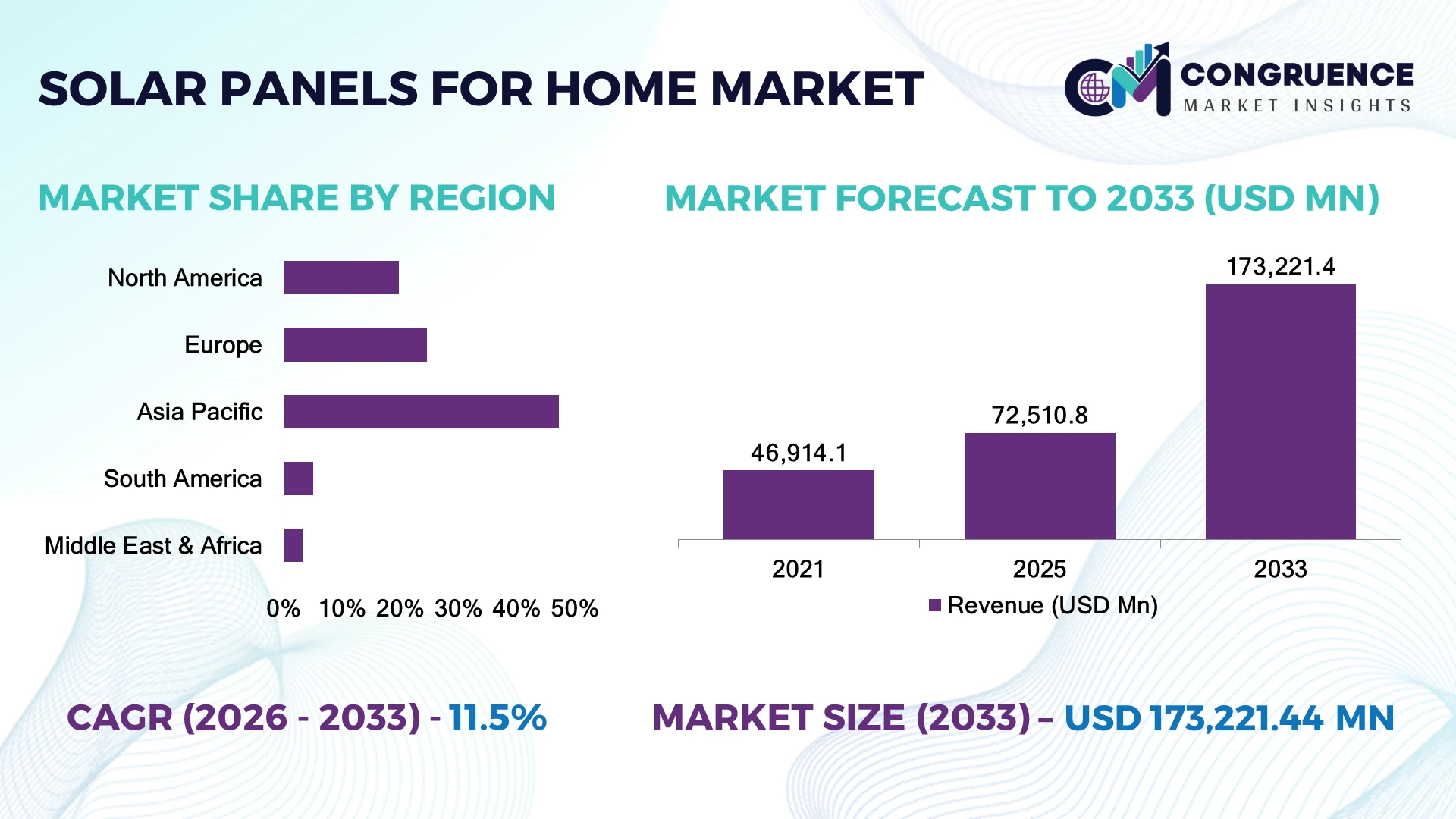
The Global Solar Panels for Home Market was valued at USD 72,510.8 Million in 2025 and is anticipated to reach a value of USD 173,221.4 Million by 2033 expanding at a CAGR of 11.5% between 2026 and 2033. Residential electrification, declining module costs, rooftop energy storage integration, and government-backed net-metering programs are accelerating home solar installations across developed and emerging economies.
China remains the dominant country, accounting for approximately 36% of global residential solar manufacturing capacity while continuing large-scale investments in high-efficiency TOPCon and HJT cell production. Residential rooftop installations exceed 28 GW annually, supported by advanced domestic manufacturing and integrated supply chains. In comparison, the United States leads residential financing innovation, while Germany records rooftop solar penetration above 22% of eligible households. Ongoing global supply-chain diversification following geopolitical trade realignments continues strengthening manufacturing resilience and localized deployment strategies.
Companies prioritizing integrated rooftop solar ecosystems, localized manufacturing, and intelligent energy management platforms will secure stronger long-term competitive positioning.
Market Size & Growth: USD 72,510.8 Million (2025) to USD 173,221.4 Million (2033), CAGR 11.5%, driven by rooftop solar and battery integration.
Top Growth Drivers: Rooftop adoption +24%, module efficiency +18%, residential storage demand +31%.
Short-Term Forecast: By 2028, installation time falls 20% through standardized mounting systems.
Emerging Technologies: TOPCon, HJT, AI-enabled energy optimization improve output by 6–10%.
Regional Leaders: Asia-Pacific leads, North America accelerates, Europe expands residential energy independence.
Consumer/End-User Trends: More than 48% of new homeowners evaluate solar-ready installations.
Pilot/Case Example: 2026 smart-home deployments reduce household grid consumption by nearly 35%.
Competitive Landscape: Top five suppliers control approximately 44% through technology and integrated offerings.
Regulatory & ESG Impact: Incentive programs improve rooftop adoption by approximately 27% across priority markets.
Investment & Funding: More than USD 18 Billion supports residential manufacturing expansion and localized supply chains.
Innovation & Future Outlook: Smart inverters, bidirectional energy management, and home storage redefine residential energy ecosystems.
The Solar Panels for Home Market is expanding through rising demand for energy independence, integrated rooftop storage, and intelligent household energy management. High-efficiency TOPCon and heterojunction modules continue improving residential performance, while nearly 40% of new premium installations include battery storage. Supply-chain localization and residential electrification policies are accelerating deployment, setting the foundation for broader strategic market transformation.
Residential solar has evolved into a strategic infrastructure investment as homeowners seek long-term energy cost stability, grid resilience, and greater energy independence. Market competition increasingly revolves around integrated solutions combining photovoltaic modules, battery storage, smart inverters, and energy management software rather than standalone panel sales. Supply-chain diversification and domestic manufacturing incentives are reshaping procurement strategies while strengthening installation capacity across major economies.
Modern TOPCon panels deliver approximately 3–5% higher energy yield than conventional PERC modules while maintaining improved temperature performance. North America emphasizes financing innovation and integrated storage adoption, whereas Asia-Pacific maintains manufacturing leadership through large-scale production efficiency. More than 45% of premium residential installations now include intelligent monitoring platforms, allowing homeowners to optimize self-consumption and reduce grid dependence.
Companies increasingly partner with battery manufacturers, installers, and smart-home technology providers to deliver complete residential energy ecosystems. For example, integrated rooftop solar with battery storage enables households to maintain critical loads during grid disruptions while maximizing renewable energy utilization. Over the next two to three years, businesses combining localized manufacturing, digital energy management, and high-efficiency module technology will establish stronger competitive differentiation and long-term operational advantage.
Rising household electrification and the pursuit of long-term energy security are reshaping residential solar investment priorities. More than 52% of new rooftop installations are now paired with battery-ready systems, while high-efficiency TOPCon modules improve residential energy output by approximately 4–6% over conventional alternatives. The United States continues expanding domestic clean-energy manufacturing incentives, and India's PM Surya Ghar rooftop initiative is accelerating household deployment, strengthening localized supply chains. This policy-driven demand increases installation volumes, reduces dependence on retail electricity, and improves installer utilization. In response, manufacturers are expanding module production, partnering with battery suppliers, and investing in smart energy management platforms. A key strategic shift is the transition from selling standalone panels to delivering integrated residential energy ecosystems with long-term service contracts.
Residential solar deployment continues to face structural barriers from grid interconnection delays, transformer capacity limitations, and fluctuating prices for polysilicon, silver paste, and electrical components. In several mature markets, grid connection approvals account for nearly 25% of total project timelines, while balance-of-system components represent approximately 38% of installation costs. Europe has also experienced periodic permitting delays that slow rooftop commissioning despite strong consumer demand. These factors reduce installer productivity, compress project margins, and extend homeowner payback periods. Companies are responding by localizing component sourcing, securing multi-year procurement contracts, and introducing standardized installation kits that reduce dependence on imported hardware. Faster permitting support and optimized procurement strategies increasingly determine operational competitiveness.
The strongest opportunity lies in integrating rooftop solar with residential batteries, AI-based energy optimization, vehicle charging, and virtual power plant participation. Nearly 45% of premium residential installations are expected to include intelligent energy management platforms, while bidirectional EV charging can increase household energy utilization efficiency by approximately 18%. Japan and Australia continue expanding distributed energy programs that reward residential grid participation. Companies are positioning through software partnerships, smart inverter development, and integrated subscription-based energy services. An emerging strategic opportunity extends beyond electricity generation toward household energy orchestration, allowing installers to create recurring service revenues while improving customer retention through connected energy ecosystems.
Long-term market expansion depends on overcoming skilled labor shortages, digital interoperability challenges, and increasingly complex residential energy architectures. More than 35% of installation firms report shortages of certified technicians, while integrated solar-storage-smart home systems require up to 30% more commissioning effort than conventional rooftop installations. Australia's rapid distributed generation growth has highlighted the need for advanced grid coordination and standardized communication protocols. Inconsistent software compatibility, cybersecurity protection, and installer training directly influence long-term system reliability. Companies must invest in workforce certification, cloud-based monitoring platforms, cybersecurity frameworks, and interoperable hardware partnerships. Organizations capable of simplifying installation while maintaining intelligent system integration will secure stronger competitive differentiation.
Smart Storage Integration Expands Residential installations increasingly combine rooftop solar with battery systems, with storage attachment rates exceeding 45% in premium projects and self-consumption improving by nearly 30%. Growing electricity price volatility drives adoption, prompting manufacturers to bundle intelligent storage, monitoring platforms, and energy optimization software into complete residential solutions.
High-Efficiency Cells Dominate TOPCon and heterojunction technologies continue replacing conventional PERC modules, delivering 4–6% higher energy yield while reducing degradation rates. Manufacturers are expanding automated production lines and accelerating next-generation cell deployment to strengthen product differentiation as homeowners increasingly prioritize lifetime energy generation over initial purchase cost.
Digital Installation Workflows Grow AI-assisted design software, drone-assisted rooftop surveys, and automated permitting reduce engineering time by approximately 35% and installation planning errors by nearly 20%. Installers are investing in cloud-based project management platforms that accelerate customer onboarding, improve scheduling accuracy, and shorten project completion cycles despite labor shortages.
Localized Manufacturing Accelerates Supply-chain diversification and domestic manufacturing incentives encourage regional module production, reducing logistics exposure by nearly 15% while improving delivery reliability. Companies continue expanding local assembly, strategic procurement partnerships, and vertically integrated operations, creating faster response capabilities and strengthening resilience against global trade disruptions and component shortages.
Monocrystalline solar panels dominate the market with an estimated 63% share, driven by superior efficiency, longer operational life, and better rooftop space utilization. Their higher power density makes them the preferred option for urban homes with limited roof area. TOPCon-based monocrystalline modules are the fastest-growing segment as homeowners increasingly prioritize higher energy yield and compatibility with residential battery systems. Manufacturers continue expanding TOPCon and heterojunction production while investing in automated cell manufacturing to improve module performance and reduce production costs.
Polycrystalline panels remain relevant in cost-sensitive residential projects despite gradual market share erosion, while thin-film panels occupy specialized applications requiring lightweight and flexible installations. Building-integrated photovoltaic (BIPV) solutions represent the emerging segment as modern residential construction increasingly incorporates energy-generating building materials. Companies are differentiating portfolios through premium efficiency modules, integrated smart inverters, and extended warranty programs. Investment priorities continue shifting toward high-efficiency technologies capable of delivering 4–6% greater annual energy output and stronger lifetime value for homeowners.
According to the International Energy Agency (IEA), high-efficiency crystalline silicon technologies accounted for the overwhelming majority of global solar module deployments entering 2025, reinforcing monocrystalline panels as the preferred residential technology.
Grid-connected residential systems account for approximately 78% of total installations, supported by net-metering programs, lower installation costs, and reliable utility integration. Households benefit from exporting surplus electricity while maintaining grid reliability during periods of reduced solar generation. Hybrid solar systems represent the fastest-growing application, driven by rising battery adoption and increasing consumer demand for energy resilience. More than 40% of premium residential installations now incorporate battery-ready configurations, encouraging manufacturers to deliver integrated solar-plus-storage solutions.
Off-grid residential systems continue expanding in remote communities and regions with unreliable electricity infrastructure, while community solar participation is strengthening where rooftop installation is limited. Companies are scaling hybrid inverter production, deploying AI-enabled energy management software, and partnering with battery suppliers to improve overall household energy optimization. Demand is shifting from electricity generation alone toward complete home energy ecosystems that improve self-consumption, backup capability, and long-term operational savings.
Findings published by the International Renewable Energy Agency (IRENA) indicate that grid-connected distributed solar remains the dominant residential deployment model, while hybrid systems continue recording the fastest installation growth across new household projects.
Individual homeowners represent the largest end-user segment, accounting for approximately 71% of market demand due to rising electricity prices, energy independence objectives, and attractive financing options. Large detached homes generate the highest installation volumes because of greater roof availability and higher electricity consumption. Multi-family residential buildings are the fastest-growing end-user group as shared solar installations, community energy models, and apartment electrification programs expand. Companies increasingly offer customized financing, subscription-based maintenance, and integrated storage packages to improve customer acquisition and retention.
Residential developers and housing communities continue incorporating rooftop solar into new construction projects, while affordable housing initiatives increasingly include standardized photovoltaic systems to improve long-term energy affordability. Manufacturers and installers are strengthening partnerships with developers, financial institutions, and smart-home technology providers to accelerate deployment. Competitive positioning increasingly depends on delivering complete residential energy ecosystems rather than standalone panel installations.
According to the International Energy Agency, residential rooftop solar deployment continues accelerating as homeowners remain the primary adopters, while new housing developments increasingly integrate photovoltaic systems during the construction phase.
Asia-Pacific accounted for the largest market share at 47.2% in 2025 however, North America is expected to register the fastest growth, expanding at a CAGR of 12.1% between 2026 and 2033.
Residential energy storage reshapes rooftop solar economics
North America continues strengthening its position through rapid adoption of rooftop solar paired with battery storage, supported by domestic manufacturing expansion and favorable residential financing. More than 55% of new premium rooftop installations now include battery-ready systems, improving household energy resilience and reducing grid dependence. Utilities are increasingly integrating distributed energy resources into grid operations, while installers expand digital monitoring and predictive maintenance services. Domestic module manufacturing investments and localized supply chains improve equipment availability and shorten project delivery cycles. Companies are strengthening partnerships across module production, inverter technology, and home energy management platforms to deliver integrated residential energy solutions with higher customer lifetime value.
United States Market Outlook: The United States leads the regional market through strong residential installation volumes, expanding domestic module manufacturing, and advanced financing models. More than 70% of regional residential solar deployments originate from the country, supported by tax incentives, battery adoption, and virtual power plant participation. Installers continue investing in AI-enabled monitoring, integrated storage, and smart-home compatibility to strengthen long-term customer retention.
Energy independence accelerates rooftop modernization
Europe remains a leading residential solar market as households prioritize energy security, building electrification, and lower electricity costs. Germany, the Netherlands, Italy, and Spain continue expanding rooftop deployments supported by distributed energy policies and advanced grid integration. Nearly 28% of new residential installations incorporate battery storage, while digital energy management platforms improve household self-consumption. Companies increasingly focus on premium modules, smart inverters, and integrated installation services to maximize rooftop efficiency and reduce dependence on conventional electricity supplies.
Germany Market Outlook: Germany remains Europe's largest residential solar market due to strong rooftop adoption, advanced installer networks, and mature distributed generation infrastructure. High residential electricity prices continue supporting household investment in photovoltaic systems. Companies expand integrated battery offerings, intelligent monitoring platforms, and energy management solutions that increase self-consumption while strengthening household energy independence.
Manufacturing leadership drives deployment scale
Asia-Pacific dominates global residential solar through integrated manufacturing ecosystems, expanding rooftop deployment, and competitive production costs. China, Japan, India, and Australia collectively account for the majority of regional residential installations and module production. China alone contributes more than 75% of global photovoltaic manufacturing capacity, while India continues accelerating household rooftop adoption through national incentive programs. Manufacturers expand TOPCon and heterojunction production, automate manufacturing lines, and strengthen regional supply chains to improve module efficiency and delivery reliability.
China Market Outlook: China leads both manufacturing and residential deployment through vertically integrated photovoltaic production and extensive domestic installation programs. Large-scale investments in high-efficiency cell technologies continue improving global competitiveness. Companies focus on intelligent manufacturing, automated quality control, and premium residential solutions while expanding exports and strengthening localized after-sales support across international markets.
Distributed generation strengthens residential demand
South America is experiencing consistent residential solar expansion driven by rising electricity costs, distributed generation policies, and improving financing availability. Brazil dominates regional installations, while Chile and Colombia continue expanding rooftop adoption through grid modernization initiatives. Residential installers increasingly deploy integrated monitoring platforms and battery-ready systems to improve long-term energy savings. Infrastructure constraints remain in selected markets, encouraging suppliers to strengthen local distribution partnerships and regional technical support capabilities.
Brazil Market Outlook: Brazil represents the largest residential solar market in South America through strong distributed generation policies, favorable solar resources, and expanding installer networks. Residential rooftop systems continue gaining momentum among homeowners seeking predictable electricity costs. Companies invest in regional warehousing, installer certification, and localized technical support to improve deployment efficiency and customer satisfaction.
Residential electrification expands investment focus
The Middle East & Africa market is progressing through residential electrification, sustainable housing initiatives, and investments in distributed renewable energy. Gulf countries increasingly integrate rooftop solar into modern housing developments, while African markets utilize residential photovoltaic systems to improve electricity access. Battery integration and smart energy management are becoming important differentiators for premium residential projects. Companies expand partnerships with local installers, distributors, and financial institutions to improve market accessibility and accelerate deployment.
Saudi Arabia Market Outlook: Saudi Arabia leads regional investment through residential sustainability initiatives, smart-city development, and expanding renewable energy infrastructure. New housing developments increasingly incorporate rooftop photovoltaic systems as part of energy-efficient building strategies. Companies continue strengthening local assembly, installer training, and integrated residential energy solutions that combine solar generation, battery storage, and digital energy management platforms.
Global leaders including JinkoSolar, LONGi Green Energy, Trina Solar, JA Solar, and Canadian Solar compete directly with regional module manufacturers, residential system integrators, and premium technology specialists. The top five suppliers collectively account for approximately 46% of the global residential module market. Competition centers on module efficiency, supply-chain integration, warranty strength, and complete energy ecosystems rather than pricing alone. TOPCon and heterojunction modules deliver 4–6% higher energy yield, while vertically integrated manufacturers reduce production costs by nearly 12%. Premium brands compete through smart energy platforms, battery partnerships, and localized manufacturing, whereas regional installers differentiate through customized rooftop designs and faster installation cycles, often reducing project timelines by 20%. The competitive shift is moving from standalone panel sales to integrated solar-storage solutions supported by digital monitoring. Entry barriers include advanced cell technology, manufacturing scale, certification, and installer networks. Winning requires high-efficiency products, resilient supply chains, intelligent energy management, and strong post-installation service.
JinkoSolar
LONGi Green Energy Technology
Trina Solar
JA Solar Technology Co., Ltd.
Canadian Solar Inc.
Hanwha Q CELLS
First Solar, Inc.
REC Group
Maxeon Solar Technologies
Yingli Solar
Astronergy
Risen Energy
Vikram Solar
Waaree Energies Limited
TOPCon and heterojunction (HJT) technologies are redefining residential solar performance by improving conversion efficiency, temperature tolerance, and long-term energy generation. More than 60% of newly commissioned premium residential systems now utilize n-type technologies, increasing annual energy production by approximately 5% while reducing degradation rates by nearly 20%. AI-enabled monitoring platforms and smart inverters further optimize self-consumption, enabling homeowners to maximize rooftop generation without manual intervention.
Emerging technologies include perovskite-silicon tandem cells, module-level power electronics, and AI-driven predictive maintenance. Compared with conventional PERC modules, TOPCon panels generate approximately 4–6% more electricity under identical operating conditions while maintaining stronger low-light performance. Around 42% of residential installers now integrate battery-ready smart inverters during installation, creating competitive advantages for manufacturers offering complete energy ecosystems rather than standalone photovoltaic modules.
Between 2026 and 2028, residential solar will increasingly integrate bidirectional EV charging, virtual power plant connectivity, and intelligent home energy management. Automated energy optimization can improve household self-consumption by approximately 18%, while cloud-based monitoring reduces maintenance response time by nearly 25%. Companies investing in integrated hardware, software, and storage platforms will secure stronger customer retention, higher recurring service revenue, and superior competitive differentiation as residential energy systems become fully connected digital assets.
May 2025 JinkoSolar announced full-year deliveries exceeding 390 GW cumulatively, with Tiger Neo shipments surpassing 220 GW, strengthening its leadership in high-efficiency residential and distributed solar applications. Business impact reinforced global installer confidence. Source: JinkoSolar Investor Relations. (JinkoSolar)
June 2026 Trina Solar secured its first commercial order for perovskite/crystalline silicon tandem residential modules, marking commercial deployment of next-generation tandem technology for premium distributed energy customers. Business impact accelerated high-efficiency residential product commercialization. Source: Trina Solar
May 2026 JinkoSolar signed a strategic 2 GW Tiger Neo module supply agreement with Masdar for a major renewable energy project, expanding advanced module deployment and reinforcing integrated solar leadership. Business impact strengthened manufacturing utilization and technology adoption. Source: JinkoSolar News Center
June 2026 Chinese photovoltaic manufacturers accelerated investment in battery energy storage, with battery exports projected to increase by 30% during 2026. Business impact shifted residential offerings toward integrated solar-plus-storage solutions.
The report provides comprehensive analysis of the residential photovoltaic industry across module types, installation configurations, applications, end-users, and major geographic markets from 2026 to 2033. It evaluates deployment patterns, manufacturing capabilities, battery integration, smart inverter adoption, digital energy management, and technology evolution across established and emerging residential markets. More than 70% of the assessment focuses on rooftop solar deployment, integrated storage systems, and high-efficiency module adoption supported by evolving consumer preferences and policy frameworks.
The study further benchmarks leading manufacturers, regional supply chains, installation ecosystems, and competitive technology strategies while examining distributed energy trends, financing models, and localized manufacturing expansion. Strategic insights support investment prioritization, product development, partnership evaluation, market entry planning, and competitive positioning by identifying high-growth residential segments, emerging technologies, operational efficiencies, and evolving homeowner adoption patterns shaping the future of distributed residential solar energy.
| Report Attribute/Metric | Report Details |
|---|---|
|
Market Revenue in 2025 |
USD 72,510.8 Million |
|
Market Revenue in 2033 |
USD 173,221.4 Million |
|
CAGR (2026 - 2033) |
11.5% |
|
Base Year |
2025 |
|
Forecast Period |
2026 - 2033 |
|
Historic Period |
2021 - 2025 |
|
Segments Covered |
By Type
By Application
By End-User
|
|
Key Report Deliverable |
Revenue Forecast, Growth Trends, Market Dynamics, Segmental Overview, Regional and Country-wise Analysis, Competition Landscape |
|
Region Covered |
North America, Europe, Asia-Pacific, South America, Middle East, Africa |
|
Key Players Analyzed |
JinkoSolar, LONGi Green Energy Technology, Trina Solar, JA Solar Technology Co., Ltd., Canadian Solar Inc., Hanwha Q CELLS, First Solar, Inc., REC Group, Maxeon Solar Technologies, Yingli Solar, Astronergy, Risen Energy, Vikram Solar, Waaree Energies Limited |
|
Customization & Pricing |
Available on Request (10% Customization is Free) |




