
Reports
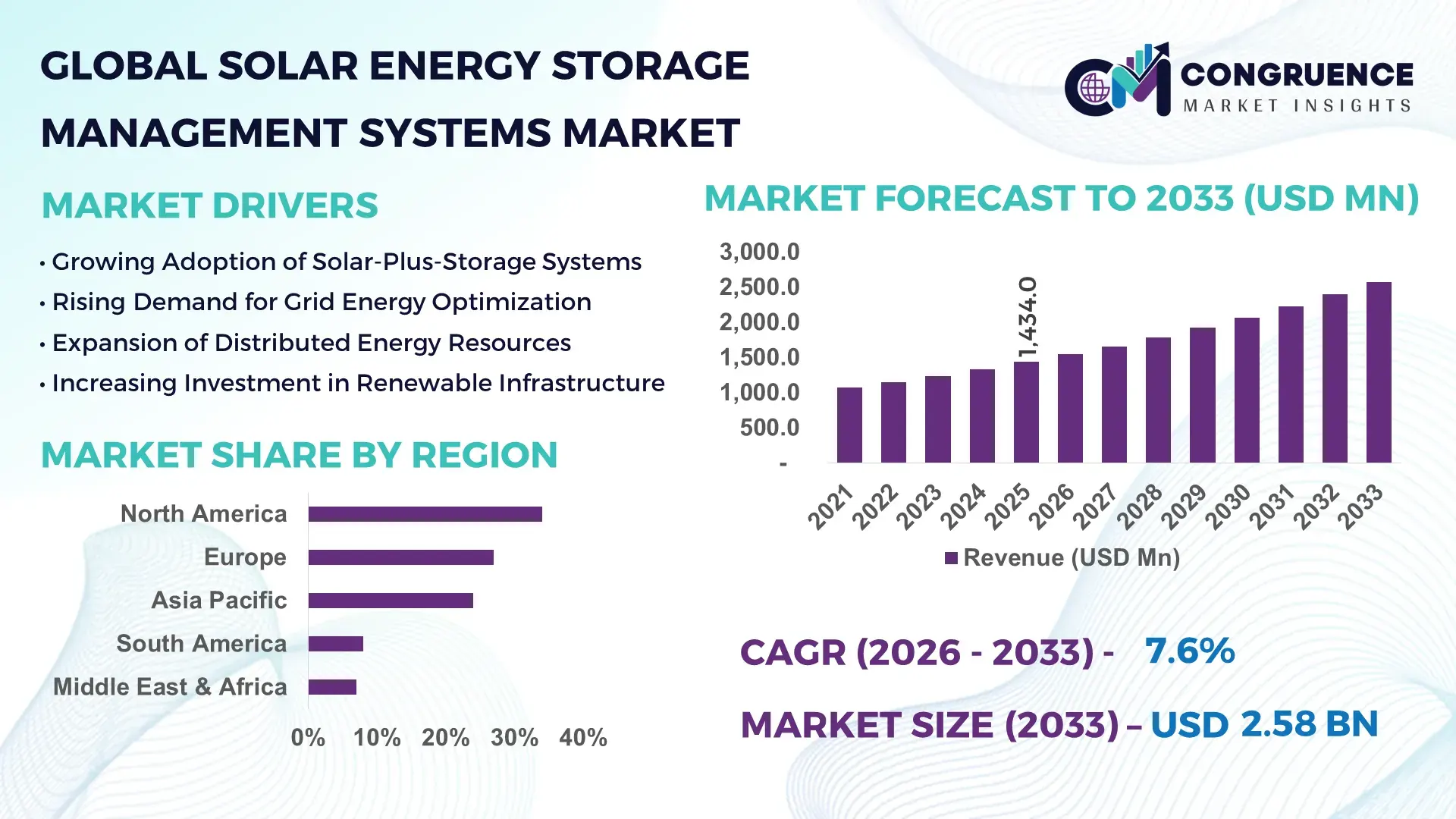
The Global Solar Energy Storage Management Systems Market was valued at USD 1,434.0 Million in 2025 and is anticipated to reach a value of USD 2,576.6 Million by 2033 expanding at a CAGR of 7.6% between 2026 and 2033, according to an analysis by Congruence Market Insights. Growth is primarily driven by the rapid integration of battery storage with solar power installations to improve grid reliability, optimize energy dispatch, and enable efficient renewable energy management across utility-scale, commercial, and residential sectors.
The United States plays a pivotal role in advancing solar energy storage management systems through large-scale deployment and technological innovation. The country installed over 31 GW of new solar capacity in 2024, with approximately 45% of new utility-scale solar projects integrated with battery storage systems to enable energy shifting and grid stability. More than 10 GW of battery storage capacity has already been deployed alongside solar plants across states such as California, Texas, and Arizona. Additionally, commercial and residential solar-plus-storage adoption is expanding rapidly, with nearly 18% of new residential solar installations including battery management systems that rely on advanced software platforms for load optimization, predictive maintenance, and energy trading. Investments in smart energy management technologies exceeded USD 3.5 billion between 2023 and 2025, accelerating the development of AI-driven storage control platforms and cloud-based energy analytics for distributed energy resources across North America.
Market Size & Growth: The market reached USD 1,434.0 million in 2025 and is projected to reach USD 2,576.6 million by 2033, expanding at 7.6% CAGR, driven by rising deployment of solar-plus-storage systems to enhance renewable energy reliability and grid flexibility.
Top Growth Drivers: Around 42% growth in solar-battery hybrid installations, 35% efficiency gains through intelligent energy management software, and 28% increase in distributed energy resource deployments are accelerating demand for storage management systems.
Short-Term Forecast: By 2028, predictive energy management platforms are expected to reduce storage system operational costs by 18% while improving battery lifecycle performance by 22%.
Emerging Technologies: AI-driven battery optimization, blockchain-enabled energy trading platforms, and cloud-based distributed energy resource management systems (DERMS) are transforming solar storage management capabilities.
Regional Leaders: North America is projected to reach USD 910 million by 2033 due to large-scale solar-plus-storage projects; Europe is expected to surpass USD 720 million driven by grid decarbonization programs; Asia-Pacific may exceed USD 680 million supported by expanding solar installations and smart grid deployments.
Consumer/End-User Trends: Utilities and commercial facilities account for over 55% of deployments, while residential adoption is rising as nearly 1 in 5 new rooftop solar systems integrate smart storage management platforms.
Pilot or Case Example: In 2024, a hybrid solar-storage pilot in California integrated AI-based energy management software, improving grid balancing efficiency by 27% and reducing peak-load stress by 19%.
Competitive Landscape: The market leader holds roughly 18% share, followed by major technology providers including Siemens, Schneider Electric, Honeywell, Tesla Energy, and ABB, which focus on intelligent battery management platforms.
Regulatory & ESG Impact: Renewable energy mandates, including clean energy targets exceeding 50% renewable penetration in multiple countries, are encouraging the deployment of solar-plus-storage systems supported by advanced energy management technologies.
Investment & Funding Patterns: Global investments exceeding USD 9 billion between 2022 and 2025 have been directed toward solar-plus-storage projects and digital energy management platforms, supported by green financing and infrastructure funds.
Innovation & Future Outlook: Integration of AI-powered grid analytics, vehicle-to-grid battery coordination, and real-time energy trading platforms is expected to reshape energy storage management across distributed solar networks.
Solar energy storage management systems are increasingly integrated across utility-scale solar plants (around 48% deployment share), commercial and industrial energy management networks (32% share), and residential solar-plus-storage systems (20% share). Advancements such as AI-based battery diagnostics, cloud-connected energy monitoring, and automated demand-response control are transforming system efficiency. Regulatory frameworks supporting grid decarbonization and distributed energy resources are accelerating adoption, while emerging microgrid and peer-to-peer energy trading platforms indicate strong long-term expansion potential for intelligent solar storage management solutions.
The Solar Energy Storage Management Systems Market has become strategically significant as governments, utilities, and enterprises seek to stabilize renewable energy integration while maintaining grid reliability. With solar energy becoming one of the fastest-growing power sources globally, efficient energy storage management solutions are essential for optimizing battery usage, controlling load fluctuations, and enabling smart dispatch of stored electricity. Large-scale solar-plus-storage systems are increasingly deployed in utility grids, microgrids, and distributed energy networks to improve operational resilience and maximize renewable output.
Advanced digital management platforms now incorporate artificial intelligence and predictive analytics to enhance battery lifecycle performance. For instance, AI-driven energy storage optimization platforms deliver nearly 24% improvement in battery utilization efficiency compared to conventional rule-based energy management systems, enabling utilities to extract higher value from existing storage infrastructure. These improvements are particularly relevant as global battery installations continue to scale rapidly across renewable energy projects.
Regional adoption patterns also vary significantly. North America dominates in deployment volume due to large-scale solar-plus-storage infrastructure projects, while Europe leads in adoption intensity, with nearly 38% of energy utilities integrating advanced energy management software across distributed renewable assets. Asia-Pacific is emerging as a fast-growing hub as countries expand solar generation and invest heavily in digital grid management systems.
Short-term projections indicate rapid technological transformation. By 2028, AI-enabled distributed energy resource management platforms are expected to reduce energy storage dispatch errors by nearly 20%, improving grid balancing and renewable integration efficiency. These technologies also support decentralized energy markets and enable energy trading among prosumers.
Sustainability goals are further shaping market strategies. Many energy companies have committed to reducing grid-related carbon emissions by 30% by 2030 through renewable energy expansion and advanced energy storage management systems that reduce curtailment of solar generation. Additionally, circular battery management programs are emerging to improve recycling rates and reduce lifecycle environmental impacts.
A notable micro-scenario occurred in 2024 when a U.S. utility operator deployed AI-enabled storage optimization software across a solar-plus-battery facility, improving peak-load balancing efficiency by 26% while reducing grid congestion events by 18%. Such initiatives highlight how intelligent storage management is transforming renewable energy operations.
Looking ahead, the Solar Energy Storage Management Systems Market is positioned as a critical pillar supporting energy transition strategies, enabling resilient grid infrastructure, regulatory compliance, and sustainable economic growth as renewable energy penetration accelerates worldwide.
The Solar Energy Storage Management Systems Market is evolving rapidly as solar generation expands across residential, commercial, and utility-scale sectors worldwide. Effective management of energy storage assets has become essential for stabilizing intermittent solar power generation, balancing grid loads, and enabling efficient energy dispatch. Increasing penetration of distributed energy resources such as rooftop solar systems and community solar projects is creating demand for intelligent energy management platforms capable of monitoring battery performance, forecasting power generation, and optimizing charging cycles. Utilities are also investing in digital grid infrastructure to integrate storage systems with demand response programs and smart grids. Advanced analytics, AI-enabled predictive maintenance, and cloud-based monitoring tools are further enhancing operational efficiency. Governments and regulatory bodies are encouraging renewable energy adoption through supportive policies, clean energy targets, and incentives for solar-plus-storage projects. As energy networks become more decentralized, solar energy storage management platforms are playing a central role in enabling microgrids, virtual power plants, and real-time energy trading ecosystems, strengthening the resilience and sustainability of modern electricity systems.
Rapid expansion of solar energy installations globally is significantly increasing the demand for advanced storage management platforms. Solar generation is inherently intermittent, making battery storage essential for maintaining stable power supply and ensuring efficient utilization of generated electricity. Utility-scale solar projects increasingly incorporate energy storage systems to manage peak demand periods and reduce curtailment of renewable energy. For example, more than 40% of newly deployed utility-scale solar plants worldwide now include integrated battery storage systems, requiring intelligent software platforms to manage charging cycles, load forecasting, and energy dispatch operations. Commercial and industrial facilities adopting solar power for energy cost optimization are also integrating storage management systems to regulate power consumption and maintain operational continuity during grid disruptions. Additionally, the growth of residential solar-plus-battery installations is driving demand for cloud-based monitoring platforms that enable homeowners to optimize electricity consumption and participate in demand response programs. As solar capacity continues expanding across both developed and emerging economies, the need for sophisticated storage management systems capable of handling distributed energy assets is expected to intensify significantly.
One of the primary restraints affecting the Solar Energy Storage Management Systems Market is the complexity associated with integrating diverse hardware components and energy infrastructure. Solar energy storage systems typically involve multiple technologies, including photovoltaic panels, battery storage units, inverters, grid communication interfaces, and monitoring software platforms. Differences in communication protocols and proprietary control systems often create interoperability challenges between equipment supplied by different manufacturers. In many installations, storage management systems must coordinate with grid management software, demand response platforms, and smart meters, increasing system complexity and deployment costs. Small and mid-scale solar operators frequently face technical barriers when integrating storage systems with legacy power infrastructure that lacks digital connectivity. In addition, data security concerns related to cloud-based energy management platforms can discourage adoption among critical infrastructure operators. Utilities also require extensive testing and certification processes before deploying advanced control software in grid-connected systems, which can delay project timelines and limit rapid market expansion. Addressing these integration challenges will require standardized communication protocols, interoperable energy platforms, and greater collaboration across technology providers.
The expansion of distributed energy resources such as rooftop solar, community solar farms, and localized microgrids is creating substantial opportunities for advanced solar energy storage management systems. As electricity generation becomes more decentralized, utilities and energy service providers require intelligent platforms capable of coordinating thousands of distributed storage units and solar arrays. Digital energy management platforms enable real-time monitoring, predictive analytics, and automated dispatch of energy across distributed networks, improving grid flexibility and operational efficiency. The development of virtual power plants, which aggregate distributed solar and battery assets into coordinated energy resources, is another promising opportunity. These systems allow energy operators to combine the capacity of multiple small-scale solar-plus-storage installations to support grid stability and participate in electricity markets. Additionally, emerging peer-to-peer energy trading platforms enable households and businesses with solar storage systems to sell excess electricity to neighboring consumers. As governments accelerate smart grid investments and promote decentralized energy systems, the role of advanced storage management platforms will expand significantly across both developed and emerging energy markets.
Efficient management of battery lifecycle and long-term performance remains a key challenge for solar energy storage management systems. Lithium-ion batteries, which dominate solar storage deployments, gradually degrade due to repeated charging and discharging cycles, temperature variations, and operational stress. Without advanced management systems, battery efficiency and energy capacity can decline significantly over time. Maintaining optimal operating conditions for large storage installations requires continuous monitoring of voltage, temperature, and charging behavior across thousands of battery cells. In utility-scale solar-plus-storage plants, improper battery management can lead to efficiency losses and increased maintenance requirements. Additionally, operators must ensure that energy storage systems comply with grid reliability standards and safety regulations. Managing these technical parameters while maintaining cost efficiency requires sophisticated analytics platforms and predictive maintenance tools. As the scale of solar-plus-storage deployments grows, ensuring accurate forecasting, real-time monitoring, and optimized battery lifecycle management will remain a critical challenge for system operators and technology providers.
Rapid Growth of AI-Driven Battery Optimization Platforms: Artificial intelligence is transforming solar storage management systems by enabling predictive energy dispatch and automated battery performance monitoring. More than 46% of newly installed commercial solar-plus-storage projects now incorporate AI-based optimization software capable of forecasting energy generation and demand patterns. These systems can improve battery efficiency by nearly 22% and reduce unplanned maintenance events by 18% through predictive analytics that detect early signs of battery degradation.
Expansion of Distributed Energy Resource Management Systems (DERMS): Utilities are increasingly deploying DERMS platforms to coordinate solar installations and battery storage across distributed energy networks. Approximately 52% of grid operators in advanced energy markets are integrating DERMS platforms to manage distributed solar assets and battery systems. These platforms enable real-time monitoring of thousands of solar installations and allow utilities to adjust energy dispatch dynamically, improving grid balancing efficiency by nearly 20%.
Integration of Solar Storage Systems with Electric Vehicle Charging Infrastructure: Solar energy storage systems are increasingly connected with EV charging networks to reduce peak grid loads and improve renewable energy utilization. Around 28% of newly deployed EV fast-charging stations in North America and Europe now integrate solar-battery energy systems to store surplus solar energy and supply electricity during high-demand periods. Such integration can reduce peak energy consumption from the grid by nearly 17%, improving sustainability outcomes for urban charging networks.
Emergence of Virtual Power Plants Using Solar-Plus-Storage Networks: Virtual power plant (VPP) platforms are enabling utilities to aggregate thousands of distributed solar storage systems into coordinated energy resources. More than 35% of distributed solar installations in certain advanced energy markets are being connected to VPP networks, allowing energy providers to manage energy supply during peak demand events. These systems can improve renewable energy utilization rates by approximately 25% while reducing grid congestion during high-demand periods.
The Solar Energy Storage Management Systems Market is segmented across type, application, and end-user categories to address diverse energy management requirements. Storage management platforms are increasingly used to optimize solar-plus-battery operations in residential, commercial, and utility-scale installations. Different system types focus on battery optimization, grid integration, and energy analytics capabilities, enabling energy operators to maximize renewable energy utilization. Applications range from residential energy management and commercial energy optimization to utility-scale grid stabilization. End-users include utilities, commercial enterprises, and residential solar adopters, each requiring specialized energy management features. Growing adoption of distributed energy resources, expansion of microgrids, and increasing demand for energy resilience are strengthening the role of storage management technologies across multiple energy sectors.
Solar energy storage management systems are broadly categorized into Battery Energy Storage Management Systems (BMS), Distributed Energy Resource Management Systems (DERMS), and Hybrid Energy Management Platforms. Among these, Battery Energy Storage Management Systems lead the market with approximately 48% share, primarily due to their critical role in controlling battery charging cycles, monitoring cell health, and maintaining safe operation across solar-plus-storage installations. BMS platforms are essential in both residential and utility-scale deployments where battery safety and performance monitoring are crucial for long-term reliability. Distributed Energy Resource Management Systems account for around 27% adoption, enabling utilities to manage multiple distributed solar assets and battery systems through centralized digital platforms. These systems facilitate real-time grid balancing and support demand response programs that coordinate renewable generation with energy consumption. Hybrid energy management platforms represent nearly 25% of deployments, integrating solar generation forecasting, battery optimization, and grid communication features in a unified control environment. However, DERMS platforms are emerging as the fastest-growing segment with an estimated 9.1% CAGR, driven by expanding distributed solar networks and increasing adoption of virtual power plant architectures.
• In 2024, a national grid operator implemented DERMS technology to coordinate more than 50,000 distributed solar-plus-storage systems, enabling automated grid balancing and improving renewable energy utilization across multiple urban regions.
Solar energy storage management systems serve multiple applications including Utility-Scale Solar Plants, Commercial & Industrial Energy Systems, and Residential Solar-Plus-Storage Installations. Utility-scale solar plants dominate the segment with nearly 45% adoption, as large solar farms require advanced management platforms to control high-capacity battery storage systems and regulate electricity dispatch during peak demand periods. Energy operators rely on intelligent management software to maintain grid stability and improve renewable energy utilization efficiency. The Commercial & Industrial sector accounts for about 32% of deployments, where businesses use solar-plus-storage systems to reduce electricity costs and maintain power reliability for critical operations. Facilities such as data centers, manufacturing plants, and logistics hubs increasingly rely on storage management systems to manage energy consumption during grid outages or peak tariffs. The Residential solar-plus-storage segment holds roughly 23% share, supported by the growing adoption of rooftop solar systems integrated with smart battery management software. However, residential applications are expanding fastest with an estimated 9.4% CAGR, driven by energy independence goals and rising electricity costs. In 2025, more than 37% of new rooftop solar installations globally included battery storage systems connected to digital monitoring platforms, reflecting strong consumer adoption of integrated energy solutions.
• In 2024, a national residential energy program deployed smart solar-plus-storage management platforms across 120,000 homes, enabling automated load balancing and improving household energy efficiency by nearly 19%.
End-users in the Solar Energy Storage Management Systems Market include Utilities, Commercial & Industrial Enterprises, and Residential Consumers. Utilities represent the largest segment with approximately 50% adoption, as power grid operators deploy advanced storage management systems to regulate renewable energy flows, stabilize grid operations, and manage large-scale battery installations connected to solar farms. Utilities increasingly rely on AI-enabled analytics platforms to forecast demand patterns and optimize energy dispatch across regional power networks. Commercial and industrial enterprises account for around 30% of deployments, driven by increasing demand for energy cost management, sustainability goals, and backup power capabilities. Large manufacturing facilities, logistics centers, and corporate campuses are integrating solar-plus-storage solutions to reduce dependency on conventional grid electricity. The residential segment represents about 20% of the market, as homeowners adopt solar storage solutions to achieve energy independence and reduce electricity costs. However, residential users are the fastest-growing end-user group with nearly 9.6% CAGR, supported by government incentives and rising rooftop solar adoption. In 2025, approximately 41% of enterprises globally reported piloting advanced solar energy management systems to improve operational energy efficiency, reflecting increasing corporate adoption of renewable energy technologies.
• In 2024, a national smart grid initiative deployed advanced solar storage management platforms across more than 200 utility-scale energy sites, enabling real-time monitoring and improving grid reliability across multiple regions.
North America accounted for the largest market share at 34% in 2025 however, Asia-Pacific is expected to register the fastest growth, expanding at a CAGR of 9.1% between 2026 and 2033.
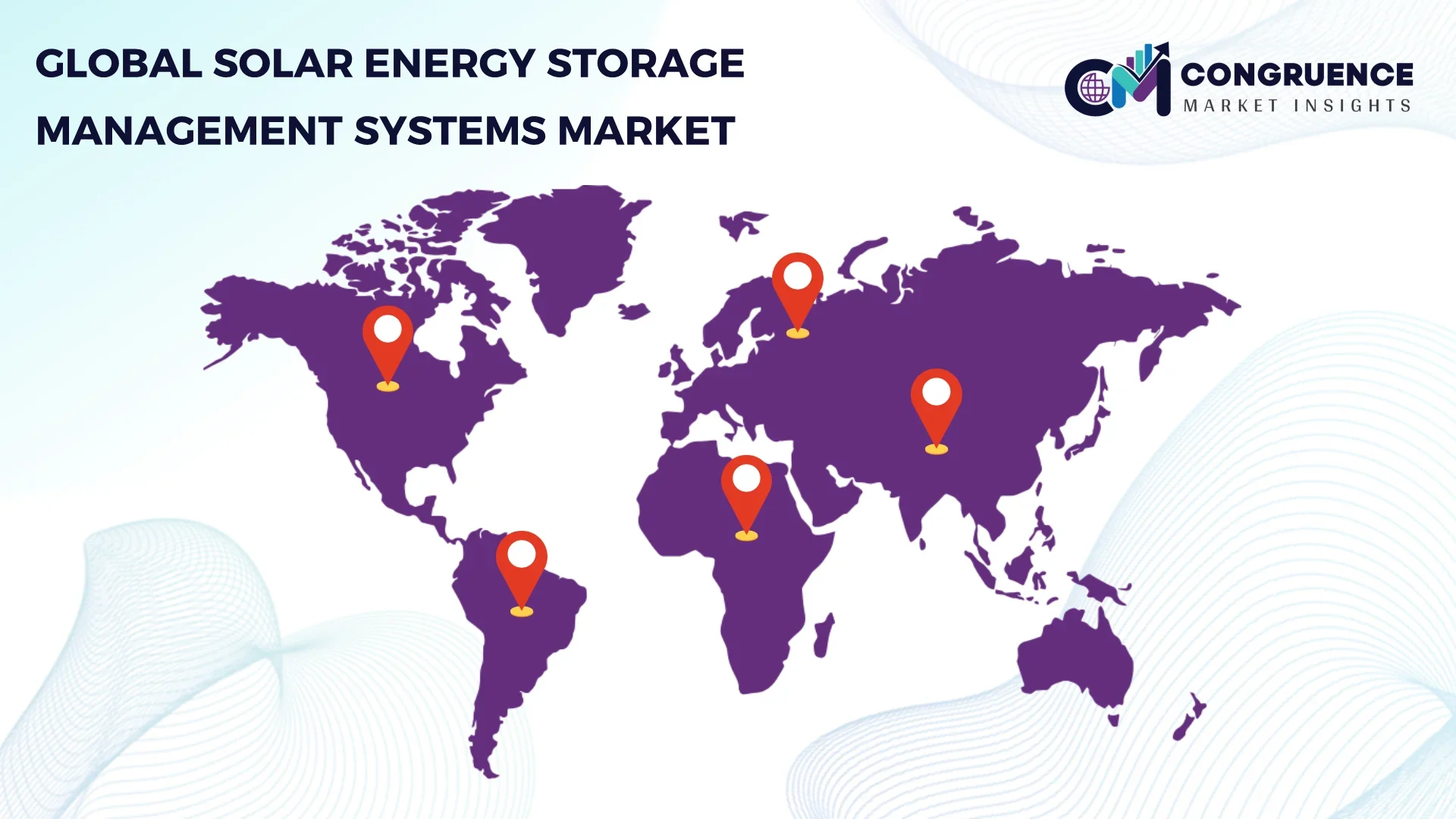
The regional distribution of the Solar Energy Storage Management Systems Market reflects differences in renewable energy infrastructure, solar capacity deployment, and smart grid integration across global markets. North America leads with approximately 34% market share, supported by more than 10 GW of solar-plus-storage capacity installed across utility-scale and distributed energy projects. Europe follows with nearly 27% share, driven by renewable integration mandates and grid modernization programs in countries such as Germany and the UK. Asia-Pacific accounts for roughly 24% of the market, but is experiencing the fastest expansion as solar installations exceeded 390 GW of cumulative capacity across major economies including China, India, and Japan. Meanwhile, South America contributes close to 8% share, led by large-scale solar projects in Brazil and Chile, while the Middle East & Africa region represents nearly 7% of global adoption, supported by large solar parks and hybrid renewable energy projects in the UAE, Saudi Arabia, and South Africa. Increasing energy storage investments and digital grid transformation programs are expected to accelerate regional demand for solar energy storage management systems worldwide.
North America represents approximately 34% of the global Solar Energy Storage Management Systems Market, supported by extensive solar-plus-storage deployments across the United States and Canada. Utility-scale renewable energy projects, commercial energy optimization systems, and residential solar installations are the primary industries driving demand. More than 45% of newly installed utility-scale solar plants in the region integrate battery storage systems, creating strong demand for advanced storage management platforms. Government policies such as clean energy standards and investment tax credits encourage solar-plus-storage deployment across multiple states. Digital transformation of the power grid is also accelerating adoption of distributed energy resource management systems and AI-based storage optimization tools. Technology providers are introducing cloud-based monitoring platforms to improve energy dispatch accuracy and predictive maintenance. For instance, Tesla Energy has deployed thousands of intelligent battery management platforms across solar storage installations through its energy software ecosystem. Regional consumer behavior shows high adoption among commercial enterprises, with nearly 40% of large corporate campuses integrating renewable energy storage management solutions to reduce grid dependency and stabilize electricity costs.
Europe accounts for roughly 27% of the Solar Energy Storage Management Systems Market, driven by aggressive renewable energy targets and decarbonization policies across the region. Key markets such as Germany, the United Kingdom, and France collectively represent over 60% of regional solar storage deployments. European energy transition programs require utilities to integrate distributed renewable generation with advanced energy management systems to maintain grid stability. Regulatory initiatives encouraging smart grid development and decentralized energy networks are strengthening demand for storage management platforms capable of coordinating distributed solar assets. Technological adoption is also accelerating as energy operators implement artificial intelligence and real-time grid analytics to optimize battery storage operations. Companies such as Siemens Energy are actively developing digital energy management platforms designed to support solar storage optimization and microgrid operations. Consumer behavior in the region reflects strong sustainability awareness, where over 35% of energy utilities are investing in intelligent storage control systems to meet carbon reduction targets and ensure efficient renewable energy integration across national grids.
Asia-Pacific is among the fastest expanding regions in the Solar Energy Storage Management Systems Market and ranks third globally in overall market volume. The region hosts several of the world’s largest solar markets, including China, India, and Japan, which together account for more than 65% of solar capacity installations in Asia-Pacific. Rapid urbanization and increasing electricity demand are driving investments in hybrid solar-plus-storage systems capable of stabilizing grid operations. China alone operates more than 180 GW of large-scale solar installations, many of which integrate battery storage technologies managed through advanced software platforms. Regional infrastructure expansion and manufacturing capabilities have also enabled rapid deployment of energy storage technologies. Innovation hubs across countries such as South Korea and Japan are advancing digital grid technologies, including AI-driven battery monitoring and predictive analytics platforms. For example, Huawei Digital Power is developing intelligent photovoltaic and storage management platforms widely deployed across Asia-Pacific solar farms. Consumer behavior in the region reflects strong technology adoption, particularly in emerging economies where distributed solar installations are expanding rapidly to support energy access and microgrid development.
South America holds approximately 8% share of the global Solar Energy Storage Management Systems Market, supported by increasing solar power installations across Brazil, Chile, and Argentina. Brazil represents the largest national market in the region with more than 30 GW of installed solar capacity, including multiple solar-plus-storage projects designed to enhance grid stability and reduce reliance on hydroelectric generation. Regional infrastructure development programs are promoting the adoption of renewable energy systems integrated with battery storage management platforms. Government incentives for solar installations, including tax exemptions and energy auction mechanisms, are encouraging investment in distributed energy systems across commercial and residential sectors. Technology adoption is also increasing as utilities implement advanced energy management systems to control hybrid solar and storage projects. For instance, WEG, a major Brazilian technology provider, has introduced integrated solar and energy management platforms for commercial energy users. Consumer behavior in the region indicates growing interest in distributed solar solutions, with nearly 25% of new commercial solar installations integrating battery storage systems to ensure reliable power supply during grid interruptions.
The Middle East & Africa region accounts for nearly 7% of the global Solar Energy Storage Management Systems Market, supported by rapid expansion of renewable energy infrastructure and large-scale solar park developments. Countries such as the United Arab Emirates, Saudi Arabia, and South Africa are leading regional solar deployments, with combined solar capacity exceeding 20 GW across major utility projects. Solar storage management systems are increasingly used to coordinate hybrid renewable energy plants and support grid stability in high-temperature environments. Governments are implementing energy diversification strategies to reduce dependence on fossil fuels while expanding renewable energy generation. Technological modernization is also accelerating as utilities adopt AI-powered monitoring systems and advanced grid analytics platforms to optimize battery performance and solar output. Local players such as ACWA Power are investing in hybrid solar projects integrated with digital energy management technologies. Consumer behavior across the region varies significantly, with higher adoption among energy-intensive industries such as oil & gas, mining, and construction that rely on hybrid solar energy systems to ensure operational reliability in remote locations.
United States – 29% Market Share: Strong solar-plus-storage infrastructure, large-scale renewable energy projects, and advanced grid management technologies drive the country’s leadership.
China – 21% Market Share: Massive solar manufacturing capacity and extensive utility-scale solar installations support widespread deployment of intelligent solar energy storage management platforms.
The Solar Energy Storage Management Systems Market features a moderately fragmented competitive landscape characterized by a mix of global technology companies, renewable energy solution providers, and specialized energy software developers. More than 60 active companies operate in this sector, focusing on digital energy platforms, battery optimization technologies, and distributed energy resource management systems. The top five companies collectively account for approximately 38% of the market, reflecting moderate consolidation driven by strategic partnerships and technological differentiation.
Leading technology providers are investing heavily in artificial intelligence, cloud-based monitoring systems, and predictive battery analytics to strengthen their competitive positioning. Several firms are also integrating storage management software with smart grid infrastructure and virtual power plant platforms. Strategic collaborations between solar equipment manufacturers and digital energy companies are increasingly common, enabling integrated solar-plus-storage solutions capable of optimizing power generation, storage, and distribution.
Innovation remains a key competitive factor, with companies focusing on developing AI-enabled battery diagnostics, real-time energy trading platforms, and digital grid management systems. Product launches related to distributed energy resource management systems have increased significantly as utilities and enterprises expand solar-plus-storage deployments. Additionally, mergers and partnerships between renewable energy developers and software providers are reshaping the competitive environment. Many companies are also expanding into emerging markets across Asia-Pacific and the Middle East, where solar infrastructure investments and smart grid initiatives are accelerating adoption of advanced energy storage management technologies.
Siemens Energy
Schneider Electric
ABB Ltd.
Honeywell International
Huawei Digital Power
Eaton Corporation
Wärtsilä Energy
Fluence Energy
Stem Inc.
AutoGrid Systems
SMA Solar Technology AG
Sungrow Power Supply Co. Ltd.
Enphase Energy
Generac Holdings Inc.
Technological innovation is significantly reshaping the Solar Energy Storage Management Systems Market as energy providers and utilities seek more efficient ways to manage solar-plus-storage infrastructure. One of the most important developments is the integration of artificial intelligence and machine learning algorithms within energy management platforms. AI-enabled systems can analyze historical generation data, weather patterns, and consumption trends to optimize battery charging cycles and reduce energy losses. These intelligent systems are capable of improving battery utilization efficiency by nearly 20–25% while reducing unexpected downtime through predictive maintenance capabilities.
Another major technological advancement is the development of Distributed Energy Resource Management Systems (DERMS), which enable grid operators to coordinate thousands of decentralized solar installations and battery systems through a single digital platform. These systems provide real-time monitoring and automated control of distributed energy resources, improving grid balancing and enabling participation in demand response programs. Utilities in advanced energy markets now operate DERMS platforms capable of monitoring tens of thousands of solar installations simultaneously.
Cloud computing and Internet of Things (IoT) technologies are also transforming solar energy storage management systems. IoT-enabled sensors embedded in battery storage units continuously track parameters such as voltage, temperature, and charge cycles across thousands of cells, generating vast volumes of operational data. Cloud-based analytics platforms process this data to detect anomalies and optimize battery performance. In large solar farms, these systems can monitor more than 100,000 battery cells in real time, significantly improving safety and operational efficiency.
Another emerging technology trend is the development of virtual power plant (VPP) platforms, which aggregate distributed solar and battery assets into coordinated energy networks. These platforms allow utilities to combine multiple distributed storage systems into a single dispatchable energy resource capable of supporting grid stability during peak demand events. Advanced VPP platforms can integrate thousands of residential solar storage systems, enabling households to contribute stored electricity to the grid during periods of high demand. As digital grid infrastructure expands globally, these technologies are expected to play a crucial role in improving renewable energy utilization and enabling intelligent energy ecosystems.
• In February 2025, Tesla began trial production at its Megapack manufacturing facility in Shanghai, marking its first grid-scale battery production site outside the United States. The plant is designed to manufacture large-scale battery systems used in solar-plus-storage projects and utility-scale grid stabilization deployments. Source: www.ess-news.com
• In June 2025, Tesla signed an agreement with the Shanghai municipal government and China Kangfu International Leasing to build a grid-scale energy storage station using Megapack batteries, valued at approximately ¥4 billion ($556.8 million) to strengthen grid stability and renewable integration.
• In July 2024, Fluence Energy announced a partnership with Excelsior Energy Capital to deploy 2.2 GWh of battery energy storage projects in the United States, using domestically manufactured battery systems scheduled for deployment beginning in 2025.
• In September 2025, Tesla unveiled the Megapack 3 and Megablock utility-scale battery platforms, designed as integrated storage solutions combining battery packs, power electronics, and switchgear to simplify installation. The system enables 23% faster installation and up to 40% lower construction costs for grid-scale renewable energy storage projects.
The Solar Energy Storage Management Systems Market Report provides a comprehensive analysis of the technologies, applications, and industry developments shaping the adoption of intelligent solar energy storage management solutions worldwide. The report covers the evolving ecosystem of solar-plus-storage systems that combine photovoltaic generation with advanced battery storage management platforms to enhance grid reliability and renewable energy utilization. The analysis evaluates multiple technology categories including battery energy storage management systems, distributed energy resource management platforms, hybrid energy optimization software, and cloud-based monitoring systems used in modern renewable energy networks.
The scope of the report includes detailed segmentation across types, applications, and end-user industries. Product-level analysis evaluates battery management platforms, distributed energy resource management systems, and integrated energy optimization software used in solar installations. Application insights focus on utility-scale solar power plants, commercial and industrial energy management systems, and residential solar-plus-storage networks, highlighting how different sectors deploy storage management technologies to optimize energy consumption and grid interactions. End-user analysis examines adoption across utilities, energy service providers, industrial enterprises, and residential consumers.
Geographically, the report evaluates major regional markets including North America, Europe, Asia-Pacific, South America, and the Middle East & Africa, analyzing deployment patterns, solar capacity expansion, and digital grid transformation initiatives shaping demand for solar energy storage management platforms. It also highlights emerging industry segments such as virtual power plants, microgrid energy systems, peer-to-peer energy trading platforms, and AI-enabled battery diagnostics, which are influencing the next phase of market development. By covering technological innovation, regulatory developments, and industry adoption trends, the report offers strategic insights for stakeholders involved in renewable energy infrastructure, digital grid technologies, and advanced energy storage management solutions.
| Report Attribute / Metric | Details |
|---|---|
| Market Revenue (2025) | USD 1,434.0 Million |
| Market Revenue (2033) | USD 2,576.6 Million |
| CAGR (2026–2033) | 7.6% |
| Base Year | 2025 |
| Forecast Period | 2026–2033 |
| Historic Period | 2021–2025 |
| Segments Covered |
By Type
By Application
By End-User Insights
|
| Key Report Deliverables | Revenue Forecast; Market Trends; Growth Drivers & Restraints; Technology Insights; Segmentation Analysis; Regional Insights; Competitive Landscape; Regulatory & ESG Overview; Recent Developments |
| Regions Covered | North America; Europe; Asia-Pacific; South America; Middle East & Africa |
| Key Players Analyzed | Tesla Energy; Siemens Energy; Schneider Electric; ABB Ltd.; Honeywell International; Huawei Digital Power; Eaton Corporation; Wärtsilä Energy; Fluence Energy; Stem Inc.; AutoGrid Systems; SMA Solar Technology AG; Sungrow Power Supply Co. Ltd.; Enphase Energy; Generac Holdings Inc. |
| Customization & Pricing | Available on Request (10% Customization Free) |




