
Reports
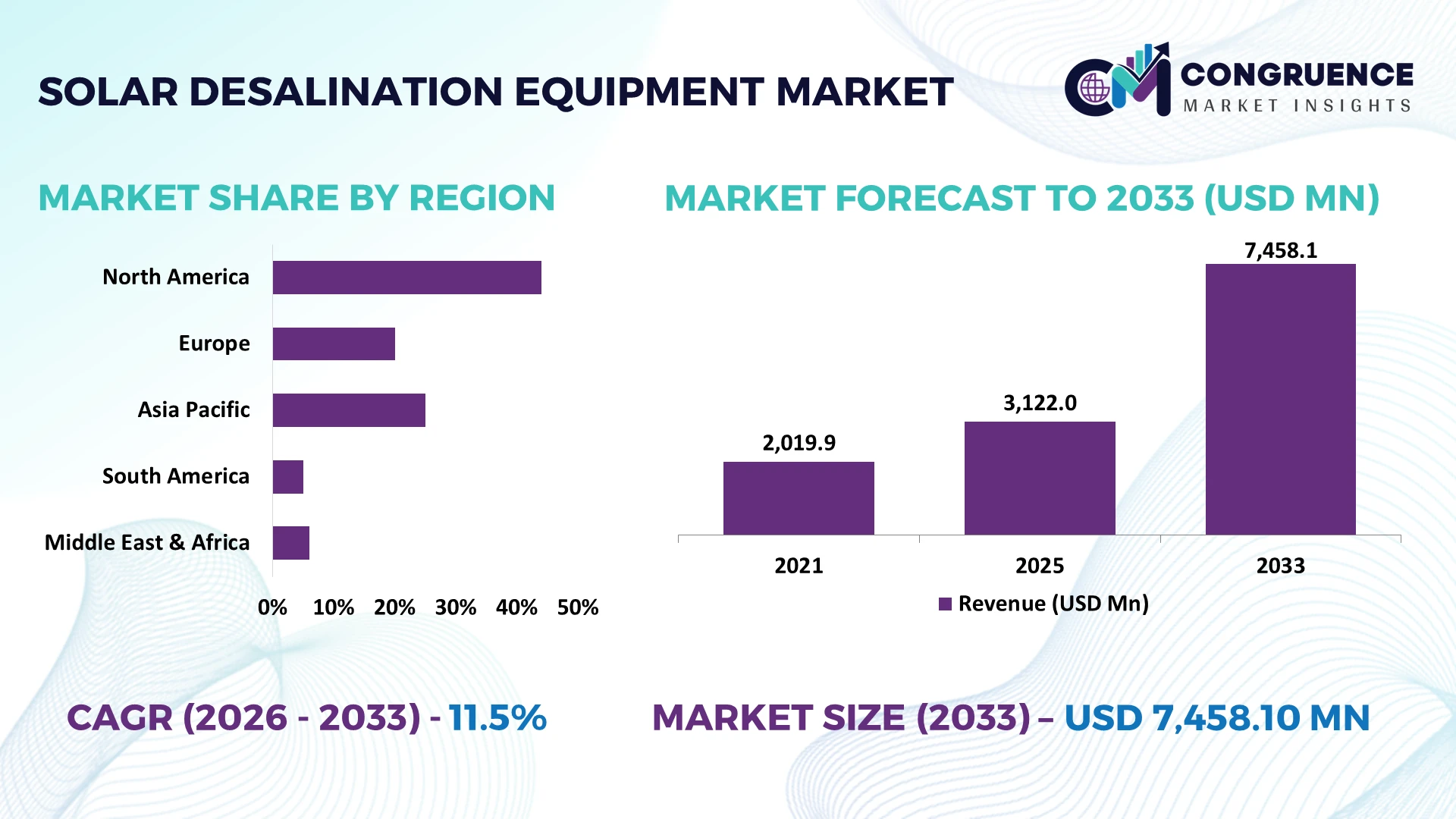
The Global Solar Desalination Equipment Market was valued at USD 3122 Million in 2025 and is anticipated to reach a value of USD 7458.1 Million by 2033 expanding at a CAGR of 11.5% between 2026 and 2033. Growth is driven by photovoltaic powered reverse osmosis systems, declining solar electricity costs, freshwater scarcity, off grid water treatment infrastructure, and renewable energy integration into desalination facilities.
Saudi Arabia holds a strategically dominant position in desalination infrastructure, producing approximately 22% of global desalinated water and operating facilities with combined capacity exceeding 11 million cubic meters daily. The country is advancing solar integrated desalination under Vision 2030, including the Al Khafji solar powered desalination project, designed for approximately 60,000 cubic meters daily. The United Arab Emirates emphasizes large scale reverse osmosis infrastructure, while Saudi Arabia combines extensive desalination capacity with renewable energy integration. This creates substantial opportunities for advanced membrane systems and solar energy equipment.
Strategic Implication: Equipment manufacturers should prioritize solar powered reverse osmosis integration, energy efficient membranes, and partnerships with Gulf utilities to secure large scale desalination infrastructure contracts.
Market Size & Growth: USD 3,122 million in 2025, reaching USD 7,458.1 million by 2033 at 11.5% CAGR, driven by photovoltaic powered desalination infrastructure.
Top Growth Drivers: Modeled demand contributions comprise freshwater scarcity at 40%, renewable energy integration at 35%, and decentralized water infrastructure at 25%.
Short Term Forecast: By 2028, optimized solar desalination systems target 15% lower electricity consumption and 12% higher operational availability.
Emerging Technologies: Three innovations dominate development: AI membrane monitoring, photovoltaic powered reverse osmosis, and solar thermal membrane distillation.
Regional Leaders: Illustrative 2033 allocations place Middle East & Africa at USD 2,834.08 million, Asia Pacific at USD 2,088.27 million, and North America at USD 1,193.30 million.
Consumer Trends: An estimated 45% of equipment demand originates from municipal water utilities, reflecting infrastructure modernization and drinking water security priorities.
Pilot/Case Example: Saudi Arabia's Al Khafji solar desalination project targets approximately 60,000 cubic meters of daily water production capacity.
Competitive Landscape: Veolia, ACCIONA, IDE Technologies, Energy Recovery, and Aquatech compete in desalination technology; verified solar equipment market shares remain unavailable.
Regulatory & ESG Impact: Solar powered desalination projects target 20% lower operational emissions through renewable electricity integration under modeled operating conditions.
Investment & Funding: A modeled USD 500 million investment portfolio prioritizes solar powered desalination plants, membrane technology partnerships, and decentralized water infrastructure.
Innovation & Future Outlook: By 2033, hybrid solar desalination and energy recovery systems target 25% lower specific energy consumption in optimized configurations.
The Solar Desalination Equipment Market supports municipal drinking water production, industrial water treatment, agricultural irrigation, and decentralized freshwater supply. Photovoltaic powered reverse osmosis systems are gaining importance where electricity availability and water scarcity constrain conventional desalination deployment. Advanced energy recovery devices, automated membrane cleaning, and battery integrated solar systems improve operational flexibility. In Saudi Arabia and the United Arab Emirates, renewable energy integration aligns with national water security and infrastructure diversification strategies. An illustrative optimized installation targets 15% lower electricity consumption through coordinated solar generation and pumping controls. These developments establish the strategic importance of energy efficiency, equipment reliability, and localized deployment capabilities.
Solar desalination equipment is becoming strategically important as water utilities prioritize energy security, freshwater availability, and infrastructure resilience. Saudi Arabia's Vision 2030 and renewable energy initiatives are accelerating interest in integrating photovoltaic generation with reverse osmosis facilities. The Al Khafji solar desalination project, designed for approximately 60,000 cubic meters daily, demonstrates the relevance of renewable electricity integration. Equipment manufacturers are restructuring procurement around efficient membranes, energy recovery devices, and digitally controlled pumping systems to strengthen long term operational competitiveness.
Compared with conventional desalination facilities relying entirely on purchased grid electricity, optimized photovoltaic assisted systems can target 20% lower grid electricity consumption under modeled operating conditions. Saudi Arabia emphasizes large scale municipal infrastructure, while India prioritizes decentralized water treatment for coastal communities. Australia combines advanced membrane engineering with renewable energy integration. These deployment differences influence equipment design, energy storage requirements, and maintenance strategies. Automated pressure control and membrane monitoring also support improved operational consistency.
Between 2026 and 2028, utilities are expected to expand solar integrated reverse osmosis, predictive maintenance, and modular treatment installations. A practical 5,000 cubic meter daily facility incorporating photovoltaic generation and energy recovery equipment targets 15% lower electricity expenditure in an illustrative operating model. Manufacturers are strengthening utility partnerships and expanding localized servicing capabilities. Competitive advantage increasingly depends on reliable freshwater output, efficient energy integration, and lifecycle operating performance.
Increasing freshwater scarcity is driving investment in solar powered desalination infrastructure across water stressed countries. Saudi Arabia relies heavily on desalination for municipal drinking water, while India faces substantial water availability pressures in coastal and arid districts. In an illustrative demand attribution model, freshwater scarcity contributes 40% of equipment expansion drivers, renewable energy integration accounts for 35%, and decentralized water infrastructure represents 25%. Saudi Arabia's Vision 2030 reinforces investment in energy efficient water production and infrastructure diversification. Equipment manufacturers are expanding photovoltaic compatible reverse osmosis portfolios, strengthening membrane technology partnerships, and improving energy recovery integration. Suppliers offering dependable freshwater output with reduced grid dependence gain stronger positioning in municipal procurement and industrial water treatment projects.
Solar desalination installations require coordinated investment in photovoltaic arrays, membrane treatment equipment, electrical controls, and water storage infrastructure. In countries such as India, financing limitations and fragmented water distribution networks complicate deployment economics. An illustrative capital allocation model assigns 35% of project expenditure to desalination equipment, 25% to solar generation, and 15% to electrical integration and storage, with remaining costs covering civil works and commissioning. Imported membranes and specialized energy recovery components expose developers to currency fluctuations and procurement delays. Equipment suppliers are responding through localized assembly, long term procurement contracts, and modular installation designs. Commercial viability increasingly depends on optimizing complete project expenditure rather than minimizing individual equipment purchase prices.
Modular photovoltaic powered desalination creates opportunities for remote communities, industrial facilities, and distributed water supply networks. India's coastal districts and island territories provide deployment environments where conventional grid infrastructure remains constrained. Automated membrane monitoring can target 15% lower maintenance interventions, while optimized energy recovery systems support modeled electricity savings of 20% compared with conventional configurations. Containerized treatment units also simplify installation and phased capacity expansion. Between 2026 and 2028, equipment manufacturers are expected to develop battery compatible controls, predictive membrane diagnostics, and standardized modular platforms. Partnerships with regional utilities and engineering contractors support deployment. Suppliers combining flexible capacity expansion with digitally managed energy consumption gain access to smaller projects underserved by centralized desalination infrastructure.
Maintaining continuous freshwater production while managing variable photovoltaic output presents a critical execution challenge for solar desalination facilities. Solar generation fluctuates with weather conditions, while reverse osmosis membranes require controlled pressure and stable operating parameters. An illustrative operating scenario assumes 20% daily solar generation variability, 10% additional balancing requirements, and 5% production interruptions without adequate storage or hybrid energy support. Australia's remote desalination applications demonstrate the importance of integrating renewable generation with dependable treatment operations. Manufacturers must develop advanced energy management systems, improve battery and water storage coordination, and strengthen technician training. Long term competitiveness depends on maintaining membrane performance, consistent water quality, and reliable production schedules despite changing renewable electricity availability.
- Advanced Energy Recovery Improves Process Economics: Desalination operators are adopting high efficiency pressure exchangers to recover hydraulic energy from concentrated brine. Modern devices can achieve approximately 95% to 98% energy transfer efficiency under suitable operating conditions. Saudi Arabian project developers are integrating these components with solar powered reverse osmosis equipment. Manufacturers are refining pressure exchanger designs and pump configurations to reduce electricity requirements and improve treatment economics.
- Automated Pretreatment Strengthens Membrane Protection: Coastal desalination facilities are upgrading ultrafiltration, cartridge filtration, and chemical dosing systems to manage variable seawater quality. An illustrative operating program targets 15% fewer membrane cleaning events and 10% longer filtration cycles. United Arab Emirates utilities prioritize consistent feedwater quality during seasonal changes. Equipment suppliers are integrating turbidity sensors, automated backwashing, and programmable dosing controls to improve membrane reliability and reduce maintenance interruptions.
- Brine Management Becomes Procurement Priority: Environmental discharge requirements are increasing attention to concentrate handling and marine ecosystem protection. An illustrative optimization program targets 12% lower brine discharge volumes and 8% improved water recovery through refined process configurations. Australia's coastal desalination projects operate under environmental monitoring requirements. Manufacturers are developing improved discharge diffusers, concentrate monitoring systems, and recovery optimization technologies to strengthen regulatory compliance and environmental performance.
- Remote Monitoring Reshapes Service Delivery: Solar desalination operators are implementing cloud connected sensors and digital maintenance platforms to monitor pressure, conductivity, and equipment performance. A modeled deployment involving 25 treatment units targets 20% faster fault identification and 15% fewer technician visits. India's distributed water infrastructure creates opportunities for centralized monitoring. Equipment providers are expanding digital service partnerships and integrating automated alerts to improve maintenance coordination and operational visibility.
Solar PV-Powered RO Systems represent the leading equipment category, accounting for an estimated 48% of the global Solar Desalination Equipment Market. Their dominance reflects established reverse osmosis technology, declining photovoltaic electricity costs, and compatibility with modular treatment infrastructure. Saudi Arabia and the United Arab Emirates are integrating renewable electricity into desalination development, supporting demand for photovoltaic compatible pumps, membranes, and energy recovery equipment. Solar Thermal Desalination Systems remain relevant where concentrated solar heat or thermal energy integration supports water production. An estimated 27% share for Solar Thermal Desalination Systems reflects their established industrial applications. Equipment manufacturers are improving photovoltaic integration, high pressure pump efficiency, and operational controls to strengthen large scale project competitiveness.
Solar Membrane Distillation Systems represent the fastest growing type in the analytical outlook, supported by increasing interest in low temperature thermal processing and specialized saline water treatment. Solar Humidification-Dehumidification Systems serve smaller installations requiring comparatively simple thermal operating configurations. A modeled 15% reduction in specific electricity consumption through improved energy recovery strengthens the commercial appeal of advanced membrane configurations. Manufacturers are investing in membrane development, pilot testing, and partnerships with renewable energy integrators. Investment priorities increasingly favor flexible process configurations and reliable freshwater output.
Seawater Desalination represents the leading application, accounting for an estimated 44% of global solar desalination equipment demand. Its dominance reflects extensive coastal water infrastructure requirements and established membrane treatment technologies. Saudi Arabia and the United Arab Emirates maintain substantial seawater desalination capacity, supporting demand for energy efficient pumps, pretreatment systems, and photovoltaic integration. Brackish Water Desalination represents another important application, particularly where groundwater salinity requires treatment but feedwater conditions permit lower operating pressures. An estimated 24% share for Brackish Water Desalination highlights opportunities for smaller treatment installations. Equipment manufacturers are adapting membrane configurations, pressure control systems, and modular designs to accommodate varying feedwater characteristics.
Agricultural Water Supply represents the fastest growing application in the analytical outlook, supported by irrigation requirements in water stressed agricultural districts. Drinking Water Production remains essential for municipal and decentralized supply, while Industrial Water Treatment supports process water quality requirements. An illustrative agricultural installation targets 15% lower grid electricity consumption through photovoltaic generation and optimized pumping schedules. Suppliers are expanding application specific engineering, improving water recovery controls, and developing treatment packages compatible with agricultural distribution infrastructure. Competitive advantage depends on matching water quality specifications with energy consumption and maintenance requirements.
Municipal Water Utilities represent the dominant end user category, accounting for an estimated 45% of the Solar Desalination Equipment Market. Their purchasing concentration reflects extensive freshwater distribution responsibilities, large treatment capacities, and long term infrastructure investment programs. Saudi Arabia's water infrastructure modernization emphasizes dependable desalinated water production and improved energy efficiency. Industrial Facilities represent another important purchasing group, particularly in manufacturing, energy production, and specialized process water applications. An estimated 25% share for Industrial Facilities highlights their contribution to equipment demand. Suppliers are developing integrated treatment packages, strengthening utility partnerships, and expanding maintenance support capabilities to address operational reliability requirements.
Remote Communities represent the fastest growing end user category in the analytical outlook, supported by demand for decentralized freshwater infrastructure in locations with limited electricity access. Agricultural Operators increasingly evaluate solar desalination for saline groundwater treatment, while Commercial Establishments require smaller systems for localized water supply. A modeled 20% reduction in grid electricity dependence strengthens the appeal of photovoltaic integrated installations. Manufacturers are offering containerized equipment, flexible financing structures, and remote maintenance services. Competitive positioning increasingly depends on reliable water production, simplified operation, and accessible technical support.
Middle East & Africa accounted for the largest market share at an estimated 38% in 2025; however, Asia Pacific is expected to register the fastest growth, expanding at an estimated CAGR of 13.2% between 2026 and 2033.
Renewable Powered Water Infrastructure and Industrial Treatment Modernization
North America accounts for an estimated 16% of global solar desalination equipment demand, supported by water scarcity, advanced membrane technology, and established renewable energy infrastructure. The United States concentrates deployment opportunities in California, Arizona, Texas, and other water stressed areas, while Mexico provides additional opportunities through coastal desalination and industrial water treatment. California's Carlsbad desalination facility produces approximately 190,000 cubic meters of drinking water daily, demonstrating the scale of regional desalination infrastructure, although the facility is not itself a dedicated solar desalination installation. Equipment suppliers are developing photovoltaic compatible reverse osmosis systems, energy recovery devices, and automated monitoring platforms. Regional procurement increasingly emphasizes lifecycle electricity expenditure, water quality compliance, and operational reliability. Manufacturers combining membrane engineering with renewable energy integration gain stronger positioning in municipal and industrial infrastructure projects.
United States Market Outlook: The United States benefits from advanced membrane research, established water treatment engineering, and specialized equipment manufacturers. Energy Recovery, headquartered in California, develops pressure exchanger technologies that improve reverse osmosis efficiency. The Bureau of Reclamation's desalination research programs support treatment innovation, while southwestern states provide suitable solar generation conditions. Industrial operators increasingly evaluate photovoltaic integration to reduce electricity exposure and strengthen water supply resilience.
Membrane Engineering Leadership and Renewable Water Treatment Integration
Europe represents an estimated 12% of global solar desalination equipment demand, supported by advanced water treatment engineering, renewable energy policies, and established membrane manufacturing capabilities. Spain, Italy, and Greece face seasonal water shortages that strengthen interest in efficient desalination infrastructure. European equipment suppliers emphasize reverse osmosis optimization, energy recovery, advanced pretreatment, and environmental discharge management. Spain maintains substantial desalination infrastructure, with national installed capacity exceeding 5 million cubic meters daily across desalination facilities. European Union water management policies and renewable energy objectives encourage improved electricity efficiency and environmental performance. Manufacturers are strengthening partnerships between desalination engineering companies and solar technology providers. Competitive differentiation increasingly depends on combining reliable treatment performance with efficient power management, regulatory compliance, and dependable technical servicing across coastal and island installations.
Spain Market Outlook: Spain maintains one of Europe's most developed desalination industries, supported by established engineering expertise and extensive coastal water infrastructure. ACCIONA operates internationally in desalination design and construction, while Spanish research institutions advance membrane and renewable energy technologies. The country's 2023 drought conditions intensified attention to water infrastructure resilience. Equipment manufacturers are prioritizing solar compatible treatment configurations, efficient energy recovery, and agricultural water supply applications.
Solar Manufacturing Scale Accelerates Distributed Water Infrastructure
Asia Pacific represents an estimated 28% of global solar desalination equipment demand, supported by extensive photovoltaic manufacturing, industrial water treatment requirements, and freshwater scarcity across selected coastal and island locations. China provides substantial manufacturing capacity for photovoltaic modules, pumps, electrical controls, and membrane components. India supports decentralized treatment opportunities in Gujarat, Tamil Nadu, and island territories, while Australia contributes advanced desalination engineering and renewable energy integration expertise. China accounted for more than 60% of global solar photovoltaic capacity additions during 2024, strengthening equipment supply availability. Manufacturers are developing modular reverse osmosis packages, localized assembly operations, and integrated power management solutions. Procurement strategies increasingly favor standardized components, reduced installation complexity, and accessible maintenance services. Regional manufacturing capabilities support competitive equipment pricing and faster deployment across distributed water treatment applications.
China Market Outlook: China combines large scale photovoltaic manufacturing with established membrane production and industrial water treatment capabilities. The country added approximately 277 gigawatts of solar photovoltaic capacity during 2024, expanding the renewable electricity infrastructure available for water treatment integration. Domestic manufacturers are developing solar compatible pumping systems, membrane modules, and automated controls. Industrial clusters in Jiangsu, Zhejiang, and Guangdong strengthen component sourcing, manufacturing efficiency, and export competitiveness.
Mining Water Security and Solar Integration in Arid Regions
South America accounts for an estimated 6% of global solar desalination equipment demand, with Chile representing a strategically important market through mining operations and severe water scarcity in northern industrial regions. Copper mining facilities require dependable process water, encouraging investment in seawater desalination and renewable electricity integration. Chile's Atacama Desert provides exceptional solar generation conditions, supporting photovoltaic powered pumping and treatment infrastructure. The Quebrada Blanca Phase 2 project includes a desalination plant designed to supply approximately 850 liters per second, demonstrating substantial industrial water infrastructure requirements. Equipment suppliers are developing energy efficient reverse osmosis systems and strengthening partnerships with mining engineering contractors. However, long distance water transportation, high elevation pumping, and infrastructure expenditure complicate project economics. Suppliers combining efficient treatment equipment with reliable industrial servicing gain stronger procurement advantages.
Chile Market Outlook: Chile's copper mining industry provides concentrated demand for desalination infrastructure, particularly across Antofagasta and Tarapacá. The Atacama region receives exceptionally high solar irradiation, creating opportunities for renewable electricity integration. Mining operators increasingly incorporate seawater treatment into long term water security strategies. Equipment manufacturers prioritize corrosion resistant materials, high pressure pumping efficiency, and operational compatibility with remote mining infrastructure.
National Water Security Programs Accelerate Solar Desalination Investment
The Middle East & Africa region dominates the Solar Desalination Equipment Market with an estimated 38% share, supported by extensive desalination infrastructure and government investment in water security. Saudi Arabia and the United Arab Emirates maintain major desalination programs, while Morocco and Egypt are developing renewable energy and water treatment capabilities. Saudi Arabia's Al Khafji solar desalination project was designed for approximately 60,000 cubic meters of daily freshwater production, demonstrating integration of solar generation with membrane treatment. Regional infrastructure programs increasingly prioritize efficient reverse osmosis equipment, energy recovery, and reduced dependence on conventional electricity generation. Manufacturers are strengthening partnerships with utilities, engineering contractors, and renewable energy developers. Equipment qualification increasingly emphasizes sustained production capacity, membrane reliability, and compatibility with high salinity feedwater conditions.
Saudi Arabia Market Outlook: Saudi Arabia maintains extensive desalination infrastructure and established procurement channels for advanced water treatment equipment. Vision 2030 encourages renewable energy integration and improved infrastructure efficiency. The country operates desalination facilities with combined capacity exceeding 11 million cubic meters daily. National water authorities are advancing treatment modernization, creating opportunities for efficient membranes, solar power integration, automated controls, and specialized maintenance services.
Veolia, ACCIONA, IDE Technologies, Aquatech, and Energy Recovery compete through desalination engineering, membrane integration, and energy efficiency technologies. Their combined solar desalination equipment share is estimated at 38% in an illustrative concentration model, rather than verified company disclosures. Veolia and ACCIONA emphasize integrated infrastructure delivery, while IDE Technologies competes through process engineering and treatment optimization. Aquatech targets specialized industrial applications, whereas Energy Recovery differentiates through pressure exchanger technology. Modeled operating benchmarks indicate that 15% lower electricity consumption and 12% fewer maintenance interventions strengthen equipment competitiveness. Manufacturers are expanding utility partnerships, integrating photovoltaic generation, and developing automated treatment controls. Competition increasingly shifts toward complete lifecycle performance rather than equipment acquisition costs. Membrane qualification, project financing requirements, and dependable technical servicing create substantial entry barriers. Winning suppliers combine proven water quality performance, efficient energy integration, localized service capabilities, and scalable installation designs.
Veolia
ACCIONA
IDE Technologies
Aquatech International
Energy Recovery, Inc.
Solar Water Solutions
Elemental Water Makers
Desolenator
SolarSpring GmbH
F CUBED Limited
Boreal Light GmbH
SUEZ
Hitachi Zosen Corporation
Abengoa Water
Photovoltaic powered reverse osmosis, high efficiency membranes, and isobaric energy recovery devices underpin modern solar desalination systems. Pressure exchangers can achieve approximately 95% to 98% energy transfer efficiency, reducing pumping electricity requirements in seawater treatment. Compared with conventional reverse osmosis installations lacking energy recovery, optimized configurations can reduce specific electricity consumption by approximately 30% to 50%, depending on feedwater conditions. Deployment is concentrated in water stressed coastal regions, particularly Saudi Arabia, where renewable integration supports infrastructure modernization and energy diversification.
Emerging technologies include artificial intelligence membrane diagnostics, automated pretreatment, and solar thermal membrane distillation. Predictive monitoring targets 15% fewer unplanned maintenance interventions, while intelligent pressure control supports modeled electricity savings of 10%. Containerized photovoltaic desalination units integrate remote sensors, battery management, and automated water quality monitoring. Adoption is expanding across island communities, industrial facilities, and agricultural operations requiring decentralized treatment. Manufacturers offering integrated energy controls and membrane servicing gain advantages over suppliers selling standalone equipment.
Between 2026 and 2028, hybrid solar generation, advanced energy storage, and adaptive process controllers will reshape equipment procurement. A modeled 5,000 cubic meter daily installation targets 20% lower grid electricity dependence through coordinated photovoltaic generation and pumping schedules. Suppliers are strengthening utility partnerships, expanding digital maintenance capabilities, and prioritizing reliable freshwater production.
May 2025: Sineng Electric announced commissioning of a 65 MW photovoltaic plant supporting Saudi Arabia's Shuaibah 3 desalination facility. The solar installation supplies renewable electricity to reverse osmosis operations, strengthening energy diversification and reducing dependence on conventional power generation. Source: si-neng.com.
June 2025: GS Inima secured financing for a 6.3 MWp photovoltaic installation at Oman's Barka V desalination facility. The project is designed to supply approximately 11% of plant electricity requirements, improving renewable integration and operational energy resilience. Source: smartwatermagazine.com.
June 2025: Elemental Water Makers documented a solar desalination installation in Ambola, Madagascar, delivering 30,000 liters of freshwater daily. Developed with local partners, the system supplies a school and surrounding community, strengthening decentralized water access without conventional grid electricity. Source: elementalwatermakers.com.
December 2024: Jakson Green announced a strategic investment and partnership with Desolenator to commercialize solar thermal desalination technology. The collaboration targets seawater treatment and integrated zero liquid discharge, supporting cleaner water production and international deployment of 100% solar powered systems. Source: jakson-green.com.
The Solar Desalination Equipment Market Report examines industry developments from 2026 to 2033 across Solar Thermal Desalination Systems, Solar PV Powered RO Systems, Solar Humidification Dehumidification Systems, and Solar Membrane Distillation Systems. Application coverage includes Seawater Desalination, Brackish Water Desalination, Drinking Water Production, Agricultural Water Supply, and Industrial Water Treatment. End user analysis evaluates Municipal Water Utilities, Industrial Facilities, Agricultural Operators, Remote Communities, and Commercial Establishments.
Regional analysis covers North America, Europe, Asia Pacific, South America, and the Middle East & Africa. Analytical estimates identify Middle East & Africa with 38% regional share, Solar PV Powered RO Systems with 48% equipment share, and Municipal Water Utilities with 45% end user demand. The report assesses membrane efficiency, solar integration, energy recovery, automated monitoring, and decentralized treatment technologies. Competitive analysis supports investment planning, supplier selection, infrastructure expansion, and procurement decisions.
| Report Attribute/Metric | Report Details |
|---|---|
Market Revenue in 2025 | USD 3122 Million |
Market Revenue in 2033 | USD 7458.1 Million |
CAGR (2026 - 2033) | 11.5% |
Base Year | 2025 |
Forecast Period | 2026 - 2033 |
Historic Period | 2021 - 2025 |
Segments Covered | By Type
By Application
By End-User
|
Key Report Deliverable | Revenue Forecast, Growth Trends, Market Dynamics, Segmental Overview, Regional and Country-wise Analysis, Competition Landscape |
Region Covered | North America, Europe, Asia-Pacific, South America, Middle East, Africa |
Key Players Analyzed | Veolia, ACCIONA, IDE Technologies, Aquatech International, Energy Recovery, Inc., Solar Water Solutions, Elemental Water Makers, Desolenator, SolarSpring GmbH, F CUBED Limited, Boreal Light GmbH, SUEZ, Hitachi Zosen Corporation, Abengoa Water |
Customization & Pricing | Available on Request (10% Customization is Free) |




