
Reports
The Global Solar Control Films Market was valued at USD 900 Million in 2025 and is anticipated to reach a value of USD 1381.21 Million by 2033 expanding at a CAGR of 5.5% between 2026 and 2033. Growth is driven by rising heat-management requirements in glazed buildings, automotive cabin cooling, and retrofit demand for energy-efficient window solutions.
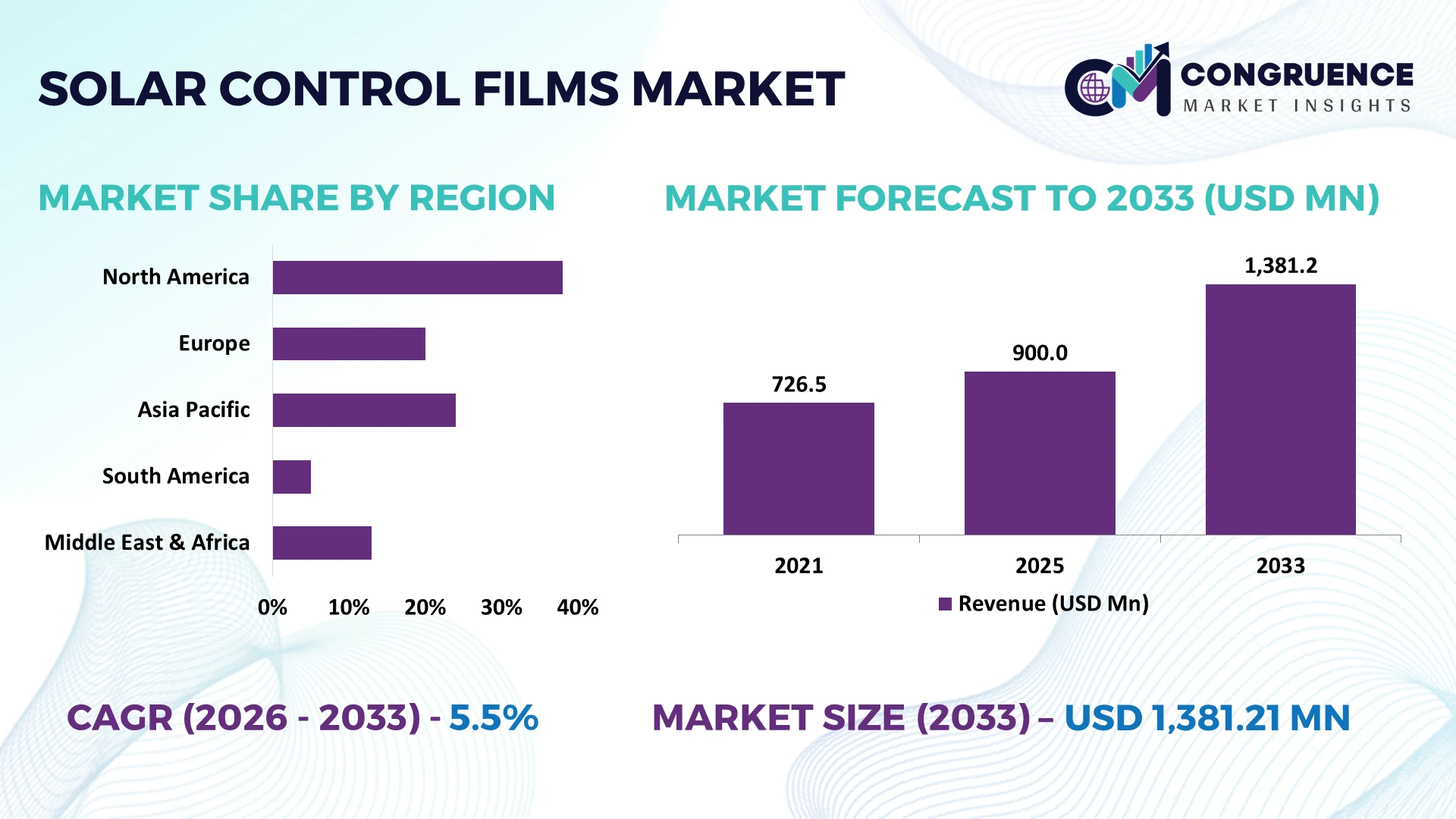
China-led Asia-Pacific holds the dominant position, with the region accounting for 36.91% of global solar control films demand in 2025. China remains a major manufacturing and construction hub, while India recorded a 13.62% import CAGR during 2020–2024. Automotive, commercial construction, and retrofit projects are accelerating adoption of vacuum-coated and advanced heat-rejection films, while India sources products from China, Israel, the U.S., Thailand, and the Netherlands.
Strategically, manufacturers should prioritize Asia-Pacific capacity, localized supply chains, and advanced films that deliver measurable cooling and energy-performance gains.
Market Size & Growth: USD 900 million in 2025 to USD 1,381.21 million by 2033 at 5.5% CAGR, driven by energy-efficient glazing retrofits.
Top Growth Drivers: Building energy efficiency 35%, automotive heat management 30%, UV/glare control 25%.
Short-Term Forecast: By 2028, advanced films are positioned to improve solar-heat rejection by 10–15% versus conventional dyed films.
Emerging Technologies: Vacuum-coated multilayers, smart tinting, AI-assisted optical design, and advanced polymer films are reshaping product performance.
Regional Leaders: Asia-Pacific reaches USD 371.63 million in 2026 with expanding construction adoption; North America benefits from energy retrofits; Europe advances low-carbon building upgrades.
Consumer/End-User Trends: Automotive and commercial users increasingly prioritize films capable of blocking up to 70% of solar heat.
Pilot/Case Example: A Shanghai commercial-building study recorded a 27.5% reduction in peak window-related cooling load using exterior solar-control film.
Competitive Landscape: Leading suppliers control about 38% collectively, with 3M, Avery Dennison, Eastman, Lintec, and Saint-Gobain shaping global competition.
Regulatory & ESG Impact: Building-efficiency policies and retrofit programs strengthen demand as solar films can reduce cooling requirements by about 29% in suitable applications.
Investment & Funding: U.S. infrastructure programs totaling about USD 1.2 trillion reinforce construction modernization and energy-efficiency opportunities.
Innovation & Future Outlook: Next-generation multilayer, smart, self-healing, and electronically controlled films are shifting competition toward performance, durability, and low-carbon retrofits.
Solar control films are increasingly concentrated in commercial glazing, automotive windows, high-solar-load buildings, and retrofit projects where conventional glass replacement is costly. Advanced multilayer and vacuum-coated products are improving heat rejection while preserving optical clarity, with some applications reducing solar radiation by about 60%. India’s expanding import network, alongside China’s manufacturing strength, reflects a broader supply-chain shift toward diversified regional sourcing and faster installation-led adoption, creating a stronger strategic pathway for the global Solar Control Films Market.
Solar control films are becoming strategically important because they let building owners and automakers upgrade thermal performance without replacing installed glazing, turning retrofit capability into a competitive cost lever. The strongest investment case is emerging where cooling loads, glass façades, and passenger comfort intersect. In the next 2–3 years, adoption will increasingly track building-modernization programs and tighter energy-performance requirements rather than new construction alone.
Technology is also changing the economics. Advanced sputtered or multilayer films can reject roughly 60–80% of solar energy while preserving higher visible-light transmission, compared with conventional dyed films that typically deliver weaker infrared control. This performance gap can lower peak cooling demand by around 10–20% in suitable buildings. China leads on manufacturing scale, while the United States and Germany show stronger premium-film innovation and specification-led deployment.
Operationally, a Mumbai commercial tower can retrofit solar-control film across existing façades with limited structural disruption, avoiding a full glazing replacement cycle. Manufacturers are therefore expanding coating capacity, partnering with façade contractors, and localizing distribution. Strategically, the winners will combine optical performance, installation speed, durability, and regional supply resilience into a defensible retrofit proposition. This strengthens lifecycle economics and differentiates suppliers in specification-driven projects.
The primary growth driver is the push to reduce cooling loads from expansive glass façades while preserving daylight and occupant comfort. High-performance films can block about 60–80% of solar energy, while well-specified installations can reduce peak cooling demand by 10–20%. India’s commercial construction pipeline and China’s manufacturing ecosystem are accelerating specification activity. As electricity-cost management and building-efficiency requirements tighten, companies are expanding multilayer coating capacity, strengthening installer networks, and forming façade-system partnerships. The non-obvious advantage is retrofit speed: film can improve existing glazing without replacing frames, allowing property owners to capture efficiency gains with less disruption and shorter project cycles.
Cost volatility in polymers, specialty coatings, and imported optical materials remains a structural restraint, particularly for markets dependent on overseas supply. Input-price movements of 8–12% can materially compress installer and converter margins on fixed-price projects, while premium multilayer films can cost 20–40% more than basic dyed products. India’s reliance on imported specialty films and China’s concentration of manufacturing create exposure to freight disruptions and trade-policy changes. Companies are responding through dual sourcing, regional warehousing, longer procurement contracts, and localized converting. The sharper operational issue is specification substitution: cheaper films can reduce project performance, forcing suppliers to defend lifecycle value rather than compete solely on upfront price.
Next-generation opportunity is shifting toward smart, spectrally selective, and electronically controllable films that combine heat management with daylight optimization. Spectrally selective products can reject roughly 50–70% of solar heat while maintaining substantially higher visible transmission than conventional dark films, opening premium applications in offices, hospitals, airports, and vehicle cabins. India, the UAE, and Southeast Asian cities offer strong retrofit potential because high cooling loads coexist with large installed glazing bases. Over the next 2–3 years, suppliers are positioned to expand R&D, collaborate with glass processors and building-automation firms, and package films with energy-management systems. The strategic opportunity is moving from film supply to integrated façade-performance solutions.
Execution challenges increasingly center on installation consistency, substrate compatibility, and performance verification rather than product availability alone. Poor surface preparation or incorrect application can reduce optical uniformity and shorten service life, while complex façades require trained installers and controlled quality procedures. Premium projects can involve 15–25% higher labor or specification costs when advanced films require specialized handling. In Japan and Germany, stringent façade standards raise documentation and testing expectations; in India, uneven installer capability creates variability between projects. Companies must invest in certified installation networks, digital measurement tools, warranty tracking, and technical training. Long-term competitiveness will depend on delivering repeatable field performance at scale, not simply developing higher-performing film chemistry.
Ceramic Films Gain Specification Share: Ceramic films now command approximately 35% of type demand, supported by high infrared rejection, optical clarity, and signal compatibility. U.S. automotive and commercial projects are shifting from basic dyed products toward nano-ceramic formulations, while manufacturers expand premium coating capacity and installer partnerships.
Retrofit Installation Gets Faster: Commercial retrofit workflows increasingly favor film over complete glazing replacement, with project cycles typically 30–50% shorter. A Shanghai commercial-building study found exterior film reduced window-related cooling load by 27.5%, encouraging facility managers to prioritize minimally disruptive envelope upgrades and suppliers to strengthen contractor networks.
Performance Certification Shapes Procurement: Building owners increasingly specify solar heat-gain coefficient, visible-light transmission, and UV-blocking performance rather than tint darkness alone. Advanced films can deliver up to 29% heating-and-cooling energy savings in hot climates, pushing manufacturers toward standardized testing, digital product specifications, and performance-backed warranties.
Supply Chains Move Toward Localization: Geopolitical trade pressure is encouraging converters to diversify imported polymers, coatings, and specialty substrates across India and Southeast Asia. Companies are increasing regional inventory buffers and dual-sourcing arrangements, reducing exposure to freight disruption while improving delivery reliability for large architectural and automotive installation programs.
Ceramic Films lead the Solar Control Films Market with approximately 34.9% share, supported by strong heat rejection, optical clarity, durability, and minimal interference with electronic signals. Metalized Films follow at about 29.2%, retaining strong demand where high solar reflectance and cost-performance balance are priorities. Dyed Films account for roughly 19.8%, benefiting from lower acquisition costs and established aftermarket installation networks, while Carbon Films hold approximately 11.2% and are gaining traction where color stability and thermal performance matter. The mature dyed segment remains relevant for price-sensitive retrofit projects, but investment is increasingly moving toward ceramic formulations as architects and automotive buyers demand higher infrared rejection without darker appearance. Manufacturers are expanding ceramic production, refining multilayer structures, and partnering with installers to secure premium specifications. The strategic shift favors suppliers that combine heat rejection, clarity, durability, and signal compatibility rather than competing primarily on film price.
Heat Reduction represents the leading application at approximately 48% share, reflecting the direct operational need to control solar heat entering buildings and vehicle cabins. Glare Reduction accounts for about 24%, while UV Protection represents nearly 18% and Privacy & Security approximately 10%. Heat-management applications remain strongest in hot-climate markets such as India, China, and the Middle East, where glazing contributes materially to cooling loads. Glare Reduction is gaining specification importance in offices, retail spaces, and transportation environments where screen visibility and occupant comfort affect daily operations. UV Protection remains a mature but essential requirement, particularly for vehicles and commercial interiors containing sensitive furnishings. Companies are responding with multifunctional films that combine thermal control, glare management, and UV blocking within one installation. This integrated approach reduces application complexity and improves the value proposition of premium film systems.
Commercial Buildings represent the dominant end-user group at approximately 42% share, supported by extensive glazed façades, high occupancy, cooling intensity, and recurring retrofit requirements. Automotive follows at around 31% and is the fastest-shifting major segment as manufacturers increasingly integrate advanced films for cabin thermal comfort, UV protection, and electronic-signal compatibility. Residential Buildings contribute nearly 18%, while Transportation accounts for approximately 9%. Commercial buyers increasingly evaluate films through energy-performance specifications and façade-contractor partnerships, whereas automotive customers place greater emphasis on OEM validation, optical clarity, and production-line compatibility. Companies are therefore customizing product portfolios by end-use, strengthening architectural installer ecosystems, and pursuing automotive partnerships. The non-obvious shift is toward specification-led commercial purchasing, where documented lifecycle performance increasingly outweighs the lowest upfront installation cost.
Asia-Pacific accounted for the largest market share at 36.91% in 2025 however, Middle East & Africa is expected to register the fastest growth, expanding at a CAGR of 6.2% between 2026 and 2033.

Premium Retrofit Demand Strengthens
North America holds approximately 25% of global demand, with the United States dominating commercial retrofit and automotive applications. California, Texas, Florida, and Arizona remain important deployment centers because intense solar exposure increases cooling requirements across offices, retail properties, hospitals, and vehicle fleets. Ceramic and spectrally selective films are gaining preference, with advanced products rejecting approximately 60–80% of solar energy while maintaining higher visible-light transmission. Commercial buyers increasingly evaluate SHGC performance, durability, and installation downtime rather than tint appearance alone. Manufacturers are responding through certified installer networks, architectural partnerships, and automotive distribution agreements. The strategic shift toward retrofit efficiency is strengthening demand for films that deliver measurable thermal benefits without requiring complete glazing replacement.
United States Market Outlook: The United States remains the dominant North American market because of its extensive commercial building stock, established aftermarket installation ecosystem, and advanced automotive sector. Premium ceramic films are gaining specification traction, while suppliers are strengthening relationships with architects, façade contractors, and automotive distributors.
Energy-Efficient Renovation Reshapes Specifications
Europe represents approximately 21% of global demand, with Germany, France, Italy, Spain, and the United Kingdom driving architectural deployment. Building renovation programs and stricter energy-performance requirements are shifting purchasing toward spectrally selective and low-reflectance products. Advanced films can reject approximately 50–70% of solar heat while preserving daylight, supporting deployment across offices, hospitals, retail facilities, and transportation infrastructure. Southern European markets emphasize cooling-load reduction, while Germany and Northern European markets prioritize building-envelope modernization and lifecycle efficiency. Manufacturers are expanding high-performance product portfolios and strengthening partnerships with façade engineers and installers. Retrofit compatibility remains a major competitive advantage because property owners can upgrade existing glazing without undertaking extensive structural reconstruction.
Germany Market Outlook: Germany provides a strategically important premium market because commercial renovation increasingly emphasizes measurable façade efficiency. Suppliers are targeting architects, facility managers, and façade specialists with ceramic and spectrally selective films that combine solar control, optical clarity, durability, and daylight preservation.
Manufacturing Scale Drives Regional Leadership
Asia-Pacific leads the global market with approximately 36.91% share, supported by China’s manufacturing capacity, India’s commercial construction activity, and Japan and South Korea’s advanced automotive industries. China remains a major production and export center, enabling competitive pricing and shorter supply cycles across Asian markets. India is strengthening deployment in commercial buildings, automotive glazing, and retrofit projects, while Japan prioritizes premium optical and durability specifications. Advanced films increasingly achieve 60–80% solar-energy rejection, supporting adoption in high-temperature environments. Manufacturers are expanding coating capacity, local warehouses, distributor networks, and installation partnerships. Supply-chain localization is becoming more important as producers seek greater control over specialty materials, delivery times, and regional customer service.
China Market Outlook: China remains the most strategically significant market because manufacturing scale, automotive production, construction activity, and export infrastructure reinforce the entire supply chain. Domestic producers are increasingly investing in ceramic formulations, multilayer structures, optical clarity, and high-volume production efficiency.
Brazil Anchors Automotive and Retrofit Demand
South America accounts for approximately 8% of global demand, with Brazil representing the principal consumption and installation market. Commercial buildings, retail facilities, automotive aftermarket applications, and high-solar-exposure properties generate the strongest requirement for heat and glare management. Brazil’s automotive manufacturing base creates additional opportunities for OEM-linked and aftermarket products, while residential adoption remains more price-sensitive. Dyed and metallized films therefore retain substantial volume demand, although ceramic products are gaining traction in premium vehicles and corporate buildings. Installation capability remains uneven outside major cities, encouraging suppliers to strengthen distributor networks, installer training, and regional inventory. Companies are increasingly prioritizing major metropolitan markets where retrofit films offer faster installation and lower disruption than complete glazing replacement.
Brazil Market Outlook: Brazil holds the strongest strategic position through its automotive manufacturing ecosystem, commercial building stock, and established aftermarket channels. Suppliers are combining cost-efficient products for volume applications with premium ceramic films for higher-value vehicles and corporate properties.
Extreme Heat Accelerates Premium Deployment
Middle East & Africa represents approximately 8% of global demand, with Saudi Arabia and the United Arab Emirates leading premium architectural deployment. Airports, hotels, commercial towers, transportation facilities, and major urban developments increasingly require advanced solar-control products because intense solar exposure directly increases cooling requirements. High-performance films rejecting approximately 60–80% of solar energy are gaining specification preference in glass-intensive projects. Gulf infrastructure programs are encouraging suppliers to establish local project teams, distributor relationships, inventory hubs, and façade partnerships. African markets remain comparatively price-sensitive, supporting continued demand for dyed and metallized films. Manufacturers are therefore developing segmented portfolios that address premium Gulf projects while maintaining cost-focused solutions for African commercial and residential applications.
Saudi Arabia Market Outlook: Saudi Arabia offers the strongest strategic pipeline through large-scale urban, hospitality, transportation, and commercial infrastructure development. Suppliers with local project partnerships, rapid delivery capabilities, advanced architectural films, and technical specification support are positioned to capture premium installations.
The Solar Control Films Market features global leaders including 3M, Eastman, Avery Dennison, Saint-Gobain, and LINTEC competing with regional converters and cost-focused manufacturers. The top five players collectively account for approximately 35–40% of market share, while regional specialists compete for customized and price-sensitive contracts. Competition centers on optical performance, heat rejection, durability, pricing, customization, installation speed, and supply reliability. Premium ceramic and multilayer products command approximately 20–40% higher pricing than conventional dyed films, while delivering around 15–25% stronger solar-energy rejection. Global companies are expanding coating capacity, strengthening automotive OEM relationships, and developing architectural specification networks. Regional suppliers counter with localized inventory, faster delivery, and customized formulations. The competitive structure is shifting from basic tinting toward performance-certified solutions as buyers demand measurable thermal outcomes. Technology ownership, dependable supply, installer ecosystems, customization capability, and specification relationships will determine which companies secure premium contracts and defend market position.
3M Company
Eastman Chemical Company
Avery Dennison Corporation
Saint-Gobain
LINTEC Corporation
Garware Hi-Tech Films Limited
Johnson Window Films
Madico, Inc.
XPEL, Inc.
Hanita Coatings
Toray Industries, Inc.
Sekisui Chemical Co., Ltd.
Current solar-control technology is shifting from dyed and conventional metallized films toward nano-ceramic, sputtered, and spectrally selective structures. Advanced ceramic films can improve infrared rejection by about 10–15% versus older dyed systems while preserving higher visible transmission. Adoption is strongest in premium automotive and commercial glazing, where roughly 30–35% of premium specifications prioritize non-metalized performance. Integration with façade energy modeling is strengthening specification accuracy.
Emerging systems combine multilayer optical stacks, recycled PET substrates, and low-reflectance coatings. Recycled-material films can cut material-related carbon impact by around 15–18%, while advanced coatings improve solar-energy rejection by 1–2% through tighter spectral control. Deployment remains concentrated in retrofit-heavy commercial buildings and vehicles, giving manufacturers using sustainable materials and high-clarity formulations a differentiation advantage. Automated optical testing and digital specification tools reduce selection errors and installation rework.
Disruptive development is moving toward dynamic thermochromic and electronically controlled films that adjust solar transmission according to temperature or control signals. Commercialization should improve thermal-management efficiency by 1–2% as switching reliability and manufacturing scale improve. From 2026–2028, suppliers combining smart films with building-management systems, sensors, and energy controls will gain competitive advantage. Companies should act now because advanced materials, automation, and sustainable substrates are shifting procurement toward lifecycle performance.
June 2026 Avery Dennison launched Clima Architectural Window Films in India, introducing four options for commercial and luxury residential properties. The portfolio targets solar control and cooling efficiency, strengthening localized specifications and expanding premium-film opportunities across climate-intensive buildings.
July 2025 LINTEC launched BR-50UH RECYCLE 100, a solar-control film using 100% recycled PET resin. It reduces solar-radiation permeability to approximately 57%, blocks over 99% ultraviolet rays, and cuts CO2 emissions 17.5% versus non-recycled PET, advancing sustainable differentiation. Source: lintec-global.com
June 2025 American Window Film acquired Denver-based Solar Vision, a 3M Authorized Dealer, expanding its national installation footprint. The transaction strengthened access to commercial, government, and residential customers while adding expertise in solar-control and security-film deployment across Colorado. Source: americanwindowfilm.com
August 2025 3M documentation for Crystalline automotive films reported up to 98% infrared rejection, 99.9% UV blocking, and 61% total solar-energy rejection. The performance profile reinforces non-metalized films as a technology route for thermal comfort without compromising connectivity. Source: 3m.com
The Solar Control Films Market Report covers Dyed Films, Metallized Films, Ceramic Films, and Carbon Films across Heat Reduction, Glare Reduction, UV Protection, and Privacy & Security applications. End-user analysis includes Residential Buildings, Commercial Buildings, Automotive, and Transportation, enabling comparison of mature volume segments with premium performance-led applications. Regional coverage spans North America, Europe, Asia-Pacific, South America, and Middle East & Africa, with country-level analysis focused on China, India, the United States, Germany, Brazil, and Saudi Arabia.
The report evaluates nano-ceramic, multilayer, sputtered, spectrally selective, recycled-material, and emerging smart-film technologies, alongside adoption patterns, installation models, supply-chain positioning, and competitive strategies. It supports investment planning by identifying approximately 35%–40% concentration among leading suppliers, premium technology shifts, retrofit deployment priorities, and application-specific demand. Strategic insights help companies optimize capacity expansion, partnerships, product positioning, regional entry, and technology investment through 2026–2033.
| Report Attribute/Metric | Report Details |
|---|---|
Market Revenue in 2025 | USD 900 Million |
Market Revenue in 2033 | USD 1381.21 Million |
CAGR (2026 - 2033) | 5.5% |
Base Year | 2025 |
Forecast Period | 2026 - 2033 |
Historic Period | 2021 - 2025 |
Segments Covered | By Type
By Application
By End-User
|
Key Report Deliverable | Revenue Forecast, Growth Trends, Market Dynamics, Segmental Overview, Regional and Country-wise Analysis, Competition Landscape |
Region Covered | North America, Europe, Asia-Pacific, South America, Middle East, Africa |
Key Players Analyzed | 3M Company, Eastman Chemical Company, Avery Dennison Corporation, Saint-Gobain, LINTEC Corporation, Garware Hi-Tech Films Limited, Johnson Window Films, Madico, Inc., XPEL, Inc., Hanita Coatings, Toray Industries, Inc., Sekisui Chemical Co., Ltd. |
Customization & Pricing | Available on Request (10% Customization is Free) |




