
Reports
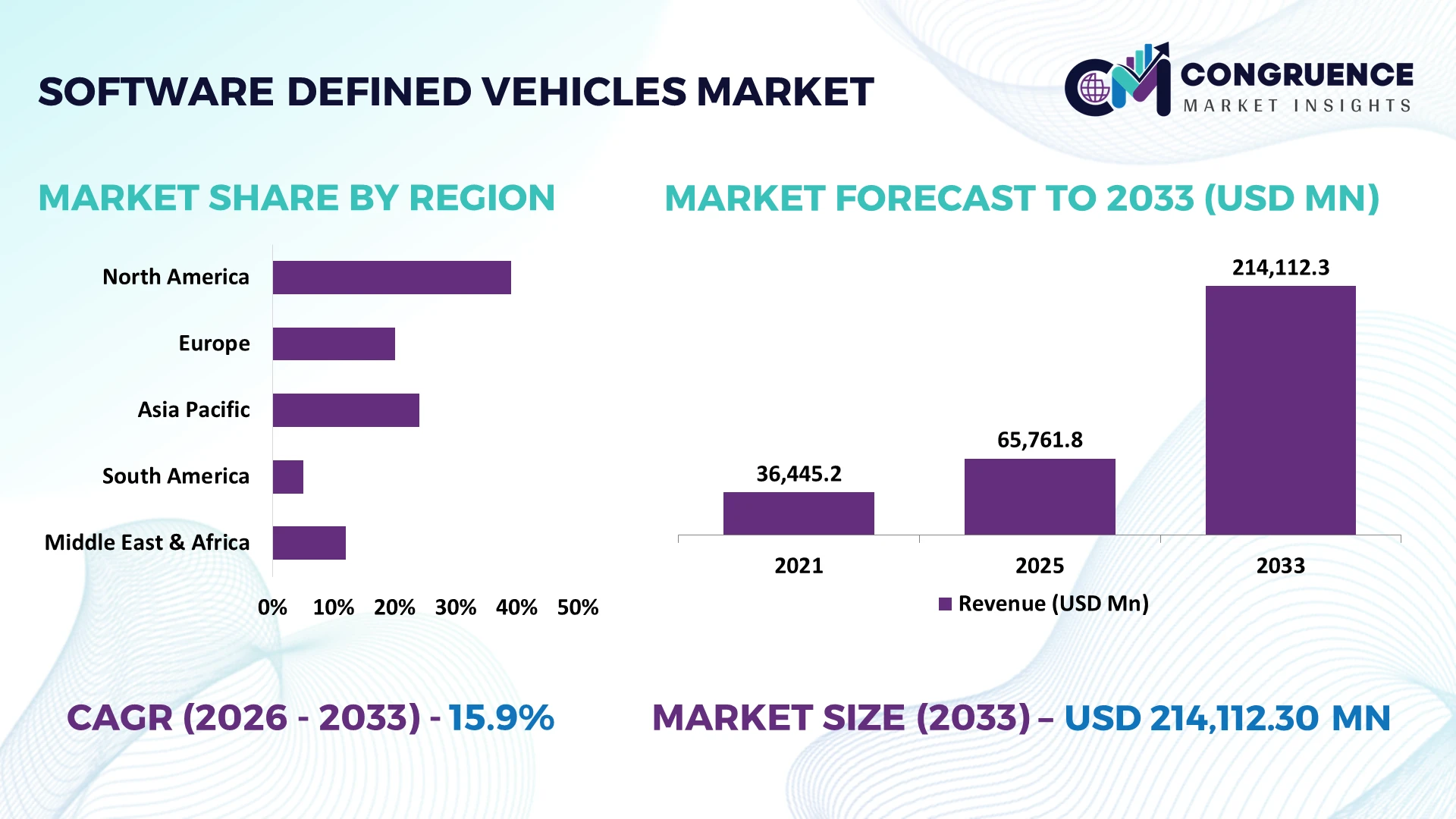
The Global Software-Defined Vehicles Market was valued at USD 65761.8 Million in 2025 and is anticipated to reach a value of USD 214112.3 Million by 2033 expanding at a CAGR of 15.9% between 2026 and 2033. Growth is driven by centralized vehicle computing, zonal electrical architectures, over the air software delivery, AI enabled driving functions, and automaker migration from hardware coupled electronic control units toward upgradeable software platforms.
China anchors global deployment through the world’s largest automotive manufacturing base, producing more than 31 million vehicles in 2024, while new energy vehicles represented over 40% of domestic new vehicle sales. Compared with Germany’s premium engineering led transition, Chinese manufacturers commercialize connected cockpit, assisted driving, and centralized computing functions across broader price bands. US restrictions on advanced semiconductor exports to China are simultaneously accelerating domestic automotive chip development and localized software stacks, making technology sovereignty an increasingly important vehicle architecture consideration.
Automakers controlling software architecture, computing hardware integration, and lifecycle updates will capture greater vehicle value while reducing dependence on fragmented supplier controlled electronic systems.
Market Size & Growth: USD 65,761.8 million in 2025 reaches USD 214,112.3 million by 2033 at 15.9% CAGR, driven by centralized computing and continuous software upgrades.
Top Growth Drivers: Connected vehicle penetration above 70%, electric vehicle sales share above 20%, and OTA capable architectures exceeding 50% accelerate software centric vehicle development.
Short Term Forecast: By 2028, centralized electronic architectures can reduce wiring complexity by 20%, lowering vehicle weight while simplifying software and hardware integration.
Emerging Technologies: AI accelerators, zonal controllers, and vehicle operating systems consolidate functions previously distributed across 70 to 100 electronic control units.
Regional Leaders: Asia Pacific approaches USD 92 billion, North America USD 65 billion, and Europe USD 48 billion by 2033 as centralized architectures penetrate vehicle platforms.
Consumer and End User Trends: More than 70% of new vehicles globally incorporate connected capabilities, expanding demand for remotely delivered functionality, diagnostics, infotainment, and personalization.
Pilot and Case Example: In 2025, Volvo’s EX90 architecture used NVIDIA DRIVE Orin delivering 254 TOPS, consolidating AI processing for advanced driving and safety functions.
Competitive Landscape: Tesla holds an estimated 18% position in advanced software centric vehicle deployment, competing with BYD, Volkswagen, Mercedes Benz, and General Motors.
Regulatory & ESG Impact: EU fleet targets require a 55% CO₂ reduction for new cars by 2030, reinforcing electrified architectures where software manages energy and vehicle performance.
Investment & Funding: Volkswagen and Rivian established a joint venture valued at up to USD 5.8 billion to develop next generation electrical architecture and software technology.
Innovation & Future Outlook: 1 centralized compute platform increasingly replaces dozens of domain controllers, shifting competitive differentiation toward operating systems, AI models, and upgradeable vehicle functions.
The Software-Defined Vehicles Market is reshaping automotive engineering around centralized compute, standardized middleware, zonal controllers, cloud connectivity, and continuously updateable functions. Advanced driver assistance, digital cockpits, predictive diagnostics, battery optimization, and personalized services increasingly depend on software rather than fixed mechanical differentiation. Modern premium vehicles can contain more than 100 million lines of code, intensifying demand for modular architectures and automated validation. Semiconductor localization following geopolitical supply restrictions is also influencing platform design, pushing automakers toward adaptable hardware abstraction and multivendor computing strategies that establish the foundation for the industry’s next strategic transition.
Software defined vehicles are shifting automotive competition from model year hardware differentiation toward continuously upgradeable digital platforms, making software architecture a core investment decision. Automakers are restructuring supplier relationships as centralized compute, proprietary operating systems, and semiconductor control replace fragmented ECU procurement. Cybersecurity regulation is reinforcing this transition, with UNECE software update requirements increasingly embedded in vehicle homologation programs across major automotive markets.
Zonal architectures can reduce wiring harness length by roughly 30% versus conventional domain based electrical systems while consolidating computing functions into fewer controllers. China leads deployment scale through vertically integrated electric vehicle platforms, whereas Germany emphasizes safety validated architectures across premium vehicles. Through 2028, manufacturers will increasingly standardize common software platforms across multiple models, reducing duplicated engineering while accelerating feature deployment.
A practical architecture can connect propulsion, cockpit, body, safety, and connectivity functions through centralized computers and zonal gateways, allowing validated features to reach fleets remotely. Automakers are forming semiconductor alliances, software ventures, and technology partnerships while expanding internal engineering teams. Competitive leadership will depend on owning reusable software foundations that shorten development cycles, preserve hardware flexibility, and support continuous customer value after vehicle delivery.
Automakers are replacing distributed electronics with centralized computing because conventional architectures can contain more than 100 ECUs, increasing wiring, validation, and integration complexity. Zonal designs can reduce wiring requirements by 20% to 30%, while shared compute platforms eliminate duplicated hardware across vehicle functions. China is accelerating this transition through electric vehicle platforms integrating cockpit, connectivity, and assisted driving software from initial design. The structural impact extends beyond component reduction: centralized architectures allow common software to serve multiple vehicle lines, improving engineering reuse and update consistency. Automakers are responding through proprietary operating systems, semiconductor partnerships, and dedicated software organizations. The decisive advantage is platform reuse, because each validated software module can be deployed across several models without rebuilding separate electronic architectures.
Software centric vehicles require powerful processors, memory, networking chips, and specialized accelerators, creating dependence on a semiconductor supply chain concentrated across limited manufacturing locations. Taiwan produces more than 60% of global foundry output and over 90% of the most advanced logic chips, while automotive semiconductor lead times can exceed 20 weeks during supply disruptions. US technology restrictions affecting China further complicate access to advanced computing hardware and development tools. Hardware redesign after chip substitution increases validation expense because safety critical software must be retested against changed processors. Automakers are reducing exposure through dual sourcing, long term capacity agreements, regional semiconductor partnerships, and hardware abstraction layers. The strategic restraint is therefore qualification rigidity: software flexibility cannot compensate when certified computing hardware becomes unavailable.
Upgradeable vehicle functions create a commercial opportunity to extend customer relationships beyond the initial vehicle purchase. Connected architectures allow automakers to activate driver assistance, performance settings, entertainment, navigation, and comfort functions remotely, while OTA delivery can eliminate more than 50% of software related workshop interventions for suitable faults. South Korea provides a strong development environment through advanced electronics, 5G infrastructure, and integrated automotive manufacturing. By 2028, feature on demand platforms will increasingly combine subscription, temporary activation, and permanent upgrade models. Manufacturers are building application marketplaces, developer ecosystems, standardized APIs, and cloud connected service platforms. A non obvious advantage is inventory simplification: common hardware can support differentiated software configurations, reducing physical option complexity while allowing manufacturers to personalize vehicles after production.
Vehicle software complexity is expanding faster than traditional validation processes can scale. Modern premium vehicles can exceed 100 million lines of code, while safety critical functions require compliance with standards such as ISO 26262 and cybersecurity engineering under ISO/SAE 21434. Software defects are particularly costly because one faulty shared component can propagate across multiple vehicle domains and models. Germany’s safety intensive automotive engineering environment illustrates the pressure to reconcile rapid software releases with rigorous homologation and functional safety requirements. Automakers must invest in virtual validation, hardware in the loop testing, digital twins, automated regression pipelines, and software bill of materials management. The long term challenge is release discipline: companies must increase update frequency without allowing shared platform defects to scale simultaneously across connected fleets.
Ethernet Replaces Legacy Vehicle Networks: Automakers are migrating high bandwidth functions toward automotive Ethernet as cameras, radar, infotainment, and diagnostics overwhelm conventional CAN networks. Ethernet supports speeds from 100 Mbps to 10 Gbps, versus CAN commonly operating below 10 Mbps. German premium OEMs are expanding Ethernet backbones across new platforms, while suppliers scale switches, gateways, and time sensitive networking components to reduce communication bottlenecks and simplify data intensive vehicle architectures.
Digital Twins Accelerate Vehicle Validation: Virtual engineering is moving software testing earlier in development, allowing teams to validate functions before physical prototypes become available. Digital simulation can reduce physical prototype requirements by 20% and shorten selected validation cycles by 30%. European manufacturers are connecting simulation environments with continuous software integration pipelines. OEMs and engineering suppliers are expanding virtual ECU testing and cloud simulation capacity, improving release speed without proportionally increasing prototype fleets or laboratory infrastructure.
Open Source Middleware Gains Ground: Vehicle manufacturers are adopting reusable middleware to separate applications from underlying hardware and reduce proprietary integration dependencies. Standardized interfaces can improve software component reuse by 25% and reduce selected integration workloads by 15%. Japanese and European automakers are participating in collaborative software ecosystems as development talent becomes strategically constrained. Suppliers are expanding AUTOSAR compatible stacks, containerized services, and abstraction frameworks, allowing applications to migrate between processor generations with less redevelopment.
Vehicle Data Platforms Expand Commercially: Connected fleets are turning vehicle telemetry into engineering, maintenance, insurance, and mobility intelligence. A connected vehicle can generate gigabytes of operational data daily, while 5G networks deliver latency below 20 milliseconds under optimized conditions. Automakers are establishing consent management, cloud analytics, and data exchange frameworks. The non obvious shift is toward selective edge filtering, which reduces unnecessary transmission costs while preserving commercially valuable events for downstream services.
Embedded Systems lead with an estimated 31% share because virtually every software defined vehicle depends on processors, firmware, sensors, memory, and control software operating within safety critical functions. Their installed scale remains greater than newer architectural layers, while standardized embedded platforms can improve software reuse by roughly 20%. Vehicle Operating Systems increasingly coordinate applications and hardware resources, whereas Domain Controllers remain important transitional architectures consolidating related functions such as cockpit or driving assistance.
Centralized Computing is the fastest growing type as automakers consolidate workloads previously distributed across dozens of controllers. Central computers can replace several domain specific processors, improving compute utilization while reducing duplicated hardware. Zonal Architecture is developing alongside this shift by reorganizing electronics around vehicle location rather than function, with wiring reductions approaching 30% in optimized designs. Automakers and semiconductor suppliers are investing in high performance processors, zonal gateways, middleware, and scalable reference platforms. Capital allocation is consequently moving from isolated controllers toward reusable computing foundations supporting multiple models and software generations.
ADAS represents the leading application with an estimated 27% share as cameras, radar, ultrasonic sensing, perception algorithms, and driver monitoring increase software intensity. Level 2 functionality already represents a substantial proportion of newly produced vehicles in major automotive markets, requiring continuous sensor fusion and compute management. Infotainment remains a mature software domain, while Vehicle Connectivity increasingly links cars with cloud services, applications, diagnostics, and external infrastructure. Powertrain Control and Body Control remain essential but comparatively established workloads.
Autonomous Driving is the fastest growing application because higher automation levels require substantially greater perception, prediction, localization, and decision processing. Advanced autonomous platforms can exceed 1,000 TOPS of aggregate computing capability, far above conventional cockpit workloads. Over the Air Updates are becoming an architectural requirement because software functions require remote maintenance throughout vehicle life. OEMs are therefore expanding AI compute partnerships, simulation programs, connectivity platforms, and integrated software validation. Investment is shifting toward applications capable of improving continuously after production rather than remaining fixed at factory configuration.
Passenger Cars lead with an estimated 44% share because their production scale supports broad deployment of digital cockpits, connected services, driver assistance, and software controlled comfort functions. Automotive OEMs remain critical institutional buyers because they determine vehicle architecture, software procurement, and platform standardization. Commercial Vehicles increasingly adopt software for fleet diagnostics and utilization management, while Fleet Operators prioritize uptime, routing visibility, and remote maintenance. Mobility Services require centralized fleet software capable of managing vehicles across continuous operating cycles.
Electric Vehicles are the fastest growing end user segment because digitally native electrical architectures simplify integration between battery management, propulsion, connectivity, and centralized computing. Battery electric cars represented more than 15% of global new car sales in 2024, creating a rapidly expanding software addressable fleet. Autonomous Vehicles remain technologically intensive but deployment constrained, while mobility operators provide targeted commercial testing environments. OEMs are responding with dedicated EV software platforms, strategic semiconductor agreements, cloud partnerships, and modular service packages. Competitive positioning increasingly depends on retaining control of software throughout the vehicle lifecycle.
Asia Pacific accounted for the largest market share at 42% in 2025 however, Asia Pacific is expected to register the fastest growth, expanding at a CAGR of 18.2% between 2026 and 2033.

Software Platforms Reshape Automotive Value Chains
North America accounted for an estimated 29% market share in 2025, supported by strong automotive software engineering, semiconductor design, cloud infrastructure, and advanced mobility development. The region’s advantage increasingly centers on vertically coordinated computing ecosystems rather than vehicle assembly volume. US automakers are integrating high performance processors with cloud connected development environments, while technology suppliers provide AI accelerators, simulation tools, cybersecurity platforms, and mapping infrastructure. SAE Level 2 driving functions are already widely available across new premium and mainstream models, strengthening demand for scalable software stacks. Automakers are also separating software development from conventional model programs, enabling common code bases across vehicle families. Partnerships between OEMs, chip designers, cloud companies, and software specialists are becoming central to controlling development schedules and reducing platform fragmentation.
United States Market Outlook: The United States combines established technology companies with major automotive engineering centers in Michigan, California, and Texas. Tesla’s vertically integrated software approach demonstrated the strategic value of continuous feature deployment, while General Motors and Ford are restructuring internal software programs. US semiconductor leadership also gives automakers access to computing platforms exceeding hundreds of TOPS for advanced vehicle functions.
Regulation Accelerates Architecture Standardization
Europe represented an estimated 25% market share in 2025, with Germany, France, Sweden, and the United Kingdom concentrating automotive software engineering and premium vehicle development. UNECE cybersecurity and software update regulations are pushing manufacturers toward traceable development, controlled remote updating, and lifecycle software governance. Europe manufactured roughly 15 million motor vehicles in 2024, creating a substantial installed production base for architecture migration. German OEMs are developing proprietary operating environments, while suppliers increasingly provide hardware independent middleware and standardized software components. The transition is also restructuring procurement as automakers seek greater ownership of application layers while retaining specialist suppliers for safety critical functions. Partnerships between OEMs, semiconductor companies, software developers, and engineering groups are accelerating because regulatory compliance must increasingly be designed into vehicle architecture rather than added after development.
Germany Market Outlook: Germany remains Europe’s strategic center through Volkswagen, Mercedes Benz, BMW, Bosch, Continental, and a dense engineering ecosystem. The country produced more than 4 million passenger cars in 2024. Premium manufacturers increasingly use common software foundations across multiple nameplates, making Germany particularly important for scalable operating systems, cockpit software, automated driving integration, and validation technology.
China Scale Compresses Software Development Cycles
Asia Pacific held approximately 42% of the market in 2025, reflecting China’s vehicle scale alongside advanced automotive electronics capabilities in Japan and South Korea. China sold more than 31 million vehicles during 2024, giving domestic manufacturers unusually large fleets for collecting operational data and refining digital functions. Competitive pressure is shortening product cycles as manufacturers integrate intelligent cockpits, assisted driving, connectivity, and cloud services across mainstream models. Japan contributes safety engineering and automotive semiconductor expertise, while South Korea combines vehicle manufacturing with advanced displays, memory, telecommunications, and consumer electronics capabilities. Domestic technology ecosystems are becoming strategically important as manufacturers localize software tools and computing components. OEMs are expanding internal software teams and collaborating with technology companies to accelerate architecture development while retaining greater control over vehicle data.
China Market Outlook: China offers exceptional commercialization speed because automotive manufacturers operate alongside large battery, electronics, telecommunications, and digital platform ecosystems. Domestic brands captured more than 60% of Chinese passenger vehicle sales during 2024, strengthening their ability to define software interfaces independently. Intense competition is pushing advanced cockpit and assisted driving functionality from premium models toward higher volume vehicle categories.
Connected Platforms Enter Local Production
South America represented an estimated 2% market share in 2025, with Brazil accounting for the majority of software enabled vehicle deployment and manufacturing activity. The market is shaped primarily by connected passenger vehicles, fleet telematics, localized production, and gradual electrification rather than advanced autonomous deployment. Brazil produced roughly 2.5 million vehicles in 2024, providing meaningful manufacturing scale for introducing globally developed electronic architectures into locally assembled models. Argentina contributes additional automotive production, while Chile provides an important technology adoption environment through vehicle imports and electrification initiatives. Infrastructure differences outside major cities constrain continuous connected services, making offline functionality and resilient telecommunications important design considerations. Automakers are adapting global platforms for local connectivity conditions while telecommunications providers and fleet technology companies expand vehicle data services.
Brazil Market Outlook: Brazil combines the region’s largest automotive manufacturing ecosystem with extensive commercial fleets and strong mobile connectivity. São Paulo, Minas Gerais, Paraná, and Rio Grande do Sul concentrate automotive production and supplier activity. Local manufacturers increasingly introduce connected infotainment, remote diagnostics, telematics, and digital services, creating a practical foundation for progressively more software controlled vehicle architectures.
Digital Mobility Investment Accelerates Deployment
Middle East and Africa accounted for an estimated 2% market share in 2025, with deployment concentrated in the UAE, Saudi Arabia, Israel, and South Africa. Gulf countries provide particularly favorable conditions for connected vehicles because high quality telecommunications networks, smart city programs, and digitally managed transport infrastructure support cloud dependent automotive services. Saudi Arabia is simultaneously building domestic electric vehicle manufacturing capabilities, while the UAE is advancing autonomous mobility testing and intelligent transportation infrastructure. Dubai targets autonomous journeys to represent 25% of all transportation by 2030, creating a policy driven environment for vehicle software, connectivity, mapping, and fleet orchestration. Automakers and mobility technology companies are establishing local partnerships around connected services and automated transportation, while African deployment remains more dependent on telecommunications coverage, vehicle affordability, and fleet economics.
United Arab Emirates Market Outlook: The UAE provides a concentrated test environment for connected and autonomous mobility through advanced 5G infrastructure, digitally managed roads, and government backed transport programs. Dubai has conducted autonomous taxi and mobility trials involving global technology providers, while high premium vehicle penetration supports advanced digital cockpit and driver assistance adoption before broader deployment across neighboring markets.
Tesla, Volkswagen, Toyota, General Motors, Mercedes Benz, and BYD compete to control software platforms while semiconductor suppliers compete for architecture influence beneath OEM stacks. The top five platform leaders hold an estimated 46% combined share of software defined vehicle deployments. Competition depends on software ownership, development speed, computing efficiency, and ecosystem control rather than hardware specifications alone. Centralized architectures can reduce electronic hardware complexity by 20%, reusable software platforms can cut development effort by 25%, and automated validation can shorten release cycles by 30%. Volkswagen and Rivian are pooling architecture development, Toyota is expanding Arene, Mercedes Benz is scaling MB.OS, and Chinese manufacturers are vertically integrating software with electronics. Competitive power is shifting toward OEM controlled operating layers and standardized compute platforms. Validation costs, cybersecurity certification, semiconductor access, and developer scale constrain entry. Winning requires reusable software, secure update capability, hardware abstraction, rapid validation, and ecosystem ownership across vehicle generations.
Tesla
Volkswagen Group
Toyota Motor Corporation
General Motors
Mercedes Benz Group
BYD
BMW Group
Ford Motor Company
Hyundai Motor Company
NVIDIA
Qualcomm
Bosch
Continental
Aptiv
Current SDV technology centers on Ethernet, service oriented middleware, hardware abstraction, and cloud native development. Time sensitive networking can deliver deterministic gigabit communication, while virtualized ECUs reduce dependence on physical prototypes and can shorten integration cycles by 25%. Central compute adoption is moving from premium vehicles toward volume platforms, giving OEMs reusable software foundations and faster cross model deployment.
Emerging platforms combine virtual system on chips, containerized applications, AI accelerators, and digital twin validation. Cloud virtual development can begin before hardware exists, reducing hardware dependent testing effort by 30%. Compared with legacy ECU specific development, virtualized software pipelines can improve engineering reuse by 20% across vehicle programs. Automakers with common middleware and silicon partnerships gain advantage because software teams can validate applications once and deploy them across multiple vehicle tiers.
Between 2026 and 2028, disruptive integration will center on agentic AI, chiplet compute, vehicle to cloud orchestration, and adaptive software deployment. Edge AI can reduce cloud communication requirements by 15% through local inference and data transmission. OEMs are prioritizing unified developer environments, safety certified AI frameworks, and continuous validation. Acting now matters because architecture choices made today determine software portability, update economics, and feature velocity across fleets at industrial scale.
November 2024 Volkswagen Group and Rivian launched their software and electrical architecture joint venture, with Volkswagen committing up to USD 5.8 billion. The partnership targets next generation SDVs across vehicle segments, accelerating platform development and deployment. Source: Volkswagen Group.
March 2025 General Motors expanded its NVIDIA collaboration, adopting AI infrastructure, simulation software, and DRIVE AGX for next generation driver assistance. GM expects Super Cruise to generate USD 2 billion annually within five years, strengthening software monetization globally. Source: Reuters.
January 2026 Qualcomm expanded Snapdragon Digital Chassis adoption, reporting Cockpit platforms powering more than 75 million vehicles and Ride Flex deployed across eight production programs. The scale strengthens centralized compute adoption and automaker access to integrated AI globally. Source: Qualcomm.
February 2025 Mercedes Benz positioned MB.OS as the foundation for its largest product and technology launch program, covering dozens of refreshed models through 2027. The architecture integrates infotainment and automated driving, increasing software reuse across vehicles. Source: Mercedes Benz.
The Software-Defined Vehicles Market report evaluates Embedded Systems, Vehicle Operating Systems, Domain Controllers, Centralized Computing, and Zonal Architecture across ADAS, Infotainment, Vehicle Connectivity, Powertrain Control, Body Control, Autonomous Driving, and Over the Air Updates. End user coverage spans Passenger Cars, Commercial Vehicles, Electric Vehicles, Autonomous Vehicles, Fleet Operators, Automotive OEMs, and Mobility Services, capturing both established deployments and emerging software intensive mobility models.
Regional assessment covers North America, Europe, Asia Pacific, South America, and Middle East and Africa, examining architecture adoption, manufacturing concentration, digital infrastructure, regulation, and localization. Technology analysis addresses automotive Ethernet, virtual ECUs, middleware, edge AI, cloud development, digital twins, and adaptive software deployment. The 2026 to 2033 framework supports semiconductor partnerships, platform investment, geographic expansion, supplier selection, competitive benchmarking, and architecture decisions as automotive value shifts toward reusable software and centralized computing.
| Report Attribute/Metric | Report Details |
|---|---|
Market Revenue in 2025 | USD 65761.8 Million |
Market Revenue in 2033 | USD 214112.3 Million |
CAGR (2026 - 2033) | 15.9% |
Base Year | 2025 |
Forecast Period | 2026 - 2033 |
Historic Period | 2021 - 2025 |
Segments Covered | By Type
By Application
By End-User
|
Key Report Deliverable | Revenue Forecast, Growth Trends, Market Dynamics, Segmental Overview, Regional and Country-wise Analysis, Competition Landscape |
Region Covered | North America, Europe, Asia-Pacific, South America, Middle East, Africa |
Key Players Analyzed | Tesla, Volkswagen Group, Toyota Motor Corporation, General Motors, Mercedes Benz Group, BYD, BMW Group, Ford Motor Company, Hyundai Motor Company, NVIDIA, Qualcomm, Bosch, Continental, Aptiv |
Customization & Pricing | Available on Request (10% Customization is Free) |




